REVIEW 3 major objections 4 minor 1 cited by
The paper claims that non-Markovian exceptional points—where two decay modes of the extended Liouvillian coalesce—make a far-from-equilibrium state relax faster than a nearer one, demonstrated in an exactly solvable damped harmonic oscillat
Reviewed by Pith at T0; open to challenge. T0 means a machine referee read the full paper against a public rubric. the ladder, T0–T4 →
T0 review · deepseek-v4-flash
2026-08-03 21:52 UTC pith:SJ5Z3ALJ
load-bearing objection The spectral math is solid, but the central QMPE claim compares two different Liouvillians, so the advertised effect is not a Mpemba effect under the standard definition. the 3 major comments →
Quantum Mpemba Effect Induced by Non-Markovian Exceptional Points
The pith
A machine-rendered reading of the paper's core claim, the machinery that carries it, and where it could break.
Core claim
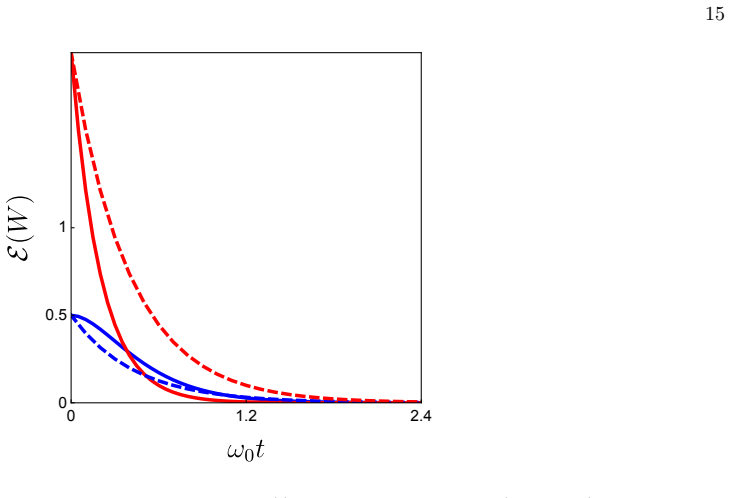
On the paper's own terms, the central discovery is a mechanism: when non-Markovian memory is encoded in pseudomodes, the enlarged Liouvillian acquires exceptional points that are absent in the Born-Markovian limit, and these non-Markovian LEPs can induce the quantum Mpemba effect. For a dissipative harmonic oscillator with a Lorentzian spectral density, the two dominant Liouvillian eigenvalues collide at γ = 4α, giving λ1 = λ2 = −γ/4 − iω0, exactly where the spectral gap Δ = γ/4 − (1/4)√(γ² − 16α²) reaches its maximum. Because the system stays in a coherent state with amplitude ξP(t), the trace distance to equilibrium is D(t) = √(1 − e^{−|ξP(t)|²}); choosing ξ1 > ξ2 and letting the farther s
What carries the argument
The load-bearing object is the pseudomode-extended Liouvillian superoperator L and its characteristic polynomial Q(λ). The pseudomode master equation replaces a time-non-local non-Markovian equation with a Lindblad equation for the system plus auxiliary bosonic modes, so that eigenvalues of L—found via a Bogoliubov transformation and su(1,1) algebra—define relaxation rates; a non-Markovian LEP is a point where two eigenvalues and their eigenmatrices coalesce. The spectral gap Δ = −Re(λ1) sets the slowest relaxation timescale, and the LEP maximizes this gap, producing the accelerated relaxation.
Load-bearing premise
The load-bearing premise is that a quantum Mpemba effect can be demonstrated by letting the two initial states evolve under two different Liouvillians—one tuned to an exceptional point and one not—rather than under the same dynamics with only the initial state changed, which is the standard definition.
What would settle it
Evolve both coherent states |ξ1⟩ and |ξ2⟩ under exactly the same Liouvillian at γ = 4α and compare their trace distances. Equation (12) with identical P(t) predicts the larger-|ξ| state stays farther at all times, so no crossing occurs; observing a crossing under identical dynamics would confirm the effect, while its absence would show the reported QMPE is an artifact of comparing different decay parameters.
If this is right
- If the mechanism is right, LEP-induced quantum Mpemba effects can be observed outside the Born-Markovian weak-coupling regime, in exactly solvable oscillator systems with Lorentzian baths.
- The same LEP speedup can accelerate the discharging of a quantum battery; the paper shows the advantage disappears under the Born-Markovian approximation.
- The pseudomode framework gives additional tunability, so the condition for forming an LEP in a two-level system becomes Γ = 2Λ rather than the Markovian Γ = 4ϵ, making the effect accessible with much weaker system-bath coupling.
- Proposed experimental platforms include nuclear magnetic resonance simulators with pseudomodes encoded in ancillary nuclei and superconducting circuits where the extended Liouvillian is a 9×9 non-Hermitian matrix.
- Any non-Markovian open quantum system whose bath correlation function is a finite sum of exponentials can be brought into this framework, so the scheme is not restricted to harmonic oscillators.
Where Pith is reading between the lines
- Editorial inference: the comparison that produces the reported crossing is between two different Liouvillians (γ = 4α vs γ = 6α), each assigned to a different initial state; the standard Mpemba comparison would hold both states under one fixed Liouvillian. Equation (12) indicates that for a single fixed Liouvillian the larger-|ξ| state remains farther at every time, so the paper's speedup is a par
- Editorial inference: a sharper test of the LEP mechanism would sweep γ through 4α for a single initial state and look for a maximum or kink in the relaxation rate exactly at the exceptional point; the paper's Fig. 2(b) hints at this via the γ = 4α curve, but the two-state crossing is the headline claim.
- Editorial inference: the pseudomode construction suggests the same exceptional-point argument should work for finite-temperature baths and multiple pseudomodes, where additional LEPs beyond the first pair may appear and could produce multiple or oscillatory Mpemba crossings.
Editorial analysis
A structured set of objections, weighed in public.
Referee Report
Summary. The paper claims to realize a quantum Mpemba effect (QMPE) induced by non-Markovian Liouvillian exceptional points (LEPs). The authors use the pseudomode master equation to map a non-Markovian open system onto a Lindbladian evolution of an extended system, perform spectral analysis, and identify an LEP at γ=4α for a damped harmonic oscillator with Lorentzian spectral density. They then select two coherent initial states, one farther from and one closer to the steady state, and evolve the far state under the LEP Liouvillian and the near state under a non-LEP Liouvillian. The reported faster relaxation of the far state is presented as QMPE. The paper also derives the Born-Markovian limit and applies the mechanism to a quantum battery.
Significance. The pseudomode spectral analysis and the exact solution of the damped harmonic oscillator are coherent and potentially useful: the eigenvalue derivation in the Supplemental Material and the Markovian-limit reduction are correct as far as they go. However, the central claim—that a QMPE is induced by non-Markovian LEPs—is invalid as stated, because the two compared states evolve under different Liouvillians. Under the standard QMPE definition, the dynamics must be identical and only the initial state may differ. The paper's own exact solution, Eq. (12), shows that for any fixed Liouvillian the trace distance is monotonically increasing in |ξ|, so no anomalous crossing occurs under fixed dynamics. The acceleration is preselected by assigning the LEP parameters to the farther state. This is a load-bearing flaw that cannot be fixed within the manuscript's current scope.
major comments (3)
- [Non-Markovian LEPs and QMPE; Exemplification] The central claim is invalid under the standard definition of QMPE. The protocol compares two initial states evolving under two different Liouvillians: ϱ_s^(1)(0) evolves under L with γ=4α (LEP) while ϱ_s^(2)(0) evolves under L with γ=6α (no LEP). Standard QMPE requires the same Liouvillian, with only the initial state varied. The text explicitly states that the states are 'designed to evolve under the guidances of L with and without an LEP,' but this is not a legitimate QMPE setup.
- [Eq. (12)] For any fixed Liouvillian, P(t) is fixed, and Eq. (12), D(t)=√(1−e^{−|ξP(t)|²}), is monotonically increasing in |ξ|. Thus, if both initial states evolved under the same L, the state with larger |ξ| would remain farther from equilibrium at all times and no crossing could occur. The observed crossing in Fig. 2(b) and Fig. 3(c) is entirely due to the different P(t) functions assigned to the two states, i.e., to different spectral gaps, not to any initial-state-dependent anomalous relaxation.
- [Exemplification, Fig. 3(d)] Fig. 3(d) is presented as showing that 'no QMPE occurs' when both states evolve under non-LEP Liouvillians. This confirms that the effect is generated by the parameter difference between the two dynamics. Selecting the LEP condition for the far state is equivalent to giving it the maximum spectral gap; the faster relaxation is a direct consequence of that parameter choice. The paper neither justifies why changing the environment between the two runs is allowed for QMPE nor shows any anomaly for identical dynamics.
minor comments (4)
- [Supplemental Material, Eq. (37)] The bath correlation function is computed by extending the frequency integral from [0,∞) to (−∞,∞). This is a standard narrow-band approximation but should be stated as such; as written, it appears to be an exact identity. The pseudomode equivalence relies on this approximation, so its regime of validity should be discussed.
- [Discussion] 'we propose a experiment friendly scheme' should read 'an experiment-friendly scheme.' There is also a repeated typo: 'Disscussions' in Ref. [61] and 'can be can partially transferred' in the Introduction.
- [Introduction and References] Refs. [29] and [67] are the same book, listed twice with different citation numbers; this should be unified.
- [General] The phrase 'non-Markovian LEPs' is used to describe LEPs of the extended pseudomode Liouvillian. This is reasonable, but the distinction between the original non-Markovian dynamics and the pseudo-mode representation should be kept explicit throughout, since the spectral gap argument applies only to the extended Liouvillian.
Circularity Check
Claimed QMPE is preselected: the farther initial state is evolved under the LEP Liouvillian (γ=4α) and the closer state under a different non-LEP Liouvillian (γ=6α); Eq. (12) shows no crossing can occur under identical dynamics.
specific steps
-
self definitional
[Main text, 'Non-Markovian LEPs and QMPE' (scheme) and 'Exemplification' (γ=4α vs γ=6α, α/ω0=2.5 vs 2.4), with Eq. (12) and Fig. 3(d)]
"choosing two different initial states ϱ(1)s(0) and ϱ(2)s(0) with ϱ(2)s(0) being closer to the long-time steady state ϱeq s, then ϱ(1)s(0) and ϱ(2)s(0) are designed to evolve under the guidances of L with and without an LEP, respectively. ... The evolution of ϱ(1)s(t) is governed by the L with γ = 4α, which ensures the occurrence of an LEP; while ϱ(2)s(t) is determined by a L without LEPs. ... D(t) = ... = sqrt(1−e^{−|ξP(t)|^2})."
The QMPE is defined and demonstrated by comparing two different Liouvillians: the farther state is put at the LEP (γ=4α) where the spectral gap is maximal, and the nearer state at a non-LEP (γ=6α). Standard QMPE requires identical dynamics with only the initial state changed. The paper's exact solution makes the reduction explicit: for any fixed P(t), D(t) is monotonically increasing in |ξ|, so under a single Liouvillian the state with larger ξ remains farther at all times and no crossing occurs. Thus the accelerated relaxation is not an anomalous initial-state effect but the direct consequence of the chosen parameter assignment; the paper even confirms that if the far state is also evolved without an LEP, 'no QMPE occurs.'
full rationale
The non-Markovian pseudomode mapping, the spectral calculation, and the exact coherent-state solution are internally consistent and are not themselves circular. The circularity is in the central claim: the paper presents as a 'quantum Mpemba effect' a comparison in which the two initial states are evolved under different dynamics selected so that the farther state is at the exceptional point. Eq. (12) shows that under identical dynamics the farther coherent state never crosses the closer one, so the advertised speedup is an artifact of comparing different Liouvillians rather than a property of the initial state. The self-citations present (e.g., Refs. [10,47,48,69]) are not load-bearing here: the pseudomode and Lie-algebra results are independently derived or cited to external works, and the Born-Markovian comparison is a standard limit. Therefore the derivations of the spectrum and of P(t) are self-contained, but the core QMPE claim reduces by construction to the input parameter choice.
Axiom & Free-Parameter Ledger
free parameters (3)
- γ/α ratio for the two trajectories =
γ=4α (LEP), γ=6α, γ=2α (non-LEP)
- Spectral parameters α, γ, ω0 =
α/ω0=1, 2.4, 2.5; γ=10ω0; ω0=1 cm^-1
- Initial coherent amplitudes ξ1, ξ2 =
ξ1=2, ξ2=1
axioms (5)
- domain assumption Pseudomode mapping is exact when the bath correlation function is a finite sum of exponentials (Ref [42]).
- domain assumption The Lorentzian spectral density integration lower limit is extended from 0 to −∞ in Eq. (37).
- domain assumption Standard QMPE compares two initial states under the same evolution.
- domain assumption Markovian limit uses γ_i→∞ and Born approximation ρ_sp≈ϱ_s⊗ρ_p.
- standard math su(1,1) superoperator algebra and Bogoliubov diagonalization from Ref [60] are valid.
read the original abstract
Quantum Mpemba effect describes an anomalous phenomenon of accelerated relaxation which is of fundamental interest in the field of nonequilibrium thermodynamics. Conventional theories on this phenomenon strongly rely on the Born-Markovian approximation resulting in a Lindblad-type master equation whose evolution is governed by a Liouvillian superoperator. It has been demonstrated that exceptional points of the Liouvillian superoperator can induce the Mpemba effect in Markovian regimes. Moving beyond this Markovian limit, we here propose a mechanism for realizing the quantum Mpemba effect in a general non-Markovian relaxation process by means of non-Markovian exceptional points. We verify the feasibility of this mechanism within a dissipative quantum harmonic oscillator model, which is exactly solvable and experimentally practical. Providing new insight into the interesting non-equilibrium dynamics, our work paves a way to accelerate the transfer of energy and information in quantum systems.
Figures


Forward citations
Cited by 1 Pith paper
-
Accelerating qubit reset through the Mpemba effect
A single entangling gate that turns slow-decaying local qubit coherences into fast-decaying two-qubit coherences shortens passive reset by up to T2/T1 (about 30-50% time reduction) in the T2>T1 regime.
Reference graph
Works this paper leans on
-
[1]
E. B. Mpemba and D. G. Osborne, “Cool?” Physics Ed- ucation 4, 172 (1969)
1969
-
[2]
The freezing of hot and cold water,
G. S. Kell, “The freezing of hot and cold water,” Ameri- can Journal of Physics 37, 564–565 (1969)
1969
-
[3]
When does hot water freeze faster then cold water? a search for the mpemba effect,
James D. Brownridge, “When does hot water freeze faster then cold water? a search for the mpemba effect,” Amer- ican Journal of Physics 79, 78–84 (2011)
2011
-
[4]
Exponentially accelerated approach to stationarity in markovian open quantum systems through the mpemba effect,
Federico Carollo, Antonio Lasanta, and Igor Lesanovsky, “Exponentially accelerated approach to stationarity in markovian open quantum systems through the mpemba effect,” Phys. Rev. Lett. 127, 060401 (2021)
2021
-
[5]
Quantum mpemba effect in a quantum dot with reservoirs,
Amit Kumar Chatterjee, Satoshi Takada, and Hisao Hayakawa, “Quantum mpemba effect in a quantum dot with reservoirs,” Phys. Rev. Lett. 131, 080402 (2023)
2023
-
[6]
Non-markovian quantum mpemba effect,
David J. Strachan, Archak Purkayastha, and Stephen R. Clark, “Non-markovian quantum mpemba effect,” Phys. Rev. Lett. 134, 220403 (2025)
2025
-
[7]
Micro- scopic origin of the quantum mpemba effect in integrable systems,
Colin Rylands, Katja Klobas, Filiberto Ares, Pasquale Calabrese, Sara Murciano, and Bruno Bertini, “Micro- scopic origin of the quantum mpemba effect in integrable systems,” Phys. Rev. Lett. 133, 010401 (2024)
2024
-
[8]
Observing the quan- tum mpemba effect in quantum simulations,
Lata Kh. Joshi, Johannes Franke, Aniket Rath, Filiberto Ares, Sara Murciano, Florian Kranzl, Rainer Blatt, Pe- ter Zoller, Beno ˆ ıt Vermersch, Pasquale Calabrese, Chris- tian F. Roos, and Manoj K. Joshi, “Observing the quan- tum mpemba effect in quantum simulations,” Phys. Rev. Lett. 133, 010402 (2024)
2024
-
[9]
Anomalous discharging of quantum batteries: The ergotropic mpemba effect,
Ivan Medina, Ois ´ ın Culhane, Felix C. Binder, Gabriel T. Landi, and John Goold, “Anomalous discharging of quantum batteries: The ergotropic mpemba effect,” Phys. Rev. Lett. 134, 220402 (2025)
2025
-
[10]
Observation of quantum strong mpemba effect,
Jie Zhang, Gang Xia, Chun-Wang Wu, Ting Chen, Qian Zhang, Yi Xie, Wen-Bo Su, Wei Wu, Cheng-Wei Qiu, Ping-Xing Chen, Weibin Li, Hui Jing, and Yan-Li Zhou, “Observation of quantum strong mpemba effect,” Nature Communications 16, 301 (2025)
2025
-
[11]
Multiple quantum mpemba effect: Excep- tional points and oscillations,
Amit Kumar Chatterjee, Satoshi Takada, and Hisao Hayakawa, “Multiple quantum mpemba effect: Excep- tional points and oscillations,” Phys. Rev. A 110, 022213 (2024)
2024
-
[13]
Bosonic mpemba effect with non- classical states of light,
Stefano Longhi, “Bosonic mpemba effect with non- classical states of light,” APL Quantum1, 046110 (2024)
2024
-
[14]
Mpemba effects in nonequilibrium open quantum systems,
Xuanhua Wang and Jin Wang, “Mpemba effects in nonequilibrium open quantum systems,” Phys. Rev. Res. 6, 033330 (2024)
2024
-
[15]
Quantum otto heat engine and quantum mpemba ef- fect in quasiperiodic systems,
Ao Zhou, Feng Lu, Shujie Cheng, and Gao Xianlong, “Quantum otto heat engine and quantum mpemba ef- fect in quasiperiodic systems,” (2025), arXiv:2509.12572 [cond-mat.dis-nn]
arXiv 2025
-
[16]
Nonequilibrium thermody- namics of the markovian mpemba effect and its inverse,
Zhiyue Lu and Oren Raz, “Nonequilibrium thermody- namics of the markovian mpemba effect and its inverse,” Proceedings of the National Academy of Sciences 114, 5083–5088 (2017)
2017
-
[17]
Mpemba effects in open nonequilibrium quantum systems,
Andrea Nava and Reinhold Egger, “Mpemba effects in open nonequilibrium quantum systems,” Phys. Rev. Lett. 133, 136302 (2024)
2024
-
[18]
Faster uphill re- laxation in thermodynamically equidistant temperature quenches,
Alessio Lapolla and Alja ˇ z Godec, “Faster uphill re- laxation in thermodynamically equidistant temperature quenches,” Phys. Rev. Lett. 125, 110602 (2020)
2020
-
[19]
A fresh understanding of the mpemba effect,
John Bechhoefer, Avinash Kumar, and Rapha¨ el Ch´ etrite, “A fresh understanding of the mpemba effect,” Nature Reviews Physics 3, 534–535 (2021)
2021
-
[20]
A general strategy for realizing mpemba effects in open quantum systems,
Yaru Liu and Yucheng Wang, “A general strategy for realizing mpemba effects in open quantum systems,” (2025), arXiv:2511.04354 [quant-ph]
arXiv 2025
-
[21]
Accel- 6 erating relaxation through liouvillian exceptional point,
Yan-Li Zhou, Xiao-Die Yu, Chun-Wang Wu, Xie-Qian Li, Jie Zhang, Weibin Li, and Ping-Xing Chen, “Accel- 6 erating relaxation through liouvillian exceptional point,” Phys. Rev. Res. 5, 043036 (2023)
2023
-
[22]
A resource theoretical unification of mpemba ef- fects: classical and quantum,
Alessandro Summer, Mattia Moroder, Laetitia P. Bettmann, Xhek Turkeshi, Iman Marvian, and John Goold, “A resource theoretical unification of mpemba ef- fects: classical and quantum,” (2025), arXiv:2507.16976 [quant-ph]
Pith/arXiv arXiv 2025
-
[23]
Symmetry restoration and quantum mpemba effect in many-body localization systems,
Shuo Liu, Hao-Kai Zhang, Shuai Yin, Shi-Xin Zhang, and Hong Yao, “Symmetry restoration and quantum mpemba effect in many-body localization systems,” Sci- ence Bulletin 70, 3991–3996 (2025)
2025
-
[24]
Quantum mpemba effects from symmetry perspectives,
Hui Yu, Shuo Liu, and Shi-Xin Zhang, “Quantum mpemba effects from symmetry perspectives,” AAPPS Bulletin 35, 17 (2025)
2025
-
[25]
Symmetry restoration and quantum mpemba ef- fect in symmetric random circuits,
Shuo Liu, Hao-Kai Zhang, Shuai Yin, and Shi-Xin Zhang, “Symmetry restoration and quantum mpemba ef- fect in symmetric random circuits,” Phys. Rev. Lett.133, 140405 (2024)
2024
-
[26]
Accelerating quan- tum relaxation via temporary reset: A mpemba-inspired approach,
Ruicheng Bao and Zhonghuai Hou, “Accelerating quan- tum relaxation via temporary reset: A mpemba-inspired approach,” Phys. Rev. Lett. 135, 150403 (2025)
2025
-
[27]
Intrin- sic quantum mpemba effect in markovian systems and quantum circuits,
Dongheng Qian, Huan Wang, and Jing Wang, “Intrin- sic quantum mpemba effect in markovian systems and quantum circuits,” Phys. Rev. B 111, L220304 (2025)
2025
-
[28]
Thermodynamics of the quantum mpemba effect,
Mattia Moroder, Ois ´ ın Culhane, Krissia Zawadzki, and John Goold, “Thermodynamics of the quantum mpemba effect,” Phys. Rev. Lett. 133, 140404 (2024)
2024
-
[29]
H. P. Breuer and F. Petruccione, The Theory of Open Quantum Systems (Oxford University Press, Oxford, 2002)
2002
-
[30]
Spectral theory of liouvillians for dis- sipative phase transitions,
Fabrizio Minganti, Alberto Biella, Nicola Bartolo, and Cristiano Ciuti, “Spectral theory of liouvillians for dis- sipative phase transitions,” Phys. Rev. A 98, 042118 (2018)
2018
-
[31]
Quantum exceptional points of non-hermitian hamiltonians and liouvillians: The effects of quantum jumps,
Fabrizio Minganti, Adam Miranowicz, Ravindra W. Chhajlany, and Franco Nori, “Quantum exceptional points of non-hermitian hamiltonians and liouvillians: The effects of quantum jumps,” Phys. Rev. A 100, 062131 (2019)
2019
-
[32]
Colloquium: Non-markovian dynam- ics in open quantum systems,
Heinz-Peter Breuer, Elsi-Mari Laine, Jyrki Piilo, and Bassano Vacchini, “Colloquium: Non-markovian dynam- ics in open quantum systems,” Rev. Mod. Phys. 88, 021002 (2016)
2016
-
[33]
Dynamics of non- markovian open quantum systems,
In´ es de Vega and Daniel Alonso, “Dynamics of non- markovian open quantum systems,” Rev. Mod. Phys. 89, 015001 (2017)
2017
-
[34]
Canonical versus noncanonical equili- bration dynamics of open quantum systems,
Chun-Jie Yang, Jun-Hong An, Hong-Gang Luo, Yading Li, and C. H. Oh, “Canonical versus noncanonical equili- bration dynamics of open quantum systems,” Phys. Rev. E 90, 022122 (2014)
2014
-
[35]
General non-markovian dynamics of open quantum systems,
Wei-Min Zhang, Ping-Yuan Lo, Heng-Na Xiong, Matisse Wei-Yuan Tu, and Franco Nori, “General non-markovian dynamics of open quantum systems,” Phys. Rev. Lett. 109, 170402 (2012)
2012
-
[36]
Non- markovian quantum exceptional points,
Jhen-Dong Lin, Po-Chen Kuo, Neill Lambert, Adam Miranowicz, Franco Nori, and Yueh-Nan Chen, “Non- markovian quantum exceptional points,” Nature Com- munications 16, 1289 (2025)
2025
-
[37]
Accelerated calculation of impurity green’s func- tions exploiting the extreme mpemba effect,
David J. Strachan, Archak Purkayastha, and Stephen R. Clark, “Accelerated calculation of impurity green’s func- tions exploiting the extreme mpemba effect,” (2025), arXiv:2510.26651 [quant-ph]
arXiv 2025
-
[38]
Thermodynamic limits of the mpemba effect: A unified resource theory analysis,
Doruk Can Aly¨ ur¨ uk, Mahir H. Ye¸ siller, Vlatko Ve- dral, and Onur Pusuluk, “Thermodynamic limits of the mpemba effect: A unified resource theory analysis,” (2025), arXiv:2502.00123 [quant-ph]
Pith/arXiv arXiv 2025
-
[39]
Ergotropic mpemba effect in non-markovian quantum systems,
Yan Li, Wenlin Li, and Xingli Li, “Ergotropic mpemba effect in non-markovian quantum systems,” Phys. Rev. A 112, 032209 (2025)
2025
-
[40]
Time-convolutionless master equation for quantum dots: Perturbative expansion to arbitrary order,
Carsten Timm, “Time-convolutionless master equation for quantum dots: Perturbative expansion to arbitrary order,” Phys. Rev. B 83, 115416 (2011)
2011
-
[41]
Non- markovian quantum dynamics: Local versus nonlocal,
Dariusz Chru´ sci´ nski and Andrzej Kossakowski, “Non- markovian quantum dynamics: Local versus nonlocal,” Phys. Rev. Lett. 104, 070406 (2010)
2010
-
[42]
Nonperturbative treatment of non-markovian dy- namics of open quantum systems,
D. Tamascelli, A. Smirne, S. F. Huelga, and M. B. Ple- nio, “Nonperturbative treatment of non-markovian dy- namics of open quantum systems,” Phys. Rev. Lett. 120, 030402 (2018)
2018
-
[43]
Efficient simulation of finite-temperature open quantum systems,
D. Tamascelli, A. Smirne, J. Lim, S. F. Huelga, and M. B. Plenio, “Efficient simulation of finite-temperature open quantum systems,” Phys. Rev. Lett. 123, 090402 (2019)
2019
-
[44]
Nonperturbative decay of an atomic system in a cavity,
B. M. Garraway, “Nonperturbative decay of an atomic system in a cavity,” Phys. Rev. A 55, 2290–2303 (1997)
1997
-
[45]
Time evolution of a quantum system in contact with a nearly gaussian- markoffian noise bath,
Yoshitaka Tanimura and Ryogo Kubo, “Time evolution of a quantum system in contact with a nearly gaussian- markoffian noise bath,” Journal of the Physical Society of Japan 58, 101–114 (1989)
1989
-
[46]
Numerically “exact
Yoshitaka Tanimura, “Numerically “exact” approach to open quantum dynamics: The hierarchical equations of motion (heom),” The Journal of Chemical Physics 153, 020901 (2020)
2020
-
[47]
Realization of hierarchical equations of motion from stochastic perspectives,
Wei Wu, “Realization of hierarchical equations of motion from stochastic perspectives,” Phys. Rev. A 98, 012110 (2018)
2018
-
[48]
Stochastic decoupling approach to the spin- boson dynamics: Perturbative and nonperturbative treatments,
Wei Wu, “Stochastic decoupling approach to the spin- boson dynamics: Perturbative and nonperturbative treatments,” Phys. Rev. A 98, 032116 (2018)
2018
-
[49]
Quan- tum brownian motion in a general environment: Exact master equation with nonlocal dissipation and colored noise,
B. L. Hu, Juan Pablo Paz, and Yuhong Zhang, “Quan- tum brownian motion in a general environment: Exact master equation with nonlocal dissipation and colored noise,” Phys. Rev. D 45, 2843–2861 (1992)
1992
-
[50]
Exact solution of the hu-paz-zhang master equation,
G. W. Ford and R. F. O’Connell, “Exact solution of the hu-paz-zhang master equation,” Phys. Rev. D64, 105020 (2001)
2001
-
[51]
Crossover between non-markovian and markovian dynamics induced by a hierarchical envi- ronment,
Tiantian Ma, Yusui Chen, Tian Chen, Samuel R. Hede- mann, and Ting Yu, “Crossover between non-markovian and markovian dynamics induced by a hierarchical envi- ronment,” Phys. Rev. A 90, 042108 (2014)
2014
-
[52]
Hierarchical-environment-assisted non- markovian speedup dynamics control,
Kai Xu, Ying-Jie Zhang, Yun-Jie Xia, Z. D. Wang, and Heng Fan, “Hierarchical-environment-assisted non- markovian speedup dynamics control,” Phys. Rev. A 98, 022114 (2018)
2018
-
[53]
Noise- assisted quantum coherence protection in a hierarchical environment,
Xinyu Zhao, Yong-hong Ma, and Yan Xia, “Noise- assisted quantum coherence protection in a hierarchical environment,” Phys. Rev. A 105, 042217 (2022)
2022
-
[54]
Purified pseudomode model for non- linear system-bath interactions,
Cheng Zhang, Neill Lambert, Xin-Qi Li, Mauro Cirio, and Pengfei Liang, “Purified pseudomode model for non- linear system-bath interactions,” Phys. Rev. B 112, 115131 (2025)
2025
-
[55]
Quantum simulation of spin-boson mod- els with structured bath,
Ke Sun, Mingyu Kang, Hanggai Nuomin, George Schwartz, David N. Beratan, Kenneth R. Brown, and Jungsang Kim, “Quantum simulation of spin-boson mod- els with structured bath,” Nature Communications 16, 4042 (2025)
2025
-
[56]
Vari- ational approach to entangled non-hermitian open sys- 7 tems,
Jiarui Zeng, Wen-Qiang Xie, and Yang Zhao, “Vari- ational approach to entangled non-hermitian open sys- 7 tems,” Journal of Chemical Theory and Computation21, 3857–3866 (2025)
2025
-
[57]
Quasi-lindblad pseudomode theory for open quantum systems,
Gunhee Park, Zhen Huang, Yuanran Zhu, Chao Yang, Garnet Kin-Lic Chan, and Lin Lin, “Quasi-lindblad pseudomode theory for open quantum systems,” Phys. Rev. B 110, 195148 (2024)
2024
-
[58]
M. A. Nielsen and I. L. Chuang, Quantum Computation and Quantum Information(Cambridge University Press, Cambridge, England, 2000)
2000
-
[59]
Reduced den- sity matrix after a quantum quench,
Maurizio Fagotti and Fabian H. L. Essler, “Reduced den- sity matrix after a quantum quench,” Phys. Rev. B 87, 245107 (2013)
2013
-
[60]
Lindblad dynamics of open multimode bosonic systems: Algebra of quadratic super- operators, exceptional points, and speed of evolution,
Andrei Gaidash, Alexei D. Kiselev, Anton Kozubov, and George Miroshnichenko, “Lindblad dynamics of open multimode bosonic systems: Algebra of quadratic super- operators, exceptional points, and speed of evolution,” Phys. Rev. A 111, 062211 (2025)
2025
-
[61]
Disscussions on the condition of exper- imental realization in qubit systems and the application in quantum batteries are provided as well
In this Supplemental Material, we provide the details of deriving the analytical expressions for complex eigen- values and the corresponding reduced density opera- tors of the system in both the Markovian and the non- Markovian cases. Disscussions on the condition of exper- imental realization in qubit systems and the application in quantum batteries are ...
-
[62]
Exact non-markovian cavity dynamics strongly coupled to a reservoir,
Heng-Na Xiong, Wei-Min Zhang, Xiaoguang Wang, and Meng-Hsiu Wu, “Exact non-markovian cavity dynamics strongly coupled to a reservoir,” Phys. Rev. A82, 012105 (2010)
2010
-
[63]
Non-markovian relaxation of a three-level system: Quantum trajectory approach,
Jun Jing and Ting Yu, “Non-markovian relaxation of a three-level system: Quantum trajectory approach,” Phys. Rev. Lett. 105, 240403 (2010)
2010
-
[64]
Experimental quantum simulation of superradiant phase transition beyond no-go theorem via antisqueezing,
Xi Chen, Ze Wu, Min Jiang, Xin-You L¨ u, Xinhua Peng, and Jiangfeng Du, “Experimental quantum simulation of superradiant phase transition beyond no-go theorem via antisqueezing,” Nature Communications 12, 6281 (2021)
2021
-
[65]
Experimental quantum simulation of multicriti- cality in closed and open rabi model,
Ze Wu, Changsheng Hu, Tianyun Wang, Yuquan Chen, Yuchen Li, Liqiang Zhao, Xin-You L¨ u, and Xinhua Peng, “Experimental quantum simulation of multicriti- cality in closed and open rabi model,” Phys. Rev. Lett. 133, 173602 (2024)
2024
-
[66]
Experimental ob- servation of non-markovian quantum exceptional points,
Hao-Long Zhang, Pei-Rong Han, Fan Wu, Wen Ning, Zhen-Biao Yang, and Shi-Biao Zheng, “Experimental ob- servation of non-markovian quantum exceptional points,” Phys. Rev. Lett. 135, 230203 (2025)
2025
-
[67]
Heinz-Peter Breuer and Francesco Petruccione, The the- ory of open quantum systems(OUP Oxford, 2002)
2002
-
[68]
Mpemba effect and super-accelerated thermalization in the damped quantum harmonic oscil- lator,
Stefano Longhi, “Mpemba effect and super-accelerated thermalization in the damped quantum harmonic oscil- lator,” Quantum 9, 1677 (2025)
2025
-
[69]
Fast cooling of trapped ion in strong sideband coupling regime,
Shuo Zhang, Jian-Qi Zhang, Wei Wu, Wan-Su Bao, and Chu Guo, “Fast cooling of trapped ion in strong sideband coupling regime,” New Journal of Physics 23, 023018 (2021)
2021
-
[70]
Maximal work extraction from finite quantum systems,
A. E. Allahverdyan, R. Balian, and Th. M. Nieuwen- huizen, “Maximal work extraction from finite quantum systems,” Europhysics Letters 67, 565 (2004)
2004
-
[71]
Ergotropy from coherences in an open quantum system,
Barı ¸ s C ¸ akmak, “Ergotropy from coherences in an open quantum system,” Phys. Rev. E 102, 042111 (2020). 8 Supplemental Material for “Quantum Mpemba Effect by Non-Markovian Exceptional Points” Eigenvalues of ˆL and the general expression of ϱsp(t) Eigenvalues of ˆL In this section, we provide the details of deriving the analytical expressions of eigenv...
2020
discussion (0)
Sign in with ORCID, Apple, or X to comment. Anyone can read and Pith papers without signing in.