REVIEW 4 major objections 6 minor 21 references
GNN-CNN: An Efficient Hybrid Model of Convolutional and Graph Neural Networks for Text Representation
T0 review · 4 major / 6 minor · reviewed 2026-08-06 · deepseek-v4-flash
Pith's one-line read This paper claims a character-level CNN-GNN hybrid with a real-time sparse token graph can match pretrained transformer accuracy within a few points while running in O(n) time and memory.
desk verdict A plausible O(n) GNN-CNN hybrid whose competitive numbers may partly come from injected sentiment and embeddings; worth refereeing despite missing error bars. read the letter →
The pith
A machine-rendered reading of the paper's core claim, the machinery that carries it, and where it could break.
The reading
What carries the argument
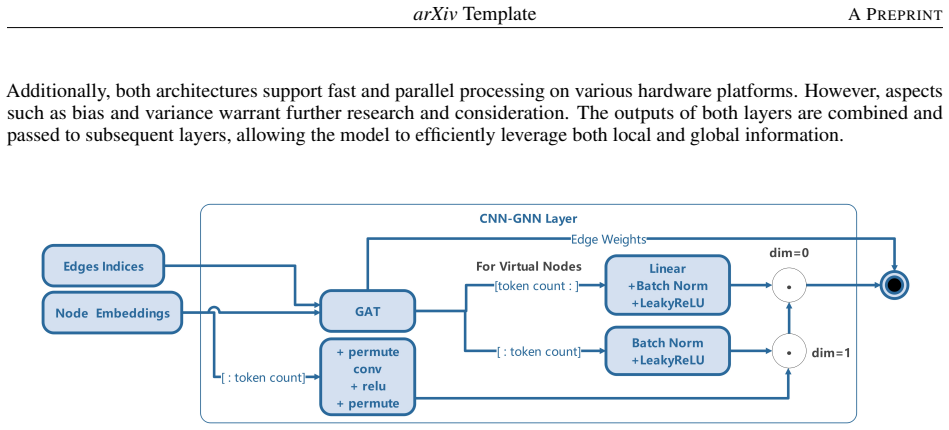
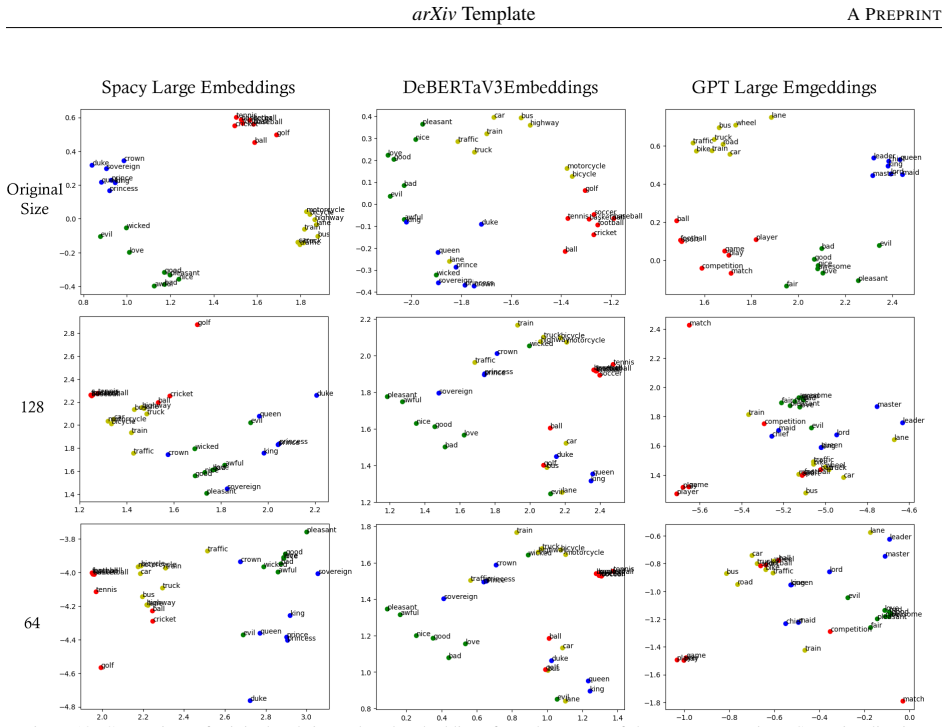
The load-bearing object is the real-time token graph paired with the CNN-GNN update. A graph-generation layer assigns each token node a constant number of lattice edges (step size 2, 8-10 per node) and random edges (4-6 per node), then subsamples edges by token frequency, producing a sparse graph with average clustering around 0.45 and average shortest paths of 4-5. The CNN-GNN layer runs a GATv2-style dynamic attention or modified sparse attention next to a 1D convolution, and later layers keep only the top attention edges before rebuilding the graph. Around this core, the model uses a compact batcher that concatenates whole documents without padding or truncation, character-level convolution followed by token aggregation, positional encoding, UMAP-compressed LLM embeddings, and token-level polarity/subjectivity injection via lookups.
What would settle it
Retrain the model on AG-News, IMDB, and the Amazon subset in three controlled variants: no injected embeddings or polarity scores at all, polarity scores randomly permuted across tokens, and injected embeddings replaced by random vectors of the same shape. If accuracy on those datasets drops noticeably in the first or third variant, the auxiliary features are doing the work attributed to the graph-CNN architecture.
Extended reading notes
Core claim
The central claim is that a fixed-degree graph, rebuilt in real time over the tokens of a compact un-padded batch, gives a GNN and CNN pair enough structure to match large pretrained encoders at a fraction of the cost. Each token is a node; each node receives a constant number of lattice and random edges, so edge count and graph construction are O(n), and the paper states the full model is O(n) in time and space with respect to input length. The GNN layer uses a GATv2-style dynamic attention or modified sparse attention over this graph while a parallel 1D CNN handles local character patterns, and attention weights from each layer decide which edges survive before the graph is rebuilt. Injected DeBERTa/GPT/SpaCy token embeddings and TextBlob/GPT polarity-subjectivity scores are concatenated in as extra features. Measured on five benchmarks, the model trails BERT and DistilBERT by roughly one to three points and slightly beats DistilBERT on the Amazon subset.
Load-bearing premise
The reported accuracy and the comparison to BERT and DistilBERT assume that the externally supplied token embeddings and sentiment-polarity scores are neutral auxiliary inputs, not information that already carries the label or a strong hint to it.
Editorial extensions
If this is right
- Long documents no longer force quadratic attention cost: a fixed number of edges per token keeps graph construction and message passing linear in input length.
- Deployment on low-power or edge hardware becomes plausible, because the full model uses 1.3 million parameters and about 40 million FLOPs per batch.
- On large review datasets the architecture can match or slightly beat DistilBERT, with 94.37% F1 versus 94.28% on the Amazon subset.
- The constant-degree graph can be rebuilt every iteration without a preprocessing bottleneck, making variable-length text a first-class input rather than a padding problem.
- The small-world structure of the generated graphs, with clustering around 0.45 and shortest paths of 4-5, implies a lightweight global information path without dense attention.
Reading between the lines
- A direct test the paper does not run: removing the injected embeddings and polarity scores from the main benchmarks would separate the architecture's own contribution from the auxiliary features; the RT-2K ablation shows those injections are worth several points.
- The same compact-batch and rebuildable-graph machinery could transfer to token-level tasks such as named entity recognition or retrieval, where variable lengths and long documents matter, but the paper evaluates only classification.
- The small-world statistics suggest the model is effectively a sparse global attention mechanism, so a head-to-head comparison with Longformer or Exphormer on genuinely long documents would place the efficiency claim in context.
Editorial analysis
A structured set of objections, weighed in public.
Referee Report
Summary. The paper proposes a hybrid GNN-CNN architecture for text classification that operates directly on character-level compact batches without padding or truncation. A real-time graph generator builds lattice-based and random edges over token nodes, and the model combines graph attention (GATv2 or sparse attention) with 1D convolutions, along with injected token embeddings and sentiment-polarity features obtained from pretrained models. The authors claim O(n) time and space complexity relative to input length n, report 1.3M parameters and 40M FLOPs, and present results on AG-News, IMDB, RT-2K, Yelp, and Amazon subsets showing accuracy close to BERT/DistilBERT. An ablation study on RT-2K examines normalization, convolution type, embedding injection, and sentiment-injection position.
Significance. If the efficiency and accuracy claims hold, the architecture would be a meaningful contribution: linear-complexity text classification with near-transformer accuracy on standard benchmarks, backed by a publicly released implementation and an unusually detailed accounting of preprocessing and model complexity. The paper also gives concrete graph-topology statistics and a reproducible complexity derivation. However, the central empirical claim is currently weakened by an unfair comparison setup: the proposed model receives task-relevant auxiliary sentiment signals and pretrained embeddings that the BERT/DistilBERT baselines do not, and the main benchmark tables lack repeated-run statistics. The architecture's standalone contribution is therefore not yet established.
major comments (4)
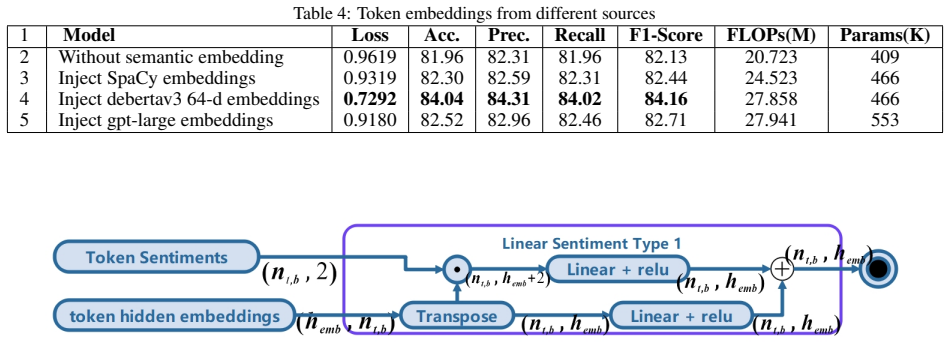
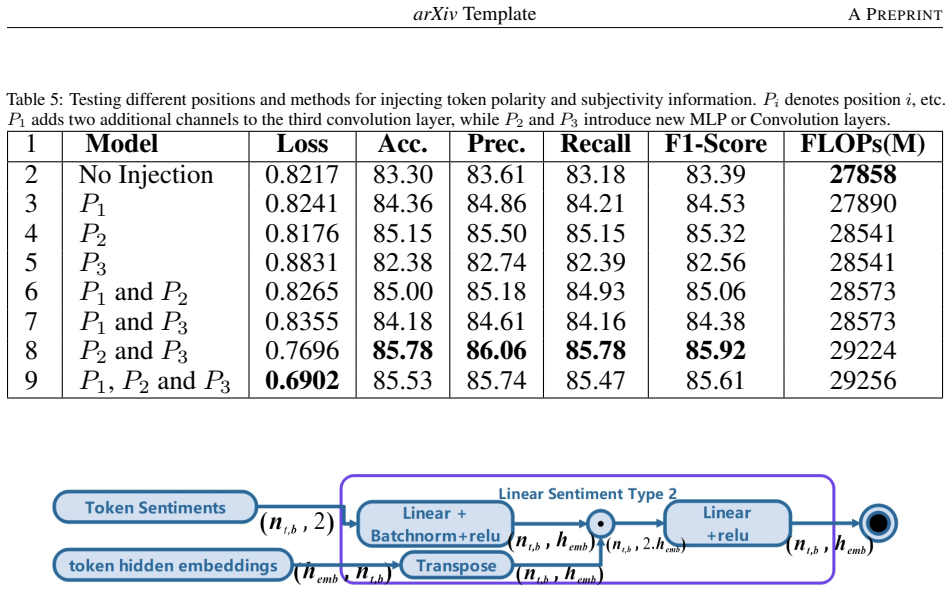
- [§2.1.1, Tables 5–6 and Tables 10–14] The reported accuracy on the sentiment benchmarks is obtained by a model that receives token-level polarity and subjectivity scores from TextBlob and the GPT-Chat API, in addition to pretrained DeBERTa/GPT/SpaCy embeddings. Table 6 shows that on RT-2K, adding the convolutional sentiment-injection layer raises F1 from 84.16 to 86.78, while the final RT-2K result in Table 12 is 87.24. Since no ablation without sentiment injection is reported on IMDB, Amazon, Yelp, or AG-News, the comparison against BERT and DistilBERT (which receive only raw text) is not apples-to-apples, and the accuracy-efficiency trade-off cannot yet be attributed to the GNN-CNN architecture itself. The authors should report results without injected sentiment features on the main benchmarks, or provide the same auxiliary features to the baseline models.
- [§2.6, Tables 10–14] None of the main benchmark tables report standard deviations, confidence intervals, or the number of repeated runs, despite the text stating that Yelp was trained five times. Several headline comparisons are within a small margin: Amazon F1 is 94.37 for the proposed model versus 94.28 for DistilBERT, and Yelp F1 is 95.61 versus 95.89. Without error bars or significance testing, these differences are indistinguishable from run-to-run variation, and the claim that the model 'matches or slightly exceeds' DistilBERT on these datasets is not supported. The paper should report means and standard deviations over at least five independent runs for all benchmark tables, following a fixed training protocol.
- [§2.5.1, Table 2] The ablation study reports 'the average of the best results obtained for each method' from 30 training runs. Averaging the best result per configuration is not a standard estimator and can inflate apparent differences, especially when comparing normalization methods. The authors should instead report the mean and standard deviation of a fixed metric (e.g., validation F1 at the last epoch, or early-stopped F1) over the 30 runs, and should clarify why the best-run selection was used.
- [§2.3.1, Eq. (25)] The complexity claim O(n(d^2 + (k1+k2)d) + bd) is reasonable under the stated assumptions of fixed hidden dimension d, fixed edges per node k1, k2, and fixed batch size b. However, the paper should state explicitly that these quantities are treated as constants in the headline 'O(n)' claim, since the empirical FLOP counts in Table 8 are for a specific configuration. As written, the simplified O(n) statement could mislead readers who vary hidden dimension or batch size.
minor comments (6)
- [§2.3, Model] The paragraph beginning 'Character-Level Processing:' appears twice verbatim in Section 2.3; one copy should be removed.
- [Abstract and title page] The line 'CNN-GNN Sources: [Rastakhiz, 2025].' appears in the abstract, which looks like a leftover reference note rather than part of the abstract text.
- [§2.5.4, Table 7] The text says subsampling gave results 'the opposit' of expectations, but Table 7 shows nearly identical accuracy (90.90 vs 90.89) with a lower loss for the subsampled model; the interpretation should be clarified.
- [§2.1.1] The description of 'OpenAI-GPT/tiktoken' does not specify which GPT model the tokenizer and embeddings come from; this should be stated explicitly for reproducibility.
- [Equation (23)] The positional encoding formula uses sin + cos with the same phase; this is an unusual design choice that should be justified or replaced with the standard sinusoidal encoding.
- [§2.2.2, Algorithm 6] The constants K1 and K2 in Algorithm 6 are not defined in the algorithm text; they appear in Table 9 as 'Number of Lattice Edges' and 'Number of Random Edges', but the connection should be made explicit.
Circularity Check
No derivation-level circularity; the efficiency analysis is self-contained, but the sentiment benchmarks inherit label-proxy inputs that make the comparison unfair.
full rationale
The paper's central formal claims are the O(n) time/space complexity analysis (Sections 2.2.3 and 2.3.1) and the real-time graph constructor (Algorithms 5-7). These are derived from explicit assumptions: fixed numbers of lattice and random edges per token (k1, k2), fixed hidden dimension d, and standard complexity results for GATv2 [Brody et al., 2022] and 1D convolutions. No fitted parameter is renamed as a prediction, and no 'uniqueness theorem' from the authors' prior work is invoked to force an architectural choice. The self-citations to Rastakhiz et al. [2024] and Rastakhiz [2025] are for prior character/token aggregation and source code/data, not for the load-bearing efficiency result. The one circularity-adjacent issue is Section 2.1.1, where per-token TextBlob and GPT-Chat sentiment polarity/subjectivity scores are injected into the model used for the Tables 10-14 sentiment benchmarks. Because those scores are external sentiment estimators, the reported F1 values are partly attributable to label-proxy input features rather than to the GNN-CNN architecture alone, so the comparison to raw-text BERT/DistilBERT baselines is not apples-to-apples. This is an evaluation-leakage/fairness concern rather than an equation-level reduction of a prediction to its inputs: the model still must learn to aggregate the injected features, and the RT-2K ablation in Table 6 honestly quantifies the sentiment-injection contribution. The paper itself also lists 'reducing unnecessary complexity and dependencies on metadata' in its future work, corroborating that the main empirical results depend on auxiliary injected metadata. Under a strict circularity definition, the manuscript's formal derivations are not circular, though the headline accuracy claims should be read with the injected-feature caveat in mind.
Assumptions & free parameters
free parameters (6)
- Hidden dimension d and injected embedding dimension =
64 / 64
- Lattice and random edges per node (k1, k2) =
10 and 6 (Table 9); 8 and 4 (Section 2.2.2)
- Lattice step size and lattice begin distance =
2 and 2
- UMAP neighbors and reduced dimension =
15 neighbors; 64 or 128 components
- Token sub-sampling threshold =
not reported
- Learning-rate milestones and decay factor =
[15,20,30,38,40,45,50] and 0.5
assumptions (5)
- standard math GATv2 complexity is O(|nu|dd' + |epsilon|d') and is linear in n when degree is fixed
- standard math 1D convolution complexity is O(nkd^2), treated as O(n) for fixed kernel and feature sizes
- domain assumption Random and lattice edge construction preserves semantic structure and produces small-world graphs useful for GNN message passing
- domain assumption Frozen LLM embeddings and TextBlob or GPT polarity scores are stable, compatible auxiliary inputs for all target datasets
- domain assumption Compact batches with concatenated documents do not introduce cross-document contamination and preserve positional information
Cite this review
Pith. "Pith review of GNN-CNN: An Efficient Hybrid Model of Convolutional and Graph Neural Networks for Text Representation." pith.science (2026). https://pith.science/paper/SJBDHS3E
@misc{pith2026250707414,
  author       = {Pith},
  title        = {Pith review of: GNN-CNN: An Efficient Hybrid Model of Convolutional and Graph Neural Networks for Text Representation},
  year         = {2026},
  howpublished = {\url{https://pith.science/paper/SJBDHS3E}},
  note         = {Machine review of arXiv:2507.07414}
}
read the original abstract
Time, cost, and energy efficiency are critical considerations in Deep-Learning (DL), particularly when processing long texts. Transformers, which represent the current state of the art, exhibit quadratic computational complexity relative to input length, making them inefficient for extended documents. This study introduces a novel model architecture that combines Graph Neural Networks (GNNs) and Convolutional Neural Networks (CNNs), integrated with a real-time, end-to-end graph generation mechanism. The model processes compact batches of character-level inputs without requiring padding or truncation. To enhance performance while maintaining high speed and efficiency, the model incorporates information from Large Language Models (LLMs), such as token embeddings and sentiment polarities, through efficient dictionary lookups. It captures local contextual patterns using CNNs, expands local receptive fields via lattice-based graph structures, and employs small-world graphs to aggregate document-level information. The generated graphs exhibit structural properties indicative of meaningful semantic organization, with an average clustering coefficient of approximately 0.45 and an average shortest path length ranging between 4 and 5. The model is evaluated across multiple text classification tasks, including sentiment analysis and news-categorization, and is compared against state-of-the-art models. Experimental results confirm the proposed model's efficiency and competitive performance.
Figures


Figures from the paper (13 more)





Reference graph
Works this paper leans on
-
[9]
Fanghui Chen, Shouliang Li, Jiale Han, Fengyuan Ren, and Zhen Yang. Review of lightweight deep convolutional neural networks.Archives of Computational Methods in Engineering, 31(4):1915–1937,
work page 1915
-
[10]
doi:https://doi.org/10.1016/j.aiopen.2021.01.001
ISSN 2666-6510. doi:https://doi.org/10.1016/j.aiopen.2021.01.001. URL https://www.sciencedirect.com/ science/article/pii/S2666651021000012. Rewon Child, Scott Gray, Alec Radford, and Ilya Sutskever. Generating long sequences with sparse transformers.arXiv preprint arXiv:1904.10509,
arXiv 2021
-
[11]
doi:https://doi.org/10.1016/j.asoc.2024.112631
ISSN 1568-4946. doi:https://doi.org/10.1016/j.asoc.2024.112631. URL https://www.sciencedirect.com/ science/article/pii/S1568494624014054. Pengcheng He, Jianfeng Gao, and Weizhu Chen. Debertav3: Improving deberta using electra-style pre-training with gradient-disentangled embedding sharing, 2021a. Jacob Devlin, Ming-Wei Chang, Kenton Lee, and Kristina Tout...
-
[15]
ISSN 2307-387X. doi:10.1162/tacl_a_00461. URL https: //doi.org/10.1162/tacl_a_00461. Jonathan H. Clark, Dan Garrette, Iulia Turc, and John Wieting. Canine: Pre-training an efficient tokenization-free encoder for language representation.Transactions of the Association for Computational Linguistics, 10:73–91, 01
-
[16]
ISSN 2307-387X. doi:10.1162/tacl_a_00448. URLhttps://doi.org/10.1162/tacl_a_00448. Xiang Zhang, Junbo Zhao, and Yann LeCun. Character-level convolutional networks for text classification. In C. Cortes, N. Lawrence, D. Lee, M. Sugiyama, and R. Garnett, editors,Advances in Neural Information Processing Systems, volume
-
[17]
URL https://proceedings.neurips.cc/paper_files/ paper/2015/file/250cf8b51c773f3f8dc8b4be867a9a02-Paper.pdf. Keiron O’Shea and Ryan Nash. An introduction to convolutional neural networks.arXiv preprint arXiv:1511.08458,
arXiv 2015
-
[21]
Victor Sanh, Lysandre Debut, Julien Chaumond, and Thomas Wolf. Distilbert, a distilled version of bert: smaller, faster, cheaper and lighter.arXiv preprint arXiv:1910.01108,
arXiv 1910
-
[2007]
What graph neural networks cannot learn: depth vs width.arXiv preprint arXiv:1907.03199,
Andreas Loukas. What graph neural networks cannot learn: depth vs width.arXiv preprint arXiv:1907.03199,
arXiv 1907
Show all 21 references
-
[2011]
URLhttp://www.aclweb.org/anthology/P11-1015
Association for Computational Linguistics. URLhttp://www.aclweb.org/anthology/P11-1015. Bo Pang and Lillian Lee. A sentimental education: Sentiment analysis using subjectivity summarization based on minimum cuts.arXiv preprint cs/0409058,
-
[2013]
Vector of locally-aggregated word embeddings (vlawe): A novel document-level representation.arXiv preprint arXiv:1902.08850,
Radu Tudor Ionescu and Andrei M Butnaru. Vector of locally-aggregated word embeddings (vlawe): A novel document-level representation.arXiv preprint arXiv:1902.08850,
1902 arXiv
-
[2015]
Distilling the knowledge in a neural network.arXiv preprint arXiv:1503.02531,
24 arXivTemplateA PREPRINT Geoffrey Hinton. Distilling the knowledge in a neural network.arXiv preprint arXiv:1503.02531,
-
[2016]
URL https: //ojs.aaai.org/index.php/AAAI/article/view/10362
doi:10.1609/aaai.v30i1.10362. URL https: //ojs.aaai.org/index.php/AAAI/article/view/10362. Linting Xue, Aditya Barua, Noah Constant, Rami Al-Rfou, Sharan Narang, Mihir Kale, Adam Roberts, and Colin Raffel. Byt5: Towards a token-free future with pre-trained byte-to-byte models....
-
[2017]
Language models are few-shot learners.Advances in neural information processing systems, 33:1877–1901,
Tom Brown, Benjamin Mann, Nick Ryder, Melanie Subbiah, Jared D Kaplan, Prafulla Dhariwal, Arvind Neelakantan, Pranav Shyam, Girish Sastry, Amanda Askell, et al. Language models are few-shot learners.Advances in neural information processing systems, 33:1877–1901,
1901
-
[2018]
Deep compression: Compressing deep neural networks with pruning, trained quantization and huffman coding.arXiv preprint arXiv:1510.00149,
Song Han, Huizi Mao, and William J Dally. Deep compression: Compressing deep neural networks with pruning, trained quantization and huffman coding.arXiv preprint arXiv:1510.00149,
-
[2019]
Yinhan Liu
URLhttps://arxiv.org/abs/1810.04805. Yinhan Liu. Roberta: A robustly optimized bert pretraining approach.arXiv preprint arXiv:1907.11692, 364,
1907 arXiv
-
[2020]
Fastbert: a self-distilling bert with adaptive inference time.arXiv preprint arXiv:2004.02178,
Weijie Liu, Peng Zhou, Zhe Zhao, Zhiruo Wang, Haotang Deng, and Qi Ju. Fastbert: a self-distilling bert with adaptive inference time.arXiv preprint arXiv:2004.02178,
2004 arXiv
-
[2021]
doi:https://doi.org/10.1016/j.ymssp.2020.107398
ISSN 0888-3270. doi:https://doi.org/10.1016/j.ymssp.2020.107398. URL https://www.sciencedirect.com/ science/article/pii/S0888327020307846. Andrew L. Maas, Raymond E. Daly, Peter T. Pham, Dan Huang, Andrew Y . Ng, and Christopher Potts. Learning word vectors for sentiment analy...
2020
-
[2022]
The cost of training nlp models: A concise overview.arXiv preprint arXiv:2004.08900,
Or Sharir, Barak Peleg, and Yoav Shoham. The cost of training nlp models: A concise overview.arXiv preprint arXiv:2004.08900,
2004 arXiv
-
[2023]
doi:https://doi.org/10.1016/j.neucom.2023.126808
ISSN 0925-2312. doi:https://doi.org/10.1016/j.neucom.2023.126808. URL https: //www.sciencedirect.com/science/article/pii/S0925231223009311. Diksha Khurana, Aditya Koli, Kiran Khatter, and Sukhdev Singh. Natural language processing: state of the art, current trends and challeng...
2023
-
[2024]
Rubén Romero, Pedro Celard, José Manuel Sorribes-Fdez, A Seara Vieira, Eva Lorenzo Iglesias, and L Borrajo
doi:10.1109/ACCESS.2024.3484578. Rubén Romero, Pedro Celard, José Manuel Sorribes-Fdez, A Seara Vieira, Eva Lorenzo Iglesias, and L Borrajo. Mobydeep: A lightweight cnn architecture to configure models for text classification.Knowledge-Based Systems, 257:109914,
2024
-
[2025]
Andrei Paleyes, Raoul-Gabriel Urma, and Neil D Lawrence
URLhttps://doi.org/10.17632/d3cw4gyz85.3. Andrei Paleyes, Raoul-Gabriel Urma, and Neil D Lawrence. Challenges in deploying machine learning: a survey of case studies.ACM computing surveys, 55(6):1–29,
Reviewed August 6, 2026 · model on record in the stance chip above.
Discussion (0). Sign in to comment.