Multilayer Screening of Double and Conventional Perovskite Solar Cells Using SCAPS-1D and Machine Learning: Optimization of ETL, HTL, and Absorber for High-Efficiency Architectures
Pith reviewed 2026-06-27 08:53 UTC · model grok-4.3
The pith
Machine learning trained on SCAPS-1D data identifies lead-free double perovskite solar cell stacks with 28.85 percent efficiency.
A machine-rendered reading of the paper's core claim, the machinery that carries it, and where it could break.
Core claim
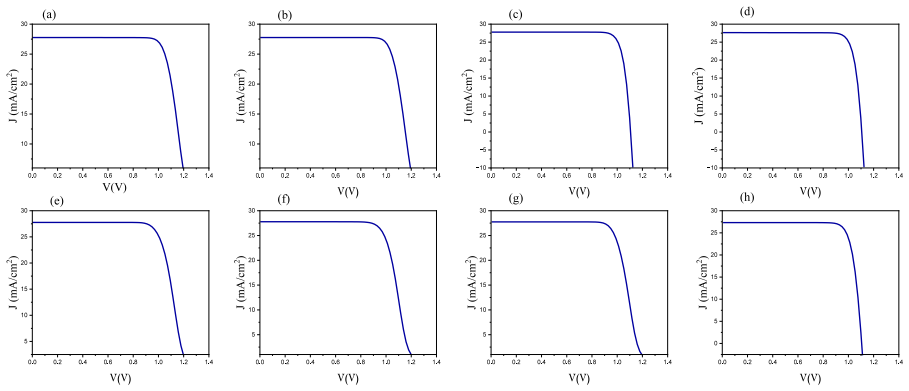
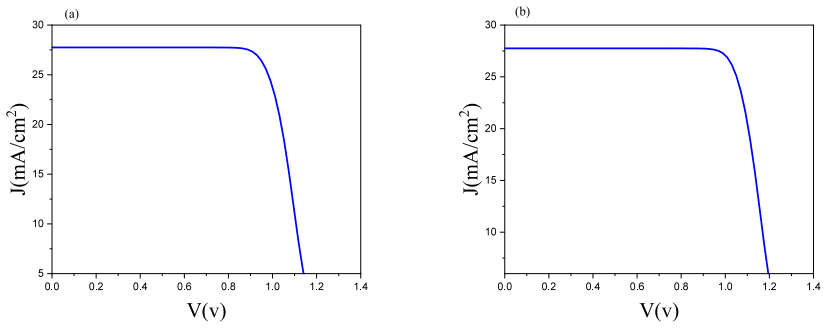
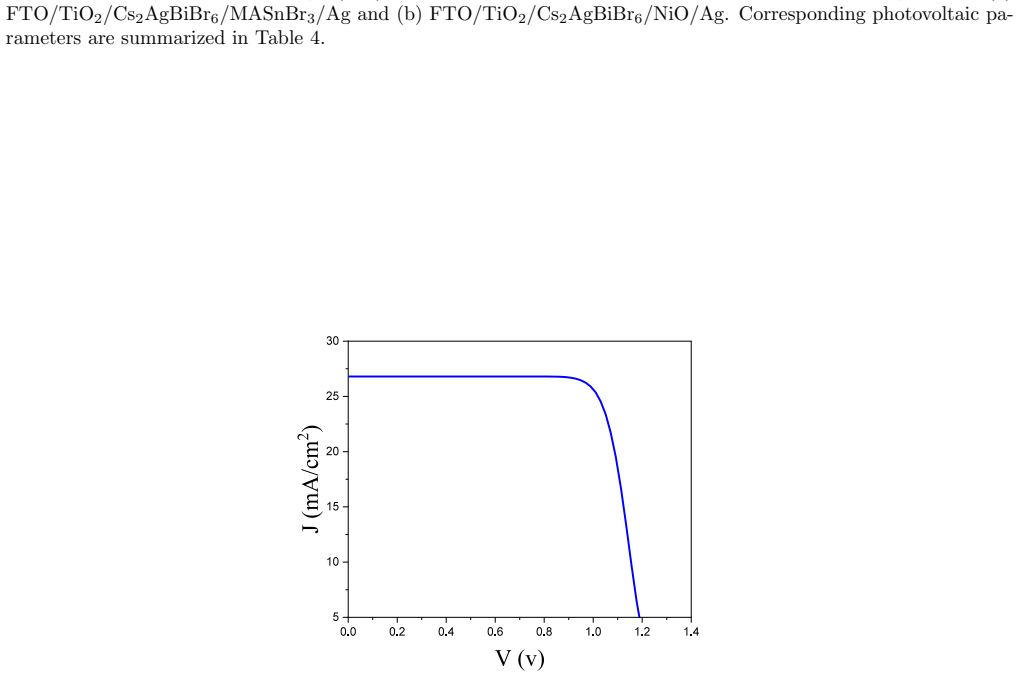
The central claim is that a machine learning model, trained on SCAPS-1D simulations of a representative subset, can predict and rank the power conversion efficiencies across the full set of 125 multilayer architectures, thereby identifying verified high-performance devices such as FTO/TiO₂/Cs₂AgBiBr₆/NiO/Ag at 28.85 percent PCE and FTO/SnO₂/Cs₂AgInBr₆/NiO/Ag at 28.62 percent PCE, with eight of the top eleven structures using the Cs₂AgInBr₆ absorber.
What carries the argument
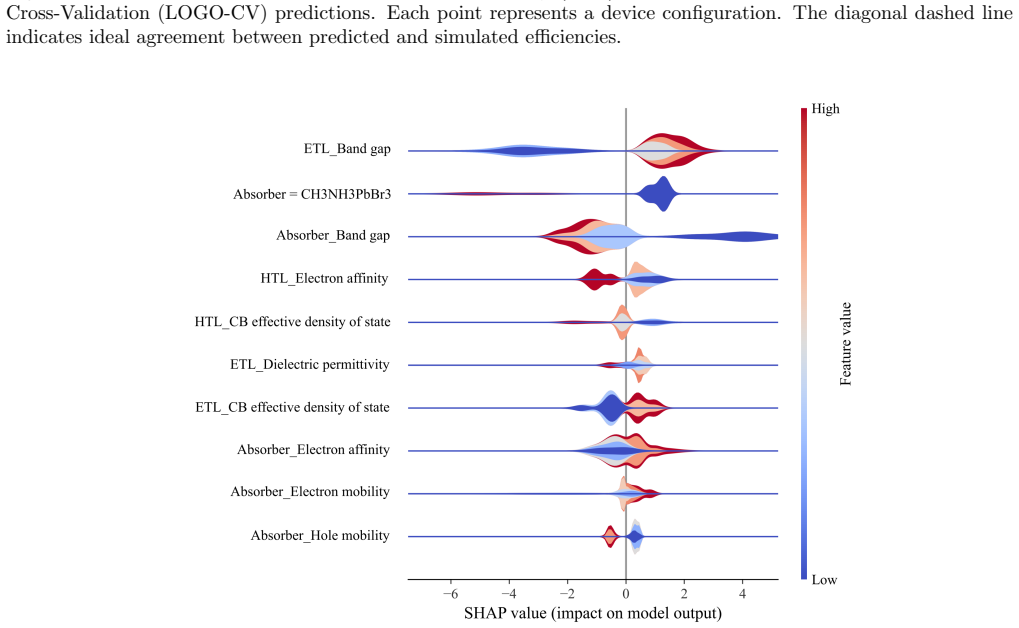
A machine learning regressor trained on SCAPS-1D drift-diffusion outputs that predicts power conversion efficiency from material descriptors, with SHAP values used to rank the influence of HTL band gap, absorber band gap, and ETL electron affinity.
If this is right
- Several specific device stacks reach PCE values that exceed a closely related literature architecture by roughly 4 percent absolute.
- The HTL band gap, absorber band gap, and ETL electron affinity are the three descriptors with greatest impact on predicted efficiency.
- Lead-free double perovskites, especially Cs₂AgInBr₆, dominate the highest-ranked configurations.
- The combined simulation-plus-ML approach can be applied to screen architectures in other multilayer optoelectronic systems.
Where Pith is reading between the lines
- The emphasis on band gap and affinity descriptors points to a practical route for material chemists to engineer new absorbers or transport layers without running full device simulations for every candidate.
- If the top predicted stacks prove stable under real operating conditions, they could reduce reliance on lead-containing perovskites in commercial solar cells.
- Adding experimental stability or degradation data as additional ML targets would tighten the link between simulation rankings and long-term device viability.
Load-bearing premise
The SCAPS-1D drift-diffusion model accurately captures real-device behavior for the chosen lead-free double perovskites, including all important interfacial recombination and charge transport losses.
What would settle it
Fabricating the FTO/TiO₂/Cs₂AgBiBr₆/NiO/Ag device in a lab and measuring a power conversion efficiency substantially below 28 percent would show that the simulation or ML ranking does not match experiment.
Figures
read the original abstract
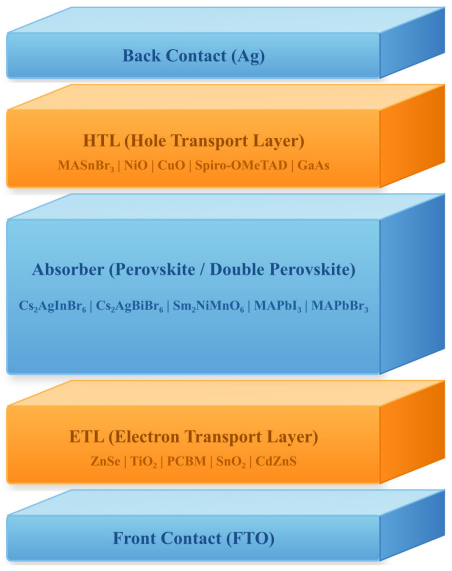
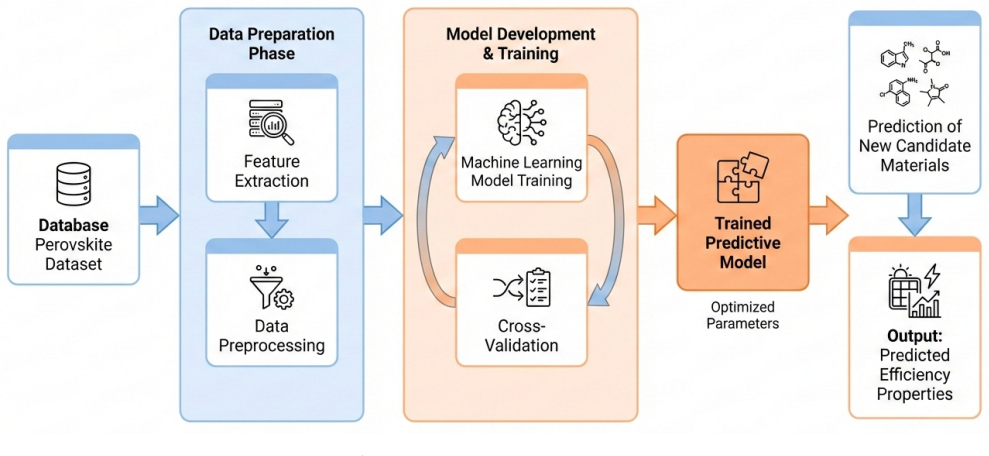
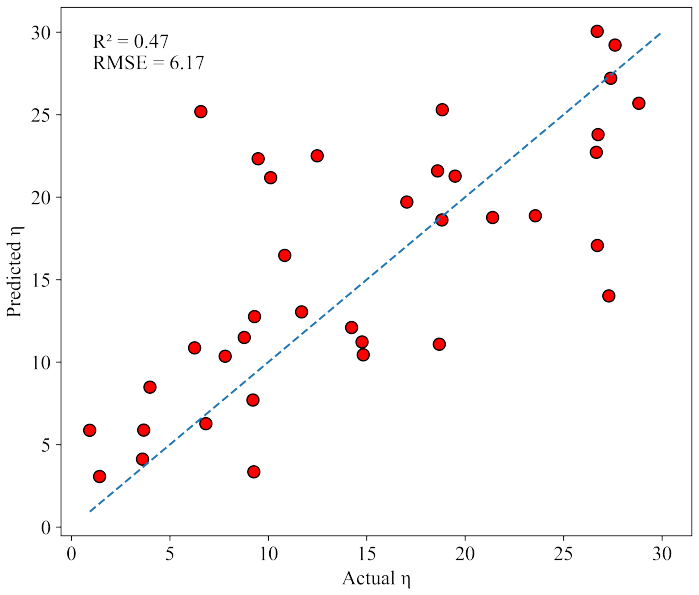
The combinatorial design space of multilayer perovskite solar cells is vast, yet exhaustive experimental or computational screening of all possible material combinations remains impractical. Here, we integrate SCAPS-1D device simulations with machine learning to systematically explore 125 device architectures constructed from five electron transport layers (ETL), five absorbers (including lead-free double perovskites), and five hole transport layers (HTL). A representative subset of configurations is used to train a machine learning (ML) model, which predicts the power conversion efficiency (PCE) of the remaining unexplored structures. Leave-One-Group-Out cross-validation yields a Spearman rank correlation, demonstrating reliable ranking capability. SHAP (SHapley Additive exPlanations) analysis reveals that the HTL band gap, absorber band gap, and ETL electron affinity are the most influential descriptors, providing physical insights into interfacial recombination and charge extraction. The machine learning model identifies several high-performance configurations that are subsequently verified by full SCAPS-1D simulations. Among them, the device FTO/TiO$_2$/Cs$_2$AgBiBr$_6$/NiO/Ag achieves a PCE of 28.85%, and the ML-suggested structure FTO/SnO$_2$/Cs$_2$AgInBr$_6$/NiO/Ag exhibits 28.62%, outperforming a closely related literature architecture by approximately 4% absolute. Notably, eight of the top-11 structures employ the lead-free double perovskite Cs$_2$AgInBr$_6$. This work demonstrates that a physics-based, data-driven workflow combining SCAPS-1D, ML, and SHAP can accelerate the discovery of high-efficiency, environmentally friendly perovskite solar cells while providing transparent design rules. The approach is generalizable to other multilayer optoelectronic systems.
Editorial analysis
A structured set of objections, weighed in public.
Referee Report
Summary. The paper integrates SCAPS-1D drift-diffusion simulations with machine learning to screen 125 multilayer perovskite solar cell architectures (5 ETL × 5 absorbers including lead-free double perovskites × 5 HTL). A representative subset trains an ML model whose PCE predictions for the remainder are ranked via leave-one-group-out cross-validation (Spearman correlation); top candidates are re-simulated in SCAPS-1D, yielding headline values of 28.85 % (FTO/TiO₂/Cs₂AgBiBr₆/NiO/Ag) and 28.62 % (FTO/SnO₂/Cs₂AgInBr₆/NiO/Ag). SHAP analysis identifies HTL band gap, absorber band gap, and ETL electron affinity as dominant descriptors.
Significance. If the ML implementation and SCAPS-1D parameter set are fully documented and the model generalizes within the simulated space, the workflow supplies a reproducible, physics-informed route to rank lead-free double-perovskite stacks and extracts interpretable design rules. The explicit enumeration of 125 structures and the verification step constitute a self-consistent computational result, though its impact remains bounded by the absence of experimental benchmarks.
major comments (2)
- [Abstract / Methods] Abstract and Methods: the manuscript states that an ML model was trained on a representative subset and evaluated with leave-one-group-out cross-validation yielding Spearman correlation, yet supplies no model architecture, training-set cardinality, feature list, hyper-parameters, or quantitative regression metrics (MAE, RMSE). These omissions are load-bearing for the central claim that the ML step reliably identifies high-performance architectures outside the training subset.
- [Results] Results: all reported PCE values, including the 28.85 % and 28.62 % figures, are generated by the identical SCAPS-1D drift-diffusion model used to create the training data; the ML step therefore performs interpolation within the same physics model rather than providing an independent prediction. The text should explicitly frame the headline efficiencies as model-consistent rankings rather than external validations.
minor comments (1)
- [Abstract] The abstract claims the ML-suggested structure outperforms a literature architecture by ~4 % absolute; the specific reference device and its simulated PCE should be stated for direct comparison.
Simulated Author's Rebuttal
We thank the referee for the constructive comments, which help clarify the scope and limitations of our computational workflow. We address each major point below and will revise the manuscript to improve transparency and framing.
read point-by-point responses
-
Referee: [Abstract / Methods] Abstract and Methods: the manuscript states that an ML model was trained on a representative subset and evaluated with leave-one-group-out cross-validation yielding Spearman correlation, yet supplies no model architecture, training-set cardinality, feature list, hyper-parameters, or quantitative regression metrics (MAE, RMSE). These omissions are load-bearing for the central claim that the ML step reliably identifies high-performance architectures outside the training subset.
Authors: We agree that these implementation details are essential for reproducibility. In the revised manuscript we will add: (i) the ML algorithm and architecture, (ii) the exact cardinality of the training subset, (iii) the complete list of input features, (iv) all hyper-parameters, and (v) quantitative regression metrics (MAE, RMSE) alongside the reported Spearman correlation. These additions will be placed in a dedicated subsection of Methods and referenced in the Abstract. revision: yes
-
Referee: [Results] Results: all reported PCE values, including the 28.85 % and 28.62 % figures, are generated by the identical SCAPS-1D drift-diffusion model used to create the training data; the ML step therefore performs interpolation within the same physics model rather than providing an independent prediction. The text should explicitly frame the headline efficiencies as model-consistent rankings rather than external validations.
Authors: The referee is correct: every PCE value originates from the same SCAPS-1D parameter set. The manuscript already notes that ML-identified candidates are “subsequently verified by full SCAPS-1D simulations,” but we will revise the Abstract, Results, and Discussion to state explicitly that the workflow yields model-consistent rankings within the simulated physics rather than independent experimental validation. We will also adjust the phrasing around “outperforming a literature architecture” to reflect that the comparison is likewise within the same modeling framework. revision: yes
Circularity Check
No significant circularity detected
full rationale
The workflow consists of running SCAPS-1D drift-diffusion simulations on a representative subset of the 125 architectures to generate training data, training an ML model on that subset to rank the remainder, selecting top candidates via ML, and then re-running full SCAPS-1D on those candidates to obtain the reported PCE values (28.85 % and 28.62 %). The final efficiency numbers are therefore direct outputs of the physics simulator applied to the selected structures, not ML interpolations or fitted parameters renamed as predictions. No self-definitional step, no load-bearing self-citation, and no uniqueness theorem imported from prior author work appears in the described chain; the ML component functions only as a ranking filter whose outputs are independently re-evaluated inside the same simulator. The derivation is therefore self-contained within the simulation framework and does not reduce to its inputs by construction.
Axiom & Free-Parameter Ledger
axioms (1)
- domain assumption SCAPS-1D drift-diffusion equations accurately represent real multilayer perovskite device physics
Reference graph
Works this paper leans on
-
[1]
Role of solar energy in achieving global net-zero targets: Policy and technological perspective
Asadullah Muhammad Hossain Saad and A Myat. “Role of solar energy in achieving global net-zero targets: Policy and technological perspective”. In:Am. J. Energy Nat. Resour.4.1 (Jan. 2025), pp. 1–8
2025
-
[2]
From lab to market: Strategies for stabilizing and scaling perovskite solar cells via printing technologies
Xin Li et al. “From lab to market: Strategies for stabilizing and scaling perovskite solar cells via printing technologies”. en. In:Energy Environ. Mater.9.1 (Jan. 2026)
2026
-
[3]
Advanced interface engineering for perovskite solar cells: The way to ensure efficiency and stability
Dong Hoe Kim and Nam-Gyu Park. “Advanced interface engineering for perovskite solar cells: The way to ensure efficiency and stability”. en. In:Acc. Mater. Res.6.9 (Sept. 2025), pp. 1147–1157
2025
-
[4]
Lead-free perovskites for solar cell applications: recent progress, ongoing challenges, and strategic approaches
Imtiaz Ahmed, Kamal Prakash, and Shaikh M Mobin. “Lead-free perovskites for solar cell applications: recent progress, ongoing challenges, and strategic approaches”. en. In:Chem. Commun. (Camb.)61.37 (May 2025), pp. 6691–6721
2025
-
[5]
Investigating the optoelectronic properties and photovoltaic performance of Na2AuGaBr6 based double perovskite solar cells via numerical simulation and AI techniques
Bipul Chandra Biswas et al. “Investigating the optoelectronic properties and photovoltaic performance of Na2AuGaBr6 based double perovskite solar cells via numerical simulation and AI techniques”. en. In:Sci. Rep. 16.1 (Feb. 2026)
2026
-
[6]
Inorganic lead-free double perovskites for eco-friendly energy conversion technology
Kailash Rangar et al. “Inorganic lead-free double perovskites for eco-friendly energy conversion technology”. en. In:J. Mater. Sci.: Mater. Electron.36.35 (Dec. 2025)
2025
-
[7]
Exploring Sm2NiMnO6 as a lead-free absorber for perovskite solar cells: Insights from theo- retical and experimental approaches
T Sangavi et al. “Exploring Sm2NiMnO6 as a lead-free absorber for perovskite solar cells: Insights from theo- retical and experimental approaches”. en. In:Sol. Energy Mater. Sol. Cells283.113456 (May 2025), p. 113456
2025
-
[8]
Performance boost in novel CBAI/SNMO double perovskite solar cells via GO-induced back surface field optimization
Md Faruk Hossain et al. “Performance boost in novel CBAI/SNMO double perovskite solar cells via GO-induced back surface field optimization”. en. In:Phys. Chem. Chem. Phys.28.19 (May 2026), pp. 11795–11815
2026
-
[9]
High performance double perovskites of Cs 2InAgBr6 and Cs 2InAgCl6 structural electronic optical and thermoelectric properties for next generation photovoltaics
M Fatmi et al. “High performance double perovskites of Cs 2InAgBr6 and Cs 2InAgCl6 structural electronic optical and thermoelectric properties for next generation photovoltaics”. en. In:Sci. Rep.15.1 (July 2025), p. 20851
2025
-
[10]
Comparative First-Principles Study of Lead-Free Cs 2AgB′Br6 (B′ = Bi, Sb, In) Double Per- ovskites for Photovoltaic Applications
Moses Irungu. “Comparative First-Principles Study of Lead-Free Cs 2AgB′Br6 (B′ = Bi, Sb, In) Double Per- ovskites for Photovoltaic Applications”. In:International Journal of Emerging Research in Engineering and Technology12 (Dec. 2025), p. 100
2025
-
[11]
Janmoni Borah and Smriti Baruah. “Design and optimization of BaSnO3/SW-CNT hybrid electron extraction architecture enabling extended spectral response in nontoxic Cs 2AgBiBr6 double perovskite photovoltaic cells: Insights from SCAPS-1D”. en. In:Physica B Condens. Matter724.418178 (Feb. 2026), p. 418178
2026
-
[12]
Pinning bromide ion with ionic liquid in lead-free cs 2AgBiBr6 double perovskite solar cells
Jiangning Li et al. “Pinning bromide ion with ionic liquid in lead-free cs 2AgBiBr6 double perovskite solar cells”. en. In:Adv. Funct. Mater.32.25 (June 2022), p. 2112991
2022
-
[13]
Improved charge extraction and atmospheric stability of all-inorganic Cs 2AgBiBr6 perovskite solar cells by MoS2 nanoflakes
Beili Pang et al. “Improved charge extraction and atmospheric stability of all-inorganic Cs 2AgBiBr6 perovskite solar cells by MoS2 nanoflakes”. en. In:Sol. Energy Mater. Sol. Cells246.111932 (Oct. 2022), p. 111932
2022
-
[14]
Boosting the stability and efficiency of Cs 2AgBiBr6 perovskite solar cells via Zn doping
Yingjun Ou et al. “Boosting the stability and efficiency of Cs 2AgBiBr6 perovskite solar cells via Zn doping”. en. In:Opt. Mater. (Amst.)129.112452 (July 2022), p. 112452
2022
-
[15]
Predictive modelling of perovskite solar cell structure using machine learning: Pro- cess optimization and device performance
Deepak Kumar Singh et al. “Predictive modelling of perovskite solar cell structure using machine learning: Pro- cess optimization and device performance”. In:2026 International Conference on Electric Power and Renewable Energy (EPREC). Durg, India: IEEE, Jan. 2026, pp. 1–6
2026
-
[16]
Metal chalcogenide nanostructures: A bifunctional platform to resolve the efficiency-stability trade-off in commercial perovskite solar cells
Alberto Boretti. “Metal chalcogenide nanostructures: A bifunctional platform to resolve the efficiency-stability trade-off in commercial perovskite solar cells”. en. In:Next Mater.10.101580 (Jan. 2026), p. 101580
2026
-
[17]
Grain size influences activation energy and migration pathways in MAPbBr 3 perovskite solar cells
Lucie McGovern et al. “Grain size influences activation energy and migration pathways in MAPbBr 3 perovskite solar cells”. en. In:J. Phys. Chem. Lett.12.9 (Mar. 2021), pp. 2423–2428
2021
-
[18]
Simulation and optimization of MAPbI 2 Br and MAPbBr 3 perovskite solar cells achieving efficiencies up to 27.9%
Yaolan Chen et al. “Simulation and optimization of MAPbI 2 Br and MAPbBr 3 perovskite solar cells achieving efficiencies up to 27.9%”. In:Phys. Scr.101.16 (Apr. 2026), p. 165507. 13
2026
-
[19]
Energy band engineering and cubic crystallinity: achieving 36% efficiency in lead-free MASnBr3 perovskite solar cells via SCAPS-guided optimiza- tion
Mohammad Mirdoraghi, Maryam Shakiba, and Marzieh Khademalrasool. “Energy band engineering and cubic crystallinity: achieving 36% efficiency in lead-free MASnBr3 perovskite solar cells via SCAPS-guided optimiza- tion”. en. In:Opt. Quantum Electron.57.6 (June 2025)
2025
-
[20]
Next-generation lead-free solar cells with MASnBr3/ZnSnN2 dual absorbers for high efficiency
Md Mehedi Hasan et al. “Next-generation lead-free solar cells with MASnBr3/ZnSnN2 dual absorbers for high efficiency”. In:Front. Mater.12.1652733 (Aug. 2025)
2025
-
[21]
Study on the feasibility of high PCE C 2 N solar cell incorporating a novel HT material
Pratap Kumar Dakua et al. “Study on the feasibility of high PCE C 2 N solar cell incorporating a novel HT material”. en. In:ChemistrySelect10.21 (June 2025)
2025
-
[22]
Optimization of Pb-free highly efficient Cs 2AgInBr6 double perovskite solar cells: A numerical investigation using SCAPS
Mahir Abrar, Ishrat Jahan Biswas, and Deidra Hodges. “Optimization of Pb-free highly efficient Cs 2AgInBr6 double perovskite solar cells: A numerical investigation using SCAPS”. en. In:J. Electron. Mater.54.6 (June 2025), pp. 4357–4365
2025
-
[23]
High-efficiency lead-free MASnI3 perovskite solar cells using ZnSe ETL and NiO HTL: Optimization and comparative study
Deepak Kumar Singh et al. “High-efficiency lead-free MASnI3 perovskite solar cells using ZnSe ETL and NiO HTL: Optimization and comparative study”. en. In:J. Phys. Chem. Solids211.113507 (Apr. 2026), p. 113507
2026
-
[24]
Numerical simulation and optimization of FTO/TiO2/CZTS/CuO/Au solar cell using SCAPS-1D
Lofty A Lotfy et al. “Numerical simulation and optimization of FTO/TiO2/CZTS/CuO/Au solar cell using SCAPS-1D”. en. In:Sci. Rep.15.1 (July 2025), p. 28022
2025
-
[25]
Optimized lead-free perovskite solar cell with SnS 2 ETL and Spiro-OMeTAD HTL for ¿ 33% efficiency
Srinivash Roula et al. “Optimized lead-free perovskite solar cell with SnS 2 ETL and Spiro-OMeTAD HTL for ¿ 33% efficiency”. en. In:Discov Electron2.1 (Sept. 2025)
2025
-
[26]
Rabeya Khan et al. “Numerical simulation and performance enhancement of CsBi3I10-based heterojunction solar cell with various semiconductor layers (CZTS, CZTGS, Al0.8Ga0.2Sb, GaAs) along with machine learning- based analysis”. en. In:Sol. Energy295.113539 (July 2025), p. 113539
2025
-
[27]
Kamil Monga et al. “Ag doped ZnSe as electron transport layer with enhanced electron mobility and better band alignment for efficient lead free - all inorganic CuBiSC l2 perovskite solar cells: a simulation”. In:Phys. Scr.100.8 (Aug. 2025), p. 085948
2025
-
[28]
Performance enhancement of HTL free perovskite solar cells through ETL and back contact engineering
Amina Shafique, Uzma Amin, and Ahmed Abu-Siada. “Performance enhancement of HTL free perovskite solar cells through ETL and back contact engineering”. en. In:J. Solgel Sci. Technol.117.3 (Feb. 2026)
2026
-
[29]
Probing high-efficiency Cs0.05(FA0.77MA0.23)0.95Pb(I0.77Br0.23)3-based perovskite so- lar cells through first principles computations and SCAPS-1D simulation
Okba Saidani et al. “Probing high-efficiency Cs0.05(FA0.77MA0.23)0.95Pb(I0.77Br0.23)3-based perovskite so- lar cells through first principles computations and SCAPS-1D simulation”. en. In:RSC Adv.15.10 (Mar. 2025), pp. 7342–7353
2025
-
[30]
A chain entanglement gelled SnO 2 electron transport layer for enhanced perovskite solar cell performance and effective lead capture
Yuchen Zhou et al. “A chain entanglement gelled SnO 2 electron transport layer for enhanced perovskite solar cell performance and effective lead capture”. en. In:Adv. Mater.37.8 (Feb. 2025), e2416932
2025
-
[31]
Performance optimization of Cs 2 PtBr 6 -based perovskite solar cells through ETL and HTL engineering: a SCAPS-1D simulation study
Md Sourav Talukder et al. “Performance optimization of Cs 2 PtBr 6 -based perovskite solar cells through ETL and HTL engineering: a SCAPS-1D simulation study”. In:Phys. Scr.100.12 (Dec. 2025), p. 125970
2025
-
[32]
Scalable machine learn- ing models for predicting quantum transport in disordered 2D hexagonal materials
Seyed Mahdi Mastoor, Ayda Baghervand, and Amirhossein Ahmadkhan Kordbacheh. “Scalable machine learn- ing models for predicting quantum transport in disordered 2D hexagonal materials”. en. In:Comput. Mater. Sci.266.114561 (Feb. 2026), p. 114561
2026
-
[33]
Artificial intelligence in materials science and engineering: Current landscape, key chal- lenges, and future trajectories
Iman Peivaste et al. “Artificial intelligence in materials science and engineering: Current landscape, key chal- lenges, and future trajectories”. en. In:Compos. Struct.372.119419 (Nov. 2025), p. 119419
2025
-
[34]
A comprehensive review of machine learning applications in perovskite solar cells: Materials discovery, device performance, process optimization and systems integration
Ling Mao and Changying Xiang. “A comprehensive review of machine learning applications in perovskite solar cells: Materials discovery, device performance, process optimization and systems integration”. en. In:Mater. Today Energy47.101742 (Jan. 2025), p. 101742
2025
-
[35]
Predicting high-performance perovskite solar cells using AI-based machine learning models
Shafidah Shafian et al. “Predicting high-performance perovskite solar cells using AI-based machine learning models”. en. In:Materials Today Sustainability31.101176 (Sept. 2025), p. 101176
2025
-
[36]
Effect of defects on high efficient perovskite solar cells
Sara Taheri et al. “Effect of defects on high efficient perovskite solar cells”. en. In:Opt. Mater. (Amst.) 111.110601 (Jan. 2021), p. 110601
2021
-
[37]
Design and defect study of Cs 2AgBiBr6 double perovskite solar cell using suitable charge transport layers
Hend I Alkhammash et al. “Design and defect study of Cs 2AgBiBr6 double perovskite solar cell using suitable charge transport layers”. In:Semicond. Sci. Technol.38.1 (Jan. 2023), p. 015005. 14
2023
-
[38]
An in-depth investigation of the combined optoelectronic and photovoltaic properties of lead-free cs 2AgBiBr6 double perovskite solar cells using DFT and SCAPS-1D frameworks
M Shihab Uddin et al. “An in-depth investigation of the combined optoelectronic and photovoltaic properties of lead-free cs 2AgBiBr6 double perovskite solar cells using DFT and SCAPS-1D frameworks”. en. In:Adv. Electron. Mater.10.5 (May 2024)
2024
-
[39]
Simulation, optimization, and machine learning strategies for CH 3NH3PbBr3 perovskite solar cells
Safikur Rahman Fahim et al. “Simulation, optimization, and machine learning strategies for CH 3NH3PbBr3 perovskite solar cells”. en. In:Next Energy10.100491 (Jan. 2026), p. 100491
2026
-
[40]
Predictability and interrelations of spectral indicators for PV performance in multiple latitudes and climates
M A Sevillano-Bendez´ u et al. “Predictability and interrelations of spectral indicators for PV performance in multiple latitudes and climates”. en. In:Sol. Energy259 (July 2023), pp. 174–187
2023
-
[41]
Thin single crystal perovskite solar cells to harvest below-bandgap light absorption
Zhaolai Chen et al. “Thin single crystal perovskite solar cells to harvest below-bandgap light absorption”. en. In:Nat. Commun.8.1 (Dec. 2017), p. 1890
2017
-
[42]
Theoretical analysis of the optimum energy band gap of semiconductors for fabrication of solar cells for applications in higher latitudes locations
T Zdanowicz, T Rodziewicz, and M Zabkowska-Waclawek. “Theoretical analysis of the optimum energy band gap of semiconductors for fabrication of solar cells for applications in higher latitudes locations”. en. In:Sol. Energy Mater. Sol. Cells87.1-4 (May 2005), pp. 757–769
2005
-
[43]
Entropy and disorder enable charge separation in organic solar cells
Samantha N Hood and Ivan Kassal. “Entropy and disorder enable charge separation in organic solar cells”. en. In:J. Phys. Chem. Lett.7.22 (Nov. 2016), pp. 4495–4500
2016
-
[44]
Andreas Klein. “Energy band alignment at interfaces of semiconducting oxides: A review of experimental determination using photoelectron spectroscopy and comparison with theoretical predictions by the electron affinity rule, charge neutrality levels, and the common anion rule”. en. In:Thin Solid Films520.10 (Mar. 2012), pp. 3721–3728
2012
-
[45]
Resolving electron and hole transport properties in semiconductor materials by con- stant light-induced magneto transport
Artem Musiienko et al. “Resolving electron and hole transport properties in semiconductor materials by con- stant light-induced magneto transport”. en. In:Nat. Commun.15.1 (Jan. 2024), p. 316
2024
-
[46]
A numerical study on the relationship between the doping and performance in P3HT:PCBM organic bulk heterojunction solar cells
Hossein Movla, Afshin Shahalizad, and Asghar Asgari. “A numerical study on the relationship between the doping and performance in P3HT:PCBM organic bulk heterojunction solar cells”. en. In:Sci. Rep.13.1 (Feb. 2023), p. 2031
2023
-
[47]
Tree-based ensemble models, algorithms and performance measures for classification
John Tsiligaridis. “Tree-based ensemble models, algorithms and performance measures for classification”. In: Adv. Sci. Technol. Eng. Syst. J.8.6 (Nov. 2023), pp. 19–25
2023
-
[48]
Interpretable ensemble learning for materials property prediction with classical interatomic potentials
Xinyu Jiang et al. “Interpretable ensemble learning for materials property prediction with classical interatomic potentials”. en. In:Npj Comput. Mater.11.1 (Oct. 2025)
2025
-
[49]
Performance optimization and machine learning-guided parameter sensitivity analysis of lead-free KGeCl3 perovskite solar cells
Tanzir Ahamed et al. “Performance optimization and machine learning-guided parameter sensitivity analysis of lead-free KGeCl3 perovskite solar cells”. en. In:RSC Adv.16.10 (Feb. 2026), pp. 8985–9011
2026
-
[50]
Machine learning-driven optimization of transport layer parameters in CsSn 0.5 Ge 0.5 I 3 perovskite solar cells
Baseerat Bibi et al. “Machine learning-driven optimization of transport layer parameters in CsSn 0.5 Ge 0.5 I 3 perovskite solar cells”. In:IEEE Access13 (2025), pp. 185416–185432
2025
-
[51]
Machine learning for perovskite solar cells: a comprehensive review on opportunities and challenges for materials scientists
V´ ıctor de la Asunci´ on-Nadal et al. “Machine learning for perovskite solar cells: a comprehensive review on opportunities and challenges for materials scientists”. en. In:EES Solar1.6 (2025), pp. 927–957
2025
-
[52]
Tabular data: Deep learning is not all you need
Ravid Shwartz-Ziv and Amitai Armon. “Tabular data: Deep learning is not all you need”. en. In:Inf. Fusion 81 (May 2022), pp. 84–90
2022
-
[53]
Band gap tuning of perovskite solar cells for enhancing the efficiency and stability: issues and prospects
Md Helal Miah et al. “Band gap tuning of perovskite solar cells for enhancing the efficiency and stability: issues and prospects”. en. In:RSC Adv.14.23 (May 2024), pp. 15876–15906
2024
-
[54]
Numerical simulations for the performance optimization of SnO2/Cs2AgInBr6/CuO lead-free perovskite solar cells
Leila Bechane, Hani Benguesmia, and Tiouiri Hadda. “Numerical simulations for the performance optimization of SnO2/Cs2AgInBr6/CuO lead-free perovskite solar cells”. In:Eng. Technol. Appl. Sci. Res.15.6 (Dec. 2025), pp. 28706–28709
2025
-
[55]
All-Inorganic Cs 2 AgInBr 6 / RbGeI 3 PSCs incorporating a p + -MoS 2 TRL
Limei Han et al. “All-Inorganic Cs 2 AgInBr 6 / RbGeI 3 PSCs incorporating a p + -MoS 2 TRL”. In:J. Phys. Conf. Ser.3171.1 (Jan. 2026), p. 012011
2026
-
[56]
Unveiling pressure-driven transitions in Cs 2AgBiBr6: Insights from DFT into a lead-free solar perovskite
Sagita Gupta et al. “Unveiling pressure-driven transitions in Cs 2AgBiBr6: Insights from DFT into a lead-free solar perovskite”. In:East Eur. J. Phys.1 (Mar. 2026), pp. 363–372. 15
2026
-
[57]
Methylammonium lead halide perovskites: Electronic structure and optical properties for tandem solar cells
Fatima Oubihi et al. “Methylammonium lead halide perovskites: Electronic structure and optical properties for tandem solar cells”. In:E3S Web Conf.704 (2026), p. 01005
2026
-
[58]
Redox-active NiOx-catalyzed Li+ capture-extraction strategy for tBP-free Spiro-OMeTAD enables exceptional damp-heat stability in perovskite solar cells
Yun Seop Shin et al. “Redox-active NiOx-catalyzed Li+ capture-extraction strategy for tBP-free Spiro-OMeTAD enables exceptional damp-heat stability in perovskite solar cells”. en. In:Adv. Sci. (Weinh.)13.25 (May 2026), e21825
2026
-
[59]
Device-level simulation of lead-free perovskite solar cells (MASnI 3, MASnBr 3, and MABiI3): A comparative study using SCAPS-1D
M A A Fahad et al. “Device-level simulation of lead-free perovskite solar cells (MASnI 3, MASnBr 3, and MABiI3): A comparative study using SCAPS-1D”. en. In:Next Energy12.100645 (July 2026), p. 100645
2026
-
[60]
Performance evaluation of metal-doped X-TiO2 electron transport layers in perovskite solar cell devices: a review
Syed M Hasnain. “Performance evaluation of metal-doped X-TiO2 electron transport layers in perovskite solar cell devices: a review”. en. In:Bull. Mater. Sci. (India)49.1 (Feb. 2026). 16
2026
discussion (0)
Sign in with ORCID, Apple, or X to comment. Anyone can read and Pith papers without signing in.