REVIEW 4 major objections 5 minor 39 references
Effects of symmetry and hydrodynamics on the cohesion of groups of swimmers
T0 review · 4 major / 5 minor · reviewed 2026-08-07 · deepseek-v4-flash
Pith's one-line read Passive hydrodynamic interactions alone cannot sustain large-scale cohesion in groups of swimmers, which instead break into smaller cohesive subgroups.
desk verdict A solid, internally consistent numerical study of an idealized dipole-swimmer model; the new milling instabilities are real for this model, but the general claim that passive hydrodynamics cannot keep groups cohesive outruns the model. read the letter →
The pith
A machine-rendered reading of the paper's core claim, the machinery that carries it, and where it could break.
The reading
What carries the argument
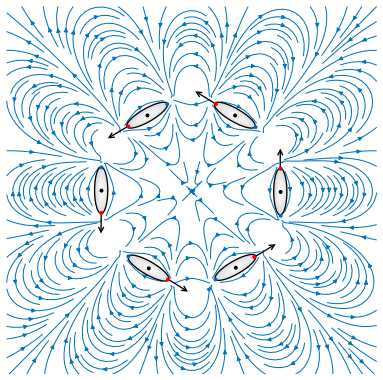
The load-bearing object is the three-dimensional source-sink dipole swimmer: each swimmer is a dumbbell with a source bead at the front and a sink bead at the rear, separated by a fixed length, so that the far-field flow is that of a dipole. Beads move as material points in the inviscid flow induced by all other beads, with a Lagrange multiplier enforcing constant body length, giving a 6N-dimensional dynamical system. For milling, the central analytic device is the Poincaré map on a rotating frame: hydrodynamic milling appears as a fixed point of this map, and its linear stability is computed by Arnoldi iteration on the Jacobian-vector products.
What would settle it
An experiment with a school of self-propelled underwater robots, or a simulation with resolved viscous vortical wakes, in which a group of more than roughly ten identical swimmers maintains a single cohesive milling or schooling configuration without any active control, would contradict the claim that passive inviscid far-field interactions alone cannot sustain large-scale cohesion.
Extended reading notes
Core claim
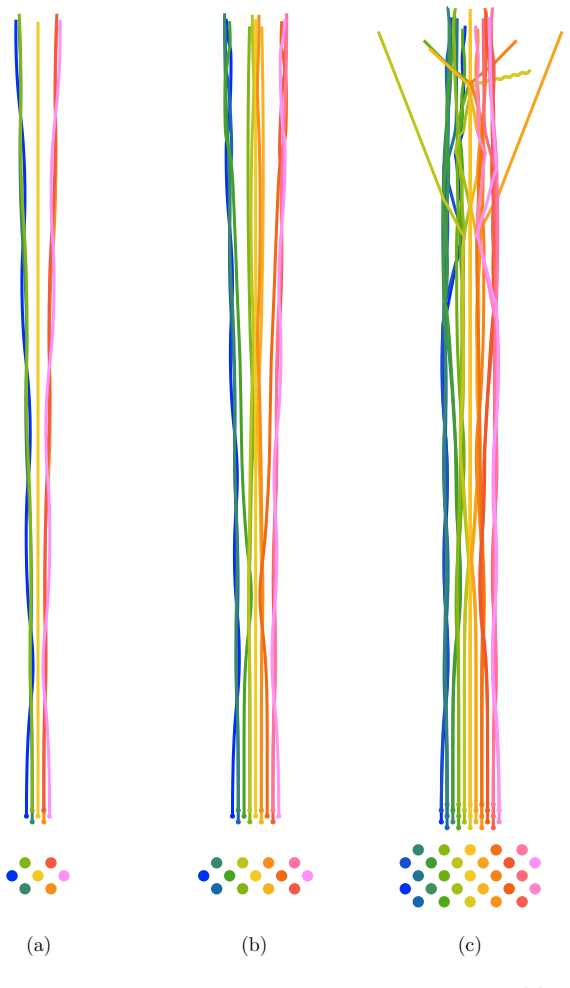
The central discovery is that passive hydrodynamic interactions are enough to create small cohesive clusters but not to sustain cohesion of a large group. In the model, every group of three or more swimmers evolves in characteristic ways: symmetric trios with one leader and two followers show only finite-time locking before divergence, while two leaders and one follower admit a stable relative equilibrium with a large basin of attraction. Diamond lattices and circular configurations are more striking: the outer layers destabilize first and the group splits into braided trios, pairs, or quintets that remain internally cohesive even as they separate from each other. For all N between 4 and 100, the model admits 'hydrodynamic milling' states—relative periodic orbits in which swimmers chase one another around a circle—but these states are linearly unstable to two asymmetric modes (a conjugate pair) and one symmetric mode. The milling state therefore cannot persist without active input.
Load-bearing premise
The whole analysis rests on treating swimmers as far-field source-sink dipoles in inviscid flow, with each bead moving as a material point—if viscous wakes, near-field forces, or social responses change the induced rotations, the predicted subgrouping and milling instability need not hold for real swimmers.
Editorial extensions
If this is right
- If the model is right, no passive far-field hydrodynamic interaction can hold a large school together; some active or social input is required for large-scale cohesion.
- The stable cohesive unit predicted is a small subgroup (pairs, trios, quintets), so engineered swarms could aim to control interactions between subgroups rather than every individual.
- Hydrodynamic milling, though visually similar to fish milling, is intrinsically unstable, so observed milling in nature likely relies on active behavior or additional physical effects.
- Because destabilization starts at the periphery and diffuses inward, controlling only the edge of a group may keep the core passively coherent.
- The stability of diamond formations depends on the swimmer model, since the vortex-pair model used earlier gives different rotational dynamics.
Reading between the lines
- A testable extension would be to add a weak social alignment term to the model; the prediction would be that a critical social strength exists below which large-scale cohesion still fails, quantifying how much 'active input' is minimally needed.
- The subgrouping mechanism resembles a wave of instability propagating inward; one could measure this propagation speed and compare it with the time scale of flow-induced rotation to see if it is controlled by the dipole interaction geometry.
- The model suggests that robotic swarm controllers should focus on edge agents; this could be tested in a water-tank experiment with propeller-driven robots programmed to hold only the boundary robots on a circle.
Editorial analysis
A structured set of objections, weighed in public.
Referee Report
Summary. The paper studies whether passive hydrodynamic interactions alone can maintain cohesion in groups of inertial swimmers. It uses a three-dimensional, inviscid, far-field model in which each swimmer is a source–sink dipole pair with two material-point beads, following the authors' earlier pairwise model. The authors first map the dynamics of triangular configurations, finding finite-time cohesive (oscillatory) states for one leader and two followers and a stable relative equilibrium with a large basin of attraction for two leaders and one follower. They then simulate diamond lattices of 7, 13, and 27 swimmers and observe that the overall group loses cohesion while smaller peripheral subgroups, such as braided trios or quintets, remain cohesive. For circular configurations, they report discovering 'hydrodynamic milling' states for every N from 4 to 100, which are relative periodic orbits, and they claim these states are always unstable to exactly three modes: two asymmetric conjugate modes and one symmetric mode. Nonlinear evolution splits the milling group into smaller subgroups. The paper concludes that passive hydrodynamics alone cannot sustain large-scale cohesion indefinitely, but that cohesive subgroups form robustly and that controlling only the periphery or inter-subgroup interactions might suffice to maintain a larger group.
Significance. If the results hold, the paper makes a useful contribution to the understanding of passive hydrodynamic mechanisms in collective swimming. The model is fully specified and parameter-free in the sense that no constants are fitted to produce the observed cohesion, subgrouping, or milling behavior; the governing equations and the numerical methods are stated clearly enough to reproduce the main simulations. The discovery of hydrodynamic milling states is novel and potentially relevant for bioinspired robotics, and the systematic treatment of triangular, diamond, and circular configurations provides a useful map of behaviors. The main limitation is that all conclusions are derived from an inviscid, far-field potential-flow model whose external validity for real swimmers is not established; in addition, two of the central claims—the universal three-mode instability of milling and the indefinite cohesion of subgroups—rest on numerical evidence that is not fully documented. These issues are fixable, but they currently leave the strongest claims less secure than the presentation suggests.
major comments (4)
- [Section V A and Appendix A] The claim that hydrodynamic milling is 'always' unstable to exactly three modes for every N in [4,100] is not supported by the reported numerical evidence. The Arnoldi iteration uses finite-difference Jacobian-vector products via Eq. (A1), but the manuscript does not state the perturbation size epsilon, the number of Arnoldi vectors, the number of iterations, or any convergence criterion. No eigenvalue spectra, growth rates, or residuals are shown for any N; only the radius and speed appear in Fig. 12, and the unstable modes are illustrated for N=10 only. Because the universal three-mode instability is a central quantitative claim, please report the eigenvalues (or at least the unstable growth rates) as functions of N, and validate the finite-difference/Arnoldi computation against a dense eigenproblem for a small case such as N=4, while demonstrating convergence in epsilon and in Krylov dimension.
- [Section VI (and Sections IV, V B)] The statement that emergent subgroups 'maintain their structure indefinitely' and 'remain cohesive for the rest of time' is an extrapolation from finite-time simulations. The paper provides no boundedness argument, no invariant set, and no quantitative measure of subgroup cohesion over time; Figs. 9, 14, and 15 show trajectories only until divergence or collision. Either soften these statements to 'for the duration of the simulations' or provide quantitative evidence such as bounded subgroup separations over long integration times, a norm that remains bounded, or an explicit statement of the simulated time horizon. This is load-bearing because the positive claim that small subgroups are indefinitely cohesive is a key part of the paper's message.
- [Abstract and Section VI] The abstract and conclusions state a general negative answer: 'passive hydrodynamics alone cannot sustain large-scale cohesion indefinitely.' All results, however, are computed with a single reduced model in which each swimmer is an inviscid, far-field source–sink dipole and each bead is a material point (Section II, Eqs. 2–4). The paper itself cites wake-based models, such as Ref. [24], that produce stable schooling at scale, and the model neglects viscous wakes, near-field forces, and finite body geometry. The general claim should be explicitly restricted to the inviscid far-field model in the abstract and conclusions, or supplemented by a robustness check that adds a near-field repulsion or a simple wake term and shows whether the qualitative conclusions persist. As written, the paper overstates the scope of its conclusions.
- [Section IV] The loss of mirror symmetry in the diamond configurations is attributed to 'round-off error in our simulations,' and this symmetry breaking is used to infer that 'certain symmetries are not robust to perturbations.' No precision study or quantitative perturbation analysis is reported. Please provide the magnitude of the asymmetry at which the symmetry breaks, and ideally verify the claim by comparing double-precision results with higher-precision arithmetic or by applying controlled asymmetric perturbations of known amplitude. This would strengthen the otherwise qualitative robustness claim.
minor comments (5)
- [Section II] There is a typo in the text after Eq. (1): 'in terms of of xc,i, ni' should read 'in terms of xc,i, ni.'
- [Section IV] The sentence 'whereas the model used in the present is appropriate for more commonly encountered long and narrow swimmers' is missing a noun; it should read 'the model used in the present work.'
- [Section V A] The phrase 'rotated π/48 from the vertical' appears without a space before the angle; it should be 'rotated by π/48 from the vertical' for clarity.
- [Figure 12] Figure 12 plots the radius and speed as functions of N, but the claim that the radius is a linear function of N is not quantified. Adding a linear fit or reporting the slope and intercept would make the scaling claim more precise.
- [Appendix A] The definition of the Poincare map is somewhat informal: the dimension of the section, the choice of the sectioning condition, and the method used to locate the fixed point p are not described. A few sentences specifying these details would improve reproducibility.
Circularity Check
No significant circularity: all central results are computed from a parameter-free model rather than fitted or defined into existence.
full rationale
The derivation chain is self-contained once the model of Section II is accepted. The model is taken from the authors' prior work [27] and from Auton et al. [36], with stated assumptions (inviscid, far-field, neutrally buoyant beads moving as material points). No parameter is fitted to the cohesion or milling data, and no target result is used in the model construction. The triangular and diamond phase diagrams are obtained by direct numerical integration of Eqs. (2)-(4). The relative equilibrium in Section III B emerges from simulations, and its basin of attraction is computed, not imposed. Hydrodynamic milling is found by solving for a fixed point of the Poincaré map with a Newton-Krylov method (Appendix A); the existence, radius, speed, and the three unstable modes are outputs of the computation rather than inputs. The negative conclusion about large-scale cohesion is a property of the simulated dynamics, though its 'indefinitely' phrasing extrapolates beyond finite-time trajectories; that is a correctness and external-validity concern, not circularity. Self-citations to [27] supply the model and pair dynamics, but these are parameter-free, externally published results with stated assumptions, so they count as independent support rather than circular import. No equation is equivalent to its own input by construction, and no fitted quantity is relabeled as a prediction.
Assumptions & free parameters
free parameters (3)
- Initial lattice spacing Δx, Δy =
16 ℓ for diamond configurations
- Circular radius R =
varies with N, see Figure 12
- Perturbation amplitude =
π/48
assumptions (4)
- domain assumption The flow around each swimmer is well represented by a potential-flow dipole (source-sink pair) at leading order.
- domain assumption Each bead moves as a material point in the inviscid flow, per Auton et al. (1988), with neutrally buoyant beads.
- domain assumption The Lagrange multiplier λi maintains constant body length without affecting net translation or rotation.
- domain assumption Collisions between swimmers are non-physical in this far-field model and are not modeled.
Cite this review
Pith. "Pith review of Effects of symmetry and hydrodynamics on the cohesion of groups of swimmers." pith.science (2026). https://pith.science/paper/SJLEVXVE
@misc{pith2026250515942,
  author       = {Pith},
  title        = {Pith review of: Effects of symmetry and hydrodynamics on the cohesion of groups of swimmers},
  year         = {2026},
  howpublished = {\url{https://pith.science/paper/SJLEVXVE}},
  note         = {Machine review of arXiv:2505.15942}
}
read the original abstract
When groups of inertial swimmers move together, hydrodynamic interactions play a key role in shaping their collective dynamics, including the cohesion of the group. To explore how these interactions influence group cohesion, we develop a three-dimensional, inviscid, far-field model of a swimmer. Focusing on symmetric triangular, diamond, and circular group arrangements, we investigate whether passive hydrodynamics alone can promote cohesive behavior, and what role symmetry of the group plays. While small symmetric (and even asymmetric) groups can be cohesive, larger groups typically are not, instead breaking apart into smaller, self-organized subgroups that are cohesive. Notably, we discover circular arrangements of swimmers that chase each other around a circle, resembling the milling behavior of natural fish schools; we call this hydrodynamic milling. Hydrodynamic milling is cohesive in the sense that it is a fixed point of a particular Poincar\'e map, but it is unstable, especially to asymmetric perturbations. Our findings suggest that while passive hydrodynamics alone cannot sustain large-scale cohesion indefinitely, controlling interactions between subgroups, or controlling the behavior of only the periphery of a large group, could potentially enable stable collective behavior with minimal active input.
Figures


Figures from the paper (13 more)





Reference graph
Works this paper leans on
-
[27]
M. N. Mabrouk and D. Floryan, Group cohesion and passive dynamics of a pair of inertial 28 swimmers with three-dimensional hydrodynamic interactions, Bioinspiration & Biomimetics 20, 016014 (2024)
work page 2024
-
[11]
M. Gazzola, A. A. Tchieu, D. Alexeev, A. De Brauer, and P. Koumoutsakos, Learning to school in the presence of hydrodynamic interactions, Journal of Fluid Mechanics 789, 726 (2016)
work page 2016
-
[24]
A. Filella, F. Nadal, C. Sire, E. Kanso, and C. Eloy, Model of collective fish behavior with hydrodynamic interactions, Physical Review Letters 120, 198101 (2018)
work page 2018
-
[1]
Vicsek and A
T. Vicsek and A. Zafeiris, Collective motion, Physics Reports 517, 71 (2012)
2012
-
[2]
J. K. Parrish and W. M. Hamner, Animal groups in three dimensions: how species aggregate (Cambridge University Press, 1997)
work page 1997
-
[3]
I. D. Couzin, J. Krause, N. R. Franks, and S. A. Levin, Effective leadership and decision- making in animal groups on the move, Nature 433, 513 (2005)
work page 2005
-
[4]
L. Landeau and J. Terborgh, Oddity and the ‘confusion effect’in predation, Animal Behaviour 34, 1372 (1986)
work page 1986
-
[5]
C. K. Hemelrijk, D. A. P. Reid, H. Hildenbrandt, and J. T. Padding, The increased efficiency of fish swimming in a school, Fish and Fisheries 16, 511 (2015)
work page 2015
Show all 39 references
-
[6]
P. F. Major, Predator-prey interactions in two schooling fishes, caranx ignobilis and stolepho- rus purpureus, Animal Behaviour 26, 760 (1978)
1978
-
[7]
Colvert, K
B. Colvert, K. Chen, and E. Kanso, Local flow characterization using bioinspired sensory information, Journal of Fluid Mechanics 818, 366 (2017)
2017
-
[8]
T. J. Pitcher, A. E. Magurran, and I. J. Winfield, Fish in larger shoals find food faster, Behavioral Ecology and Sociobiology 10, 149 (1982)
1982
-
[9]
Dorigo, G
M. Dorigo, G. Theraulaz, and V. Trianni, Reflections on the future of swarm robotics, Science Robotics 5, eabe4385 (2020)
2020
-
[10]
Gibouin, C
F. Gibouin, C. Raufaste, Y. Bouret, and M. Argentina, Study of the thrust–drag balance with a swimming robotic fish, Physics of Fluids 30 (2018)
2018
-
[12]
Zhang, H
Y. Zhang, H. Ko, M. A. Calicchia, R. Ni, and G. V. Lauder, Collective movement of schooling fish reduces the costs of locomotion in turbulent conditions, PLoS Biology22, e3002501 (2024)
2024
-
[13]
H. Ko, G. Lauder, and R. Nagpal, The role of hydrodynamics in collective motions of 27 fish schools and bioinspired underwater robots, Journal of The Royal Society Interface 20, 20230357 (2023)
2023
-
[14]
Weihs, Hydromechanics of fish schooling, Nature 241, 290 (1973)
D. Weihs, Hydromechanics of fish schooling, Nature 241, 290 (1973)
1973
-
[15]
Ashraf, H
I. Ashraf, H. Bradshaw, T.-T. Ha, J. Halloy, R. Godoy-Diana, and B. Thiria, Simple phalanx pattern leads to energy saving in cohesive fish schooling, Proceedings of the National Academy of Sciences 114, 9599 (2017)
2017
-
[16]
Zhang and G
Y. Zhang and G. V. Lauder, Energy conservation by collective movement in schooling fish, eLife 12, RP90352 (2024)
2024
-
[17]
Heydari, H
S. Heydari, H. Hang, and E. Kanso, Mapping spatial patterns to energetic benefits in groups of flow-coupled swimmers, eLife 13, RP96129 (2024)
2024
-
[18]
Vicsek, A
T. Vicsek, A. Czir´ ok, E. Ben-Jacob, I. Cohen, and O. Shochet, Novel type of phase transition in a system of self-driven particles, Physical Review Letters 75, 1226 (1995)
1995
-
[19]
I. D. Couzin, J. Krause, R. James, G. D. Ruxton, and N. R. Franks, Collective memory and spatial sorting in animal groups, Journal of Theoretical Biology 218, 1 (2002)
2002
-
[20]
D. S. Calovi, U. Lopez, S. Ngo, C. Sire, H. Chat´ e, and G. Theraulaz, Swarming, schooling, milling: phase diagram of a data-driven fish school model, New Journal of Physics 16, 015026 (2014)
2014
-
[21]
Tunstrøm, Y
K. Tunstrøm, Y. Katz, C. C. Ioannou, C. Huepe, M. J. Lutz, and I. D. Couzin, Collective states, multistability and transitional behavior in schooling fish, PLoS Computational Biology 9, e1002915 (2013)
2013
-
[22]
Lafoux, J
B. Lafoux, J. Moscatelli, R. Godoy-Diana, and B. Thiria, Illuminance-tuned collective motion in fish, Communications Biology 6, 585 (2023)
2023
-
[23]
D. S. Pavlov and A. O. Kasumyan, Patterns and mechanisms of schooling behavior in fish: a review, Journal of Ichthyology 40, S163 (2000)
2000
-
[25]
Zhou, J.-H
J. Zhou, J.-H. Seo, and R. Mittal, Effect of hydrodynamic wakes in dynamical models of large-scale fish schools, Physics of Fluids 37 (2025)
2025
-
[26]
Huang, F
C. Huang, F. Ling, and E. Kanso, Collective phase transitions in confined fish schools, Pro- ceedings of the National Academy of Sciences 121, e2406293121 (2024)
2024
-
[28]
A. A. Tchieu, E. Kanso, and P. K. Newton, The finite-dipole dynamical system, Proceedings of the Royal Society A: Mathematical, Physical and Engineering Sciences 468, 3006 (2012)
2012
-
[29]
A. C. H. Tsang and E. Kanso, Dipole interactions in doubly periodic domains, Journal of Nonlinear Science 23, 971 (2013)
2013
-
[30]
J. D. Eldredge, Mathematical Modeling of Unsteady Inviscid Flows, Vol. 50 (Springer, 2019)
2019
-
[31]
J. P. Hernandez-Ortiz, C. G. Stoltz, and M. D. Graham, Transport and collective dynamics in suspensions of confined swimming particles, Physical Review Letters 95, 204501 (2005)
2005
-
[32]
J. P. Hern´ andez-Ortiz, J. J. de Pablo, and M. D. Graham, Fast computation of many-particle hydrodynamic and electrostatic interactions in a confined geometry, Physical Review Letters 98, 140602 (2007)
2007
-
[33]
P. T. Underhill, J. P. Hernandez-Ortiz, and M. D. Graham, Diffusion and spatial correlations in suspensions of swimming particles, Physical Review Letters 100, 248101 (2008)
2008
-
[34]
J. P. Hernandez-Ortiz, P. T. Underhill, and M. D. Graham, Dynamics of confined suspensions of swimming particles, Journal of Physics: Condensed Matter 21, 204107 (2009)
2009
-
[35]
S. D. Ryan, B. M. Haines, L. Berlyand, F. Ziebert, and I. S. Aranson, Viscosity of bacterial suspensions: Hydrodynamic interactions and self-induced noise, Physical Review E 83, 050904 (2011)
2011
-
[36]
T. R. Auton, J. C. R. Hunt, and M. Prud’Homme, The force exerted on a body in inviscid unsteady non-uniform rotational flow, Journal of Fluid Mechanics 197, 241 (1988)
1988
-
[37]
D. S. Cambui, E. Gusken, M. Roehrs, and T. Iliass, The milling pattern in animal groups and its dependence on the density and on the number of particles, Physica A: Statistical Mechanics and its Applications 507, 289 (2018)
2018
-
[38]
A. P. Willis, Equilibria, periodic orbits and computing them, arXiv preprint arXiv:1908.06730 (2019)
2019 arXiv
-
[39]
L. N. Trefethen and D. Bau, Numerical linear algebra(SIAM, 2022). 29
2022
Reviewed August 7, 2026 · model on record in the stance chip above.
Discussion (0). Continue with ORCID to comment.