Skewness tunes the small-drift record rate of random walks and L\'{e}vy flights
Pith reviewed 2026-06-26 06:28 UTC · model grok-4.3
The pith
Skewness sets the power-law exponent of the vanishing record rate for random walks with small positive drift.
A machine-rendered reading of the paper's core claim, the machinery that carries it, and where it could break.
Core claim
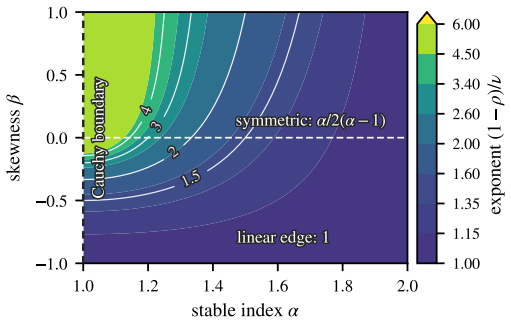
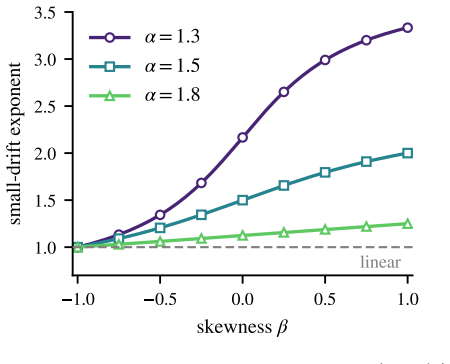
For centered steps attracted to a stable law Y with index 1 < α ≤ 2 and positivity parameter ρ = P(Y>0), the record rate satisfies λ(μ) ∼ K μ^{(1-ρ)/ν} with ν = 1-1/α as μ → 0. The exponent depends on asymmetry only through ρ and sweeps the interval [1, 1/(α-1)]. The same transform recovers the expected maximum and adjacent results such as Kingman's heavy-traffic law.
What carries the argument
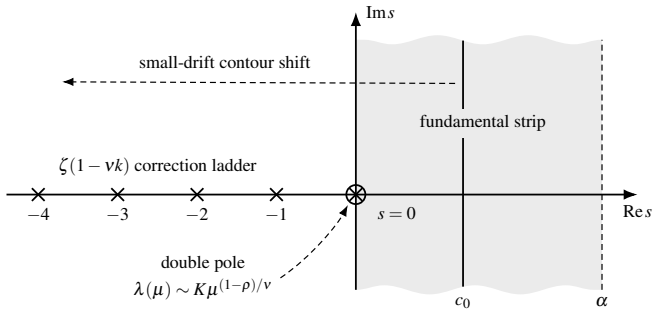
Mellin transform of the harmonic sum in the Spitzer-Baxter identity, which factorizes into a kernel transform and a Riemann ζ factor whose poles yield the leading power, prefactor K, and correction ladder.
If this is right
- Recovers the exact linear law λ(μ) ∼ √2 μ for the Gaussian case.
- Recovers the power μ^{α/2(α-1)} for symmetric heavy-tailed steps.
- Gives an explicit prefactor K for strictly stable steps while distributional details beyond the stable tail ratio enter only through K.
- Yields the expected maximum of the walk as an adjacent pole of the same transform.
Where Pith is reading between the lines
- The factorization isolates the role of skewness so cleanly that the same Mellin approach may apply to record statistics in other Markovian processes whose fluctuation theory admits a Spitzer-Baxter-type identity.
- Because the exponent depends only on ρ, one could test the prediction by varying skewness while keeping α fixed in Monte Carlo simulations of Lévy flights.
- The correction ladder generated by the ζ-factor poles supplies sub-leading terms that could be compared against finite-μ expansions in queueing or risk models.
Load-bearing premise
The step distribution belongs to the domain of attraction of a stable law whose positivity parameter ρ is well-defined and controls the leading asymptotic.
What would settle it
Direct numerical computation of the record rate λ(μ) for small μ in a strictly stable process with known α and ρ, followed by extraction of the scaling exponent and comparison against (1-ρ)/ν.
Figures
read the original abstract
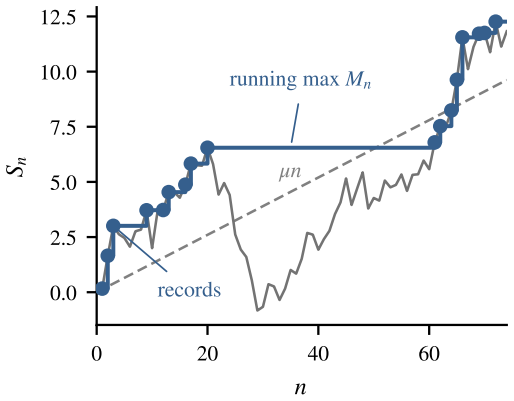
A random walk with small positive drift $\mu$ sets new records at a rate $\lambda(\mu)$ that vanishes as $\mu \to 0$. For centered steps attracted to a stable law $Y$ with index $1 < \alpha \leq 2$ and positivity parameter $\rho = P(Y>0)$, we find $\lambda(\mu) \sim K\mu^{(1-\rho)/\nu}$, $\nu=1-1/\alpha$, as $\mu \to 0$. The result is exact for Gaussian and strictly stable steps, and extends at the leading-power level to their domains of attraction. The exponent is set by the asymmetry only through $\rho$, sweeping the interval $[1,\,1/(\alpha-1)]$ as the skewness varies. It recovers the Gaussian linear law with slope $\sqrt{2}$ and, for symmetric heavy tails, the power $\mu^{\alpha/2(\alpha-1)}$; beyond the stable tail ratio, distributional details enter through the prefactor $K$, which is explicit for strictly stable steps. The result follows directly from one Mellin transform of the harmonic sum in the Spitzer-Baxter identity, which factorizes into a kernel transform and a Riemann $\zeta$ factor whose poles deliver at once the leading law, its prefactor, and a correction ladder, unifying diffusive, heavy-tailed, and skewed walks. The same transform also yields the expected maximum, recovering Kingman's heavy-traffic law for queues and Siegmund's corrected-diffusion constant as adjacent poles.
Editorial analysis
A structured set of objections, weighed in public.
Referee Report
Summary. The manuscript derives the small positive drift asymptotic for the record rate λ(μ) of random walks whose centered steps belong to the domain of attraction of a stable law Y with index 1 < α ≤ 2 and positivity parameter ρ = P(Y > 0). It obtains λ(μ) ∼ K μ^{(1-ρ)/ν} (ν = 1 - 1/α) as μ → 0, exact for Gaussian and strictly stable steps and at leading-power order for their domains of attraction. The derivation applies a single Mellin transform to the harmonic sum appearing in the Spitzer-Baxter identity; the transform factorizes into a kernel transform fixed by the limiting stable law and a Riemann-ζ factor whose rightmost pole supplies the leading power, the explicit prefactor K (for strictly stable cases), and a ladder of corrections. The same transform recovers the expected-maximum asymptotics, including Kingman’s heavy-traffic law and Siegmund’s corrected-diffusion constant as adjacent poles. The exponent depends on asymmetry only through ρ and sweeps the interval [1, 1/(α-1)] as skewness varies.
Significance. If the central claim holds, the work supplies a unified, parameter-free description of record statistics that interpolates between diffusive (Gaussian) and heavy-tailed (stable) regimes while incorporating arbitrary skewness through the single parameter ρ. The explicit prefactor K for strictly stable steps, the direct pole extraction without fitting or post-hoc adjustments, and the recovery of known limits (Gaussian slope √2, symmetric heavy-tail power α/2(α-1), Kingman and Siegmund constants) constitute clear strengths. The method also yields the expected maximum as a byproduct, extending its reach beyond the record-rate problem.
minor comments (3)
- The abstract states that the result 'extends at the leading-power level to their domains of attraction'; a short paragraph clarifying the precise continuity argument for ρ under convergence to the stable law (standard domain-of-attraction theory) would improve readability for readers outside probability theory.
- The title refers to both random walks and Lévy flights, yet the derivation is phrased entirely in discrete-time random-walk language; a brief remark on the continuous-time embedding or the appropriate scaling limit for Lévy flights would remove potential ambiguity.
- Notation for the positivity parameter ρ is introduced in the abstract but not repeated in the opening paragraph of the introduction; repeating the definition once in §1 would aid navigation.
Simulated Author's Rebuttal
We thank the referee for their careful reading of the manuscript and for the positive assessment, which leads to a recommendation to accept. We are pleased that the central claims, the method, and the recovery of known limits were viewed as strengths.
Circularity Check
Derivation is self-contained via standard Mellin analysis of Spitzer-Baxter identity
full rationale
The central claim is obtained by applying a Mellin transform directly to the harmonic sum appearing in the Spitzer-Baxter identity for the drifted random walk. The transform factorizes into a kernel (fixed by the limiting stable law) and a Riemann zeta factor; the rightmost pole supplies the exponent (1-ρ)/ν together with the prefactor K for strictly stable steps. This is an exact analytic step for Gaussian and strictly stable cases and extends at leading order via standard domain-of-attraction convergence, without any fitted parameters, self-definitional loops, or load-bearing self-citations. The paper invokes no uniqueness theorems or prior ansatzes from the same authors as justification.
Axiom & Free-Parameter Ledger
axioms (1)
- standard math Spitzer-Baxter identity relating the harmonic sum of record probabilities to the distribution of the walk
Reference graph
Works this paper leans on
-
[1]
Wergen, M
G. Wergen, M. Bogner, and J. Krug, Record statistics for biased random walks, with an application to financial data, Phys. Rev. E83, 051109 (2011)
2011
-
[2]
A. J. Bray, S. N. Majumdar, and G. Schehr, Persistence and first-passage properties in nonequilibrium systems, Adv. Phys.62, 225–361 (2013). 9
2013
-
[3]
Godr`eche, S
C. Godr`eche, S. N. Majumdar, and G. Schehr, Record statistics of a strongly correlated time series: random walks and L´evy flights, J. Phys. A: Math. Theor. 50, 333001 (2017)
2017
-
[4]
Schehr and S
G. Schehr and S. N. Majumdar, Exact record and order statistics of random walks via first-passage ideas, inFirst-Passage Phenomena and Their Appli- cations, edited by R. Metzler, G. Oshanin, and S. Redner (World Scientific, Singapore, 2014), pp. 226–251
2014
-
[5]
Sparre Andersen, On the fluctuations of sums of random variables II, Math
E. Sparre Andersen, On the fluctuations of sums of random variables II, Math. Scand.2, 195–223 (1954)
1954
-
[6]
S. N. Majumdar and R. M. Ziff, Universal record statistics of random walks and L´evy flights, Phys. Rev. Lett.101, 050601 (2008)
2008
-
[7]
Edery, A
Y . Edery, A. B. Kostinski, S. N. Majumdar, and B. Berkowitz, Record-breaking statistics for random walks in the presence of measurement error and noise, Phys. Rev. Lett.110, 180602 (2013)
2013
-
[8]
Kumar and A
A. Kumar and A. Pal, Universal framework for record ages under restart, Phys. Rev. Lett.130, 157101 (2023)
2023
-
[9]
R. A. Doney, Spitzer’s condition and ladder variables in random walks, Probab. Theory Related Fields101, 577–580 (1995)
1995
-
[10]
S. N. Majumdar, G. Schehr, and G. Wergen, Record statistics and persistence for a random walk with a drift, J. Phys. A: Math. Theor.45, 355002 (2012)
2012
-
[11]
Spitzer, A combinatorial lemma and its application to probability theory, Trans
F. Spitzer, A combinatorial lemma and its application to probability theory, Trans. Amer. Math. Soc.82, 323–339 (1956)
1956
-
[12]
Baxter, An operator identity, Pacific J
G. Baxter, An operator identity, Pacific J. Math.8, 649–663 (1958)
1958
-
[13]
Feller,An Introduction to Probability Theory and Its Applications, V ol
W. Feller,An Introduction to Probability Theory and Its Applications, V ol. II, 2nd ed. (Wiley, New York, 1971)
1971
-
[14]
Flajolet, X
P. Flajolet, X. Gourdon, and P. Dumas, Mellin transforms and asymptotics: harmonic sums, Theoret. Comput. Sci.144, 3–58 (1995)
1995
-
[15]
V . M. Zolotarev,One-dimensional Stable Distributions, Translations of Math- ematical Monographs, V ol. 65 (American Mathematical Society, Providence, 1986). 10
1986
-
[16]
J. T. Chang and Y . Peres, Ladder heights, Gaussian random walks and the Riemann zeta function, Ann. Probab.25, 787–802 (1997)
1997
-
[17]
Spitzer, A Tauberian theorem and its probability interpretation, Trans
F. Spitzer, A Tauberian theorem and its probability interpretation, Trans. Amer. Math. Soc.94, 150–169 (1960)
1960
-
[18]
J. R. G. Mendonc ¸a, Records, drift, and the longest increasing subsequence of biased Gaussian random walks, arXiv:2605.29185 (2026)
Pith/arXiv arXiv 2026
-
[19]
C. M. Hurvich and J. Reed, Series expansions for the all-time maximum of α-stable random walks, Adv. Appl. Probab.48, 744–767 (2016)
2016
-
[20]
Le Doussal and K
P. Le Doussal and K. J. Wiese, Driven particle in a random landscape: Disorder correlator, avalanche distribution, and extreme value statistics of records, Phys. Rev. E79, 051105 (2009)
2009
-
[21]
Radice and G
M. Radice and G. Cristadoro, First-passage statistics of random walks: a general approach via Riemann–Hilbert problems, J. Phys. A: Math. Theor.58, 475002 (2025)
2025
-
[22]
Berger, Notes on random walks in the Cauchy domain of attraction, Probab
Q. Berger, Notes on random walks in the Cauchy domain of attraction, Probab. Theory Related Fields175, 1–44 (2019)
2019
-
[23]
Siegmund, Corrected diffusion approximations in certain random walk problems, Adv
D. Siegmund, Corrected diffusion approximations in certain random walk problems, Adv. Appl. Probab.11, 701–719 (1979)
1979
-
[24]
Blanchet and P
J. Blanchet and P. Glynn, Complete corrected diffusion approximations for the maximum of a random walk, Ann. Appl. Probab.16, 951–983 (2006)
2006
-
[25]
Fuh, Asymptotic expansions on moments of the first ladder height in Markov random walks with small drift, Adv
C.-D. Fuh, Asymptotic expansions on moments of the first ladder height in Markov random walks with small drift, Adv. Appl. Probab.39, 826–852 (2007)
2007
-
[26]
Godr`eche and J.-M
C. Godr`eche and J.-M. Luck, On the first positive position of a random walker, J. Stat. Phys.192, 105 (2025)
2025
-
[27]
J. F. C. Kingman, On queues in heavy traffic, J. R. Stat. Soc. Ser. B24, 383–392 (1962)
1962
-
[28]
Siegmund,Sequential Analysis: Tests and Confidence Intervals(Springer, New York, 1985)
D. Siegmund,Sequential Analysis: Tests and Confidence Intervals(Springer, New York, 1985). 11
1985
-
[29]
A. J. E. M. Janssen and J. S. H. van Leeuwaarden, On Lerch’s transcendent and the Gaussian random walk, Ann. Appl. Probab.17, 421–439 (2007)
2007
-
[30]
Comtet and S
A. Comtet and S. N. Majumdar, Precise asymptotics for a random walker’s maximum, J. Stat. Mech. (2005) P06013
2005
-
[31]
S. N. Majumdar, A. Comtet, and R. M. Ziff, Unified solution of the expected maximum of a discrete time random walk and the discrete flux to a spherical trap, J. Stat. Phys.122, 833–856 (2006)
2006
-
[32]
Mounaix, S
P. Mounaix, S. N. Majumdar, and G. Schehr, Asymptotics for the expected maximum of random walks and L ´evy flights with a constant drift, J. Stat. Mech. (2018) 083201. ⋆—⋆—⋆ 12
2018
discussion (0)
Sign in with ORCID, Apple, or X to comment. Anyone can read and Pith papers without signing in.