REVIEW 3 major objections 5 minor 31 references
SynthesizeMe! Inducing Persona-Guided Prompts for Personalized Reward Models in LLMs
T0 review · 3 major / 5 minor · reviewed 2026-08-07 · deepseek-v4-flash
Pith's one-line read SynthesizeMe induces user personas from a handful of pairwise preferences and uses them to prompt LLM judges, improving personalized accuracy by 4.4% on Chatbot Arena without fine-tuning.
desk verdict A novel prompt-based personalization pipeline and a useful benchmark, but the headline gains are softer than the abstract implies and the per-user validation selection needs scrutiny. read the letter →
The pith
A machine-rendered reading of the paper's core claim, the machinery that carries it, and where it could break.
The reading
What carries the argument
The load-bearing mechanism is the validate-then-synthesize loop: BOOTSTRAP generates chain-of-thought explanations for a user's pairwise choices, discards any trace that fails on the held-out validation pairs (using 10 trials), and the surviving reasoning is compressed into a persona via a synthesis prompt that was itself refined by an automatic prompt optimizer that rewrites instructions and demonstrations. The persona then guides a second BOOTSTRAP pass whose best trial demonstrates are included in the final personalized prompt. Because selection happens on the user's own preferences, no demographic or category scaffolding is required.
What would settle it
Hold out the persona: feed the optimized prompt with a randomly selected, mismatched persona to the judge on the same test pairs. If accuracy stays the same, the claimed persona mechanism is not responsible for the gain.
Extended reading notes
Core claim
The paper's central discovery is that preference attribution—the hard part of personalization—can be delegated to an LLM through a generate-and-verify loop. Reasoning traces that explain why a user preferred one completion are produced for a sample of the user's past choices, and only those traces that correctly predict a held-out validation split are kept. That surviving reasoning is compressed into a persona, which is then used to select the most informative prior demonstrations for the final prompt. The resulting prompt improves personalized LLM-as-a-judge accuracy on Chatbot Arena by 4.4% on average, beats prior personalized reward models by as much as 4.93% without any fine-tuning, and, when combined with a fine-tuned reward model, reaches the top accuracy on PersonalRewardBench. The authors argue this shows that user interactions alone—without demographics or predefined preference categories—can carry enough signal to predict a user's future preferences.
Load-bearing premise
The entire method leans on the assumption that a held-out set of one to three preference pairs is enough to tell which reasoning traces and personas generalize, so the selected prompt may overfit to those few examples instead of capturing the user's true preferences.
Editorial extensions
If this is right
- LLM-as-a-judge accuracy on Chatbot Arena improves by 4.4% over the default judge at Llama 8B, and by up to 4.93% over prior personalized reward models without any fine-tuning.
- The method scales with user data: each additional context preference adds about 0.8% accuracy on Chatbot Arena, and five context preferences already beat the non-personalized judge.
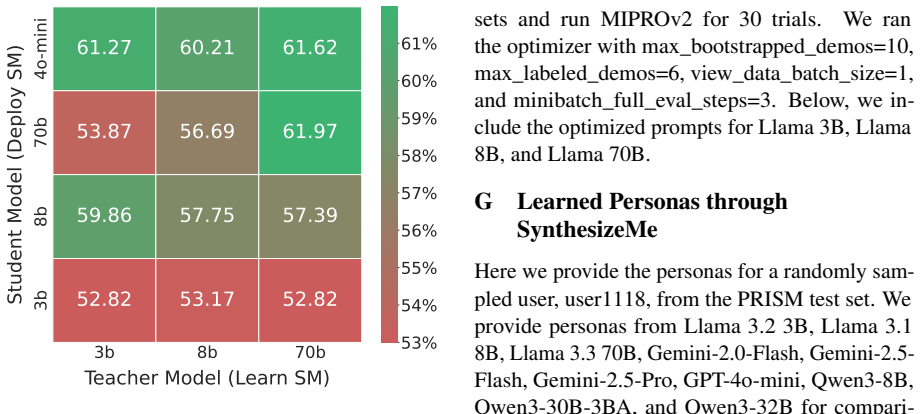
- SynthesizeMe prompts transfer across model families; in 12 of 14 tested conditions across Qwen, GPT, and Gemini models they improve over the default judge, and prompts learned on weaker teachers still help stronger students.
- Synthesized personas are interpretable and faithful: they match users' stated preferences in PRISM above the random baseline, and clustering them reveals coherent preference groups such as analytical depth, balanced perspectives, and humor.
- Augmenting a fine-tuned Bradley-Terry reward model with SynthesizeMe prompts yields the top performance on PersonalRewardBench, though gains over the plain fine-tuned model are within confidence intervals.
Reading between the lines
- If the validation-selection signal is robust, the same generate-and-verify loop could be applied to steer generation itself, not only to judge completions: the persona prompt is a free description of the user's reward function that could condition decoding or retrieval.
- Because the method needs no demographics, it sidesteps the privacy and categorization costs of identity-based personalization; this also suggests that interaction history carries more preference signal than demographic categories, which the paper's own comparisons support.
- One consequence the paper leaves implicit: the same procedure could be used to update personas over time as the user's preferences evolve, since each new pairwise judgment can re-enter the bootstrap loop.
- A skeptical reading suggests the gains might come partly from generic judge improvements (better reasoning prompts) rather than from accurate persona content; an ablation that feeds a deliberately wrong persona (or a shuffled persona) into the judge would isolate the persona's causal contribution.
Editorial analysis
A structured set of objections, weighed in public.
Referee Report
Summary. The paper introduces SynthesizeMe, a method that builds personalized prompts for LLM-as-a-judge reward models from a user's pairwise preference history. The pipeline has three steps: (1) bootstrap reasoning traces that explain a user's preferences, selecting the best trace set on a per-user validation split; (2) synthesize a natural-language persona from the selected reasoning; and (3) select informative demonstration pairs using the persona as context. The authors also introduce PersonalRewardBench, a filtered, user-stratified benchmark derived from Chatbot Arena and PRISM, and evaluate SynthesizeMe across Llama 3B/8B/70B and several API models. The central empirical claim is that SynthesizeMe prompts improve personalized LLM-as-a-judge accuracy by up to 4.4% on Chatbot Arena (abstract) and beat existing personalized reward models by up to 4.93% without finetuning (Section 1). The paper also demonstrates interpretability of the personas and transferability of prompts across model families.
Significance. If the reported gains are robust, SynthesizeMe is a valuable contribution to pluralistic alignment and personalized reward modeling: it is training-free, requires only pairwise preferences, produces interpretable personas, and transfers across model families. The paper also provides a new benchmark, PersonalRewardBench, which is likely useful to the community. The strengths include a clearly specified pipeline with pseudocode, honest discussion of the reward-model improvements falling within confidence intervals (Section 5.4), and a transferability analysis that goes beyond a single model family. However, the headline claims rest on a per-user validation selection procedure that may overfit to very small validation sets, and the main results lack paired significance testing, so the evidence is weaker than the abstract suggests.
major comments (3)
- [§3.2, Appendix C] The per-user selection in Steps 1 and 3 uses EVAL on Dval_u, but Dval_u is extremely small: Appendix C splits each user's temporally ordered conversations 50/20/30 into Dtrain/Dval/Dtgt, and Table 2 reports a median of 7 preference pairs for Chatbot Arena, so the median Arena user has roughly 1-2 validation pairs (at most about 3 for users at the lower end of the stated 5-15 pair range). With binary labels and n=10 bootstrap trials in Step 1 (and m=10 in Step 3), the argmax over EVAL can fit label noise: for |Dval_u|=2, the chance that at least one of 10 random reasoning sets matches both labels by chance is about 94%, and reusing the same tiny Dval_u in both selection steps compounds the problem. The paper provides no stability analysis across different Dval splits and no random-label control, so the reported 4.4% (abstract) and 4.93% (Section 1) gains cannot be cleanly attributed to latent user preferences rather than to selection artifacts. Please provide (a) a control where Dval_u labels are randomly permuted, (b) a stability analysis showing the selected reasoning/persona is consistent across multiple random splits of the same user's context set, and (c) if selection is kept, a bias-corrected estimate or an alternative selection rule such as leave-one-out on Dtrain_u.
- [Table 3, §5.4] The headline improvements are mostly within bootstrapped confidence intervals. For example, on Chatbot Arena with Llama-3.1-8B, the best SynthesizeMe configuration reports 61.62±3.96% versus Default 53.70±4.05%, and the intervals overlap; the same holds for several other rows (e.g., 70B Just Demos 61.97±3.96% vs Default 56.69±4.05%). The abstract claims a 4.4% improvement, but no paired significance test is reported for these principal comparisons. Please report paired bootstrap or permutation tests over users for all main comparisons (SynthesizeMe vs Default, and SynthesizeMe vs the best existing personal reward model), and report the distribution of per-user improvements. Without these, the 'improves by up to 4.4%' claim is not statistically established.
- [§4, Appendix C] PersonalRewardBench is filtered by GPT-4o-mini (Personalizable Filter) and by agreement among five LLM judges (Quality Filter). This selects examples where LLM judgments are split, which may systematically favor methods that adapt to LLM-like preference patterns rather than to human preference heterogeneity. The paper does not assess how the filtering affects the conclusions. Please report results on a less filtered or unfiltered control set (e.g., all users with at least 5 preference pairs, or a random sample with the Quality Filter removed) and discuss the sensitivity of the conclusions to the filter thresholds. This is important for the external validity of the benchmark and for interpreting the claimed gains.
minor comments (5)
- [Abstract] The abstract says 'improves personalized LLM-as-a-judge accuracy by 4.4%', but Section 5.4 says 'by up to 4.4%'; please clarify whether this is a maximum over configurations or an average, and state the exact comparison condition.
- [§1] The claim of beating other SOTA personalized reward models 'by as much as 4.93%' should identify the specific comparison in the text (it appears to be the Llama-8B full SynthesizeMe configuration versus GPO/PAL at 8B on Chatbot Arena), so that readers can verify it against Table 3.
- [Table 5] The GPT and Gemini rows are single-run results with no confidence intervals; please state this caveat prominently in the main text rather than only in the caption or appendix.
- [§6.1] There is a typo in Section 6.1: 'Chatbot Area accuracy' should be 'Chatbot Arena accuracy'.
- [Appendix F] The optimized persona-generation prompt for Llama-8B includes a 'detective' framing and a high-stakes scenario; please note whether this framing was intentionally part of the optimization output and whether it was held fixed across all models evaluated with the distilled prompt.
Circularity Check
No significant circularity; the reported gains are evaluated on held-out target preferences, and validation-based selection is a standard model-selection step rather than a fitted-input prediction.
full rationale
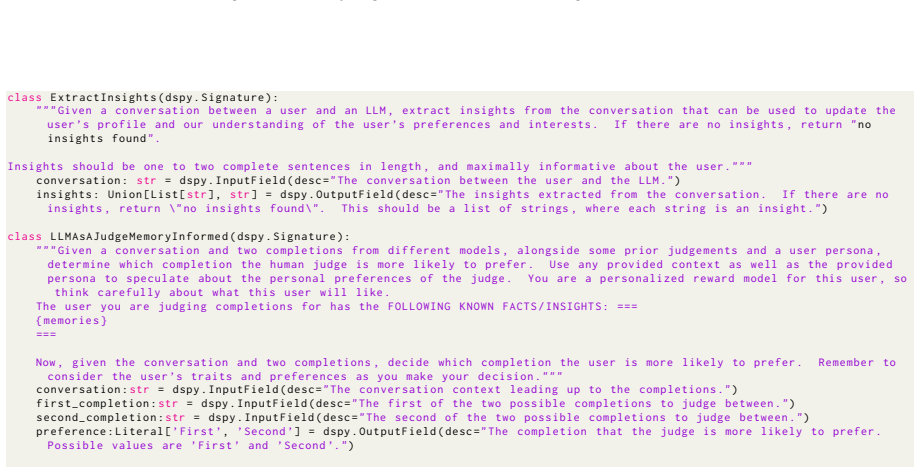
The paper's central claim is that SynthesizeMe-induced prompts improve personalized LLM-as-a-judge accuracy on held-out Chatbot Arena target preferences. Section 3.2 selects reasoning traces and demonstrations by maximizing EVAL on each user's validation split Dval_u, but the reported 4.4% and 4.93% improvements are measured on the disjoint target split Dtgt_u (the temporally last 30% of each user's conversations, per Appendix C). This is validation-based model selection, not circular test-set fitting. The persona-generation prompt Theta is optimized with MIPROv2 on PRISM training/validation users only, and Chatbot Arena test users are used for the headline results, so the transfer claim is not forced by construction. PersonalRewardBench's filtering pipeline uses GPT4o-mini and five LLM judges to define 'personalizable' and 'controversial' examples, but the ground-truth preference labels remain human judgments and are not generated by SynthesizeMe; filtering does not make the prediction equivalent to the method's inputs. The only self-citation in a load-bearing position is Opsahl-Ong et al. (2024) for MIPROv2, which is an external, published optimizer used as an off-the-shelf tool and does not import an unverified uniqueness claim or ansatz. The reader's concern about tiny Dval_u splits (1-3 pairs) causing overfitting is a legitimate robustness/correctness risk, but it is not circularity under the criteria: the selected prompt is not being evaluated on the data used to select it. No reduction of the claimed result to the fitted inputs or to a self-citation chain was found.
Assumptions & free parameters
free parameters (5)
- Threshold: minimum preference pairs per user =
5
- Number of bootstrap trials n and m =
10
- PRISM rating difference threshold =
10%
- Quality Filter agreement rule =
Remove pairs where all 5 LLM judges agree
- Personalizable Filter classifier =
GPT-4o-mini with 83% accuracy on 100 labeled examples
assumptions (4)
- domain assumption Each user has a stable latent reward function R_u that can be approximated from pairwise comparisons.
- domain assumption The validation subset Dval_u is representative of the target preferences Dtgt_u, so selecting reasoning/personas on validation transfers to target.
- domain assumption LLM chain-of-thought reasoning about user preferences is a valid inductive bias for synthesizing useful personas.
- ad hoc to paper An LLM judge (GPT-4o-mini) can reliably classify which queries are 'personalizable'.
invented entities (2)
-
Synthetic user persona
independent evidence
-
PersonalRewardBench
independent evidence
Cite this review
Pith. "Pith review of SynthesizeMe! Inducing Persona-Guided Prompts for Personalized Reward Models in LLMs." pith.science (2026). https://pith.science/paper/SJUGLHZ2
@misc{pith2026250605598,
  author       = {Pith},
  title        = {Pith review of: SynthesizeMe! Inducing Persona-Guided Prompts for Personalized Reward Models in LLMs},
  year         = {2026},
  howpublished = {\url{https://pith.science/paper/SJUGLHZ2}},
  note         = {Machine review of arXiv:2506.05598}
}
read the original abstract
Recent calls for pluralistic alignment of Large Language Models (LLMs) encourage adapting models to diverse user preferences. However, most prior work on personalized reward models heavily rely on additional identity information, such as demographic details or a predefined set of preference categories. To this end, we introduce SynthesizeMe, an approach to inducing synthetic user personas from user interactions for personalized reward modeling. SynthesizeMe first generates and verifies reasoning to explain user preferences, then induces synthetic user personas from that reasoning, and finally filters to informative prior user interactions in order to build personalized prompts for a particular user. We show that using SynthesizeMe induced prompts improves personalized LLM-as-a-judge accuracy by 4.4% on Chatbot Arena. Combining SynthesizeMe derived prompts with a reward model achieves top performance on PersonalRewardBench: a new curation of user-stratified interactions with chatbots collected from 854 users of Chatbot Arena and PRISM.
Figures


Figures from the paper (11 more)





Reference graph
Works this paper leans on
-
[1]
**Reasonable Disagreement:** If people might reasonably disagree on the appropriateness of answering (e.g., ethical dilemmas), both the query and responses may still be personalizable if they reflect subjective or varying interpretations
-
[2]
**Inconsistent Behavior:** Responses that differ due to inconsistent model behavior (e.g., refusal vs. compliance) are not personalizable unless reasonable people would disagree on the necessity of refusal
-
[3]
InInternational Conference on Learning Representations (ICLR)
Personalized reward learning with interaction- grounded learning. InInternational Conference on Learning Representations (ICLR). Abhiman Neelakanteswara, Shreyas Chaudhari, and Hamed Zamani. 2024. RAGs to style: Personal- izing LLMs with style embeddings. InProceedings of the 1st Workshop on Personalization of Generative AI Systems (PERSONALIZE 2024), pag...
work page 2024
-
[4]
Memgpt: Towards llms as operating systems. Preprint, arXiv:2310.08560. Sriyash Poddar, Yanming Wan, Hamish Ivison, Ab- hishek Gupta, and Natasha Jaques. 2024. Person- alizing reinforcement learning from human feed- back with variational preference learning.Preprint, arXiv:2408.10075. Qwen, :, An Yang, Baosong Yang, Beichen Zhang, Binyuan Hui, Bo Zheng, Bo...
arXiv 2024
-
[5]
Whose opinions do language models reflect? Preprint, arXiv:2303.17548. 12 Kristina Schaaff and Marc-André Heidelmann. 2024. Impacts of anthropomorphizing large language models in learning environments.Preprint, arXiv:2408.03945. Omar Shaikh, Michelle S. Lam, Joey Hejna, Yijia Shao, Hyundong Justin Cho, Michael S. Bernstein, and Diyi Yang. 2025. Aligning l...
arXiv 2024
-
[6]
**Logical Consistency in Responses:** Logical inconsistencies or factual errors in responses detract from their personalization potential. Even if a query invites personalization, incorrect or incoherent responses are categorized as non-personalizable. — # Examples Section ## **Personalizable Queries and Responses**
-
[8]
**Toy or Trick Queries:** Queries designed to "test" the model (e.g., adding a single line of code, impossible tasks) are not personalizable. However, responses to such queries may still exhibit meaningful personalization if they vary significantly in tone, depth, or creativity
-
[9]
**Formatting or Reorganization Requests:** Queries that explicitly ask for information to be reorganized (e.g., "Reformat this into a list") are typically non-personalizable unless the responses exhibit significant variation in structure or additional creative input beyond the request
Show all 31 references
-
[10]
Tell me about X
**Open-Ended Summaries or Explanations:** Queries that request general information (e.g., "Tell me about X") are often personalizable due to the wide range of potential angles, tones, and depths available to answer them. Assess whether responses demonstrate meaningful variatio...
-
[12]
Explain gravity to a 5-year-old
**Query:** "Explain gravity to a 5-year-old." - **Personalizable Query:** Yes - **Personalizable Responses:** Yes, as explanations can vary in tone, creativity, and complexity
-
[13]
Write a Hemingway-style description of a beach
**Query:** "Write a Hemingway-style description of a beach." - **Personalizable Query:** Yes - **Personalizable Responses:** Yes, as responses can differ in their adherence to Hemingway’s style. 20 Personalization Filter Prompt (Pt. 3/3)
-
[14]
Summarize the Bible
**Query:** "Summarize the Bible." - **Personalizable Query:** Yes - **Personalizable Responses:** Yes, as summaries can emphasize theological, historical, or narrative elements. #### **Non-Personalizable Queries and Responses**
-
[15]
What is 2+2?
**Query:** "What is 2+2?" - **Personalizable Query:** No, as it has a single correct answer. - **Personalizable Responses:** No, as differences only reflect correctness
-
[16]
Reformat these instructions into bullet points
**Query:** "Reformat these instructions into bullet points." - **Personalizable Query:** No, as the task is purely formatting. - **Personalizable Responses:** No, unless the responses provide creative restructuring beyond the query
-
[17]
Translate this into German
**Query:** "Translate this into German." - **Personalizable Query:** No, as it seeks a straightforward translation. - **Personalizable Responses:** No, as variations are trivial. ## **Gray Area Examples**
-
[18]
Should the assistant help build an AI with specific characteristics?
**Query:** "Should the assistant help build an AI with specific characteristics?" - **Personalizable Query:** Yes, as reasonable people may disagree on fulfilling the request. - **Personalizable Responses:** Yes, if responses reflect ethical considerations and subjective preferences
-
[19]
Why do chatbots use the phrase ’as an AI language model’?
**Query:** "Why do chatbots use the phrase ’as an AI language model’?" - **Personalizable Query:** Yes, as it invites reasoning and subjective interpretations. - **Personalizable Responses:** Yes, if responses vary in tone and depth
-
[20]
Summarize Monte Carlo methods in reinforcement learning
**Query:** "Summarize Monte Carlo methods in reinforcement learning." - **Personalizable Query:** Yes, as summaries can vary in technical depth and focus. - **Personalizable Responses:** No, if one response is incorrect or lacks coherence. These examples provide practical clar...
-
[21]
‘conversation‘ (str): The conversation context leading up to the completions
-
[22]
‘first_completion‘ (str): The first of the two possible completions to judge between
-
[23]
Your output fields are:
‘second_completion‘ (str): The second of the two possible completions to judge between. Your output fields are:
-
[24]
[[A]]" if you believe assistant A’s response is more suitable, or
‘preference‘ (Literal[’First’, ’Second’]): The completion that the judge is more likely to prefer. Possible values are ’First’ and ’Second’. All interactions will be structured in the following way, with the appropriate values filled in. [[ ## conversation ## ]] conversation [...
-
[25]
Your output fields are:
’past_judgements’ (str): A set of user judgements on prior conversations alongside reasoning for those judgements. Your output fields are:
-
[26]
Welcome to Wrexham
’synthesized_persona’ (str): A synthesized user persona that can be used to inform future judgements. All interactions will be structured in the following way, with the appropriate values filled in. [[ ## past_judgements ## ]] {past_judgements} [[ ## reasoning ## ]] {reasoning...
-
[27]
**Nuanced, balanced perspectives** on complex topics (e.g., religion, relationships)
-
[28]
**Specific, actionable details** in practical contexts (e.g., recipes, travel recommendations)
-
[29]
**Relevance and coherence** in responses, avoiding tangents or vague generalizations
-
[30]
**Empathy and community focus**, showing interest in shared experiences (e.g., football culture, fan passion)
-
[31]
This persona is likely a **lifelong learner** who enjoys exploring diverse topics but prioritizes clarity and utility in information
**Efficiency in communication**, preferring concise yet thorough explanations over fluff. This persona is likely a **lifelong learner** who enjoys exploring diverse topics but prioritizes clarity and utility in information. They are open to multiple viewpoints but expect respo...
-
[2023]
Hang Jiang, Xiajie Zhang, Xubo Cao, Cynthia Breazeal, Deb Roy, and Jad Kabbara
Personalized soups: Personalized large lan- guage model alignment via post-hoc parameter merg- ing.Preprint, arXiv:2310.11564. Hang Jiang, Xiajie Zhang, Xubo Cao, Cynthia Breazeal, Deb Roy, and Jad Kabbara. 2024. PersonaLLM: In- vestigating the ability of large language models...
2024 arXiv
-
[2024]
Esin Durmus, Karina Nguyen, Thomas I
Can llm be a personalized judge?Preprint, arXiv:2406.11657. Esin Durmus, Karina Nguyen, Thomas I. Liao, Nicholas Schiefer, Amanda Askell, Anton Bakhtin, Carol Chen, Zac Hatfield-Dodds, Danny Hernan- dez, Nicholas Joseph, Liane Lovitt, Sam McCan- dlish, Orowa Sikder, Alex Tamki...
2024 arXiv
Reviewed August 7, 2026 · model on record in the stance chip above.
Discussion (0). Sign in to comment.