REVIEW 5 major objections 4 minor 64 references
$|\Delta I|=3/2$ non-leptonic hyperon decays in covariant baryon chiral perturbation theory
T0 review · 5 major / 4 minor · reviewed 2026-08-12 · deepseek-v4-flash
Pith's one-line read Decuplet baryons coupled consistently, plus pion loops, significantly improve the one-loop description of |ΔI|=3/2 non-leptonic hyperon decays in covariant chiral perturbation theory.
desk verdict A careful, transparent EOMS reanalysis of |ΔI|=3/2 hyperon decays whose headline decuplet-scheme claim is not yet protected against omitted counterterms and topologies. read the letter →
The pith
A machine-rendered reading of the paper's core claim, the machinery that carries it, and where it could break.
The reading
What carries the argument
The load-bearing object is the spin-$3/2$ decuplet baryon field, described by a Rarita-Schwinger field $T^{\mu}$, together with two ways of coupling it to mesons and octet baryons: the conventional coupling, which contains unphysical spin-$1/2$ components, and the consistent coupling, which is invariant under spin-$3/2$ gauge transformations and removes those components. The analysis is carried out in covariant baryon chiral perturbation theory with EOMS renormalization, which restores chiral power counting by subtracting power-counting-breaking analytic terms from loop amplitudes. A restricted set of one-loop topologies, wave-function renormalization factors, pion decay-constant corrections, and a mass prescription that replaces the chiral-limit baryon mass $m_0$ by physical baryon masses in pole-diagram propagators complete the machinery. The comparison metric is the $\chi^2$ of fits to four isospin amplitudes, computed with loop-generated analytic terms either subtracted or retained.
What would settle it
Compute the omitted next-to-leading-order one-loop topologies shown in Appendix D within the same EOMS framework and repeat the four-amplitude fits; if the consistent coupling scheme no longer yields a lower $\chi^2$ than the conventional scheme, or the pion-loop improvement disappears, the central claim is falsified.
Extended reading notes
Core claim
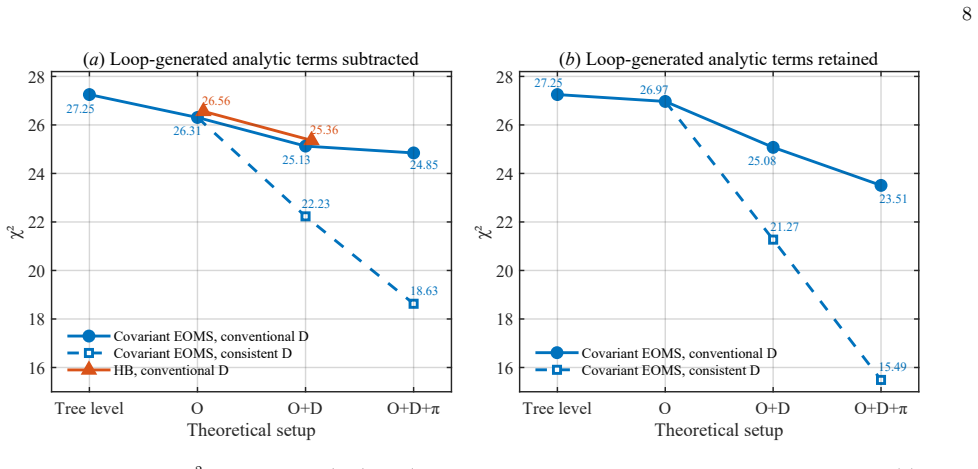
The central claim is that, within a one-loop covariant calculation restricted to the diagram topologies of the earlier heavy-baryon study, the fit quality for four selected $|\Delta I|=3/2$ amplitudes depends much more on the decuplet-baryon coupling scheme than on relativity. In the consistent coupling scheme, in which the Rarita-Schwinger field's spin-$1/2$ parts are gauged away and absorbed into higher-order constants, the $\chi^2$ drops from $26.31$ with octet loops to $22.23$ after decuplet loops are added; in the conventional scheme the corresponding drop is only to $25.13$. Adding pion-loop contributions to the consistent scheme further lowers $\chi^2$ to $18.63$. The paper presents this hierarchy as evidence that the decuplet sector, and specifically the consistent coupling prescription, contributes real missing strength in these decays, while noting that the residual deviations, especially in $P^{3,3}_{\Lambda}$, motivate a complete next-to-leading-order calculation.
Load-bearing premise
The conclusion assumes that the restricted set of one-loop diagrams inherited from the earlier heavy-baryon analysis is sufficient: the omitted next-to-leading-order topologies are assumed not to change the ranking of the coupling schemes or the pion-loop improvement.
Editorial extensions
If this is right
- Within the restricted topology set, the consistent decuplet coupling scheme is the largest single improvement to the $|\Delta I|=3/2$ fit, larger than relativistic corrections or conventional decuplet loops.
- Pion-loop contributions further improve the fit in both coupling schemes, and their effect is more pronounced in the consistent scheme.
- Retaining the NLO loop-generated analytic terms lowers the $\chi^2$ values but does not change the qualitative ordering of the theoretical setups.
- The remaining discrepancy in $P^{3,3}_{\Lambda}$ shows that a full NLO calculation, including the omitted one-loop topologies and local counterterms, is needed before these amplitudes become precision observables.
- The two S-wave observables excluded from the main fit, $S^{(3,3)}_{\Lambda}$ and $S^{(3,1)}_{\Xi}$, have vanishing NLO nonanalytic contributions in heavy-baryon theory; their covariant values are a natural place to test the conclusions.
Reading between the lines
- It is a testable extension, not proven in the paper, that evaluating the omitted NLO topologies in Appendix D will preserve the $\chi^2$ ordering between coupling schemes; if it does not, the central conclusion would be an artifact of the truncation.
- The same consistent-coupling advantage could plausibly show up in other observables that receive decuplet-loop contributions, such as baryon magnetic moments or axial couplings, because the mechanism is the removal of spurious spin-$1/2$ propagation rather than anything specific to hyperon decays.
- The modest size of the fitted inputs and the excluded S-wave amplitudes suggest that a discriminating next step is to include all six isospin amplitudes rather than four, once the covariant NLO nonanalytic parts are computed.
Editorial analysis
A structured set of objections, weighed in public.
Referee Report
Summary. Using EOMS covariant baryon chiral perturbation theory, the paper recalculates the |ΔI|=3/2 S- and P-wave amplitudes of non-leptonic hyperon decays with the same restricted one-loop topologies as the earlier heavy-baryon analysis of Ref. [24]. Two low-energy constants, β27 and δ27, are fitted to four selected isospin amplitudes, namely S(Σ)_3, P(Λ)_3, P(Ξ)_3, and P(Σ)_3, after explicitly excluding S(Λ)_3 and S(Ξ)_3. The paper compares tree-level, octet-loop, octet+decuplet-loop (conventional vs consistent couplings), and pion-loop contributions, with and without the EOMS subtraction of loop-generated analytic terms. The main quantitative claim is that the consistent decuplet coupling scheme lowers χ2 from 26.31 to 22.23 when analytic terms are subtracted and from 21.27 to 15.49 when they are retained, with pion loops bringing the best χ2 to 18.63 and 15.49, respectively.
Significance. The paper is a serious, detailed EFT calculation and provides explicit integral expressions, a clear treatment of wave-function renormalization, and a useful comparison with HB χPT. If the central claim were robust, the work would be a valuable first covariant analysis of this sector and would motivate the consistent decuplet coupling in future studies inspired by BESIII data. The main caveat is that the chi-squared comparison is made in a truncated model without NLO counterterms and without the omitted one-loop topologies, so the significance of the result is exploratory rather than definitive.
major comments (5)
- [Sec. II.A and Sec. II.C, Tables II and III] The conclusion that the consistent-coupling scheme significantly improves the fit is not protected against the omission of NLO local counterterms. The paper itself states in Sec. II.A that the spin-1/2 components of the conventional scheme can be absorbed into suitable higher-order LECs, and Sec. II.C explicitly neglects the NLO local counterterms. Consequently, the reported reductions from 26.31 to 22.23 (Table II) and from 21.27 to 15.49 (Table III) measure how much of the missing counterterm effect is mimicked by the chosen vertex structures, not a scheme-independent physical improvement. The authors should either estimate the counterterm contributions or explicitly limit the conclusion to the truncated model.
- [Sec. II.C and Appendix D] The restriction to the selected one-loop topologies is load-bearing and is not justified in the covariant framework. The text states that the remaining one-loop diagrams in Appendix D vanish in the heavy-baryon limit, but the present calculation uses covariant EOMS, where those diagrams need not vanish; no covariant check is provided. If the omitted topologies contribute differently in the conventional and consistent coupling schemes, the reported chi-squared hierarchy could change. Since the central claim rests on a comparison inside this restricted set, this assumption needs to be verified or its impact estimated.
- [Sec. III, Eq. (33), and Tables I-III] The fit dataset is selected rather than complete. The two S-wave amplitudes S(Λ)_3 and S(Ξ)_3 are excluded because their NLO non-analytic contributions vanish in HB χPT, which is a selection criterion tied to the very framework being compared. This removes two of the six experimental amplitudes from the fits, so the reported chi-squared values and the claim of significant improvement apply only to the chosen subset. The paper should demonstrate robustness to the inclusion of these observables or state the conclusions as subset-specific.
- [Sec. III and Tables II and III] The global fit quality is poor even in the best case, so the word 'significantly' is not supported by a statistical measure. With four fitted observables and two LECs, the smallest chi-squared values are 18.63 in Table II and 15.49 in Table III, corresponding to reduced chi-squared values of about 9.3 and 7.7, respectively. In those best fits, the predicted P(Λ)_3,3 is -0.118(47) or -0.122(40) against the input value 0.710(220). The paper reports only relative chi-squared changes without p-values, confidence intervals, or a goodness-of-fit test; the claim of significant improvement should be replaced by a quantitative model-comparison statement.
- [Sec. II.C, paragraph on NLO subtraction terms] The NLO subtraction terms are computed with an uncontrolled approximation: all baryon masses are set to a common value of 1 GeV and the outgoing pion mass to zero. The paper gives no estimate of the error introduced by this approximation. Since the subtraction is intended to remove the leading analytic pieces, an error in it directly changes the fitted amplitudes and therefore the chi-squared differences. The sensitivity tables compare retaining versus subtracting these approximate terms, but they do not test the mass and pion-mass approximation itself.
minor comments (4)
- [Eq. (24) and Eq. (26)] The P-wave amplitude is written as A^P_{B_f B_i π} in Eq. (24) but as A^P_{B_f B_i} elsewhere; the notation should be made consistent.
- [Sec. III and Fig. 5] The label 'pion-loop contributions' at the O+D+π stage is not defined precisely, since all diagrams in Figs. 2-4 contain pions; please specify which topologies or two-meson vertices are switched on at that stage.
- [Table I] The provenance of the input amplitudes is given only as 'taken from Ref. [22]'; please list the original experimental measurements and the extraction method, with the relevant BESIII and PDG references.
- [Table II] In the header 'HB with NLO Analytic Terms omitted', only the O and O+D(conv.) columns are reported; for clarity, indicate explicitly that no HB results are available for the consistent scheme or for the O+D+π stages, rather than leaving the reader to infer this from the columns.
Circularity Check
No significant circularity; the paper is a fit-quality model comparison whose inputs and fitted parameters are explicit.
full rationale
The paper's central claim is a comparison of fit quality: the LECs β27 and δ27 are fitted to four |ΔI|=3/2 amplitudes, and χ² values are compared across tree-level, octet-loop, decuplet-loop (conventional vs consistent coupling), and pion-loop setups (Tables II and III). This is a model-comparison exercise, not a derivation in which a target result is presupposed by its inputs. The consistent-coupling scheme is adopted from the external Pascalutsa and Pascalutsa–Timmermans literature, not from a self-cited uniqueness theorem; self-citations such as Refs. [52,53] supply input values (e.g., δ=0.231 GeV) or Lagrangian forms, but do not by themselves produce the χ² hierarchy. The heavy-baryon baseline and the experimental amplitudes come from external references [24] and [22]. The paper explicitly states that it omits NLO counterterms and some one-loop topologies, and it presents the remaining discrepancies as motivation for future work; this is a robustness limitation rather than circularity. No fitted parameter is renamed as a prediction, and no load-bearing argument reduces to a self-citation chain.
Assumptions & free parameters
free parameters (2)
- beta27 =
varies by setup, e.g., -0.070(106) to 0.241(93)
- delta27 =
varies by setup, e.g., 1.185(880) to 0.320(143)
assumptions (4)
- standard math Standard chiral perturbation theory power counting and EOMS renormalization are valid for hyperon decays.
- ad hoc to paper The restricted set of loop topologies used in earlier HB analyses is sufficient for comparing coupling schemes.
- ad hoc to paper Local NLO counterterms can be neglected in the fits.
- ad hoc to paper The approximation of setting all baryon masses to 1 GeV and the pion mass to zero for NLO subtraction terms is valid.
Cite this review
Pith. "Pith review of $|\Delta I|=3/2$ non-leptonic hyperon decays in covariant baryon chiral perturbation theory." pith.science (2026). https://pith.science/paper/SLJMKTRC
@misc{pith2026260811176,
  author       = {Pith},
  title        = {Pith review of: $|\Delta I|=3/2$ non-leptonic hyperon decays in covariant baryon chiral perturbation theory},
  year         = {2026},
  howpublished = {\url{https://pith.science/paper/SLJMKTRC}},
  note         = {Machine review of arXiv:2608.11176}
}
abstract
Inspired by the recent BESIII measurements of non-leptonic hyperon decays, we reexamine their $|\Delta I|=3/2$ amplitudes in covariant baryon chiral perturbation theory with the extended-on-mass-shell renormalization scheme. Using the same restricted set of diagrammatic topologies as in the early analyses in heavy baryon chiral perturbation theory, we assess the effects of relativistic corrections, explicit decuplet baryons, different spin-$3/2$ coupling schemes, and pion-loop contributions. Our results show that relativistic effects alone lead to only mild changes, while decuplet contributions, especially in the consistent-coupling scheme, significantly improve the fit quality. Pion-loop contributions further reduce the $\chi^2$ values. We highlight the importance of the consistent coupling scheme in the decuplet sector for describing the selected $|\Delta I|=3/2$ amplitudes.
Figures


Figures from the paper (5 more)



Reference graph
Works this paper leans on
-
[22]
Hyperon non-leptonic decays in relativistic Chiral Perturbation Theory with resonances
N. Salone, Weak nonleptonic hyperon decays in relativis- tic chiral perturbation theory (2026), arXiv:2604.00646 [hep-ph]
work page Pith review arXiv 2026
-
[24]
A. Abd El-Hady, J. Tandean, and G. Valencia, Nucl. Phys. A 651, 71 (1999) , arXiv:hep-ph/9808322
arXiv 1999
-
[1]
M. Gell-Mann and A. Pais, in Proceedings of the Inter- national Conference on High Energy Physics at Glasgow (Pergamon Press, London, 1955) p. 324
work page 1955
-
[2]
R. H. Dalitz, ∆I = 1/2 Rule for Non-Leptonic Strangeness-Changing Decay Processes , Tech. Rep. CONF-231-3 (U.S. Atomic Energy Commission, Oak Ridge, Tennessee, 1963)
work page 1963
- [3]
-
[4]
X.-G. He, H. Steger, and G. Valencia, Phys. Lett. B 272, 411 (1991)
work page 1991
-
[5]
Chang, in Workshop on Low-Energy Pbar Storage Ring (pbar2000) (2000) pp
D. Chang, in Workshop on Low-Energy Pbar Storage Ring (pbar2000) (2000) pp. 3–13, arXiv:hep-ph/0011163
arXiv 2000
-
[6]
J. Tandean and G. Valencia, Phys. Rev. D 67, 056001 (2003), arXiv:hep-ph/0211165
arXiv 2003
Show all 64 references
-
[7]
B. R. Holstein, in Hyperon 99: Hyperon Physics Sympo- sium (1999) pp. 4–9, arXiv:hep-ph/9910369
1999 arXiv
-
[8]
R. O. Bangerter, A. Barbaro-Galtieri, J. P. Berge, J. J. Murray, F. T. Solmitz, M. L. Stevenson, and R. D. Tripp, Phys. Rev. Lett. 17, 495 (1966)
1966
-
[9]
Thorne, Nucl
K. Thorne, Nucl. Phys. B Proc. Suppl. 7, 217 (1989)
1989
-
[10]
Le Yaouanc, O
A. Le Yaouanc, O. Pène, J. C. Raynal, and L. Oliver, Nucl. Phys. B 149, 321 (1979)
1979
-
[11]
J. F. Donoghue, E. Golowich, B. R. Holstein, and W. A. Ponce, Phys. Rev. D 23, 1213 (1981)
1981
-
[12]
Manohar and H
A. Manohar and H. Georgi, Nucl. Phys. B 234, 189 (1984)
1984
-
[13]
J. F. Donoghue, E. Golowich, and B. R. Holstein, Phys. Rep. 131, 319 (1986)
1986
-
[14]
J. F. Donoghue and B. R. Holstein, Phys. Rev. D 33, 2717 (1986)
1986
-
[15]
Flores-Mendieta, Phys
R. Flores-Mendieta, Phys. Rev. D 99, 094033 (2019) , arXiv:1902.05602 [hep-ph]
2019 arXiv
-
[16]
Bijnens, H
J. Bijnens, H. Sonoda, and M. B. Wise, Nucl. Phys. B 261, 185 (1985)
1985
-
[17]
Jenkins, Nucl
E. Jenkins, Nucl. Phys. B 375, 561 (1992)
1992
-
[18]
Borasoy and B
B. Borasoy and B. R. Holstein, Eur. Phys. J. C 6, 85 (1999), arXiv:hep-ph/9805430
1999 arXiv
-
[19]
Borasoy and B
B. Borasoy and B. R. Holstein, Phys. Rev. D 59, 094025 (1999), arXiv:hep-ph/9902351
1999 arXiv
-
[20]
Abd El-Hady and J
A. Abd El-Hady and J. Tandean, Phys. Rev. D 61, 114014 (2000) , arXiv:hep-ph/9908498 [hep-ph]
2000 arXiv
-
[21]
Zhang and J
W. Zhang and J. Yang, Acta Phys. Sin. 74, 241301 (2025)
2025
-
[23]
He and G
X.-G. He and G. Valencia, Phys. Lett. B 409, 469 (1997) , erratum: Phys. Lett. B 418 (1998) 443, arXiv:hep- ph/9705462
1997
-
[25]
Ablikim et al
M. Ablikim et al. (BESIII), Nature 606, 64 (2022) , arXiv:2105.11155 [hep-ex]
2022
-
[26]
Ablikim et al
M. Ablikim et al. (BESIII), Nature Phys. 15, 631 (2019) , arXiv:1808.08917 [hep-ex]
2019 arXiv
-
[27]
Ablikim et al
M. Ablikim et al. (BESIII), Phys. Rev. Lett. 125, 052004 (2020), arXiv:2004.07701 [hep-ex]
2020
-
[28]
Ablikim et al
M. Ablikim et al. (BESIII), Phys. Rev. Lett. 129, 131801 (2022), arXiv:2204.11058 [hep-ex]
2022
-
[29]
Ablikim et al
M. Ablikim et al. (BESIII), Phys. Rev. D 108, L031106 (2023), arXiv:2305.09218 [hep-ex]
2023
-
[30]
Ablikim et al
M. Ablikim et al. (BESIII), Phys. Rev. Lett. 131, 191802 (2023), arXiv:2304.14655 [hep-ex]
2023
-
[31]
D. G. Ireland, M. Döring, D. I. Glazier, J. Haidenbauer, M. Mai, R. Murray-Smith, and D. Rönchen, Phys. Rev. Lett. 123, 182301 (2019) , arXiv:1904.07616 [nucl-ex]
2019 arXiv
-
[32]
Jenkins and A
E. Jenkins and A. V. Manohar, Phys. Lett. B 255, 558 (1991)
1991
-
[33]
Jenkins, Nucl
E. Jenkins, Nucl. Phys. B 368, 190 (1992)
1992
-
[34]
Bernard, N
V. Bernard, N. Kaiser, and U.-G. Meißner, Int. J. Mod. Phys. E 4, 193 (1995) , arXiv:hep-ph/9501384 [hep-ph]
1995 arXiv
-
[35]
Becher and H
T. Becher and H. Leutwyler, Eur. Phys. J. C 9, 643 (1999), arXiv:hep-ph/9901384
1999 arXiv
-
[36]
Kubis and U.-G
B. Kubis and U.-G. Meißner, Eur. Phys. J. C 18, 747 (2001), arXiv:hep-ph/0010283 [hep-ph]
2001 arXiv
-
[37]
Kubis and U.-G
B. Kubis and U.-G. Meißner, Nucl. Phys. A 679, 698 (2001), arXiv:hep-ph/0007056 [hep-ph]
2001 arXiv
-
[38]
Fuchs, J
T. Fuchs, J. Gegelia, G. Japaridze, and S. Scherer, Phys. Rev. D 68, 056005 (2003) , arXiv:hep-ph/0302117
2003 arXiv
-
[39]
Fuchs, M
T. Fuchs, M. R. Schindler, J. Gegelia, and S. Scherer, Phys. Lett. B 575, 11 (2003) , arXiv:hep-ph/0308006
2003 arXiv
-
[40]
L. S. Geng, J. Martin Camalich, L. Alvarez-Ruso, and M. J. Vicente Vacas, Phys. Rev. Lett. 101, 222002 (2008), arXiv:0805.1419 [hep-ph]
2008 arXiv
-
[41]
Xiao, X.-L
Y. Xiao, X.-L. Ren, J.-X. Lu, L.-S. Geng, and U.-G. Meissner, Eur. Phys. J. C 78, 489 (2018) , arXiv:1803.04251 [hep-ph]
2018 arXiv
-
[42]
R.-X. Shi, Y. Xiao, and L.-S. Geng, Phys. Rev. D 100, 054019 (2019) , arXiv:1812.07833 [hep-ph]
2019 arXiv
-
[43]
Lensky and V
V. Lensky and V. Pascalutsa, Eur. Phys. J. C 65, 195 (2010), arXiv:0907.0451 [hep-ph]
2010 arXiv
-
[44]
J. M. Alarcon, J. Martin Camalich, and J. A. Oller, An- nals Phys. 336, 413 (2013) , arXiv:1210.4450 [hep-ph]
2013 arXiv
-
[45]
Chen, D.-L
Y.-H. Chen, D.-L. Yao, and H. Q. Zheng, Phys. Rev. D 87, 054019 (2013) , arXiv:1212.1893 [hep-ph]
2013 arXiv
-
[46]
Lu, C.-X
J.-X. Lu, C.-X. Wang, Y. Xiao, L.-S. Geng, J. Meng, and P. Ring, Phys. Rev. Lett. 128, 142002 (2022) , arXiv:2111.07766 [nucl-th]
2022 arXiv
-
[47]
Lu, L.-S
J.-X. Lu, L.-S. Geng, M. Doering, and M. Mai, Phys. Rev. Lett. 130, 071902 (2023) , arXiv:2209.02471 [hep- ph]
2023 arXiv
- [48]
-
[49]
Scherer, in Adv
S. Scherer, in Adv. Nucl. Phys. , Vol. 27, edited by B. W. Lee and G. E. Brown (Springer, 2003) pp. 277–538, arXiv:hep-ph/0210398
2003 arXiv
- [50]
-
[51]
Pascalutsa and R
V. Pascalutsa and R. G. E. Timmermans, Phys. Rev. C 60, 042201 (1999) , arXiv:nucl-th/9905065
1999 arXiv
-
[52]
L. S. Geng, J. Martin Camalich, and M. J. Vicente Vacas, Phys. Lett. B 676, 63 (2009) , arXiv:0903.0779 [hep-ph]
2009 arXiv
-
[53]
Ren, L.-S
X.-L. Ren, L.-S. Geng, and J. Meng, Phys. Rev. D 89, 054034 (2014) , arXiv:1307.1896 [nucl-th]
2014 arXiv
-
[54]
Georgi, Weak Interactions and Modern Particle The- ory (Benjamin/Cummings, New York, 1984)
H. Georgi, Weak Interactions and Modern Particle The- ory (Benjamin/Cummings, New York, 1984)
1984
-
[55]
Weinberg, Physica A 96, 327 (1979)
S. Weinberg, Physica A 96, 327 (1979)
1979
-
[56]
T. R. Hemmert, B. R. Holstein, and J. Kambor, J. Phys. G 24, 1831 (1998) , arXiv:hep-ph/9712496
1998 arXiv
- [57]
-
[58]
Gegelia and G
J. Gegelia and G. Japaridze, Phys. Rev. D 60, 114038 (1999), arXiv:hep-ph/9908377
1999 arXiv
-
[59]
Gegelia, G
J. Gegelia, G. Japaridze, and X. Q. Wang, J. Phys. G 29, 2303 (2003) , arXiv:hep-ph/9910260
2003 arXiv
-
[60]
R. P. Springer, Hyperon decays in chiral perturbation theory revisited (1995), arXiv:hep-ph/9508324
1995 arXiv
-
[61]
Passarino and M
G. Passarino and M. J. G. Veltman, Nuclear Physics B 160, 151 (1979)
1979
-
[62]
Granados, S
C. Granados, S. Leupold, and E. Perotti, Eur. Phys. J. A 53, 117 (2017) , arXiv:1701.09130 [hep-ph]
2017 arXiv
-
[63]
Ren, L.-S
X.-L. Ren, L.-S. Geng, J. Martin Camalich, J. Meng, and H. Toki, J. High Energy Phys. 2012 (12), 073, arXiv:1209.3641 [nucl-th]
2012 arXiv
-
[64]
Lu, L.-S
J.-X. Lu, L.-S. Geng, X.-L. Ren, and M.-L. Du, Phys. Rev. D 99, 054024 (2019) , arXiv:1812.03799 [nucl-th]
2019 arXiv
Reviewed August 12, 2026 · model on record in the stance chip above.
Discussion (0). Continue with ORCID to comment.