REVIEW 3 major objections 5 minor 2 references
BaTh$_2$Fe$_4$As$_4$(N$_{0.7}$O$_{0.3}$)$_2$: An Iron-Based Superconductor Stabilized by Inter-Block-Layer Charge Transfer
T0 review · 3 major / 5 minor · reviewed 2026-08-14 · deepseek-v4-flash
Pith's one-line read This paper reports the synthesis of BaTh2Fe4As4(N0.7O0.3)2, the first electron-doped 12442-type iron-based superconductor, with bulk superconductivity at about 22 K, and argues that inter-block-layer charge transfer is essential to…
desk verdict A credible new electron-doped 12442 superconductor; the charge-transfer mechanism is plausible but the composition analysis has an uncalibrated correction. read the letter →
The pith
A machine-rendered reading of the paper's core claim, the machinery that carries it, and where it could break.
The reading
What carries the argument
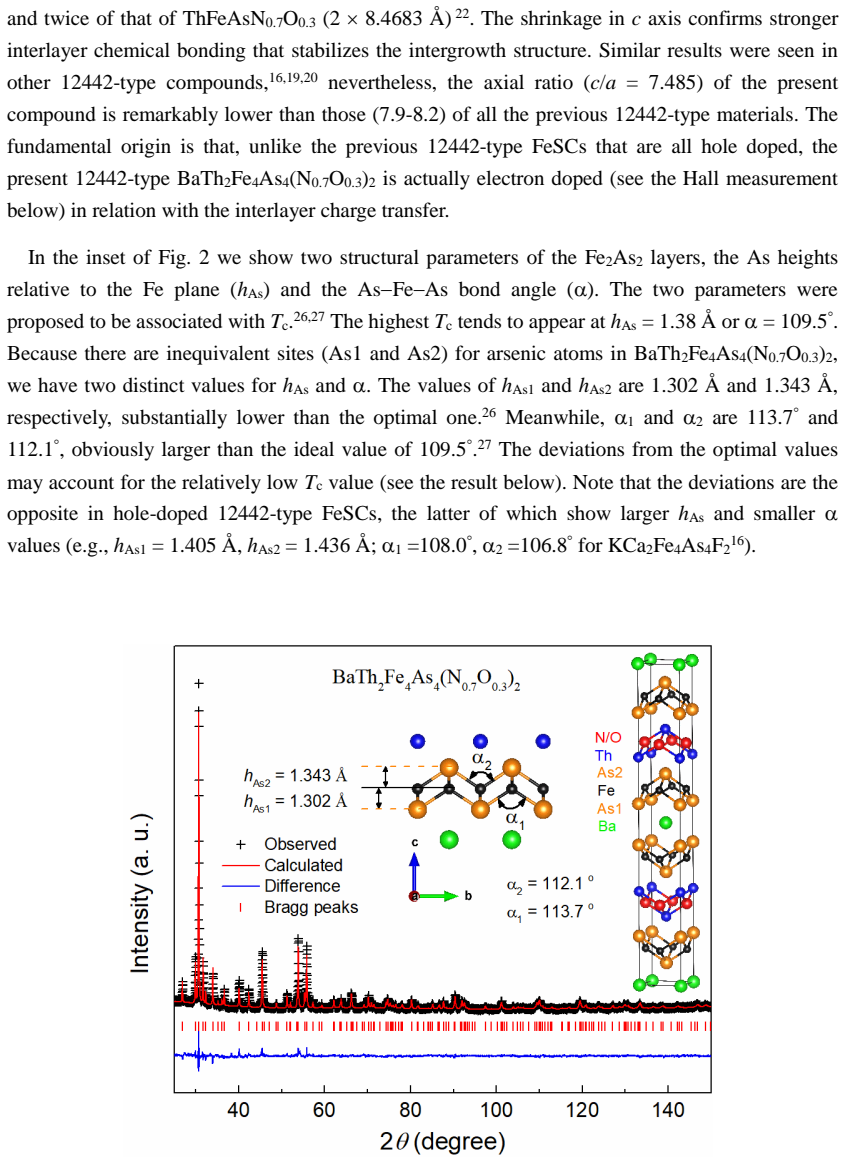
The central object is the 12442-type intergrowth structure, a stacking of double Fe2As2 layers with alternating 122-type and 1111-type blocks. The load-bearing mechanism is the inter-block-layer charge transfer: when oxygen replaces nitrogen in the ThFeAsN1-xOx block, each substitution contributes extra electrons, modeled as a transfer of $x/2$ electrons per Fe2As2 layer from the 1111 block into the 122 block. That transferred charge enhances Coulomb attraction between blocks and is what makes the intergrowth phase form, over and above the usual lattice-match criterion of less than 2 percent mismatch.
What would settle it
A neutron-diffraction refinement of the N/O site in BaTh2Fe4As4(N0.7O0.3)2 that places the oxygen occupancy well away from $x=0.3$ would break the quantitative link between nominal doping, Hall carrier count, and the $x/2$ per-Fe2As2-layer charge transfer; the same measurement could also show whether the 30 K onset and 22 K bulk transition come from one phase or from composition inhomogeneity.
Extended reading notes
Core claim
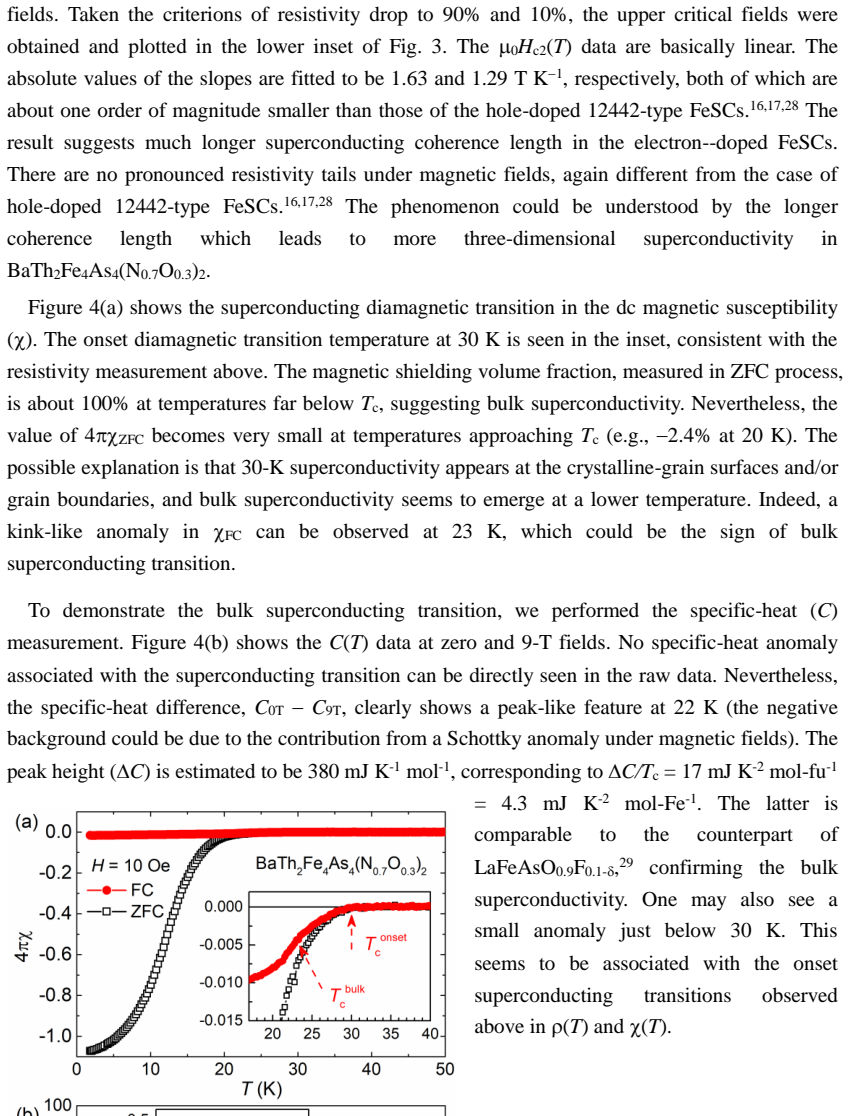
The central claim is that BaTh2Fe4As4(N0.7O0.3)2 is an electron-doped 12442-type iron-based superconductor whose formation is stabilized by charge transfer from the 1111-type block, ThFeAsN0.7O0.3, to the 122-type block, BaFe2As2. Syntheses across nominal oxygen content $x=0$ to $0.7$ show the 12442 phase only for $0.1$ to $0.7$, and the $x=0$ reaction yields separate ThFeAsN and BaFe2As2 phases. The authors interpret this as evidence that oxygen doping provides $x/2$ extra electrons per Fe2As2 layer, increasing interlayer Coulomb attraction and gluing the blocks together. Bulk superconductivity is demonstrated by a specific-heat anomaly at 22 K, with resistive and magnetic onsets near 30 K; the Hall coefficient gives 0.14 electrons per Fe, consistent with the nominal 0.15 electrons per Fe.
Load-bearing premise
The quantitative case rests on the nominal oxygen content $x=0.3$ matching the actual content and on each substituted oxygen donating one electron that is fully transferred to the Fe2As2 layer; if either assumption fails, the Hall-count agreement and the claimed stabilization mechanism would need to be revised.
Editorial extensions
If this is right
- The 12442 family now spans hole-doped and electron-doped members, so tuning the charge transfer between blocks can adjust the electron count of the Fe2As2 layers on either side of the undoped parent.
- At the same nominal electron doping, the single-layer material ThFeAsN0.85O0.15 is not superconducting down to 2 K, so the double-Fe2As2-layer geometry changes the outcome.
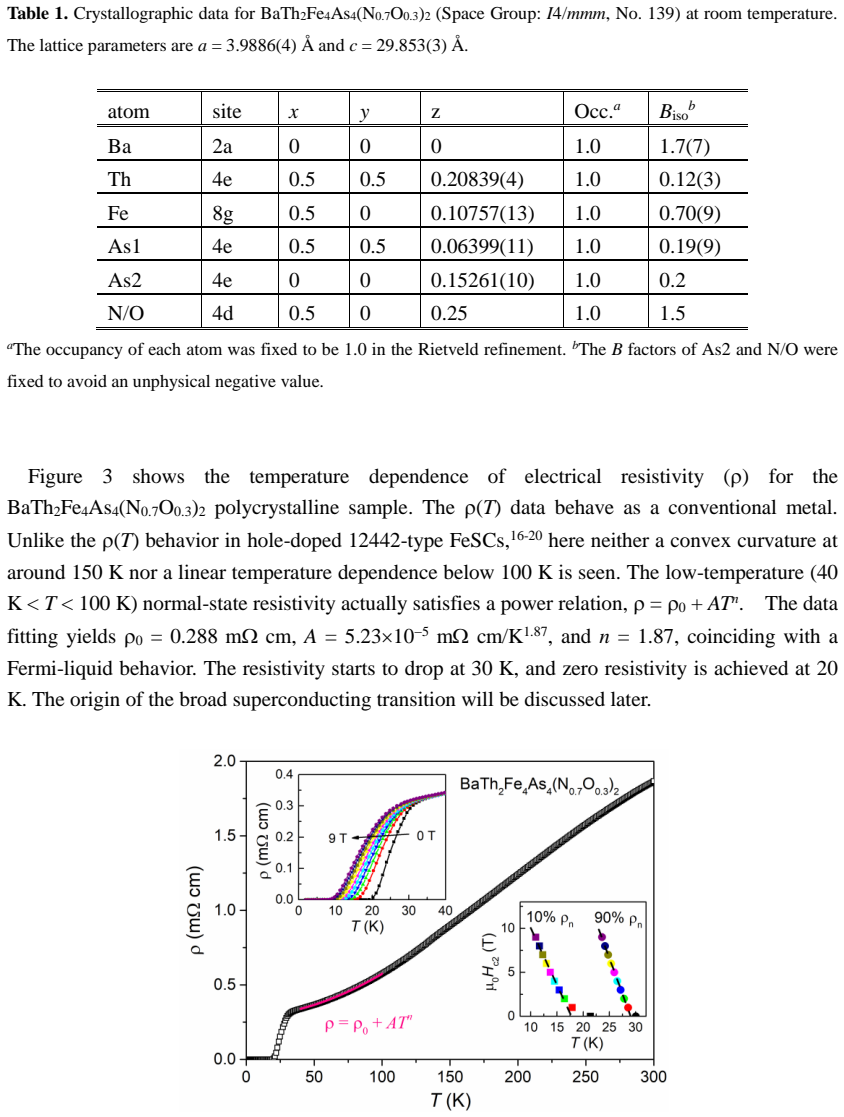
- The upper-critical-field slopes are about ten times smaller than in hole-doped 12442 compounds, implying a longer coherence length and more three-dimensional superconductivity.
- Across the BaTh2Fe4As4(N1-xOx)2 series, the bulk transition temperature tends to increase with electron doping while the onset temperature traces a U shape, suggesting surface or interface superconductivity and bulk superconductivity respond differently to doping.
- The authors conjecture that similar interlayer charge transfer stabilizes other intergrowth materials such as Bi4O4Cu1.7Se2.7Cl0.3 and Pr4Fe2As2Te1-xO4.
Reading between the lines
- The failure of the oxygen-free end member suggests a testable design rule: alternative electron donors, such as partial rare-earth or alkaline-earth substitution, might stabilize the 12442 intergrowth even without oxygen, while geometric lattice match alone should never suffice.
- The WDS data in the supplement show large scatter in nitrogen and oxygen counts before an assumed nitrogen-adsorption correction is applied, so a neutron-diffraction determination of the N/O occupancy would firm up the claimed 0.15 electrons per Fe doping and the $x/2$ per-layer charge transfer.
- If the 30 K onset truly comes from grain surfaces or interfaces, then thin films or single crystals could reveal two distinct superconducting components or an interface-enhanced transition; the kink in field-cooled susceptibility at 23 K is consistent with that picture.
Signed reviews
Editorial analysis
A structured set of objections, weighed in public.
Referee Report
Summary. The manuscript reports the synthesis, crystal structure, and superconducting properties of BaTh2Fe4As4(N0.7O0.3)2, a new 12442-type iron-based superconductor formed by intergrowth of BaFe2As2 and ThFeAsN0.7O0.3 blocks. Powder XRD with Rietveld refinement gives a = 3.9886 Å and c = 29.853 Å with R factors below 5%; resistivity shows a metallic normal state with a superconducting onset near 30 K and zero resistance near 20 K; magnetization shows nearly 100% ZFC shielding at low temperature; and the specific-heat difference C(0T)-C(9T) exhibits a peak near 22 K. Hall measurements give a negative Hall coefficient corresponding to 0.14 electrons/Fe in a single-band model, which the authors compare with the nominal electron doping of 0.15 electrons/Fe. Based on the failure to synthesize the oxygen-free compound and the appearance of the 12442 phase only for nominal oxygen contents 0.1 ≤ x ≤ 0.7, the authors conclude that inter-block-layer charge transfer stabilizes the structure and identify the compound as the first electron-doped double-Fe2As2-layer iron-based superconductor.
Significance. If the composition and charge-transfer interpretation hold, this is a significant advance: it would be the first electron-doped 12442-type iron-based superconductor, and it would provide an unusually direct example of interlayer charge transfer acting as a formation condition for an intergrowth structure. The manuscript contains several concrete strengths: the XRD indexing and Rietveld refinement are internally consistent; the resistivity and magnetization data support bulk superconductivity at low temperature; the negative Hall coefficient independently indicates electron-type carriers; and the synthesis series across nominal x = 0.1–0.7 is a testable falsifiable claim. The novelty relative to the group's earlier 12442 and ThFeAsN work is real, though incremental, and the central quantitative claim of 0.15 electrons/Fe hinges on a composition correction that is not yet independently calibrated.
major comments (3)
- [Supporting Information, §III, Table S3] The central quantitative claim of 0.15 electrons/Fe doping (main text, Fig. 5 discussion) depends on the assumed oxygen content x = 0.3. The raw WDS data in Table S3 give N1.42(32)O1.38(19) per formula unit, summing to 2.80(51); the authors subtract 0.80 from oxygen while retaining all nitrogen, citing nitrogen inertness. However, their own control in Table S2 for the ThFeAsN region of the x = 0 sample shows only about 0.2 oxygen per formula unit, so the 0.8 correction is not calibrated by the control. If the measured O/(N+O) ratio is taken at face value, x ≈ 0.49 and the expected doping is about 0.25 electrons/Fe, which is inconsistent with the measured Hall carrier count of 0.14 electrons/Fe. Because the agreement between the Hall count and the nominal doping is the main evidence for the x/2 charge-transfer mechanism, this composition uncertainty must be resolved by an independent determination (e.g., neutron diffraction or calibrated EPMA standards) or the quantitative claim must be substantially softened.
- [Results and discussion, Fig. 1 and Fig. S3] The conclusion that inter-block-layer charge transfer is 'essential' to stabilize the phase rests on the observation that the 12442 phase forms only for nominal x ≥ 0.1 and not for x = 0. The series data in Fig. S3 are based on nominal oxygen contents, and the actual N/O occupancy in the 12442 phase is not established for each x; the Rietveld refinement fixes the occupancy to the nominal value. The correlation is therefore between phase formation and nominal composition, not directly between charge transfer and stability. Alternative explanations, such as the smaller ionic radius of O2- modifying the lattice match or changing the chemical bonding, are not ruled out. Please clarify what evidence specifically isolates charge transfer as the stabilizing factor rather than a composition-dependent structural effect.
- [Figure 4(b) and surrounding text] The bulk superconducting transition at about 22 K is inferred from a peak in C(0T)-C(9T); no anomaly is directly visible in the raw C(T) data. The negative background attributed to a Schottky anomaly makes the subtraction nontrivial, and the reported ΔC/Tc = 4.3 mJ K-2 mol-Fe-1 is not accompanied by an entropy-conservation check (e.g., equality of the superconducting and normal-state entropies at Tc). Since the paper explicitly claims bulk superconductivity at ~22 K, please provide either an entropy balance or a higher-resolution raw specific-heat anomaly to support the assignment; the current figure alone is suggestive but not fully conclusive.
minor comments (5)
- [Abstract] The abstract contains several typographical issues: 'Recently, An electron-doped' should be 'Recently, an electron-doped', and 'th e' should be 'the'.
- [References] Reference [24] is malformed: 'Appl Crstallog r XX, 2007, 130: 15-20' should be 'Appl. Crystallogr., 2007, 130: 15-20' with the correct volume and page numbers.
- [Supporting Information, Table S1] The EDS-derived formula in Table S1 shows a large scatter in Th content (1.86 ± 0.11) relative to the nominal value of 2.0, which is not discussed in the main text; a brief comment on grain-to-grain variation would be helpful.
- [Conclusion] The symbols Tconset and Tcbulk should be italicized consistently as Tc,onset and Tc,bulk.
- [Supporting Information, heading] The heading 'ⅠI. SEM-EDS Results' appears to contain a stray Roman numeral; it should be 'II. SEM-EDS Results'.
Circularity Check
No circularity: the central charge-transfer claim rests on new synthesis and independent Hall data, not on fitted parameters or self-citation chains.
full rationale
The paper's derivation chain is self-contained: the target 12442-type compound is designed from a prior lattice-match criterion, synthesized with varying nominal oxygen content, and characterized by XRD, resistivity, magnetization, specific heat, and Hall measurements. The key claim that inter-block-layer charge transfer stabilizes the compound is supported by the new observation that the oxygen-free composition does not form the 12442 phase while oxygen-containing compositions do, and by the measured negative Hall coefficient giving 0.14 electrons/Fe, which the authors compare with 0.15 electrons/Fe expected from the nominal composition. This is a consistency check between an independently measured Hall carrier count and a stated nominal doping, not a fitted parameter renamed as a prediction. The Rietveld refinement fixes N/O content to the nominal value, and the WDS oxygen correction is an assumption that could affect quantitative accuracy, but neither step is circular: the correction is not chosen to force the Hall-doping agreement, and the qualitative stabilization argument does not depend on the exact oxygen content. The paper does cite the authors' prior work on 12442-type compounds and ThFeAsN, but those citations provide empirical context (lattice-match criterion, structural prototypes, phase-diagram data) rather than a uniqueness theorem or ansatz that determines the present result. No equation in the paper reduces to its own input, no fitted parameter is relabeled as a prediction, and no load-bearing conclusion is imported solely from a self-citation. Therefore no significant circularity is present.
Assumptions & free parameters
free parameters (2)
- Normal-state resistivity power-law parameters (rho0, A, n) =
rho0 = 0.288 mΩ cm, A = 5.23e-5 mΩ cm/K^1.87, n = 1.87
- Upper critical field slopes d(mu0 Hc2)/dT =
1.63 T/K (90% criterion) and 1.29 T/K (10% criterion)
assumptions (5)
- domain assumption The lattice mismatch criterion mu < 2% is a sufficient condition for intergrowth formation, so failure of BaTh2Fe4As4N2 (mu = 1.8) must be due to missing charge transfer.
- domain assumption Oxygen substitution on the nitrogen site donates x/2 electrons per Fe2As2 layer.
- domain assumption The Hall coefficient can be interpreted in a single-band model to give carrier count per Fe.
- ad hoc to paper Nitrogen adsorption, rather than actual composition, explains the excess N/O in WDS, so the true oxygen content is close to nominal.
- ad hoc to paper Enhanced interlayer Coulomb attraction from charge transfer stabilizes the intergrowth structure.
Cite this review
Pith. "Pith review of BaTh$_2$Fe$_4$As$_4$(N$_{0.7}$O$_{0.3}$)$_2$: An Iron-Based Superconductor Stabilized by Inter-Block-Layer Charge Transfer." pith.science (2026). https://pith.science/paper/SLT573AN
@misc{pith2026190803992,
  author       = {Pith},
  title        = {Pith review of: BaTh$_2$Fe$_4$As$_4$(N$_0.7$O$_0.3$)$_2$: An Iron-Based Superconductor Stabilized by Inter-Block-Layer Charge Transfer},
  year         = {2026},
  howpublished = {\url{https://pith.science/paper/SLT573AN}},
  note         = {Machine review of arXiv:1908.03992}
}
abstract
Recently, An electron-doped 12442-type iron-based superconductor BaTh$_2$Fe$_4$As$_4$(N$_{0.7}$O$_{0.3}$)$_2$ has been successfully synthesized with high-temperature solid-state reactions on basis of a structural design. The inter-block-layer charge transfer between the constituent units of "BaFe$_2$As$_2$" and "ThFeAsN$_{0.7}$O$_{0.3}$" was found to be essential to stabilize the target compound. Dominant electron-type conduction and bulk superconducting transition at ~22 K were demonstrated.
Figures

Figures from the paper (2 more)

Reference graph
Works this paper leans on
-
[1]
Superconductivity in Quasi-One-Dimensional K2Cr3As3 with Significant Electron Correlations
See the Supplemental Materials for the article “Superconductivity in Quasi-One-Dimensional K2Cr3As3 with Significant Electron Correlations” by J. K. Bao, J. Y. Liu, C.W. Ma, Z. H. Meng, Z. T. Tang, Y. L. Sun, H. F. Zhai, H. Jiang, H. Bai, C. M. Feng, Z. A. Xu, and G. H. Cao, Phys. Rev. X 2015, 5, 011013
work page 2015
-
[2]
M. H. Mao, C. Wang, H. E. Maynard-Casely, Q. Huang, Z. Wang, G. Cao, S. Li, and H. Luo, Neutron powder diffraction study on the iron-based nitride superconductor ThFeAsN, Europhys. Lett. 2017, 117, 57005
work page 2017
Reviewed August 14, 2026 · model on record in the stance chip above.
Discussion (0). Continue with ORCID to comment.