REVIEW 3 major objections 6 minor 45 references
Active particles write lasting structure into fluid droplets
Reviewed by Pith at T0; open to challenge. T0 means a machine referee read the full paper against a public rubric. the ladder, T0–T4 →
Active Brownian particles drive polymer condensates into percolated networks that persist via topological winding even after the particles are removed, creating activity-induced memory in a fluid.
T0 review reviewed 2026-07-10 challenge →
load-bearing objection Real phenomenon, but the 'topological' mechanism is undersupported on 12-monomer chains the 3 major comments →
Active Particles Imprint Persistent Percolating Networks in Polymer Condensates
The pith
A machine-rendered reading of the paper's core claim, the machinery that carries it, and where it could break.
The reading
Core claim
The central finding is that activity from excluded-volume particles imprints persistent topological memory into fluid polymer condensates. Active particles drive a transition from compact droplets to percolated networks by suppressing intrachain contacts, enhancing interchain contacts, and creating interchain winding that acts as topological constraints. These constraints outlast the active driving itself: after complete removal of active particles and continued evolution for twice the passive coalescence time, the network remains spatially extended rather than collapsing back to a droplet, even though individual polymer chains continue to exchange dynamically. The memory is thus stored not在
What carries the argument
The load-bearing mechanism is the interplay of three activity-induced effects: (1) active Brownian particles of intermediate size (1.5× the monomer diameter) suppress intrachain self-contacts by sterically opening individual chains, (2) the same particles drive interchain contact formation by pushing extended chains into one another, and (3) the resulting interchain encounters produce topological winding—chains wrap around bridging segments at junction points, creating constraints that cannot be removed without chain crossing. The persistence of the network after activity removal is attributed to these topological constraints, quantified via primitive path analysis showing increased entangl
Load-bearing premise
The claim of persistence rests on observing the network for twice the characteristic coalescence time of the passive system after removing all active particles. If the network is actually metastable and would collapse on longer timescales, the memory claim would be weakened. Additionally, the chains are only 12 monomers long, which raises the question of whether the topological winding is genuinely robust or whether it depends on the limited chain length and simulation box.
What would settle it
Run the depletion protocol for significantly longer than twice the passive coalescence time—e.g., 10× or 100×—and check whether the percolated network eventually collapses into a compact droplet. If it does, the memory is metastable rather than persistent. Alternatively, test with longer polymer chains to determine whether the topological winding mechanism scales or is an artifact of short chains.
If this is right
- If activity can write structural memory into fluid condensates, biological cells may exploit active processes (motor-driven flows, enzymatic activity) to encode information about past states in condensate architecture without sacrificing the exchange dynamics that make condensates functional.
- The finding that network formation requires an intermediate particle-size regime suggests design rules for synthetic active materials: particle size must be large enough to open chains but small enough to allow interchain winding, constraining the parameter space for engineering persistent active gels.
- The coexistence of liquid-like chain exchange with solid-like topological persistence in the same condensate suggests a new class of materials with tunable memory: fluid at the molecular level but architecturally stable at the mesoscale.
- The proposed scaling condition—active persistence length comparable to both the network mesh size and the polymer radius of gyration—provides a testable criterion for distinguishing persistent network formation from transient activity-induced swelling.
Editorial analysis
A structured set of objections, weighed in public.
Referee Report
Summary. This manuscript uses molecular dynamics simulations of sticker-spacer polymers (Np = 12 monomers) in a bath of active Brownian particles (ABPs) to show that activity can drive a structural transition from compact condensate droplets to system-spanning percolated networks. The authors report that this network persists after ABPs are removed, despite continued polymer exchange, and attribute the persistence to topological constraints imprinted via interchain winding. The claim is supported by multiple metrics: largest connected component analysis, contact network compactness, interchain vs. intrachain contact statistics, contact retention fractions, primitive path entanglement analysis (Z1+ algorithm), and controlled ABP depletion protocols at two rates. The central question—whether activity can write structural memory into a fluid condensate—is timely and well-motivated.
Significance. The paper addresses a genuinely interesting question: can a fluid condensate retain structural information written by activity after the activity ceases? The use of multiple independent diagnostics (LCC, contact networks, Z1+ entanglement analysis, depletion protocols) is a strength, and the depletion protocol is a clean experimental design. The scaling discussion in the Supplemental Material (competing length scales: sigma_s/sigma_p, Rg, active persistence length, mesh size) provides a useful physical framework even if not yet a predictive theory. The finding that interchain contacts are self-renewing (R(t) ~ 1) while intrachain contacts are suppressed is a nontrivial and falsifiable result. The connection to PopZ condensates and recent rigidity transition experiments is appropriate.
major comments (3)
- The claim of 'topological imprinting' rests on Z1+ primitive path analysis of 12-monomer chains (Fig. 3c-d, Fig. S7). In polymer physics, the entanglement molecular weight Me is typically far larger than 12 repeat units, so Z1+ kinks on such short chains may represent geometric contacts rather than topological constraints resistant to chain end-retraction. This distinction is load-bearing: if the kinks are not topological, the network persistence after ABP depletion (Fig. 4b, Fig. 5a-ii) could be a kinetic/metastable effect rather than topological memory. The paper does not verify that <Z> scales with chain length as expected for true entanglements, nor does it test whether detected constraints survive end-retraction. A chain-length study (e.g., Np = 24, 48) showing that <Z> increases proportionally would substantially strengthen the topological claim. Alternatively, the authors should直接
- The persistence test evolves the system for 'twice the characteristic coalescence time of the polymer-only system' after complete ABP depletion (main text, paragraph describing depletion protocol; Fig. S8). This assumes that 2x passive coalescence time is sufficient to distinguish true persistence from slow metastable relaxation. However, the relevant timescale for rearrangement of an extended 12-mer network may be much longer than droplet coalescence, especially if the network is kinetically arrested rather than topologically stabilized. The paper should either (a) provide evidence that the relaxation time has been sampled sufficiently (e.g., show that the contact renewal rate R(t) has reached steady state in Fig. 5b, or report the actual coalescence time in simulation units for comparison), or (b) soften the claim from 'persistent' to 'long-lived' if the timescale separation cannot be
- The chain length Np = 12 is very short relative to typical entangled polymer systems. While the authors acknowledge this is a sticker-spacer model with implicit spacers (FENE springs, R0 = 10 nm), the physical interpretation of 'interchain winding' and 'topological constraints' for chains of this length needs more careful justification. The FENE springs have R0 = 10 nm, which is 5x the monomer diameter (sigma_p = 2 nm), so the effective chain contour length is substantial. However, the paper should discuss whether the sticker-spacer architecture (with specific A-B binding at epsilon_AB = 6 kBT) creates effective topological constraints that differ from standard polymer entanglement, and whether the Z1+ analysis is appropriate for this type of bonded network.
minor comments (6)
- Fig. 3 caption: panel labels in the caption text (b, c) do not match the figure description. The caption mentions '(b) mean number of topological constraints per chain <Z>' and '(c) primitive path contour length <L_pp>', but the text also references '(b) Schematic illustration...' which appears to be a separate panel. Clarify panel labels.
- The Peclet number definition (Eq. 6) uses sigma_s in the numerator, but the ratio of active to thermal forces would naturally use the relevant length scale for the driven object. Since ABPs interact with polymers via WCA, the relevant length scale for the force ratio might be sigma_p or the interaction range. Clarify why sigma_s is the appropriate length scale.
- The bath density parameter rho_M is defined as Ns/(Np*N) in the main text but as N_ABP/N_mon in the Supplemental Material. These are equivalent but the notation should be consistent.
- Fig. S3: the percolation threshold S_threshold = 0.85 is stated but not justified. Why 85% rather than, e.g., 50% or 95%?
- The paper mentions 'five independent simulation replicates' (SM) but does not report error bars or uncertainty estimates in the main text figures. Adding error bars or confidence intervals would strengthen the quantitative claims.
- The reference list includes several 2025-2026 preprints (Refs. 23, 24, 30, 31). Ensure these are properly cited and that the manuscript does not depend on unpublished results as load-bearing premises.
Circularity Check
No significant circularity; simulation-based claims verified by direct measurement of independent observables
full rationale
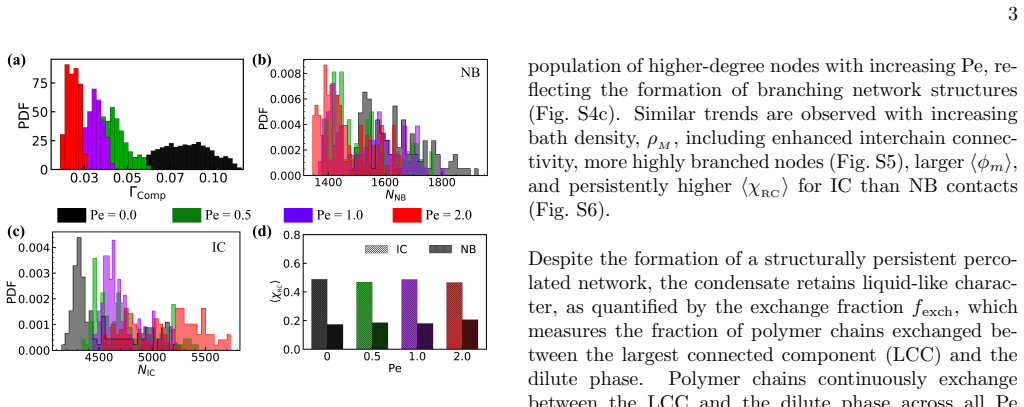
This paper is a simulation study whose central claims are verified by direct measurement of simulation observables, not by fitting parameters and then predicting the same data. The transition from droplet to percolated network (Fig. 1c) is directly observed. The mechanistic claims—enhanced interchain contacts (Fig. 2c), suppressed intrachain contacts (Fig. 2b), increased topological constraints ⟨Z⟩ via Z1+ analysis (Fig. 3c), and continued chain exchange (Fig. 3a)—are each measured by independent analysis tools applied to simulation configurations. The persistence claim is tested by a controlled ABP depletion protocol (Fig. 4, Fig. 5), which is an experimental intervention within the simulation, not a circular re-derivation. The contact retention fraction χ_RC and renewal rate R(t) are computed directly from trajectory frames, not predicted from a fitted model. The scaling picture in the SM is explicitly disclaimed as non-predictive ('Although the present work does not establish a predictive scaling theory'). Self-citations exist (Ref. 30, overlapping authors with Schwarz and Ross; Ref. 37, overlapping with Theeyancheri) but are used as motivation for model choices and background context, not as load-bearing premises for the central result. The skeptic's concern about whether Z1+ detects true topological constraints vs. geometric kinks for 12-monomer chains is a validity/correctness concern, not a circularity concern—the paper does not define its observables in terms of its own predictions or smuggle in an ansatz via self-citation. No step in the derivation chain reduces to its inputs by construction.
Axiom & Free-Parameter Ledger
free parameters (5)
- epsilon_AB =
6 kBT
- sigma_s/sigma_p ratio =
1.5
- rho_M =
0.5-2.5
- Pe =
0-2.0
- N_p =
12
axioms (4)
- domain assumption Sticker-spacer polymer model with A-B heterotypic binding captures essential physics of biomolecular condensates
- domain assumption Overdamped Langevin dynamics with ABP self-propulsion correctly models the active bath
- ad hoc to paper Twice the passive coalescence time is sufficient to demonstrate network persistence
- domain assumption Primitive path analysis (SMDP algorithm) correctly identifies topological constraints in short (12-monomer) chains
Cite this review
Pith. "Pith review of Active Particles Imprint Persistent Percolating Networks in Polymer Condensates." pith.science (2026). https://pith.science/paper/SM5PLTC7
@misc{pith2026260708048,
  author       = {Pith},
  title        = {Pith review of: Active Particles Imprint Persistent Percolating Networks in Polymer Condensates},
  year         = {2026},
  howpublished = {\url{https://pith.science/paper/SM5PLTC7}},
  note         = {Machine review of arXiv:2607.08048}
}
read the original abstract
Fluid condensates readily exchange components and reorganize, and in doing so typically erase structural history. Using simulations of sticker-spacer polymers in an active particle bath, we show that activity drives condensates from compact droplets into system-spanning percolated networks by enhancing interchain connectivity, suppressing intrachain collapse, and increasing topological constraints through interchain winding. The network persists after the active particles are removed, despite continued polymer exchange and contact turnover, revealing a fluid-like state with activity-induced topological imprinting. Hence, activity can write long-lived structural organization and memory into fluid condensates.
Figures



Reference graph
Works this paper leans on
-
[1]
D. A. Fletcher and R. D. Mullins, Cell mechanics and the cytoskeleton, Nature463, 485 (2010)
work page 2010
- [2]
-
[3]
K. Liu, A. E. Patteson, E. J. Banigan, and J. Schwarz, Dynamic nuclear structure emerges from chromatin cross-links and motors, Phys. Rev. Lett.126, 158101 (2021)
work page 2021
-
[4]
S. F. Banani, H. O. Lee, A. A. Hyman, and M. K. Rosen, Biomolecular condensates: organizers of cellular biochemistry, Nat. Rev. Mol. Cell Biol.18, 285 (2017)
work page 2017
-
[5]
Y. Shin and C. P. Brangwynne, Liquid phase condensation in cell physiology and disease, Science357, eaaf4382 (2017)
work page 2017
-
[6]
X. Su, J. A. Ditlev, E. Hui, W. Xing, S. Banjade, J. Okrut, D. S. King, J. Taunton, M. K. Rosen, and R. D. Vale, Phase separation of signaling molecules promotes T cell receptor signal transduction, Science352, 595 (2016)
work page 2016
-
[7]
G. Pei, H. Lyons, P. Li, and B. R. Sabari, Transcription regulation by biomolecular condensates, Nat. Rev. Mol. Cell Biol. 26, 213 (2025)
work page 2025
-
[8]
S. Boeynaems, S. Alberti, N. L. Fawzi, T. Mittag, M. Polymenidou, F. Rousseau, J. Schymkowitz, J. Shorter, B. Wolozin, L. Van Den Bosch, P. Tompa, and M. Fuxreiter, Protein phase separation: a new phase in cell biology, Trends Cell Biol. 28, 420 (2018)
work page 2018
-
[9]
B. S. Visser, W. P. Lipi´ nski, and E. Spruijt, The role of biomolecular condensates in protein aggregation, Nat. Rev. Chem. 8, 686 (2024)
work page 2024
-
[10]
S. Alberti and A. A. Hyman, Biomolecular condensates at the nexus of cellular stress, protein aggregation disease and ageing, Nat. Rev. Mol. Cell Biol.22, 196 (2021)
work page 2021
-
[11]
T. Mittag and R. V. Pappu, A conceptual framework for understanding phase separation and addressing open questions and challenges, Mol. Cell82, 2201 (2022)
work page 2022
-
[12]
E. W. Martin, A. S. Holehouse, I. Peran, M. Farag, J. J. Incicco, A. Bremer, C. R. Grace, A. Soranno, R. V. Pappu, and T. Mittag, Valence and patterning of aromatic residues determine the phase behavior of prion-like domains, Science367, 694 (2020)
work page 2020
- [13]
-
[14]
C. P. Brangwynne, C. R. Eckmann, D. S. Courson, A. Rybarska, C. Hoege, J. Gharakhani, F. Julicher, and A. A. Hyman, Germline P granules are liquid droplets that localize by controlled dissolution/condensation, Science324, 1729 (2009)
work page 2009
-
[15]
T.-Y. D. Tang, D. van Swaay, A. deMello, J. L. R. Anderson, and S. Mann, In vitro gene expression within membrane-free coacervate protocells, Chem. Commun.51, 11429 (2015)
work page 2015
- [16]
-
[17]
H. Tanaka and Y. Nishikawa, Viscoelastic phase separation of protein solutions, Phys. Rev. Lett.95, 078103 (2005)
work page 2005
-
[18]
I. Alshareedah, M. M. Moosa, M. Raju, D. A. Potoyan, and P. R. Banerjee, Phase transition of rna-protein complexes into ordered hollow condensates, Proc. Natl. Acad. Sci. U.S.A.117, 15650 (2020)
work page 2020
-
[19]
D. Michieletto and M. Marenda, Rheology and viscoelasticity of proteins and nucleic acids condensates, JACS Au2, 1506 (2022)
work page 2022
-
[20]
Z. Shen, B. Jia, Y. Xu, J. Wessen, T. Pal, H. S. Chan, S. Du, and M. Zhang, Biological condensates form percolated networks with molecular motion properties distinctly different from dilute solutions, eLife12, e81907 (2023)
work page 2023
- [21]
-
[22]
Z. Liao, B. Jia, D. Guan, X. Chen, M. Zhang, and P. Tong, Emergent mechanics of a networked multivalent protein condensate, Nat. Commun.16, 5237 (2025)
work page 2025
-
[23]
Z. Liao, B. Jia, Y. Xu, Z. Shen, M. Zhang, and P. Tong, Emergence of rigidity percolation and critical behavior in tunable protein condensates, bioRxiv , 2026 (2026)
work page 2026
-
[24]
D. Scholl, T. Boyd, A. P. Latham, A. Salazar, A. M. A. M. Khan, S. Boeynaems, A. S. Holehouse, G. C. Lander, A. Sali, D. Park, A. A. Deniz, and K. Lasker, The filamentous ultrastructure of the PopZ condensate is required for its cellular function, Nat. Struct. Mol. Biol. , 1 (2026)
work page 2026
-
[25]
N. Sanfeliu-Cerd´ an and M. Krieg, The mechanobiology of biomolecular condensates, Biophysics Rev.6, 011310 (2025)
work page 2025
- [26]
-
[27]
D. Zwicker, O. W. Paulin, and C. Ter Burg, Physics of droplet regulation in biological cells, Rep. Prog. Phys.88, 116601 (2025)
work page 2025
-
[28]
T. Wiegand and A. A. Hyman, Drops and fibers—how biomolecular condensates and cytoskeletal filaments influence each other, Emerging Top. Life Sci.4, 247 (2020)
work page 2020
- [29]
- [30]
- [31]
- [32]
-
[33]
J.-M. Choi, A. S. Holehouse, and R. V. Pappu, Physical principles underlying the complex biology of intracellular phase transitions, Ann. Rev. Biophys.49, 107 (2020)
work page 2020
-
[34]
K. Kremer and G. S. Grest, Dynamics of entangled linear polymer melts: A molecular-dynamics simulation, J. Chem. Phys.92, 5057 (1990)
work page 1990
-
[35]
J. D. Weeks, D. Chandler, and H. C. Andersen, Role of repulsive forces in determining the equilibrium structure of simple liquids, J. Chem. Phys.54, 5237 (1971)
work page 1971
-
[36]
C. Bechinger, R. Di Leonardo, H. L¨ owen, C. Reichhardt, G. Volpe, and G. Volpe, Active particles in complex and crowded environments, Rev. Mod. Phys.88, 045006 (2016)
work page 2016
-
[37]
L. Theeyancheri, S. Chaki, N. Samanta, R. Goswami, R. Chelakkot, and R. Chakrabarti, Translational and rotational dynamics of a self-propelled janus probe in crowded environments, Soft Matter16, 8482 (2020)
work page 2020
-
[38]
Y. Du, H. Jiang, and Z. Hou, Study of active brownian particle diffusion in polymer solutions, Soft Matter15, 2020 (2019)
work page 2020
- [39]
-
[40]
H. X. Chai, K. Kayanuma, H. Suzuki, and M. Takinoue, DNA condensates via entanglement of string-like structures based on anisotropic nanotetrahedra, JACS Au5, 3249 (2025)
work page 2025
- [41]
-
[42]
R. W. Style, T. Sai, N. Fanelli, M. Ijavi, K. Smith-Mannschott, Q. Xu, L. A. Wilen, and E. R. Dufresne, Liquid-liquid phase separation in an elastic network, Phys. Rev. X8, 011028 (2018)
work page 2018
-
[43]
Plimpton, Fast parallel algorithms for short-range molecular dynamics, J
S. Plimpton, Fast parallel algorithms for short-range molecular dynamics, J. Comp. Phys.117, 1 (1995)
work page 1995
-
[44]
M. Kr¨ oger, J. D. Dietz, R. S. Hoy, and C. Luap, The Z1+ package: Shortest multiple disconnected path for the analysis of entanglements in macromolecular systems, Comput. Phys. Commun.283, 108567 (2023)
work page 2023
-
[45]
A. Stukowski, Visualization and analysis of atomistic simulation data with OVITO–the open visualization tool, Modelling Simul. Mater. Sci. Eng.18, 015012 (2010)
work page 2010
This paper was first reviewed by glm-5.2 on July 10, 2026.
discussion (0)
Sign in with ORCID, Apple, or X to comment. Anyone can read and Pith papers without signing in.