Spatial and particle-particle entanglement in 1D quantum walks of two distinguishable or indistinguishable bosonic particles
Pith reviewed 2026-06-28 14:24 UTC · model grok-4.3
The pith
In two-particle 1D quantum walks, long-time entanglement limits vary non-monotonically with onsite repulsion for both distinguishable and indistinguishable bosons.
A machine-rendered reading of the paper's core claim, the machinery that carries it, and where it could break.
Core claim
The paper establishes that entanglement measures in the indistinguishable cases resemble those of the distinguishable cases when the initial states are comparable, but the long-time limits of the entanglement measures are typically non-monotonic as the onsite repulsion increases. This holds across different initial states and is derived from the time evolution under the Hubbard Hamiltonian using the specified entropy calculations for left-right spatial entanglement and particle-particle entanglement.
What carries the argument
Left-right entanglement from the entropy of coarse-grained states that count particles on each lattice half, together with particle-particle entanglement from the entropy of singular values of the time-evolved two-particle Fock state.
If this is right
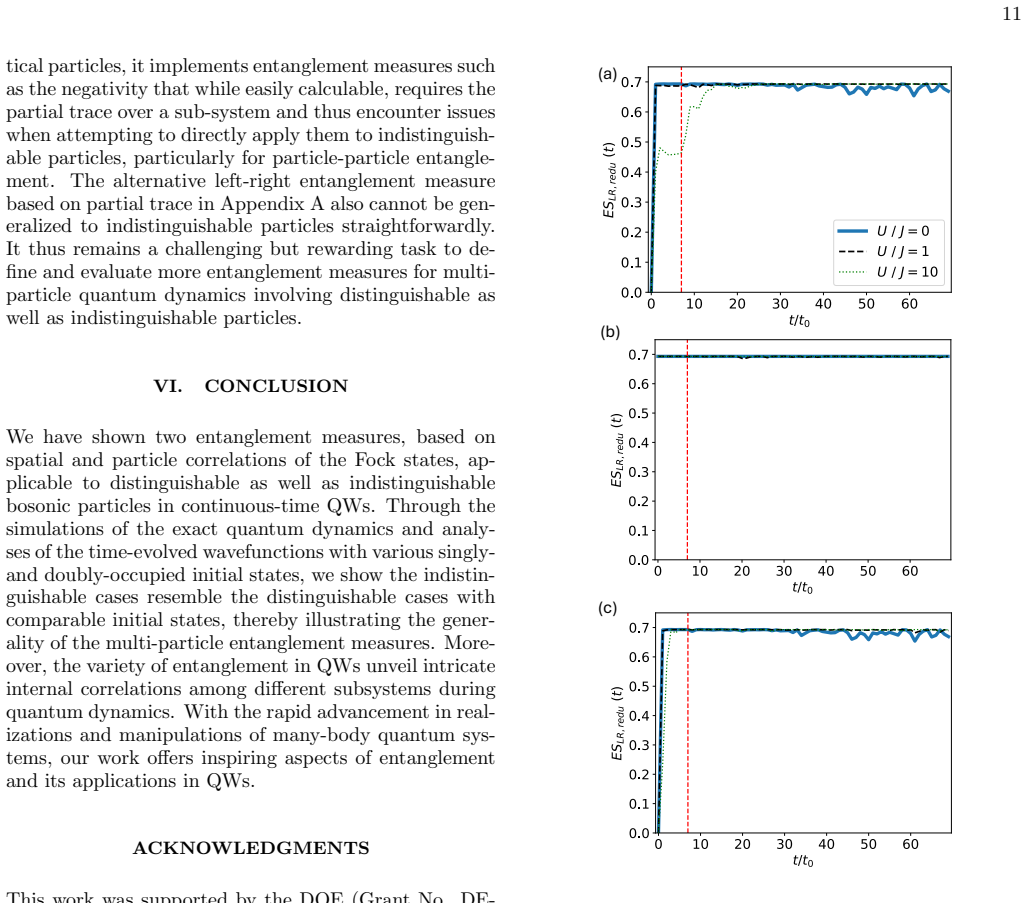
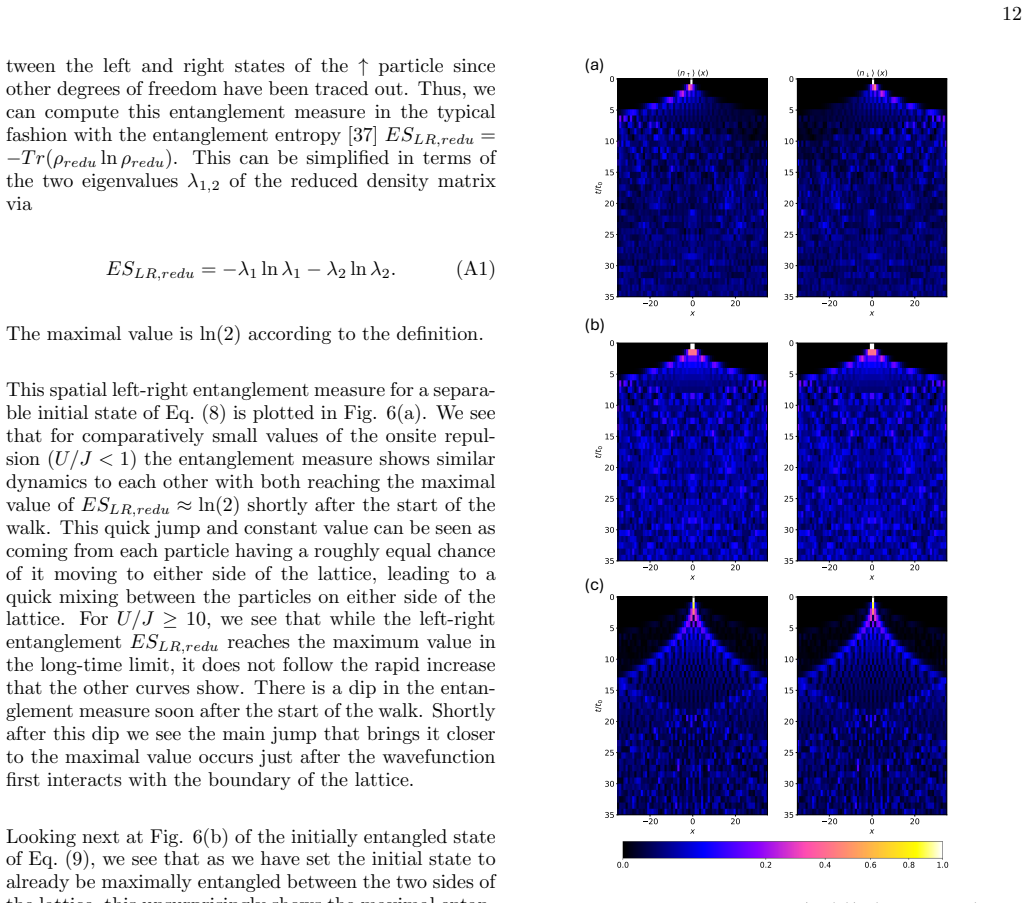
- Entanglement measures for indistinguishable particles can be compared directly to those for distinguishable particles when initial states are matched.
- Long-time entanglement saturation values can be tuned by varying onsite repulsion without a simple increasing or decreasing trend.
- The observed resemblance and non-monotonicity apply to continuous-time walks on a lattice and may guide studies of entanglement growth from separable, entangled, or doubly occupied starts.
- These measures offer a route to track multi-particle quantum dynamics in future work.
Where Pith is reading between the lines
- The non-monotonic dependence might persist when the lattice is divided into more than two regions or when particle number exceeds two.
- Experiments in optical lattices could directly measure the long-time limits to test the predicted variation with repulsion strength.
- The close resemblance between distinguishable and indistinguishable cases may break for initial states that differ strongly in symmetry properties.
Load-bearing premise
The chosen coarse-graining into left and right particle counts together with singular-value entropy of the Fock state capture the physically relevant entanglement for the system's dynamics.
What would settle it
A direct calculation showing that long-time entanglement measures increase or decrease monotonically rather than non-monotonically as onsite repulsion is varied would contradict the reported behavior.
Figures
read the original abstract
We present entanglement measures between spatially separated regions and between two distinguishable or indistinguishable particles in one-dimensional two-particle continuous-time quantum walks governed by the Hubbard Hamiltonian. The left-right entanglement checks the entropy of coarse-grained states counting the numbers of particles on the left and right halves of the lattice while the particle-particle entanglement is based on the entropy of the singular values of the time-evolved Fock state. With separable, entangled, and doubly occupied initial states, we examine initial entanglement and the following growth in different entanglement measures. While the entanglement measures of the indistinguishable cases resemble those of the distinguishable cases when the initial states are comparable, the long-time limits of the entanglement measures are typically non-monotonic as the onsite repulsion increases. We also discuss possible implications for future research of entanglement in multi-particle quantum dynamics.
Editorial analysis
A structured set of objections, weighed in public.
Referee Report
Summary. The manuscript numerically investigates spatial entanglement via left-right particle-number entropy and particle-particle entanglement via singular-value entropy of the Fock state in one-dimensional two-particle continuous-time quantum walks under the Hubbard model. It compares distinguishable and indistinguishable bosonic particles for separable, entangled, and doubly occupied initial states, reporting that the entanglement measures for indistinguishable cases resemble those for distinguishable cases with comparable initial states, and that the long-time limits are typically non-monotonic as a function of the onsite repulsion strength U.
Significance. If the reported numerical observations hold, the work supplies concrete descriptive data on entanglement growth and saturation in interacting lattice quantum walks, with the similarity between distinguishable and indistinguishable cases under matched initials and the non-monotonic U-dependence constituting the main findings. These could inform studies of multi-particle dynamics, though the paper presents the results as direct consequences of the defined measures and Hamiltonian without parameter-free derivations or machine-checked proofs.
minor comments (2)
- [Abstract] The abstract and discussion mention possible implications for multi-particle entanglement but do not outline any concrete next steps or testable predictions; adding a short paragraph would clarify the scope.
- Numerical details such as lattice size, time-stepping method, or convergence checks with respect to system size are not referenced in the provided summary; including these would allow readers to assess the robustness of the long-time limits.
Simulated Author's Rebuttal
We thank the referee for their careful reading of the manuscript and for the positive assessment that led to the recommendation of minor revision. The referee's summary correctly identifies the numerical focus on left-right and particle-particle entanglement measures, the comparison between distinguishable and indistinguishable bosons, and the non-monotonic long-time behavior with respect to onsite repulsion U. No major comments were listed in the report.
Circularity Check
No significant circularity detected
full rationale
The paper reports numerical observations of two explicitly defined entanglement measures (left-right coarse-grained particle-number entropy and singular-value entropy of the Fock state) under the Hubbard Hamiltonian for scanned values of onsite repulsion U. The central claims about resemblance between distinguishable and indistinguishable cases and non-monotonic long-time limits follow directly from these simulations with no fitted parameters, no self-citations invoked as load-bearing premises, and no reduction of outputs to inputs by construction. The derivation chain is self-contained computational evaluation of the stated Hamiltonian and measures.
Axiom & Free-Parameter Ledger
axioms (2)
- domain assumption Time evolution is generated by the two-particle Hubbard Hamiltonian on a 1D lattice
- domain assumption Entanglement is quantified by von Neumann entropy of the reduced density matrix obtained from left/right particle counts or from singular values of the Fock-state coefficients
Reference graph
Works this paper leans on
-
[1]
Following the decomposition laid out in Ref
Left-Right Entanglement Measure We first consider splitting the system in real space to a left and right half, and consider the correlations that might be created over the splitting partition. Following the decomposition laid out in Ref. [44], the Fock space states can be grouped by the occupation numbers on ei- ther side of the partition. These coarse-gr...
-
[2]
II A, we see that it is possible to consider the state to be a product state of the form|ψ⟩= P i,j ci,j| ↑, i⟩ ⊗ | ↓, j⟩
Spin Up-Down Entanglement Measure From the basis construction shown in Section. II A, we see that it is possible to consider the state to be a product state of the form|ψ⟩= P i,j ci,j| ↑, i⟩ ⊗ | ↓, j⟩. The coeffi- cient matrixc i,j contains correlations between the| ↑, i⟩ and| ↓, j⟩states over the whole lattice. If we perform the singular value decomposit...
-
[3]
Each of these states are constructed by incoherently aggregating the Fock states belonging to each category
Left-Right Entanglement Measure Similar to the case with distinguishable particles, the coarse-grained Fock states|n L, nR⟩also apply to indistin- guishable particles. Each of these states are constructed by incoherently aggregating the Fock states belonging to each category. For the time-evolved state described by |ψ(t)⟩= P n cn|n⟩, wherenlabels the Fock...
-
[4]
[47, 48], the Fock state|Ψ B⟩of two identical bosons can be cast in a second- quantization form as|Ψ b⟩= PL i,j=1 ωi,ja† i a† j|0⟩in a 1D lattice of sizeL
Particle-Particle Entaglement Measure Following the discussion given in Refs. [47, 48], the Fock state|Ψ B⟩of two identical bosons can be cast in a second- quantization form as|Ψ b⟩= PL i,j=1 ωi,ja† i a† j|0⟩in a 1D lattice of sizeL. Here|0⟩is the vacuum state. The coefficient matrixω i,j is aL×L, symmetric matrix which can be decomposed with an appropria...
-
[5]
Explicitly, |ψ0⟩sep =|0,· · ·,0,↑ L/2−1,↓ L/2,0,· · ·,0⟩.(8) The spatial left-right entanglement measure given in Eq
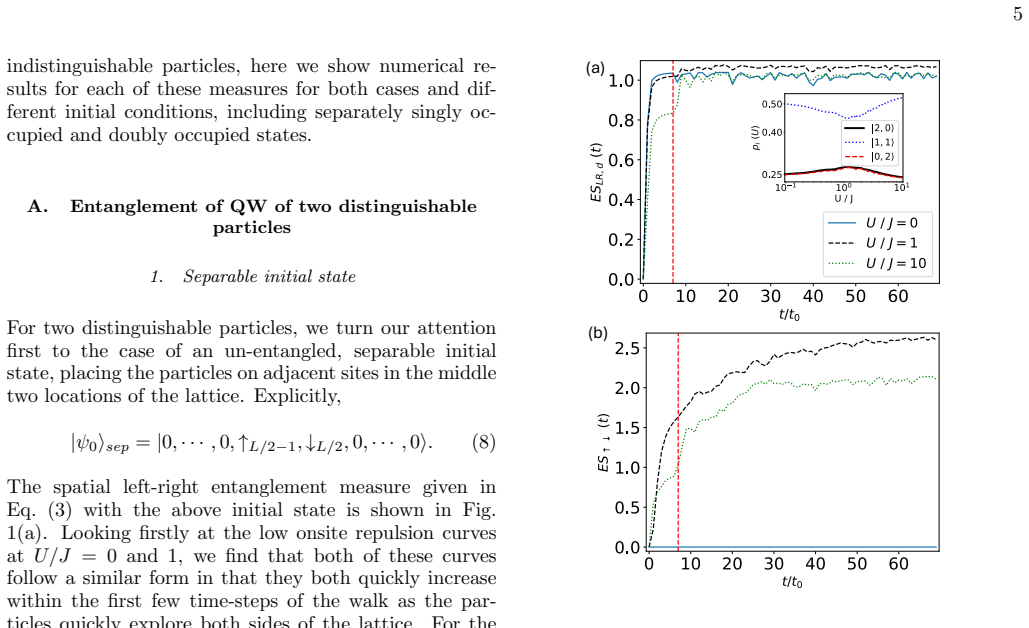
Separable initial state For two distinguishable particles, we turn our attention first to the case of an un-entangled, separable initial state, placing the particles on adjacent sites in the middle two locations of the lattice. Explicitly, |ψ0⟩sep =|0,· · ·,0,↑ L/2−1,↓ L/2,0,· · ·,0⟩.(8) The spatial left-right entanglement measure given in Eq. (3) with th...
-
[6]
Explicitly, |ψ0⟩ent = 1√ 2(|0,· · ·,↑ L/2−1,↓ L/2,· · ·,0⟩+ |0,· · ·,↓ L/2−1,↑ L/2,· · ·,0⟩).(9) We start with the left-right entanglement measure shown in Fig
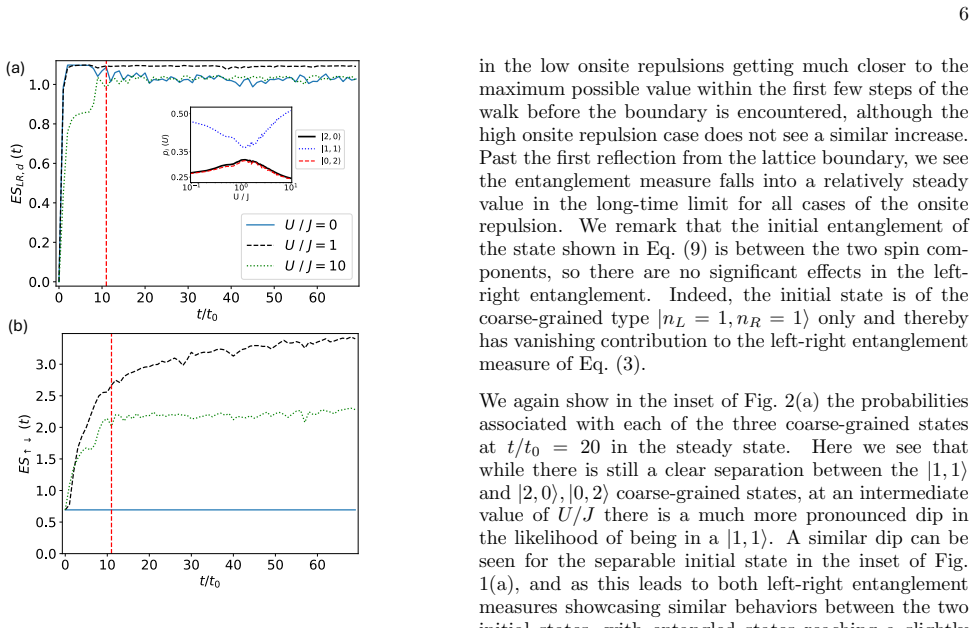
Entangled initial state Next, we look at the same spatial left-right and↑,↓en- tanglement measures from an entangled initial state of the two distinguishable particles across the middle two sites of the lattice. Explicitly, |ψ0⟩ent = 1√ 2(|0,· · ·,↑ L/2−1,↓ L/2,· · ·,0⟩+ |0,· · ·,↓ L/2−1,↑ L/2,· · ·,0⟩).(9) We start with the left-right entanglement measur...
-
[7]
Here we start the QW with both particles placed on the same lattice site near the middle
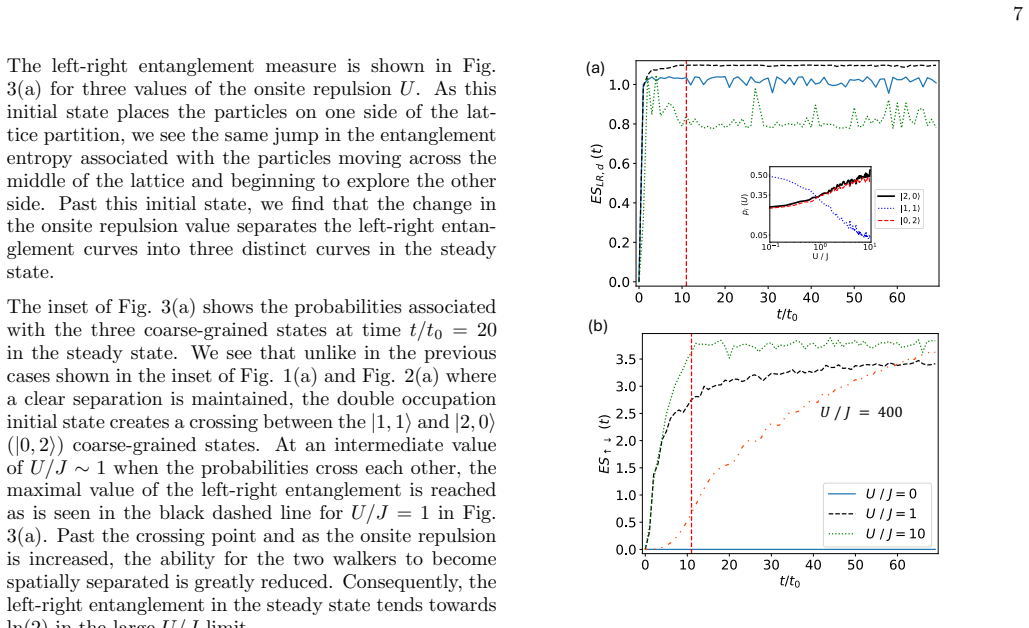
Doubly occupied initial state In the previous sections, the initial states for both the separable and entangled initial states were created with particles placed such that the initial lattice states were only singly occupied. Here we start the QW with both particles placed on the same lattice site near the middle. Explicitly, |ψ0⟩d,d =|0,· · ·,0,↑ L/2,↓ L...
-
[8]
We start with the adjacent, singly occupied initial state |ψ0⟩s,i =|0,· · ·,0,1 L/2−1,1 L/2,0,· · ·0⟩,(11) which is a symmetrized bosonic Fock state [16]
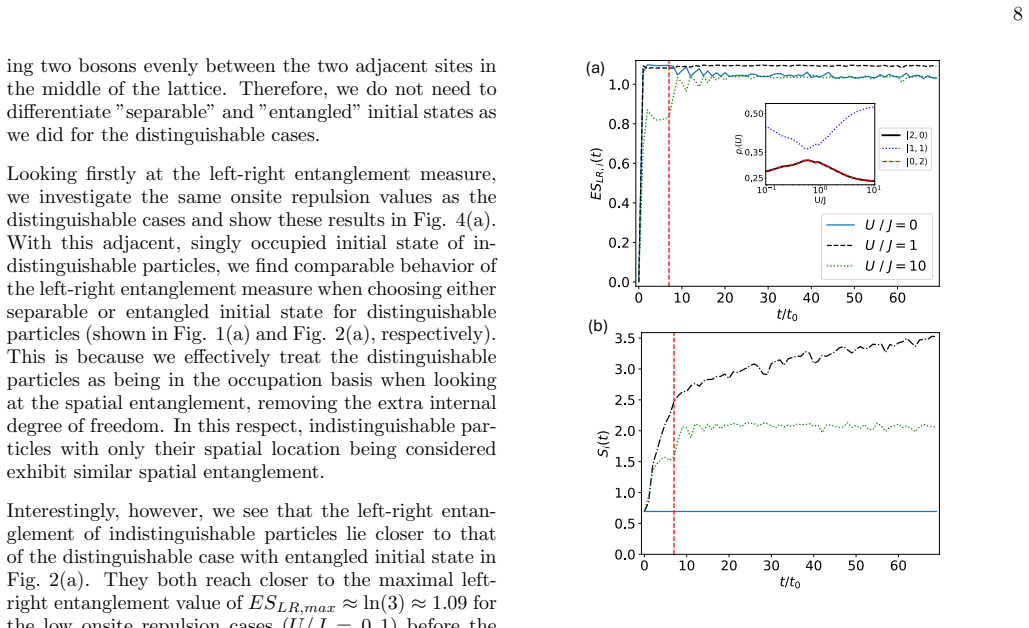
Singly occupied, adjacent initial state We now look at the entanglement measures defined for the indistinguishable two-particle walk. We start with the adjacent, singly occupied initial state |ψ0⟩s,i =|0,· · ·,0,1 L/2−1,1 L/2,0,· · ·0⟩,(11) which is a symmetrized bosonic Fock state [16]. For iden- tical particles, this is the only possible state for distr...
-
[9]
5(a) shows the left-right entanglement entropy for different values of the onsite repulsion
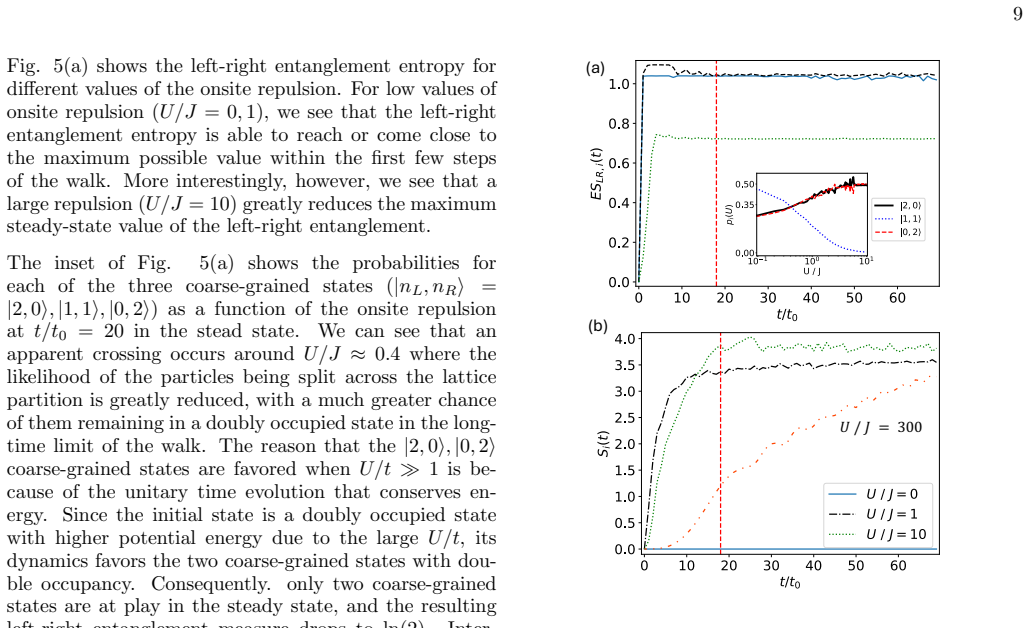
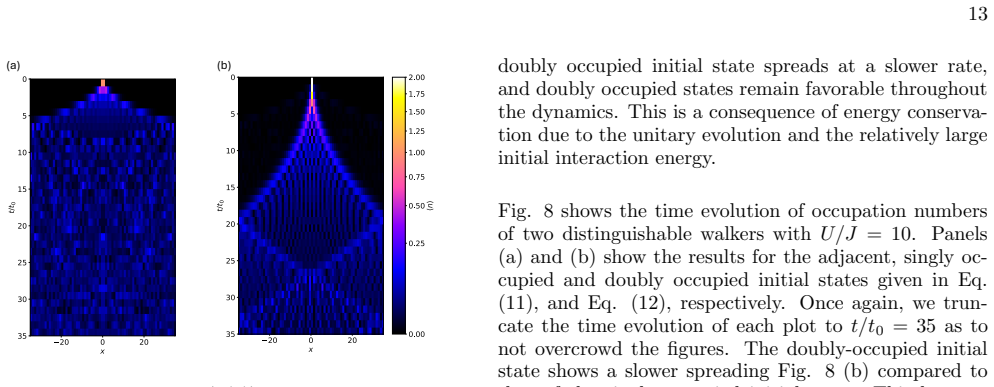
Doubly occupied initial state We also analyze the entanglement measures with a dou- bly occupied initial state for indistinguishable particles given by |ψ0⟩d,i =|0,· · ·,0,2 L/2,0,· · ·0⟩.(12) 9 Fig. 5(a) shows the left-right entanglement entropy for different values of the onsite repulsion. For low values of onsite repulsion (U/J= 0,1), we see that the l...
-
[10]
The initial state is taken as (a) separable, (b) entangled, and (c) double occupancy initial state given in Eq. (8), Eq. (9), and Eq. (10) respectively. The red dashed vertical line indicates the time when the particles reach the boundary and reflect off. from the left to the right. The density matrix can then be constructed asρ tot =|ψ tot⟩⟨ψtot|, which ...
-
[11]
J. Kempe, Quantum random walks: An introduc- tory overview, Contemporary Physics44, 307 (2003), https://doi.org/10.1080/00107151031000110776
-
[12]
Wang and K
J. Wang and K. Manouchehri,Physical Implementations of Quantum Walks(Springer, Berlin, Germany, 2014)
2014
-
[13]
S. E. Venegas-Andraca, Quantum walks: a comprehen- sive review, Quantum Information Processing11, 1015 (2012)
2012
-
[14]
Kadian, S
K. Kadian, S. Garhwal, and A. Kumar, Quantum walk and its application domains: A systematic review, Com- put. Sci. Rev41, 100419 (2021)
2021
-
[15]
Ambainis, Quantum walks and their algorithmic applications, Int
A. Ambainis, Quantum walks and their algorithmic applications, Int. J. Quantum Inf.01, 507 (2003), https://doi.org/10.1142/S0219749903000383
-
[16]
Apers, S
S. Apers, S. Chakraborty, L. Novo, and J. Roland, Quadratic speedup for spatial search by continuous-time quantum walk, Phys. Rev. Lett.129, 160502 (2022)
2022
-
[17]
Solenov and L
D. Solenov and L. Fedichkin, Continuous-time quantum walks on a cycle graph, Phys. Rev. A73, 012313 (2006)
2006
-
[18]
Herrman and T
R. Herrman and T. S. Humble, Continuous-time quan- tum walks on dynamic graphs, Phys. Rev. A100, 012306 (2019)
2019
-
[19]
P. Prerana and S. Wald, Entanglement capacity of complex networks from quantum walks (2026), arXiv:2605.00772 [quant-ph]
Pith/arXiv arXiv 2026
-
[20]
Coleman,Introduction to many-body physics(Cam- bridge University Press, 2015)
P. Coleman,Introduction to many-body physics(Cam- bridge University Press, 2015)
2015
-
[21]
Amico, D
L. Amico, D. Anderson, M. Boshier, J.-P. Brantut, L.-C. Kwek, A. Minguzzi, and W. von Klitzing, Colloquium: Atomtronic circuits: From many-body physics to quan- tum technologies, Rev. Mod. Phys.94, 041001 (2022)
2022
-
[22]
Browaeys and T
A. Browaeys and T. Lahaye, Many-body physics with in- dividually controlled rydberg atoms, Nature Physics16, 132 (2020)
2020
-
[23]
Eisert, M
J. Eisert, M. Friesdorf, and C. Gogolin, Quantum many- body systems out of equilibrium, Nature Physics11, 124 (2015)
2015
-
[24]
Fehske, R
H. Fehske, R. Schneider, and A. Weisse,Computational many-particle physics(Springer, 2007)
2007
-
[25]
Avella and F
A. Avella and F. Mancini, eds.,Strongly correlated sys- tems: Theoretical methods(Springer Berlin, Heidelberg, Germany, 2012)
2012
-
[26]
J. W. Negele,Quantum many-particle systems(CRC Press, London, England, 2019)
2019
-
[27]
Ostahie, D
B. Ostahie, D. Sticlet, C. u. u. u. u. P. m. c. Moca, B. D´ ora, M. A. Werner, J. K. Asb´ oth, and G. Zar´ and, Multiparticle quantum walk: A dynamical probe of topo- logical many-body excitations, Phys. Rev. B108, 035126 (2023)
2023
-
[28]
M. G. de Andrade, W. Dai, S. Guha, and D. Towsley, A quantum walk control plane for distributed quantum computing in quantum networks, in2021 IEEE Interna- tional Conference on Quantum Computing and Engineer- ing (QCE)(2021) pp. 313–323
2021
-
[29]
A. M. Childs, D. Gosset, and Z. Webb, Universal computation by multiparticle quantum walk, Science339, 791 (2013), https://www.science.org/doi/pdf/10.1126/science.1229957
-
[30]
J. J. Sakurai and J. Napolitano,Modern Quantum Me- chanics, 2nd ed. (Addison Wesley Longman, Boston, MA, 2010)
2010
-
[31]
H. A. Carteret, N. Linden, S. Popescu, and A. Sudbery, Multiparticle entanglement, Foundations of Physics29, 527 (1999)
1999
-
[32]
J. Eisert and D. Gross, Multi-particle entanglement (2006), arXiv:quant-ph/0505149 [quant-ph]
Pith/arXiv arXiv 2006
-
[33]
X.-G. Wen, Choreographed entangle- ment dances: Topological states of quan- tum matter, Science363, eaal3099 (2019), https://www.science.org/doi/pdf/10.1126/science.aal3099
-
[34]
Mastandrea and C.-C
C. Mastandrea and C.-C. Chien, Robustness and classi- cal proxy of entanglement in variants of quantum walks, Phys. Rev. E110, 064124 (2024)
2024
-
[35]
M. Yamagishi, N. Hatano, K. Kawabata, C. Kiumi, A. Nishino, F. Nori, and H. Obuse, Quantum walk with a local spin interaction (2026), arXiv:2603.24444 [quant- 14 ph]
arXiv 2026
-
[36]
S. K. Goyal and C. M. Chandrashekar, Spatial entan- glement using a quantum walk on a many-body system, Journal of Physics A: Mathematical and Theoretical43, 235303 (2010)
2010
-
[37]
Camacho, J
G. Camacho, J. Meinecke, and J. Wolters, Quantum walk on a square lattice with identical particles, Phys. Rev. A 111, 052416 (2025)
2025
-
[38]
Zhuang, Z
Q. Zhuang, Z. Zhang, and J. H. Shapiro, Distributed quantum sensing using continuous-variable multipartite entanglement, Phys. Rev. A97, 032329 (2018)
2018
-
[39]
Liu, Y.-B
Y.-C. Liu, Y.-B. Cheng, X.-B. Pan, Z.-Z. Sun, D. Pan, and G.-L. Long, Quantum integrated sensing and com- munication via entanglement, Phys. Rev. Appl.22, 034051 (2024)
2024
-
[40]
Zhang, S
Z. Zhang, S. Mouradian, F. N. C. Wong, and J. H. Shapiro, Entanglement-enhanced sensing in a lossy and noisy environment, Phys. Rev. Lett.114, 110506 (2015)
2015
-
[41]
R. Jozsa and N. Linden, On the role of en- tanglement in quantum-computational speed-up, Proceedings of the Royal Society A: Mathemati- cal, Physical and Engineering Sciences459, 2011 (2003), https://royalsocietypublishing.org/rspa/article- pdf/459/2036/2011/640791/rspa.2002.1097.pdf
arXiv 2011
-
[42]
Dadras, A
S. Dadras, A. Gresch, C. Groiseau, S. Wimberger, and G. S. Summy, Quantum walk in momentum space with a bose-einstein condensate, Phys. Rev. Lett.121, 070402 (2018)
2018
-
[43]
B. C. Travaglione and G. J. Milburn, Implementing the quantum random walk, Phys. Rev. A65, 032310 (2002)
2002
-
[44]
Zhou, X.-W
W.-H. Zhou, X.-W. Wang, R.-J. Ren, Y.-X. Fu, Y.-J. Chang, X.-Y. Xu, H. Tang, and X.-M. Jin, Multi-particle quantum walks on 3D integrated photonic chip, Light Sci. Appl.13, 296 (2024)
2024
-
[45]
Gr¨ afe, R
M. Gr¨ afe, R. Heilmann, M. Lebugle, D. Guzman-Silva, A. Perez-Leija, and A. Szameit, Integrated photonic quantum walks, J. Opt.18, 103002 (2016)
2016
-
[46]
Zhou, X.-W
W.-H. Zhou, X.-W. Wang, R.-J. Ren, Y.-X. Fu, Y.-J. Chang, X.-Y. Xu, H. Tang, and X.-M. Jin, Multi-particle quantum walks on 3d integrated photonic chip, Light: Science & Applications13, 296 (2024)
2024
-
[47]
M. A. Nielsen and I. L. Chuang,Quantum Computation and Quantum Information: 10th Anniversary Edition (Cambridge University Press, Cambridge, UK, 2010)
2010
-
[48]
H. M. Wiseman and J. A. Vaccaro, Entanglement of indistinguishable particles shared between two parties, Phys. Rev. Lett.91, 097902 (2003)
2003
-
[49]
Benatti, R
F. Benatti, R. Floreanini, F. Franchini, and U. Mar- zolino, Entanglement in indistinguishable particle sys- tems, Physics Reports878, 1 (2020)
2020
-
[50]
Y. S. Li, B. Zeng, X. S. Liu, and G. L. Long, Entangle- ment in a two-identical-particle system, Phys. Rev. A64, 054302 (2001)
2001
-
[51]
B. J. Dalton, J. Goold, B. M. Garraway, and M. D. Reid, Quantum entanglement for systems of identical bosons: I. general features, Phys. Scr.92, 023004 (2017)
2017
-
[52]
Morris, B
B. Morris, B. Yadin, M. Fadel, T. Zibold, P. Treutlein, and G. Adesso, Entanglement between identical parti- cles is a useful and consistent resource, Phys. Rev. X10, 041012 (2020)
2020
-
[53]
Lambert, E
N. Lambert, E. Gigu‘ere, P. Menczel, B. Li, P. Hopf, G. Su’arez, M. Gali, J. Lishman, R. Gadhvi, R. Agarwal, A. Galicia, N. Shammah, P. Nation, J. R. Johansson, S. Ahmed, S. Cross, A. Pitchford, and F. Nori, Qutip 5: The quantum toolbox in Python, Physics Reports1153, 1 (2026)
2026
-
[54]
Salomon, G
C. Salomon, G. V. Shlyapnikov, and L. F. Cugliandolo, Many-Body Physics with Ultracold Gases: Lecture Notes of the Les Houches Summer School: Volume 94, July 2010(Oxford University Press, 2012) Chap. 4
2010
-
[55]
Strang,Linear Algebra and Its Applications(Thom- son, Brooks/Cole, Belmont, CA, 2006)
G. Strang,Linear Algebra and Its Applications(Thom- son, Brooks/Cole, Belmont, CA, 2006)
2006
-
[56]
Klema and A
V. Klema and A. Laub, The singular value decompo- sition: Its computation and some applications, IEEE Transactions on Automatic Control25, 164 (1980)
1980
-
[57]
Paˇ skauskas and L
R. Paˇ skauskas and L. You, Quantum correlations in two- boson wave functions, Phys. Rev. A64, 042310
-
[58]
Wang and B
X. Wang and B. C. Sanders, Canonical entanglement for two indistinguishable particles, Journal of Physics A: Mathematical and General38, L67 (2005)
2005
-
[59]
Naudts and T
J. Naudts and T. Verhulst, Ensemble-averaged entangle- ment of two-particle states in fock space, Phys. Rev. A 75, 062104 (2007)
2007
-
[60]
Kapcia and S
K. Kapcia and S. Robaszkiewicz, The effects of the next-nearest-neighbour density–density interaction in the atomic limit of the extended hubbard model, Journal of Physics: Condensed Matter23, 105601 (2011)
2011
-
[61]
Hofmann and M
F. Hofmann and M. Potthoff, Doublon dynamics in the extended fermi-hubbard model, Phys. Rev. B85, 205127 (2012)
2012
-
[62]
Strohmaier, D
N. Strohmaier, D. Greif, R. J¨ ordens, L. Tarruell, H. Moritz, T. Esslinger, R. Sensarma, D. Pekker, E. Alt- man, and E. Demler, Observation of elastic doublon de- cay in the fermi-hubbard model, Phys. Rev. Lett.104, 080401 (2010)
2010
-
[63]
Winkler, G
K. Winkler, G. Thalhammer, F. Lang, R. Grimm, J. H. Denschlag, A. J. Daley, A. Kantian, H. P. B¨ uchler, and P. Zoller, Repulsively bound atom pairs in an optical lat- tice, Nature441, 853 (2006)
2006
-
[64]
Chien, D
C.-C. Chien, D. Gruss, M. D. Ventra, and M. Zwolak, Interaction-induced conducting–non-conducting transi- tion of ultra-cold atoms in one-dimensional optical lat- tices, New Journal of Physics15, 063026 (2013)
2013
-
[65]
Acasiete, F
F. Acasiete, F. P. Agostini, J. K. Moqadam, and R. Por- tugal, Implementation of quantum walks on ibm quan- tum computers, Quantum Information Processing19, 426 (2020)
2020
-
[66]
Georgopoulos, C
K. Georgopoulos, C. Emary, and P. Zuliani, Comparison of quantum-walk implementations on noisy intermediate- scale quantum computers, Phys. Rev. A103, 022408 (2021)
2021
-
[67]
Tornow and K
S. Tornow and K. Ziegler, Measurement-induced quan- tum walks on an ibm quantum computer, Phys. Rev. Res.5, 033089 (2023)
2023
-
[68]
Cramer, M
M. Cramer, M. B. Plenio, S. T. Flammia, R. Somma, D. Gross, S. D. Bartlett, O. Landon-Cardinal, D. Poulin, and Y.-K. Liu, Efficient quantum state tomography, Nat. Commun.1, 149 (2010)
2010
-
[69]
Karski, L
M. Karski, L. F¨ orster, J.-M. Choi, A. Steffen, W. Alt, D. Meschede, and A. Widera, Quantum walk in position space with single optically trapped atoms, Science325, 174 (2009)
2009
-
[70]
T. J. Dunn, I. A. Walmsley, and S. Mukamel, Experimen- tal determination of the quantum-mechanical state of a molecular vibrational mode using fluorescence tomogra- phy, Phys. Rev. Lett.74, 884 (1995)
1995
-
[71]
C.-K. Hu, C. Wei, C. Liu, L. Che, Y. Zhou, G. Xie, H. Qin, G. Hu, H. Yuan, R. Zhou, S. Liu, D. Tan, T. Xin, 15 and D. Yu, Experimental sample-efficient quantum state tomography via parallel measurements, Phys. Rev. Lett. 133, 160801 (2024)
2024
-
[72]
Baumgratz, D
T. Baumgratz, D. Gross, M. Cramer, and M. B. Plenio, Scalable reconstruction of density matrices, Phys. Rev. Lett.111, 020401 (2013)
2013
-
[73]
Gigena and R
N. Gigena and R. Rossignoli, Bipartite entanglement in fermion systems, Phys. Rev. A95, 062320 (2017)
2017
-
[74]
Lo Franco and G
R. Lo Franco and G. Compagno, Quantum entanglement of identical particles by standard information-theoretic notions, Scientific Reports6, 20603 (2016)
2016
-
[75]
O. Tziperman, D. Nabben, R. Ruimy, J. Holder, E. Nussinson, Y. Fang, A. Gorlach, D. Kazenwadel, A. Karnieli, I. Kaminer, and P. Baum, Two-electron quantum walks for probing entanglement and deco- herence in an electron microscope, Nature Physics 10.1038/s41567-026-03254-y (2026)
-
[76]
M. K. Giri, S. Mondal, B. P. Das, and T. Mishra, Two component quantum walk in one-dimensional lattice with hopping imbalance, Scientific Reports11, 22056 (2021)
2021
discussion (0)
Sign in with ORCID, Apple, or X to comment. Anyone can read and Pith papers without signing in.