REVIEW 2 major objections 4 minor 4 cited by
Multi-impurity method for the bond-weighted tensor renormalization group
T0 review · 2 major / 4 minor · reviewed 2026-08-12 · deepseek-v4-flash
Pith's one-line read This paper claims that replacing bond weights with impurity matrices lets BWTRG compute higher-order moments, and that at $k=-1/2$ it estimates the Ising critical temperature with relative error below $10^{-7}$ more efficiently than…
desk verdict Solid algorithmic extension with an over-reaching efficiency claim that the authors should be pushed to reconcile. read the letter →
The pith
A machine-rendered reading of the paper's core claim, the machinery that carries it, and where it could break.
The reading
What carries the argument
The load-bearing object is the bond-weighted triad tensor network: a square lattice of three-index isometric tensors $A_i$ at plaquette corners connected by diagonal bond weights $\sigma_j$ (inner) and $\tau_j$ (outer). The mechanism is the substitution rule of Eqs. (6)-(9): the renormalized inner impurity matrix is $\tilde S_j = \tau_j^{-k'} T_j \tau_j^{-k'}$, with $k'=(1-k)/2$, and the renormalized outer impurity matrix is the weighted average, over all placements of $n$ impurities, of a multilinear map $R(M_1,M_2,M_3,M_4)$ built from the current tensors and weights. Because the isometries and bond weights come from the same impurity-free SVD for every impurity configuration, the systematic summation over impurity positions carries all moments through the renormalization at $O(\chi^5)$ cost; the hyperparameter $k$ tunes the accuracy and is set to $-1/2$.
What would settle it
Compute $\langle m^2\rangle$ and $\langle m^4\rangle$ for the Ising model at $T=2.26$ with the proposed fixed-isometry impurity update at $\chi=64$ and $\chi=128$, then repeat with isometries recomputed from the SVD of each impurity-inserted network; if the two moment estimates differ by more than the truncation error, or if the estimated $T_c$ shifts by more than $10^{-7}$, the shared impurity-free isometry choice is the limiting approximation rather than a harmless simplification.
Extended reading notes
Core claim
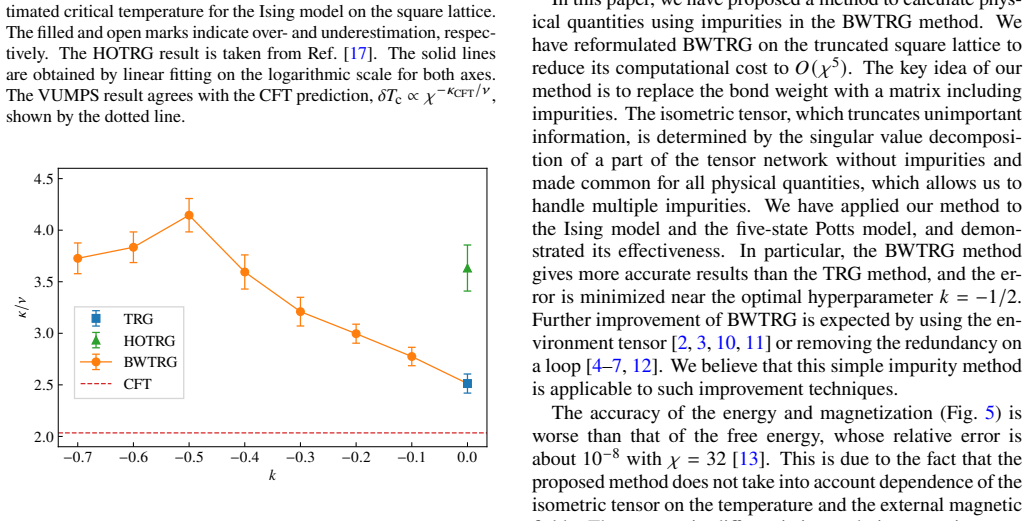
The central claim is that in a bond-weighted triad tensor network, an impurity matrix inserted at the position of a bond weight can represent a physical observable, and that systematic summation over impurity positions yields renormalized impurity matrices for moments of any order. Because the isometric tensors are computed once from the impurity-free singular value decomposition and shared by all moments, multiple impurities can be handled without repeated decompositions, making the algorithm $O(\chi^5)$. Numerically, for the Ising model at $\chi=128$ the method reproduces energy and magnetization consistent with exact results, improves on TRG across the hyperparameter $k$, and gives critical exponents and $T_c$ estimates that agree with exact values to 0.39% for $1/\nu$, 2.2% for $2\beta/\nu$, and $10^{-7}$ for $T_c$. For the five-state Potts model at $\chi=150$, the jumps in energy and magnetization at the first-order transition are substantially better estimated than by TRG. The paper further claims that the exponent $\kappa/\nu$ controlling $\delta T_c \sim \chi^{-\kappa/\nu}$ varies continuously with $k$ and reaches about 4.0 at $k=-1/2$, larger than the CFT value for MPS, and that after comparing $O(\chi^5)$ with $O(\chi^3)$ cost the BWTRG error decays as $t^{-0.80}$ versus $t^{-0.68}$ for VUMPS.
Load-bearing premise
The load-bearing assumption is that the isometric tensors obtained from the impurity-free singular value decomposition remain accurate when inserted into impurity networks, so that fixed truncation does not systematically bias the computed higher-order moments.
Editorial extensions
If this is right
- Moments of arbitrary order, for example the Binder ratio $\langle m^4\rangle/\langle m^2\rangle^2$, are available from one BWTRG run at $O(\chi^5)$ cost, allowing bond dimensions of 128-150 that were impractical with the earlier $O(\chi^7)$ HOTRG impurity method.
- At $k=-1/2$, the energy and magnetization of the Ising and five-state Potts models are consistently more accurate than TRG at equal bond dimension, with the relative error crossing the exact value near the optimal hyperparameter.
- The dimensionless fixed-point quantity $X_1$ satisfies the same $g(L^{1/\nu}t)$ scaling form as the Binder parameter and takes its CFT value at criticality, so it can be used to locate $T_c$ and $\nu$ without fitting the magnetization amplitude.
- The estimated critical temperature follows $\delta T_c \propto \chi^{-\kappa/\nu}$ with $\kappa/\nu\simeq 4.0$ at $k=-1/2$; after accounting for the $O(\chi^5)$ cost, the error decays as $t^{-0.80}$, beating the $t^{-0.68}$ of VUMPS.
- BWTRG at $\chi=128$ avoids the rank reduction caused by the corner double-line redundancy up to $L=2^{25}$, whereas TRG at the same bond dimension rank-reduces at $L=2^{20}$, so the reported scaling is governed by finite size rather than finite entanglement.
Reading between the lines
- The bond-weight-substitution idea should transfer directly to BWTRG variants on other geometries and to Grassmann tensor networks for fermions, where the same $O(\chi^5)$ moment calculation would apply; the paper does not test these cases.
- Because the isometries are shared by all moments, the fourth-order Binder cumulant and higher reduced cumulants can be extracted from the same run; their $\chi$-convergence would be a sharp test of whether the fixed-isometry approximation biases moments.
- The measured $\kappa/\nu \simeq 4.0$ at $k=-1/2$, compared with $\kappa_{\mathrm{CFT}}=2.034$ for MPS, suggests that the effective correlation length in BWTRG is not governed by the same finite-entanglement mechanism; identifying that mechanism could turn $k$ into a tunable knob for critical-point calculations.
- Since the isometries ignore temperature and field dependence, the energy and magnetization errors exceed the free-energy error; a hybrid using environment-tensor-improved isometries while keeping the impurity update could reduce those errors without leaving $O(\chi^5)$ scaling.
Editorial analysis
A structured set of objections, weighed in public.
Referee Report
Summary. The paper proposes a multi-impurity method for the bond-weighted tensor renormalization group (BWTRG), in which bond weights are replaced by impurity matrices in a triad tensor network to compute higher-order moments of physical observables. The method is formulated at O(chi^5) cost, and the authors benchmark it on the square-lattice Ising model and the five-state Potts model, reporting better accuracy than conventional TRG. They further use finite-size scaling of the dimensionless quantity X1 to extract critical exponents and the critical temperature with relative error below 10^-7. The paper's central efficiency claim is that BWTRG with the optimal hyperparameter k = -1/2 is more efficient in computational time than MPS-based approaches for estimating the critical temperature, based on a fitted exponent kappa/nu ~ 4.0 combined with the O(chi^5) scaling.
Significance. If the efficiency claim holds, the method is a valuable practical advance: it extends impurity techniques to a TRG-type algorithm with O(chi^5) cost, avoids the spreading of impurities through tensor decompositions, and delivers accurate higher-order moments in 2D classical models. The explicit update equations, the benchmarks against exact Onsager/Baxter results, and the open data repository are clear strengths. The main caveat is that the headline efficiency conclusion relies on an asymptotic exponent fitted over a narrow bond-dimension range and is not corroborated by wall-clock timings; the paper's own free-energy-error fits suggest a different exponent, so the central claim needs either additional support or qualification.
major comments (2)
- [Sec. III.B, Eq. (33), Fig. 10] The abstract's efficiency claim rests on the fitted exponent kappa/nu ~ 4.0 for BWTRG with k = -1/2, combined with Eq. (33) to obtain an error scaling t^{-0.80} versus t^{-0.68} for MPS. However, the paper itself cites free-energy-error fits giving kappa = 2.2 for the same BWTRG method and kappa = 2.0 for HOTRG (Refs. [13,37]). Since nu = 1 for the 2D Ising universality class, Eq. (33) would then predict delta T_c ~ chi^{-2.2}, not chi^{-4.0}. This factor-of-1.8 discrepancy is not addressed. If the asymptotic kappa/nu is about 2.2, the time exponents become 2.2/5 = 0.44 for BWTRG versus 2.034/3 = 0.68 for MPS, reversing the stated conclusion. The authors should either provide direct wall-clock timings, extend the fits to larger chi with an explicit treatment of corrections to scaling, or substantially qualify the claim in the abstract.
- [Sec. III.B, Fig. 9] The delta T_c data in Fig. 9 oscillate as a function of chi, and the fits are performed over only a factor-of-4 range (chi = 32 to 128). No wall-clock timings are reported. Because the efficiency comparison is derived from the asymptotic slope of delta T_c versus chi, the narrow, oscillatory data do not establish that the fitted exponent is the asymptotic kappa/nu entering Eq. (33). A direct timing measurement, or a demonstration that the exponent is stable under corrections to scaling, is needed before the computational-efficiency claim can be accepted as stated.
minor comments (4)
- [Sec. II.D, Eq. (19)] The definition of the latent heat contains a typo: 'L = E(T_c+0) - L(T_c-0)' should read 'L = E(T_c+0) - E(T_c-0)'.
- [Sec. I] The introduction states that the last section is devoted to discussion and conclusion, but the final section is titled only 'Conclusions' and contains no separate discussion; this sentence should be updated.
- [Sec. III.A] For reproducibility, the authors provide a data repository, but not the implementation code; providing the code used for the BWTRG impurity updates and the FSS analysis would be helpful, especially because the efficiency claim depends on implementation details.
- [Sec. III.B] The statement that the relative error in the estimated critical temperature is less than 10^-7 would be more informative if the actual numerical value of delta T_c for chi = 128 were quoted, since Fig. 9 uses a logarithmic scale and the precise value is not easily read off.
Circularity Check
No circularity: the impurity update rules follow from linearity of the network contraction, the hyperparameter k=-1/2 comes from independent prior work, and all central accuracy claims are benchmarked against exact Onsager/Baxter results and CFT predictions.
full rationale
The paper's derivation chain is self-contained and externally benchmarked. The impurity update rules in Eqs. (6)-(9) are exact linear coarse-graining identities for a network with fixed isometries: Eq. (7) mirrors the bond-weight update Eq. (3), and Eqs. (8)-(9) average the multilinear map R over all impurity positions, so the moments are not defined in terms of the output claim. The initial impurity matrices (Eqs. (15)-(17), (25), (27)) are constructed from gauge transformations of the physical operators, not fitted. The optimal hyperparameter k=-1/2 is taken from independent prior work by Adachi, Okubo, and Todo [13], not from the present authors, and is used as an input rather than relabeled as a result. Accuracy claims are checked against external exact data: the Ising energy and magnetization, the exact latent heat and magnetization jump of the q=5 Potts model, and the CFT value X1=1.7635955 of Eq. (30). The finite-size scaling analysis uses standard data-collapse with exact critical exponents as targets. The efficiency comparison with MPS uses a fitted exponent kappa/nu ~ 4.0 from Fig. 10 together with the CFT-based VUMPS exponent; this is a scaling extrapolation, not a circular reduction. The paper itself flags the discrepancy with free-energy-error-derived kappa ~ 2.2 and acknowledges that the isometries are impurity-independent (Sec. IV), which is an honest limitation rather than evidence of circularity. The self-citations, e.g., [17] and [41], refer to prior methodology and related analyses but are not the sole justification for the central claims, which are validated independently here.
Assumptions & free parameters
free parameters (1)
- BWTRG hyperparameter k =
-1/2 (for most calculations; varied in Fig. 5 and Fig. 10)
assumptions (5)
- domain assumption Truncated SVD retaining the chi largest singular values approximates the exact contraction of the tensor network.
- ad hoc to paper The isometric tensors computed from the impurity-free network are also valid for networks with impurity matrices.
- domain assumption The dimensionless quantity X1 obeys the Binder-like finite-size scaling form X1 = g(L^(1/nu) t).
- domain assumption The universal value of X1 at criticality is given by the CFT expression Eq. (30).
- standard math Exact solutions for the Ising model and the q=5 Potts model (critical temperature, latent heat, magnetization jump) are correct.
Cite this review
Pith. "Pith review of Multi-impurity method for the bond-weighted tensor renormalization group." pith.science (2026). https://pith.science/paper/SNFQJV6N
@misc{pith2026241113998,
  author       = {Pith},
  title        = {Pith review of: Multi-impurity method for the bond-weighted tensor renormalization group},
  year         = {2026},
  howpublished = {\url{https://pith.science/paper/SNFQJV6N}},
  note         = {Machine review of arXiv:2411.13998}
}
read the original abstract
We propose a multi-impurity method for the bond-weighted tensor renormalization group (BWTRG) to compute the higher-order moment of physical quantities in a two-dimensional system. The replacement of the bond weight with an impurity matrix in a bond-weighted triad tensor network represents a physical quantity such as the magnetization and the energy. We demonstrate that the accuracy of the proposed method is much higher than the conventional tensor renormalization group for the Ising model and the five-state Potts model. Furthermore, we perform the finite-size scaling analysis and observe that the dimensionless quantity characterizing the structure of the fixed point tensor satisfies the same scaling relation in the critical region as the Binder parameter. The estimated critical temperature dependence on the bond dimension indicates that the exponent relating the correlation length to the bond dimension varies continuously with respect to the BWTRG hyperparameter. We find that BWTRG with the optimal hyperparameter is more efficient in terms of computational time than alternative approaches based on the matrix product state in estimating the critical temperature.
Figures


Figures from the paper (4 more)


Forward citations
Cited by 4 Pith papers
-
Deconfinement from Thermal Tensor Networks: Universal CFT signature in (2+1)-dimensional $\mathbb{Z}_N$ lattice gauge theory
Tensor-network contraction of finite-temperature Z_N gauge theory yields central charges and scaling dimensions consistent with Svetitsky–Yaffe universality for N=2,3,5, including a U(1)-symmetric BKT phase for N=5, a...
-
Forward-mode automatic differentiation for the tensor renormalization group and its relation to the impurity method
Forward-mode AD for TRG is derived with (k+1)(k+2)/2 cost scaling, linked to impurity methods, and tested on the 2D/3D Ising model for energy, specific heat, and critical exponents.
-
Markov Chain Monte Carlo in Tensor Network Representation
A tensor-network-based MCMC algorithm using stochastic projectors removes the systematic error of finite bond dimension truncation and shows exponential variance reduction on the 2D Ising model.
-
Grassmann Tensor Renormalization Group for two-flavor massive Schwinger model with a theta term
A Grassmann TRG calculation of the Nf=2 massive Schwinger model finds 2pi-periodic free energy that matches large-mass analytics and suggests finite-beta deviations from the continuum phase structure.
Reference graph
Works this paper leans on
-
[1]
M. Levin and C. P. Nave, Tensor Renormalization Group Ap- proach to Two-Dimensional Classical Lattice Models, Phys. Rev. Lett. 99, 120601 (2007)
work page 2007
-
[2]
Hereafter, we use 𝑠 for the spin basis, and 𝑎,𝑏,𝑐 for the symmetric basis. After applying the gauge transformation to all the bonds, we have the initial tensor network with theZ2 symmetry [22–24]. Eventually, the initial bond weights are 𝜎𝑗 = 1 0 0 1 , 𝜏 𝑗 = 2 cosh𝐾 0 0 2 sinh 𝐾 , (12) where we define a dimensionless quantity 𝐾 ≡ 𝐽/𝑇. An element of the in...
-
[3]
Z. Y. Xie, J. Chen, M. P. Qin, J. W. Zhu, L. P. Yang, and T. Xiang, Coarse-graining renormalization by higher-order singular value decomposition, Phys. Rev. B86, 045139 (2012)
2012
-
[4]
Z. Xie, H. Jiang, Q. Chen, Z. Weng, and T. Xiang, Second renormalization of tensor-network states, Phys. Rev. Lett. 103, 160601 (2009)
work page 2009
-
[5]
G. Evenbly and G. Vidal, Tensor Network Renormalization, Phys. Rev. Lett.115, 180405 (2015)
work page 2015
-
[6]
Yang, Z.-C
S. Yang, Z.-C. Gu, and X.-G. Wen, Loop Optimization for Tensor Network Renormalization, Phys. Rev. Lett.118, 110504 (2017)
2017
- [7]
-
[8]
Harada, Entanglement branching operator, Phys
K. Harada, Entanglement branching operator, Phys. Rev. B 97, 045124 (2018)
2018
Show all 43 references
-
[9]
Adachi, T
D. Adachi, T. Okubo, and S. Todo, Anisotropic tensor renor- malization group, Phys. Rev. B102, 054432 (2020)
2020
-
[10]
Kadoh and K
D. Kadoh and K. Nakayama, Renormalization group on a triad network (2019), arXiv:1912.02414
2019 arXiv
-
[11]
Morita and N
S. Morita and N. Kawashima, Global optimization of tensor renormalization group using the corner transfer matrix, Phys. Rev. B 103, 045131 (2021)
2021
-
[12]
Kadoh, H
D. Kadoh, H. Oba, and S. Takeda, Triad second renormalization group, J. High Energy Phys. 2022 (4), 121
2022
-
[13]
Homma, T
K. Homma, T. Okubo, and N. Kawashima, Nuclear norm regu- larized loop optimization for tensor network, Phys. Rev. Res.6, 043102 (2024)
2024
-
[14]
Adachi, T
D. Adachi, T. Okubo, and S. Todo, Bond-weighted tensor renor- malization group, Phys. Rev. B105, L060402 (2022)
2022
-
[15]
Akiyama, Bond-weighting method for the Grassmann tensor renormalization group, J
S. Akiyama, Bond-weighting method for the Grassmann tensor renormalization group, J. High Energy Phys. 2022 (11), 30
2022
-
[16]
Akiyama and Y
S. Akiyama and Y. Kuramashi, Tensor renormalization group study of(1+ 1)-dimensional𝑈(1) gauge-Higgs model at𝜃=𝜋 with L¨ uscher’s admissibility condition, J. High Energy Phys. 2024 (9), 86
2024
-
[17]
Z. C. Gu, M. Levin, and X. G. Wen, Tensor-entanglement renor- malization group approach as a unified method for symmetry breaking and topological phase transitions, Physical Review B 78, 205116 (2008)
2008
-
[18]
Morita and N
S. Morita and N. Kawashima, Calculation of higher-order mo- ments by higher-order tensor renormalization group, Comput. Phys. Commun. 236, 65 (2019)
2019
-
[19]
H. H. Zhao, Z. Y. Xie, Q. N. Chen, Z. C. Wei, J. W. Cai, and T. Xiang, Renormalization of tensor-network states, Phys. Rev. B 81, 174411 (2010)
2010
-
[20]
Morita, R
S. Morita, R. Igarashi, H.-H. Zhao, and N. Kawashima, Tensor renormalization group with randomized singular value decom- position, Phys. Rev. E97, 033310 (2018)
2018
-
[21]
Baxter, Exactly Solved Models in Statistical Mechanics , Dover Books on Physics (Dover, Mineola, NY, 2007)
R. Baxter, Exactly Solved Models in Statistical Mechanics , Dover Books on Physics (Dover, Mineola, NY, 2007)
2007
-
[22]
B. M. McCoy and T. T. Wu,The Two-Dimensional Ising Model: Second Edition(Dover Publications, Mineola, New York, 2014)
2014
-
[23]
Singh, R
S. Singh, R. N. C. Pfeifer, and G. Vidal, Tensor network decom- positions in the presence of a global symmetry, Phys. Rev. A82, 050301(R) (2010)
2010
-
[24]
Singh, R
S. Singh, R. N. C. Pfeifer, and G. Vidal, Tensor network states and algorithms in the presence of a global U(1) symmetry, Phys. Rev. B 83, 115125 (2011)
2011
-
[25]
https://github.com/mhauru/abeliantensors
-
[26]
F. Y. Wu, The Potts model, Rev. Mod. Phys.54, 235 (1982)
1982
-
[27]
R. J. Baxter, Potts model at the critical temperature, J. Phys. C: Solid State Phys. 6, L445 (1973)
1973
-
[28]
R. J. Baxter, Magnetisation discontinuity of the two-dimensional potts model, J. Phys. A: Math. Gen. 15, 3329 (1982)
1982
-
[29]
Binder, Finite size scaling analysis of ising model block distribution functions, Z
K. Binder, Finite size scaling analysis of ising model block distribution functions, Z. Phys. B 43, 119 (1981)
1981
-
[30]
Binder, Critical properties from Monte Carlo Coarse graining and renormalization, Phys
K. Binder, Critical properties from Monte Carlo Coarse graining and renormalization, Phys. Rev. Lett.47, 693 (1981)
1981
-
[31]
Z. C. Gu and X. G. Wen, Tensor-entanglement-filtering renor- malization approach and symmetry-protected topological order, Phys. Rev. B80, 155131 (2009)
2009
-
[32]
Harada, Bayesian inference in the scaling analysis of critical phenomena, Phys
K. Harada, Bayesian inference in the scaling analysis of critical phenomena, Phys. Rev. E84, 056704 (2011)
2011
-
[33]
https://github.com/KenjiHarada/FSS-tools
-
[34]
Zauner-Stauber, L
V. Zauner-Stauber, L. Vanderstraeten, M. T. Fishman, F. Ver- straete, and J. Haegeman, Variational optimization algorithms for uniform matrix product states, Phys. Rev. B 97, 045145 (2018)
2018
-
[35]
Vanderstraeten, J
L. Vanderstraeten, J. Haegeman, and F. Verstraete, Tangent- space methods for uniform matrix product states, SciPost Phys. Lect. Notes 2019, 7 (2019). 10
2019
-
[36]
Pollmann, S
F. Pollmann, S. Mukerjee, A. M. Turner, and J. E. Moore, The- ory of finite-entanglement scaling at one-dimensional quantum critical points, Phys. Rev. Lett.102, 255701 (2009)
2009
-
[37]
Pirvu, G
B. Pirvu, G. Vidal, F. Verstraete, and L. Tagliacozzo, Matrix product states for critical spin chains: Finite-size versus finite- entanglement scaling, Phys. Rev. B86, 075117 (2012)
2012
-
[38]
H. Ueda, K. Okunishi, and T. Nishino, Doubling of entangle- ment spectrum in tensor renormalization group, Phys. Rev. B 89, 075116 (2014)
2014
-
[39]
M. E. Fisher and M. N. Barber, Scaling theory for finite-size effects in the critical region, Phys. Rev. Lett.28, 1516 (1972)
1972
-
[40]
J. M. Luck, Corrections to finite-size-scaling laws and conver- gence of transfer-matrix methods, Phys. Rev. B31, 3069 (1985)
1985
-
[41]
H. Shao, W. Guo, and A. W. Sandvik, Quantum criticality with two length scales, Science 352, 213 (2016)
2016
-
[42]
S. Iino, S. Morita, N. Kawashima, and A. W. Sandvik, De- tecting Signals of Weakly First-order Phase Transitions in Two- dimensional Potts Models, J. Phys. Soc. Jpn.88, 034006 (2019)
2019
-
[43]
https://datarepo.mdcl.issp.u-tokyo.ac.jp/repo/49
Reviewed August 12, 2026 · model on record in the stance chip above.
Discussion (0). Continue with ORCID to comment.