REVIEW 3 major objections 4 minor 50 references
RADLER: Radar Object Detection Leveraging Semantic 3D City Models and Self-Supervised Radar-Image Learning
T0 review · 3 major / 4 minor · reviewed 2026-08-16 · deepseek-v4-flash
Pith's one-line read Fusing semantic 3D city models with self-supervised radar learning lifts detection by 4.17 mAP.
desk verdict First fusion of semantic 3D city models with radar detection, but the 4.17-point mAP gain rests on a split that may leak scene content. read the letter →
The pith
A machine-rendered reading of the paper's core claim, the machinery that carries it, and where it could break.
The reading
What carries the argument
The load-bearing object is the semantic-depth map (SDM): a per-pixel map in which each direction of the scene carries both the semantic class and the distance of the nearest object surface from the semantic 3D city model, produced by raycasting and limited to the radar's 35-meter range. The paper's key move is to treat this map as an additional modality and fuse it channel-wise with the encoded range-azimuth radar features, rather than adding it element-wise, which is shown to generate ghost targets. The radar encoder itself is learned in a pretext task that maximizes agreement between range-azimuth maps and paired camera images using an InfoNCE contrastive loss with a momentum-updated queue of negative image samples; the design uses a Vision Transformer backbone. In the downstream task the transferred radar features are decoded into per-class confidence maps, and location-based non-maximum suppression turns those maps into detection lists.
What would settle it
Re-split the RadarCity downstream data so that every frame of a given object instance or continuous recording segment is assigned entirely to training or entirely to testing, retrain RADLER, and compare; if the 4.17-point mAP gain from SDM collapses, the claim that city-model priors generalize fails. A complementary test is evaluating on a completely unseen scene whose SDM is built from that scene's own city model.
Extended reading notes
Core claim
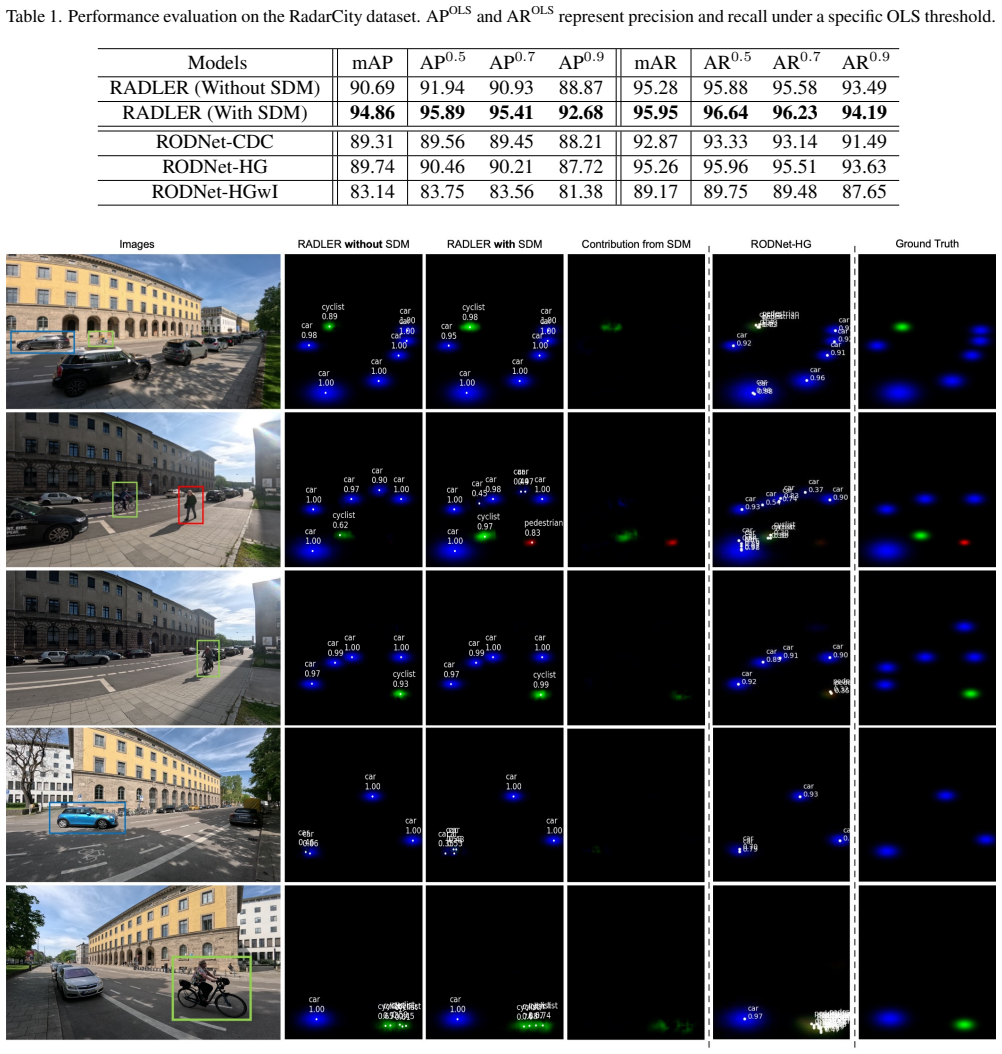
The central claim is that fusing semantic-depth maps (SDM) into a radar detector trained with radar-image contrastive learning improves detection of pedestrians, cyclists, and cars. SDM are generated by raycasting a semantic 3D city model so that every pixel carries the semantic class and distance of the nearest mapped surface, masked to the radar's 35-meter range. In RADLER, a radar encoder pretrained to align range-azimuth maps with camera images is transferred to a detection head, and its features are concatenated channel-wise with features extracted from the SDM by a residual CNN. The paper reports that this fusion raises mAP from 90.69% to 94.86% and mAR from 95.28% to 95.95% on the RadarCity test split, beating three RODNet variants by average margins of 5.46% mAP and 3.51% mAR, with consistent gains across overlap thresholds.
Load-bearing premise
The performance claims rest on the assumption that the 80/20 split of the annotated frames is a fair generalization test; the paper specifies only the split ratio, so if near-duplicate views of the same objects or scenes appear on both sides of the split, the reported gains could overstate performance on unseen scenes.
Editorial extensions
If this is right
- Radar detectors no longer need to rely on dense annotations or extra sensors alone; standardized semantic 3D city models, which already exist at scale, can supply geometric and semantic context.
- Because SDM improve mAP by 4.17 points but mAR by only 0.67, the prior's main effect is suppressing false positives and sharpening confidence, not finding objects the radar missed.
- The contrastive radar-image pretext step transfers to a different radar detection architecture and improves high-confidence detections on the CRUW dataset, indicating the learned representations localize objects more crisply than supervised pretraining.
- With SDM fusion, RADLER outperforms the strongest RODNet baseline at every evaluated overlap threshold, with the largest advantage at high OLS thresholds.
Reading between the lines
- A natural extension the paper leaves implicit is dynamic map conditioning: because SDM are static, a temporal or object-disjoint evaluation would clarify how much of the gain comes from geometry rather than from seeing the same scene during training.
- The mAP/mAR asymmetry suggests the fusion would be most valuable in precision-critical settings such as emergency braking; a testable variant would apply SDM fusion to tracking or 3D detection with a split that isolates unseen object identities.
- Since city models are absolutely georeferenced, RADLER could be extended to condition on the sensor's pose and query the relevant slice of a large city model on the fly, turning a per-scene prior into a scalable map prior.
- The high-confidence improvement from self-supervision on CRUW hints that cross-modal contrastive pretraining may improve confidence calibration generally, which could be tested by measuring calibration error on RADLER's confidence maps.
Signed reviews
Editorial analysis
A structured set of objections, weighed in public.
Referee Report
Summary. The paper introduces RadarCity, a dataset of 54K synchronized radar-image pairs collected in four static scenes, enriched with semantic 3D city models (CityGML). It proposes RADLER, a radar object detector that first learns radar representations via MoCo-style contrastive learning between range-azimuth (RA) maps and camera images, then fuses the learned features with semantic-depth maps (SDM) raycast from CityGML. On RadarCity, RADLER with SDM is reported to achieve 94.86% mAP and 95.95% mAR, versus 90.69% and 95.28% without SDM, and average improvements of 5.46% mAP and 3.51% mAR over three RODNet baselines. The self-supervised component is additionally evaluated on CRUW using RODNet-CDC, where it shows higher precision at large peak thresholds.
Significance. If the reported gains hold, the core idea of using openly available semantic 3D city models as a prior for radar-based object detection is novel, practical, and likely to stimulate follow-up work in map-supported perception. The dataset release with synchronized radar-image pairs and associated CityGML models is a useful community resource, and the project page is publicly available. The paper also provides internally consistent baseline comparisons against RODNet variants, and the CRUW experiments give some evidence that contrastive radar-image pretraining can improve peak-quality detection. However, the central performance claim currently rests on an evaluation protocol that may leak scene-level information and lacks variance reporting; these issues need to be resolved before the main conclusions are fully supported.
major comments (3)
- [Sec. 4 and Suppl. 7.3] The downstream train/test split is described only as an 80/20 ratio, and the data are collected stationarily as continuous recordings in four scenes. Because SDMs are static raycasts that are identical for every frame of a given scene (Sec. 5.1), a random frame-level split can place near-duplicate views of the same scene, and even the same object trajectories, in both training and test sets. This would directly inflate the SDM gain reported in Table 1 (90.69 to 94.86 mAP), since the static scene layout could be memorized from training frames. The paper does not state whether the split is temporal, scene-disjoint, or object-disjoint. Please rerun the evaluation with a leave-one-scene-out split or a temporal hold-out, and explicitly state the split criterion; this is load-bearing for the central claim.
- [Sec. 5.3 and Suppl. 8.1] All reported numbers in Table 1 come from a single training run, with no error bars, multiple seeds, or per-scene results. The L-NMS OLS threshold is described as 'empirically chosen to ensure the best performance of our RADLER and RODNet' (Sec. 5.3), and Fig. 13 reports threshold sweeps on the test data. With a single run, the 4.17-point mAP gain from SDM could be within run-to-run variance, and threshold selection on the test set can bias model comparisons. Please report mean and standard deviation over at least three seeds, and fix the threshold selection procedure (e.g., cross-validation or a pre-registered value) so that the comparison is not optimized on the test split.
- [Sec. 5.5] The self-supervised learning component is evaluated only on CRUW with RODNet-CDC, not on RadarCity. In Table 1, the comparison between RADLER (without SDM) and the RODNet baselines confounds the SSL-pretrained encoder with the ViT-based architecture and the overall training pipeline, so the specific contribution of contrastive SSL to the RadarCity results is not directly measured. Please add an ablation that trains the same detector architecture with and without the contrastive pretraining on RadarCity, or otherwise justify why the CRUW transfer evidence is sufficient to attribute the RadarCity gains to SSL.
minor comments (4)
- [Abstract and Sec. 1] The abstract contains typos: 'mean avarage precision' and 'mean avarage recall' appear twice; these should be corrected to 'mean average precision' and 'mean average recall'.
- [Sec. 5.2] The number of concatenated channels for the radar features and the SDM features in the channel-wise fusion is said to be 'empirically fine-tuned', but no final values are reported. Please provide the exact configuration used in the finalized model (Figure 8) for reproducibility.
- [Sec. 5.3] Training hyperparameters such as the InfoNCE temperature, momentum coefficient m, learning rate, batch size, and number of epochs are not reported for either the pretext or downstream tasks. Please include these details in the supplementary material.
- [Suppl. Sec. 7.2] Data cluster 3, which contains additional object classes such as trucks and vans, is described but it is not stated explicitly whether it is excluded from all experiments and why. Please clarify the role of cluster 3 in the reported evaluation.
Circularity Check
No significant circularity: RADLER's SDM priors come from external CityGML models, GT is manual annotation, and the reported gains are measured outputs rather than recovered inputs.
full rationale
The paper's derivation chain is self-contained with respect to circularity. The SDM prior is generated by raycasting Open3D on CityGML semantic 3D city models (Sec. 5.1), which are external geodata products, not outputs of the detection model. Ground truth ConfMaps are manually annotated (Sec. 7.3), independent of both the radar features and the SDM. The contrastive SSL pretext task (MoCo/InfoNCE, Eq. 1) and the downstream BCE detection loss (Eq. 3) are standard objectives trained on data; no parameter is fitted to the reported mAP/mAR and then renamed as a prediction. The claimed gains (Table 1) are measured on held-out frames under an 80/20 split (Sec. 4, Suppl. 7.3). The only legitimate concern is that the split is described only by ratio and data were collected stationarily in four scenes, so train/test frames may share scene layout or even object trajectories; that is an evaluation-validity or generalization risk, not a circular-derivation step, and per the review rules it belongs under correctness rather than circularity. Self-citations (e.g., TUM2TWIN [34], Scan2LoD3 [39], city model review [40]) are used as data sources or related work, not as load-bearing proof of the detection results. No equation in the paper reduces its central claim to its inputs by construction.
Assumptions & free parameters
free parameters (3)
- L-NMS OLS threshold =
not reported numerically
- Number of concatenated channels in radar-SDM fusion =
not reported
- SDM depth mask cutoff =
35 m
assumptions (4)
- domain assumption Semantic 3D city models of the test area (TUM campus) are geometrically accurate and semantically complete enough for raycasted SDM to be a reliable prior.
- domain assumption The device pose (location and orientation) can be determined accurately from a point cloud scan and remains fixed during data collection.
- domain assumption Contrastive SSL on 35K radar-image pairs transfers to the downstream radar detection task.
- domain assumption Manual annotations of object bounding boxes on range-azimuth maps are accurate enough to measure mAP/mAR.
Cite this review
Pith. "Pith review of RADLER: Radar Object Detection Leveraging Semantic 3D City Models and Self-Supervised Radar-Image Learning." pith.science (2026). https://pith.science/paper/SOBBO67M
@misc{pith2026250412167,
  author       = {Pith},
  title        = {Pith review of: RADLER: Radar Object Detection Leveraging Semantic 3D City Models and Self-Supervised Radar-Image Learning},
  year         = {2026},
  howpublished = {\url{https://pith.science/paper/SOBBO67M}},
  note         = {Machine review of arXiv:2504.12167}
}
read the original abstract
Semantic 3D city models are worldwide easy-accessible, providing accurate, object-oriented, and semantic-rich 3D priors. To date, their potential to mitigate the noise impact on radar object detection remains under-explored. In this paper, we first introduce a unique dataset, RadarCity, comprising 54K synchronized radar-image pairs and semantic 3D city models. Moreover, we propose a novel neural network, RADLER, leveraging the effectiveness of contrastive self-supervised learning (SSL) and semantic 3D city models to enhance radar object detection of pedestrians, cyclists, and cars. Specifically, we first obtain the robust radar features via a SSL network in the radar-image pretext task. We then use a simple yet effective feature fusion strategy to incorporate semantic-depth features from semantic 3D city models. Having prior 3D information as guidance, RADLER obtains more fine-grained details to enhance radar object detection. We extensively evaluate RADLER on the collected RadarCity dataset and demonstrate average improvements of 5.46% in mean avarage precision (mAP) and 3.51% in mean avarage recall (mAR) over previous radar object detection methods. We believe this work will foster further research on semantic-guided and map-supported radar object detection. Our project page is publicly available athttps://gpp-communication.github.io/RADLER .
Figures


Figures from the paper (11 more)




Reference graph
Works this paper leans on
-
[1]
Self- supervised learning for domain adaptation on point clouds
Idan Achituve, Haggai Maron, and Gal Chechik. Self- supervised learning for domain adaptation on point clouds. In Proceedings of the IEEE/CVF winter conference on ap- plications of computer vision, pages 123–133, 2021. 2
work page 2021
-
[2]
Look, radiate, and learn: Self-supervised localisation via radio-visual cor- respondence
Mohammed Alloulah and Maximilian Arnold. Look, radiate, and learn: Self-supervised localisation via radio-visual cor- respondence. In Proceedings of the IEEE/CVF Conference on Computer Vision and Pattern Recognition, pages 17430– 17440, 2023. 1, 2
work page 2023
-
[3]
Self-supervised radio-visual representation learning for 6g sensing
Mohammed Alloulah, Akash Deep Singh, and Maximilian Arnold. Self-supervised radio-visual representation learning for 6g sensing. In ICC 2022-IEEE International Conference on Communications, pages 1955–1961. IEEE, 2022. 1, 2
work page 2022
-
[4]
Self-supervised learning by cross-modal audio-video clustering
Humam Alwassel, Dhruv Mahajan, Bruno Korbar, Lorenzo Torresani, Bernard Ghanem, and Du Tran. Self-supervised learning by cross-modal audio-video clustering. Advances in Neural Information Processing Systems , 33:9758–9770,
-
[5]
Psynet: Self-supervised approach to object localization using point symmetric transformation
Kyungjune Baek, Minhyun Lee, and Hyunjung Shim. Psynet: Self-supervised approach to object localization using point symmetric transformation. In Proceedings of the AAAI Conference on Artificial Intelligence , pages 10451–10459,
-
[6]
All are worth words: A vit backbone for diffusion models
Fan Bao, Shen Nie, Kaiwen Xue, Yue Cao, Chongxuan Li, Hang Su, and Jun Zhu. All are worth words: A vit backbone for diffusion models. In Proceedings of the IEEE/CVF con- ference on computer vision and pattern recognition , pages 22669–22679, 2023. 3
2023
-
[7]
Christof Beil and Thomas H. Kolbe. Applications for Se- mantic 3D Streetspace Models and Their Requirements—A Review and Look at the Road Ahead. ISPRS International Journal of Geo-Information, 13(10):363, 2024. 3
work page 2024
-
[8]
Ghost target detection in 3d radar data using point cloud based deep neural network
Mahdi Chamseddine, Jason Rambach, Didier Stricker, and Oliver Wasenmuller. Ghost target detection in 3d radar data using point cloud based deep neural network. In 2020 25th International Conference on Pattern Recognition (ICPR) , pages 10398–10403. IEEE, 2021. 1
work page 2020
Show all 50 references
-
[9]
A simple framework for contrastive learning of visual representations
Ting Chen, Simon Kornblith, Mohammad Norouzi, and Ge- offrey Hinton. A simple framework for contrastive learning of visual representations. In International conference on ma- chine learning, pages 1597–1607. PMLR, 2020. 1, 2, 8
2020
-
[10]
Short- range radar based real-time hand gesture recognition using lstm encoder
Jae-Woo Choi, Si-Jung Ryu, and Jong-Hwan Kim. Short- range radar based real-time hand gesture recognition using lstm encoder. IEEE Access, 7:33610–33618, 2019. 1
2019
-
[11]
An image is worth 16x16 words: Transformers for image recognition at scale
Alexey Dosovitskiy. An image is worth 16x16 words: Transformers for image recognition at scale. arXiv preprint arXiv:2010.11929, 2020. 3
2010 arXiv
-
[12]
Bootstrap your own latent-a new approach to self-supervised learning
Jean-Bastien Grill, Florian Strub, Florent Altch ´e, Corentin Tallec, Pierre Richemond, Elena Buchatskaya, Carl Doersch, Bernardo Avila Pires, Zhaohan Guo, Mohammad Ghesh- laghi Azar, et al. Bootstrap your own latent-a new approach to self-supervised learning. Advances in neur...
2020
-
[13]
Bootstrap- ping autonomous driving radars with self-supervised learn- ing
Yiduo Hao, Sohrab Madani, Junfeng Guan, Mohammed Al- loulah, Saurabh Gupta, and Haitham Hassanieh. Bootstrap- ping autonomous driving radars with self-supervised learn- ing. In Proceedings of the IEEE/CVF Conference on Com- puter Vision and Pattern Recognition , pages 15012–15023,
-
[14]
Deep residual learning for image recognition
Kaiming He, Xiangyu Zhang, Shaoqing Ren, and Jian Sun. Deep residual learning for image recognition. In Proceed- ings of the IEEE conference on computer vision and pattern recognition, pages 770–778, 2016. 4
2016
-
[15]
Momentum contrast for unsupervised visual rep- resentation learning
Kaiming He, Haoqi Fan, Yuxin Wu, Saining Xie, and Ross Girshick. Momentum contrast for unsupervised visual rep- resentation learning. In Proceedings of the IEEE/CVF con- ference on computer vision and pattern recognition , pages 9729–9738, 2020. 1, 2, 3, 8
2020
-
[16]
Radarslam: Radar based large-scale slam in all weathers
Ziyang Hong, Yvan Petillot, and Sen Wang. Radarslam: Radar based large-scale slam in all weathers. In 2020 IEEE/RSJ International Conference on Intelligent Robots and Systems (IROS), pages 5164–5170. IEEE, 2020. 2
2020
-
[17]
Three ways to improve se- mantic segmentation with self-supervised depth estimation
Lukas Hoyer, Dengxin Dai, Yuhua Chen, Adrian Koring, Suman Saha, and Luc Van Gool. Three ways to improve se- mantic segmentation with self-supervised depth estimation. In Proceedings of the IEEE/CVF conference on computer vi- sion and pattern recognition, pages 11130–11140, 2021. 2
2021
-
[18]
L4dr: Lidar-4dradar fusion for weather-robust 3d ob- ject detection
Xun Huang, Ziyu Xu, Hai Wu, Jinlong Wang, Qiming Xia, Yan Xia, Jonathan Li, Kyle Gao, Chenglu Wen, and Cheng Wang. L4dr: Lidar-4dradar fusion for weather-robust 3d ob- ject detection. arXiv preprint arXiv:2408.03677, 2024. 1
2024 arXiv
-
[19]
Kolbe, Tatjana Kutzner, Carl Stephen Smyth, Claus Nagel, Carsten Roensdorf, and Charles Heazel
Thomas H. Kolbe, Tatjana Kutzner, Carl Stephen Smyth, Claus Nagel, Carsten Roensdorf, and Charles Heazel. OGC City Geography Markup Language (CityGML) Part 1: Con- ceptual Model Standard v3.0, 2021. 2
2021
-
[20]
Using machine learning to detect ghost images in automotive radar
Florian Kraus, Nicolas Scheiner, Werner Ritter, and Klaus Dietmayer. Using machine learning to detect ghost images in automotive radar. In 2020 IEEE 23rd International Con- ference on Intelligent Transportation Systems (ITSC), pages 1–7. IEEE, 2020. 1
2020
-
[21]
Tatjana Kutzner, Kanishk Chaturvedi, and Thomas H. Kolbe. CityGML 3.0: New functions open up new applications. PFG – Journal of Photogrammetry, Remote Sensing and Geoinformation Science, 2020. 3
2020
-
[22]
Semisupervised human activity recognition with radar micro-doppler signatures
Xinyu Li, Yuan He, Francesco Fioranelli, and Xiaojun Jing. Semisupervised human activity recognition with radar micro-doppler signatures. IEEE Transactions on Geoscience and Remote Sensing, 60:1–12, 2021. 1
2021
-
[23]
Exploring plain vision transformer backbones for object de- tection
Yanghao Li, Hanzi Mao, Ross Girshick, and Kaiming He. Exploring plain vision transformer backbones for object de- tection. In European conference on computer vision , pages 280–296. Springer, 2022. 3
2022
-
[24]
Multipath propagation analy- sis and ghost target removal for fmcw automotive radars
Chenwen Liu, Shengheng Liu, Cheng Zhang, Yongming Huang, and Haiming Wang. Multipath propagation analy- sis and ghost target removal for fmcw automotive radars. In IET International Radar Conference (IET IRC 2020) , pages 330–334. IET, 2020. 1
2020
-
[25]
Self-emd: Self- supervised object detection without imagenet.arXiv preprint arXiv:2011.13677, 2020
Songtao Liu, Zeming Li, and Jian Sun. Self-emd: Self- supervised object detection without imagenet.arXiv preprint arXiv:2011.13677, 2020. 2
2011 arXiv
-
[26]
Roofd- iffusion: Constructing roofs from severely corrupted point data via diffusion
Kyle Shih-Huang Lo, J ¨org Peters, and Eric Spellman. Roofd- iffusion: Constructing roofs from severely corrupted point data via diffusion. In European Conference on Computer Vision, pages 38–57. Springer, 2024. 3 9
2024
-
[27]
Rrpn: Radar region proposal network for object detection in autonomous vehicles
Ramin Nabati and Hairong Qi. Rrpn: Radar region proposal network for object detection in autonomous vehicles. In2019 IEEE International Conference on Image Processing (ICIP), pages 3093–3097. IEEE, 2019. 1
2019
-
[28]
Centerfusion: Center-based radar and camera fusion for 3d object detection
Ramin Nabati and Hairong Qi. Centerfusion: Center-based radar and camera fusion for 3d object detection. In Proceed- ings of the IEEE/CVF Winter Conference on Applications of Computer Vision, pages 1527–1536, 2021. 1
2021
-
[29]
Learning transferable visual models from natural language supervi- sion
Alec Radford, Jong Wook Kim, Chris Hallacy, Aditya Ramesh, Gabriel Goh, Sandhini Agarwal, Girish Sastry, Amanda Askell, Pamela Mishkin, Jack Clark, et al. Learning transferable visual models from natural language supervi- sion. In International conference on machine learning, ...
2021
-
[30]
An INSPIRE- conform 3D building model of Bavaria using cadastre in- formation, LiDAR and image matching
Robert Roschlaub and Joachim Batscheider. An INSPIRE- conform 3D building model of Bavaria using cadastre in- formation, LiDAR and image matching. The International Archives of the Photogrammetry, Remote Sensing and Spa- tial Information Sciences, XLI-B4:747–754, 2016. 3
2016
-
[31]
Info3d: Representation learning on 3d ob- jects using mutual information maximization and contrastive learning
Aditya Sanghi. Info3d: Representation learning on 3d ob- jects using mutual information maximization and contrastive learning. In Computer Vision–ECCV 2020: 16th European Conference, Glasgow, UK, August 23–28, 2020, Proceed- ings, Part XXIX 16, pages 626–642. Springer, 2020. 2
2020
-
[32]
Radhar: Human activity recognition from point clouds generated through a millimeter-wave radar
Akash Deep Singh, Sandeep Singh Sandha, Luis Garcia, and Mani Srivastava. Radhar: Human activity recognition from point clouds generated through a millimeter-wave radar. In Proceedings of the 3rd ACM Workshop on Millimeter-wave Networks and Sensing Systems, pages 51–56, 2019. 1
2019
-
[33]
Tex- ture2LoD3: Enabling LoD3 Building Reconstruction With Panoramic Images
Wenzhao Tang, Weihang Li, Xiucheng Liang, Olaf Wysocki, Filip Biljecki, Christoph Holst, and Boris Jutzi. Tex- ture2LoD3: Enabling LoD3 Building Reconstruction With Panoramic Images. https://arxiv.org/abs/2504.05249, 2025. 3
2025 arXiv
-
[34]
TUM2TWIN
TUM2TWIN team. TUM2TWIN. https://tum2t. win/, 2023. [Accessed 27-11-2024]. 5
2023
-
[35]
Rodnet: Radar object detection using cross-modal supervision
Yizhou Wang, Zhongyu Jiang, Xiangyu Gao, Jenq-Neng Hwang, Guanbin Xing, and Hui Liu. Rodnet: Radar object detection using cross-modal supervision. In Proceedings of the IEEE/CVF Winter Conference on Applications of Com- puter Vision, pages 504–513, 2021. 1
2021
-
[36]
A framework for fully automated reconstruction of semantic building model at urban-scale using textured lod2 data
Yuefeng Wang, Wei Jiao, Hongchao Fan, and Guoqing Zhou. A framework for fully automated reconstruction of semantic building model at urban-scale using textured lod2 data. IS- PRS Journal of Photogrammetry and Remote Sensing , 216: 90–108, 2024. 3
2024
-
[37]
Boosting 3d single object tracking with 2d matching distilla- tion and 3d pre-training
Qiangqiang Wu, Yan Xia, Jia Wan, and Antoni B Chan. Boosting 3d single object tracking with 2d matching distilla- tion and 3d pre-training. In European Conference on Com- puter Vision, pages 270–288. Springer, 2024. 1
2024
-
[38]
Oloocki/awesome-citygml: Release, 2022
Olaf Wysocki, Benedikt Schwab, and Bruno Willenborg. Oloocki/awesome-citygml: Release, 2022. 2
2022
-
[39]
Scan2LoD3: Reconstructing semantic 3D building models at LoD3 using ray casting and Bayesian networks
Olaf Wysocki, Yan Xia, Magdalena Wysocki, Eleonora Grilli, Ludwig Hoegner, Daniel Cremers, and Uwe Stilla. Scan2LoD3: Reconstructing semantic 3D building models at LoD3 using ray casting and Bayesian networks. IEEE/CVF Conference on Computer Vision and Pattern Recognition Work...
2023
-
[40]
Reviewing open data seman- tic 3d city models to develop novel 3d reconstruction meth- ods
Olaf Wysocki, Benedikt Schwab, Christof Beil, Christoph Holst, and Thomas H Kolbe. Reviewing open data seman- tic 3d city models to develop novel 3d reconstruction meth- ods. The International Archives of the Photogrammetry, Re- mote Sensing and Spatial Information Sciences, 4...
-
[41]
A lightweight and detector-free 3d single object tracker on point clouds
Yan Xia, Qiangqiang Wu, Wei Li, Antoni B Chan, and Uwe Stilla. A lightweight and detector-free 3d single object tracker on point clouds. IEEE Transactions on Intelligent Transportation Systems, 24(5):5543–5554, 2023. 1
2023
-
[42]
Text2loc: 3d point cloud localization from natural language
Yan Xia, Letian Shi, Zifeng Ding, Joao F Henriques, and Daniel Cremers. Text2loc: 3d point cloud localization from natural language. In Proceedings of the IEEE/CVF con- ference on computer vision and pattern recognition , pages 14958–14967, 2024. 2
2024
-
[43]
Roof plane parsing towards lod-2.2 building recon- struction based on joint learning using remote sensing im- ages
Yajin Xu, Juilson Jubanski, Ksenia Bittner, and Florian Siegert. Roof plane parsing towards lod-2.2 building recon- struction based on joint learning using remote sensing im- ages. International Journal of Applied Earth Observation and Geoinformation, 133:104096, 2024. 3
2024
-
[44]
In- stance localization for self-supervised detection pretraining
Ceyuan Yang, Zhirong Wu, Bolei Zhou, and Stephen Lin. In- stance localization for self-supervised detection pretraining. In Proceedings of the IEEE/CVF Conference on Computer Vision and Pattern Recognition, pages 3987–3996, 2021. 2
2021
-
[45]
Radar-camera fusion for object detection and semantic segmentation in autonomous driving: A comprehensive review
Shanliang Yao, Runwei Guan, Xiaoyu Huang, Zhuoxiao Li, Xiangyu Sha, Yong Yue, Eng Gee Lim, Hyungjoon Seo, Ka Lok Man, Xiaohui Zhu, et al. Radar-camera fusion for object detection and semantic segmentation in autonomous driving: A comprehensive review. IEEE Transactions on In- ...
2023
-
[46]
Latern: Dy- namic continuous hand gesture recognition using fmcw radar sensor
Zhenyuan Zhang, Zengshan Tian, and Mu Zhou. Latern: Dy- namic continuous hand gesture recognition using fmcw radar sensor. IEEE Sensors Journal, 18(8):3278–3289, 2018. 1
2018
-
[47]
Open3d: A modern library for 3d data processing
Qian-Yi Zhou, Jaesik Park, and Vladlen Koltun. Open3d: A modern library for 3d data processing. arXiv preprint arXiv:1801.09847, 2018. 5
2018 arXiv
-
[48]
Self-supervised learning of object parts for semantic segmentation
Adrian Ziegler and Yuki M Asano. Self-supervised learning of object parts for semantic segmentation. In Proceedings of the IEEE/CVF Conference on Computer Vision and Pattern Recognition, pages 14502–14511, 2022. 2 10 RADLER: Radar Object Detection Leveraging Semantic 3D City M...
2022
-
[49]
RadarCity Dataset 7.1. Sensor and Device Setup The sensor platform for collecting the dataset contains a Go- Pro HERO11 Black camera and a 77GHz FMCW mmWave radar from Texas Instrument, model AWR1843Boost. The radar’s field of view (FoV) after post-processing is 1-33.7m, ±60° ...
-
[50]
Impact of OLS in L-NMS The OLS value used in L-NMS is chosen through an ex- perimental evaluation
Evaluation Results 8.1. Impact of OLS in L-NMS The OLS value used in L-NMS is chosen through an ex- perimental evaluation. The results of mAP and mAR for RADLER and RODNet under different OLS values as thresholds for L-NMS are shown in Fig. 13. An observa- tion applied for all...
Reviewed August 16, 2026 · model on record in the stance chip above.
Discussion (0). Continue with ORCID to comment.