REVIEW 3 major objections 3 minor 69 references
DGenNO: A Novel Physics-aware Neural Operator for Solving Forward and Inverse PDE Problems based on Deep, Generative Probabilistic Modeling
T0 review · 3 major / 3 minor · reviewed 2026-08-08 · deepseek-v4-flash
Pith's one-line read DGenNO claims that forward and inverse PDE problems can be solved jointly from a single low-dimensional latent code that generates both the input field and the solution, with the governing equation's weak-form residuals as the only…
desk verdict The paper's real contribution is a workable physics-driven latent-variable operator for forward and inverse PDE problems; the discrete-inverse claim is plausible but rests on an unproven identifiability assumption. read the letter →
The pith
A machine-rendered reading of the paper's core claim, the machinery that carries it, and where it could break.
The reading
What carries the argument
The load-bearing object is the latent generator $\beta\in\mathbb{R}^{d_\beta}$ (128-dimensional for the two-phase Darcy problem, 64-dimensional elsewhere) with a uniform prior on the hypercube, paired with an amortized deterministic encoder $e_\phi(a)$ that maps a sampled input field to its code. Two decoders share that code: one reconstructs the input field (sigmoid output for binary phase fields, Gaussian output for continuous fields) and the other produces the solution $u_{\theta_u}(\beta)$. The architectural contribution is MultiONet, a generalization of DeepONet that averages weighted inner products of branch and trunk network outputs across multiple layers instead of using only the final layer, which the paper shows improves accuracy at equal parameter count. The physics enters through virtual observables: weak-form residuals $r_{w_j}(a,u)$ are computed with compactly supported radial basis functions as test functions and are forced to equal zero, so no derivative of a discontinuous coefficient ever appears. Training maximizes an evidence lower bound whose terms are the weighted residuals, the boundary conditions, and the input reconstruction, and the trained model answers a forward query by encoding $a$ and decoding $u$ and an inverse query by sampling the posterior over $\beta$ given sparse noisy observations and decoding $a$.
What would settle it
A concrete check: take two two-phase permeability fields that differ only by moving a small inclusion, run the trained encoder, and compare their codes; if the codes are nearly identical, the inverse posterior will concentrate on one point and the recovered field will be a hybrid that matches neither measurement set. The paper's capacity claim would also fail predictably if the number of phases or the fineness of inclusions is raised until the recovery cross-correlation Icorr drops sharply, revealing a saturation of what $d_\beta=128$ can represent.
Extended reading notes
Core claim
On the paper's own terms, the discovery is that a finite-dimensional latent generator $\beta$ can carry all the information needed to reproduce both the PDE input field $a$ and its solution $u$, and that this bidirectional map $a \leftarrow \beta \rightarrow u$ can be learned with the governing equations as the only supervision. Because the solution is determined by the input through the PDE, any $\beta$ that reconstructs $a$ well enough also encodes $u$; the paper therefore pairs a reconstruction decoder $p_{\theta_a}(a|\beta)$ with a degenerate Dirac solution decoder $p_{\theta_u}(u|\beta)=\delta(u-u_{\theta_u}(\beta))$ and trains the pair by maximizing a variational lower bound on the data likelihood in which physics enters through weighted residuals treated as virtual observations forced to zero. The inverse problem then stops being an optimization over a discontinuous function space: given noisy observations $u_{\mathrm{obs}}$, one samples the low-dimensional posterior over $\beta$ and pushes those samples through the input decoder, so discrete-valued fields are recovered without ever differentiating with respect to $a$. Experiments on two-phase Darcy flow, Burgers' equation, and Stokes flow around a cylinder support the claims that no labeled PDE data is needed and that accuracy under noise beats strong-form baselines, with the hardest case—recovering a piecewise-constant coefficient from 100 noisy pressure sensors—succeeding where PINN-style strong-form training fails.
Load-bearing premise
The whole scheme rests on one bet: a code of 64 or 128 numbers, produced by a single deterministic encoder, preserves every distinction between input fields that the physics cares about; if two genuinely different fields collapse to the same code, the forward map quietly agrees on them and the inverse step can never separate them, no matter how accurate the solution decoder is.
Editorial extensions
If this is right
- Neural operator training no longer needs solved examples: sampling the coefficient field and enforcing weak-form residuals of the governing equation is enough supervision, which matters when reference solutions are expensive or impossible to obtain.
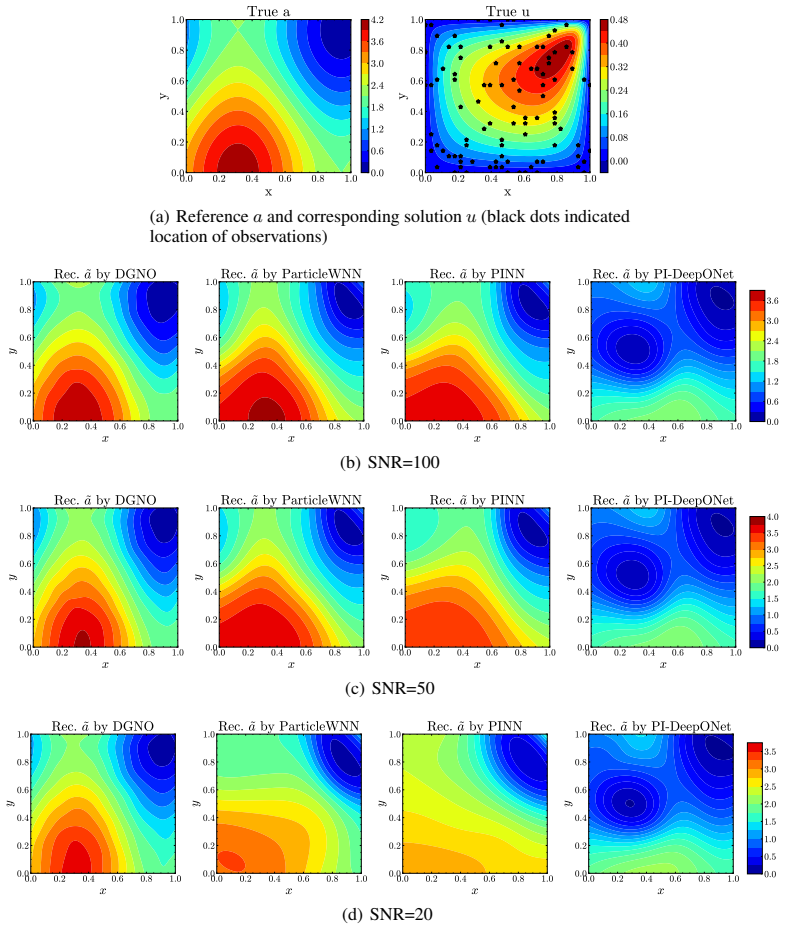
- Inverse problems with discrete-valued coefficients become tractable, because inference runs in a smooth low-dimensional code space rather than on the discontinuous field itself; the paper's two-phase Darcy experiment recovers the permeability map with cross-correlation 0.92–0.95 at signal-to-noise ratios from 100 down to 20.
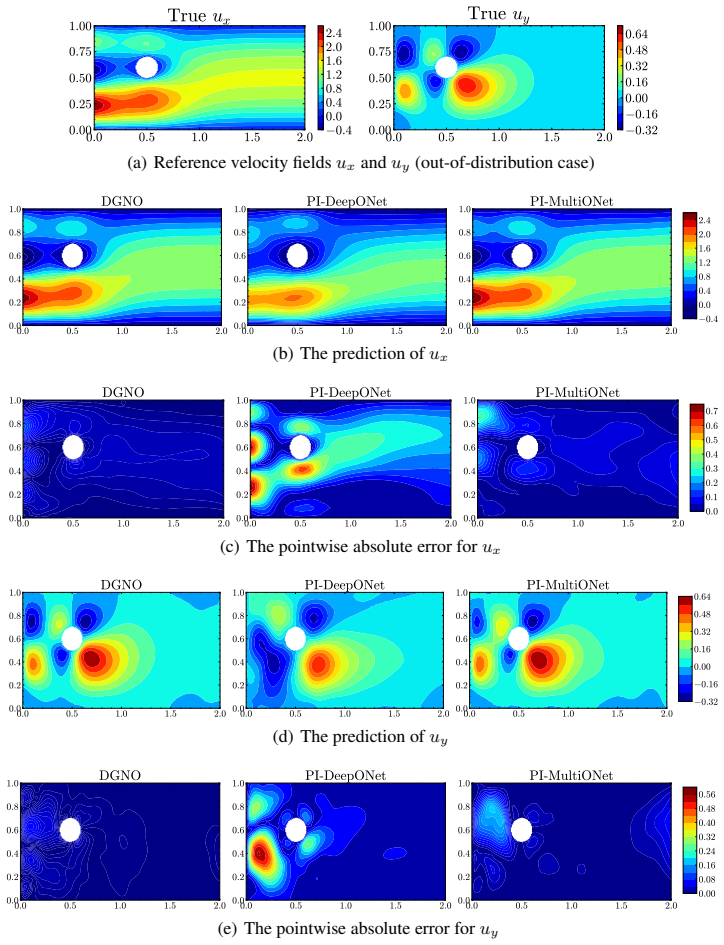
- The claimed accuracy gains are largest precisely where strong-form collocation breaks down—piecewise-constant coefficients, flow around an obstacle, and out-of-distribution inputs—where the reported errors of the physics-informed DeepONet baselines are several times larger.
- Because the model is probabilistic, forward and inverse predictions come with posterior standard deviations, giving users a quantified sense of confidence under sparse and noisy data.
- The latent space doubles as a design space: linear interpolation between codes of two materials traces out physically valid intermediate coefficient–solution pairs, which the paper points to as a route toward inverse design of multi-phase materials.
Reading between the lines
- A capacity check the paper does not run: raise the number of phases or shrink the inclusions and watch the recovery cross-correlation fall as the fixed code dimension saturates; the resulting Icorr-versus-$d_\beta$ curve would delimit when the uniform-prior latent space is the bottleneck rather than the residual formulation.
- The posterior over $\beta$ given sparse observations could drive adaptive sensing: the observation locations that most reduce the entropy of $p(\beta|u_{\mathrm{obs}})$ would give a principled next-sensor rule, an experimental design step the paper never attempts.
- If the bidirectional-code idea generalizes, one encoder could feed several solution decoders for different PDEs sharing the same input field—coupling, say, pressure and temperature in the same two-phase medium—a multi-physics extension the paper does not consider.
Editorial analysis
A structured set of objections, weighed in public.
Referee Report
Summary. The paper proposes DGenNO, a physics-aware neural operator for parametric forward and inverse PDE problems. The method learns a finite-dimensional latent code β that generates both the coefficient/input field a and the PDE solution u through MultiONet decoders, with an amortized encoder eφ(a). Training maximizes a variational ELBO containing reconstruction, boundary, and weak-form weighted-residual terms (with CSRBFs as test functions), avoiding PDE-solution labels. For inverse problems, the trained decoder pθa(a|β) is combined with a posterior over β conditioned on solution observations and virtual residuals. Experiments cover Darcy flow with piecewise-constant coefficients, Burgers, Stokes around a cylinder, and Darcy inverse problems with discrete and continuous targets, comparing with PI-DeepONet, PI-MultiONet, PINN, and ParticleWNN. The paper also introduces MultiONet as a layer-averaged generalization of DeepONet, and provides a public code repository.
Significance. If the central claims hold, DGenNO addresses a real gap: learning solution operators without labeled input-output pairs, relaxing regularity demands through weak residuals, and enabling latent-space inversion for discontinuous/discrete-valued fields. The forward results are largely convincing, with DGenNO outperforming strong-form baselines on Darcy and Stokes and matching PI-MultiONet on Burgers; the authors candidly report the Burgers null result. The provided code and reproducible experimental setup are strengths. However, the inverse identifiability issue and the narrow inverse evidence mean that the headline discrete-valued inverse claim is not yet secured.
major comments (3)
- [Sec. 3.2, 3.4; Eqs. (13), (22)-(24)] The inverse problem for discrete-valued coefficient fields is a headline claim, but the paper does not establish that the latent code β separates such fields. The variational posterior qφ(β|a) is a Dirac delta at eφ(a), and the uniform prior on β supplies no grouping structure; the only pressure on eφ to separate coefficient fields comes indirectly from Frec,a and Fpde. Neither term enforces injectivity, a bi-Lipschitz condition, or even a controlled margin between encodings of distinct admissible fields. If two admissible piecewise-constant fields are encoded to nearby β, the posterior p(β|uobs, R̂M) in Eqs. (23)-(24) may concentrate on the wrong field even when the forward surrogate uθu is accurate. No experiment in Section 4.4 probes the near-collapse regime; the reported Icorr values only show that the method works on sampled targets far from that regime. This gap is load-bearing for the central claim, so it should be closed either by an identifiability/separation analysis of the encoder or by an explicit stress test that measures encoder discrimination and failure modes.
- [Sec. 4.4, Table 5] The discrete inverse experiment provides only point estimates for what appears to be a single target coefficient field. No standard deviation across target draws is reported, and the table does not state whether the same target was used for all SNR levels. Since the central claim is about recovering discrete-valued fields from sparse noisy observations, a single favorable draw without error bars is weak evidence. At minimum, report Icorr statistics over repeated target fields (e.g., 20-50 draws) along with examples from the lower end of the performance distribution. This connects directly to the identifiability concern: the test distribution should include fields whose encodings are close in β-space.
- [Sec. 5, final paragraph] The concluding remarks state that the use of inexpensive unlabeled data (i.e., just PDE inputs) is 'one final aspect that we have not explored,' which appears to contradict Section 4.1 and Section 4.2, where the training dataset consists of unlabeled input samples â(i) with no PDE solutions. This is more than a wording issue because it obscures what was actually demonstrated. If the intended distinction is additional unlabeled instances beyond the training fields already used, this should be stated and tested; otherwise the sentence should be corrected.
minor comments (3)
- [Algorithm 1] The labels of the E-step and M-step are reversed relative to the text in Section 3.3. The block that updates ϕ while θ is fixed is the E-step by the text's definition, and the block that updates θ while ϕ is fixed is the M-step, but the algorithm prints the opposite names.
- [Table 3 and Section 4.4] There are several small presentation errors: the in-distribution RMSE for PI-DeepONet is printed as '3.01−2' rather than '3.01e−2'; 'ParticlWNN' should be 'ParticleWNN'; and 'by sampling aGP' should read 'by sampling a GP'.
- [Section 4.4, PI-DeepONet baseline] The description of the adapted PI-DeepONet inverse baseline is ambiguous about precisely what is optimized. Clarify whether the baseline performs direct gradient descent on a with the trained forward operator and, if so, how the discrete-valued case is handled in the continuous-coefficient comparison.
Circularity Check
No significant circularity: DGenNO's training objective is self-contained physics-plus-unlabeled-input fitting, and its forward/inverse predictions are evaluated against independently computed references.
full rationale
The claimed derivation chain is: encode unlabeled input fields a into beta via the amortized encoder q_phi(beta|a) (Eq. 13), decode to solutions u via u_theta_u(beta) (Eq. 10), and train the composite model by maximizing the ELBO (Eq. 15), whose only data-dependent terms are the input reconstruction F_rec,a (Eqs. 18-19), boundary term F_bc (Eq. 17), and physics residual term F_pde (Eq. 16). No term fits target PDE solutions or target coefficients from labeled input-output pairs; the physics residuals are computed from the predicted u_theta_u(e_phi(a)) and the supplied a, so the physics loss is not defined in terms of the prediction target. Forward test errors are measured against FEM/Chebfun reference solutions not used in training (Tables 2-4), and inverse recovery is scored against held-out ground-truth fields with I_corr/RMSE (Tables 5-6). The self-citations to [49], [50], and [52] supply methodological ingredients (virtual observables, CSRBF-weighted residuals, generative latent modeling) rather than proving the paper's performance claims, and those ingredients are implemented and benchmarked here; hence they are not load-bearing circularity. The main genuine risk is the unproven injectivity/identifiability of the degenerate encoder (Eq. 13) for discrete-valued fields, which could cause inverse recovery to fail even with a perfect forward surrogate; this is a correctness or robustness limitation, not a circular derivation, because it is not asserted by construction. Overall, no circular step was found.
Assumptions & free parameters
free parameters (7)
- latent dimension dβ =
64 or 128
- PDE residual weight λpde =
1 for Darcy and Burgers, 10 for Stokes, 1 for inverse problems
- reconstruction weight λrec =
0.25 (Darcy forward)
- boundary/data likelihood weights λbc and λdata =
10 for Burgers initial condition, 2 for Stokes boundaries, 50 or 25 for inverse data
- number of weighted residuals M =
300 (Darcy), 100 (Burgers), 256 (Stokes), 100 (inverse)
- integration points per residual Nint =
25 (Darcy), 10 (Burgers), 32 (Stokes), 25 (inverse)
- CSRBF support radius R =
10^-4
assumptions (5)
- domain assumption The parametric PDE is well-posed: for each admissible coefficient a, a unique solution u exists.
- domain assumption A finite set of M localized weighted residuals with Nint quadrature points is an adequate surrogate for the PDE.
- ad hoc to paper The amortized encoder and degenerate variational posterior qφ(β|a)=δ(β-eφ(a)) capture the latent posterior well enough for forward and inverse tasks.
- domain assumption The output density pθu(u|β)=δ(u-uθu(β)) and the Gaussian/Bernoulli likelihoods for residuals and inputs are appropriate.
- ad hoc to paper The uniform prior on β∈[-1,1]^dβ is sufficient; no learnable prior is needed.
Cite this review
Pith. "Pith review of DGenNO: A Novel Physics-aware Neural Operator for Solving Forward and Inverse PDE Problems based on Deep, Generative Probabilistic Modeling." pith.science (2026). https://pith.science/paper/SPATTQBT
@misc{pith2026250206250,
  author       = {Pith},
  title        = {Pith review of: DGenNO: A Novel Physics-aware Neural Operator for Solving Forward and Inverse PDE Problems based on Deep, Generative Probabilistic Modeling},
  year         = {2026},
  howpublished = {\url{https://pith.science/paper/SPATTQBT}},
  note         = {Machine review of arXiv:2502.06250}
}
read the original abstract
Solving parametric partial differential equations (PDEs) and associated PDE-based, inverse problems is a central task in engineering and physics, yet existing neural operator methods struggle with high-dimensional, discontinuous inputs and require large amounts of {\em labeled} training data. We propose the Deep Generative Neural Operator (DGenNO), a physics-aware framework that addresses these challenges by leveraging a deep, generative, probabilistic model in combination with a set of lower-dimensional, latent variables that simultaneously encode PDE-inputs and PDE-outputs. This formulation can make use of unlabeled data and significantly improves inverse problem-solving, particularly for discontinuous or discrete-valued input functions. DGenNO enforces physics constraints without labeled data by incorporating as virtual observables, weak-form residuals based on compactly supported radial basis functions (CSRBFs). These relax regularity constraints and eliminate higher-order derivatives from the objective function. We also introduce MultiONet, a novel neural operator architecture, which is a more expressive generalization of the popular DeepONet that significantly enhances the approximating power of the proposed model. These innovations make DGenNO particularly effective for challenging forward and inverse, PDE-based problems, such as those involving multi-phase media. Numerical experiments demonstrate that DGenNO achieves higher accuracy across multiple benchmarks while exhibiting robustness to noise and strong generalization to out-of-distribution cases. Its adaptability, and the ability to handle sparse, noisy data while providing probabilistic estimates, make DGenNO a powerful tool for scientific and engineering applications.
Figures


Figures from the paper (11 more)




Reference graph
Works this paper leans on
-
[1]
G. K. Batchelor, An introduction to fluid dynamics, Cambridge university press, 2000
work page 2000
-
[2]
D. W. Hahn, M. N. ¨Ozisik, Heat conduction, John Wiley & Sons, 2012
work page 2012
-
[3]
D. S. Jones, The theory of electromagnetism, Elsevier, 2013
work page 2013
-
[4]
Meakin, Models for material failure and deformation, Science 252 (5003) (1991) 226–234
P. Meakin, Models for material failure and deformation, Science 252 (5003) (1991) 226–234
work page 1991
- [5]
-
[6]
C. Li, N. Duric, P. Littrup, L. Huang, In vivo breast sound-speed imaging with ultrasound tomography, Ultrasound in medicine & biology 35 (10) (2009) 1615–1628
work page 2009
-
[7]
V . C. Scholz, Y . Zang, P.-S. Koutsourelakis, Weak neural variational inference for solving bayesian inverse problems without forward models: applications in elastography, Computer Methods in Applied Mechanics and Engineering 433 (2025) 117493
2025
-
[8]
D. A. Randall, R. A. Wood, S. Bony, R. Colman, T. Fichefet, J. Fyfe, V . Kattsov, A. Pitman, J. Shukla, J. Srinivasan, et al., Climate models and their evaluation, in: Climate change 2007: The physical science basis. Contribution of Working Group I to the Fourth Assessment Report of the IPCC (FAR), Cambridge University Press, 2007, pp. 589–662
work page 2007
Show all 69 references
-
[9]
Gholizadeh, A review of non-destructive testing methods of composite materials, Procedia structural integrity 1 (2016) 50–57
S. Gholizadeh, A review of non-destructive testing methods of composite materials, Procedia structural integrity 1 (2016) 50–57
2016
-
[10]
Zang, P.-S
Y . Zang, P.-S. Koutsourelakis, Psp-gen: Stochastic inversion of the process-structure-property chain in materials design through deep, generative probabilistic modeling, Acta Materialia (2024) 120600
2024
-
[11]
Raissi, P
M. Raissi, P. Perdikaris, G. E. Karniadakis, Physics-informed neural networks: A deep learning framework for solving forward and inverse problems involving nonlinear partial differential equations, Journal of Computational physics 378 (2019) 686–707
2019
-
[12]
G. Pang, L. Lu, G. E. Karniadakis, fpinns: Fractional physics-informed neural networks, SIAM Journal on Scientific Computing 41 (4) (2019) A2603–A2626
2019
-
[13]
X. Jin, S. Cai, H. Li, G. E. Karniadakis, Nsfnets (navier-stokes flow nets): Physics-informed neural networks for the incompressible navier-stokes equations, Journal of Computational Physics 426 (2021) 109951
2021
-
[14]
H. Gao, L. Sun, J.-X. Wang, Phygeonet: Physics-informed geometry-adaptive convolutional neural networks for solving parameterized steady-state pdes on irregular domain, Journal of Computational Physics 428 (2021) 110079
2021
-
[15]
Yu, et al., The deep ritz method: a deep learning-based numerical algorithm for solving variational problems, Communications in Mathematics and Statistics 6 (1) (2018) 1–12
B. Yu, et al., The deep ritz method: a deep learning-based numerical algorithm for solving variational problems, Communications in Mathematics and Statistics 6 (1) (2018) 1–12
2018
-
[16]
Y . Zang, G. Bao, X. Ye, H. Zhou, Weak adversarial networks for high-dimensional partial differential equations, Journal of Computational Physics 411 (2020) 109409
2020
-
[17]
G. Bao, X. Ye, Y . Zang, H. Zhou, Numerical solution of inverse problems by weak adversarial networks, Inverse Problems 36 (11) (2020) 115003
2020
-
[18]
Kharazmi, Z
E. Kharazmi, Z. Zhang, G. E. Karniadakis, Variational physics-informed neural networks for solving partial differential equations, arXiv preprint arXiv:1912.00873 (2019)
2019 arXiv
-
[19]
Y . Zhu, N. Zabaras, P.-S. Koutsourelakis, P. Perdikaris, Physics-constrained deep learning for high-dimensional surrogate modeling and uncertainty quantification without labeled data, Jour- nal of Computational Physics 394 (2019) 56–81. doi:10.1016/j.jcp.2019.05.024. URL http...
2019 doi
-
[20]
J. Han, A. Jentzen, W. E, Solving high-dimensional partial differential equations using deep learning, Proceedings of the National Academy of Sciences 115 (34) (2018) 8505–8510
2018
-
[21]
Sirignano, K
J. Sirignano, K. Spiliopoulos, Dgm: A deep learning algorithm for solving partial differential equations, Journal of computational physics 375 (2018) 1339–1364
2018
-
[22]
G.-J. Both, S. Choudhury, P. Sens, R. Kusters, Deepmod: Deep learning for model discovery in noisy data, Journal of Computational Physics 428 (2021) 109985. 33
2021
-
[23]
H. Yan, J. Du, V . Y . Tan, J. Feng, On robustness of neural ordinary differential equations, arXiv preprint arXiv:1910.05513 (2019)
2019 arXiv
-
[24]
Mowlavi, S
S. Mowlavi, S. Nabi, Optimal control of pdes using physics-informed neural networks, Journal of Computational Physics 473 (2023) 111731
2023
-
[25]
L. Lu, P. Jin, G. Pang, Z. Zhang, G. E. Karniadakis, Learning nonlinear operators via deeponet based on the universal approximation theorem of operators, Nature machine intelligence 3 (3) (2021) 218–229
2021
-
[26]
T. Chen, H. Chen, Universal approximation to nonlinear operators by neural networks with arbitrary activation functions and its application to dynamical systems, IEEE transactions on neural networks 6 (4) (1995) 911–917
1995
-
[27]
Kaltenbach, P
S. Kaltenbach, P. Perdikaris, P.-S. Koutsourelakis, Semi-supervised invertible neural operators for Bayesian inverse problems, Computational Mechanics 72 (3) (2023) 451–470. doi:10. 1007/s00466-023-02298-8 . URL https://doi.org/10.1007/s00466-023-02298-8
2023 doi
-
[28]
Z. Li, N. Kovachki, K. Azizzadenesheli, B. Liu, K. Bhattacharya, A. Stuart, A. Anandku- mar, Neural operator: Graph kernel network for partial differential equations, arXiv preprint arXiv:2003.03485 (2020)
2020 arXiv
-
[29]
Z. Li, N. Kovachki, K. Azizzadenesheli, B. Liu, K. Bhattacharya, A. Stuart, A. Anand- kumar, Fourier neural operator for parametric partial differential equations, arXiv preprint arXiv:2010.08895 (2020)
2020 arXiv
-
[30]
Guibas, M
J. Guibas, M. Mardani, Z. Li, A. Tao, A. Anandkumar, B. Catanzaro, Adaptive fourier neural operators: Efficient token mixers for transformers, arXiv preprint arXiv:2111.13587 (2021)
2021 arXiv
-
[31]
H. You, Q. Zhang, C. J. Ross, C.-H. Lee, Y . Yu, Learning deep implicit fourier neural operators (ifnos) with applications to heterogeneous material modeling, Computer Methods in Applied Mechanics and Engineering 398 (2022) 115296
2022
-
[32]
Tripura, S
T. Tripura, S. Chakraborty, Wavelet neural operator for solving parametric partial differential equations in computational mechanics problems, Computer Methods in Applied Mechanics and Engineering 404 (2023) 115783
2023
-
[33]
Z. Li, D. Z. Huang, B. Liu, A. Anandkumar, Fourier neural operator with learned deformations for pdes on general geometries, Journal of Machine Learning Research 24 (388) (2023) 1–26
2023
-
[34]
V . S. Fanaskov, I. V . Oseledets, Spectral neural operators, in: Doklady Mathematics, V ol. 108, Springer, 2023, pp. S226–S232
2023
-
[35]
Z. Li, H. Zheng, N. Kovachki, D. Jin, H. Chen, B. Liu, K. Azizzadenesheli, A. Anandkumar, Physics-informed neural operator for learning partial differential equations, ACM/JMS Journal of Data Science 1 (3) (2024) 1–27. URL https://dl.acm.org/doi/pdf/10.1145/3648506
2024 doi
-
[36]
Chatzopoulos, P.-S
M. Chatzopoulos, P.-S. Koutsourelakis, Physics-aware neural implicit solvers for multiscale, parametric pdes with applications in heterogeneous media, arXiv preprint arXiv:2405.19019 (2024)
2024 arXiv
-
[37]
S. Wang, H. Wang, P. Perdikaris, Learning the solution operator of parametric partial differen- tial equations with physics-informed deeponets, Science advances 7 (40) (2021) eabi8605. URL https://www.science.org/doi/pdf/10.1126/sciadv.abi8605
2021 doi
-
[38]
Goswami, A
S. Goswami, A. Bora, Y . Yu, G. E. Karniadakis, Physics-informed deep neural operator networks, in: Machine Learning in Modeling and Simulation: Methods and Applications, Springer, 2023, pp. 219–254. URL https://arxiv.org/pdf/2207.05748
2023 arXiv
-
[39]
Goswami, M
S. Goswami, M. Yin, Y . Yu, G. E. Karniadakis, A physics-informed variational deeponet for predicting crack path in quasi-brittle materials, Computer Methods in Applied Mechanics and Engineering 391 (2022) 114587
2022
-
[40]
Navaneeth, T
N. Navaneeth, T. Tripura, S. Chakraborty, Physics informed wno, Computer Methods in Ap- plied Mechanics and Engineering 418 (2024) 116546
2024
-
[41]
Gupta, X
G. Gupta, X. Xiao, P. Bogdan, Multiwavelet-based operator learning for differential equations, Advances in neural information processing systems 34 (2021) 24048–24062. 34
2021
-
[42]
Zhong, H
W. Zhong, H. Meidani, Physics-informed discretization-independent deep compositional oper- ator network, Computer Methods in Applied Mechanics and Engineering 431 (2024) 117274
2024
-
[43]
Zhong, H
W. Zhong, H. Meidani, Physics-informed geometry-aware neural operator, Computer Methods in Applied Mechanics and Engineering 434 (2025) 117540
2025
-
[44]
Kashefi, T
A. Kashefi, T. Mukerji, Physics-informed pointnet: A deep learning solver for steady-state incompressible flows and thermal fields on multiple sets of irregular geometries, Journal of Computational Physics 468 (2022) 111510
2022
-
[45]
C. R. Qi, H. Su, K. Mo, L. J. Guibas, Pointnet: Deep learning on point sets for 3d classification and segmentation, in: Proceedings of the IEEE conference on computer vision and pattern recognition, 2017, pp. 652–660
2017
-
[46]
Vadeboncoeur, I
A. Vadeboncoeur, I. Kazlauskaite, Y . Papandreou, F. Cirak, M. Girolami, O. D. Akyildiz, Ran- dom grid neural processes for parametric partial differential equations, in: Proceedings of the 40th International Conference on Machine Learning, V ol. 202 of ICML’23, JMLR.org, Hon-...
2023
-
[47]
Vadeboncoeur, O
A. Vadeboncoeur, O. D. Akyildiz, I. Kazlauskaite, M. Girolami, F. Cirak, Fully probabilistic deep models for forward and inverse problems in parametric PDEs, Journal of Computational Physics 491 (2023) 112369. doi:10.1016/j.jcp.2023.112369. URL https://www.sciencedirect.com/sc...
2023
-
[48]
A. Jiao, Q. Yan, J. Harlim, L. Lu, Solving forward and inverse pde problems on unknown manifolds via physics-informed neural operators, arXiv preprint arXiv:2407.05477 (2024)
2024 arXiv
-
[49]
Rixner, P.-S
M. Rixner, P.-S. Koutsourelakis, A probabilistic generative model for semi-supervised training of coarse-grained surrogates and enforcing physical constraints through virtual observables, Journal of Computational Physics 434 (2021) 110218. doi:10.1016/j.jcp.2021.110218. URL ht...
2021
-
[50]
Kaltenbach, P.-S
S. Kaltenbach, P.-S. Koutsourelakis, Incorporating physical constraints in a deep probabilistic machine learning framework for coarse-graining dynamical systems, Journal of Computational Physics 419 (2020) 109673, publisher: Elsevier BV .doi:10.1016/j.jcp.2020.109673. URL http...
2020
-
[51]
B. Finlayson (Ed.), The method of weighted residuals and variational principles, with appli- cation in fluid mechanics, heat and mass transfer, V olume 87, Academic Press, New York, 1972
1972
-
[52]
Y . Zang, G. Bao, Particlewnn: a novel neural networks framework for solving partial differen- tial equations, arXiv preprint arXiv:2305.12433 (2023)
2023 arXiv
-
[53]
M. J. Beal, Z. Ghahramani, The Variational Bayesian EM Algorithm for Incomplete Data: with Application to Scoring Graphical Model Structures, Bayesian Statistics 7 (2003)
2003
-
[54]
D. P. Kingma, M. Welling, et al., Auto-encoding variational bayes (2013)
2013
-
[55]
S. L. Cotter, M. Dashti, A. M. Stuart, Approximation of bayesian inverse problems for pdes, SIAM journal on numerical analysis 48 (1) (2010) 322–345
2010
-
[56]
Zhang, K
X. Zhang, K. Garikipati, Bayesian neural networks for weak solution of pdes with uncertainty quantification, arXiv preprint arXiv:2101.04879 (2021)
2021 arXiv
-
[57]
Vadeboncoeur, ¨O
A. Vadeboncoeur, ¨O. D. Akyildiz, I. Kazlauskaite, M. Girolami, F. Cirak, Fully probabilistic deep models for forward and inverse problems in parametric pdes, Journal of Computational Physics 491 (2023) 112369
2023
-
[58]
Viswanath, M
H. Viswanath, M. A. Rahman, A. Vyas, A. Shor, B. Medeiros, S. Hernandez, S. E. Prameela, A. Bera, Neural operator: Is data all you need to model the world? an insight into the impact of physics informed machine learning, arXiv preprint arXiv:2301.13331 (2023)
2023 arXiv
-
[59]
Alberts, I
A. Alberts, I. Bilionis, Physics-informed information field theory for modeling physical sys- tems with uncertainty quantification, Journal of Computational Physics 486 (2023) 112100. doi:10.1016/j.jcp.2023.112100. URL https://www.sciencedirect.com/science/article/pii/S0021999...
2023
-
[60]
Ganguly, S
A. Ganguly, S. Jain, U. Watchareeruetai, Amortized variational inference: A systematic review, Journal of Artificial Intelligence Research 78 (2023) 167–215. 35
2023
-
[61]
R. M. Neal, G. E. Hinton, A View of the Em Algorithm that Justifies Incremental, Sparse, and other Variants, in: M. I. Jordan (Ed.), Learning in Graphical Models, NATO ASI Series, Springer Netherlands, Dordrecht, 1998, pp. 355–368. doi:10.1007/978-94-011-5014-9_ 12. URL https:...
1998 doi
-
[62]
T. A. Driscoll, N. Hale, L. N. Trefethen, Chebfun guide (2014)
2014
-
[63]
C. Rao, H. Sun, Y . Liu, Physics-informed deep learning for incompressible laminar flows, Theoretical and Applied Mechanics Letters 10 (3) (2020) 207–212
2020
-
[64]
B. Hu, D. McDaniel, Applying physics-informed neural networks to solve navier–stokes equa- tions for laminar flow around a particle, Mathematical and Computational Applications 28 (5) (2023) 102
2023
-
[65]
Bourke, Cross correlation, Cross Correlation”, Auto Correlation—2D Pattern Identification 596 (1996)
P. Bourke, Cross correlation, Cross Correlation”, Auto Correlation—2D Pattern Identification 596 (1996)
1996
-
[66]
D. L. McDowell, J. Panchal, H.-J. Choi, C. Seepersad, J. Allen, F. Mistree, Integrated Design of Multiscale, Multifunctional Materials and Products, Butterworth-Heinemann, 2009
2009
-
[67]
Bastek, D
J.-H. Bastek, D. M. Kochmann, Inverse design of nonlinear mechanical metamaterials via video denoising diffusion models, Nature Machine Intelligence 5 (12) (2023) 1466–1475, pub- lisher: Nature Publishing Group. doi:10.1038/s42256-023-00762-x . URL https://www.nature.com/artic...
2023 doi
-
[68]
A. P. Generale, A. E. Robertson, C. Kelly, S. R. Kalidindi, Inverse stochastic microstructure design, Acta Materialia 271 (2024) 119877. doi:10.1016/j.actamat.2024.119877. URL https://www.sciencedirect.com/science/article/pii/S1359645424002301
2024
-
[69]
particles
H. Wendland, Piecewise polynomial, positive definite and compactly supported radial func- tions of minimal degree, Advances in computational Mathematics 4 (1995) 389–396. A Weighted residuals Strong-form, collocation-type residuals are most commonly used in physics-informed me...
1995
Reviewed August 8, 2026 · model on record in the stance chip above.
Discussion (0). Continue with ORCID to comment.