REVIEW 4 major objections 5 minor 47 references
Test-time adaptation to drifting distributions should be gated by a leaky accumulator of surprise, not by every prediction error.
Reviewed by Pith at T0; open to challenge. T0 means a machine referee read the full paper against a public rubric. the ladder, T0–T4 →
T0 review · deepseek-v4-flash
2026-08-01 13:58 UTC pith:SPIY44L6
load-bearing objection A novel and honestly evaluated event-triggered test-time adaptation policy, with the main open question being sensitivity to validation calibration. the 4 major comments →
Black-Mamba: Biologically-Inspired Leaky Accumulation for Conceptual Knowledge under Distribution Drift
The pith
A machine-rendered reading of the paper's core claim, the machinery that carries it, and where it could break.
Core claim
The paper's central claim is that the decision of when to adapt should be separated from the decision of how to adapt. It formalizes drift as a time-indexed family of conditional laws and splits each change into a predictable component and a zero-mean innovation; then a leaky accumulator of surprisal acts as an evidence filter whose threshold crossing marks 'persistent enough to count as regime change.' On its own terms, the paper establishes that this event-triggered rule recovers continuous updating as a boundary case (leak zero, threshold below all surprises), bounds the variance of the filtered innovation by σ²/(1−λ²), shows persistent drift accumulates to μ/(1−λ), and bounds false-trigg
What carries the argument
A leaky evidence accumulator u_t = λu_{t−1} + s_t, where s_t is a scalar surprisal signal derived from the prediction error, and a threshold τ that gates memory updates: the memory state is rewritten only when u_t ≥ τ, after which the accumulator is partially reset (u ← ρu). This mechanism carries the entire selective-adaptation claim by acting as a low-pass filter: persistent drift's contribution sums to about μ/(1−λ), while zero-mean innovations have variance bounded by σ²/(1−λ²), and Azuma–Hoeffding bounds the chance that pure noise crosses the threshold.
Load-bearing premise
The central claim rests on the surprisal signal decomposing into predictable drift plus zero-mean innovation (a martingale-difference assumption) and, for the headline empirical results, on the validation-calibrated gate parameters transferring to the test stream — a transfer the paper's own Appendix G.4 warns may fail if validation misestimates drift intensity, with no sensitivity analysis reported.
What would settle it
A direct test: calibrate the gate on a validation split, then run it on a held-out stream whose drift intensity is deliberately doubled or halved (e.g., regime-switch frequency changes by 2× or 0.5×). If update savings collapse or the long-horizon exchange-rate advantage reverses under mild miscalibration, the practical claim is calibration transfer rather than the accumulation mechanism; if the gate degrades as the paper's G.4 warning expects, then the mechanism governs. Also run λ=0.95/0.99 sensitivity on the synthetic streams to see whether the 52.19% / 98.9% result persists.
If this is right
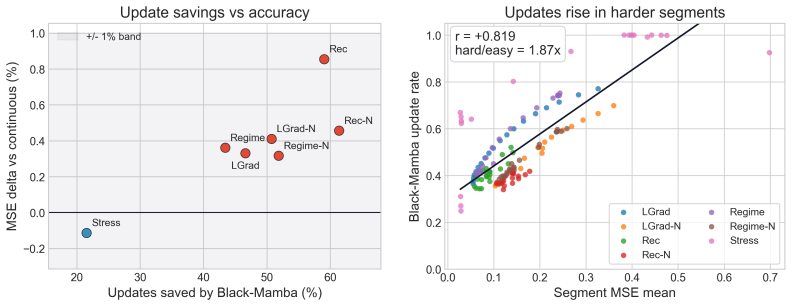
- Adaptation need not be continuous: on the paper's seven synthetic streams, about 47.8% of the continuous-adapter's writes are effectively skipped while giving up only about 1.1% of the achievable MSE gain.
- Update frequency becomes a diagnostic of local drift: the gate's update rate correlates strongly with segment MSE (+0.819), and the hardest segment quintile receives 1.87× more updates than the easiest, so update rate can be read as a real-time drift indicator.
- Continuous updating can over-adapt on long-horizon real drift: the exchange-rate horizon-720 result (continuous updating worse by +1.797% MSE, +0.556% MAE, significant for MAE) shows a concrete failure mode that selective gating avoids.
- The gated mechanism generalizes existing test-time memory updates: setting leak to zero and threshold below all surprises exactly recovers the continuous-update rule, so the paper's proposal is a spectrum rather than a replacement.
- On streams with no measurable drift, the gate leaves the frozen backbone's accuracy effectively unchanged, meaning selective adaptation does not impose an accuracy penalty in stable conditions.
Where Pith is reading between the lines
- Editorial inference: the calibration-transfer fragility the paper flags in Appendix G.4 could be attacked by making τ and possibly λ adaptive to a running drift monitor, so the update policy self-tunes at deployment instead of inheriting validation assumptions.
- Editorial inference: the same evidence-gated rule should transfer beyond forecasting to other online-learning settings, such as continual learning of large models, because the mechanism is stated independently of the base predictor and the low-rank adapter; the paper only tests one adapter, so this is an extrapolation.
- Editorial inference: the false-trigger bound suggests a principled design procedure—choose τ from an acceptable false-update rate rather than from a validation surprisal quantile—which would decouple the gate from validation drift calibration and make the claimed savings more portable.
Editorial analysis
A structured set of objections, weighed in public.
Referee Report
Summary. The paper proposes Black-Mamba, a test-time adaptive forecasting architecture in which a leaky accumulator integrates a scalar surprisal signal and triggers a LoRA memory update only when accumulated evidence crosses a threshold. The stated goal is to decouple adaptation from instantaneous prediction errors, so that persistent distribution drift is tracked while zero-mean innovations are suppressed. The authors provide four propositions bounding the variance of filtered innovation, showing accumulation of persistent drift, and bounding false-trigger probabilities. They evaluate the method on real long-term forecasting benchmarks (ETT, Electricity, Exchange Rate, Traffic, Weather) and seven synthetic drift streams, comparing frozen SiMBA, a continuous-update adapter, and Black-Mamba. The headline empirical claim is that Black-Mamba retains 98.9% of the MSE improvement of continuous updating over frozen SiMBA while using 52.19% of the update budget, and that on Exchange Rate at horizon 720 it avoids the degradation seen with continuous updating.
Significance. If the central claim survives scrutiny, the paper makes a useful conceptual contribution: it reformulates test-time adaptation as an event-triggered evidence-accumulation problem and provides a modular, policy-level change that could be applied to any memory-augmented predictor. The design is clean and the experimental setup is thoughtful in one important respect: both adaptive variants share the same frozen SiMBA backbone and the same LoRA adapter, so the comparison isolates the update policy rather than the base model. The paper also reports paired HAC tests, per-horizon results, section-level diagnostics, and an unusually explicit discussion of limitations in Appendix G.4. The mathematical propositions are correct but elementary; they establish basic properties of a leaky integrator and do not by themselves guarantee any forecasting benefit. The empirical value therefore rests on the experiments, and the experiments currently leave a load-bearing robustness question open, because every headline number depends on a single validation-calibrated gate setting. The Exchange Rate H720 result is a single horizon with borderline p-values and would need multiple-testing care. With additi
major comments (4)
- [§5.2, Appendix G.4] The headline claims — 52.19% of the update budget, 98.9% of the MSE improvement, and the Exchange Rate H720 advantage — all depend on a single calibration point: λ=0.97 and a threshold τ taken from a validation-surprisal quantile, transferred unchanged to the test stream. Appendix G.4 explicitly concedes that if the validation stream underestimates or overestimates drift intensity or noise, "the gate may become too conservative or too reactive." No quantitative sensitivity analysis is reported over λ, τ quantile, or validation/test drift mismatch. This is load-bearing because the main empirical contribution is precisely that selective gating preserves most of the benefit of continuous updating; without a sweep or an alternate-calibration experiment, the reader cannot distinguish a robust property of the mechanism from a favorable calibration. I would like to see a sensitivity table, e.g.
- [§5.3, Table 3] The real-drift evidence for Black-Mamba rests on one horizon of one dataset: Exchange Rate H720, where the MSE difference has pdir=0.056 and the MAE difference has pdir=0.039. The table reports four horizons for Exchange Rate, and the paper also examines Traffic and the synthetic streams; no multiple-testing adjustment is made. Given that the aggregate real-benchmark results show almost no differences, the H720 result is a single borderline finding from a small set of real-drift comparisons. The authors should either pre-specify this as the primary directional hypothesis, apply a modest multiple-comparison correction across the four Exchange Rate horizons, or present replication evidence on additional long-horizon drifting datasets.
- [§5, Appendix F.2] The continuous-update baseline is a reconstruction of the Titans-inspired neural-memory update rule, because "the official architecture was not public at the time of implementation." This is a reasonable practical choice, but it means the central comparison cannot fully separate the update-policy effect from artifacts of the reconstruction. The paper should make this limitation more prominent in the main text and provide evidence that the reconstruction is faithful — for example, by comparing the reconstructed continuous-update rule against any later public implementation, or by showing that plausible alternative continuous-update implementations (different learning-rate bounds, different memory write rules) do not change the qualitative conclusions.
- [§4, Propositions 1–4] The propositions are correct but largely restate the mechanism of exponential averaging: a leaky accumulator suppresses martingale noise, accumulates a persistent mean, and has a sub-Gaussian tail under bounded noise. These results support the internal consistency of the mechanism but do not establish that this update policy is preferable to continuous updating in forecasting accuracy. The paper would be strengthened by stating more explicitly that the theoretical analysis does not predict universal dominance, and by clarifying what empirical pattern would falsify the mechanism. As it stands, the synthetic results show continuous updating is usually slightly better in MSE, so the theoretical 'preference' for selective updating is not directly validated by loss; it is validated only indirectly through update savings and the H720 real-data case.
minor comments (5)
- [§4, Proposition 4] The false-trigger bound is derived under the no-drift assumption st=ξt. It would be helpful to state explicitly that this bound applies only to the noise-only regime and does not quantify false triggers when drift is present but the threshold is poorly calibrated.
- [Table 1] Many cells for SiMBA, Cont. update, and Black-Mamba are identical to three decimal places. This is interpretable as practical equivalence, but the table would be clearer with a note that the adaptive variants do not change these values at reported precision, rather than leaving the reader to infer it.
- [Appendix G.6] The definition of concept_scorew = max(D_w G_w, G_w) is slightly opaque; a sentence explaining why the maximum is taken over these two terms would help. Also, the Weather dataset is said to extend to 2026-04-07 in the author's collected copy; a URL or checksum for the exact Weather version would improve reproducibility.
- [§5.2] The sentence 'It captures 98.9% of the MSE improvement obtained by continuous updating over frozen SiMBA' is computed across six synthetic scenarios (per Appendix G.5), while the main text says 'across the seven synthetic streams' for the budget number. This discrepancy in the denominator should be clarified.
- [References] Several references are dated 2026 and may be preprint-only; please check that all citations conform to the journal's policy on citing unpublished work and that the arXiv IDs are correctly formatted.
Circularity Check
No significant circularity: the empirical claims are measured on held-out streams and the mathematical propositions are standard analytic consequences, not fitted to the results.
full rationale
I walked the claimed derivation chain: the architecture is defined by a leaky accumulator over surprisal with thresholded updates, and the mathematical propositions (variance bound, drift accumulation, false-trigger control) follow directly from the stated martingale-difference assumptions and standard inequalities. These are analytic properties of the proposed construction, not empirical predictions obtained by fitting outputs to inputs; they do not constitute circularity because they are not presented as data-dependent discoveries and are not used to manufacture the experimental numbers. The headline empirical result—52.19% of the continuous-update budget and 98.9% of the MSE improvement captured—is reported as a measured outcome on held-out synthetic test traces. The trigger threshold is calibrated on the validation stream (F.2), but the test-stream update rates and losses are observed, not algebraically forced by the calibration: no equation maps the validation surprisal quantile to the reported 52.19% or to the per-dataset update rates, and the selective-update diagnostics show substantial variation across streams. Appendix G.4 explicitly concedes that if the validation stream underestimates or overestimates drift intensity, 'the gate may become too conservative or too reactive'; this is an honest robustness limitation and a threat to external validity, but it is not a circular reduction. The Titans-style continuous-update baseline is acknowledged to be a reproduction because the official architecture was unavailable; this weakens baseline fidelity but is not self-citation or definitional circularity. There are no load-bearing self-citations from the present authors, no uniqueness theorem imported from the authors' prior work, and no fitted parameter renamed as a prediction. The main residual concerns—lack of sensitivity analysis over λ and τ, and reconstruction risk in the baseline—are correctness/robustness issues, not circularity.
Axiom & Free-Parameter Ledger
free parameters (4)
- leak coefficient λ =
0.97
- trigger threshold τ =
validation surprisal quantile
- reset factor ρ =
not reported (0≤ρ<1)
- online learning rate bounds and LoRA rank/alpha =
η∈[1e-6,1e-4], rank=4, alpha=4
axioms (4)
- domain assumption Martingale-difference innovation: E[ξt|H_{t-1}]=0 and E[ξt^2|H_{t-1}]≤σ²
- ad hoc to paper Surprisal decomposes as st = at + ξt, with at induced by predictable drift
- domain assumption Validation-calibrated gate transfers to the test stream
- domain assumption Latent regime z(t) exists and memory ϕt tracks h(z(t))
invented entities (1)
-
leaky evidence accumulator u_t
no independent evidence
read the original abstract
Forecasting under real-world conditions is inherently non-stationary, as the conditional distribution of future observations evolves over time. Recent test-time adaptive sequence models address this challenge by updating internal states during inference, but tie adaptation to instantaneous prediction errors or surprise. This coupling can conflate persistent distribution shift with stochastic innovations, leading to unnecessary updates and inefficient adaptation. We introduce Black-Mamba, a test-time adaptive forecasting architecture that formulates online adaptation as evidence-gated state tracking under distribution drift. The model augments a base predictor with a dynamic memory updated when temporally accumulated surprisal provides sufficient evidence of a regime change. This turns adaptation into a selective, event-driven process rather than a continuous one. Across multiple forecasting benchmarks with non-stationary dynamics, Black-Mamba achieves competitive or improved predictive performance compared to existing test-time adaptation methods while significantly reducing the number of memory updates during inference. Together with mathematical analysis and biological evidence, these results suggest that accumulated surprisal provides a principled signal for distinguishing persistent drift from transient noise, yielding more efficient and robust adaptation.
Figures


Reference graph
Works this paper leans on
-
[1]
The Journal of Physiology , volume =
Long-lasting Potentiation of Synaptic Transmission in the Dentate Area of the Anaesthetized Rabbit Following Stimulation of the Perforant Path , author =. The Journal of Physiology , volume =. doi:10.1113/jphysiol.1973.sp010273 , urldate =
-
[2]
, year = 2002, publisher =
Gerstner, Wulfram and Kistler, Werner M. , year = 2002, publisher =. Spiking Neuron Models:
2002
-
[3]
Lynch, M A , year = 2004, journal =. Long-
2004
- [4]
-
[5]
Burkitt, A. N. , year = 2006, month = aug, journal =. A Review of the Integrate-and-Fire Neuron Model:. doi:10.1007/s00422-006-0082-8 , urldate =
-
[6]
Redondo, Roger L. and Morris, Richard G. M. , year = 2011, month = jan, journal =. Making Memories Last: The Synaptic Tagging and Capture Hypothesis , shorttitle =. doi:10.1038/nrn2963 , urldate =
doi:10.1038/nrn2963 2011
-
[7]
Viola, Hayd. The. Progress in. doi:10.1016/B978-0-12-420170-5.00013-1 , urldate =
-
[8]
, year = 2017, month = jan, journal =
Nicoll, Roger A. , year = 2017, month = jan, journal =. A. doi:10.1016/j.neuron.2016.12.015 , urldate =
-
[9]
Lai, Guokun and Chang, Wei-Cheng and Yang, Yiming and Liu, Hanxiao , year = 2018, month = apr, number =. Modeling. doi:10.48550/arXiv.1703.07015 , urldate =. arXiv , langid =:1703.07015 , primaryclass =
-
[10]
doi:10.48550/arXiv.1804.04849 , urldate =
The Unreasonable Effectiveness of the Forget Gate , author =. doi:10.48550/arXiv.1804.04849 , urldate =. arXiv , keywords =:1804.04849 , primaryclass =
-
[11]
Autoformer:
Wu, Haixu and Xu, Jiehui and Wang, Jianmin and Long, Mingsheng , year = 2021, abstract =. Autoformer:
2021
-
[12]
Zhou, Haoyi and Zhang, Shanghang and Peng, Jieqi and Zhang, Shuai and Li, Jianxin and Xiong, Hui and Zhang, Wancai , year = 2021, month = may, journal =. Informer:. doi:10.1609/aaai.v35i12.17325 , urldate =
-
[13]
and Shen, Yelong and Wallis, Phillip and
Hu, Edward J. and Shen, Yelong and Wallis, Phillip and. doi:10.48550/arXiv.2106.09685 , urldate =. arXiv , langid =:2106.09685 , primaryclass =
-
[14]
Communications Biology , volume =
Memory Consolidation and Improvement by Synaptic Tagging and Capture in Recurrent Neural Networks , author =. Communications Biology , volume =. doi:10.1038/s42003-021-01778-y , urldate =
-
[15]
Wang, Qin and Fink, Olga and Gool, Luc Van and Dai, Dengxin , year = 2022, month = mar, number =. Continual. doi:10.48550/arXiv.2203.13591 , urldate =. arXiv , keywords =:2203.13591 , primaryclass =
-
[16]
Zeng, Ailing and Chen, Muxi and Zhang, Lei and Xu, Qiang , year = 2023, month = jun, journal =. Are. doi:10.1609/aaai.v37i9.26317 , urldate =
-
[17]
and Sinthong, Phanwadee and Kalagnanam, Jayant , year = 2023, month = mar, number =
Nie, Yuqi and Nguyen, Nam H. and Sinthong, Phanwadee and Kalagnanam, Jayant , year = 2023, month = mar, number =. A. doi:10.48550/arXiv.2211.14730 , urldate =. arXiv , keywords =:2211.14730 , primaryclass =
-
[18]
Behrouz, Ali and Hashemi, Farnoosh , year = 2024, journal =. Graph. doi:10.48550/ARXIV.2402.08678 , abstract =
-
[19]
Patro, Badri N. and Agneeswaran, Vijay S. , year = 2024, month = apr, number =. doi:10.48550/arXiv.2403.15360 , urldate =. arXiv , langid =:2403.15360 , primaryclass =
-
[20]
Behrouz, Ali and Zhong, Peilin and Mirrokni, Vahab , year = 2024, month = dec, number =. Titans:. doi:10.48550/arXiv.2501.00663 , urldate =. arXiv , keywords =:2501.00663 , primaryclass =
-
[21]
doi:10.48550/arXiv.2505.23735 , urldate =
Behrouz, Ali and Li, Zeman and Kacham, Praneeth and Daliri, Majid and Deng, Yuan and Zhong, Peilin and Razaviyayn, Meisam and Mirrokni, Vahab , year = 2025, month = may, number =. doi:10.48550/arXiv.2505.23735 , urldate =. arXiv , keywords =:2505.23735 , primaryclass =
-
[22]
arXiv (Cornell University) , doi =
A. arXiv (Cornell University) , doi =
-
[23]
Effectively
Cao, Daniel Yiming and Behrouz, Ali and Parviz, Ali and Karami, Mahdi and Santacatterina, Michele and Zabih, Ramin , year = 2025, abstract =. Effectively
2025
-
[24]
Luo, Yun and Yang, Zhen and Meng, Fandong and Li, Yafu and Zhou, Jie and Zhang, Yue , year = 2025, month = jan, number =. An. doi:10.48550/arXiv.2308.08747 , urldate =. arXiv , keywords =:2308.08747 , primaryclass =
-
[25]
Mongaras, Gabriel and Larson, Eric C. , year = 2025, journal =. On the. doi:10.48550/ARXIV.2507.23632 , abstract =
-
[26]
Meskin, Asal and Mirrokni, Alireza and Najar, Ali and Behrouz, Ali , year = 2025, month = nov, number =. Hydra:. doi:10.48550/arXiv.2511.00989 , urldate =. arXiv , keywords =:2511.00989 , primaryclass =
-
[27]
Behrouz, Ali and Razaviyayn, Meisam and Zhong, Peilin and Mirrokni, Vahab , year = 2025, month = apr, number =. It's. doi:10.48550/arXiv.2504.13173 , urldate =. arXiv , keywords =:2504.13173 , primaryclass =
-
[28]
Trends in Cognitive Sciences , volume =
Towards Large Language Models with Human-like Episodic Memory , author =. Trends in Cognitive Sciences , volume =. doi:10.1016/j.tics.2025.06.016 , urldate =
-
[29]
Sun, Yu and Li, Xinhao and Dalal, Karan and Xu, Jiarui and Vikram, Arjun and Zhang, Genghan and Dubois, Yann and Chen, Xinlei and Wang, Xiaolong and Koyejo, Sanmi and Hashimoto, Tatsunori and Guestrin, Carlos , year = 2025, month = aug, number =. Learning to (. doi:10.48550/arXiv.2407.04620 , urldate =. arXiv , keywords =:2407.04620 , primaryclass =
-
[30]
Behrouz, Ali and Cao, Daniel Yiming and Parviz, Ali and Santacatterina, Michele and Zabih, Ramin , year = 2025, month = jul, abstract =
2025
-
[31]
Sun, Weigao and Lan, Disen and Zhu, Tong and Qu, Xiaoye and Cheng, Yu , year = 2025, journal =. Linear-. doi:10.48550/ARXIV.2503.05447 , abstract =
-
[32]
Behrouz, Ali and Razaviyayn, Meisam and Zhong, Peilin and Mirrokni, Vahab , year = 2025, month = dec, number =. Nested. doi:10.48550/arXiv.2512.24695 , urldate =. arXiv , keywords =:2512.24695 , primaryclass =
-
[33]
Nepi, Gavriel Di and Siciliano, Federico and Silvestri, Fabrizio , year = 2025, month = oct, number =. Titans. doi:10.48550/arXiv.2510.09551 , urldate =. arXiv , keywords =:2510.09551 , primaryclass =
-
[34]
doi:10.48550/arXiv.2506.17671 , urldate =
Furfaro, Fabien , year = 2025, month = aug, number =. doi:10.48550/arXiv.2506.17671 , urldate =. arXiv , keywords =:2506.17671 , primaryclass =
-
[35]
Ren, Ruifeng and Sheng, Ouyang and Tang, Hua and Liu, Yong , year = 2025, journal =. Transformers as. doi:10.48550/ARXIV.2511.00907 , abstract =
-
[36]
Lee, Hyunji and Yu, Wenhao and Zhang, Hongming and Ma, Kaixin and Kim, Jiyeon and Yu, Dong and Seo, Minjoon , year = 2025, journal =. Understanding and. doi:10.18653/V1/2025.BABYLM-MAIN.27 , abstract =
-
[37]
Fu, Zichuan and Song, Wentao and Li, Guojing and Wang, Yejing and Wu, Xian and Deng, Yimin and Yan, Hanyu and Zheng, Yefeng and Zhao, Xiangyu , year = 2026, journal =. Attention. doi:10.48550/ARXIV.2601.00919 , abstract =
-
[38]
Zahn, Oliver and Beton, Matthew and Chana, Simran , year = 2026, month = jan, publisher =. Attention. doi:10.5281/zenodo.18273985 , urldate =
-
[39]
doi:10.48550/arXiv.2601.13748 , urldate =
Pham, Tien-Dat and Tran, Xuan-The , year = 2026, month = jan, number =. doi:10.48550/arXiv.2601.13748 , urldate =. arXiv , keywords =:2601.13748 , primaryclass =
-
[40]
Bonnet, Djohan and Lohoff, Jamie and Finkbeiner, Jan and Skhikerujah, Elidona and Neftci, Emre , year = 2026, month = feb, number =. Learning to. doi:10.48550/arXiv.2602.09075 , urldate =. arXiv , keywords =:2602.09075 , primaryclass =
-
[41]
Behrouz, Ali and Li, Zeman and Deng, Yuan and Zhong, Peilin and Razaviyayn, Meisam and Mirrokni, Vahab , year = 2026, month = feb, number =. Memory. doi:10.48550/arXiv.2602.24281 , urldate =. arXiv , keywords =:2602.24281 , primaryclass =
-
[42]
Pecerskis, Tims and Smirnovs, Aivars , year = 2026, month = jan, publisher =. Mixture-of-. doi:10.5281/zenodo.18338777 , urldate =
-
[43]
doi:10.48550/ARXIV.2601.22887 , abstract =
Li, Yangyan , year = 2026, journal =. doi:10.48550/ARXIV.2601.22887 , abstract =
-
[44]
Wind, Mark , year = 2026, month = jan, number =. Prometheus. doi:10.48550/arXiv.2601.15324 , urldate =. arXiv , keywords =:2601.15324 , primaryclass =
-
[45]
Yang, Zhenyu and Pei, Gensheng and Yao, Yazhou and Zhou, Tianfei and Ding, Lizhong and Shen, Fumin , year = 2026, month = feb, number =. Towards. doi:10.48550/arXiv.2602.10491 , urldate =. arXiv , keywords =:2602.10491 , primaryclass =
-
[46]
Liu, Junchen and Elflein, Sven and Litany, Or and Gojcic, Zan and Li, Ruilong , year = 2026, journal =. Test-. doi:10.48550/ARXIV.2602.21204 , abstract =
-
[47]
doi:10.48550/arXiv.2503.24067 , urldate =
Li, Yixing and Xie, Ruobing and Yang, Zhen and Sun, Xingwu and Li, Shuaipeng and Han, Weidong and Kang, Zhanhui and Cheng, Yu and Xu, Chengzhong and Wang, Di and Jiang, Jie , year = 2026, month = jan, number =. doi:10.48550/arXiv.2503.24067 , urldate =. arXiv , keywords =:2503.24067 , primaryclass =
discussion (0)
Sign in with ORCID, Apple, or X to comment. Anyone can read and Pith papers without signing in.