Structural Distinguishability of Static and Adaptive Policy Regimes in Agent-Based Regulatory Simulation
Pith reviewed 2026-06-27 02:31 UTC · model grok-4.3
The pith
A controlled benchmark in an emissions ABM shows regulatory outcomes depend on whether policies and agents adapt.
A machine-rendered reading of the paper's core claim, the machinery that carries it, and where it could break.
Core claim
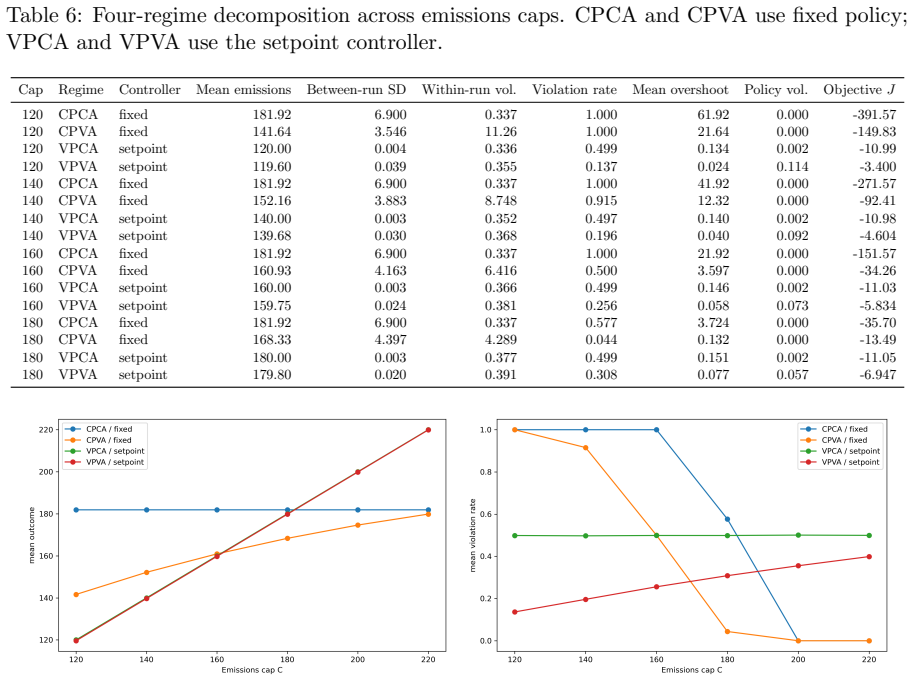
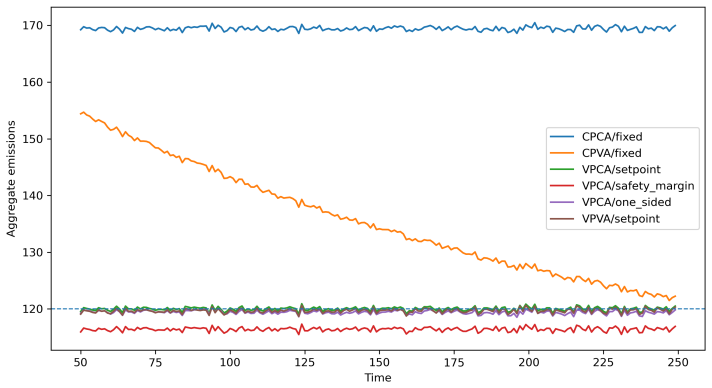
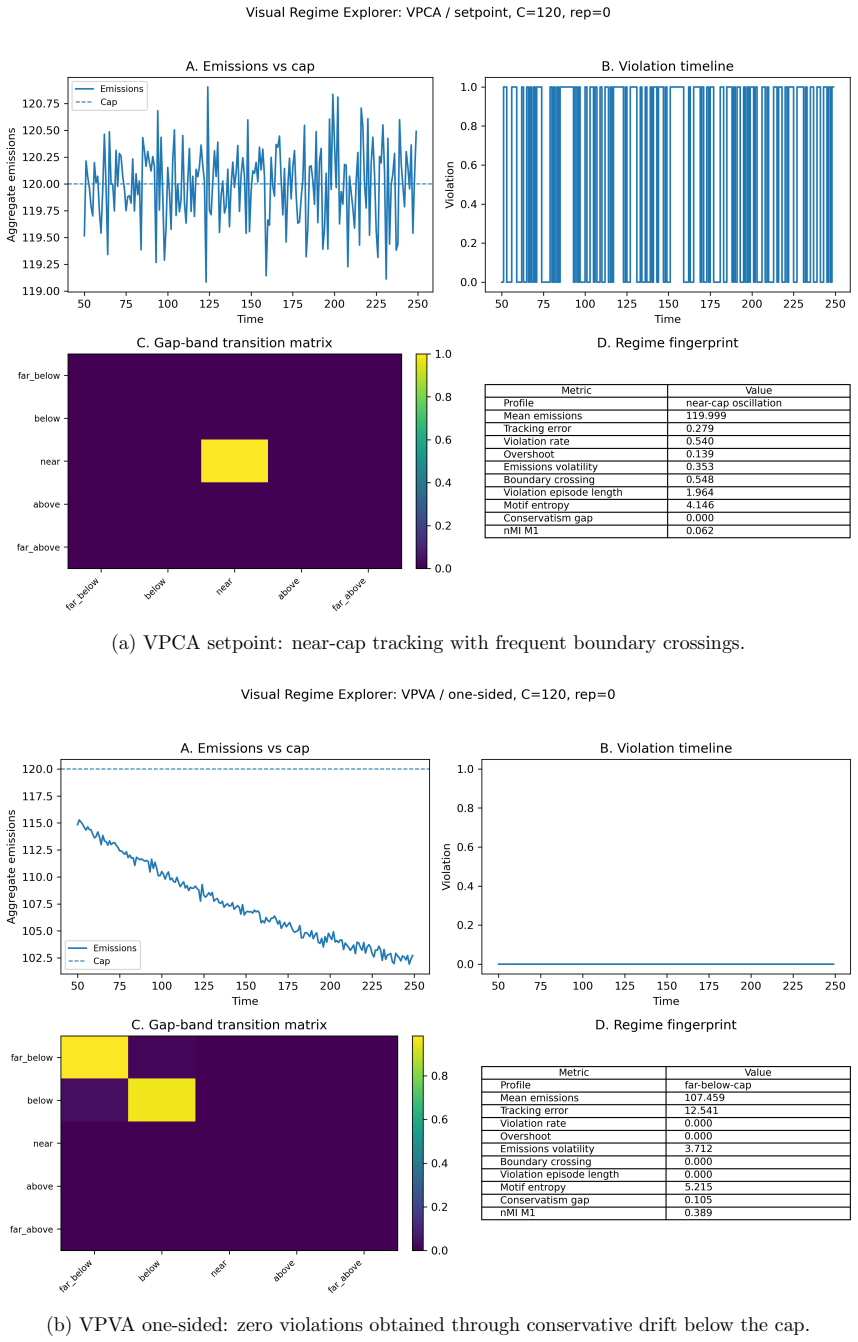
Using a single configurable emissions-regulation agent-based model, comparisons of the four policy-agent regimes recover the expected controller archetypes: setpoint control tracks the cap but produces frequent boundary crossings, safety-margin control reduces violations through conservatism, and one-sided control can limit violations but may ratchet toward over-conservatism when paired with adaptive agents. Scalar indicators, cap-relative symbolic diagnostics, trajectory motifs, and visual inspection together show that regulatory conclusions can differ across regimes even when average outcomes appear similar.
What carries the argument
The four-regime architecture that contrasts constant versus adaptive policies against constant versus adaptive agents, evaluated through matched simulations and a joint set of scalar, symbolic, and visual diagnostics.
If this is right
- Setpoint control tracks the emissions cap but produces frequent boundary crossings.
- Safety-margin control reduces violations through added conservatism.
- One-sided control limits violations but risks progressive over-conservatism when agents also adapt.
- Regulatory conclusions drawn from average performance alone can differ from those obtained when regime distinguishability is examined.
Where Pith is reading between the lines
- The same regime-comparison approach could be applied to agent-based models in domains other than emissions regulation to test whether adaptation changes policy conclusions.
- Single-regime studies risk overgeneralizing the effectiveness of a given controller when the other three regimes are not checked.
- Modelers may need to report results across all four combinations rather than selecting one as representative.
Load-bearing premise
Observed differences across the four regimes are caused by the structural distinctions between static and adaptive policies and agents rather than by model-specific artifacts or unexamined parameter choices.
What would settle it
Repeating the benchmark on the same model but with altered agent rules or different parameter values and finding that the three controller archetypes no longer appear in the expected patterns would falsify the claim that the benchmark distinguishes regimes structurally.
Figures
read the original abstract
Agent-based models are widely used to evaluate policy interventions in complex socio-technical systems, yet many policy-oriented ABMs represent regulation as a fixed scenario parameter. This limits their ability to distinguish whether regulatory conclusions depend on agent adaptation, policy adaptation, or the interaction between both. Building on a previously proposed four-regime architecture, this paper contributes a controlled simulation benchmark rather than a new general framework. Using a single configurable emissions-regulation ABM, we compare constant policy/constant agents, constant policy/adaptive agents, adaptive policy/constant agents, and adaptive policy/adaptive agents under matched simulation conditions. We evaluate naive fixed policies, tracking-aware calibrated fixed policies, and three adaptive controllers: setpoint, safety-margin, and one-sided control. The benchmark recovers expected controller archetypes: setpoint control tracks the cap but produces frequent boundary crossings, safety-margin control reduces violations through conservatism, and one-sided control can limit violations but may ratchet toward over-conservatism when combined with adaptive agents. The contribution is methodological: scalar indicators, cap-relative symbolic diagnostics, trajectory motifs, and visual inspection jointly reveal how regulatory conclusions can differ even when average outcomes appear similar. Adaptive policy-oriented ABMs should therefore be evaluated through regime distinguishability, not only through average performance.
Editorial analysis
A structured set of objections, weighed in public.
Referee Report
Summary. The paper claims that a controlled simulation benchmark in a single configurable emissions-regulation ABM can distinguish structural differences between four policy and agent regimes (constant policy/constant agents, constant policy/adaptive agents, adaptive policy/constant agents, and adaptive policy/adaptive agents). By evaluating naive fixed policies, tracking-aware fixed policies, and adaptive controllers (setpoint, safety-margin, one-sided), the benchmark recovers expected archetypes such as setpoint tracking with boundary crossings, safety-margin conservatism, and one-sided ratcheting. The methodological contribution is that adaptive-policy ABMs should be evaluated using regime distinguishability via scalar indicators, symbolic diagnostics, trajectory motifs, and visual inspection, rather than averages alone.
Significance. If the results hold and the distinctions are structural, this work underscores the importance of accounting for adaptation in both policies and agents when using ABMs for regulatory evaluation. It provides a concrete benchmark approach that can help reveal how regulatory conclusions may differ across regimes even when average outcomes are similar, contributing to more robust policy analysis in complex socio-technical systems.
major comments (1)
- [Abstract] Abstract: The central claim that the benchmark demonstrates structural distinguishability of regimes, leading to the recommendation for regime distinguishability evaluation, is load-bearing on the assumption that observed differences arise from the policy/agent regimes rather than from unexamined features of the single ABM used. The manuscript employs only one configurable emissions-regulation ABM under matched conditions and does not report tests across variations in underlying agent rules, market structure, or emissions dynamics, leaving the generalizability of the archetype recoveries unaddressed.
minor comments (2)
- The abstract mentions specific controller behaviors but provides no implementation details, statistical tests, error analysis, or verification steps for the simulation results.
- Consider adding discussion of how the configurable ABM parameters were chosen to ensure the regimes are compared under equivalent conditions.
Simulated Author's Rebuttal
We thank the referee for their constructive feedback. We respond to the single major comment below, clarifying the intended scope of the work.
read point-by-point responses
-
Referee: [Abstract] Abstract: The central claim that the benchmark demonstrates structural distinguishability of regimes, leading to the recommendation for regime distinguishability evaluation, is load-bearing on the assumption that observed differences arise from the policy/agent regimes rather than from unexamined features of the single ABM used. The manuscript employs only one configurable emissions-regulation ABM under matched conditions and does not report tests across variations in underlying agent rules, market structure, or emissions dynamics, leaving the generalizability of the archetype recoveries unaddressed.
Authors: We agree that the study is limited to one configurable emissions-regulation ABM and does not include cross-model validation or tests on altered agent rules, market structures, or emissions dynamics. The manuscript explicitly frames its contribution as a controlled benchmark within a single ABM (see abstract and Section 1) rather than a claim of universality. The central claim is that, under matched conditions in this ABM, the four regimes produce distinguishable outcomes via the proposed diagnostics (scalar indicators, cap-relative symbolic diagnostics, trajectory motifs, and visual inspection), even when average outcomes appear similar. The recovered archetypes (setpoint tracking with crossings, safety-margin conservatism, one-sided ratcheting) are presented as expected behaviors in this context. The methodological recommendation—that adaptive-policy ABMs should be evaluated through regime distinguishability—is therefore supported by the demonstration that such distinctions are detectable when they exist. We do not assert that the specific patterns will be identical in every possible ABM; the work provides a proof-of-concept benchmark and evaluation approach. Extending to multiple distinct ABMs would constitute a substantial follow-on study beyond the current scope. revision: no
Circularity Check
No significant circularity in simulation benchmark
full rationale
The paper is a comparative simulation exercise that runs matched conditions across four policy/agent regimes in one configurable emissions ABM and reports observed archetype recoveries. No equations, fitted parameters, or predictions are described that reduce to their own inputs by construction. The reference to a 'previously proposed four-regime architecture' is a standard citation to prior work and does not justify any load-bearing claim; the central results derive from the simulation runs themselves rather than from any self-citation chain, self-definition, or ansatz smuggling. This is the normal case of a self-contained empirical study with no evident circularity.
Axiom & Free-Parameter Ledger
Reference graph
Works this paper leans on
-
[1]
Challenges, tasks, and opportunities in modeling agent-based complex systems
Li An et al. Challenges, tasks, and opportunities in modeling agent-based complex systems. Ecological Modelling, 457:109685, 2021
2021
-
[2]
Brian Arthur
W. Brian Arthur. Inductive reasoning and bounded rationality.American Economic Re- view, 84(2):406–411, 1994
1994
-
[3]
A comprehensive survey of multi- agent reinforcement learning.IEEE Transactions on Systems, Man, and Cybernetics, Part C, 38(2):156–172, 2008
Lucian Busoniu, Robert Babuska, and Bart De Schutter. A comprehensive survey of multi- agent reinforcement learning.IEEE Transactions on Systems, Man, and Cybernetics, Part C, 38(2):156–172, 2008
2008
-
[4]
On agent-based modeling and computational social science.Frontiers in Psychology, 5:668, 2014
Rosaria Conte and Mario Paolucci. On agent-based modeling and computational social science.Frontiers in Psychology, 5:668, 2014
2014
-
[5]
Crutchfield
James P. Crutchfield. The calculi of emergence.Physica D, 75(1–3):11–54, 1994
1994
-
[6]
Joshua M. Epstein. Agent-based computational models and generative social science.Com- plexity, 4(5):41–60, 1999
1999
-
[7]
Epstein.Generative Social Science
Joshua M. Epstein.Generative Social Science. Princeton University Press, 2012. 18
2012
-
[8]
Roberto Garrone. An adaptive, data-integrated agent-based modeling framework for ex- plainable and contestable policy design. arXiv preprint arXiv:2511.19726, 2025
arXiv 2025
-
[9]
Characterizing agent-based model dynamics viaϵ-machines and Kolmogorov-style complexity
Roberto Garrone. Characterizing agent-based model dynamics viaϵ-machines and Kolmogorov-style complexity. arXiv preprint arXiv:2510.12729, 2025
arXiv 2025
-
[10]
SAGE Publications, 2008
Nigel Gilbert.Agent-Based Models. SAGE Publications, 2008
2008
-
[11]
The ODD protocol for describing agent-based and other simulation models: A second update.Journal of Artificial Societies and Social Simulation, 23(2):7, 2020
Volker Grimm et al. The ODD protocol for describing agent-based and other simulation models: A second update.Journal of Artificial Societies and Social Simulation, 23(2):7, 2020
2020
-
[12]
Cambridge University Press, 2009
Judea Pearl.Causality: Models, Reasoning, and Inference. Cambridge University Press, 2009
2009
-
[13]
Shalizi and James P
Cosma R. Shalizi and James P. Crutchfield. Computational mechanics: Pattern and pre- diction, structure and simplicity.Journal of Statistical Physics, 104:817–879, 2001
2001
-
[14]
Agent-based computational economics: A constructive approach to eco- nomic theory
Leigh Tesfatsion. Agent-based computational economics: A constructive approach to eco- nomic theory. InHandbook of Computational Economics, Volume 2. Elsevier, 2006
2006
-
[15]
Judd, editors.Handbook of Computational Economics, Volume 2: Agent-Based Computational Economics
Leigh Tesfatsion and Kenneth L. Judd, editors.Handbook of Computational Economics, Volume 2: Agent-Based Computational Economics. Elsevier, 2006
2006
-
[16]
Multi-agent reinforcement learning: A selective overview of theories and algorithms
Kaiqing Zhang, Zhuoran Yang, and Tamer Basar. Multi-agent reinforcement learning: A selective overview of theories and algorithms. InHandbook of Reinforcement Learning and Control, pages 321–384. Springer, 2021. 19
2021
discussion (0)
Sign in with ORCID, Apple, or X to comment. Anyone can read and Pith papers without signing in.