FLFL: Federated Latent Factor Learning for Private Recovery of Spatio-Temporal Signals
Pith reviewed 2026-06-26 09:08 UTC · model grok-4.3
The pith
A federated latent factor model recovers missing sensor signals by training only on uploaded gradients while enforcing spatio-temporal correlations.
A machine-rendered reading of the paper's core claim, the machinery that carries it, and where it could break.
Core claim
FLFL shows that a sensor-level federated learning setup built on latent factor models, augmented with spatio-temporal correlation regularization, can produce accurate missing-data estimates while ensuring that raw sensing values never leave their originating nodes.
What carries the argument
sensor-level federated learning framework on latent factor models with spatio-temporal regularization constraint
If this is right
- Recovery accuracy exceeds that of eight prior federated and non-federated baselines on real WSN traces.
- Raw data never leaves individual sensors, satisfying privacy requirements that block centralized latent factor learning.
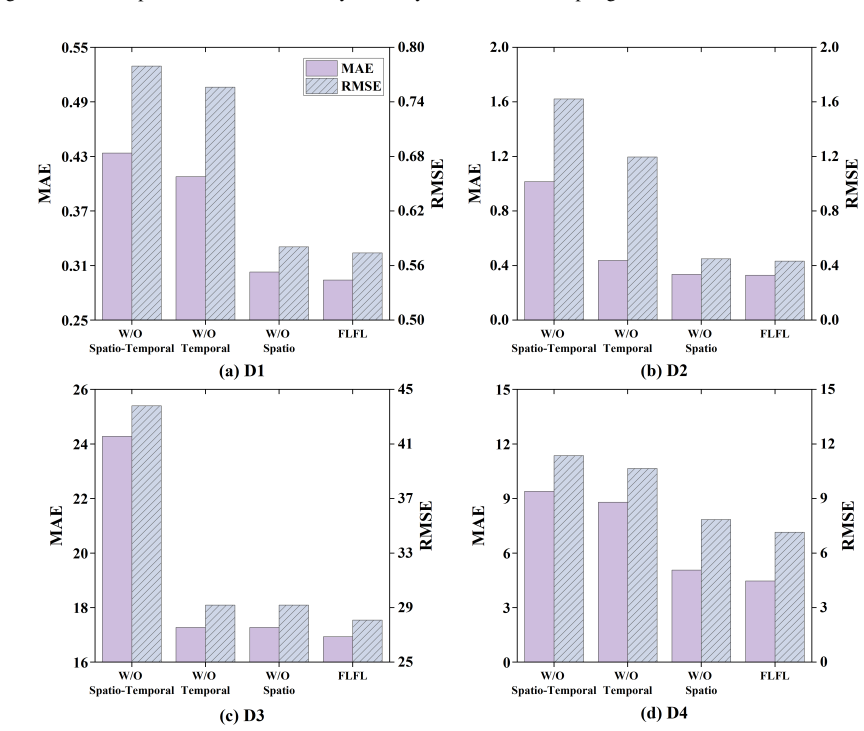
- Spatio-temporal regularization improves completion quality inside the federated setting.
- The same framework can be applied to any collection of sensors whose readings exhibit both spatial proximity and temporal continuity.
Where Pith is reading between the lines
- If gradient inversion attacks prove stronger than assumed, the privacy guarantee would require additional defenses such as differential privacy noise.
- The approach could be tested on mobile or edge-deployed sensor arrays where communication cost is the dominant constraint.
- Extending the regularization term to include known physical constraints (for example, diffusion equations) might further raise accuracy without extra data sharing.
Load-bearing premise
Sharing only gradient information during federated training is enough both to learn an accurate recovery model and to keep the original raw sensing signals private.
What would settle it
Demonstrate an attack that reconstructs any original sensor reading to high accuracy from the sequence of gradients uploaded by that sensor alone.
Figures


read the original abstract
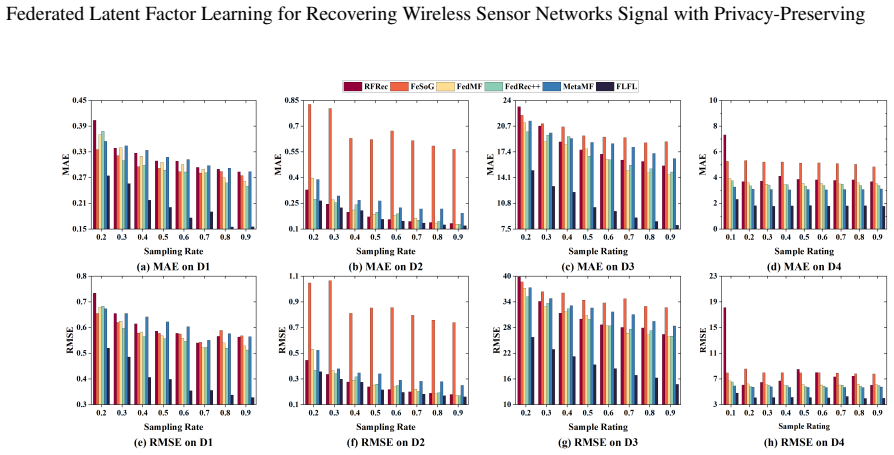
Wireless sensor network (WSNs) stands out as a burgeoning and promising domain in intelligent sensing. Owing to various factors such as sudden sensor malfunctions or deliberate shutdown of partial nodes to save energy, the collected sensing signals from WSNs commonly have massive missing data, leading to adverse effects on subsequent analysis or decision-making. Latent factor learning (LFL) has proven to be highly effective in recovering the missing data for WSNs. However, the existing LFL models require the collected sensing signals to be maintained in one central place like a central server, which is becoming unacceptable for data owners who are getting increasingly privacy-sensitive. To address this issue, this paper innovatively proposes a federated latent factor learning (FLFL) model for privacy-preserving spatio-temporal signal recovery. Its main idea is two-fold: 1) it designs a sensor-level federated learning framework based on LFL, where each sensor only needs to upload gradient information rather than raw data for training a privacy-preserving recovery model, and 2) it incorporates the spatio-temporal correlation into the designed federated learning framework as the regularization constraint to improve its recovery accuracy. With such designs, FLFL can not only accurately recover the missing data of WSNs but also ensure data owners' privacy-preserving of raw data. To evaluate the proposed FLFL model, extensive experiments have been conducted on four real-world WSN datasets. The results demonstrate that FLFL significantly outperforms eight state-of-the-art federated and non-federated signal recovery models in terms of recovery accuracy with privacy-preserving.
Editorial analysis
A structured set of objections, weighed in public.
Referee Report
Summary. The paper proposes FLFL, a sensor-level federated latent factor learning model for recovering missing spatio-temporal signals in wireless sensor networks. Sensors upload only local gradients (not raw data) to a central server; a spatio-temporal regularization term is added to the LFL objective. The authors claim that this simultaneously achieves accurate recovery and privacy preservation, and that FLFL significantly outperforms eight federated and non-federated baselines on four real-world WSN datasets.
Significance. If the empirical gains are reproducible and the privacy claim is supported by analysis, the work would usefully extend latent-factor methods to privacy-sensitive distributed sensing. The sensor-level FL framing and the explicit spatio-temporal regularizer are natural and potentially impactful for WSN applications.
major comments (2)
- [Abstract and §3] Abstract and §3 (Method): the central claim that 'uploading gradient information rather than raw data' ensures privacy-preserving recovery is unsupported by any formal privacy analysis, differential-privacy mechanism, secure-aggregation protocol, or empirical leakage evaluation (e.g., gradient-inversion or membership-inference bounds). This assumption is load-bearing for both the title and the stated contribution.
- [§4] §4 (Experiments): the abstract asserts outperformance on four datasets, yet the provided description supplies neither quantitative recovery metrics (MAE/RMSE), error bars, baseline hyper-parameter settings, nor privacy-leakage measurements. Without these, the comparative claim cannot be verified and is load-bearing for the empirical contribution.
minor comments (2)
- [§3] Notation for the latent-factor matrices and the spatio-temporal regularizer should be introduced with explicit dimensions and update rules to allow reproduction.
- [Introduction] The paper should cite the specific prior LFL works it builds upon and clarify what is novel versus inherited.
Simulated Author's Rebuttal
We thank the referee for the constructive and detailed comments on our manuscript. We address each major comment point-by-point below, indicating planned revisions where appropriate. Our responses focus on clarifying the existing contributions while acknowledging areas that require strengthening.
read point-by-point responses
-
Referee: [Abstract and §3] Abstract and §3 (Method): the central claim that 'uploading gradient information rather than raw data' ensures privacy-preserving recovery is unsupported by any formal privacy analysis, differential-privacy mechanism, secure-aggregation protocol, or empirical leakage evaluation (e.g., gradient-inversion or membership-inference bounds). This assumption is load-bearing for both the title and the stated contribution.
Authors: We acknowledge that the manuscript does not provide a formal privacy analysis (e.g., differential privacy bounds or empirical attacks). The privacy claim rests on the standard federated learning design in which raw sensor data never leaves the local device and only gradients are communicated. This is consistent with the privacy motivation in many FL papers for WSNs. To address the concern, we will revise §3 and add a new subsection in the discussion that explicitly qualifies the privacy guarantees, cites relevant FL privacy literature, and notes the absence of formal mechanisms as a limitation. We will also tone down the title and abstract wording from 'private' to 'privacy-preserving via federated gradients' if that better reflects the current analysis. revision: yes
-
Referee: [§4] §4 (Experiments): the abstract asserts outperformance on four datasets, yet the provided description supplies neither quantitative recovery metrics (MAE/RMSE), error bars, baseline hyper-parameter settings, nor privacy-leakage measurements. Without these, the comparative claim cannot be verified and is load-bearing for the empirical contribution.
Authors: The full §4 of the manuscript already contains tables reporting MAE and RMSE for FLFL versus the eight baselines on all four datasets, with error bars shown as standard deviations over repeated runs. Hyper-parameter values and search ranges are listed in the experimental setup paragraph. Privacy-leakage measurements are indeed absent, which we will handle together with the first comment by adding a short discussion of why such measurements were not performed and what they would entail. If any numerical values or settings appear insufficiently detailed in the current version, we will expand the tables and text accordingly. revision: partial
Circularity Check
No circularity; claims rest on framework design and external experiments
full rationale
The abstract and description present FLFL as a sensor-level federated extension of existing LFL models, with gradient sharing for privacy and added spatio-temporal regularization. No equations, predictions, or derivations are shown that reduce the recovery accuracy or privacy claims to fitted inputs or self-citations by construction. The evaluation relies on experiments against eight baselines on four real-world datasets, which constitute independent validation rather than tautological re-derivation of inputs.
Axiom & Free-Parameter Ledger
Reference graph
Works this paper leans on
-
[1]
A robust latent factor analysis model for incomplete data recovery in wireless sensor networks
Zhikai Yu, Di Wu, and Yi He. A robust latent factor analysis model for incomplete data recovery in wireless sensor networks. In2022 IEEE International Conference on Edge Computing and Communications (EDGE), pages 178–183. IEEE, 2022
2022
-
[2]
Ai-empowered iot security for smart cities.ACM Transactions on Internet Technology, 21:1–21, 2021
Zhihan Lv, Liang Qiao, Amit Kumar Singh, and Qingjun Wang. Ai-empowered iot security for smart cities.ACM Transactions on Internet Technology, 21:1–21, 2021
2021
-
[3]
Seno Adi Putra, Bambang Riyanto Trilaksono, Muhammad Riyansyah, and Dina Shona Laila. Multiagent architecture for bridge capacity measurement system using wireless sensor network and weight in motion.IEEE Transactions on Instrumentation and Measurement, 70:1–14, 2020
2020
-
[4]
Model study of transient imaging with multi-frequency time-of-flight sensors.IEEE Transactions on Pattern Analysis and Machine Intelligence, 43:3523–3539, 2020
Hongman Wang, Hui Qiao, Jingyu Lin, Rihui Wu, Yebin Liu, and Qionghai Dai. Model study of transient imaging with multi-frequency time-of-flight sensors.IEEE Transactions on Pattern Analysis and Machine Intelligence, 43:3523–3539, 2020
2020
-
[5]
Mingwei Lin, Hengshuo Yang, Xiuqin Xu, Ling Lin, Zeshui Xu, and Xin Luo. Momentum-accelerated and biased unconstrained non-negative latent factor model for handling high-dimensional and incomplete data.ACM Transactions on Knowledge Discovery from Data, 2025
2025
-
[6]
Adaptively-accelerated parallel stochastic gradient descent for high- dimensional and incomplete data representation learning.IEEE Transactions on Big Data, 10(1):92–107, 2023
Wen Qin, Xin Luo, and MengChu Zhou. Adaptively-accelerated parallel stochastic gradient descent for high- dimensional and incomplete data representation learning.IEEE Transactions on Big Data, 10(1):92–107, 2023
2023
-
[7]
A generalized nesterov-accelerated second-order latent factor model for high-dimensional and incomplete data.IEEE Transactions on Neural Networks and Learning Systems, 2023
Weiling Li, Renfang Wang, and Xin Luo. A generalized nesterov-accelerated second-order latent factor model for high-dimensional and incomplete data.IEEE Transactions on Neural Networks and Learning Systems, 2023
2023
-
[8]
Robust low-rank latent feature analysis for spatiotemporal signal recovery.IEEE Transactions on Neural Networks and Learning Systems, 36:2829–2842, 2025
Di Wu, Zechao Li, Zhikai Yu, Yi He, and Xin Luo. Robust low-rank latent feature analysis for spatiotemporal signal recovery.IEEE Transactions on Neural Networks and Learning Systems, 36:2829–2842, 2025
2025
-
[9]
An outlier-resilient autoencoder for representing high-dimensional and incomplete data.IEEE Transactions on Emerging Topics in Computational Intelligence, 2024
Di Wu, Yuanpeng Hu, Kechen Liu, Jing Li, Xianmin Wang, Song Deng, Nenggan Zheng, and Xin Luo. An outlier-resilient autoencoder for representing high-dimensional and incomplete data.IEEE Transactions on Emerging Topics in Computational Intelligence, 2024
2024
-
[10]
Pseudo gradient-adjusted particle swarm optimization for accurate adaptive latent factor analysis.IEEE Transactions on Systems, Man, and Cybernetics: Systems, 2024
Xin Luo, Jiufang Chen, Ye Yuan, and Zidong Wang. Pseudo gradient-adjusted particle swarm optimization for accurate adaptive latent factor analysis.IEEE Transactions on Systems, Man, and Cybernetics: Systems, 2024
2024
-
[11]
A fast non-negative latent factor model based on generalized momentum method.IEEE Transactions on Systems, Man, and Cybernetics: Systems, 51:610–620, 2021
Xin Luo, Zhigang Liu, Shuai Li, Mingsheng Shang, and Zidong Wang. A fast non-negative latent factor model based on generalized momentum method.IEEE Transactions on Systems, Man, and Cybernetics: Systems, 51:610–620, 2021
2021
-
[12]
Multi-constrained symmetric nonnegative latent factor analysis for accurately representing undirected weighted networks
Yurong Zhong, Zhe Xie, Weiling Li, and Xin Luo. Multi-constrained symmetric nonnegative latent factor analysis for accurately representing undirected weighted networks. In2023 IEEE International Conference on Systems, Man, and Cybernetics (SMC), pages 4920–4925. IEEE, 2023
2023
-
[13]
A fast nonnegative autoencoder-based approach to latent feature analysis on high-dimensional and incomplete data.IEEE Transactions on Services Computing, 17(3):733–746, 2023
Fanghui Bi, Tiantian He, and Xin Luo. A fast nonnegative autoencoder-based approach to latent feature analysis on high-dimensional and incomplete data.IEEE Transactions on Services Computing, 17(3):733–746, 2023
2023
-
[14]
A survey on federated learning systems: Vision, hype and reality for data privacy and protection.IEEE Transactions on Knowledge and Data Engineering, 35:3347–3366, 2021
Qinbin Li, Zeyi Wen, Zhaomin Wu, Sixu Hu, Naibo Wang, Yuan Li, Xu Liu, and Bingsheng He. A survey on federated learning systems: Vision, hype and reality for data privacy and protection.IEEE Transactions on Knowledge and Data Engineering, 35:3347–3366, 2021
2021
-
[15]
A survey on federated learning.Knowledge- Based Systems, 216:106775, 2021
Chen Zhang, Yu Xie, Hang Bai, Bin Yu, Weihong Li, and Yuan Gao. A survey on federated learning.Knowledge- Based Systems, 216:106775, 2021
2021
-
[16]
Federated machine learning: Concept and applications
Qiang Yang, Yang Liu, Tianjian Chen, and Yongxin Tong. Federated machine learning: Concept and applications. ACM Transactions on Intelligent Systems and Technology (TIST), 10:1–19, 2019
2019
-
[17]
Xin Luo, Yue Zhou, Zhigang Liu, and MengChu Zhou. Fast and accurate non-negative latent factor analysis of high-dimensional and sparse matrices in recommender systems.IEEE Transactions on Knowledge and Data Engineering, 35:3897–3911, 2023
2023
-
[18]
Generalized nesterov’s acceleration-incorporated, non-negative and adaptive latent factor analysis.IEEE Transactions on Services Computing, 15:2809–2823, 2022
Xin Luo, Yue Zhou, Zhigang Liu, Lun Hu, and MengChu Zhou. Generalized nesterov’s acceleration-incorporated, non-negative and adaptive latent factor analysis.IEEE Transactions on Services Computing, 15:2809–2823, 2022
2022
-
[19]
Xin Luo, Zidong Wang, and Mingsheng Shang. An instance-frequency-weighted regularization scheme for non-negative latent factor analysis on high-dimensional and sparse data.IEEE Transactions on Systems, Man, and Cybernetics: Systems, 51:3522–3532, 2021. 12 Federated Latent Factor Learning for Recovering Wireless Sensor Networks Signal with Privacy-Preserving
2021
-
[20]
Temporal pattern-aware qos prediction via biased non-negative latent factorization of tensors.IEEE Transactions on Cybernetics, 50:1798–1809, 2020
Xin Luo, Hao Wu, Huaqiang Yuan, and MengChu Zhou. Temporal pattern-aware qos prediction via biased non-negative latent factorization of tensors.IEEE Transactions on Cybernetics, 50:1798–1809, 2020
2020
-
[21]
Xin Luo, Yurong Zhong, Zidong Wang, and Maozhen Li. An alternating-direction-method of multipliers- incorporated approach to symmetric non-negative latent factor analysis.IEEE Transactions on Neural Networks and Learning Systems, 34:4826–4840, 2021
2021
-
[22]
Xin Luo, MengChu Zhou, Shuai Li, Zhuhong You, Yunni Xia, and Qingsheng Zhu. A nonnegative latent factor model for large-scale sparse matrices in recommender systems via alternating direction method.IEEE transactions on neural networks and learning systems, 27(3):579–592, 2015
2015
-
[23]
Two-stream graph convolutional network-incorporated latent feature analysis.IEEE Transactions on Services Computing, 16(4):3027–3042, 2023
Fanghui Bi, Tiantian He, Yuetong Xie, and Xin Luo. Two-stream graph convolutional network-incorporated latent feature analysis.IEEE Transactions on Services Computing, 16(4):3027–3042, 2023
2023
-
[24]
Effects of preprocessing and training biases in latent factor models for recommender systems.Neurocomputing, 275:2019–2030, 2018
Ye Yuan, Xin Luo, and Ming-Sheng Shang. Effects of preprocessing and training biases in latent factor models for recommender systems.Neurocomputing, 275:2019–2030, 2018
2019
-
[25]
A review on federated learning architectures for privacy-preserving ai: Lightweight and secure cloud–edge–end collaboration
Shanhao Zhan, Lianfen Huang, Gaoyu Luo, Shaolong Zheng, Zhibin Gao, and Han-Chieh Chao. A review on federated learning architectures for privacy-preserving ai: Lightweight and secure cloud–edge–end collaboration. Electronics, 14(13):2512, 2025
2025
-
[26]
Collaborative federated learning for healthcare: Multi-modal covid-19 diagnosis at the edge.IEEE Open Journal of the Computer Society, 3:172–184, 2022
Adnan Qayyum, Kashif Ahmad, Muhammad Ahtazaz Ahsan, Ala Al-Fuqaha, and Junaid Qadir. Collaborative federated learning for healthcare: Multi-modal covid-19 diagnosis at the edge.IEEE Open Journal of the Computer Society, 3:172–184, 2022
2022
-
[27]
Smart policy control for securing federated learning management system.IEEE Transactions on Network and Service Management, 20(2):1600– 1611, 2023
Aditya Pribadi Kalapaaking, Ibrahim Khalil, and Mohammed Atiquzzaman. Smart policy control for securing federated learning management system.IEEE Transactions on Network and Service Management, 20(2):1600– 1611, 2023
2023
-
[28]
Flock: Robust and privacy-preserving federated learning based on practical blockchain state channels
Ruonan Chen, Ye Dong, Yizhong Liu, Tingyu Fan, Dawei Li, Zhenyu Guan, Jianwei Liu, and Jianying Zhou. Flock: Robust and privacy-preserving federated learning based on practical blockchain state channels. InProceedings of the ACM on Web Conference 2025, page 884–895. Association for Computing Machinery, 2025
2025
-
[29]
Empowering federated graph rationale learning with latent environments
Linan Yue, Qi Liu, Yawen Li, Fangzhou Yao, Weibo Gao, and Junping Du. Empowering federated graph rationale learning with latent environments. page 3863–3873, New York, NY , USA, 2025. Association for Computing Machinery
2025
-
[30]
Personalized federated recommendation for cold-start users via adaptive knowledge fusion
Yichen Li, Yijing Shan, Yi Liu, Haozhao Wang, Wei Wang, Yi Wang, and Ruixuan Li. Personalized federated recommendation for cold-start users via adaptive knowledge fusion. page 2700–2709, New York, NY , USA, 2025. Association for Computing Machinery
2025
-
[31]
A tutorial of personalized federated recommender systems: Recent advances and future directions
Jing Jiang, Chunxu Zhang, Honglei Zhang, Zhiwei Li, Yidong Li, and Bo Yang. A tutorial of personalized federated recommender systems: Recent advances and future directions. page 21–24, New York, NY , USA, 2025. Association for Computing Machinery
2025
-
[32]
PhD thesis,
Quande Liu.Multi-center Medical Image Computing with Robust Federated Learning and Beyond. PhD thesis,
-
[33]
Gebrekiros Gebreyesus Gebremariam, J Panda, and S Indu. Blockchain-based secure localization against malicious nodes in iot-based wireless sensor networks using federated learning.Wireless communications and mobile computing, 2023(1):8068038, 2023
2023
-
[34]
Correlated spatio-temporal data collection in wireless sensor networks based on low rank matrix approximation and optimized node sampling.Sensors, 14(12):23137–23158, 2014
Xinglin Piao, Yongli Hu, Yanfeng Sun, Baocai Yin, and Junbin Gao. Correlated spatio-temporal data collection in wireless sensor networks based on low rank matrix approximation and optimized node sampling.Sensors, 14(12):23137–23158, 2014
2014
-
[35]
Time-varying graph signal reconstruction.IEEE Journal of Selected Topics in Signal Processing, 11(6):870–883, 2017
Kai Qiu, Xianghui Mao, Xinyue Shen, Xiaohan Wang, Tiejian Li, and Yuantao Gu. Time-varying graph signal reconstruction.IEEE Journal of Selected Topics in Signal Processing, 11(6):870–883, 2017
2017
-
[36]
Spatio-temporal signal recovery based on low rank and differential smoothness.IEEE Transactions on Signal Processing, 66(23):6281–6296, 2018
Xianghui Mao, Kai Qiu, Tiejian Li, and Yuantao Gu. Spatio-temporal signal recovery based on low rank and differential smoothness.IEEE Transactions on Signal Processing, 66(23):6281–6296, 2018
2018
-
[37]
Eldar, Haifeng Wang, Kai Kang, and Hua Qian
Liu Yang, Yonina C. Eldar, Haifeng Wang, Kai Kang, and Hua Qian. An admm-net for data recovery in wireless sensor networks. In2020 28th European Signal Processing Conference (EUSIPCO), pages 1712–1716, 2021
2021
-
[38]
Recovery of corrupted data in wireless sensor networks using tensor robust principal component analysis.IEEE Communications Letters, 25(10):3389–3393, 2021
Xiaoyue Zhang, Jingfei He, Yunpei Li, Yue Chi, and Yatong Zhou. Recovery of corrupted data in wireless sensor networks using tensor robust principal component analysis.IEEE Communications Letters, 25(10):3389–3393, 2021
2021
-
[39]
Sheng, Tao Gu, and Lina Yao
Peipei Xu, Wenjie Ruan, Quan Z. Sheng, Tao Gu, and Lina Yao. Interpolating the missing values for multi- dimensional spatial-temporal sensor data: A tensor svd approach. InProceedings of the 14th EAI International 13 Federated Latent Factor Learning for Recovering Wireless Sensor Networks Signal with Privacy-Preserving Conference on Mobile and Ubiquitous ...
2017
-
[40]
Antonio Ortega, Pascal Frossard, Jelena Kovaˇcevi´c, José M. F. Moura, and Pierre Vandergheynst. Graph signal processing: Overview, challenges, and applications.Proceedings of the IEEE, 106(5):808–828, 2018
2018
-
[41]
Graph learning for spatiotem- poral signals with long- and short-term characterization.IEEE Transactions on Signal and Information Processing over Networks, 6:699–713, 2020
Yueliang Liu, Wenbin Guo, Kangyong You, Lei Zhao, Tao Peng, and Wenbo Wang. Graph learning for spatiotem- poral signals with long- and short-term characterization.IEEE Transactions on Signal and Information Processing over Networks, 6:699–713, 2020
2020
-
[42]
Reconstruction of time-varying graph signals via sobolev smoothness.IEEE Transactions on Signal and Information Processing over Networks, 8:201–214, 2022
Jhony H Giraldo, Arif Mahmood, Belmar Garcia-Garcia, Dorina Thanou, and Thierry Bouwmans. Reconstruction of time-varying graph signals via sobolev smoothness.IEEE Transactions on Signal and Information Processing over Networks, 8:201–214, 2022
2022
-
[43]
Large-scale and scalable latent factor analysis via distributed alternative stochastic gradient descent for recommender systems.IEEE Transactions on Big Data, 8:420–431, 2022
Xiaoyu Shi, Qiang He, Xin Luo, Yanan Bai, and Mingsheng Shang. Large-scale and scalable latent factor analysis via distributed alternative stochastic gradient descent for recommender systems.IEEE Transactions on Big Data, 8:420–431, 2022
2022
-
[44]
Federated learning of deep networks using model averaging,
H. Brendan McMahan, Eider Moore, Daniel Ramage, and Blaise Agüera y Arcas. Federated learning of deep networks using model averaging.CoRR, abs/1602.05629, 2016
-
[45]
Reschedule gradients: Temporal non-iid resilient federated learning.IEEE Internet of Things Journal, 10(1):747–762, 2023
Xianyao You, Ximeng Liu, Nan Jiang, Jianping Cai, and Zuobin Ying. Reschedule gradients: Temporal non-iid resilient federated learning.IEEE Internet of Things Journal, 10(1):747–762, 2023
2023
-
[46]
Secure federated matrix factorization.IEEE Intelligent Systems, 36:11–20, 2020
Di Chai, Leye Wang, Kai Chen, and Qiang Yang. Secure federated matrix factorization.IEEE Intelligent Systems, 36:11–20, 2020
2020
-
[47]
Fedrec: Federated recommendation with explicit feedback
Guanyu Lin, Feng Liang, Weike Pan, and Zhong Ming. Fedrec: Federated recommendation with explicit feedback. IEEE Intelligent Systems, 36:21–30, 2020
2020
-
[48]
Fedrec++: Lossless federated recommendation with explicit feedback
Feng Liang, Weike Pan, and Zhong Ming. Fedrec++: Lossless federated recommendation with explicit feedback. InProceedings of the AAAI conference on artificial intelligence, volume 35, pages 4224–4231, 2021
2021
-
[49]
Meta matrix factorization for federated rating predictions
Yujie Lin, Pengjie Ren, Zhumin Chen, Zhaochun Ren, Dongxiao Yu, Jun Ma, Maarten de Rijke, and Xiuzhen Cheng. Meta matrix factorization for federated rating predictions. InProceedings of the 43rd International ACM SIGIR Conference on Research and Development in Information Retrieval, pages 981–990, 2020
2020
-
[50]
Fedgnn: Federated graph neural network for privacy-preserving recommendation
Chuhan Wu, Fangzhao Wu, Yang Cao, Yongfeng Huang, and Xing Xie. Fedgnn: Federated graph neural network for privacy-preserving recommendation. 2021
2021
-
[51]
An adaptively bias-extended non-negative latent factorization of tensors model for accurately representing the dynamic qos data.IEEE Transactions on Services Computing, 2025
Xiuqin Xu, Mingwei Lin, Xin Luo, and Zeshui Xu. An adaptively bias-extended non-negative latent factorization of tensors model for accurately representing the dynamic qos data.IEEE Transactions on Services Computing, 2025
2025
-
[52]
Springer Nature, 2022
Ye Yuan and Xin Luo.Latent Factor Analysis for High-dimensional and Sparse Matrices: A particle swarm optimization-based approach. Springer Nature, 2022
2022
-
[53]
A momentum-accelerated hessian-vector-based latent factor analysis model.IEEE Transactions on Services Computing, 16(2):830–844, 2022
Weiling Li, Xin Luo, Huaqiang Yuan, and MengChu Zhou. A momentum-accelerated hessian-vector-based latent factor analysis model.IEEE Transactions on Services Computing, 16(2):830–844, 2022
2022
-
[54]
Nonnegative latent factor analysis-incorporated and feature-weighted fuzzy double c-means clustering for incomplete data.IEEE Transactions on Fuzzy Systems, 30(10):4165–4176, 2022
Yan Song, Ming Li, Zhengyu Zhu, Guisong Yang, and Xin Luo. Nonnegative latent factor analysis-incorporated and feature-weighted fuzzy double c-means clustering for incomplete data.IEEE Transactions on Fuzzy Systems, 30(10):4165–4176, 2022
2022
-
[55]
Symmetry-constrained non-negative matrix factorization approach for highly-accurate community detection
Zhigang Liu, Xin Luo, and MengChu Zhou. Symmetry-constrained non-negative matrix factorization approach for highly-accurate community detection. In2021 IEEE 17th International Conference on Automation Science and Engineering (CASE), pages 1521–1526. IEEE, 2021
2021
-
[56]
Alternating-direction-method of multipliers-based symmetric nonnegative latent factor analysis for large-scale undirected weighted networks
Yurong Zhong and Xin Luo. Alternating-direction-method of multipliers-based symmetric nonnegative latent factor analysis for large-scale undirected weighted networks. In2021 IEEE 17th International Conference on Automation Science and Engineering (CASE), pages 1527–1532. IEEE, 2021
2021
-
[57]
Xin Luo, Zhigang Liu, Long Jin, Yue Zhou, and MengChu Zhou. Symmetric nonnegative matrix factorization- based community detection models and their convergence analysis.IEEE Transactions on Neural Networks and Learning Systems, 33(3):1203–1215, 2021
2021
-
[58]
A multilayered-and-randomized latent factor model for high-dimensional and sparse matrices.IEEE transactions on big data, 8(3):784–794, 2020
Ye Yuan, Qiang He, Xin Luo, and Mingsheng Shang. A multilayered-and-randomized latent factor model for high-dimensional and sparse matrices.IEEE transactions on big data, 8(3):784–794, 2020
2020
-
[59]
Adaptive regularization-incorporated latent factor analysis
Xin Luo, Ye Yuan, and Di Wu. Adaptive regularization-incorporated latent factor analysis. In2020 IEEE International Conference on Knowledge Graph (ICKG), pages 481–488. IEEE, 2020. 14 Federated Latent Factor Learning for Recovering Wireless Sensor Networks Signal with Privacy-Preserving
2020
-
[60]
Incremental collaborative filtering recommender based on regularized matrix factorization.Knowledge-Based Systems, 27:271–280, 2012
Xin Luo, Yunni Xia, and Qingsheng Zhu. Incremental collaborative filtering recommender based on regularized matrix factorization.Knowledge-Based Systems, 27:271–280, 2012
2012
-
[61]
An l 1-and-l 2-norm-oriented latent factor model for recommender systems.IEEE Transactions on Neural Networks and Learning Systems, 33(10):5775–5788, 2021
Di Wu, Mingsheng Shang, Xin Luo, and Zidong Wang. An l 1-and-l 2-norm-oriented latent factor model for recommender systems.IEEE Transactions on Neural Networks and Learning Systems, 33(10):5775–5788, 2021
2021
-
[62]
Di Wu, Xin Luo, Yi He, and Mengchu Zhou. A prediction-sampling-based multilayer-structured latent factor model for accurate representation to high-dimensional and sparse data.IEEE Transactions on Neural Networks and Learning Systems, 35:3845–3858, 2024
2024
-
[63]
Robust latent factor analysis for precise representation of high-dimensional and sparse data
Di Wu and Xin Luo. Robust latent factor analysis for precise representation of high-dimensional and sparse data. IEEE/CAA Journal of Automatica Sinica, 8:796–805, 2021
2021
-
[64]
Xin Luo, MengChu Zhou, Shuai Li, and MingSheng Shang. An inherently nonnegative latent factor model for high-dimensional and sparse matrices from industrial applications.IEEE Transactions on Industrial Informatics, 14(5):2011–2022, 2017
2011
-
[65]
Generating highly accurate predictions for missing qos data via aggregating nonnegative latent factor models
Xin Luo, MengChu Zhou, Yunni Xia, Qingsheng Zhu, Ahmed Chiheb Ammari, and Ahmed Alabdulwahab. Generating highly accurate predictions for missing qos data via aggregating nonnegative latent factor models. IEEE transactions on neural networks and learning systems, 27(3):524–537, 2015
2015
-
[66]
Hierarchical particle swarm optimization-incorporated latent factor analysis for large-scale incomplete matrices.IEEE Transactions on Big Data, 8(6):1524–1536, 2021
Jia Chen, Xin Luo, and Mengchu Zhou. Hierarchical particle swarm optimization-incorporated latent factor analysis for large-scale incomplete matrices.IEEE Transactions on Big Data, 8(6):1524–1536, 2021
2021
-
[67]
An l1-and-l2-norm-oriented latent factor model for recommender systems.IEEE Transactions on Neural Networks and Learning Systems, 33:5775–5788, 2022
Di Wu, Mingsheng Shang, Xin Luo, and Zidong Wang. An l1-and-l2-norm-oriented latent factor model for recommender systems.IEEE Transactions on Neural Networks and Learning Systems, 33:5775–5788, 2022
2022
-
[68]
Incorpora- tion of efficient second-order solvers into latent factor models for accurate prediction of missing qos data.IEEE Transactions on Cybernetics, 48:1216–1228, 2018
Xin Luo, MengChu Zhou, Shuai Li, YunNi Xia, Zhu-Hong You, QingSheng Zhu, and Hareton Leung. Incorpora- tion of efficient second-order solvers into latent factor models for accurate prediction of missing qos data.IEEE Transactions on Cybernetics, 48:1216–1228, 2018
2018
-
[69]
A second-order symmetric non-negative latent factor model for undirected weighted network representation.IEEE Transactions on Network Science and Engineering, 10:606–618, 2023
Weiling Li, Renfang Wang, Xin Luo, and MengChu Zhou. A second-order symmetric non-negative latent factor model for undirected weighted network representation.IEEE Transactions on Network Science and Engineering, 10:606–618, 2023
2023
-
[70]
A dynamic linear bias incorporation scheme for nonnegative latent factor analysis
Yurong Zhong, Zhe Xie, Weiling Li, and Xin Luo. A dynamic linear bias incorporation scheme for nonnegative latent factor analysis. InPacific Rim International Conference on Artificial Intelligence, pages 39–51. Springer, 2023
2023
-
[71]
Alternating-direction-method of multipliers-based adaptive nonnegative latent factor analysis.IEEE Transactions on Emerging Topics in Computational Intelligence, 2024
Yurong Zhong, Kechen Liu, Shangce Gao, and Xin Luo. Alternating-direction-method of multipliers-based adaptive nonnegative latent factor analysis.IEEE Transactions on Emerging Topics in Computational Intelligence, 2024
2024
-
[72]
An adaptive divergence-based non-negative latent factor model.IEEE Transactions on Systems, Man, and Cybernetics: Systems, 53:6475–6487, 2023
Ye Yuan, Renfang Wang, Guangxiao Yuan, and Luo Xin. An adaptive divergence-based non-negative latent factor model.IEEE Transactions on Systems, Man, and Cybernetics: Systems, 53:6475–6487, 2023
2023
-
[73]
Position-transitional particle swarm optimization- incorporated latent factor analysis.IEEE Transactions on Knowledge and Data Engineering, 34:3958–3970, 2022
Xin Luo, Ye Yuan, Sili Chen, Nianyin Zeng, and Zidong Wang. Position-transitional particle swarm optimization- incorporated latent factor analysis.IEEE Transactions on Knowledge and Data Engineering, 34:3958–3970, 2022
2022
-
[74]
Mma: Multi-metric-autoencoder for analyzing high-dimensional and incomplete data
Cheng Liang, Di Wu, Yi He, Teng Huang, Zhong Chen, and Xin Luo. Mma: Multi-metric-autoencoder for analyzing high-dimensional and incomplete data. InJoint European Conference on Machine Learning and Knowledge Discovery in Databases, pages 3–19. Springer, 2023
2023
-
[75]
A nonlinear pid-incorporated adaptive stochastic gradient descent algorithm for latent factor analysis.IEEE Transactions on Automation Science and Engineering, 2023
Jinli Li, Xin Luo, Ye Yuan, and Shangce Gao. A nonlinear pid-incorporated adaptive stochastic gradient descent algorithm for latent factor analysis.IEEE Transactions on Automation Science and Engineering, 2023
2023
-
[76]
A generalized and fast-converging non-negative latent factor model for predicting user preferences in recommender systems
Ye Yuan, Xin Luo, Mingsheng Shang, and Di Wu. A generalized and fast-converging non-negative latent factor model for predicting user preferences in recommender systems. InProceedings of The Web Conference 2020, pages 498–507, 2020
2020
-
[77]
A proportional-integral-derivative-incorporated stochastic gradient descent-based latent factor analysis model.Neurocomputing, 427:29–39, 2021
Jinli Li, Ye Yuan, Tao Ruan, Jia Chen, and Xin Luo. A proportional-integral-derivative-incorporated stochastic gradient descent-based latent factor analysis model.Neurocomputing, 427:29–39, 2021
2021
-
[78]
Latent factor-based recommenders relying on extended stochastic gradient descent algorithms.IEEE Transactions on Systems, Man, and Cybernetics: Systems, 51(2):916–926, 2019
Xin Luo, Dexian Wang, MengChu Zhou, and Huaqiang Yuan. Latent factor-based recommenders relying on extended stochastic gradient descent algorithms.IEEE Transactions on Systems, Man, and Cybernetics: Systems, 51(2):916–926, 2019
2019
-
[79]
Asynchronous parallel fuzzy stochastic gradient descent for high-dimensional incomplete data representation.IEEE Transactions on Fuzzy Systems, 32(2):445–459, 2023
Wen Qin and Xin Luo. Asynchronous parallel fuzzy stochastic gradient descent for high-dimensional incomplete data representation.IEEE Transactions on Fuzzy Systems, 32(2):445–459, 2023. 15 Federated Latent Factor Learning for Recovering Wireless Sensor Networks Signal with Privacy-Preserving
2023
-
[80]
Wen Qin, Xin Luo, Shuai Li, and MengChu Zhou. Parallel adaptive stochastic gradient descent algorithms for latent factor analysis of high-dimensional and incomplete industrial data.IEEE Transactions on Automation Science and Engineering, 2023
2023
discussion (0)
Sign in with ORCID, Apple, or X to comment. Anyone can read and Pith papers without signing in.