Memory Beyond Recall: A Dual-Process Cognitive Memory System for Self-Evolving LLM Agents
Pith reviewed 2026-06-27 16:29 UTC · model grok-4.3
The pith
A dual-process memory system for LLM agents records facts fast and induces schemas slowly to handle implicit personalisation.
A machine-rendered reading of the paper's core claim, the machinery that carries it, and where it could break.
Core claim
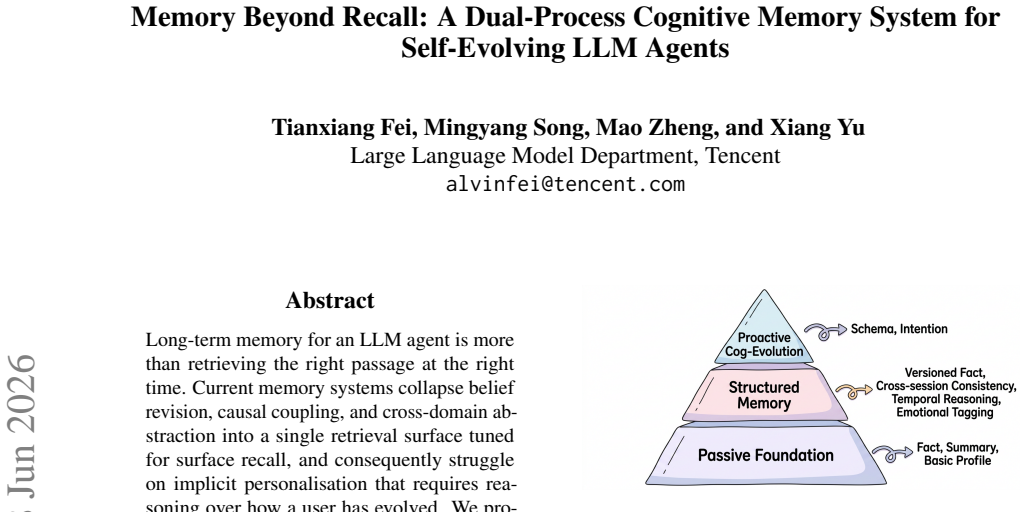
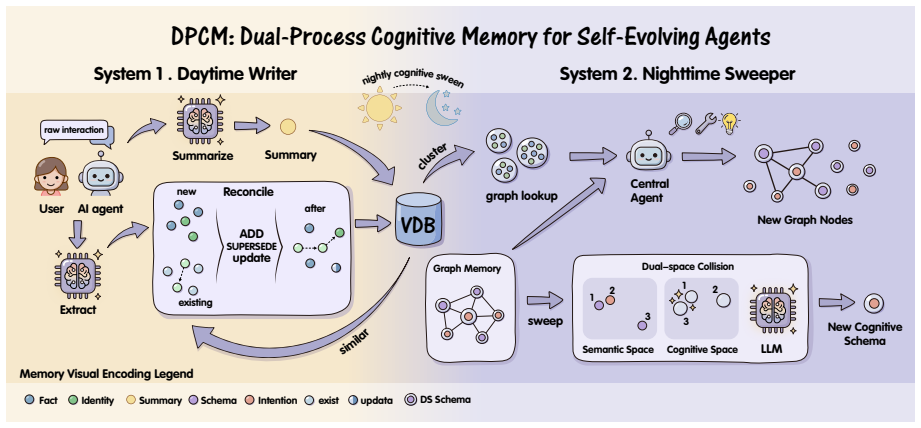
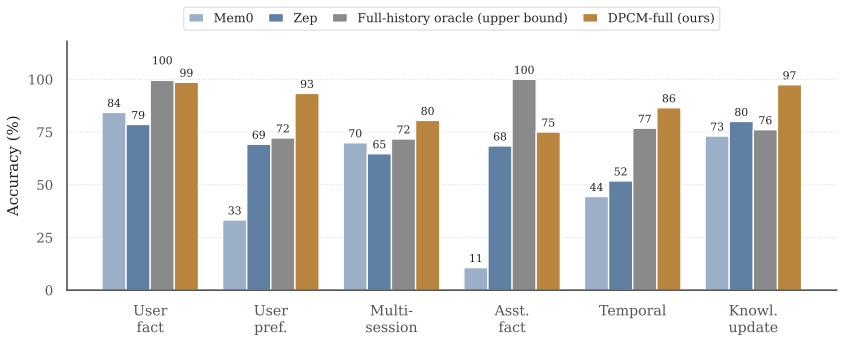
DCPM reorganises agent memory along a cognitive capability hierarchy ascending from raw inputs and atomic facts, through diachronic belief trajectories and identity, to domain schemas, latent intentions and cross-domain patterns. The hierarchy is driven by a synchronous daytime writer that records belief revisions as doubly linked supersedes chains and an asynchronous nighttime engine that induces schemas and intentions while sweeping for cross-domain collisions abstracted into higher-level core schemas. On the tested benchmarks, enabling the nighttime engine produces the largest gains where implicit cross-session inference is required and the smallest gains on span recall.
What carries the argument
The dual-process cognitive hierarchy in which System1 synchronously writes belief-revision chains and System2 asynchronously induces schemas from cross-domain collisions.
If this is right
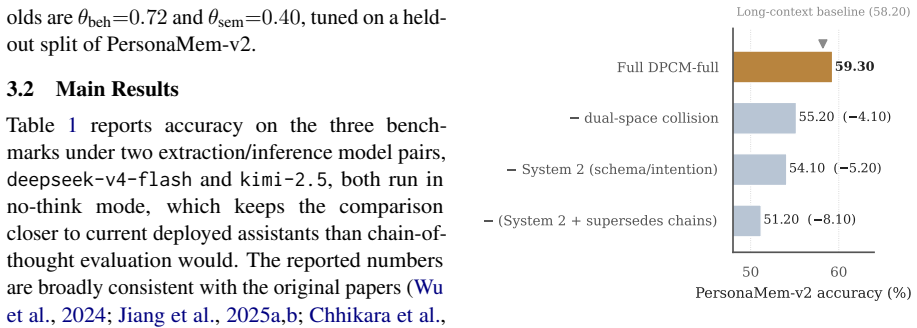
- Enabling the asynchronous engine improves results most on benchmarks that reward implicit cross-session inference.
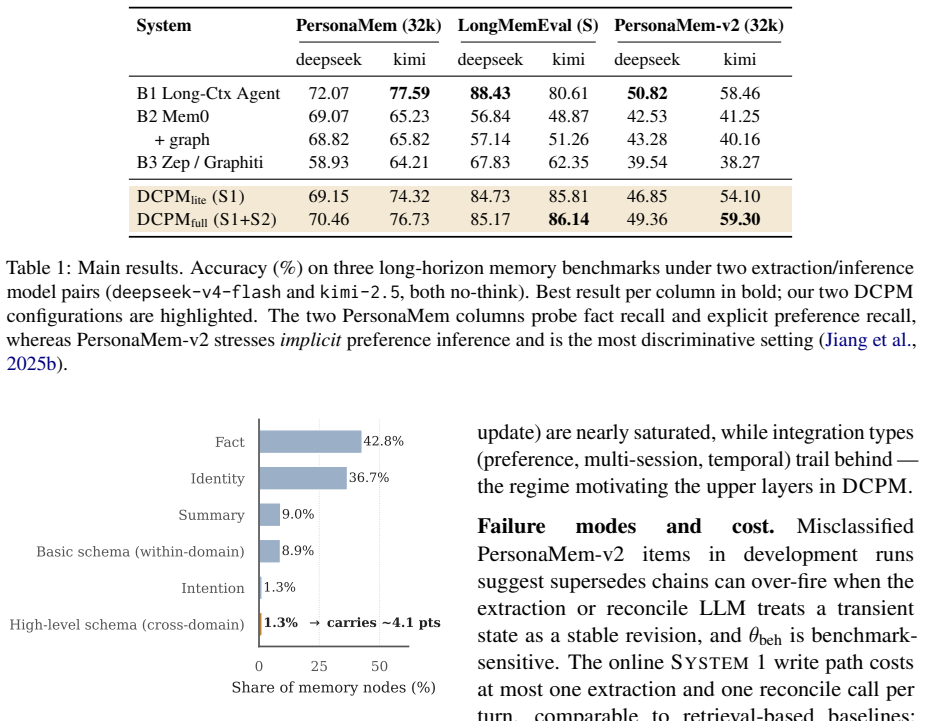
- The measured uplift reaches 5.20 points on PersonaMem-v2 when the engine runs.
- The same engine adds the least value on tasks limited to span recall.
- The observed pattern of gains matches the architectural prediction that the dual-process split aligns with differing cognitive demands.
Where Pith is reading between the lines
- Agents built this way could maintain coherent models of evolving users across many sessions with reduced need for explicit feedback.
- The same daytime-nighttime split could be tested in planning or tool-use modules that also require both immediate updates and periodic abstraction.
- Deployment would need to verify that the asynchronous engine can run in background without excessive compute or user-visible latency.
- The hierarchy offers a concrete route to test whether artificial memory can exhibit something analogous to human overnight consolidation.
Load-bearing premise
The benchmarks LongMemEval, PersonaMem and PersonaMem-v2 accurately measure the intended benefits of the proposed cognitive hierarchy and dual-process split for implicit personalisation in self-evolving agents.
What would settle it
A controlled run of PersonaMem-v2 in which the nighttime engine is disabled yet scores on the implicit cross-session items remain equal to or higher than the full system would falsify the claim that the asynchronous process is responsible for those gains.
Figures
read the original abstract
Long-term memory for an LLM agent is more than retrieving the right passage at the right time. Current memory systems collapse belief revision, causal coupling, and cross-domain abstraction into a single retrieval surface tuned for surface recall, and consequently struggle on implicit personalisation that requires reasoning over how a user has evolved. We propose DCPM, which reorganises agent memory along a cognitive capability hierarchy ascending from raw inputs and atomic facts, through diachronic belief trajectories and identity, to domain schemas, latent intentions and cross-domain patterns. The hierarchy is driven by two processes inheriting the architectural split of dual-process theory: a synchronous daytime writer (System1) that records belief revisions as doubly linked supersedes chains, and an asynchronous nighttime engine (System2) that induces schemas and intentions and sweeps for cross-domain collisions abstracted into higher-level core schemas. On LongMemEval, PersonaMem and PersonaMem-v2, enabling System2 contributes most where the benchmark rewards implicit cross-session inference (up to +5.20 on PersonaMem-v2) and least on span recall, matching the architectural prediction.
Editorial analysis
A structured set of objections, weighed in public.
Referee Report
Summary. The paper proposes DCPM, a dual-process cognitive memory architecture for LLM agents that organizes long-term memory into a capability hierarchy (raw inputs → atomic facts → diachronic belief trajectories → domain schemas → latent intentions → cross-domain patterns). It implements this via a synchronous daytime System1 writer that maintains doubly-linked supersedes chains for belief revisions and an asynchronous nighttime System2 engine that induces schemas, detects cross-domain collisions, and abstracts core schemas. Experiments on LongMemEval, PersonaMem, and PersonaMem-v2 report that enabling System2 yields the largest gains (up to +5.20) on tasks requiring implicit cross-session inference and the smallest gains on span recall, consistent with the architectural prediction.
Significance. If the reported differential gains are shown to arise specifically from the System2 schema-induction and collision-sweep mechanisms rather than from generic increases in memory capacity or context length, the work would supply a concrete, cognitively motivated alternative to flat retrieval-based memory systems and could guide the design of self-evolving agents that maintain coherent user models over extended interactions.
major comments (2)
- [§4] §4 (Evaluation): The central claim that System2 gains are largest precisely where benchmarks reward implicit cross-session inference presupposes that PersonaMem-v2 items cannot be solved by improved retrieval or longer context alone. No item-level annotations, construction protocol, or control conditions (e.g., ablations that disable only the nighttime schema step while preserving all other memory components) are reported to establish this differential demand.
- [§4.2] §4.2 and Table 2: The abstract and results state performance numbers without baselines, error bars, statistical tests, or data-exclusion rules. It is therefore impossible to determine whether the +5.20 delta on PersonaMem-v2 exceeds what would be obtained by any long-term memory augmentation of comparable capacity.
minor comments (2)
- [Figure 1] The hierarchy diagram (Figure 1) uses overlapping arrows whose meaning is not defined in the caption; clarify whether they represent information flow, supersession, or abstraction.
- [§3.1] Notation for the doubly-linked supersedes chains is introduced in §3.1 but never given an explicit update rule or pseudocode; add a short algorithm box.
Simulated Author's Rebuttal
We thank the referee for the constructive feedback on the evaluation design and statistical reporting. The comments highlight important gaps in demonstrating that the reported gains stem specifically from the System2 mechanisms rather than generic memory enhancements. We address each point below and will revise the manuscript accordingly.
read point-by-point responses
-
Referee: §4 (Evaluation): The central claim that System2 gains are largest precisely where benchmarks reward implicit cross-session inference presupposes that PersonaMem-v2 items cannot be solved by improved retrieval or longer context alone. No item-level annotations, construction protocol, or control conditions (e.g., ablations that disable only the nighttime schema step while preserving all other memory components) are reported to establish this differential demand.
Authors: We agree that the current version does not sufficiently isolate the contribution of the nighttime schema induction. The benchmarks were designed around tasks requiring cross-session reasoning, but without explicit controls this remains an assumption. In revision we will add the full construction protocol for PersonaMem-v2 as an appendix, provide item-level annotations classifying each query by inference type, and introduce a targeted ablation that disables only the asynchronous System2 engine (schema induction and collision sweep) while preserving the daytime writer, supersedes chains, and retrieval surface. This will directly test the differential demand claim. revision: yes
-
Referee: §4.2 and Table 2: The abstract and results state performance numbers without baselines, error bars, statistical tests, or data-exclusion rules. It is therefore impossible to determine whether the +5.20 delta on PersonaMem-v2 exceeds what would be obtained by any long-term memory augmentation of comparable capacity.
Authors: We accept this criticism of the results presentation. The revised manuscript will include: (i) additional baselines consisting of flat long-term memory systems and long-context models matched for total stored tokens, (ii) error bars from at least five independent runs with different seeds, (iii) paired statistical significance tests with reported p-values, and (iv) explicit data-exclusion criteria. These changes will allow direct comparison against generic capacity increases. revision: yes
Circularity Check
No significant circularity detected
full rationale
The abstract presents a proposed cognitive hierarchy and dual-process split (System1 daytime writer recording supersedes chains; System2 nighttime schema induction) as an architectural reorganization of agent memory, followed by empirical benchmark results showing differential System2 gains that are described as matching the prediction. No equations, parameter-fitting steps, or self-citation chains are visible that would reduce the claimed prediction or hierarchy to definitional equivalence with the inputs. The results are framed as external validation on LongMemEval, PersonaMem and PersonaMem-v2 rather than quantities constructed from the architecture itself. The derivation chain therefore remains self-contained against the stated benchmarks.
Axiom & Free-Parameter Ledger
axioms (1)
- domain assumption Dual-process theory from cognitive psychology supplies a useful architectural split for LLM agent memory
Reference graph
Works this paper leans on
-
[1]
arXiv preprint arXiv:2310.08560 , year =
MemGPT: Towards LLMs as Operating Systems , author =. arXiv preprint arXiv:2310.08560 , year =
-
[2]
arXiv preprint arXiv:2504.19413 , year =
Mem0: Building Production-Ready AI Agents with Scalable Long-Term Memory , author =. arXiv preprint arXiv:2504.19413 , year =
-
[3]
arXiv preprint arXiv:2410.10813 , year =
LongMemEval: Benchmarking Chat Assistants on Long-Term Interactive Memory , author =. arXiv preprint arXiv:2410.10813 , year =
-
[4]
arXiv preprint arXiv:2504.14225 , year =
Know Me, Respond to Me: Benchmarking LLMs for Dynamic User Profiling and Personalized Responses at Scale , author =. arXiv preprint arXiv:2504.14225 , year =
-
[5]
arXiv preprint arXiv:2512.06688 , year =
PersonaMem-v2: Towards Personalized Intelligence via Learning Implicit User Personas and Agentic Memory , author =. arXiv preprint arXiv:2512.06688 , year =
-
[6]
arXiv preprint arXiv:2304.03442 , year =
Generative Agents: Interactive Simulacra of Human Behavior , author =. arXiv preprint arXiv:2304.03442 , year =
-
[7]
arXiv preprint arXiv:2005.11401 , year =
Retrieval-Augmented Generation for Knowledge-Intensive NLP Tasks , author =. arXiv preprint arXiv:2005.11401 , year =
Pith/arXiv arXiv 2005
-
[8]
International Conference on Machine Learning (ICML) , year =
Improving language models by retrieving from trillions of tokens , author =. International Conference on Machine Learning (ICML) , year =
-
[9]
arXiv preprint arXiv:2501.13956 , year =
Zep: A Temporal Knowledge Graph Architecture for Agent Memory , author =. arXiv preprint arXiv:2501.13956 , year =
-
[10]
arXiv preprint arXiv:2312.10997 , year =
Retrieval-Augmented Generation for Large Language Models: A Survey , author =. arXiv preprint arXiv:2312.10997 , year =
-
[11]
arXiv preprint arXiv:2402.17753 , year =
Evaluating Very Long-Term Conversational Memory of LLM Agents , author =. arXiv preprint arXiv:2402.17753 , year =
-
[12]
2011 , publisher =
Thinking, Fast and Slow , author =. 2011 , publisher =
2011
-
[13]
Perspectives on Psychological Science , volume =
Dual-Process Theories of Higher Cognition: Advancing the Debate , author =. Perspectives on Psychological Science , volume =. 2013 , publisher =
2013
-
[14]
2014 , publisher =
Making Minds: How Theory of Mind Develops , author =. 2014 , publisher =
2014
-
[15]
Quarterly Journal of Experimental Psychology , volume =
What is ``theory of mind''? Concepts, cognitive processes and individual differences , author =. Quarterly Journal of Experimental Psychology , volume =
-
[16]
1932 , publisher =
Remembering: A Study in Experimental and Social Psychology , author =. 1932 , publisher =
1932
-
[17]
Neuron , volume =
The Future of Memory: Remembering, Imagining, and the Brain , author =. Neuron , volume =
-
[18]
1988 , publisher =
Knowledge in Flux: Modeling the Dynamics of Epistemic States , author =. 1988 , publisher =
1988
-
[19]
1986 , publisher =
Communication and Persuasion: Central and Peripheral Routes to Attitude Change , author =. 1986 , publisher =
1986
-
[20]
Psychological Review , volume =
Encoding Specificity and Retrieval Processes in Episodic Memory , author =. Psychological Review , volume =
-
[21]
2013 , publisher =
Social Cognition: From Brains to Culture , author =. 2013 , publisher =
2013
-
[22]
arXiv preprint arXiv:2502.12110 , year =
A-MEM: Agentic Memory for LLM Agents , author =. arXiv preprint arXiv:2502.12110 , year =
-
[23]
Proceedings of the AAAI Conference on Artificial Intelligence (AAAI) , year =
MemoryBank: Enhancing Large Language Models with Long-Term Memory , author =. Proceedings of the AAAI Conference on Artificial Intelligence (AAAI) , year =
-
[24]
Advances in Neural Information Processing Systems (NeurIPS) , year =
HippoRAG: Neurobiologically Inspired Long-Term Memory for Large Language Models , author =. Advances in Neural Information Processing Systems (NeurIPS) , year =
-
[25]
Transactions on Machine Learning Research , year =
Voyager: An Open-Ended Embodied Agent with Large Language Models , author =. Transactions on Machine Learning Research , year =
-
[26]
Advances in Neural Information Processing Systems (NeurIPS) , year =
Reflexion: Language Agents with Verbal Reinforcement Learning , author =. Advances in Neural Information Processing Systems (NeurIPS) , year =
-
[27]
arXiv preprint arXiv:2402.16288 , year =
PerLTQA: A Personal Long-Term Memory Dataset for Memory Classification, Retrieval, and Synthesis in Question Answering , author =. arXiv preprint arXiv:2402.16288 , year =
-
[28]
Proceedings of the 60th Annual Meeting of the Association for Computational Linguistics (ACL) , year =
Beyond Goldfish Memory: Long-Term Open-Domain Conversation , author =. Proceedings of the 60th Annual Meeting of the Association for Computational Linguistics (ACL) , year =
-
[29]
Organization of Memory , editor =
Episodic and Semantic Memory , author =. Organization of Memory , editor =. 1972 , publisher =
1972
-
[30]
arXiv preprint arXiv:2604.07894 , year =
TSUBASA: Improving Long-Horizon Personalization via Evolving Memory and Self-Learning with Context Distillation , author =. arXiv preprint arXiv:2604.07894 , year =
-
[31]
2026 , url =
Feng, Xinshun and Song, Xinhao and Li, Lijun and Liu, Gongshen and Shao, Jing , journal =. 2026 , url =
2026
-
[32]
Experience Compression Spectrum: Unifying Memory, Skills, and Rules in
Zhang, Xing and Wang, Guanghui and Cui, Yanwei and Qiu, Wei and Li, Ziyuan and Zhu, Bing and He, Peiyang , journal =. Experience Compression Spectrum: Unifying Memory, Skills, and Rules in. 2026 , url =
2026
-
[33]
arXiv preprint arXiv:2603.14517 , year =
Learning to Forget: Sleep-Inspired Memory Consolidation for Resolving Proactive Interference in Large Language Models , author =. arXiv preprint arXiv:2603.14517 , year =
-
[34]
2026 , url =
Zhao, Xinping and Hu, Xinshuo and Xu, Jiaxin and Tang, Danyu and Zhang, Xin and Zhou, Mengjia and Zhong, Yan and Zhou, Yao and Shan, Zifei and Zhang, Meishan and Hu, Baotian and Zhang, Min , journal =. 2026 , url =
2026
-
[35]
2026 , url =
Liu, Shuai and Tian, Shulin and Hu, Kairui and Dong, Yuhao and Yang, Zhe and Li, Bo and Yang, Jingkang and Loy, Chen Change and Liu, Ziwei , journal =. 2026 , url =
2026
-
[36]
Nils Reimers and Iryna Gurevych , title =. Proceedings of the 2019 Conference on Empirical Methods in Natural Language Processing and the 9th International Joint Conference on Natural Language Processing (EMNLP-IJCNLP) , pages =
2019
-
[37]
Advances in Neural Information Processing Systems (NeurIPS) , year =
Aman Madaan and Niket Tandon and Prakhar Gupta and Skyler Hallinan and Luyu Gao and Sarah Wiegreffe and Uri Alon and Nouha Dziri and Shrimai Prabhumoye and Yiming Yang and Shashank Gupta and Bodhisattwa Prasad Majumder and Katherine Hermann and Sean Welleck and Amir Yazdanbakhsh and Peter Clark , title =. Advances in Neural Information Processing Systems ...
-
[38]
Sumers and Shunyu Yao and Karthik Narasimhan and Thomas L
Theodore R. Sumers and Shunyu Yao and Karthik Narasimhan and Thomas L. Griffiths , title =. Transactions on Machine Learning Research , year =
-
[39]
International Conference on Learning Representations (ICLR) , year =
Yuhuai Wu and Markus Norman Rabe and DeLesley Hutchins and Christian Szegedy , title =. International Conference on Learning Representations (ICLR) , year =
-
[40]
arXiv preprint arXiv:2407.21783 , year =
The. arXiv preprint arXiv:2407.21783 , year =
-
[41]
and Lin, Kevin and Hewitt, John and Paranjape, Ashwin and Bevilacqua, Michele and Petroni, Fabio and Liang, Percy , title =
Liu, Nelson F. and Lin, Kevin and Hewitt, John and Paranjape, Ashwin and Bevilacqua, Michele and Petroni, Fabio and Liang, Percy , title =. Transactions of the Association for Computational Linguistics , volume =
-
[42]
Chen, Jianlv and Xiao, Shitao and Zhang, Peitian and Luo, Kun and Lian, Defu and Liu, Zheng , journal=
discussion (0)
Sign in with ORCID, Apple, or X to comment. Anyone can read and Pith papers without signing in.