REVIEW 4 major objections 5 minor 27 references
FSE: Continual Learning for Named Entity Recognition by Fast-Slow Experts
T0 review · 4 major / 5 minor · reviewed 2026-08-01 · deepseek-v4-flash
Pith's one-line read A shared fast expert learns token-pair link strengths to prune candidate spans, so a task-specific slow expert classifies fewer candidates and continual named-entity recognition forgets less.
desk verdict A genuinely new fast-slow span architecture for continual NER, with solid but modest gains, yet the core filtering bias clashes with the benchmark's negative labeling of other-type entities, and that goes unexamined. read the letter →
The pith
A machine-rendered reading of the paper's core claim, the machinery that carries it, and where it could break.
The reading
What carries the argument
The load-bearing mechanism is the token-link computation: a pair of feed-forward layers maps each adjacent token pair to a scalar link score, and softmin pooling converts the link scores inside a span into a span-level fast score that stays high only when every internal link is strong. That fast score is fused with the slow expert's span score through a harmonic mean, so the model recognizes an entity only with the agreement of both experts. This mechanism carries the argument because it turns the O(n^2) span-classification problem into an O(n) link-learning problem plus classification of a pruned candidate set, and because the link predictor is shared across tasks, it provides a route for t
What would settle it
Train FSE, then evaluate the fast expert in isolation: compute the fast score for every span in a held-out set and check whether all gold entity spans receive a fast score high enough to survive fusion. If a substantial share of true entities falls below the operating threshold used in the model, the fast expert is discarding real entities and the gains are not coming from lossless pruning.
Extended reading notes
Core claim
The central claim is that a span-based NER system can learn entity types incrementally without losing old ones by decomposing the task into a shared link predictor and a per-task span classifier. The link predictor, called the fast expert, assigns a score to each adjacent token pair and is trained under the inductive bias that entity spans contain only strong internal links while non-entity spans always contain at least one weak link. Softmin pooling aggregates the link scores inside a span into a single fast score, and a harmonic-mean fusion with the slow expert's span score ensures that both the link gate and the classifier must agree before a span is predicted as an entity. Training is jo
Load-bearing premise
The design rests on the inductive bias that every true entity span has all strong internal token links and every non-entity span has at least one weak link; if real text regularly violates this, the fast expert cannot separate candidates from non-candidates and the claimed reduction in learning burden collapses.
Editorial extensions
If this is right
- On synthetic continual versions of OntoNotes and FewNERD, the full model reaches higher final macro-F1 than the compared span-based baselines, including models with knowledge distillation only.
- Ablation results show that the fast expert, its cross-task sharing, and the length-decay negative sampling each contribute to the final score; replacing the learned links with a fixed length threshold hurts performance.
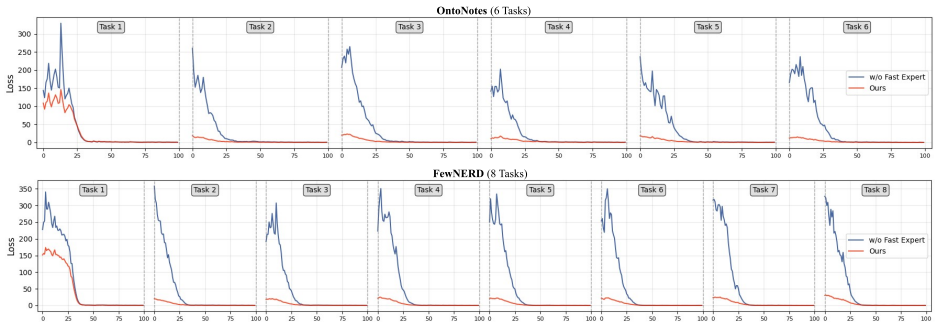
- Loss curves over the first training steps of each task show faster convergence when the fast expert is present, supporting the claim that the architecture lowers the learning burden per new task.
- Because the fast expert prunes most negative spans, negative sampling can be applied aggressively without sacrificing hard negatives, offering a practical way to handle span imbalance in continual NER.
- Joint optimization of both experts avoids error propagation between filtering and classification, which the authors identify as a key reason the fused model is stable.
Reading between the lines
- An untested but natural extension is to train the fast expert with an explicit supervision signal on gold boundaries ('is this token pair inside a mention?') and measure the recall of the fast expert alone; this would isolate the inductive bias from the end-to-end training signal.
- If the bias that non-entity spans always contain a weak link is violated in real data (e.g., long appositive phrases with strong local cohesion), the fast expert would silently suppress valid entities; the paper does not report a standalone recall analysis of the fast expert, so this remains an open risk.
- Because the fast expert is shared and language-like, it may transfer across domains with little or no fine-tuning; the paper tests datasets from the same domain and does not explore cross-domain transfer, which would be a stronger test of the sharing claim.
- The harmonic-mean fusion uses one global fast score for every entity type; a type-specific or threshold-adapted gate could better handle entity types with very different internal cohesion, but that variant is not explored.
Editorial analysis
A structured set of objections, weighed in public.
Referee Report
Summary. The paper proposes FSE, a span-based continual NER model with two experts: a task-shared fast expert that predicts adjacent-token link strengths and pools them into a span-level fast score via softmin pooling (Eq. 4), and task-specific slow experts that classify spans. The final span score is the harmonic mean of the two expert scores; knowledge distillation is used to retain old-task knowledge, and a length-decay negative-sampling schedule (Eq. 10) is applied to both the BCE and KD losses. Experiments on two synthetic CLNER benchmarks, built from OntoNotes and FewNERD, compare FSE with seven non-LLM baselines and two LLM baselines, and include ablations, convergence curves, and visualizations. The paper claims final-step state-of-the-art results: 89.23 Macro-F1 on OntoNotes and 63.69 on FewNERD, and argues that the fast expert reduces per-task learning burden while sharing useful knowledge across tasks.
Significance. If the mechanism is validated, this is a valuable contribution: it introduces a new form of task-shared knowledge for CLNER (adjacent-token link strength), with a clean formulation and a generally sound evaluation design (multi-permutation averaging, final standard deviations, a non-CL upper bound, and LLM comparisons). The final-step gains over SpanKL (0.25 and 1.54 points) are substantial relative to the reported final standard deviations. However, the central inductive bias is not validated, the negative-sampling curve is tuned on the same benchmarks, and no code or data are released, so the empirical and mechanistic claims need reinforcement before they can be fully trusted.
major comments (4)
- [Sec. 3.2.4 and Sec. 4.1] The fast-expert bias ('every non-entity span contains at least one weak link') conflicts with the CLNER benchmark construction. In Sec. 4.1, a span is negative whenever its true type is not the current task's type; e.g., a PER mention is a negative during an ORG task. Under the declared bias, that mention must contain a weak link, yet the same shared fast expert (which receives no task identifier) must later produce strong links inside the same mention when PER becomes positive. The paper provides no link-level statistics or ablation that separates true non-entities from other-type entity spans. If fast scores are systematically low for cross-type entity spans, the filtering mechanism suppresses exactly the spans future tasks must learn, undermining the claimed cross-task sharing and reduced learning burden. Please report fast-score distributions for true non-entities, other-type entitie
- [Sec. 3.2.7, Eq. (10)] The length-decay sampling parameters (base ratio eta, slope 0.8, shift 11) are selected in 'preliminary experiments' on these benchmarks, and only the best setting is presented. Since negative sampling contributes 0.23 Macro-F1 points on both datasets (Table 3), the lack of a sensitivity analysis leaves open whether the reported gain is robust or an artifact of tuning. Please provide a sensitivity sweep over the curve parameters, per-permutation results, or a validation-based selection protocol.
- [Sec. 4.5, Table 2] The statement that FSE 'consistently maintains SoTA performance' on FewNERD is not supported by Table 2. At Steps 1-3, FSE (66.61, 62.43, 62.39) is below SpanKL (67.81, 64.16, 63.62) and SKD-NER (67.68, 64.55, 63.90). The final-step gain is real, but the early-task deficit should be discussed and the claim reworded to 'state-of-the-art at the final step'.
- [Availability] No code or data release is mentioned. FSE has many implementation details (softmin-pooling via logcumsumexp, span enumeration, negative sampling in both losses), and the reported gains over strong baselines are modest. Without release, or at least per-permutation results and a complete configuration appendix, the experiments are not independently verifiable. Please state data/code availability or provide enough detail to reproduce the pipeline exactly.
minor comments (5)
- [Abstract and contributions] 'synthestic' should be 'synthetic'; 'CNLER' in the contributions list should be 'CLNER'.
- [Tables 1 and 3] Table 1 has 'S tep6' in the header; Table 3 has 'w/oshared FastExpert' without spacing. Also, throughput numbers in Table 3 are given without variance, so the claim that the fast expert 'does not significantly slow down' training is hard to evaluate.
- [Eq. (5)] The notation 'h_{ij}^k B sigma(...)' uses 'B' for assignment; use ':=' or a left arrow symbol.
- [Sec. 1 and Eq. (4)] The span count '0.5(n 2-n)' should be typeset as n(n-1)/2 with a superscript. In Eq. (4), the statement that the weakest link acts as an upper bound is correct only in the limit tau -> 0; the text should acknowledge the finite-temperature approximation.
- [Sec. 4.2] Standard deviations are reported only at the final step. Since the paper makes claims about incremental behavior (e.g., early-task deficits), per-step variances should be reported or the discussion limited to final-step comparisons.
Circularity Check
No significant circularity: FSE’s benchmark gains are external experimental results, and the disclosed inductive bias and hyperparameter tuning are not input–output equivalences.
full rationale
FSE’s central claim is an empirical performance comparison on synthetic CLNER benchmarks. The final Macro-F1 numbers are obtained by training on held-out test sets, not derived algebraically from the loss functions or from the model definitions. The fast-expert link bias is explicitly presented as an assumption: “this link mechanism is merely a designed inductive bias imposed on the model, the specific link strengths are still automatically learned by the model itself during training”—so the model learns the links and is then evaluated, rather than having the evaluation result encoded in the assumption. The length-decay negative-sampling curve in Eq. 10 is the closest candidate for a fitted input: the paper states “These values and their approximate ranges were tested in preliminary experiments. The current values performed best,” which is transparent hyperparameter selection, not a fitted parameter renamed as a prediction of the benchmark metric. The only self-citation with author overlap is SpanKL [11], used as the base span-modeling architecture and as a baseline; that prior work is published and externally reviewed, and it is not invoked to rule out alternatives or to supply a uniqueness theorem. No equation in the paper makes the claimed final F1 equal to an input by construction. The flagged inductive-bias concern is a correctness/robustness issue, not circularity. Therefore the appropriate finding is no significant circularity.
Assumptions & free parameters
free parameters (5)
- Length-decay sampling constants (eta, scale, floor, slope, shift) =
eta=1, scale=0.95, floor=0.05, slope=0.8, shift=11
- Softmin-pooling temperature tau =
0.1
- Loss weights alpha and beta =
alpha=1, beta=1
- Hard-pruning length threshold (ablation variant) =
10
- FFN output dimensions d_o and d_l =
50
assumptions (3)
- ad hoc to paper Entity spans have all-strong internal token links; every non-entity span contains at least one weak link.
- domain assumption Token-link patterns learned on earlier entity types transfer to later entity types.
- domain assumption Synthetic CLNER splits (random partition of OntoNotes/FewNERD and masking of unseen annotations) faithfully operationalize continual NER.
Cite this review
Pith. "Pith review of FSE: Continual Learning for Named Entity Recognition by Fast-Slow Experts." pith.science (2026). https://pith.science/paper/SRMP5HCU
@misc{pith2026260722075,
  author       = {Pith},
  title        = {Pith review of: FSE: Continual Learning for Named Entity Recognition by Fast-Slow Experts},
  year         = {2026},
  howpublished = {\url{https://pith.science/paper/SRMP5HCU}},
  note         = {Machine review of arXiv:2607.22075}
}
read the original abstract
Continual Learning for Named Entity Recognition (CLNER) enable models to incrementally learn new entity types without forgetting previously acquired ones. However, existing methods suffer from catastrophic forgetting and insufficient exploitation of shared information across tasks. This paper proposes FSE, a Fast-Slow Experts enhanced span-based NER model for CLNER. The shared fast expert learns token-level links to efficiently filter out unlikely spans, while the task-specific slow expert performs span classification only on the remaining candidates. It stabilizes learning by promoting knowledge sharing across tasks and maintains plasticity by reducing learning burden at each task. A length-decay negative sampling strategy to mitigate span imbalance is also introduced. Extensive experiments on OntoNotes and FewNERD synthestic datasets demonstrate that FSE achieves state-of-the-art performance in CLNER scenarios, with effectiveness of each component, empirical evidence of faster convergence and expected functionality of both experts.
Figures


Figures from the paper (3 more)


Reference graph
Works this paper leans on
-
[1]
L. Wang, X. Zhang, H. Su, J. Zhu, A comprehensive survey of continual learning: Theory, method and application, IEEE trans- actions on pattern analysis and machine intelligence 46 (2024) 5362–5383
2024
-
[2]
Monaikul, G
N. Monaikul, G. Castellucci, S. Filice, O. Rokhlenko, Continual learning for named entity recognition, in: Proceedings of the AAAI Conference on Artificial Intelligence, volume 35, 2021, pp. 13570–13577
2021
-
[3]
Benk ˝o, Example forgetting and rehearsal in continual learn- ing, Pattern Recognit
B. Benk ˝o, Example forgetting and rehearsal in continual learn- ing, Pattern Recognit. Lett. 179 (2024) 65–72
2024
-
[4]
D. Zhou, Y . Song, Pnsp: Overcoming catastrophic forgetting using primary null space projection in continual learning, Pattern Recognit. Lett. 179 (2024) 137–143
2024
-
[5]
W. L. Seow, I. Chaturvedi, A. Hogarth, R. Mao, E. Cambria, A review of named entity recognition: from learning methods to modelling paradigms and tasks, Artif. Intell. Rev. 58 (2025) 315
2025
-
[6]
H. Liu, X. Xin, W. Peng, J. Song, J. Sun, Concept-driven knowl- edge distillation and pseudo label generation for continual named entity recognition, Expert Systems with Applications 270 (2025) 126546
2025
-
[7]
Dohare, J
S. Dohare, J. F. Hernandez-Garcia, Q. Lan, P. Rahman, A. R. Mahmood, R. S. Sutton, Loss of plasticity in deep continual learning, Nature 632 (2024) 768 – 774
2024
-
[8]
Lample, M
G. Lample, M. Ballesteros, S. Subramanian, K. Kawakami, C. Dyer, Neural architectures for named entity recognition, in: Proceedings of NAACL-HLT, 2016, pp. 260–270
2016
Show all 27 references
-
[9]
Straková, M
J. Straková, M. Straka, J. Haji ˇc, Neural architectures for nested ner through linearization, arXiv preprint arXiv:1908.06926 (2019)
1908 arXiv
-
[10]
J. Yu, B. Bohnet, M. Poesio, Named entity recognition as depen- dency parsing, in: Proceedings of the 58th Annual Meeting of the Association for Computational Linguistics, 2020
2020
-
[11]
Zhang, Q
Y . Zhang, Q. Chen, A neural span-based continual named entity recognition model, in: Proceedings of the AAAI conference on artificial intelligence, volume 37, 2023, pp. 13993–14001
2023
-
[12]
X. Li, J. Feng, Y . Meng, Q. Han, F. Wu, J. Li, A unified MRC framework for named entity recognition, in: Proceedings of the 58th Annual Meeting of the Association for Computational Lin- guistics, 2020
2020
-
[13]
Y . Fei, X. Xu, Gfmrc: A machine reading comprehension model for named entity recognition, Pattern Recognition Letters 172 (2023) 97–105
2023
-
[14]
H. Yan, T. Gui, J. Dai, Q. Guo, Z. Zhang, X. Qiu, A unified generative framework for various ner subtasks, in: Proceedings of the 59th Annual Meeting of the Association for Computational Linguistics, 2021
2021
-
[15]
Y . Lu, Q. Liu, D. Dai, X. Xiao, H. Lin, X. Han, L. Sun, H. Wu, Unified structure generation for universal information extraction, in: Proceedings of the 60th Annual Meeting of the Association for Computational Linguistics, 2022, pp. 5755–5772
2022
-
[16]
Y . Xia, Q. Wang, Y . Lyu, Y . Zhu, W. Wu, S. Li, D. Dai, Learn and review: Enhancing continual named entity recognition via reviewing synthetic samples, in: Findings of the association for computational linguistics: ACL 2022, 2022, pp. 2291–2300
2022
-
[17]
Zhang, Y
D. Zhang, Y . Yu, F. Chen, X. Chen, Decomposing logits distil- lation for incremental named entity recognition, in: Proceedings of the 46th international ACM SIGIR conference on research and development in information retrieval, 2023, pp. 1919–1923
2023
-
[18]
Y . Chen, L. He, Skd-ner: Continual named entity recognition via span-based knowledge distillation with reinforcement learning, in: Proceedings of the 2023 conference on empirical methods in natural language processing, 2023, pp. 6689–6700
2023
-
[19]
B. Yuan, D. Zhao, A survey on continual semantic segmentation: Theory, challenge, method and application, IEEE Transactions on Pattern Analysis and Machine Intelligence 46 (2024) 10891– 10910
2024
-
[20]
Zhang, J.-W
C.-B. Zhang, J.-W. Xiao, X. Liu, Y .-C. Chen, M.-M. Cheng, Rep- resentation compensation networks for continual semantic seg- mentation, in: Proceedings of the IEEE/CVF Conference on Computer Vision and Pattern Recognition, 2022, pp. 7053–7064
2022
-
[21]
B. Yuan, D. Zhao, Z. Shi, Learning at a glance: Towards interpretable data-limited continual semantic segmentation via semantic-invariance modelling, IEEE Transactions on Pattern Analysis and Machine Intelligence 46 (2024) 7909–7923
2024
-
[22]
Weischedel, M
R. Weischedel, M. Palmer, M. Marcus, E. Hovy, S. Pradhan, L. Ramshaw, N. Xue, A. Taylor, J. Kaufman, M. Franchini, M. El-Bachouti, R. Belvin, A. Houston, Ontonotes Release 5.0, 2013
2013
-
[23]
N. Ding, G. Xu, Y . Chen, X. Wang, X. Han, P. Xie, H.-T. Zheng, Z. Liu, Few-nerd: A few-shot named entity recognition dataset, in: Proceedings of the 59th Annual Meeting of the Association for Computational Linguistics, 2021, pp. 3198–3213
2021
-
[24]
Devlin, M.-W
J. Devlin, M.-W. Chang, K. Lee, K. Toutanova, Bert: Pre- training of deep bidirectional transformers for language under- standing, in: North American Chapter of the Association for Computational Linguistics, 2019, pp. 4171–4186
2019
-
[25]
Loshchilov, F
I. Loshchilov, F. Hutter, Decoupled weight decay regularization, in: International Conference on Learning Representations, 2017
2017
-
[26]
URL:https://openai.com/ zh-Hans-CN/gpt-5/
OpenAI, Gpt-5, 2025. URL:https://openai.com/ zh-Hans-CN/gpt-5/
2025
-
[27]
Grattafiori, A
A. Grattafiori, A. Dubey, A. Jauhri, A. Pandey, A. Kadian, A. Al- Dahle, A. Letman, A. Mathur, A. Schelten, A. Vaughan, et al., The llama 3 herd of models, arXiv preprint arXiv:2407.21783 (2024). 8
2024 arXiv
Reviewed August 1, 2026 · model on record in the stance chip above.
Discussion (0). Continue with ORCID to comment.