REVIEW 3 major objections 4 minor 68 references
Magnon blockade in spin-magnon systems with frequency detuning
T0 review · 3 major / 4 minor · reviewed 2026-08-07 · deepseek-v4-flash
Pith's one-line read A frequency-detuned YIG–NV hybrid system can make conventional and unconventional magnon blockade happen at the same time, yielding a single-magnon source with g^(2)(0) ≈ 10^-8.
desk verdict The detuning-based simultaneous CMB+UMB intersection is a real theoretical result, but the 10^-8 purity is only shown at an experimentally ungrounded g/γ=20, so the claim about five orders of magnitude needs tempering. read the letter →
The pith
A machine-rendered reading of the paper's core claim, the machinery that carries it, and where it could break.
The reading
What carries the argument
The central object is the equal-time second-order magnon correlation function g^(2)(0), evaluated from the steady state of a non-Hermitian Schrödinger equation truncated to the two-excitation subspace. Analytically it factorizes as g^(2)(0) ≈ |B2|²|C|²/(|A2|²|D|²), so blockade appears when the factor |B2|² (unconventional, drive-dependent) or |C|² (conventional, drive-independent) vanishes. The drive ratio λ=Ω_NV/Ω_m enters |B2|² and shifts the UMB lines; requiring both |B2|²=0 and |C|²=0 yields the intersection formula for Δ_F^(1,2,3), with Δ_F^(3) existing only for λ>2√2.
What would settle it
A direct check is to measure g^(2)(0) as a function of driving detuning in a single YIG-NV device with g/κ ≈ 40, qubit-to-magnon drive ratio λ=4, and near-zero temperature. The scheme predicts a dip below $10^{-7}$ at the detuning \$Delta_F^{{(3)}}$ = -g(\$\lambda$ - 3\sqrt{\$lambda^{2}$-8})/8, and the dip should disappear when the qubit drive is off; observing no such detuning-controlled dip, or a dip only at \Delta_F=0, would falsify the simultaneous-blockade claim.
Extended reading notes
Core claim
On the paper's own terms, the discovery is that conventional and unconventional magnon blockade are not mutually exclusive regimes but can be merged by detuning. In the singly driven magnon case, the CMB condition |C|²=0 gives a hyperbola Δ=±√(g²+Δ_F²), while the UMB condition |B1|²=0 gives shifted lines; in the doubly driven case, the qubit drive shifts the UMB by 2λg, producing three intersections with the CMB hyperbola when λ>2√2. The authors identify the third intersection Δ_F^(3) = -g(λ-3√(λ²-8))/8 as the point where destructive interference and anharmonicity reinforce each other, far from the magnon-induced-tunneling region, yielding g^(2)(0) ~ $10^{-8}$ for g=20γ and λ=4. They further show that the combined scheme keeps blockade at weak coupling and yields a monotone time-delayed correlation function.
Load-bearing premise
The result assumes the YIG-NV coupling can be as large as twenty times the common decay rate while the thermal magnon occupation stays near zero; if the realizable coupling is much smaller than the decay rates, the point where conventional and unconventional blockade coincide does not exist.
Editorial extensions
If this is right
- A single-magnon source with g^(2)(0) ~ 10^-8 becomes accessible in the same device, about five orders of magnitude stronger antibunching than earlier magnon-blockade proposals.
- Strong coupling is not required for blockade: with both drives on, the conventional blockade appears even at g=0.5γ, so a wider class of spin-magnon samples can be used.
- The time-delayed correlation function for the combined scheme approaches zero smoothly rather than oscillating above one, so single-magnon detection does not require high time resolution.
- The combined blockade tolerates thermal magnon occupations up to n_th ≈ 0.1 before losing antibunching, whereas the unconventional blockade alone fails already at n_th = 10^-3.
- The drive-ratio condition λ>2√2 is a concrete experimental target: below it only one intersection exists and the optimal blockade point disappears.
Reading between the lines
- The same frequency-detuning prescription may carry over to other magnetic-dipole-coupled spin-magnon platforms, since the derivation only uses a two-level spin and a single magnon mode; the optimal point would shift with the physical parameters but the intersection logic would not.
- Because the qubit drive causes the downward shift of the UMB, the drive ratio λ can be used as a tuning knob independent of detuning; one could hold the device fixed and sweep λ to map the predicted three intersections.
- The zero-temperature, weak-driving limit underlies the 10^-8 number; a practical source would need a finite-drive and finite-temperature version of the correlation formula to predict the best achievable purity.
Editorial analysis
A structured set of objections, weighed in public.
Referee Report
Summary. The manuscript proposes a scheme for magnon blockade in a hybrid system consisting of a YIG-sphere Kittel mode coupled to an NV-center spin qubit, with a frequency detuning ΔF between the magnon and the spin. In the weak-driving limit the authors derive approximate analytical expressions for the equal-time second-order correlation function g^(2)(0) from a non-Hermitian Hamiltonian, and identify conditions for conventional (|C|^2=0) and unconventional (|B1|^2=0 or |B2|^2=0) blockade. For two-tone driving with λ=Ω_NV/Ω_m>2√2, the CMB and UMB conditions intersect, producing deeper blockade; QuTiP master-equation simulations confirm the analytical blockade loci. The authors report g^(2)(0)≈1e-8 for g/γ=20, λ=4, and study the time-delayed correlation function and thermal-occupation robustness.
Significance. If the required parameters are physically accessible, the scheme is a clean theoretical proposal for a high-purity single-magnon source. The analytical formulas are explicit and parameter-free in the sense that all coefficients are expressed in Hamiltonian parameters, and the numerical master-equation results match the predicted blockade curves, giving confidence in the internal consistency. The frequency detuning is identified as a useful control knob that shifts the UMB condition and enables the CMB+UMB overlap. The main limitations are the lack of experimental justification for the strong-coupling, symmetric-decay operating point used for the 1e-8 value, and the absence of a quantitative comparison with earlier magnon-blockade results; these issues do not invalidate the derivation but bound the claimed practical significance.
major comments (3)
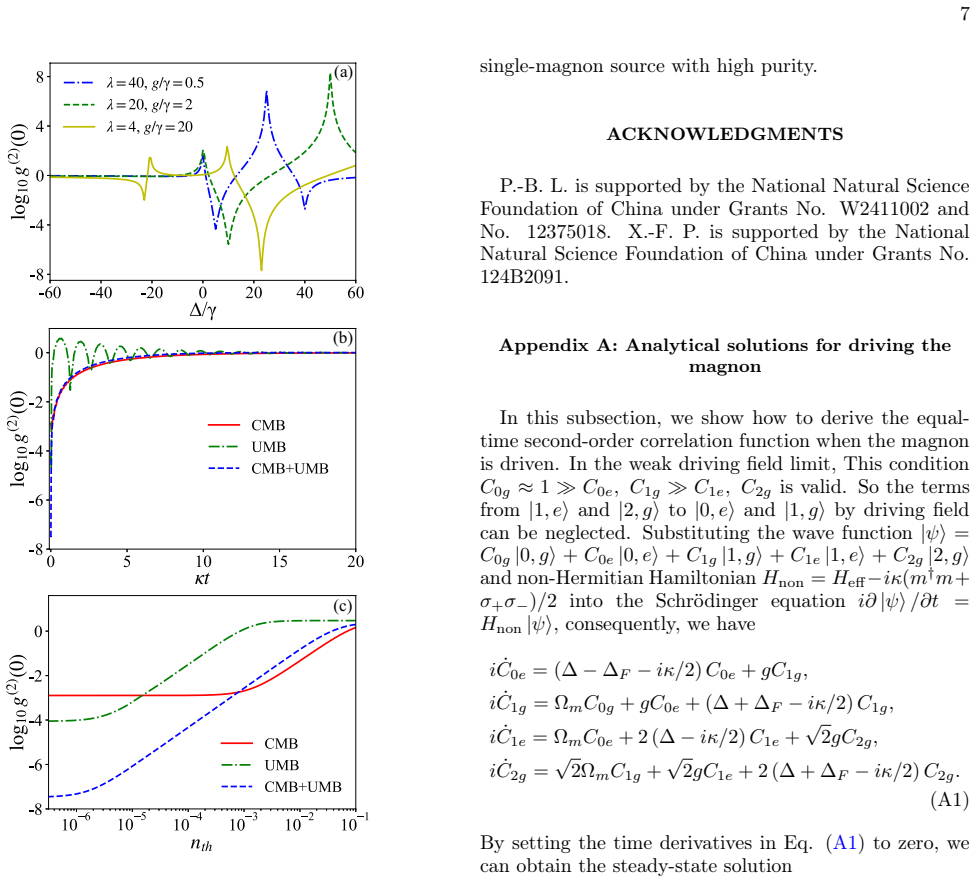
- [Sec. III.B, Fig. 8(a), Eq. (16)] The headline value g^(2)(0)≈1e-8 is obtained at g/γ=20, κ/γ=0.5, λ=4, and ΔF^(3)/γ≈11.2, but the manuscript does not provide an experimental or quantitative basis for a directly coupled single-NV/Kittel-mode coupling of g/2π≈20 MHz; Ref. [56] is a theoretical design rather than a measurement. Because the blockade depth in Fig. 8(a) clearly improves as g increases, the abstract's claim that the scheme 'relaxes the requirements for coupling strength' is not supported in the regime where the 1e-8 value is obtained. Please add a scaling analysis of the minimum g^(2)(0) versus g/κ (and versus κq/κm) and state the coupling threshold below which the advertised improvement is lost.
- [Sec. III, Eq. (6), Eqs. (10) and (14)] The master equation sets κm=κq=κ, and the non-Hermitian Hamiltonian in Eq. (8) adds the same κ/2 damping to the magnon and spin sectors; this equality is used in the derivation of all analytical blockade conditions. For an NV center, the spin amplitude decay rate is typically orders of magnitude smaller than the Kittel-mode linewidth, and the paper gives no argument that the symmetric case is representative. Because the UMB relies on destructive interference between decay-broadened pathways, the 1e-8 minimum may be an artifact of this symmetric choice. Please report results for κq/κm ranging from 0.01 to 1, or justify κq=κ for the proposed experimental setup.
- [Abstract and Sec. III.B] The claim that the achieved g^(2)(0)≈1e-8 is 'about five orders of magnitude lower than that in previous works' is never backed by specific numerical values from the cited earlier studies. Without a quantitative baseline, the magnitude of the improvement cannot be assessed. Please add a comparison table or cite explicit g^(2)(0) minima from the relevant references (e.g., Refs. [47]-[55]) and state the parameters at which they were obtained.
minor comments (4)
- [Sec. III.B, text before Eq. (16)] 'Combining Eq. (11) and Eq. (15)' should read 'Combining Eq. (12) and Eq. (15)', because the intersection points in Eq. (16) follow from the CMB curve (12) and the two-drive UMB curve (15), not from the single-drive UMB condition (11).
- [Fig. 8(a) caption] The caption lists only ΔF/γ values for curves (i)-(iii) and refers to 'different λ and g' without specifying λ and g for each curve; please give the exact parameter values used for each curve.
- [Sec. III.B, Fig. 8(b) discussion] The statement that for the CMB+UMB case 'g^(2)(t) smoothly approaches 0' is confusing on a log10 axis; the physically expected long-time value is 1, so the text should say 'g^(2)(t) smoothly approaches 1' or 'the log10 value tends to 0 without oscillation'.
- [Sec. III, opening paragraph] The word 'mast equation' should be 'master equation'.
Circularity Check
No significant circularity: the blockade conditions and the 10^-8 correlation value are model outputs from the stated Hamiltonian, not inputs or fitted quantities.
full rationale
The paper's derivation chain is self-contained and non-circular. It starts from the explicitly stated spin-magnon Hamiltonian, Eq. (5), and the Lindblad master equation, Eq. (6), then solves the weak-driving amplitude equations in Appendices A and B to obtain closed-form expressions for the equal-time second-order correlation function, Eqs. (9) and (13). The conventional and unconventional blockade conditions are derived as the zeros of the factors |C|^2 and |B1|^2 or |B2|^2, and the simultaneous-blockade points, Eq. (16), are obtained algebraically by requiring both factors to vanish. The numerical QUTIP simulation is an independent solution of the same master equation and confirms the analytical conditions rather than being fit to them. No parameter is fitted to the target correlation function; values such as g/gamma = 20, kappa/gamma = 0.5, lambda = 4, and Delta_F/gamma = 11.2 are chosen operating points, and the value g^(2)(0) ~ 10^-8 is the output of the calculation, not an input. The only overlapping-author citation is Ref. [56], used to justify the direct magnon-NV magnetic-dipole interaction Hamiltonian. This is a standard Jaynes-Cummings-type coupling, is not the target result of the paper, and is not invoked as a uniqueness theorem or as a prohibition on alternative models; moreover, the coupling form is independently standard. The paper's practical weakness, namely that the extreme 10^-8 value requires a large coupling g/gamma = 20 that may not yet be experimentally demonstrated, is a feasibility or parameter-justification concern, not a circularity concern. Overall, no step reduces by construction to its own input, and there is no fitted input renamed as a prediction.
Assumptions & free parameters
free parameters (7)
- g/γ (spin-magnon coupling ratio) =
0.5, 3, 20 (chosen values)
- κ/γ (decay rate ratio) =
0.5
- Ω_m/γ (magnon drive amplitude) =
0.01
- λ = Ω_NV/Ω_m (drive ratio) =
4 (also 1, 3, 5 studied)
- Δ_F/γ (frequency detuning) =
11.2 at the optimal point
- Δ/γ (driving detuning) =
22.8 at the optimal point
- n_th (thermal magnon occupation) =
0
assumptions (6)
- standard math Master equation with Lindblad dissipators is the correct open-system description.
- domain assumption Rotating-wave approximation is valid (g smaller than resonance frequencies).
- domain assumption NV center can be truncated to a two-level system (|0>, |−1>); |+1> is off-resonant.
- domain assumption Only the Kittel mode of the YIG sphere is considered.
- domain assumption Weak-driving limit Ω_m, Ω_NV ≪ κ allows truncation to the two-excitation subspace.
- standard math Non-Hermitian Hamiltonian evolution with neglected quantum jumps gives the steady-state wavefunction in the weak-driving limit.
Cite this review
Pith. "Pith review of Magnon blockade in spin-magnon systems with frequency detuning." pith.science (2026). https://pith.science/paper/SS67IWSF
@misc{pith2026250521320,
  author       = {Pith},
  title        = {Pith review of: Magnon blockade in spin-magnon systems with frequency detuning},
  year         = {2026},
  howpublished = {\url{https://pith.science/paper/SS67IWSF}},
  note         = {Machine review of arXiv:2505.21320}
}
abstract
Magnon blockade is a physical mechanism for the preparation of a single-magnon source, which has important applications in quantum information processing. Here we propose a scheme for generating an optimal magnon blockade in the spin-magnon quantum system. By introducing frequency detuning between the magnon and the spin qubit of the NV center, the conventional magnon blockade and the unconventional magnon blockade can be obtained under both strong and weak coupling, relaxing the requirements for coupling strength. Moreover, the conventional and unconventional magnon blockade can occur simultaneously when both the magnon and the spin qubit are driven. This allows the equal-time second-order correlation function to reach $10^{-8}$, about five orders of magnitude lower than that in previous works. Additionally, the time-delayed second-order correlation function avoids oscillation. Our study demonstrates the impact of frequency detuning on the magnon blockade and proposes methods to enhance the magnon blockade and relax the requirements for coupling strength through frequency detuning.
Figures


Figures from the paper (5 more)


Reference graph
Works this paper leans on
-
[56]
F. Wang, C. Gou, J. Xu, and C. Gong, Hybrid magnon- atom entanglement and magnon blockade via quantum interference, Phys. Rev. A106, 013705 (2022)
2022
- [47]
-
[55]
C. Zhao, X. Li, S. Chao, R. Peng, C. Li, and L. Zhou, Simultaneous blockade of a photon, phonon, and magnon induced by a two-level atom, Phys. Rev. A101, 063838 (2020)
work page 2020
-
[1]
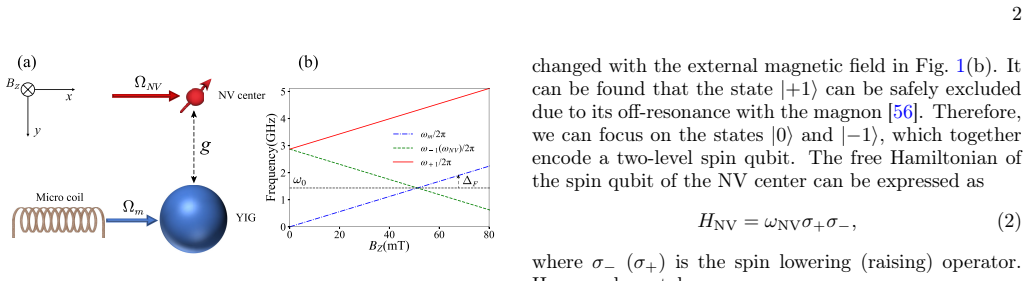
AndtheeigenstatesofspinoperatorS Z are{|0⟩,|±1⟩} withS Z |j⟩=j|j⟩andj= 0and±1. Since the external magnetic fieldB Z exists along the axis of symmetry of the NV center, the degeneracy of state|±1⟩splits by the Zeeman effect [34, 60] withω± =D 0 ± |γe|B Z taking|0⟩ as the energy reference value. Here,D0 = 2π×2.87GHz is the zero-field splitting. We plot the ...
-
[2]
To verify intersection points of the CMB and the UMB, we plot the equal-time second-order magnon correlation functionlog10 g(2) (0)as a function of ∆and∆ F with different values ofλin Fig. 7. As shown in Fig. 7(a), whenλ= 1, only one intersection point ∆F (1)exists at∆ F = 0and∆ =g. When the param- eterλ >2 √ 2is satisfied, we can see three intersection p...
-
[3]
Knill, R
E. Knill, R. Laflamme, and G. J. Milburn, A scheme for efficient quantum computation with linear optics, Nature 409, 46 (2001)
2001
-
[4]
P. Kok, W. J. Munro, K. Nemoto, T. C. Ralph, J. P. Dowling, and G. J. Milburn, Linear optical quantum computing with photonic qubits, Rev. Mod. Phys.79, 135 (2007)
2007
-
[5]
H. J. Kimble, The quantum internet, Nature453, 1023 (2008)
2008
Show all 68 references
-
[6]
M. A. Gilleo and S. Geller, Magnetic and crystallo- graphic properties of substituted yttrium-iron garnet, 3y2o3 ·xm 2o3 ·(5−x)fe 2o3, Phys. Rev.110, 73 (1958)
1958
-
[7]
Tabuchi, S
Y. Tabuchi, S. Ishino, T. Ishikawa, R. Yamazaki, K. Us- ami, and Y. Nakamura, Hybridizing ferromagnetic magnons and microwave photons in the quantum limit, Phys. Rev. Lett.113, 083603 (2014)
2014
-
[8]
Barker and G
J. Barker and G. E. W. Bauer, Thermal spin dynamics of yttriumirongarnet,Phys.Rev.Lett.117,217201(2016)
2016
-
[9]
Collet, X
M. Collet, X. De Milly, O. d’Allivy Kelly, V. V. Naletov, R. Bernard, P. Bortolotti, J. Ben Youssef, V. Demidov, S. Demokritov, J. L. Prieto, et al., Generation of coher- ent spin-wave modes in yttrium iron garnet microdiscs by spin–orbit torque, Nat. Commun.7, 10377 (2016)
2016
-
[10]
A. J. Princep, R. A. Ewings, S. Ward, S. Tóth, C. Dubs, D. Prabhakaran, and A. T. Boothroyd, The full magnon spectrum of yttrium iron garnet, npj Quant. Mater.2, 63 (2017)
2017
-
[11]
X.-Y. Wei, O. A. Santos, C. S. Lusero, G. Bauer, J. Ben Youssef, and B. van Wees, Giant magnon spin conductivity in ultrathin yttrium iron garnet films, Nat. Mater.21, 1352 (2022)
2022
-
[12]
Zhang, C.-L
X. Zhang, C.-L. Zou, L. Jiang, and H. X. Tang, Cavity magnomechanics, Science Advances2, e1501286 (2016)
2016
-
[13]
Zhang, C.-L
X. Zhang, C.-L. Zou, L. Jiang, and H. X. Tang, Strongly coupled magnons and cavity microwave photons, Phys. Rev. Lett.113, 156401 (2014)
2014
-
[14]
H.Huebl, C.W.Zollitsch, J.Lotze, F.Hocke, M.Greifen- stein, A. Marx, R. Gross, and S. T. B. Goennenwein, High cooperativity in coupled microwave resonator ferri- magnetic insulator hybrids, Phys. Rev. Lett.111, 127003 (2013)
2013
-
[15]
Zare Rameshti, Y
B. Zare Rameshti, Y. Cao, and G. E. W. Bauer, Mag- netic spheres in microwave cavities, Phys. Rev. B91, 214430 (2015)
2015
-
[16]
Maier-Flaig, M
H. Maier-Flaig, M. Harder, R. Gross, H. Huebl, and S. T. B. Goennenwein, Spin pumping in strongly cou- pled magnon-photon systems, Phys. Rev. B94, 054433 (2016)
2016
-
[17]
Tabuchi, S
Y. Tabuchi, S. Ishino, A. Noguchi, T. Ishikawa, R. Ya- mazaki, K.Usami, andY.Nakamura, Coherentcoupling between a ferromagnetic magnon and a superconducting qubit, Science349, 405 (2015)
2015
-
[18]
Li and G.-L
T. Li and G.-L. Long, Hyperparallel optical quantum computation assisted by atomic ensembles embedded in double-sided optical cavities, Phys. Rev. A94, 022343 (2016)
2016
-
[19]
Clerk, K
A. Clerk, K. Lehnert, P. Bertet, J. Petta, and Y. Naka- mura, Hybrid quantum systems with circuit quantum electrodynamics, Nat. Phys.16, 257 (2020)
2020
-
[20]
O. O. Soykal and M. E. Flatté, Strong field interactions between a nanomagnet and a photonic cavity, Phys. Rev. Lett.104, 077202 (2010)
2010
-
[21]
L. Bai, M. Harder, Y. P. Chen, X. Fan, J. Q. Xiao, and C.-M. Hu, Spin pumping in electrodynamically coupled magnon-photon systems, Phys. Rev. Lett.114, 227201 (2015)
2015
-
[22]
Viola Kusminskiy, H
S. Viola Kusminskiy, H. X. Tang, and F. Marquardt, Coupled spin-light dynamics in cavity optomagnonics, Phys. Rev. A94, 033821 (2016)
2016
-
[23]
J. A. Haigh, A. Nunnenkamp, A. J. Ramsay, and A. J. Ferguson, Triple-resonant brillouin light scattering in magneto-optical cavities, Phys. Rev. Lett.117, 133602 (2016)
2016
-
[24]
Kounalakis, G
M. Kounalakis, G. E. W. Bauer, and Y. M. Blanter, Analog quantum control of magnonic cat states on a chip byasuperconductingqubit,Phys.Rev.Lett.129,037205 (2022)
2022
-
[25]
Wang, G.-Q
Y.-P. Wang, G.-Q. Zhang, D. Zhang, T.-F. Li, C.-M. Hu, and J. Q. You, Bistability of cavity magnon polaritons, Phys. Rev. Lett.120, 057202 (2018)
2018
-
[26]
Zhang, C.-L
X. Zhang, C.-L. Zou, N. Zhu, F. Marquardt, L. Jiang, and H. X. Tang, Magnon dark modes and gradient mem- ory, Nat. commun.6, 8914 (2015)
2015
-
[27]
Y. Xiao, X. H. Yan, Y. Zhang, V. L. Grigoryan, C. M. Hu, H. Guo, and K. Xia, Magnon dark mode of an antiferromagnetic insulator in a microwave cavity, Phys. Rev. B99, 094407 (2019)
2019
-
[28]
Iguchi, S
Y. Iguchi, S. Uemura, K. Ueno, and Y. Onose, Non- reciprocal magnon propagation in a noncentrosymmetric ferromagnet life5o8, Phys. Rev. B92, 184419 (2015)
2015
-
[29]
C. Kong, H. Xiong, and Y. Wu, Magnon-induced non- reciprocity based on the magnon kerr effect, Phys. Rev. Appl.12, 034001 (2019)
2019
-
[30]
Wang, G.-Q
Y.-P. Wang, G.-Q. Zhang, D. Zhang, X.-Q. Luo, W. Xiong, S.-P. Wang, T.-F. Li, C.-M. Hu, and J. Q. You, Magnon kerr effect in a strongly coupled cavity- magnon system, Phys. Rev. B94, 224410 (2016)
2016
-
[31]
Sharma, Y
S. Sharma, Y. M. Blanter, and G. E. W. Bauer, Optical cooling of magnons, Phys. Rev. Lett.121, 087205 (2018)
2018
-
[32]
Zhang, D.-Y
W. Zhang, D.-Y. Wang, C.-H. Bai, T. Wang, S. Zhang, and H.-F. Wang, Generation and transfer of squeezed states in a cavity magnomechanical system by two-tone microwave fields, Opt. Express29, 11773 (2021)
2021
-
[33]
Li, S.-Y
J. Li, S.-Y. Zhu, and G. S. Agarwal, Squeezed states of magnons and phonons in cavity magnomechanics, Phys. Rev. A99, 021801 (2019)
2019
-
[34]
Aharonovich, A
I. Aharonovich, A. D. Greentree, and S. Prawer, Dia- mond photonics, Nat. Photon.5, 397 (2011)
2011
-
[35]
J. F. Barry, J. M. Schloss, E. Bauch, M. J. Turner, C. A. Hart, L. M. Pham, and R. L. Walsworth, Sensitivity 10 optimization for nv-diamond magnetometry, Rev. Mod. Phys.92, 015004 (2020)
2020
-
[36]
M. W. Doherty, N. B. Manson, P. Delaney, F. Jelezko, J. Wrachtrup, and L. C. Hollenberg, The nitrogen- vacancy colour centre in diamond, Phys. Rep.528, 1 (2013)
2013
-
[37]
Bar-Gill, L
N. Bar-Gill, L. M. Pham, A. Jarmola, D. Budker, and R. L. Walsworth, Solid-state electronic spin coherence time approaching one second, Nat. Commun.4, 1743 (2013)
2013
-
[38]
M. W. Doherty, V. V. Struzhkin, D. A. Simpson, L. P. McGuinness, Y. Meng, A. Stacey, T. J. Karle, R. J. Hem- ley, N. B. Manson, L. C. L. Hollenberg, and S. Prawer, Electronic properties and metrology applications of the diamondnv − center under pressure, Phys. Rev. Lett. 112, ...
2014
-
[39]
M. H. Abobeih, J. Cramer, M. A. Bakker, N. Kalb, M.Markham, D.J.Twitchen, andT.H.Taminiau, One- second coherence for a single electron spin coupled to a multi-qubit nuclear-spin environment, Nat. Commun.9, 2552 (2018)
2018
-
[40]
Fuchs, G
G. Fuchs, G. Burkard, P. Klimov, and D. Awschalom, A quantum memory intrinsic to single nitrogen–vacancy centres in diamond, Nat. Phys.7, 789 (2011)
2011
-
[41]
Kolkowitz, A
S. Kolkowitz, A. C. B. Jayich, Q. P. Unterreithmeier, S. D. Bennett, P. Rabl, J. G. E. Harris, and M. D. Lukin, Coherent sensing of a mechanical resonator with a single-spin qubit, Science335, 1603 (2012)
2012
-
[42]
Dolde, H
F. Dolde, H. Fedder, M. W. Doherty, T. Nöbauer, F. Rempp, G. Balasubramanian, T. Wolf, F. Reinhard, L. C. Hollenberg, F. Jelezko, et al., Electric-field sensing using single diamond spins, Nat. Phys.7, 459 (2011)
2011
-
[43]
K. M. Birnbaum, A. Boca, R. Miller, A. D. Boozer, T. E. Northup, and H. J. Kimble, Photon blockade in an optical cavity with one trapped atom, Nature436, 87 (2005)
2005
-
[44]
Rabl, Photon blockade effect in optomechanical sys- tems, Phys
P. Rabl, Photon blockade effect in optomechanical sys- tems, Phys. Rev. Lett.107, 063601 (2011)
2011
-
[45]
Ridolfo, M
A. Ridolfo, M. Leib, S. Savasta, and M. J. Hartmann, Photon blockade in the ultrastrong coupling regime, Phys. Rev. Lett.109, 193602 (2012)
2012
-
[46]
Y.-x. Liu, A. Miranowicz, Y. B. Gao, J. c. v. Bajer, C. P. Sun, and F. Nori, Qubit-induced phonon blockade as a signature of quantum behavior in nanomechanical res- onators, Phys. Rev. A82, 032101 (2010)
2010
-
[48]
X.-Y. Yao, H. Ali, F.-L. Li, and P.-B. Li, Nonreciprocal phonon blockade in a spinning acoustic ring cavity cou- pled to a two-level system, Phys. Rev. Appl.17, 054004 (2022)
2022
-
[49]
Z.-X. Liu, H. Xiong, and Y. Wu, Magnon blockade in a hybrid ferromagnet-superconductor quantum system, Phys. Rev. B100, 134421 (2019)
2019
-
[50]
Xie, S.-l
J.-k. Xie, S.-l. Ma, and F.-l. Li, Quantum-interference- enhanced magnon blockade in an yttrium-iron-garnet sphere coupled to superconducting circuits, Phys. Rev. A101, 042331 (2020)
2020
-
[51]
Zhang, S
W. Zhang, S. Liu, S. Zhang, and H.-F. Wang, Magnon blockadeinducedbyparametricamplification,Phys.Rev. A109, 043712 (2024)
2024
-
[52]
Wang, K.-W
X. Wang, K.-W. Huang, and H. Xiong, Magnon block- ade in a qed system with a giant spin ensemble and a giant atom coupled to a waveguide, Phys. Rev. A110, 033702 (2024)
2024
-
[53]
Yuan, Y.-J
Z.-H. Yuan, Y.-J. Chen, J.-X. Han, J.-L. Wu, W.-Q. Li, Y. Xia, Y.-Y. Jiang, and J. Song, Periodic photon- magnon blockade in an optomagnonic system with chiral exceptional points, Phys. Rev. B108, 134409 (2023)
2023
-
[54]
Jin and J
Z.-y. Jin and J. Jing, Magnon blockade in magnon-qubit systems, Phys. Rev. A108, 053702 (2023)
2023
-
[57]
R. Hou, W. Zhang, X. Han, H.-F. Wang, and S. Zhang, Magnon blockade based on the kerr nonlinearity in cavity electromagnonics, Phys. Rev. A109, 033721 (2024)
2024
-
[58]
Hei, X.-L
X.-L. Hei, X.-L. Dong, J.-Q. Chen, C.-P. Shen, Y.-F. Qiao, and P.-B. Li, Enhancing spin-photon coupling with a micromagnet, Phys. Rev. A103, 043706 (2021)
2021
-
[59]
Gonzalez-Ballestero, D
C. Gonzalez-Ballestero, D. Hümmer, J. Gieseler, and O. Romero-Isart, Theory of quantum acoustomagnonics and acoustomechanics with a micromagnet, Phys. Rev. B101, 125404 (2020)
2020
-
[60]
Kittel, On the theory of ferromagnetic resonance ab- sorption, Phys
C. Kittel, On the theory of ferromagnetic resonance ab- sorption, Phys. Rev.73, 155 (1948)
1948
-
[61]
Tabuchi, S
Y. Tabuchi, S. Ishino, A. Noguchi, T. Ishikawa, R. Ya- mazaki, K. Usami, and Y. Nakamura, Quantum magnonics: The magnon meets the superconducting qubit, C. R. Phys.17, 729 (2016)
2016
-
[62]
Li, P.-B
B. Li, P.-B. Li, Y. Zhou, J. Liu, H.-R. Li, and F.-L. Li, Interfacing a topological qubit with a spin qubit in a hybrid quantum system, Phys. Rev. Appl.11, 044026 (2019)
2019
-
[63]
J. R. Johansson, P. D. Nation, and F. Nori, Qutip: An open-source python framework for the dynamics of open quantum systems, Comput. phys. commun.183, 1760 (2012)
2012
-
[64]
Xu, Y.-J
X.-W. Xu, Y.-J. Li, and Y.-x. Liu, Photon-induced tunneling in optomechanical systems, Phys. Rev. A87, 025803 (2013)
2013
-
[65]
Kowalewska-Kudłaszyk, S
A. Kowalewska-Kudłaszyk, S. I. Abo, G. Chimczak, J. Peřina, F. Nori, and A. Miranowicz, Two-photon blockade and photon-induced tunneling generated by squeezing, Phys. Rev. A100, 053857 (2019)
2019
-
[66]
C. Zhai, R. Huang, H. Jing, and L.-M. Kuang, Me- chanical switch of photon blockade and photon-induced tunneling, Opt. Express27, 27649 (2019)
2019
-
[67]
M. B. Plenio and P. L. Knight, The quantum-jump ap- proach to dissipative dynamics in quantum optics, Rev. Mod. Phys.70, 101 (1998)
1998
-
[68]
Minganti, A
F. Minganti, A. Miranowicz, R. W. Chhajlany, and F. Nori, Quantum exceptional points of non-hermitian hamiltonians and liouvillians: The effects of quantum jumps, Phys. Rev. A100, 062131 (2019)
2019
Reviewed August 7, 2026 · model on record in the stance chip above.
Discussion (0). Continue with ORCID to comment.