REVIEW 3 major objections 5 minor 63 references
Dynamic Graph Message Passing Networks
T0 review · 3 major / 5 minor · reviewed 2026-08-14 · deepseek-v4-flash
Pith's one-line read This paper claims that long-range visual context can be captured by a single message-passing layer that dynamically samples a small node neighborhood, predicts input-specific filter weights and affinities, and thereby beats fully…
desk verdict A credible and well-ablated efficiency claim against Non-local, but the adaptive sampling story is weaker than the paper's framing; the 1.3 mIoU dynamic-sampling gain lacks a capacity-matched control. read the letter →
The pith
A machine-rendered reading of the paper's core claim, the machinery that carries it, and where it could break.
The reading
What carries the argument
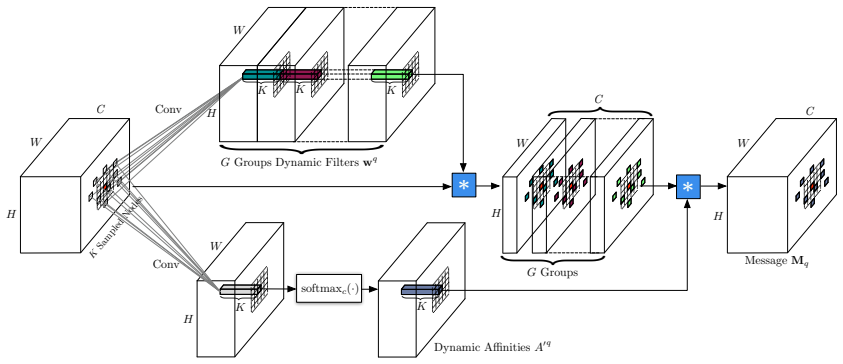
The central mechanism is a dynamic graph message passing (DGMN) layer with two coupled dynamic properties. First, node sampling: uniform sampling at multiple rates gives an initial neighborhood, and a learned random walk (Eq. 4, implemented as a $3\times 3$ convolution) moves each sample to a data-dependent location. Second, message conditioning: the same sampled nodes predict node-specific grouped filter weights and an affinity matrix (Eqs. 6-7) used to weight and transform the sampled features. The message update (Eq. 5) is the object doing the argument's work: it is the single place where dynamic sampling, dynamic filters, and dynamic affinities combine, and the ablation studies attribute gains to each component.
What would settle it
Train the full DGMN and a control in which the predicted offsets are replaced by randomized offsets drawn from the same spatial distribution, or by the mean offset, while everything else is kept fixed. If the control matches the full model on Cityscapes validation, or if the learned offsets are shown to be nearly input-independent, then learned sampling is not the source of the claimed long-range gain.
Extended reading notes
Core claim
The central claim is that efficiency and accuracy need not be traded off by choosing between locally and fully connected graphs. Interpreting a feature map as graph nodes, DGMN uses a set of uniform sampling rates to generate $S$ small neighborhoods per node, then predicts position-specific random-walk offsets from the sampled features; these offsets relocate the sampled nodes before message passing. On the relocated nodes, a matrix transformation predicts grouped dynamic filter weights and an affinity, normalized along the channel axis, and the message for node $i$ is $\sum_q \sum_{j\in\mathcal N_q(i)} \beta_q A'^q_{i,j}\varrho(h'_j\mid V,j,\Delta d^q_j) w^q_j$. The paper claims this formulation keeps a large receptive field, removes redundant connections, and outperforms fully connected non-local message passing on three tasks while using substantially fewer FLOPs and parameters.
Load-bearing premise
The learned offset that moves each sampled location must actually pick more useful spots than the original grid; if the offsets merely deform the uniform neighborhood, the dynamic-sampling gain collapses and the method reduces to a deformable-convolution variant.
Editorial extensions
If this is right
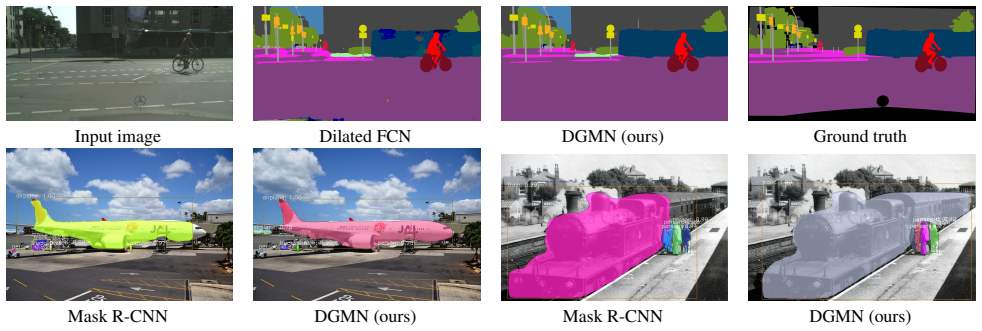
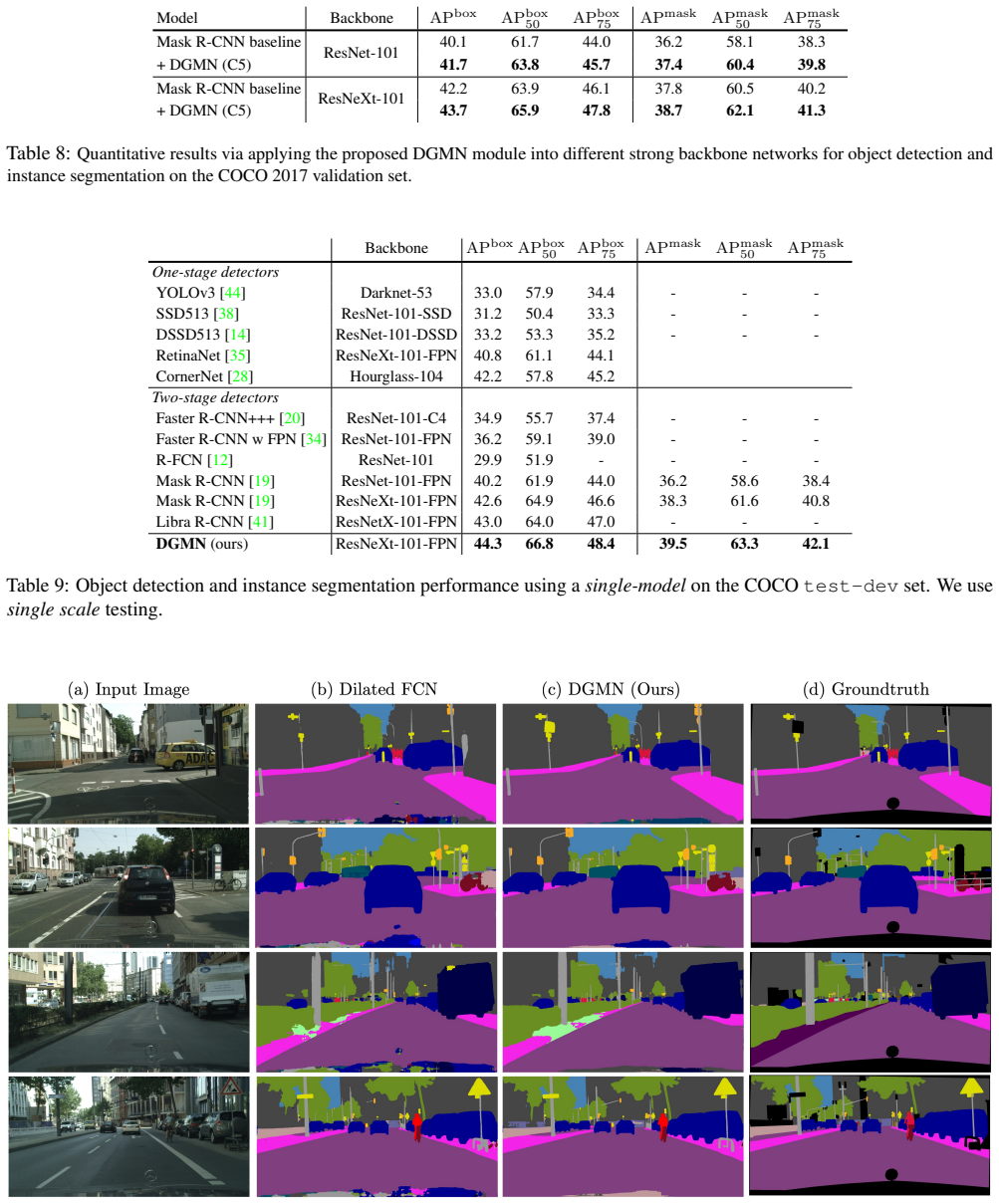
- Fully connected non-local graphs can be replaced by smaller sampled graphs: DGMN reaches Cityscapes validation mIoU 80.4 versus 79.0 for Non-local with about 33% of Non-local's FLOPs.
- The layer is modular: inserting DGMN into a Mask R-CNN backbone improves COCO APbox to 40.2 and APmask to 36.0 over 37.8 and 34.4.
- Dynamic sampling and dynamic weights/affinities are complementary: ablations show each contributes, with dynamic sampling adding 1.3 mIoU over the already strong DA+DW variant.
- The same module generalizes across backbones ResNet-50, ResNet-101 and ResNeXt-101 on the COCO test-dev set.
Reading between the lines
- A testable extension is to replace the $3\times 3$ random-walk predictor with a wider or multi-scale context; the reported gains attribute long-range behavior to this predictor, but its local receptive field makes the long-range claim stronger than the architecture alone guarantees.
- If dynamic sampling works by selecting semantically relevant locations, the same layer should transfer to sparse or irregular graph inputs, where uniform grids are unavailable.
- The channel-wise softmax affinity and grouped dynamic filters could be interpreted as a structured low-rank attention mechanism, inviting direct comparison with sparse attention using learned indices on sequences or point clouds.
Signed reviews
Editorial analysis
A structured set of objections, weighed in public.
Referee Report
Summary. The paper proposes Dynamic Graph Message Passing Networks (DGMN), a modular layer that replaces fully-connected non-local message passing with a sparse, input-conditioned scheme. For each node, a small set of neighbours is first selected by uniform sampling at multiple rates, then refined by learned random-walk offsets; the sampled nodes are used to predict node-conditioned filter weights and affinities that propagate information into the node update. The authors evaluate the module on Cityscapes semantic segmentation and COCO detection/instance segmentation, reporting that DGMN outperforms Non-local while using about 33% of its FLOPs on Cityscapes, and improves on Mask R-CNN baselines across ResNet-50/101/ResNeXt-101 backbones. The central claim is that input-conditioned sampling of a small neighbourhood, together with dynamically predicted weights and affinities, can capture long-range context more efficiently and accurately than fully-connected attention.
Significance. If the central claim is correct, the paper is a valuable contribution: it shows that a single, plug-in layer can replace quadratic-complexity attention with a sparse, content-adaptive message-passing scheme while improving accuracy, and it validates the approach on three tasks and several backbones. The modular instantiation and the extensive comparisons to Non-local, GCNet, CCNet, and deformable convolution are useful to the community. The paper also includes honest ablations of the DA, DW, and DS components and reports the effect of training/inference strategies in the appendix. However, the specific benefit of the ``dynamic sampling'' component is not cleanly isolated, and the formulation contains a notational/implementation mismatch that needs to be resolved before the contribution can be fully assessed.
major comments (3)
- [Table 1 and Sec. 4.2]
- [Sec. 3.3, Eq. (4) vs Sec. 3.5]
- [All experimental tables (Tables 1-4)]
minor comments (5)
- [Appendix, Table 5 caption]
- [Sec. 3.3, Eq. (4)]
- [Sec. 3.6]
- [Eq. (2)]
- [Sec. 4.2]
Circularity Check
No significant circularity: the paper's claims are external empirical comparisons, and its self-citations are non-load-bearing.
full rationale
The paper's central claims are empirical comparisons on Cityscapes and COCO evaluation servers, so no derivation-from-fitted-parameter circularity applies. DGMN is defined by Eqs. 4-6 (random walk offsets, dynamic filters and affinities) implemented with convolutional layers; the claimed improvements are measured against external baselines such as Non-local and Mask R-CNN, not derived from a fitted quantity that is then renamed as a prediction. The ablation in Table 1 treats sampling rates and group counts as transparent hyperparameters and reports the effect of adding dynamic sampling; this is model selection, not a statistically forced prediction of a fitted value. The only self-citations are references [21] and [31] in Sec. 3.3, used as general motivation that long-range context is important; they do not supply a theorem, forbid alternatives, or carry the load of the accuracy claims, so they do not create circularity. No uniqueness theorem is invoked, and no ansatz is smuggled in via citation. Each load-bearing component is evaluated against held-out public benchmarks with standard protocols. Therefore no step in the claimed derivation chain is equivalent by construction to its input.
Assumptions & free parameters
free parameters (4)
- Sampling rate set phi =
{1,6,12,24,36} on Cityscapes; {1,4,8,12} on COCO.
- Number of filter groups G =
4
- Message passing iterations T =
1
- Neighborhood size K =
9 (3x3)
assumptions (4)
- standard math Bilinear sampling rho (Eq. 5, Sec 3.3) is differentiable and lets gradients flow to the predicted walks so the sampling locations can be learned.
- domain assumption A set of K sampled nodes per receiving node is enough to approximate the full-graph message distribution (Sec 3.3, Eq. 1).
- domain assumption T=1 message passing iteration is sufficient for feature refinement (Sec 3.5).
- domain assumption Walks predicted from a 3x3 convolution over the uniform-sampled neighborhood yield globally relevant sampling locations (Eq. 4, Sec 3.5).
Cite this review
Pith. "Pith review of Dynamic Graph Message Passing Networks." pith.science (2026). https://pith.science/paper/SSSSURFO
@misc{pith2026190806955,
  author       = {Pith},
  title        = {Pith review of: Dynamic Graph Message Passing Networks},
  year         = {2026},
  howpublished = {\url{https://pith.science/paper/SSSSURFO}},
  note         = {Machine review of arXiv:1908.06955}
}
read the original abstract
Modelling long-range dependencies is critical for scene understanding tasks in computer vision. Although CNNs have excelled in many vision tasks, they are still limited in capturing long-range structured relationships as they typically consist of layers of local kernels. A fully-connected graph is beneficial for such modelling, however, its computational overhead is prohibitive. We propose a dynamic graph message passing network, that significantly reduces the computational complexity compared to related works modelling a fully-connected graph. This is achieved by adaptively sampling nodes in the graph, conditioned on the input, for message passing. Based on the sampled nodes, we dynamically predict node-dependent filter weights and the affinity matrix for propagating information between them. Using this model, we show significant improvements with respect to strong, state-of-the-art baselines on three different tasks and backbone architectures. Our approach also outperforms fully-connected graphs while using substantially fewer floating-point operations and parameters. The project website is http://www.robots.ox.ac.uk/~lz/dgmn/
Figures


Figures from the paper (6 more)




Reference graph
Works this paper leans on
-
[1]
Higher order conditional random fields in deep neural networks
Anurag Arnab, Sadeep Jayasumana, Shuai Zheng, and Philip HS Torr. Higher order conditional random fields in deep neural networks. In ECCV, 2016. 2
work page 2016
-
[2]
Anurag Arnab, Shuai Zheng, Sadeep Jayasumana, Bernardino Romera-Paredes, M˚ans Larsson, Alexander Kirillov, Bogdan Savchynskyy, Carsten Rother, Fredrik Kahl, and Philip HS Torr. Conditional random fields meet deep neural networks for semantic segmentation: Combining probabilistic graphical models with deep learning for structured prediction. IEEE Signal Pr...
work page 2018
-
[3]
Geodesic matting: A frame- work for fast interactive image and video segmentation and matting
Xue Bai and Guillermo Sapiro. Geodesic matting: A frame- work for fast interactive image and video segmentation and matting. IJCV, 2009. 1
work page 2009
-
[4]
Gcnet: Non-local networks meet squeeze-excitation networks and beyond
Yue Cao, Jiarui Xu, Stephen Lin, Fangyun Wei, and Han Hu. Gcnet: Non-local networks meet squeeze-excitation networks and beyond. arXiv, 2019. 7
work page 2019
-
[5]
Liang-Chieh Chen, George Papandreou, Iasonas Kokkinos, Kevin Murphy, and Alan L. Yuille. Semantic image segmen- tation with deep convolutional nets and fully connected CRFs. In ICLR, 2015. 2, 9
work page 2015
-
[6]
Rethinking atrous convolution for semantic image segmentation
Liang-Chieh Chen, George Papandreou, Florian Schroff, and Hartwig Adam. Rethinking atrous convolution for semantic image segmentation. arXiv, 2017. 6, 7, 8, 9
work page 2017
-
[7]
Encoder-decoder with atrous separable convolution for semantic image segmentation
Liang-Chieh Chen, Yukun Zhu, George Papandreou, Florian Schroff, and Hartwig Adam. Encoder-decoder with atrous separable convolution for semantic image segmentation. In ECCV, 2018. 9
work page 2018
-
[8]
Graph-based global reasoning networks
Yunpeng Chen, Marcus Rohrbach, Zhicheng Yan, Shuicheng Yan, Jiashi Feng, and Yannis Kalantidis. Graph-based global reasoning networks. In CVPR, 2019. 5, 8, 9
work page 2019
Show all 63 references
-
[9]
Xception: Deep learning with depthwise separable convolutions
Franc ¸ois Chollet. Xception: Deep learning with depthwise separable convolutions. In CVPR, 2017. 5, 9
2017
-
[10]
The cityscapes dataset for semantic urban scene understanding
Marius Cordts, Mohamed Omran, Sebastian Ramos, Timo Rehfeld, Markus Enzweiler, Rodrigo Benenson, Uwe Franke, Stefan Roth, and Bernt Schiele. The cityscapes dataset for semantic urban scene understanding. In CVPR, 2016. 1, 2, 6, 9
2016
-
[11]
Boxsup: Exploit- ing bounding boxes to supervise convolutional networks for semantic segmentation
Jifeng Dai, Kaiming He, and Jian Sun. Boxsup: Exploit- ing bounding boxes to supervise convolutional networks for semantic segmentation. In ICCV, 2015. 9
2015
-
[12]
R-fcn: Object detection via region-based fully convolutional networks
Jifeng Dai, Yi Li, Kaiming He, and Jian Sun. R-fcn: Object detection via region-based fully convolutional networks. In NeurIPS, 2016. 11
2016
-
[13]
Deformable convolutional networks
Jifeng Dai, Haozhi Qi, Yuwen Xiong, Yi Li, Guodong Zhang, Han Hu, and Yichen Wei. Deformable convolutional networks. In ICCV, 2017. 2, 5, 6
2017
-
[14]
Dssd: Deconvolutional single shot detector
Cheng-Yang Fu, Wei Liu, Ananth Ranga, Ambrish Tyagi, and Alexander C Berg. Dssd: Deconvolutional single shot detector. arXiv, 2017. 11
2017
-
[15]
Dual attention network for scene segmentation
Jun Fu, Jing Liu, Haijie Tian, Zhiwei Fang, and Hanqing Lu. Dual attention network for scene segmentation. In CVPR,
-
[16]
Neural message passing for quantum chemistry
Justin Gilmer, Samuel S Schoenholz, Patrick F Riley, Oriol Vinyals, and George E Dahl. Neural message passing for quantum chemistry. In ICML, 2017. 1, 3
2017
-
[17]
Accurate, large minibatch sgd: Training imagenet in 1 hour
Priya Goyal, Piotr Doll ´ar, Ross Girshick, Pieter Noord- huis, Lukasz Wesolowski, Aapo Kyrola, Andrew Tulloch, Yangqing Jia, and Kaiming He. Accurate, large minibatch sgd: Training imagenet in 1 hour. In arXiv, 2017. 9
2017
-
[18]
Inductive representation learning on large graphs
Will Hamilton, Zhitao Ying, and Jure Leskovec. Inductive representation learning on large graphs. In NeurIPS, 2017. 1, 2
2017
-
[19]
Mask r-cnn
Kaiming He, Georgia Gkioxari, Piotr Doll ´ar, and Ross Gir- shick. Mask r-cnn. In ICCV, 2017. 6, 10, 11, 12, 13
2017
-
[20]
Deep residual learning for image recognition
Kaiming He, Xiangyu Zhang, Shaoqing Ren, and Jian Sun. Deep residual learning for image recognition. In CVPR, 2016. 1, 6, 11
2016
-
[21]
Strip pooling: Rethinking spatial pooling for scene parsing
Qinbin Hou, Li Zhang, Ming-Ming Cheng, and Jiashi Feng. Strip pooling: Rethinking spatial pooling for scene parsing. In CVPR, 2020. 3
2020
-
[22]
Ccnet: Criss-cross attention for semantic segmentation
Zilong Huang, Xinggang Wang, Lichao Huang, Chang Huang, Yunchao Wei, and Wenyu Liu. Ccnet: Criss-cross attention for semantic segmentation. In ICCV, 2019. 7, 8
2019
-
[23]
Spatial transformer networks
Max Jaderberg, Karen Simonyan, Andrew Zisserman, and Ko- ray Kavukcuoglu. Spatial transformer networks. In NeurIPS,
-
[24]
Dynamic filter networks
Xu Jia, Bert De Brabandere, Tinne Tuytelaars, and Luc V Gool. Dynamic filter networks. In NeurIPS, 2016. 2
2016
-
[25]
Semi-supervised classifi- cation with graph convolutional networks
Thomas N Kipf and Max Welling. Semi-supervised classifi- cation with graph convolutional networks. In ICLR, 2017. 1, 3
2017
-
[26]
Alex Krizhevsky, Ilya Sutskever, and Geoffrey E. Hinton. Im- ageNet classification with deep convolutional neural networks. In NeurIPS, 2012. 1
2012
-
[27]
Efficient inference in fully connected crfs with gaussian edge potentials
Philipp Krhenbhl and Vladlen Koltun. Efficient inference in fully connected crfs with gaussian edge potentials. NeurIPS,
-
[28]
Cornernet: Detecting objects as paired keypoints
Hei Law and Jia Deng. Cornernet: Detecting objects as paired keypoints. In ECCV, 2018. 10, 11
2018
-
[29]
Sampling from large graphs
Jure Leskovec and Christos Faloutsos. Sampling from large graphs. In SIGKDD, 2006. 3
2006
-
[30]
Holistic, instance-level human parsing
Qizhu Li, Anurag Arnab, and Philip HS Torr. Holistic, instance-level human parsing. In BMVC, 2017. 9
2017
-
[31]
Global aggregation then local dis- tribution in fully convolutional networks
Xiangtai Li, Li Zhang, Ansheng You, Maoke Yang, Kuiyuan Yang, and Yunhai Tong. Global aggregation then local dis- tribution in fully convolutional networks. In BMVC, 2019. 3
2019
-
[32]
Gated graph sequence neural networks
Yujia Li, Daniel Tarlow, Marc Brockschmidt, and Richard Zemel. Gated graph sequence neural networks. In ICLR,
-
[33]
Deeply learning the messages in message passing inference
Guosheng Lin, Chunhua Shen, Ian Reid, and Anton van den Hengel. Deeply learning the messages in message passing inference. In NeurIPS, 2015. 5
2015
-
[34]
Girshick, Kaiming He, Bharath Hariharan, and Serge J
Tsung-Yi Lin, Piotr Dollr, Ross B. Girshick, Kaiming He, Bharath Hariharan, and Serge J. Belongie. Feature pyramid networks for object detection. In CVPR, 2017. 11
2017
-
[35]
Focal loss for dense object detection
Tsung-Yi Lin, Priya Goyal, Ross Girshick, Kaiming He, and Piotr Doll´ar. Focal loss for dense object detection. In ICCV,
-
[36]
Microsoft coco: Common objects in context
Tsung-Yi Lin, Michael Maire, Serge Belongie, James Hays, Pietro Perona, Deva Ramanan, Piotr Doll´ar, and C Lawrence Zitnick. Microsoft coco: Common objects in context. In ECCV, 2014. 2, 6, 9
2014
-
[37]
Microsoft coco: Common objects in context
Tsung-Yi Lin, Michael Maire, Serge Belongie, James Hays, Pietro Perona, Deva Ramanan, Piotr Doll´ar, and C Lawrence Zitnick. Microsoft coco: Common objects in context. In ECCV, 2014. 9
2014
-
[38]
Ssd: Single shot multibox detector
Wei Liu, Dragomir Anguelov, Dumitru Erhan, Christian Szegedy, Scott Reed, Cheng-Yang Fu, and Alexander C Berg. Ssd: Single shot multibox detector. In ECCV, 2016. 11
2016
-
[39]
maskrcnn-benchmark: Fast, modular reference implementation of Instance Seg- mentation and Object Detection algorithms in PyTorch
Francisco Massa and Ross Girshick. maskrcnn-benchmark: Fast, modular reference implementation of Instance Seg- mentation and Object Detection algorithms in PyTorch. https://github.com/facebookresearch/ maskrcnn-benchmark, 2018. 6, 9, 12, 13
2018
-
[40]
The role of context in object recognition
Aude Oliva and Antonio Torralba. The role of context in object recognition. Trends in cognitive sciences, 2007. 1, 3
2007
-
[41]
Libra r-cnn: Towards balanced learning for object detection
Jiangmiao Pang, Kai Chen, Jianping Shi, Huajun Feng, Wanli Ouyang, and Dahua Lin. Libra r-cnn: Towards balanced learning for object detection. In CVPR, 2019. 10, 11
2019
-
[42]
Full-resolution residual networks for semantic segmentation in street scenes
Tobias Pohlen, Alexander Hermans, Markus Mathias, and Bastian Leibe. Full-resolution residual networks for semantic segmentation in street scenes. In CVPR, 2017. 9
2017
-
[43]
Objects in context
Andrew Rabinovich, Andrea Vedaldi, Carolina Galleguillos, Eric Wiewiora, and Serge Belongie. Objects in context. In ICCV, 2007. 1, 3
2007
-
[44]
Yolov3: An incremental improvement
Joseph Redmon and Ali Farhadi. Yolov3: An incremental improvement. arXiv, 2018. 11
2018
-
[45]
In-place activated batchnorm for memory-optimized training of dnns
Samuel Rota Bul `o, Lorenzo Porzi, and Peter Kontschieder. In-place activated batchnorm for memory-optimized training of dnns. In CVPR, 2018. 9
2018
-
[46]
Training region-based object detectors with online hard ex- ample mining
Abhinav Shrivastava, Abhinav Gupta, and Ross Girshick. Training region-based object detectors with online hard ex- ample mining. In CVPR, 2016. 9
2016
-
[47]
Very deep convolu- tional networks for large-scale image recognition
Karen Simonyan and Andrew Zisserman. Very deep convolu- tional networks for large-scale image recognition. In ICLR,
-
[48]
Attention is all you need
Ashish Vaswani, Noam Shazeer, Niki Parmar, Jakob Uszko- reit, Llion Jones, Aidan N Gomez, Łukasz Kaiser, and Illia Polosukhin. Attention is all you need. In NeurIPS, 2017. 1
2017
-
[49]
Graph attention networks
Petar Veliˇckovi´c, Guillem Cucurull, Arantxa Casanova, Adri- ana Romero, Pietro Lio, and Yoshua Bengio. Graph attention networks. In ICLR, 2018. 3
2018
-
[50]
Understanding convolu- tion for semantic segmentation
Panqu Wang, Pengfei Chen, Ye Yuan, Ding Liu, Zehua Huang, Xiaodi Hou, and Garrison Cottrell. Understanding convolu- tion for semantic segmentation. In WACV, 2018. 5
2018
-
[51]
Non-local neural networks
Xiaolong Wang, Ross Girshick, Abhinav Gupta, and Kaiming He. Non-local neural networks. In CVPR, 2018. 1, 2, 3, 5, 6, 7, 8, 9
2018
-
[52]
Pay less attention with lightweight and dynamic convolutions
Felix Wu, Angela Fan, Alexei Baevski, Yann N Dauphin, and Michael Auli. Pay less attention with lightweight and dynamic convolutions. In ICLR, 2019. 2
2019
-
[53]
Aggregated residual transformations for deep neural networks
Saining Xie, Ross Girshick, Piotr Doll´ar, Zhuowen Tu, and Kaiming He. Aggregated residual transformations for deep neural networks. In CVPR, 2017. 6
2017
-
[54]
Learning deep structured multi-scale features using attention-gated crfs for contour prediction
Dan Xu, Wanli Ouyang, Xavier Alameda-Pineda, Elisa Ricci, Xiaogang Wang, and Nicu Sebe. Learning deep structured multi-scale features using attention-gated crfs for contour prediction. In NeurIPS, 2017. 2
2017
-
[55]
Denseaspp for semantic segmentation in street scenes
Maoke Yang, Kun Yu, Chi Zhang, Zhiwei Li, and Kuiyuan Yang. Denseaspp for semantic segmentation in street scenes. In CVPR, 2018. 8
2018
-
[56]
Bisenet: Bilateral segmentation network for real-time semantic segmentation
Changqian Yu, Jingbo Wang, Chao Peng, Changxin Gao, Gang Yu, and Nong Sang. Bisenet: Bilateral segmentation network for real-time semantic segmentation. In ECCV, 2018. 9
2018
-
[57]
Multi-scale context aggrega- tion by dilated convolutions
Fisher Yu and Vladlen Koltun. Multi-scale context aggrega- tion by dilated convolutions. In ICLR, 2016. 2, 4, 6, 11
2016
-
[58]
Ocnet: Object context network for scene parsing
Yuhui Yuan and Jingdong Wang. Ocnet: Object context network for scene parsing. arXiv, 2018. 9
2018
-
[59]
Dual graph convolutional network for semantic segmentation
Li Zhang, Xiangtai Li, Anurag Arnab, Kuiyuan Yang, Yunhai Tong, and Philip HS Torr. Dual graph convolutional network for semantic segmentation. In BMVC, 2019. 5
2019
-
[60]
Pyramid scene parsing network
Hengshuang Zhao, Jianping Shi, Xiaojuan Qi, Xiaogang Wang, and Jiaya Jia. Pyramid scene parsing network. In CVPR, 2017. 8, 9
2017
-
[61]
Psanet: Point-wise spatial attention network for scene parsing
Hengshuang Zhao, Yi Zhang, Shu Liu, Jianping Shi, Chen Change Loy, Dahua Lin, and Jiaya Jia. Psanet: Point-wise spatial attention network for scene parsing. In ECCV, 2018. 8, 9
2018
-
[62]
Shuai Zheng, Sadeep Jayasumana, Bernardino Romera- Paredes, Vibhav Vineet, Zhizhong Su, Dalong Du, Chang Huang, and Philip H. S. Torr. Conditional random fields as recurrent neural networks. In ICCV, 2015. 2
2015
-
[63]
De- formable convnets v2: More deformable, better results
Xizhou Zhu, Han Hu, Stephen Lin, and Jifeng Dai. De- formable convnets v2: More deformable, better results. In CVPR, 2019. 2, 5, 6, 7
2019
Reviewed August 14, 2026 · model on record in the stance chip above.
Discussion (0). Continue with ORCID to comment.