Ultracold atomic lattice systems for simulating topological phases: A review
Pith reviewed 2026-06-27 02:24 UTC · model grok-4.3
The pith
Ultracold atomic lattice systems have reached a pivotal stage as versatile programmable simulators for topological phases.
A machine-rendered reading of the paper's core claim, the machinery that carries it, and where it could break.
Core claim
Owing to rapid recent progress, ultracold atomic lattice systems for simulating topological phases are now at a pivotal stage, evolving from established paradigms into increasingly versatile and programmable quantum simulators, with representative breakthroughs, realized models, and detection techniques documented across the four platform classes.
What carries the argument
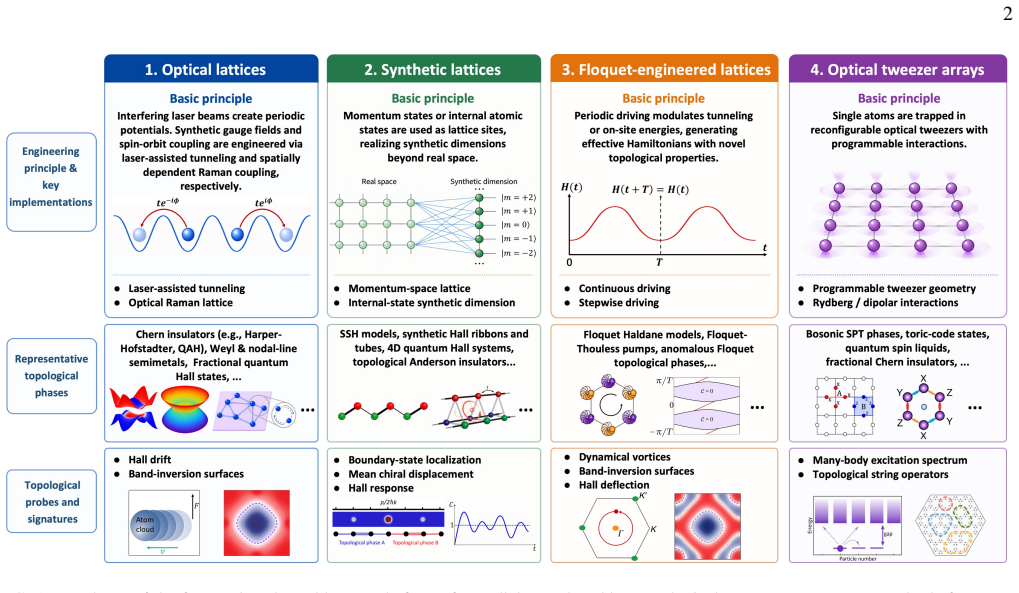
The four major complementary platform classes—optical lattices with laser-assisted tunneling and Raman lattices, synthetic lattices in momentum or internal-state space, Floquet-engineered lattices, and optical tweezer arrays—which offer distinct capabilities for realizing and probing topological matter.
If this is right
- Each platform enables realization of specific topological models with tailored detection methods.
- The approaches collectively support exploration of strongly correlated topological phases.
- Nonequilibrium topological dynamics become accessible through Floquet and synthetic techniques.
- Programmable control in tweezer arrays and Raman lattices extends simulation reach beyond static cases.
Where Pith is reading between the lines
- Combining elements from multiple platform classes could enable hybrid simulators for phases requiring both strong interactions and tunable geometry.
- The documented detection advances suggest that measuring topological invariants may become routine in programmable setups, aiding comparison with theoretical predictions.
- Focus on nonequilibrium phases implies these systems could test dynamical properties like topological pumping under controlled driving.
Load-bearing premise
The four listed platform classes represent the major complementary routes that together expand the frontier of quantum simulation.
What would settle it
A demonstration that topological phases can be simulated and characterized at scale using a lattice platform outside these four classes, or that progress in programmability has stalled across all of them, would challenge the central claim.
Figures
read the original abstract
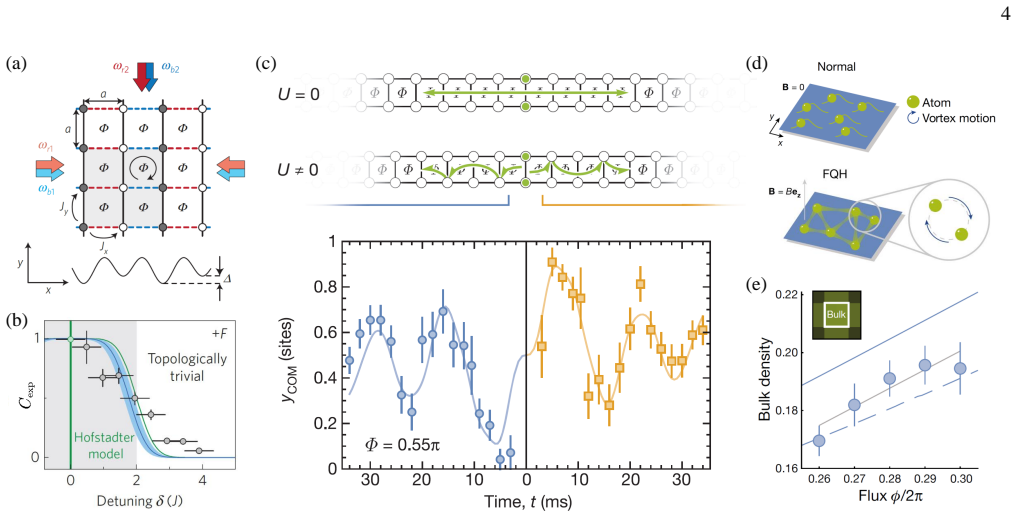
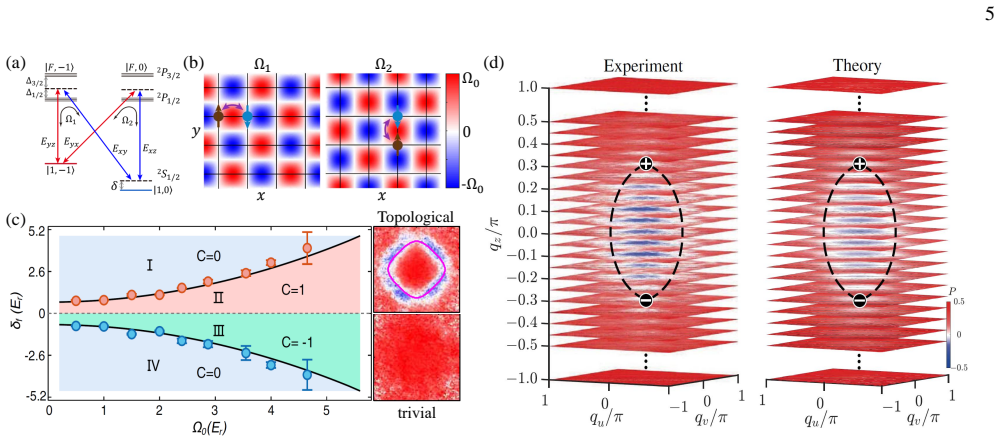
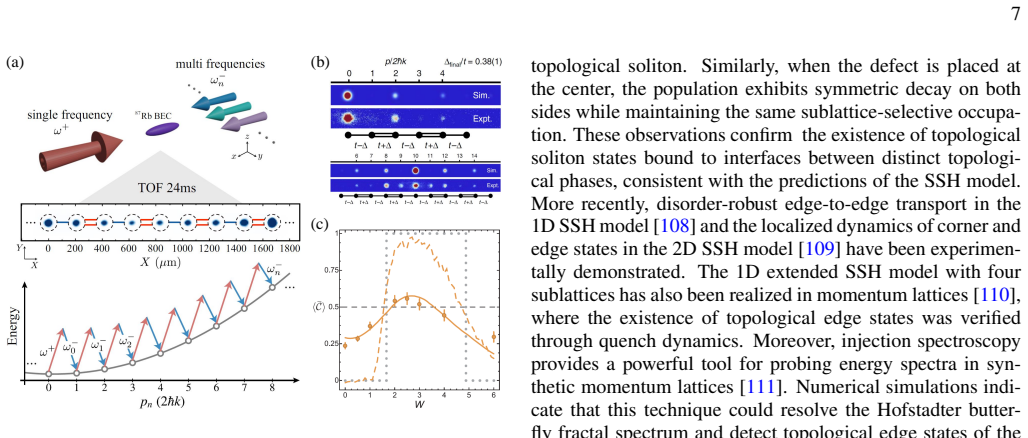
Owing to rapid recent progress, ultracold atomic lattice systems for simulating topological phases are now at a pivotal stage, evolving from established paradigms into increasingly versatile and programmable quantum simulators. In this review, we survey recent experimental advances across four major classes of platforms: optical lattices, including optical lattices with laser-assisted tunneling and optical Raman lattices; synthetic lattices in momentum or internal-state space; Floquet-engineered lattices; and optical tweezer arrays, all of which offer distinct capabilities for realizing and probing topological matter. For each class, we highlight representative experimental breakthroughs, the topological models that have been realized, and the advanced detection and characterization techniques employed, emphasizing how these complementary approaches collectively expand the frontier of quantum simulation. We also discuss emerging directions in strongly correlated and nonequilibrium topological phases, and conclude with an outlook on future prospects.
Editorial analysis
A structured set of objections, weighed in public.
Referee Report
Summary. The manuscript is a review article claiming that ultracold atomic lattice systems for simulating topological phases have reached a pivotal stage, evolving from established paradigms into versatile and programmable quantum simulators. It surveys recent experimental advances across four major platform classes: optical lattices (including those with laser-assisted tunneling and optical Raman lattices), synthetic lattices in momentum or internal-state space, Floquet-engineered lattices, and optical tweezer arrays. For each class the review highlights representative experimental breakthroughs, the specific topological models realized, and the advanced detection and characterization techniques used, while also discussing emerging directions in strongly correlated and nonequilibrium topological phases and concluding with an outlook.
Significance. If the synthesis of the literature is accurate and balanced, the review would provide a structured, accessible overview of complementary experimental routes in a rapidly advancing subfield. By organizing platforms according to their distinct capabilities for realizing and probing topological matter, it could help researchers identify suitable systems for specific models and detection needs. The explicit linkage of experimental realizations to topological models and the forward-looking discussion of nonequilibrium phases constitute a useful service to the community.
minor comments (2)
- [Abstract] Abstract: the phrase 'four major classes of platforms' is repeated in slightly different wording; a single consistent enumeration would improve readability.
- Ensure that the section headings for the four platform classes use parallel grammatical structure (e.g., all noun phrases) to aid navigation.
Simulated Author's Rebuttal
We thank the referee for their positive assessment of the manuscript and for recommending acceptance. The referee's summary accurately captures the scope, structure, and contributions of the review.
Circularity Check
No significant circularity: review of external literature
full rationale
This is a review article whose content consists of surveying and organizing published experimental results from the broader literature on ultracold-atom platforms. No derivation, equation, fitted parameter, prediction, or uniqueness theorem is advanced by the authors themselves. The four-class taxonomy is presented as a descriptive grouping of existing work rather than a claim derived from any internal construction. Consequently no load-bearing step reduces to the paper's own inputs.
Axiom & Free-Parameter Ledger
Reference graph
Works this paper leans on
-
[1]
For example, realistic schemes have been proposed to realize Floquet topological states by periodically shaking optical lattices [154]
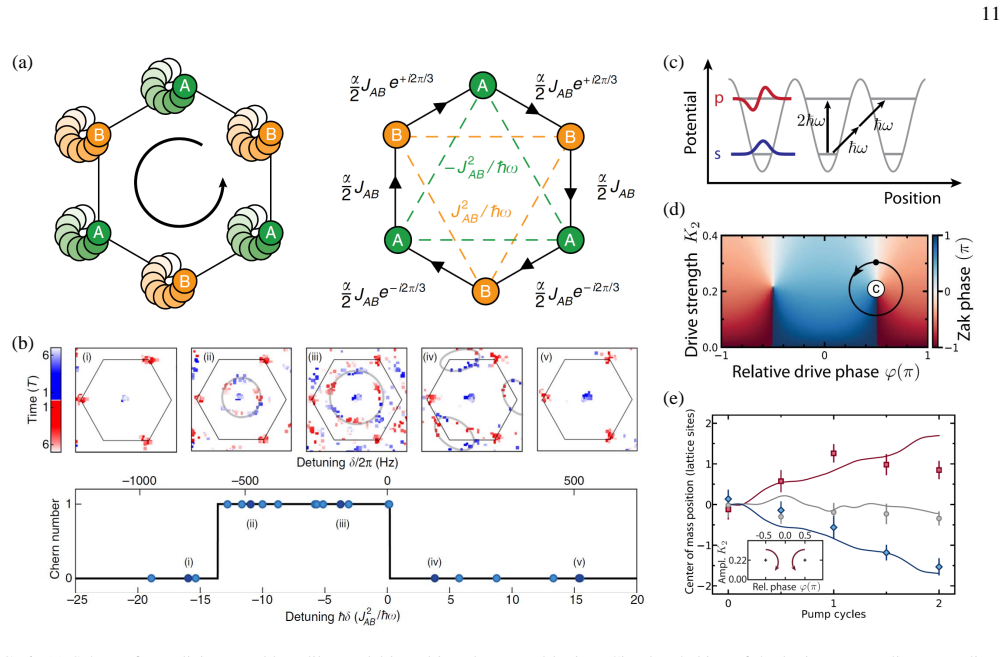
Conventional topological models As time-periodic modulation can renormalize tunneling and generate effective complex hoppings, periodic driving pro- vides an experimentally accessible route to realizing topologi- cal Hamiltonians that are challenging to implement in equilib- rium [53]. For example, realistic schemes have been proposed to realize Floquet t...
-
[2]
hop- ping
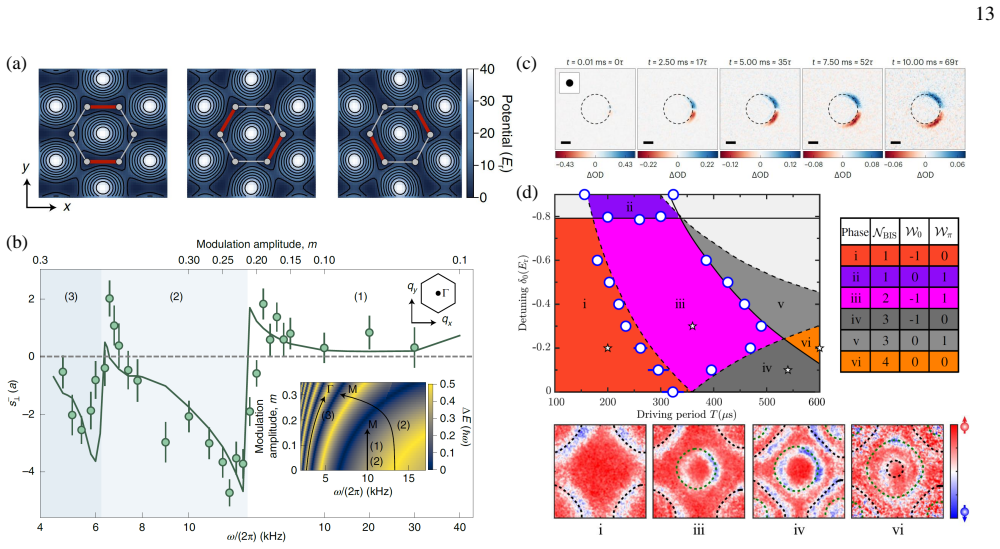
Anomalous Floquet topological phases A distinctive feature of Floquet systems is their ability to host genuinely nonequilibrium topological phases that have no static counterparts. Among them, anomalous Floquet topo- logical phases are characterized by trivial bulk band invari- 12 ants, such as vanishing Chern numbers in 2D systems, yet sup- porting topol...
-
[3]
M. Z. Hasan and C. L. Kane, Rev. Mod. Phys.82, 3045 (2010), URLhttps://link.aps.org/doi/10.1103/ RevModPhys.82.3045
2010
-
[4]
Qi and S.-C
X.-L. Qi and S.-C. Zhang, Rev. Mod. Phys.83, 1057 (2011), URLhttps://link.aps.org/doi/10.1103/ RevModPhys.83.1057
2011
-
[5]
A. P. Schnyder, S. Ryu, A. Furusaki, and A. W. W. Ludwig, Phys. Rev. B78, 195125 (2008), URLhttps://link.aps. org/doi/10.1103/PhysRevB.78.195125
-
[6]
Kitaev, AIP Conference Proceedings1134, 22 (2009), URL https://doi.org/10.1063/1.3149495
A. Kitaev, AIP Conference Proceedings1134, 22 (2009), URL https://doi.org/10.1063/1.3149495
-
[7]
A. W. W. Ludwig, Physica Scripta2016, 014001 (2015), URLhttps://dx.doi.org/10.1088/0031-8949/2015/ T168/014001
-
[8]
C.-K. Chiu, J. C. Y . Teo, A. P. Schnyder, and S. Ryu, Rev. Mod. Phys.88, 035005 (2016), URLhttps://link.aps. org/doi/10.1103/RevModPhys.88.035005
-
[9]
X. Chen, Z.-C. Gu, Z.-X. Liu, and X.-G. Wen, Science338, 1604 (2012), URLhttps://www.science.org/doi/abs/ 10.1126/science.1227224
-
[10]
Chen, Z.-C
X. Chen, Z.-C. Gu, Z.-X. Liu, and X.-G. Wen, Phys. Rev. B 87, 155114 (2013), URLhttps://link.aps.org/doi/10. 1103/PhysRevB.87.155114
2013
-
[11]
Senthil, Annual Review of Condensed Mat- ter Physics6, 299 (2015), URLhttps://www
T. Senthil, Annual Review of Condensed Mat- ter Physics6, 299 (2015), URLhttps://www. annualreviews.org/content/journals/10.1146/ annurev-conmatphys-031214-014740
2015
-
[12]
Yan and C
B. Yan and C. Felser, Annual Review of Condensed Matter Physics8, 337 (2017), URLhttps://doi.org/10.1146/ annurev-conmatphys-031016-025458
2017
-
[13]
N. P. Armitage, E. J. Mele, and A. Vishwanath, Rev. Mod. Phys.90, 015001 (2018), URLhttps://link.aps.org/ doi/10.1103/RevModPhys.90.015001
-
[14]
B. Q. Lv, T. Qian, and H. Ding, Rev. Mod. Phys.93, 025002 (2021), URLhttps://link.aps.org/doi/10. 1103/RevModPhys.93.025002
2021
-
[15]
X. G. Wen, International Journal of Modern Physics B04, 239 (1990), URLhttps://doi.org/10.1142/ S0217979290000139
1990
-
[17]
C. Nayak, S. H. Simon, A. Stern, M. Freedman, and S. Das Sarma, Rev. Mod. Phys.80, 1083 (2008), URLhttps: //link.aps.org/doi/10.1103/RevModPhys.80.1083
-
[18]
S. D. Sarma, M. Freedman, and C. Nayak, npj Quantum Infor- mation1, 15001 (2015), URLhttps://doi.org/10.1038/ npjqi.2015.1
2015
-
[19]
ˇZuti´c, J
I. ˇZuti´c, J. Fabian, and S. Das Sarma, Rev. Mod. Phys.76, 323 (2004), URLhttps://link.aps.org/doi/10.1103/ RevModPhys.76.323
2004
-
[20]
D. Pesin and A. H. MacDonald, Nature Materials11, 409 (2012), URLhttps://doi.org/10.1038/nmat3305
-
[21]
X. Lin, W. Yang, K. L. Wang, and W. Zhao, Nature Elec- tronics2, 274 (2019), URLhttps://doi.org/10.1038/ s41928-019-0273-7
2019
-
[22]
Bloch, Nature Physics1, 23 (2005), URLhttps://doi
I. Bloch, Nature Physics1, 23 (2005), URLhttps://doi. org/10.1038/nphys138
-
[23]
Bloch, J
I. Bloch, J. Dalibard, and W. Zwerger, Rev. Mod. Phys.80, 885 (2008), URLhttps://link.aps.org/doi/10.1103/ RevModPhys.80.885
2008
-
[24]
P. Windpassinger and K. Sengstock, Reports on Progress in Physics76, 086401 (2013), URLhttps://dx.doi.org/ 10.1088/0034-4885/76/8/086401
-
[25]
J. Dalibard, F. Gerbier, G. Juzeli ¯unas, and P. ¨Ohberg, Rev. Mod. Phys.83, 1523 (2011), URLhttps://link.aps.org/ doi/10.1103/RevModPhys.83.1523
-
[26]
N. Goldman, G. Juzeli ¯unas, P. ¨Ohberg, and I. B. Spielman, Re- ports on Progress in Physics77, 126401 (2014), URLhttps: //dx.doi.org/10.1088/0034-4885/77/12/126401
-
[27]
Gross and I
C. Gross and I. Bloch, Science357, 995 (2017), URL https://www.science.org/doi/abs/10.1126/ science.aal3837
2017
-
[28]
F. Sch ¨afer, T. Fukuhara, S. Sugawa, Y . Takasu, and Y . Taka- hashi, Nature Reviews Physics2, 411 (2020), URLhttps: //doi.org/10.1038/s42254-020-0195-3
-
[29]
Zohar, J
E. Zohar, J. I. Cirac, and B. Reznik, Reports on Progress in Physics79, 014401 (2015), URLhttps://doi.org/10. 1088/0034-4885/79/1/014401
2015
-
[30]
M. Aidelsburger, L. Barbiero, A. Bermudez, T. Chanda, A. Dauphin, D. Gonz ´alez-Cuadra, P. R. Grzybowski, S. Hands, F. Jendrzejewski, J. J ¨unemann, et al., Philosophi- cal Transactions of the Royal Society A: Mathematical, Phys- ical and Engineering Sciences380, 20210064 (2021), URL https://doi.org/10.1098/rsta.2021.0064
-
[31]
J. C. Halimeh, M. Aidelsburger, F. Grusdt, P. Hauke, and B. Yang, Nature Physics21, 25 (2025), URLhttps://doi. org/10.1038/s41567-024-02721-8
-
[32]
Kuhr, National Science Review3, 170 (2016), URLhttps: //doi.org/10.1093/nsr/nww023
S. Kuhr, National Science Review3, 170 (2016), URLhttps: //doi.org/10.1093/nsr/nww023
-
[33]
C. Gross and W. S. Bakr, Nature Physics17, 1316 (2021), URLhttps://doi.org/10.1038/s41567-021-01370-5
-
[34]
C. J. Vale and M. Zwierlein, Nature Physics17, 1305 (2021), URLhttps://doi.org/10.1038/s41567-021-01434-6
-
[35]
M. Lohse, C. Schweizer, H. M. Price, O. Zilberberg, and I. Bloch, Nature553, 55 (2018), URLhttps://doi.org/ 10.1038/nature25000
-
[36]
J.-B. Bouhiron, A. Fabre, Q. Liu, Q. Redon, N. Mittal, T. Satoor, R. Lopes, and S. Nascimbene, Science384, 223 (2024), URLhttps://www.science.org/doi/abs/ 10.1126/science.adf8459
-
[37]
S. de L ´es´eleuc, V . Lienhard, P. Scholl, D. Barredo, S. Weber, N. Lang, H. P. B ¨uchler, T. Lahaye, and A. Browaeys, Sci- ence365, 775 (2019), URLhttps://www.science.org/ doi/abs/10.1126/science.aav9105
-
[38]
Sompet, S
P. Sompet, S. Hirthe, D. Bourgund, T. Chalopin, J. Bibo, J. Koepsell, P. Bojovi´c, R. Verresen, F. Pollmann, G. Salomon, et al., Nature606, 484 (2022), URLhttps://doi.org/10. 18 1038/s41586-022-04688-z
2022
-
[39]
Z. Yue, Y .-F. Mao, X. Liang, Z.-X. Hua, P. Ge, Y .-X. Chao, K. Li, C. Jia, M. K. Tey, Y . Xu, et al., Nature Physics (2026), URLhttps://doi.org/10.1038/s41567-026-03271-x
-
[40]
J. L ´eonard, S. Kim, J. Kwan, P. Segura, F. Grusdt, C. Repellin, N. Goldman, and M. Greiner, Nature619, 495 (2023), URL https://doi.org/10.1038/s41586-023-06122-4
-
[41]
G. Semeghini, H. Levine, A. Keesling, S. Ebadi, T. T. Wang, D. Bluvstein, R. Verresen, H. Pichler, M. Kalinowski, R. Samajdar, et al., Science374, 1242 (2021), URLhttps: //doi.org/10.1126/science.abi8794
-
[42]
S. J. Evered, M. Kalinowski, A. A. Geim, T. Manovitz, D. Blu- vstein, S. H. Li, N. Maskara, H. Zhou, S. Ebadi, M. Xu, et al., Nature645, 341 (2025), URLhttps://doi.org/10.1038/ s41586-025-09475-0
2025
-
[43]
Potirniche, A
I.-D. Potirniche, A. C. Potter, M. Schleier-Smith, A. Vish- wanath, and N. Y . Yao, Phys. Rev. Lett.119, 123601 (2017), URLhttps://link.aps.org/doi/10.1103/ PhysRevLett.119.123601
2017
-
[45]
K. Li, J.-H. Wang, Y .-B. Yang, and Y . Xu, Phys. Rev. Lett. 127, 263004 (2021), URLhttps://link.aps.org/doi/ 10.1103/PhysRevLett.127.263004
-
[46]
Verresen, M
R. Verresen, M. D. Lukin, and A. Vishwanath, Phys. Rev. X 11, 031005 (2021), URLhttps://link.aps.org/doi/10. 1103/PhysRevX.11.031005
2021
-
[48]
Verresen and A
R. Verresen and A. Vishwanath, Phys. Rev. X12, 041029 (2022), URLhttps://link.aps.org/doi/10. 1103/PhysRevX.12.041029
2022
-
[49]
S. Weber, R. Bai, N. Makki, J. M ¨ogerle, T. Lahaye, A. Browaeys, M. Daghofer, N. Lang, and H. P. B¨uchler, PRX Quantum3, 030302 (2022), URLhttps://link.aps.org/ doi/10.1103/PRXQuantum.3.030302
-
[50]
Kalinowski, N
M. Kalinowski, N. Maskara, and M. D. Lukin, Phys. Rev. X 13, 031008 (2023), URLhttps://link.aps.org/doi/10. 1103/PhysRevX.13.031008
2023
-
[51]
B.-Y . Sun, N. Goldman, M. Aidelsburger, and M. Bukov, PRX Quantum4, 020329 (2023), URLhttps://link.aps.org/ doi/10.1103/PRXQuantum.4.020329
-
[52]
Kamal, J
H. Kamal, J. Kemp, Y .-C. He, Y . Fuji, M. Aidels- burger, P. Zoller, and N. Y . Yao, Phys. Rev. Lett.133, 163403 (2024), URLhttps://link.aps.org/doi/10. 1103/PhysRevLett.133.163403
2024
-
[53]
Chen, B.-Z
Y .-H. Chen, B.-Z. Wang, T.-F. J. Poon, X.-C. Zhou, Z.-X. Liu, and X.-J. Liu, Phys. Rev. Res.6, L042054 (2024), URLhttps://link.aps.org/doi/10.1103/ PhysRevResearch.6.L042054
2024
-
[54]
J. M ¨ogerle, K. Brechtelsbauer, A. Gea-Caballero, J. Prior, G. Emperauger, G. Bornet, C. Chen, T. Lahaye, A. Browaeys, and H. B ¨uchler, PRX Quantum6, 020332 (2025), URL https://link.aps.org/doi/10.1103/PRXQuantum.6. 020332
-
[55]
A. Eckardt, Rev. Mod. Phys.89, 011004 (2017), URL https://link.aps.org/doi/10.1103/RevModPhys.89. 011004
-
[56]
M. S. Rudner and N. H. Lindner, Nature Reviews Physics2, 229 (2020), URLhttps://doi.org/10.1038/ s42254-020-0170-z
2020
-
[57]
Weitenberg and J
C. Weitenberg and J. Simonet, Nature Physics17, 1342 (2021), URLhttps://doi.org/10.1038/ s41567-021-01316-x
2021
-
[58]
Harper, R
F. Harper, R. Roy, M. S. Rudner, and S. Sondhi, Annual Review of Condensed Matter Physics11, 345 (2020), URLhttps://doi.org/10.1146/ annurev-conmatphys-031218-013721
2020
-
[59]
McGinley and N
M. McGinley and N. R. Cooper, Phys. Rev. Lett.121, 090401 (2018), URLhttps://link.aps.org/doi/10. 1103/PhysRevLett.121.090401
2018
-
[60]
McGinley and N
M. McGinley and N. R. Cooper, Phys. Rev. B99, 075148 (2019), URLhttps://link.aps.org/doi/10. 1103/PhysRevB.99.075148
2019
-
[61]
Gong and M
Z. Gong and M. Ueda, Phys. Rev. Lett.121, 250601 (2018), URLhttps://link.aps.org/doi/10.1103/ PhysRevLett.121.250601
2018
-
[62]
C. Wang, P. Zhang, X. Chen, J. Yu, and H. Zhai, Phys. Rev. Lett.118, 185701 (2017), URLhttps://link.aps.org/ doi/10.1103/PhysRevLett.118.185701
-
[63]
Zhang, L
L. Zhang, L. Zhang, S. Niu, and X.-J. Liu, Science Bulletin 63, 1385 (2018), URLhttps://www.sciencedirect.com/ science/article/pii/S209592731830478X
2018
-
[64]
Zhang, W
L. Zhang, W. Jia, and X.-J. Liu, Science Bulletin67, 1236 (2022), URLhttps://www.sciencedirect.com/ science/article/pii/S2095927322001554
2022
-
[65]
E. J. Bergholtz, J. C. Budich, and F. K. Kunst, Rev. Mod. Phys. 93, 015005 (2021), URLhttps://link.aps.org/doi/10. 1103/RevModPhys.93.015005
2021
-
[66]
K. Ding, C. Fang, and G. Ma, Nature Reviews Physics 4, 745 (2022), URLhttps://doi.org/10.1038/ s42254-022-00516-5
2022
-
[67]
Okuma and M
N. Okuma and M. Sato, Annual Review of Condensed Matter Physics14, 83 (2023), URLhttps://doi.org/10.1146/ annurev-conmatphys-040521-033133
2023
-
[68]
Wintersperger, C
K. Wintersperger, C. Braun, F. N. ¨Unal, A. Eckardt, M. D. Liberto, N. Goldman, I. Bloch, and M. Aidelsburger, Na- ture Physics16, 1058 (2020), URLhttps://doi.org/10. 1038/s41567-020-0949-y
2020
-
[69]
J.-Y . Zhang, C.-R. Yi, L. Zhang, R.-H. Jiao, K.-Y . Shi, H. Yuan, W. Zhang, X.-J. Liu, S. Chen, and J.-W. Pan, Physical Review Letters130, 043201 (2023), URLhttps://link. aps.org/doi/10.1103/PhysRevLett.130.043201
-
[70]
Zhang, W.-W
H. Zhang, W.-W. Wang, C. Qiao, L. Zhang, M.-C. Liang, R. Wu, X.-J. Wang, X.-J. Liu, and X. Zhang, Science Bul- letin69, 747 (2024), URLhttps://www.sciencedirect. com/science/article/pii/S2095927324000367
2024
-
[71]
Z. Ren, D. Liu, E. Zhao, C. He, K. K. Pak, J. Li, and G.-B. Jo, Nature Physics18, 385 (2022), URLhttps://doi.org/ 10.1038/s41567-021-01491-x
-
[72]
E. Zhao, Z. Wang, C. He, T. F. J. Poon, K. K. Pak, Y .-J. Liu, P. Ren, X.-J. Liu, and G.-B. Jo, Nature637, 565 (2025), URL https://doi.org/10.1038/s41586-024-08347-3
-
[73]
A. Browaeys and T. Lahaye, Nature Physics16, 132 (2020), URLhttps://doi.org/10.1038/s41567-019-0733-z
-
[74]
M. Morgado and S. Whitlock, A VS Quantum Science 3, 023501 (2021), URLhttps://doi.org/10.1116/5. 0036562
work page doi:10.1116/5 2021
-
[75]
A. M. Kaufman and K.-K. Ni, Nature Physics17, 1324 (2021), URLhttps://doi.org/10.1038/s41567-021-01357-2
-
[76]
X. Wu, X. Liang, Y . Tian, F. Yang, C. Chen, Y .-C. Liu, M. K. Tey, and L. You, Chinese Physics B30, 020305 (2021), URL https://doi.org/10.1088/1674-1056/abd76f
-
[77]
Y . Cheng and H. Zhai, Nature Reviews Physics6, 566 (2024), 19 URLhttps://doi.org/10.1038/s42254-024-00749-6
-
[78]
N. Goldman, J. C. Budich, and P. Zoller, Nature Physics12 (2016), URLhttps://doi.org/10.1038/nphys3803
-
[79]
D.-W. Zhang, Y .-Q. Zhu, Y . X. Zhao, H. Yan, and S.-L. Zhu, Advances in Physics67, 253 (2018), URLhttps://doi. org/10.1080/00018732.2019.1594094
-
[80]
N. R. Cooper, J. Dalibard, and I. B. Spielman, Rev. Mod. Phys. 91, 015005 (2019), URLhttps://link.aps.org/doi/10. 1103/RevModPhys.91.015005
2019
-
[81]
M. Aidelsburger, M. Lohse, C. Schweizer, M. Atala, J. T. Bar- reiro, S. Nascimb `ene, N. R. Cooper, I. Bloch, and N. Gold- man, Nature Physics11, 162 (2015), URLhttps://doi. org/10.1038/nphys3171
-
[82]
M. E. Tai, A. Lukin, M. Rispoli, R. Schittko, T. Menke, D. Borgnia, P. M. Preiss, F. Grusdt, A. M. Kaufman, and M. Greiner, Nature546, 519 (2017), URLhttps://doi. org/10.1038/nature22811
-
[83]
D. Jaksch and P. Zoller, New Journal of Physics5, 56 (2003), URLhttps://doi.org/10.1088/1367-2630/5/1/356
discussion (0)
Sign in with ORCID, Apple, or X to comment. Anyone can read and Pith papers without signing in.