REVIEW 1 major objections 5 minor 1 cited by
Multi-wavelength disk images reveal how dust settles as disks age
Reviewed by Pith at T0; open to challenge. T0 means a machine referee read the full paper against a public rubric. the ladder, T0–T4 →
T0 review · deepseek-v4-flash
2026-08-04 17:43 UTC pith:STTQHOUZ
load-bearing objection A sound, clearly written tutorial that accurately synthesizes known methods for dust settling and grain size inference; the only new element is a small model grid, and the summary overstates settling confidence slightly relative to its own caveats. the 1 major comments →
An Introduction to Dust Evolution and Vertical Transport in Protoplanetary Disks
The pith
A machine-rendered reading of the paper's core claim, the machinery that carries it, and where it could break.
Core claim
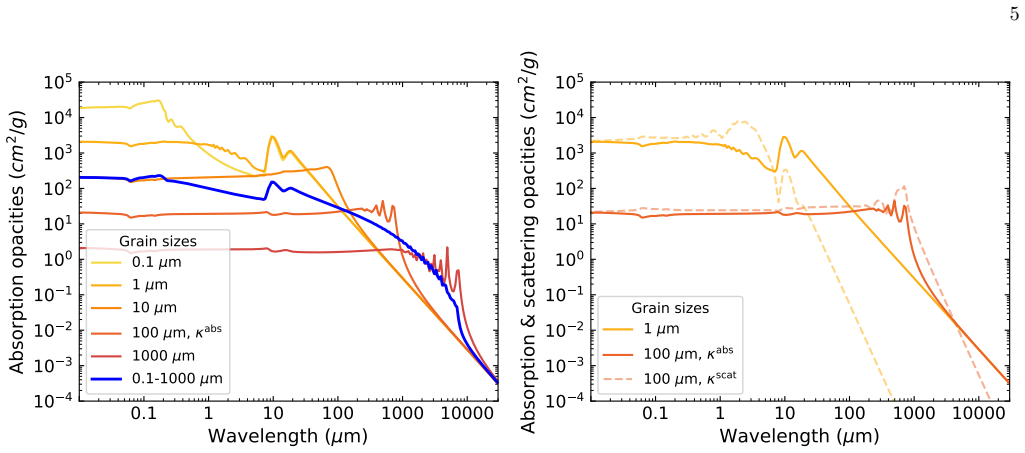
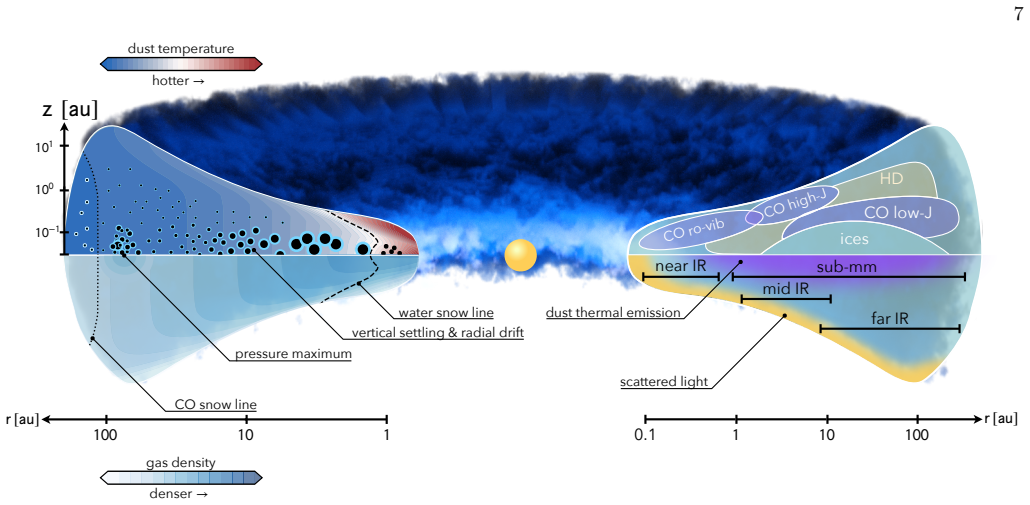
Working through the physics of dust-gas coupling (Stokes number), opacity as a function of grain size and wavelength, and radiative transfer with scattering, the author establishes an interpretive scheme: each observing wavelength is dominated by grains close to its resonance size, so multi-wavelength images act like a sieve on grain size; and each tracer's vertical extent—the dark-lane width in edge-on disks, the offset of scattered-light rings, the minor-axis shape of millimeter rings, the channel-map emission surface of molecular lines—can be converted into a physical height above the midplane. The synthesis shows that in mature Class II disks the outer regions have dust scale heights of
What carries the argument
The central objects are the Stokes number St, which sets how tightly a grain is coupled to the gas, and the settling–diffusion balance H_d/H_g = (1 + St Sc/α_z)^(-1), which turns a measured dust scale height into a turbulence level. On the observational side, the workhorse is the intensity equation including scattering (Equation 10), used at multiple millimeter wavelengths to fit grain size and column density, plus three geometric converters: the near/far channel-map ellipse (Equation 11) for molecular emission height, the minor-axis offset (Equation 12) for scattered-light surfaces, and the minor-axis profile shape of edge-on disks for millimeter dust heights.
Load-bearing premise
The entire interpretive chain rests on modeling grains as compact spheres in the Epstein drag regime with a single isotropic turbulence coefficient; if grains are porous aggregates or turbulence is anisotropic, the inferred sizes and scale heights are systematically biased.
What would settle it
Measure the same disk's dust scale height from two independent tracers whose opacities depend differently on porosity—e.g., millimeter continuum scattering and near-infrared polarimetry. If the inferred scale heights disagree beyond the compact-sphere model uncertainties, the single-grain-population assumption fails. Alternatively, directly resolving the vertical structure of a Class 0 disk at sub-millimeter wavelengths and finding a thin midplane layer would contradict the claim that young disks are un-settled.
If this is right
- A measured dust-to-gas scale-height ratio yields a direct constraint on vertical turbulence α_z, typically implying values below about 10^-3 in settled outer disk regions.
- Azimuthal brightness asymmetries in rings (the wall effect and the optically-thin ring effect) diagnose whether substructures are vertically thick or thin and where dust is concentrated.
- Inferred maximum grain sizes around millimeters to centimeters imply growth is often limited by fragmentation or radial drift rather than by sticking alone.
- Settled outer disks are favorable sites for pebble accretion, so planet formation may proceed efficiently exactly where dust has fallen into a thin midplane layer.
- Comparing CO emission surfaces with scattered-light surfaces constrains the vertical temperature and gas structure and quantifies the degree of dust–gas separation.
Where Pith is reading between the lines
- If grains are porous, the same observations would imply larger physical grain sizes and looser constraints on α_z; combining scattering albedo with polarization fractions could partially break this degeneracy.
- A direct test would measure gas and dust scale heights independently in the same disk; a mismatch beyond the isotropic-turbulence prediction would indicate anisotropic or non-uniform turbulence.
- The geometric methods assume circular, axisymmetric rings; applying them to spiral or warped disks would bias height estimates, so a natural extension is to generalize these methods to non-axisymmetric geometries.
- The thin dust layers implied by the tutorial are prime sites for streaming instability, so searching for unresolved optically thick azimuthal brightness enhancements could identify where planetesimals form.
Editorial analysis
A structured set of objections, weighed in public.
Referee Report
Summary. This tutorial paper, intended as an introduction for beginners, connects basic theory of dust transport and evolution in protoplanetary disks with observational methods for inferring dust grain sizes and vertical structure. It recaps the standard equations for Epstein-regime stopping time, Stokes number, vertical settling, radial drift, and turbulent mixing; discusses dust opacities and porosity; and then reviews methods for constraining dust sizes from multi-wavelength millimeter observations and for measuring the vertical extent of dust and gas in edge-on and moderately inclined disks. It also presents a small parameterized mcfost model grid (Fig. 7) to illustrate how major-axis and minor-axis profiles depend on dust mass, scale height, and inclination, and it summarizes current observational constraints, emphasizing that millimeter dust is commonly vertically settled in outer Class II disks while settling may be less efficient in younger systems.
Significance. If the technical content is corrected, this tutorial would be a valuable pedagogical reference. Its strengths are the clear organization, the explicit listing of model parameters for the illustrative mcfost grid, the citation of publicly available analysis tools (disksurf, DISCMINER, ALFAHOR, DRAGyS), and the balanced presentation of open issues such as porosity, composition degeneracies, and the difficulty of measuring gas scale heights. The paper makes no claim to new observational results; it is a synthesis of existing methods and findings, with the author's own prior work cited appropriately for specific observational constraints. The main value lies in giving early-career readers a single, well-structured entry point to this literature.
major comments (1)
- [Sec. 2.1, Eqs. (5) and (6)] The dust scale-height ratio is mis-stated. The standard solution for vertical settling balanced by turbulent diffusion is H_d/H_g = (1 + St Sc/α_z)^(-1/2) (e.g., Dubrulle et al. 1995; Youdin & Lithwick 2007), not the exponent −1 printed in Eq. (5). The same issue affects Eq. (6), where the standard radial dust-ring width relation is w_d/w_g = (1 + St Sc/α_r)^(-1/2) (Dullemond et al. 2018). As written, these equations imply a linear rather than square-root dependence on St/α; in the well-coupled limit St/α ≪ 1, the inferred α_z would be off by a factor of two. This is not purely cosmetic: Section 5.2.3 and Section 6 interpret observed h_mm/r upper limits as constraints on α_z/St by reference to Eq. (5), so the incorrect exponent changes the quantitative translation from observations to turbulence parameters. Please correct the exponent and verify the prefactor against the cited sources.
minor comments (5)
- [Abstract and Sec. 6] The gas-scale-height limitation is correctly acknowledged in Sec. 5.1 and at the end of Sec. 6, but the abstract and the opening sentence of Sec. 6 state the settling conclusion without that caveat. Consider adding a short clause such as 'under current gas-scale-height assumptions' to avoid overstating the observational consensus.
- [Throughout] There are numerous typographical errors. Examples: 'co-called' → 'so-called' (Sec. 2.1), 'refereed to as' → 'referred to as' (Sec. 1), 'phenomenons' → 'phenomena' (Sec. 1), 'particule'/'particules' → 'particle'/'particles' (multiple), 'wavelenghts' → 'wavelengths' (multiple), 'an larger impact' → 'a larger impact' (Sec. 3.1), 'The later parameter' → 'The latter parameter' (Sec. 4.2), 'At the other hand' → 'On the other hand' (Sec. 5.1.2).
- [Fig. 5] The axis labels of Fig. 5 are garbled in the typeset version (the unicode for log(τ_ν) and ω_ν appears corrupted). Please ensure the figure is regenerated with clear axis labels.
- [Sec. 2.1, Eq. (1)] For readers unfamiliar with the Epstein regime, it would help to state explicitly that Eq. (1) is a proportionality, with the numerical constant of order unity (e.g., sqrt(π/8)) omitted. The current text is not wrong, but the notation could be clearer.
- [Sec. 3.3] The sentence 'Compact grains scatter most efficiencly within a short range of wavelength' is grammatically awkward and contains a typo. Rephrase as 'Compact grains scatter efficiently only over a narrow range of wavelengths.'
Circularity Check
No significant circularity; tutorial/review reports standard methods and independent observational constraints.
full rationale
The paper is an introductory tutorial and review rather than a derivation whose predictions reduce to fitted inputs. Its physical equations (Epstein stopping time, Stokes number, settling/drift velocities, H_d/H_g balance, radiative-transfer intensity with scattering, geometric emission-height relations) are standard results cited to independent literature (Youdin & Lithwick 2007; Dubrulle et al. 1995; Sierra et al. 2019; Pinte et al. 2018; Avenhaus et al. 2018), not results imported from the author's own prior work. The illustrative mcfost models in Fig. 7 are forward models with chosen scale heights, used to display morphology, not fits that are then relabeled as measurements. The summary statements about vertical settling cite a mix of the author's observational papers and independent teams (e.g., Tazaki et al. 2025; Ribas et al. 2024; Doi & Kataoka 2021), so the self-citations are not load-bearing. The paper also explicitly acknowledges the main assumption that limits its summary claim, noting in Sect. 5.1 that gas scale-height constraints remain limited and that several settling constraints rely on radiative-transfer-model midplane temperatures, needing future direct gas constraints. This is an honest limitation rather than a hidden circular step. No equation or inference was found to reduce to its own inputs by construction.
Axiom & Free-Parameter Ledger
free parameters (4)
- H0 (dust/gas scale height at 100 au in Fig. 7 models) =
10 au, 3 au, 1 au
- Dust mass (for Fig. 7 models) =
1e-5, 1e-4, 1e-3 Msun
- Size distribution slope p =
3.5
- Radial scaling exponent for Hd =
1.125
axioms (6)
- domain assumption Epstein drag regime applies to observable dust grains (Eq. 1)
- domain assumption Vertically isothermal, non-self-gravitating gas in hydrostatic equilibrium (Eq. 2)
- domain assumption Small dust-to-gas ratio for Eqs 4a and 4b
- domain assumption Turbulent mixing balances settling, giving Eq. 5 (Youdin & Lithwick 2007; Dubrulle et al. 1995)
- domain assumption Dust opacities for compact astronomical silicates (Laor & Draine 1993)
- domain assumption Keplerian rotation and circular orbits for gas emission surface method (Eq. 11)
Cite this review
Pith. "Pith review of An Introduction to Dust Evolution and Vertical Transport in Protoplanetary Disks." pith.science (2026). https://pith.science/paper/STTQHOUZ
@misc{pith2026250910614,
  author       = {Pith},
  title        = {Pith review of: An Introduction to Dust Evolution and Vertical Transport in Protoplanetary Disks},
  year         = {2026},
  howpublished = {\url{https://pith.science/paper/STTQHOUZ}},
  note         = {Machine review of arXiv:2509.10614}
}
read the original abstract
This tutorial is an introduction to observational studies of dust transport and evolution in protoplanetary disks. Spatially resolved observations of disks at multiple wavelengths can allow to infer the distribution of various dust grains and gas species. Combining these observations offers a more complete understanding of dust structure and properties across different disk locations. For example, by better characterizing the disk vertical structure, observations help to constrain the level of vertical settling and identify regions of high dust density, which are favorable for grain growth and planet formation. This tutorial describes various methodologies for inferring dust properties and vertical height of different tracers, as an introduction for beginners.
Figures




Forward citations
Cited by 1 Pith paper
-
Dust Growth in Binary Systems: Inhibition of dust settling and growth in circumbinary discs
Dust grains in circumbinary discs end up five times smaller than in single-star discs, and the conditions for streaming-instability clumping are not met, arguing against in-situ planet formation there.
Reference graph
Works this paper leans on
-
[1]
Andrews, S. M. 2020, ARA&A, 58, 483, doi: 10.1146/annurev-astro-031220-010302
-
[2]
Andrews, S. M., Huang, J., Pérez, L. M., et al. 2018, ApJL, 869, L41, doi: 10.3847/2041-8213/aaf741
-
[3]
2023, ApJ, 945, 130, doi: 10.3847/1538-4357/acbb01
Angelo, I., Duchene, G., Stapelfeldt, K., et al. 2023, ApJ, 945, 130, doi: 10.3847/1538-4357/acbb01
-
[4]
Avenhaus, H., Quanz, S. P., Garufi, A., et al. 2018, ApJ, 863, 44, doi: 10.3847/1538-4357/aab846
-
[5]
2023, in Astronomical Society of the Pacific Conference Series, Vol
Bae, J., Isella, A., Zhu, Z., et al. 2023, in Astronomical Society of the Pacific Conference Series, Vol. 534, Protostars and Planets VII, ed. S. Inutsuka, Y. Aikawa, T. Muto, K. Tomida, & M. Tamura, 423, doi: 10.48550/arXiv.2210.13314
-
[6]
Balbus, S. A., & Hawley, J. F. 1991, ApJ, 376, 214, doi: 10.1086/170270
doi:10.1086/170270 1991
-
[7]
Beckwith, S. V. W., & Sargent, A. I. 1991, ApJ, 381, 250, doi: 10.1086/170646 19
doi:10.1086/170646 1991
-
[8]
2023, in Astronomical Society of the Pacific Conference Series, Vol
Benisty, M., Dominik, C., Follette, K., et al. 2023, in Astronomical Society of the Pacific Conference Series, Vol. 534, Protostars and Planets VII, ed. S. Inutsuka, Y. Aikawa, T. Muto, K. Tomida, & M. Tamura, 605, doi: 10.48550/arXiv.2203.09991
-
[9]
Berghea, C. T., Bayyari, A., Sitko, M. L., et al. 2024, ApJL, 967, L3, doi: 10.3847/2041-8213/ad43e3
-
[10]
2024, ARA&A, 62, 157, doi: 10.1146/annurev-astro-071221-052705
Birnstiel, T. 2024, ARA&A, 62, 157, doi: 10.1146/annurev-astro-071221-052705
-
[11]
Birnstiel, T., Andrews, S. M., Pinilla, P., & Kama, M. 2015, ApJL, 813, L14, doi: 10.1088/2041-8205/813/1/L14
-
[12]
Birnstiel, T., Ormel, C. W., & Dullemond, C. P. 2011, A&A, 525, A11, doi: 10.1051/0004-6361/201015228
-
[13]
2008, ARA&A, 46, 21, doi: 10.1146/annurev.astro.46.060407.145152
Blum, J., & Wurm, G. 2008, ARA&A, 46, 21, doi: 10.1146/annurev.astro.46.060407.145152
arXiv 2008
-
[14]
Burrows, C. J., Stapelfeldt, K. R., Watson, A. M., et al. 1996, ApJ, 473, 437, doi: 10.1086/178156
doi:10.1086/178156 1996
-
[15]
Calahan, J. K., Bergin, E. A., Zhang, K., et al. 2021, ApJS, 257, 17, doi: 10.3847/1538-4365/ac143f
-
[16]
Canovas, H., Ménard, F., de Boer, J., et al. 2015, A&A, 582, L7, doi: 10.1051/0004-6361/201527267 Carrasco-González, C., Sierra, A., Flock, M., et al. 2019, ApJ, 883, 71, doi: 10.3847/1538-4357/ab3d33
-
[17]
Carrera, D., Johansen, A., & Davies, M. B. 2015, A&A, 579, A43, doi: 10.1051/0004-6361/201425120
-
[18]
Carrera, D., Lim, J., Eriksson, L. E. J., Lyra, W., & Simon, J. B. 2025, A&A, 696, L23, doi: 10.1051/0004-6361/202554100
-
[19]
Carvalho, A. S., Pérez, L. M., Sierra, A., et al. 2024, ApJ, 971, 129, doi: 10.3847/1538-4357/ad5a07 D’Alessio, P., Calvet, N., Hartmann, L., Franco-Hernández, R., & Servín, H. 2006, ApJ, 638, 314, doi: 10.1086/498861 de Boer, J., Salter, G., Benisty, M., et al. 2016, A&A, 595, A114, doi: 10.1051/0004-6361/201629267
-
[20]
Dent, W. R. F., Pinte, C., Cortes, P. C., et al. 2019, MNRAS, 482, L29, doi: 10.1093/mnrasl/sly181
-
[21]
2024, A&A, 688, A149, doi: 10.1051/0004-6361/202348555
Derkink, A., Ginski, C., Pinilla, P., et al. 2024, A&A, 688, A149, doi: 10.1051/0004-6361/202348555
-
[22]
2021, ApJ, 912, 164, doi: 10.3847/1538-4357/abe5a6 —
Doi, K., & Kataoka, A. 2021, ApJ, 912, 164, doi: 10.3847/1538-4357/abe5a6 —. 2023, ApJ, 957, 11, doi: 10.3847/1538-4357/acf5df
-
[23]
Dominik, C., & Dullemond, C. P. 2024, A&A, 682, A144, doi: 10.1051/0004-6361/202347716 Drążkowska, J., Bitsch, B., Lambrechts, M., et al. 2023, in Astronomical Society of the Pacific Conference Series, Vol. 534, Protostars and Planets VII, ed. S. Inutsuka, Y. Aikawa, T. Muto, K. Tomida, & M. Tamura, 717, doi: 10.48550/arXiv.2203.09759
-
[24]
1995, Icarus, 114, 237, doi: 10.1006/icar.1995.1058 Duchêne, G., McCabe, C., Ghez, A
Dubrulle, B., Morfill, G., & Sterzik, M. 1995, Icarus, 114, 237, doi: 10.1006/icar.1995.1058 Duchêne, G., McCabe, C., Ghez, A. M., & Macintosh, B. A. 2004, ApJ, 606, 969, doi: 10.1086/383126 Duchêne, G., Ménard, F., Stapelfeldt, K., & Duvert, G. 2003, A&A, 400, 559, doi: 10.1051/0004-6361:20021906 Duchêne, G., McCabe, C., Pinte, C., et al. 2010, ApJ, 712,...
arXiv 1995
-
[25]
Dullemond, C. P., & Dominik, C. 2004, A&A, 421, 1075, doi: 10.1051/0004-6361:20040284
-
[26]
P., Birnstiel, T., Huang, J., et al
Dullemond, C. P., Birnstiel, T., Huang, J., et al. 2018, ApJL, 869, L46, doi: 10.3847/2041-8213/aaf742
-
[27]
2017, A&A, 607, A130, doi: 10.1051/0004-6361/201730645
Dutrey, A., Guilloteau, S., Piétu, V., et al. 2017, A&A, 607, A130, doi: 10.1051/0004-6361/201730645
-
[28]
Encalada, F. J., Looney, L. W., Takakuwa, S., et al. 2024, ApJ, 966, 32, doi: 10.3847/1538-4357/ad3442
-
[29]
Fischer, W. J., Megeath, S. T., Tobin, J. J., et al. 2014, ApJ, 781, 123, doi: 10.1088/0004-637X/781/2/123
-
[30]
2021, AJ, 161, 239, doi: 10.3847/1538-3881/abeb1e
Flores, C., Duchêne, G., Wolff, S., et al. 2021, AJ, 161, 239, doi: 10.3847/1538-3881/abeb1e
-
[31]
Fromang, S., & Nelson, R. P. 2009, A&A, 496, 597, doi: 10.1051/0004-6361/200811220
-
[32]
2006, ApJS, 165, 568, doi: 10.1086/505468
Furlan, E., Hartmann, L., Calvet, N., et al. 2006, ApJS, 165, 568, doi: 10.1086/505468
doi:10.1086/505468 2006
-
[33]
Furlan, E., Luhman, K. L., Espaillat, C., et al. 2011, ApJS, 195, 3, doi: 10.1088/0067-0049/195/1/3
-
[34]
Galloway-Sprietsma, M., Bae, J., Izquierdo, A. F., et al. 2025, ApJL, 984, L10, doi: 10.3847/2041-8213/adc437
-
[35]
Garcia, A. J. L., & Gonzalez, J.-F. 2020, MNRAS, 493, 1788, doi: 10.1093/mnras/staa382
-
[36]
Garufi, A., Ginski, C., van Holstein, R. G., et al. 2024, A&A, 685, A53, doi: 10.1051/0004-6361/202347586
-
[37]
2025, A&A, 694, A290, doi: 10.1051/0004-6361/202452496
Garufi, A., Carrasco-González, C., Macías, E., et al. 2025, A&A, 694, A290, doi: 10.1051/0004-6361/202452496
-
[38]
Gerosa, F. A., Méheut, H., & Bec, J. 2023, European Physical Journal Plus, 138, 9, doi: 10.1140/epjp/s13360-022-03585-8
-
[39]
2016, A&A, 595, A112, doi: 10.1051/0004-6361/201629265
Ginski, C., Stolker, T., Pinilla, P., et al. 2016, A&A, 595, A112, doi: 10.1051/0004-6361/201629265
-
[40]
2024, A&A, 685, A52, doi: 10.1051/0004-6361/202244005
Ginski, C., Garufi, A., Benisty, M., et al. 2024, A&A, 685, A52, doi: 10.1051/0004-6361/202244005
-
[41]
M., Ménard, F., Pinte, C., et al
Glauser, A. M., Ménard, F., Pinte, C., et al. 2008, A&A, 485, 531, doi: 10.1051/0004-6361:20065685
-
[42]
Goldreich, P., & Ward, W. R. 1973, ApJ, 183, 1051, doi: 10.1086/152291 Gräfe, C., Wolf, S., Guilloteau, S., et al. 2013, A&A, 553, A69, doi: 10.1051/0004-6361/201220720
doi:10.1086/152291 1973
-
[43]
Grant, S. L., Espaillat, C. C., Megeath, S. T., et al. 2018, ApJ, 863, 13, doi: 10.3847/1538-4357/aacda7 20
-
[44]
Greaves, J. S., & Mason, B. 2022, MNRAS, 513, 3180, doi: 10.1093/mnras/stac856
-
[45]
2003, ApJ, 586, 296, doi: 10.1086/367557
Grosso, N., Alves, J., Wood, K., et al. 2003, ApJ, 586, 296, doi: 10.1086/367557
doi:10.1086/367557 2003
-
[46]
M., Carrasco-González, C., Macías, E., et al
Guerra-Alvarado, O. M., Carrasco-González, C., Macías, E., et al. 2024, A&A, 686, A298, doi: 10.1051/0004-6361/202349046
-
[47]
2022, A&A, 664, A137, doi: 10.1051/0004-6361/202142303
Guidi, G., Isella, A., Testi, L., et al. 2022, A&A, 664, A137, doi: 10.1051/0004-6361/202142303
-
[48]
2021, ApJ, 915, 22, doi: 10.3847/1538-4357/abf6cf Hernández-Vera, C., Guzmán, V
Wada, K. 2021, ApJ, 915, 22, doi: 10.3847/1538-4357/abf6cf Hernández-Vera, C., Guzmán, V. V., Artur de la
-
[49]
2024, ApJ, 967, 68, doi: 10.3847/1538-4357/ad3cdb
Villarmois, E., et al. 2024, ApJ, 967, 68, doi: 10.3847/1538-4357/ad3cdb
-
[50]
Huang, J., Andrews, S. M., Dullemond, C. P., et al. 2018, ApJL, 869, L42, doi: 10.3847/2041-8213/aaf740
-
[51]
Hull, C. L. H., Yang, H., Li, Z.-Y., et al. 2018, ApJ, 860, 82, doi: 10.3847/1538-4357/aabfeb
-
[52]
F., Testi, L., Facchini, S., Rosotti, G
Izquierdo, A. F., Testi, L., Facchini, S., Rosotti, G. P., & van Dishoeck, E. F. 2021, A&A, 650, A179, doi: 10.1051/0004-6361/202140779
-
[53]
F., Testi, L., Facchini, S., et al
Izquierdo, A. F., Testi, L., Facchini, S., et al. 2023, A&A, 674, A113, doi: 10.1051/0004-6361/202245425
-
[54]
Stauffer, J. R. 2002, ApJL, 571, L51, doi: 10.1086/341202
doi:10.1086/341202 2002
-
[55]
Jiang, H., Macías, E., Guerra-Alvarado, O. M., & Carrasco-González, C. 2024, A&A, 682, A32, doi: 10.1051/0004-6361/202348271
-
[56]
2014, in Protostars and Planets VI, ed
Johansen, A., Blum, J., Tanaka, H., et al. 2014, in Protostars and Planets VI, ed. H. Beuther, R. S. Klessen, C. P. Dullemond, & T. Henning, 547–570, doi: 10.2458/azu_uapress_9780816531240-ch024
-
[57]
2007, ApJ, 662, 627, doi: 10.1086/516730
Johansen, A., & Youdin, A. 2007, ApJ, 662, 627, doi: 10.1086/516730
doi:10.1086/516730 2007
-
[58]
Kamp, I., Henning, T., Arabhavi, A. M., et al. 2023, Faraday Discussions, 245, 112, doi: 10.1039/D3FD00013C
-
[59]
Dullemond, C. P. 2016, ApJ, 820, 54, doi: 10.3847/0004-637X/820/1/54
-
[60]
2014, A&A, 568, A42, doi: 10.1051/0004-6361/201323199
Kataoka, A., Okuzumi, S., Tanaka, H., & Nomura, H. 2014, A&A, 568, A42, doi: 10.1051/0004-6361/201323199
-
[61]
2013, A&A, 557, L4, doi: 10.1051/0004-6361/201322151
Kataoka, A., Tanaka, H., Okuzumi, S., & Wada, K. 2013, A&A, 557, L4, doi: 10.1051/0004-6361/201322151
-
[62]
2015, ApJ, 809, 78, doi: 10.1088/0004-637X/809/1/78
Kataoka, A., Muto, T., Momose, M., et al. 2015, ApJ, 809, 78, doi: 10.1088/0004-637X/809/1/78
-
[63]
Krist, J. E., Stapelfeldt, K. R., Golimowski, D. A., et al. 2005, AJ, 130, 2778, doi: 10.1086/497069
doi:10.1086/497069 2005
-
[64]
Lada, C. J. 1987, in IAU Symposium, Vol. 115, Star Forming Regions, ed. M. Peimbert & J. Jugaku, 1
1987
-
[65]
2012, A&A, 544, A32, doi: 10.1051/0004-6361/201219127
Lambrechts, M., & Johansen, A. 2012, A&A, 544, A32, doi: 10.1051/0004-6361/201219127
-
[66]
Lambrechts, M., Morbidelli, A., Jacobson, S. A., et al. 2019, A&A, 627, A83, doi: 10.1051/0004-6361/201834229
-
[67]
Laor, A., & Draine, B. T. 1993, ApJ, 402, 441, doi: 10.1086/172149
doi:10.1086/172149 1993
-
[68]
Law, C. J., Alarcón, F., Cleeves, L. I., Öberg, K. I., & Paneque-Carreño, T. 2023a, ApJL, 959, L27, doi: 10.3847/2041-8213/ad0e06
-
[69]
Law, C. J., Teague, R., Loomis, R. A., et al. 2021, ApJS, 257, 4, doi: 10.3847/1538-4365/ac1439
-
[70]
J., Crystian, S., Teague, R., et al
Law, C. J., Crystian, S., Teague, R., et al. 2022, ApJ, 932, 114, doi: 10.3847/1538-4357/ac6c02
-
[71]
Law, C. J., Teague, R., Öberg, K. I., et al. 2023b, ApJ, 948, 60, doi: 10.3847/1538-4357/acb3c4
-
[72]
J., Benisty, M., Facchini, S., et al
Law, C. J., Benisty, M., Facchini, S., et al. 2024, ApJ, 964, 190, doi: 10.3847/1538-4357/ad24d2
-
[73]
Lee, C.-F., Li, Z.-Y., Ho, P. T. P., et al. 2017, Science Advances, 3, e1602935, doi: 10.1126/sciadv.1602935
-
[74]
2023, in Astronomical Society of the Pacific Conference Series, Vol
Lesur, G., Flock, M., Ercolano, B., et al. 2023, in Astronomical Society of the Pacific Conference Series, Vol. 534, Protostars and Planets VII, ed. S. Inutsuka, Y. Aikawa, T. Muto, K. Tomida, & M. Tamura, 465, doi: 10.48550/arXiv.2203.09821
-
[75]
Lim, J., Simon, J. B., Li, R., et al. 2024, ApJ, 969, 130, doi: 10.3847/1538-4357/ad47a2
-
[76]
D., Lee, C.-F., Li, Z.-Y., Tobin, J
Lin, Z.-Y. D., Lee, C.-F., Li, Z.-Y., Tobin, J. J., & Turner, N. J. 2021, MNRAS, 501, 1316, doi: 10.1093/mnras/staa3685
-
[77]
Lin, Z.-Y. D., Li, Z.-Y., Tobin, J. J., et al. 2023, ApJ, 951, 9, doi: 10.3847/1538-4357/acd5c9
-
[78]
Liu, H. B. 2019, ApJL, 877, L22, doi: 10.3847/2041-8213/ab1f8e
-
[79]
Liu, Y., Bertrang, G. H. M., Flock, M., et al. 2022, Science China Physics, Mechanics, and Astronomy, 65, 129511, doi: 10.1007/s11433-022-1982-y
-
[80]
Long, F., Pinilla, P., Herczeg, G. J., et al. 2018, ApJ, 869, 17, doi: 10.3847/1538-4357/aae8e1 Macías, E., Guerra-Alvarado, O., Carrasco-González, C., et al. 2021, A&A, 648, A33, doi: 10.1051/0004-6361/202039812
discussion (0)
Sign in with ORCID, Apple, or X to comment. Anyone can read and Pith papers without signing in.