REVIEW 3 major objections 5 minor 27 references
Configurational Entropy and Its Scaling Behavior in Lattice Systems with Number of States Defined by Coordination Numbers
T0 review · 3 major / 5 minor · reviewed 2026-08-06 · deepseek-v4-flash
Pith's one-line read For a lattice model where each site has as many states as its coordination number, per-site configurational entropy approaches $\ln(z)$ with a universal finite-size deficit $\Delta s_N \sim N^{-1/d}$.
desk verdict The exact enumeration is solid, but the 'universal' scaling law is just the boundary fraction in disguise, and the paper never specifies its cluster geometries. read the letter →
The pith
A machine-rendered reading of the paper's core claim, the machinery that carries it, and where it could break.
The reading
What carries the argument
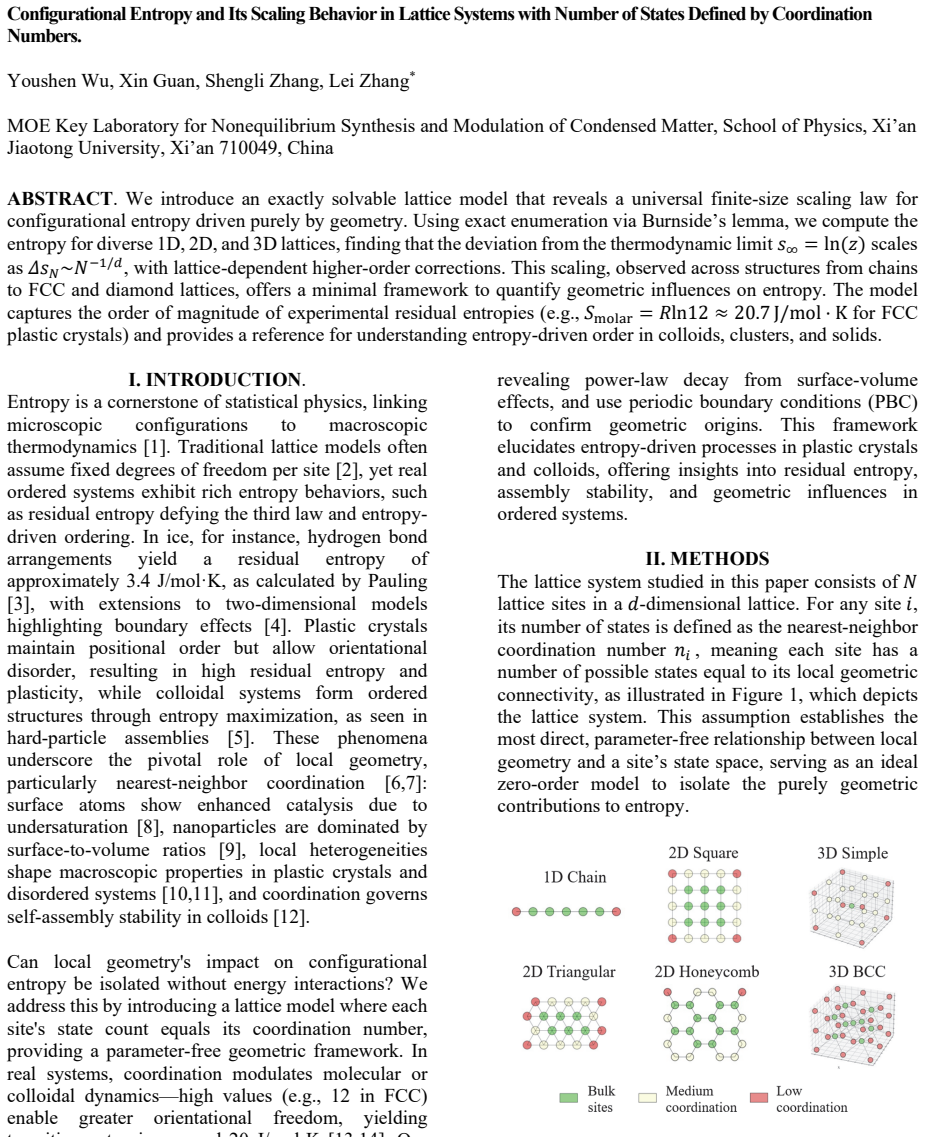
The engine of the calculation is Burnside's lemma, used in logarithmic space with a log-sum-exp step to count physically distinct configurations as $\Omega = (1/|G|)\sum_{g\in G} \mathrm{Fix}(g)$ without overflow. The scaling conclusion rests on a bulk-boundary decomposition: $\sum_i \ln n_i = N_{\mathrm{bulk}} \ln z + N_{\mathrm{boundary}} \ln z'$, with $N_{\mathrm{boundary}} \sim N^{(d-1)/d}$, so the per-site boundary correction is of order $N^{-1/d}$. The symmetry group's size $|G|$ is a constant and drops out in the thermodynamic limit.
What would settle it
Enumerate $\Delta s_N$ for a 2D square-lattice cluster shaped as a 1×L strip of width one site. If the universal law holds for every cluster shape, the deficit should still scale as $N^{-1/2}$; if the boundary-count argument controls the exponent, it will instead scale as $N^{-1}$, showing that the stated law requires compact clusters.
Extended reading notes
Core claim
The discovery is a universal finite-size scaling law for configurational entropy. In the thermodynamic limit, the per-site entropy equals $\ln(z)$, where $z$ is the bulk coordination number: interior sites all have $n_i = z$, and the boundary contribution vanishes. For finite open-boundary clusters, the entropy approaches this limit from below, and the deviation obeys $\Delta s_N \sim N^{-1/d}$, with lattice-dependent higher-order terms from edges and corners; fitted exponents for the eight lattices lie close to $1/d$ (1.000 in 1D, 0.507–0.521 in 2D, 0.335–0.343 in 3D). Periodic-boundary calculations converge much faster, confirming that the correction is a surface-to-volume effect. The model also predicts a molar configurational entropy of $R \ln 12 \approx 20.7$ J/mol·K for FCC coordination, matching the order of magnitude of measured plastic-crystal transition entropies.
Load-bearing premise
The scaling law rests on the finite clusters used in the open-boundary enumeration having a number of boundary sites that scales as $N^{(d-1)/d}$; the paper never specifies the cluster shapes, and for non-compact shapes the exponent would change.
Editorial extensions
If this is right
- For any of the eight lattices, exact enumeration data should fall on a straight line of slope $-1/d$ in a log-log plot of $\Delta s_N$ versus $N$; the fitted slopes in Table 2 confirm this to within a few hundredths.
- Under periodic boundary conditions, $s_N$ approaches $\ln(z)$ markedly faster than under open boundaries, so finite-size entropy corrections in these noncritical systems can be attributed to surfaces rather than to the model's state-counting rule.
- The model assigns FCC (z = 12) a molar configurational entropy $R \ln 12 \approx 20.7$ J/mol·K, which sits inside the 18–36 J/mol·K range reported for plastic-crystal transitions.
- In the free-energy approximation $F \approx -T S_{\mathrm{config}}$, the boundary correction becomes an entropic surface penalty of order $k_B T N^{(d-1)/d}$, which the paper links to the stability of magic-number colloidal clusters.
- Because the higher-order corrections differ between lattices, the fitted scaling exponent and its deviation from $1/d$ can serve as a geometric fingerprint of lattice structure.
Reading between the lines
- A natural test the paper does not perform: enumerate a 2D square-lattice cluster shaped as a 1×L strip; its boundary count scales as $L \sim N$, so $\Delta s_N$ should decay as $N^{-1}$ rather than $N^{-1/2}$, implying the universal exponent holds for compact clusters whose boundary scales as $N^{(d-1)/d}$.
- If the model is extended to state counts depending on next-nearest neighbours, the leading $N^{-1/d}$ term should survive for compact shapes while the coefficient $C_1$ changes; measuring $C_1$ would then separate short-range from longer-range geometric constraints.
- The exact per-site entropies from Burnside enumeration could serve as benchmark data for approximate local-entropy estimators used in glass and quasicrystal studies, since the model gives exact values against a known $\ln(z)$ limit.
Editorial analysis
A structured set of objections, weighed in public.
Referee Report
Summary. The paper introduces a parameter-free lattice model in which each site's number of allowed states equals its nearest-neighbor coordination number, making all configurations degenerate. Using Burnside's lemma with a log-sum-exp implementation, the authors exactly enumerate the number of physically distinct configurations for eight lattices in one, two, and three dimensions. They compute the per-site configurational entropy s_N under open boundary conditions, observe that it approaches ln(z) from below, and claim a universal finite-size scaling law Δs_N = s_∞ - s_N ∼ N^{-1/d}, with lattice-dependent higher-order corrections. The paper also compares open and periodic boundary conditions for square and simple-cubic lattices and connects the model to residual entropy of plastic crystals and to entropy-driven ordering in colloids.
Significance. If the claims are properly supported, the paper would provide a clean, exactly solvable reference model for purely geometric contributions to configurational entropy, with an exact-enumeration tool that is validated against exhaustive counts in Table 1. Strengths include the parameter-free construction, the use of Burnside's lemma with numerical stabilization, the explicit exhaustive-check table, and the stated public availability of the Python code. However, the central scaling law is, for regular cluster families, a direct consequence of the boundary-site fraction rather than an independent emergent law; the paper's value is therefore more as a solvable reference model and a methodological demonstration than as evidence for a new universal exponent. The significance of the result depends on whether the finite clusters used in the fits are specified and whether the exponent claim is supported by quantitative fits.
major comments (3)
- [II, Eqs. (2)-(3)] Equation (2) is internally inconsistent as printed: it states W_labeled/|G| = Ω = W_labeled, even though the surrounding text calls it an inequality. The subsequent logarithm and the convergence argument in Eq. (3) only make sense if Eq. (2) is meant to read W_labeled/|G| ≤ Ω ≤ W_labeled. Please correct the displayed equation and rewrite the bound argument accordingly.
- [III, Figs. 2-3 and Table 2] The finite clusters used for the OBC enumeration are never specified. The derivation of Eq. (7) assumes a boundary-site fraction scaling as N^{-1/d}, which holds only for regular Euclidean cluster families; for strip-like or elongated clusters the boundary fraction is O(1) and Δs_N would not follow N^{-1/d}. Since the central claim is the universality of the exponent, the paper must state the exact cluster shapes, side lengths, and aspect ratios for each of the eight lattices, and confirm that the boundary fraction indeed scales as N^{-1/d} for the reported data.
- [III, Table 2 and IV] The fitted exponents in Table 2 are reported without fit ranges, uncertainties, or the functional form used for the fits. The claim that α is systematically larger than 1/d because of higher-order edge and corner terms is not supported by any estimate of the coefficient C2 in Eq. (10) or by a fit that includes such corrections. Please provide the fitting details and error bars, or soften the claim that the deviations are a geometric fingerprint.
minor comments (5)
- [III and IV] Equation (10) is used twice with different content: first for Δs_N ~ N^{-α} and later for the expansion Δs_N = C1 N^{-1/d} + C2 N^{-2/d} + ... . Please renumber.
- [II, Burnside's lemma] The symmetry group G is not described for any of the finite clusters. Since Burnside's lemma requires an explicit group action, please specify how G is generated for each cluster shape, including the PBC cases in Fig. 4.
- [Table 1] The exhaustive validation is performed only for very small clusters (N up to 17), far below the sizes likely used for the fits in Figs. 2-3. Please state whether the solver was also validated at intermediate sizes, or provide additional checks for the clusters used in the scaling analysis.
- [Fig. 4] Figure 4 does not state the axes, the system sizes, or how the PBC clusters are constructed. Please specify the torus side lengths and the corresponding symmetry groups so that the OBC/PBC comparison is reproducible.
- [Throughout] The displayed equations and inline symbols contain OCR-style corruption (e.g., subscripts and Greek letters appearing as unrelated glyphs). The final typeset version should use standard notation throughout.
Circularity Check
No significant circularity: the entropy scaling is derived from boundary counting and independently checked by exact enumeration.
full rationale
The paper's derivation chain is self-contained and does not reduce to its own inputs. The model defines the labeled configuration count as W_labeled = ∏ n_i, the symmetry-reduced count via Burnside's lemma, and the configurational entropy as S = ln Ω. Equation (4), s_inf = lim (1/N) ∑ ln n_i, follows from the definition of the model and the fact that the boundary contribution vanishes in the thermodynamic limit; Eq. (6), s_inf = ln z, is then a direct mathematical consequence, not a fitted or assumed result. Equation (7), Δs_N ~ N^{-1/d}, is also derived rather than assumed: it follows from the stated boundary-site counting argument, and the exact enumeration verifies the arithmetic of that derivation. The exhaustive checks in Table 1 against direct counting for small systems independently validate the Burnside solver, and the model has no fitted parameters. The fitted exponents in Table 2 are diagnostic consistency checks, not inputs used to produce the predicted scaling. There are no load-bearing self-citations, no imported uniqueness theorems, and no ansatz smuggled in via citation; the cited finite-size scaling literature is external and supports, rather than carries, the argument. A legitimate caveat is that the manuscript does not specify the cluster shapes used in the open-boundary enumerations (Figs. 2-3 and Table 2), so the universality claim is conditional on regular Euclidean cluster families; this is a reproducibility and rigor limitation, but it does not make the derivation circular because the enumerated entropy values are computed, not presupposed.
Assumptions & free parameters
assumptions (4)
- domain assumption All configurations are assigned equal statistical weight (complete degeneracy, no energy interactions).
- domain assumption The finite clusters under OBC are regular Euclidean shapes whose number of boundary sites scales as N^((d-1)/d).
- standard math The symmetry group factor ln|G| / N vanishes in the thermodynamic limit, so s_∞ = ln z.
- standard math The number of physically distinct configurations Ω is computed via Burnside's lemma under the full automorphism group of the labeled lattice.
Cite this review
Pith. "Pith review of Configurational Entropy and Its Scaling Behavior in Lattice Systems with Number of States Defined by Coordination Numbers." pith.science (2026). https://pith.science/paper/SU43H73U
@misc{pith2026250720660,
  author       = {Pith},
  title        = {Pith review of: Configurational Entropy and Its Scaling Behavior in Lattice Systems with Number of States Defined by Coordination Numbers},
  year         = {2026},
  howpublished = {\url{https://pith.science/paper/SU43H73U}},
  note         = {Machine review of arXiv:2507.20660}
}
abstract
We introduce an exactly solvable lattice model that reveals a universal finite-size scaling law for configurational entropy driven purely by geometry. Using exact enumeration via Burnside's lemma, we compute the entropy for diverse 1D, 2D, and 3D lattices, finding that the deviation from the thermodynamic limit $s_{\infty} = \ln (z)$ scales as $\Delta s_{N} \sim N^{-1/d}$, with lattice-dependent higher-order corrections. This scaling, observed across structures from chains to FCC and diamond lattices, offers a minimal framework to quantify geometric influences on entropy. The model captures the order of magnitude of experimental residual entropies (e.g., $S_{\mathrm{molar}} = R \ln 12 \approx 20.7 \, \mathrm{J/mol \cdot K}$) and provides a reference for understanding entropy-driven order in colloids, clusters, and solids.
Figures


Reference graph
Works this paper leans on
-
[1]
R. K. Pathria and P. D. Beale, Statistical Mechanics, 3rd ed. (Academic Press, Boston, 2011)
work page 2011
-
[2]
R. J. Baxter, Exactly Solved Models in Statistical Mechanics (Academic Press, London, 1982)
work page 1982
-
[3]
Pauling, J
L. Pauling, J. Am. Chem. Soc. 57, 2680 (1935)
1935
-
[4]
E. H. Lieb, Phys. Rev. 162, 162 (1967)
work page 1967
-
[5]
G. Meng, N. Arkus, M. P. Brenner, and V. N. Manoharan, Science 327, 560 (2010)
work page 2010
-
[6]
N. W. Ashcroft and N. D. Mermin, Solid State Physics (Holt, Rinehart and Winston, New York, 1976)
1976
-
[7]
J. M. Ziman, Models of Disorder (Cambridge University Press, Cambridge, 1979)
1979
- [8]
Show all 27 references
-
[9]
Roduner, Chem
E. Roduner, Chem. Soc. Rev. 35, 583 (2006)
2006
-
[10]
The Plastically Crystalline State: Orientationally Disordered Crystals, edited by J. N. Sherwood (John Wiley & Sons, Chichester, 1979)
1979
-
[11]
Berthier and G
L. Berthier and G. Biroli, Rev. Mod. Phys. 83, 587 (2011)
2011
-
[12]
P. F. Damasceno, M. Engel, and S. C. Glotzer, Science 337, 453 (2012)
2012
-
[13]
J. G. Aston and G. H. Messerly, J. Am. Chem. Soc. 58, 2354 (1936)
1936
-
[14]
J. G. Aston, G. J. Szasz, and H. L. Fink, J. Am. Chem. Soc. 65, 1135 (1943)
1943
-
[15]
M. N. Barber, in Phase Transitions and Critical Phenomena, edited by C. Domb and J. L. Lebowitz (Academic Press, New York, 1983), Vol. 8, p. 145
1983
-
[16]
Privman (World Scientific, Singapore, 1990)
Finite Size Scaling and Numerical Simulation of Statistical Systems , edited by V. Privman (World Scientific, Singapore, 1990)
1990
-
[17]
Pólya and R
G. Pólya and R. C. Read, Combinatorial Enumeration of Groups, Graphs, and Chemical Compounds (Springer-Verlag, New York, 1987)
1987
-
[18]
J. F. Nagle, in Phase Transitions and Critical Phenomena, edited by C. Domb and M. S. Green (Academic Press, London, 1974), Vol. 3, p. 331
1974
-
[19]
B. C. Rocha, S. Paul , and H. Vashisth, Entropy 22, 877 (2020)
2020
-
[20]
Barry and Z
E. Barry and Z. Dogic, Proc. Natl. Acad. Sci. U.S.A. 107, 10348 (2010)
2010
-
[21]
W. I. F. David et al., Nature (London) 353, 147 (1991)
1991
-
[22]
J. Wang, C. F. Mbah, T. Przybilla, B. A. Zubiri, E. Spiecker, M. Engel, and N. Vogel, Nat. Commun. 9, 5259 (2018)
2018
-
[23]
van Anders, N
G. van Anders, N. K. Ahmed, R. Smith, M. Engel, and S. C. Glotzer, ACS Nano 8, 931 (2014)
2014
-
[24]
P. F. Damasceno, M. Engel, and S. C. Glotzer, Sci. Adv. 5, eaaw0514 (2019)
2019
-
[25]
L. Jia, D. Culver, and J. M. Schwarz, Phys. Rev. Lett. 125, 028001 (2020)
2020
-
[26]
F. P. C. Benetti, G. Parisi, F. Ricci-Tersenghi, G. Ruocco, and G. Sicuro, Phys. Rev. Lett. 120, 075502 (2018)
2018
-
[27]
Fayen, L
E. Fayen, L. Filion, G. Foffi, and F. Smallenburg, Phys. Rev. Lett. 132, 048202 (2024)
2024
Reviewed August 6, 2026 · model on record in the stance chip above.
Discussion (0). Continue with ORCID to comment.