REVIEW 2 major objections 4 minor 1 cited by
Density-Functional Excited-State Gradients and Nonadiabatic Couplings on a Consumer GPU from a Contraction-DAG
T0 review · 2 major / 4 minor · reviewed 2026-08-15 · deepseek-v4-flash
Pith's one-line read This paper reports the first analytic nonadiabatic coupling matrix element for a double-hybrid excited state, derived by a single reverse-mode contraction graph and validated against a literal wavefunction-overlap oracle to about…
desk verdict First analytic double-hybrid excited-state coupling is real and oracle-checked, but the step from the validated unscaled d(D) to the B2PLYP c_PT2-scaled coupling is asserted, not tested. read the letter →
The pith
A machine-rendered reading of the paper's core claim, the machinery that carries it, and where it could break.
The reading
What carries the argument
The load-bearing object is a single contraction-DAG: the electronic-structure calculation is a directed acyclic graph whose nodes are elementary operations, and every first derivative is a reverse-mode transpose of that graph, the same mechanism as backpropagation in machine learning. The graph is closed under one non-symmetric atomic-orbital-direct Laplace $J/K$ primitive, in which the left and right weight densities are independent and each may itself be non-symmetric, which is exactly what interstate couplings and response densities require; ordinary symmetric $J/K$ is the $W_L=W_R$ special case. The double-hybrid coupling is carried by the CIS(D) doubles coefficient $c^K = u^K/(D+\Omega_K)$, whose derivative separates into the three contributions above and whose two-electron derivative integrals are evaluated by a split derivative-Fock kernel on Cholesky-decomposed densities. The topology-correct manifolds are the hole-hole and particle-particle Tamm-Dancoff approximations, in which ground and excited states are eigenvectors of one Hermitian matrix built on an $(N\pm2)$-electron reference, so their mutual coupling does not vanish at ground-state-involving crossings. Validation uses a literal many-electron wavefunction-overlap oracle built from amplitudes and cross-geometry molecular-orbital overlaps, with per-contribution freezing so each analytic term is gated separately.
What would settle it
Rerun the double-hybrid coupling $d^{(D)}$ on the H2O/STO-3G $C_{2v}$ reference with a dense eigensolve and a tightened finite-difference step for the degenerate pair: if the 14% deviation does not collapse to roughly $10^{-4}$, or any single per-contribution sub-oracle error exceeds $10^{-3}$, the analytic decomposition is missing a term. A second check is to evaluate $d^{(D)}$ for an ionic $\pi\pi^*$ state such as formaldehyde at a larger basis against the literal overlap oracle, because the same doubles amplitude over-corrects the energy there and a large coupling error would show the failure is in the derivative as well.
Extended reading notes
Core claim
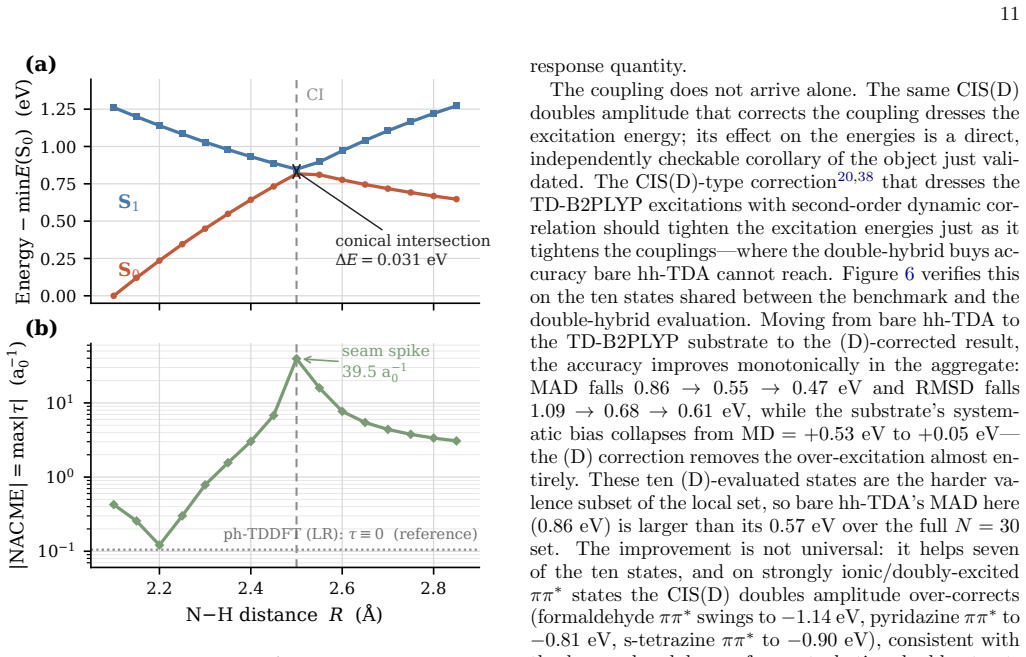
The central discovery is a working expression for the doubles-sector double-hybrid derivative coupling $d^{(D)}$ between two excited states, the object no prior implementation supplies. Starting from the B2PLYP reference and a first-order perturbative doubles correction to a TDA root, the paper decomposes $d^{(D)}$ into three contributions: singles-times-doubles orbital connections, a doubles amplitude-response term carrying numerator, orbital-energy, and excitation-energy responses, and a doubles orbital-connection term built from a transition one-particle density. Each two-electron piece contracts through one non-symmetric $J/K$ primitive with independent left and right, generally non-symmetric, weight densities, and the orbital and eigenvector relaxations reduce to two reusable $Z$-vector solves. The coupling is validated to about $10^{-4}$ relative against a literal determinant-overlap oracle at a distorted $C_1$ geometry, with each contribution gated separately, and it is exactly affine in the single empirical PT2 prefactor $c_{\mathrm{PT2}}=0.27$ rather than being a derivative of the energy. Alongside it, the same engine produces analytic hh-TDA and pp-TDA gradients and NACMEs, reproduces the $F-2$ conical-intersection topology on twisted ethylene, and gives a nonvanishing $39.5\,\mathrm{a}_0^{-1}$ coupling spike at the ammonia $n\to\sigma^*$ covalent seam where linear-response TDDFT gives $\tau\equiv0$.
Load-bearing premise
The load-bearing premise is that the finite-difference oracle's per-contribution freezing does not share the analytic method's decomposition structure, so the rough $10^{-4}$ agreement tests the derivation rather than a common hidden ansatz.
Editorial extensions
If this is right
- Nonadiabatic dynamics can now, in principle, carry double-hybrid accuracy in the coupling itself, not only in the energy, using B2PLYP-type CIS(D) doubles corrections.
- The hh-TDA and pp-TDA manifolds get analytic gradients and NACMEs on consumer hardware with the correct $F-2$ conical-intersection seam, including nonzero coupling at ground-state-involving crossings where linear-response TDDFT gives $\tau\equiv0$.
- The same doubles amplitude that corrects the coupling corrects the excitation energies, lowering the mean absolute deviation from 0.86 to 0.47 eV and removing most of the +0.53 eV over-excitation bias on the shared benchmark subset.
- A single reverse-mode engine replaces per-method hand-derived response equations, so gradients and couplings for a family of density-functional excited-state methods follow from one transpose and one shared kernel.
- The profile-guided derivative-Fock optimization gives bit-identical results with a roughly 133-fold wall-clock reduction, placing correlated excited-state derivative capability within an 8 GB consumer GPU.
Reading between the lines
- Because the oracle validates the analytic derivation against the same CIS(D) ansatz, the roughly $10^{-4}$ agreement establishes that the equations are implemented correctly, not that the double-hybrid model is chemically accurate at production basis sizes or on ionic $\pi\pi^*$ states.
- If the $J/K$ build scales near quadratically as reported, the same contraction-DAG transpose could plausibly supply other non-variational properties, such as transition dipole derivatives or spin-orbit couplings, without hand-derived response equations.
- The known over-correction of ionic $\pi\pi^*$ excitation energies by the perturbative doubles amplitude should also appear in the corresponding coupling magnitudes; a testable extension is to compare $d^{(D)}$ at covalent versus ionic seams against the overlap oracle.
- The 14% symmetry-point discrepancy and the eigensolver under-convergence fix imply that any production implementation of eigenvector-response couplings should use dense eigensolves or explicit symmetry breaking for near-degenerate pairs.
Signed reviews
Editorial analysis
A structured set of objections, weighed in public.
Referee Report
Summary. The manuscript presents an analytic-gradient and nonadiabatic-coupling implementation for density-functional excited states—specifically hh-TDA/pp-TDA and a double-hybrid CIS(D)-type correction—obtained as a reverse-mode transpose of a single contraction-DAG engine running on a consumer RTX 4060 GPU. The headline claim is that this provides the first analytic derivative NACME for a double-hybrid excited state, validated against a literal many-electron wavefunction-overlap oracle at ~1e-4 relative error (Table II), together with excitation-energy statistics that reproduce and improve upon bare hh-TDA (Figs. 2, 3, 6). The paper also reports a shared non-symmetric AO-Laplace J/K kernel and performance optimizations (a ~133x launch collapse) for the derivative-Fock build.
Significance. If the central claim holds, this is a substantial methodological advance: nonadiabatic dynamics on double-hybrid potential surfaces would become practical on commodity hardware, and the contraction-DAG reverse-mode design would provide a uniform engine for multiple response properties. The paper's strengths include an independent oracle that shares no code path with the analytic assembler; a machine-independent CPU-verifiable reproducibility bundle; an honest acknowledgment of the ionic pi-pi* over-correction and of the missing end-to-end wall-clock; and a parity check against published hh-TDA statistics that tracks even the characteristic over-splitting of azine pi-pi* states. The principal weakness is the unvalidated and, as written, underived c_PT2 scaling of the headline double-hybrid coupling.
major comments (2)
- [II F, Eqs. (6)-(8)] The derivation of the c_PT2-affine formula for the double-hybrid coupling is a non sequitur. The text argues that because the unscaled CIS(D) amplitudes c_K contain no c_PT2 and c_PT2 multiplies the entire second-order energy correction, 'the doubles-sector contribution to every property therefore carries this single prefactor.' But a NACME is not an energy derivative, and the paper explicitly concedes this ('without the coupling being a derivative of the energy'). For a wavefunction |S>+|D>, the overlap derivative mixes terms of different powers in the doubles coefficient; no single wavefunction ansatz of the form |S>+alpha|D> yields a uniform affine scaling d_IJ = d_ref + c_PT2 d(D) with the same alpha for the cross terms and the dd term. Moreover, the oracle in Sec. V E/Table II validates only the unscaled d(D) and is explicitly independent of c_PT2, so the scaling law connecting the validated object to the 'first double-hybrid NACME' has no numerical or first-principles support in the manuscript. The authors need to either derive the scaling from a specified wavefunction normalization (and then accept the resulting quadratic c_PT2^2 term for d[dd], which would contradict Eq. (8)'s uniform scaling) or validate the full c_PT2-scaled coupling against an oracle with weighted amplitudes.
- [V E, Table II] The validation evidence for the central double-hybrid coupling rests on a single system: H2O/STO-3G, at a single minimal basis. The per-contribution sub-oracles and the symmetry-breaking C1 re-run all use the same basis and geometry. Given that the paper highlights the oracle's ability to catch a wrong Lagrangian ansatz, this discriminating power has been demonstrated only on one small vehicle; there is no evidence from an f-shell or production-basis system, nor from the ionic pi-pi* states where the energy correction is admitted to over-correct. A second, independent validation (for example, a small molecule in a larger basis, or one of the benchmark states) would materially strengthen the 'first analytic double-hybrid NACME' claim.
minor comments (4)
- [Fig. 4] The label in panel (a) reads 'hh-TDA- B97X' but the method is hh-TDA-omegaB97X; the omega is missing.
- [II F, Eq. (9)] Equation (9) uses a proportionality sign rather than an explicit normalization; for reproducibility, the full prefactors (including the 1/sqrt(N_I N_J) constants and any c_PT2 factors) should be stated explicitly.
- [V F] The paper honestly refrains from quoting an end-to-end wall-clock for the excited-state paths because the long-range kernels are not yet in the ahead-of-time-compiled library; even a single device-resident end-to-end timing on a small system would strengthen the consumer-GPU claim, but as disclosed this does not affect correctness.
- [Data Availability] The CPU-verifiable oracle scripts are a commendable reproducibility feature, but the withholding of the performance-tuned CUDA kernels is a real limitation on re-measuring the speedups; this is disclosed honestly in the text.
Circularity Check
No circular reduction found: the double-hybrid coupling is validated by an independent overlap oracle and external benchmarks; the c_PT2 affine-scaling claim is an unvalidated assumption, not a circular one.
full rationale
The analytic d(D) is derived from the CIS(D) amplitude cK of Eq. (7) and checked against the finite difference of the literal overlap S_IJ(δ)=<Ψ_I(R)|Ψ_J(R+δ)> of Eq. (13), which is assembled from amplitudes and cross-geometry MO overlaps with no shared code path. This is a standard analytic-vs-numerical derivative validation of the same defined wavefunction; it does not introduce the target quantity as an input. Energy claims are benchmarked against the external Thiel TBE set (Fig. 6) and against Bannwarth et al.'s published hh-TDA statistics (Figs. 2-3). c_PT2=0.27 is a B2PLYP functional parameter, not fitted to the couplings. The assertion that the coupling is exactly affine in c_PT2 (Sec. II F) is a derivation assumption that is not validated by the oracle and is not a derivative of energy; however, it is not circular: the paper does not obtain d_IJ by substituting d_IJ into its own definition, nor is the unscaled d(D) fitted to the target. Self-citations to the companion engine (Ref. 22) and code generator (Ref. 31) are infrastructure; every correctness claim is gated by machine-precision engine cross-checks, determinant oracles, or external benchmarks, so no load-bearing premise rests solely on a self-citation. The c_PT2 affine-scaling issue is a correctness/derivation gap to flag outside circularity scoring.
Assumptions & free parameters
free parameters (4)
- c_PT2 (B2PLYP PT2 scaling) =
0.27
- wB97X range-separation parameter omega =
0.3 bohr^-1 (standard, not restated in paper)
- Laplace quadrature length n_L =
8-10 nodes (minimax)
- SSF grid level and J/K screening thresholds =
level-4 SSF; thresholds not quoted
assumptions (6)
- domain assumption CIS(D) doubles ansatz with shifted denominator D_ijab + Omega_K (Eqs. 6-7).
- domain assumption The coupling is exactly affine in c_PT2 with a single uniform prefactor; block-dependent weighting is excluded (Sec. II F).
- domain assumption The oracle's per-contribution sub-oracles isolate each analytic contribution by freezing chosen response blocks (Sec. III).
- domain assumption hh-TDA/pp-TDA on (N+/-2) references make S0 and S1 eigenvectors of one Hermitian problem, giving the F-2 seam (Sec. II E).
- standard math Laplace factorization with short minimax quadrature converges for D_ijab and D_ijab + Omega_K (Eq. 3).
- standard math Derivative two-electron integrals retain bra-ket symmetry so the non-symmetric build is a well-defined scalar (Eq. 4).
Cite this review
Pith. "Pith review of Density-Functional Excited-State Gradients and Nonadiabatic Couplings on a Consumer GPU from a Contraction-DAG." pith.science (2026). https://pith.science/paper/SVTIMLEH
@misc{pith2026260806536,
  author       = {Pith},
  title        = {Pith review of: Density-Functional Excited-State Gradients and Nonadiabatic Couplings on a Consumer GPU from a Contraction-DAG},
  year         = {2026},
  howpublished = {\url{https://pith.science/paper/SVTIMLEH}},
  note         = {Machine review of arXiv:2608.06536}
}
abstract
Nonadiabatic dynamics needs an excited-state gradient and an interstate nonadiabatic coupling matrix element (NACME) at every nuclear geometry, and a double-hybrid functional's accuracy has been unavailable for the coupling. We report the first analytic derivative NACME for a double-hybrid excited state---deferred in the original hh-TDA method and supplied for hybrids only by Yu \emph{et al.}---derived, with the hole-hole and particle-particle Tamm--Dancoff (\hhTDA/\ppTDA) gradients and NACMEs, as a single reverse-mode transpose of one contraction graph closed under a non-symmetric atomic-orbital-direct $J/K$ kernel. Its double-hybrid excitation energy lowers the vertical-excitation mean absolute deviation from bare-\hhTDA\ $0.86$ to $0.47$~eV and removes the $+0.53\!\rightarrow\!+0.05$~eV over-excitation bias, improving seven of ten states while over-correcting the ionic $\pi\pi^*$ states---the expected perturbative-doubles failure, reported not trimmed. Every coupling is validated to $\sim\!10^{-4}$ against an independent \emph{literal many-electron wavefunction-overlap} oracle that shares no code path with the method, and is physically meaningful at the ammonia $n\!\rightarrow\!\sigma^*$ \emph{covalent} conical intersection, where the \hhTDA/\ppTDA manifolds recover the $F\!-\!2$ seam and adiabatic linear-response TDDFT gives $\tau\!\equiv\!0$ by construction. Gradients, NACMEs, and the double-hybrid coupling all run device-resident and AO-direct through one shared Cholesky-decomposed $J/K$ engine within the 8\,GB of a consumer RTX~4060 (a profile-guided $\sim\!10^2\times$ launch collapse preserving double-precision bit-identity)---placing on a commodity desktop card a correlated excited-state derivative capability that has until now required datacenter hardware.
Figures


Figures from the paper (8 more)



Forward citations
Cited by 1 Pith paper
-
Spin Rotatory Strength as the Equilibrium Observable for Chiral-Induced Spin Selectivity
The paper identifies spin rotatory strength as the equilibrium CISS observable, proves a static no-go and a Wilson-loop topology condition, and reports exact diagonalization evidence for regime-dependent behavior on s...
Reference graph
Works this paper leans on
-
[1]
van Aggelen, Helen and Yang, Yang and Yang, Weitao , title =. Phys. Rev. A , volume =. 2013 , doi =
work page 2013
-
[2]
Yang, Yang and van Aggelen, Helen and Yang, Weitao , title =. J. Chem. Phys. , volume =. 2013 , doi =
work page 2013
-
[3]
Bannwarth, Christoph and Yu, Jeffrey K. and Hohenstein, Edward G. and Mart. Hole-hole Tamm-Dancoff-approximated density functional theory: A highly efficient electronic structure method incorporating dynamic and static correlation , journal =. 2020 , doi =
work page 2020
-
[4]
Grimme, Stefan and Neese, Frank , title =. J. Chem. Phys. , volume =. 2007 , doi =
work page 2007
-
[5]
Head-Gordon, Martin and Rico, R. J. and Oumi, Manabu and Lee, Timothy J. , title =. Chem. Phys. Lett. , volume =. 1994 , doi =
work page 1994
-
[6]
Tamayo-Mendoza, Teresa and Kreisbeck, Christoph and Lindh, Roland and Aspuru-Guzik, Al. Automatic Differentiation in Quantum Chemistry with Applications to Fully Variational Hartree-Fock , journal =. 2018 , doi =
work page 2018
-
[7]
Zhang, Xing and Chan, Garnet Kin-Lic , title =. J. Chem. Phys. , volume =. 2022 , doi =
work page 2022
-
[8]
Schweizer, Simon and Doser, Bernd and Ochsenfeld, Christian , title =. J. Chem. Phys. , volume =. 2008 , doi =
work page 2008
Show all 50 references
-
[9]
2026 , eprint =
Guerrero, Ruben Dario , title =. 2026 , eprint =
2026
-
[10]
and Bannwarth, Christoph and Hohenstein, Edward G
Yu, Jimmy K. and Bannwarth, Christoph and Hohenstein, Edward G. and Mart. Ab Initio Nonadiabatic Molecular Dynamics with Hole-Hole. J. Chem. Theory Comput. , volume =. 2020 , doi =
2020
-
[11]
Li, Zhendong and Suo, Bingbing and Liu, Wenjian , title =. J. Chem. Phys. , volume =. 2014 , doi =
2014
-
[12]
Zhang, Du and Peng, Degao and Zhang, Peng and Yang, Weitao , title =. Phys. Chem. Chem. Phys. , volume =. 2015 , doi =
2015
-
[13]
Yang, Yang and Peng, Degao and Lu, Jianfeng and Yang, Weitao , title =. J. Chem. Phys. , volume =. 2014 , doi =
2014
-
[14]
and Peng, Degao and Yang, Weitao , title =
Yang, Yang and van Aggelen, Helen and Steinmann, Stephan N. and Peng, Degao and Yang, Weitao , title =. J. Chem. Phys. , volume =. 2013 , doi =
2013
-
[15]
, title =
Yarkony, David R. , title =. Rev. Mod. Phys. , volume =. 1996 , doi =
1996
-
[16]
and Ko, Chaehyuk and Quenneville, Jason and Mart
Levine, Benjamin G. and Ko, Chaehyuk and Quenneville, Jason and Mart. Conical intersections and double excitations in time-dependent density functional theory , journal =. 2006 , doi =
2006
-
[17]
and Mart
Levine, Benjamin G. and Mart. Isomerization through conical intersections , journal =. 2007 , doi =
2007
-
[18]
Shape of multireference, equation-of-motion coupled-cluster, and density functional theory potential energy surfaces at a conical intersection , journal =
Gozem, Samer and Melaccio, Federico and Valentini, Alessio and Filatov, Michael and Huix-Rotllant, Miquel and Ferr. Shape of multireference, equation-of-motion coupled-cluster, and density functional theory potential energy surfaces at a conical intersection , journal =. 2014 , doi =
2014
-
[19]
Rhee, Young Min and Head-Gordon, Martin , title =. J. Phys. Chem. A , volume =. 2007 , doi =
2007
-
[20]
Rhee, Young Min and Casanova, David and Head-Gordon, Martin , title =. J. Chem. Theory Comput. , volume =. 2009 , doi =
2009
-
[21]
, title =
Teh, Hung-Hsuan and Subotnik, Joseph E. , title =. J. Chem. Phys. , volume =. 2020 , doi =
2020
-
[22]
Goerigk, Lars and Grimme, Stefan , title =. J. Chem. Phys. , volume =. 2010 , doi =
2010
-
[23]
Goerigk, Lars and Grimme, Stefan , title =. J. Chem. Theory Comput. , volume =. 2011 , doi =
2011
-
[24]
Furche, Filipp and Ahlrichs, Reinhart , title =. J. Chem. Phys. , volume =. 2002 , doi =
2002
-
[25]
Furche, Filipp and Ahlrichs, Reinhart , title =. J. Chem. Phys. , volume =. 2004 , doi =
2004
-
[26]
and Head-Gordon, Martin and Pople, John A
Foresman, James B. and Head-Gordon, Martin and Pople, John A. and Frisch, Michael J. , title =. J. Phys. Chem. , volume =. 1992 , doi =
1992
-
[27]
Send, Robert and Furche, Filipp , title =. J. Chem. Phys. , volume =. 2010 , doi =
2010
-
[28]
, title =
Fatehi, Shervin and Alguire, Ethan and Shao, Yihan and Subotnik, Joseph E. , title =. J. Chem. Phys. , volume =. 2011 , doi =
2011
-
[29]
and Subotnik, Joseph E
Ou, Qi and Alguire, Ethan C. and Subotnik, Joseph E. , title =. J. Phys. Chem. B , volume =. 2015 , doi =
2015
-
[30]
, title =
Zhang, Xing and Herbert, John M. , title =. J. Chem. Phys. , volume =. 2014 , doi =
2014
-
[31]
and Schaefer, III, Henry F
Handy, Nicholas C. and Schaefer, III, Henry F. , title =. J. Chem. Phys. , volume =. 1984 , doi =
1984
-
[32]
Pople, J. A. and Krishnan, R. and Schlegel, H. B. and Binkley, J. S. , title =. Int. J. Quantum Chem. Symp. , volume =. 1979 , doi =
1979
-
[33]
, title =
Pulay, P. , title =. Mol. Phys. , volume =. 1969 , doi =
1969
-
[34]
and Chan, Garnet Kin-Lic , title =
Zhang, Xing and Li, Chenghan and Ye, Hong-Zhou and Berkelbach, Timothy C. and Chan, Garnet Kin-Lic , title =. J. Chem. Phys. , volume =. 2024 , doi =
2024
-
[35]
Elimination of energy denominators in
Alml. Elimination of energy denominators in. Chem. Phys. Lett. , volume =. 1991 , doi =
1991
-
[36]
Laplace transform techniques in
H. Laplace transform techniques in. J. Chem. Phys. , volume =. 1992 , doi =
1992
-
[37]
Takatsuka, Akio and Ten-no, Seiichiro and Hackbusch, Wolfgang , title =. J. Chem. Phys. , volume =. 2008 , doi =
2008
-
[38]
Braess, Dietrich and Hackbusch, Wolfgang , title =. IMA J. Numer. Anal. , volume =. 2005 , doi =
2005
-
[39]
and Scuseria, Gustavo E
Ayala, Philippe Y. and Scuseria, Gustavo E. , title =. J. Chem. Phys. , volume =. 1999 , doi =
1999
-
[40]
and Kussmann, J
Doser, Bernd and Lambrecht, Daniel S. and Kussmann, J. Linear-scaling atomic orbital-based second-order. J. Chem. Phys. , volume =. 2009 , doi =
2009
-
[41]
and Mart
Ufimtsev, Ivan S. and Mart. Quantum Chemistry on Graphical Processing Units. 1. Strategies for Two-Electron Integral Evaluation , journal =. 2008 , doi =
2008
-
[42]
and Mart
Ufimtsev, Ivan S. and Mart. Quantum Chemistry on Graphical Processing Units. 3. Analytical Energy Gradients, Geometry Optimization, and First Principles Molecular Dynamics , journal =. 2009 , doi =
2009
-
[43]
Beebe, Nelson H. F. and Linderberg, Jan , title =. Int. J. Quantum Chem. , volume =. 1977 , doi =
1977
-
[44]
Reduced scaling in electronic structure calculations using
Koch, Henrik and S. Reduced scaling in electronic structure calculations using. J. Chem. Phys. , volume =. 2003 , doi =
2003
-
[45]
Aquilante, Francesco and Lindh, Roland and Pedersen, Thomas Bondo , title =. J. Chem. Phys. , volume =. 2008 , doi =
2008
-
[46]
Filatov, Michael and Lee, Seunghoon and Choi, Cheol Ho , title =. J. Chem. Theory Comput. , volume =. 2021 , doi =
2021
-
[47]
and Schaefer, Henry F
Brooks, Bernard R. and Schaefer, Henry F. , title =. J. Am. Chem. Soc. , volume =. 1979 , doi =
1979
-
[48]
Salem, Lionel , title =. Acc. Chem. Res. , volume =. 1979 , doi =
1979
-
[49]
Grimme, Stefan , title =. J. Chem. Phys. , volume =. 2006 , doi =
2006
-
[50]
Chai, Jeng-Da and Head-Gordon, Martin , title =. J. Chem. Phys. , volume =. 2008 , doi =
2008
Reviewed August 15, 2026 · model on record in the stance chip above.
Discussion (0). Continue with ORCID to comment.