Distributionally Robust Joint Information and Mechanism Design for Multi-Area Power System Coordination
Pith reviewed 2026-06-26 06:50 UTC · model grok-4.3
The pith
Incentive alignment via Groves transfers reduces the bilevel Stackelberg problem in power coordination to a single robust control problem.
A machine-rendered reading of the paper's core claim, the machinery that carries it, and where it could break.
Core claim
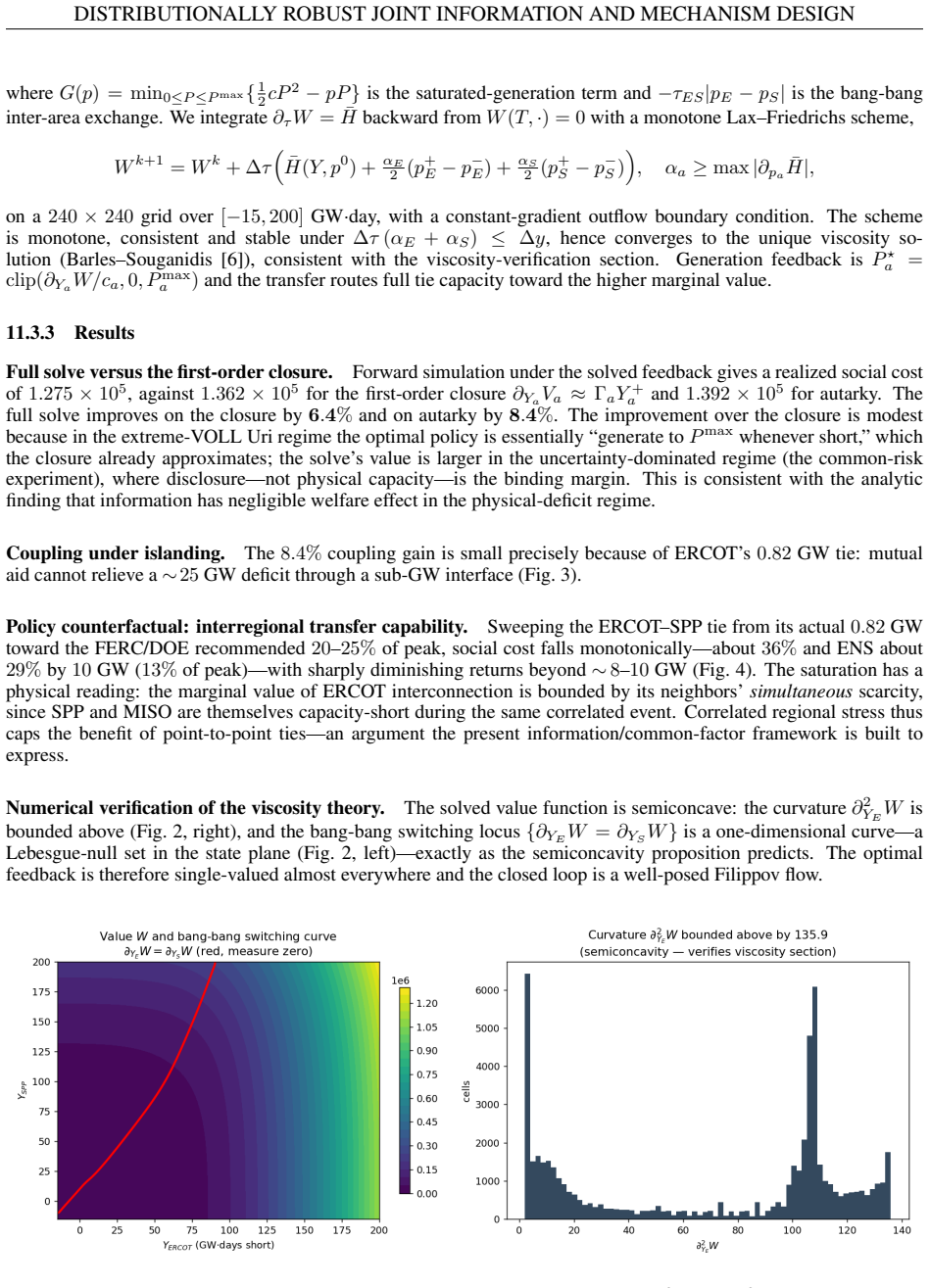
Incentive alignment collapses the bilevel Stackelberg problem to a single robust control problem with an exact first-order condition. The value function is characterized as the unique viscosity solution to the Isaacs equation, with a verification theorem valid for non-smooth bang-bang feedback and a semiconcavity result that renders the switching set Lebesgue-null. The approach is applied to resilient multi-area power-system coordination, showing specific cost reductions from information and mechanism design under weather events.
What carries the argument
The Groves transfer combined with Gaussian public signaling, which aligns incentives and reduces the Stackelberg game to a single distributionally robust Isaacs equation.
If this is right
- Efficient behavior is a dominant-strategy best response under truthful disclosure.
- The induced differential game admits saturated and bang-bang Nash feedback.
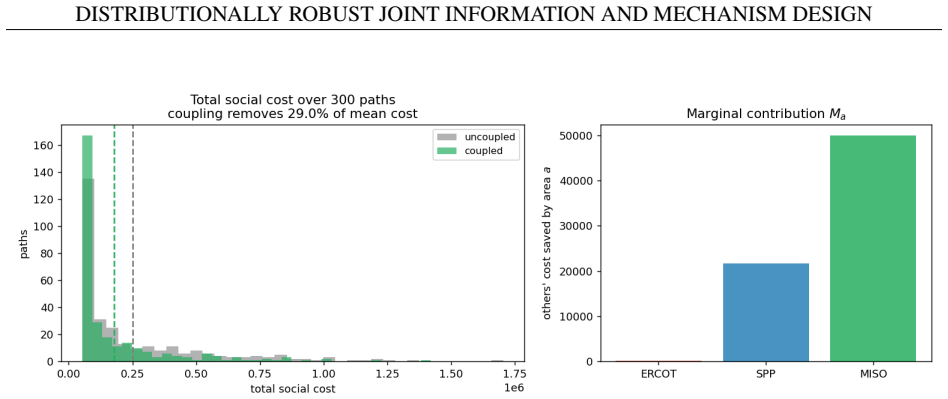
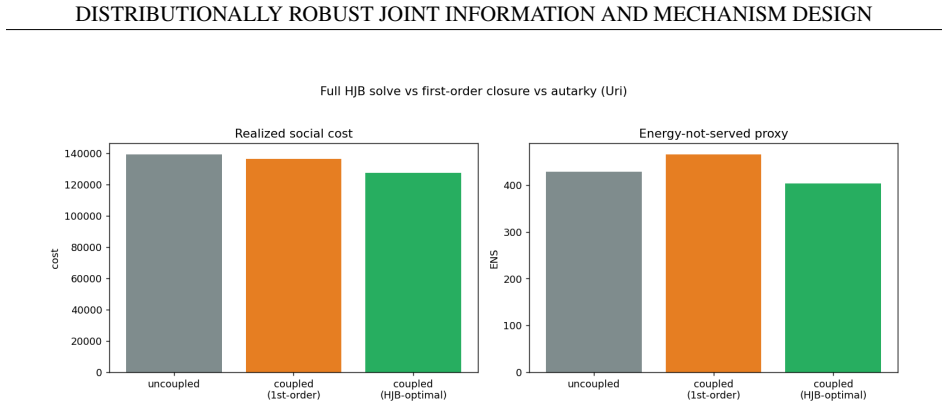
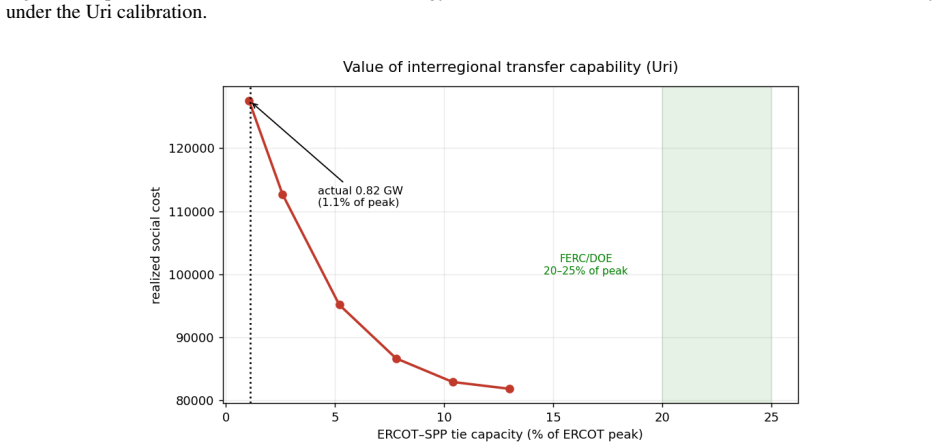
- Mutual aid removes about 8% of social cost in the ERCOT interconnection, rising to roughly 30% under recommended transfer capability.
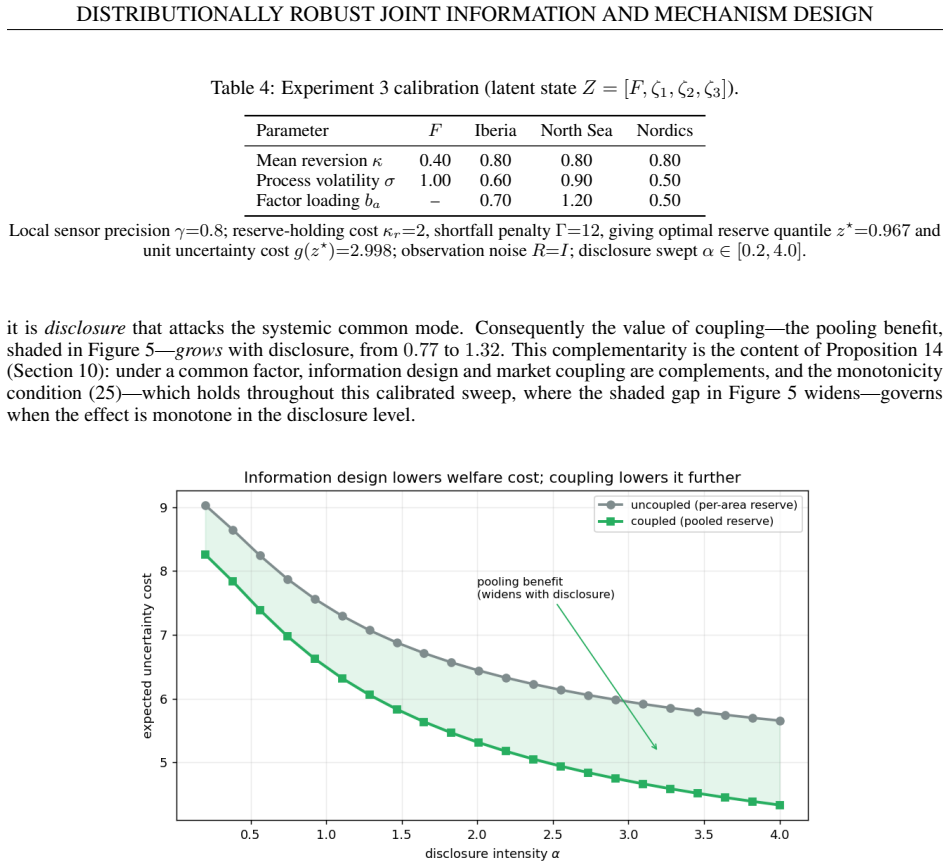
- Public disclosure lowers welfare cost by 37% under autarky and 48% under market coupling.
- Information design and market coupling are complements under common systemic risk.
Where Pith is reading between the lines
- The method could be tested in other critical infrastructure systems facing strategic agents and ambiguity.
- The Lebesgue-null switching set implies that bang-bang policies switch on sets of measure zero, potentially simplifying implementation.
- Further calibration to additional weather events would strengthen the empirical estimates of cost savings.
- Relaxing the finite-dimensional filter assumption might require new approximation techniques for belief tracking.
Load-bearing premise
The leader commits to a Gaussian public-signaling channel whose belief consequences can be tracked by a finite-dimensional projection filter despite the exact filter being infinite-dimensional.
What would settle it
Numerical evidence that the first-order condition of the reduced robust control problem is not satisfied by the equilibrium strategies after applying the Groves transfer.
Figures
read the original abstract
We study a continuous-time stochastic Stackelberg control problem in which a leader steers a system of strategic followers through two non-standard channels - the information structure and a transfer mechanism - rather than through the dynamics directly. The latent environment is a jump-diffusion; the leader commits to a Gaussian public-signaling channel whose belief consequences are tracked by a finite-dimensional projection filter (the exact filter being infinite-dimensional), together with a Groves transfer that aligns the followers' incentives. Under truthful disclosure, efficient behavior is a dominant-strategy best response, and the induced differential game admits saturated and bang-bang Nash feedback. We cast the leader's distributionally robust problem, over a relative-entropy ambiguity neighborhood, as a two-controller Isaacs equation; prove that incentive alignment collapses the bilevel Stackelberg problem to a single robust control problem with an exact first-order condition; and characterize the value function as the unique viscosity solution, with a verification theorem valid for the non-smooth bang-bang feedback and a semiconcavity result that renders the switching set Lebesgue-null. We instantiate the framework on resilient multi-area power-system coordination under extreme weather. Calibrated to the 2021 Winter Storm Uri, an Isaacs solve over ERCOT's near-islanded interconnection (a 0.82 GW tie, under 2% of peak) shows mutual aid removes about 8% of social cost, rising to roughly 30% under the FERC/DOE-recommended interregional transfer capability; a reserve-scheduling experiment shows that public disclosure lowers welfare cost by 37% under autarky and 48% under market coupling, and that information design and market coupling are complements under common (systemic) risk.
Editorial analysis
A structured set of objections, weighed in public.
Referee Report
Summary. The manuscript presents a continuous-time stochastic Stackelberg control framework in which a leader designs both a Gaussian public-signaling channel (tracked via finite-dimensional projection filter) and Groves transfers to coordinate strategic followers in a jump-diffusion environment under distributional robustness. It claims that incentive alignment reduces the bilevel problem to a single robust control problem admitting an exact first-order condition, with the value function being the unique viscosity solution to the associated Isaacs equation; a verification theorem is provided for the resulting non-smooth bang-bang feedback, along with a semiconcavity property. The framework is instantiated on multi-area power system coordination, with numerical results for ERCOT under Winter Storm Uri conditions demonstrating welfare gains from mutual aid and information design.
Significance. If the central reduction and characterization results hold rigorously, the work would advance distributionally robust mechanism design by showing an exact collapse of a bilevel game to a single-controller Isaacs problem, together with a verification theorem applicable to non-smooth feedback. The semiconcavity result that renders the switching set Lebesgue-null and the concrete power-system application (quantifying 8-30% social-cost reductions from interregional transfers and 37-48% gains from public disclosure) add policy relevance. The relative-entropy ambiguity formulation and the explicit handling of the infinite-dimensional filter via projection are technically distinctive.
major comments (2)
- [projection filter modeling] The modeling of the finite-dimensional projection filter (described in the abstract and the section introducing the information channel): the claim that incentive alignment produces an exact collapse to a single robust control problem with an exact first-order condition is load-bearing, yet the manuscript does not supply a uniform error bound showing that the projection error remains controlled inside the relative-entropy ambiguity set. Without this, the reduction to the two-controller Isaacs equation and the subsequent viscosity-solution characterization cannot be guaranteed to be exact.
- [verification theorem] The verification theorem for non-smooth bang-bang feedback (the theorem stated after the Isaacs equation): because the state is the output of the finite-dimensional projection rather than the full infinite-dimensional nonlinear filter, the theorem must explicitly verify that the semiconcavity property and the Lebesgue-null switching set continue to hold under the approximation; the current statement does not address this extension.
minor comments (1)
- [ERCOT numerical results] The numerical section on ERCOT calibration would benefit from a brief sensitivity table showing how the reported 8% and 30% social-cost reductions vary with the radius of the relative-entropy ball.
Simulated Author's Rebuttal
We thank the referee for the careful and constructive report. The two major comments concern the exactness of the reduction and verification results when the state is the finite-dimensional projection filter output. We respond point-by-point below, clarifying that all claims are made and proven exactly within the projected finite-dimensional model.
read point-by-point responses
-
Referee: [projection filter modeling] The modeling of the finite-dimensional projection filter (described in the abstract and the section introducing the information channel): the claim that incentive alignment produces an exact collapse to a single robust control problem with an exact first-order condition is load-bearing, yet the manuscript does not supply a uniform error bound showing that the projection error remains controlled inside the relative-entropy ambiguity set. Without this, the reduction to the two-controller Isaacs equation and the subsequent viscosity-solution characterization cannot be guaranteed to be exact.
Authors: The distributionally robust problem is formulated directly on the finite-dimensional projected belief process, with the relative-entropy ambiguity set defined with respect to the law of this projected output. Incentive alignment therefore produces an exact collapse to the single-controller Isaacs equation, and the first-order condition and viscosity characterization hold exactly inside this modeled system. A uniform error bound relative to the infinite-dimensional filter would strengthen the justification for using the projection but is not required for the exactness of the results stated for the projected dynamics. revision: no
-
Referee: [verification theorem] The verification theorem for non-smooth bang-bang feedback (the theorem stated after the Isaacs equation): because the state is the output of the finite-dimensional projection rather than the full infinite-dimensional nonlinear filter, the theorem must explicitly verify that the semiconcavity property and the Lebesgue-null switching set continue to hold under the approximation; the current statement does not address this extension.
Authors: The verification theorem and semiconcavity result are established for the value function of the finite-dimensional projected state. The Isaacs equation is posed and solved in the coordinates of the projection filter, and semiconcavity is proven directly in this finite-dimensional space, which immediately implies that the switching set is Lebesgue-null for the projected state. The theorem therefore applies rigorously to the non-smooth bang-bang feedback within the system analyzed in the manuscript. revision: no
Circularity Check
No circularity: derivation proceeds from Stackelberg structure via explicit incentive alignment and standard viscosity theory
full rationale
The abstract and reader's summary present the collapse of the bilevel problem to a single Isaacs equation as a proved consequence of Groves transfers plus the Gaussian channel under the stated filter approximation, not as a definitional equivalence or a fitted parameter renamed as prediction. No self-citations, uniqueness theorems imported from prior author work, or ansatzes smuggled via citation appear in the provided text. The semiconcavity and verification results are characterized as consequences of the Isaacs formulation rather than inputs. The finite-dimensional projection is an explicit modeling assumption whose effect on exactness is external to the derivation chain itself. The overall argument is therefore self-contained against external benchmarks and receives the default non-circularity finding.
Axiom & Free-Parameter Ledger
Reference graph
Works this paper leans on
-
[1]
Continuous-time persuasion by filtering
Ren ´e A¨ıd, Ofelia Bonesini, Giorgia Callegaro, and Luciano Campi. Continuous-time persuasion by filtering. Journal of Economic Dynamics and Control, 176:105100, 2025
2025
-
[2]
Affine incentive schemes for stochastic systems with dynamic information.SIAM Journal on Control and Optimization, 22(2):199–210, 1984
Tamer Bas ¸ar. Affine incentive schemes for stochastic systems with dynamic information.SIAM Journal on Control and Optimization, 22(2):199–210, 1984
1984
-
[3]
Mean-field games and dynamic demand management in power grids.Dy- namic Games and Applications, 4(2):155–176, 2014
Fabio Bagagiolo and Dario Bauso. Mean-field games and dynamic demand management in power grids.Dy- namic Games and Applications, 4(2):155–176, 2014
2014
-
[4]
Springer, 2009
Alan Bain and Dan Crisan.Fundamentals of Stochastic Filtering, volume 60 ofStochastic Modelling and Applied Probability. Springer, 2009
2009
-
[5]
Systems & Control: Foundations & Applications
Martino Bardi and Italo Capuzzo-Dolcetta.Optimal Control and Viscosity Solutions of Hamilton–Jacobi– Bellman Equations. Systems & Control: Foundations & Applications. Birkh ¨auser, 1997
1997
-
[6]
Souganidis
Guy Barles and Panagiotis E. Souganidis. Convergence of approximation schemes for fully nonlinear second order equations.Asymptotic Analysis, 4(3):271–283, 1991
1991
-
[7]
SIAM, 2nd edition, 1999
Tamer Bas ¸ar and Geert Jan Olsder.Dynamic Noncooperative Game Theory, volume 23 ofClassics in Applied Mathematics. SIAM, 2nd edition, 1999
1999
-
[8]
Bayes correlated equilibrium and the comparison of information structures in games.Theoretical Economics, 11(2):487–522, 2016
Dirk Bergemann and Stephen Morris. Bayes correlated equilibrium and the comparison of information structures in games.Theoretical Economics, 11(2):487–522, 2016
2016
-
[9]
Information design: A unified perspective.Journal of Economic Literature, 57(1):44–95, March 2019
Dirk Bergemann and Stephen Morris. Information design: A unified perspective.Journal of Economic Literature, 57(1):44–95, March 2019
2019
-
[10]
Chance-constrained optimal power flow: Risk-aware network control under uncertainty.SIAM Review, 56(3):461–495, 2014
Daniel Bienstock, Michael Chertkov, and Sean Harnett. Chance-constrained optimal power flow: Risk-aware network control under uncertainty.SIAM Review, 56(3):461–495, 2014
2014
-
[11]
Busby, Kyri Baker, Morgan D
Joshua W. Busby, Kyri Baker, Morgan D. Bazilian, Milena N. Alexandrova, Thomas A. Deetjen, Matthew He- icking, Emily Grubert, Jesse D. Jenkins, Carey W. King, George Loch-Temzelides, Charles Olson, Varun Rai, and Joshua D. Rhodes. Cascading risks: Understanding the 2021 winter blackout in Texas.Energy Research & Social Science, 77:102106, 2021
2021
-
[12]
Birkh ¨auser, 2004
Piermarco Cannarsa and Carlo Sinestrari.Semiconcave Functions, Hamilton–Jacobi Equations, and Optimal Control, volume 58 ofProgress in Nonlinear Differential Equations and Their Applications. Birkh ¨auser, 2004
2004
-
[13]
Springer, 2018
Ren ´e Carmona and Franc ¸ois Delarue.Probabilistic Theory of Mean Field Games with Applications, volume 83 & 84 ofProbability Theory and Stochastic Modelling. Springer, 2018
2018
-
[14]
Clarke, Yuri S
Francis H. Clarke, Yuri S. Ledyaev, Ronald J. Stern, and Peter R. Wolenski.Nonsmooth Analysis and Control Theory, volume 178 ofGraduate Texts in Mathematics. Springer, 1998
1998
-
[15]
Perlaza, Hamidou Tembine, and M ´erouane Debbah
Romain Couillet, Samir M. Perlaza, Hamidou Tembine, and M ´erouane Debbah. Electrical vehicles in the smart grid: A mean field game analysis.IEEE Journal on Selected Areas in Communications, 30(6):1086–1096, 2012. 19 DISTRIBUTIONALLY ROBUST JOINT INFORMATION AND MECHANISM DESIGN
2012
-
[16]
Crandall, Hitoshi Ishii, and Pierre-Louis Lions
Michael G. Crandall, Hitoshi Ishii, and Pierre-Louis Lions. User’s guide to viscosity solutions of second order partial differential equations.Bulletin of the American Mathematical Society, 27(1):1–67, 1992
1992
-
[17]
John M. Danskin. The theory of max–min, with applications.SIAM Journal on Applied Mathematics, 14(4):641– 664, 1966
1966
-
[18]
Incentives and incomplete information.Journal of Public Economics, 11(1):25–45, 1979
Claude d’Aspremont and Louis-Andr ´e G´erard-Varet. Incentives and incomplete information.Journal of Public Economics, 11(1):25–45, 1979
1979
-
[19]
Jeffrey C. Ely. Beeps.American Economic Review, 107(1):31–53, 2017
2017
-
[20]
Fleming and H
Wendell H. Fleming and H. Mete Soner.Controlled Markov Processes and Viscosity Solutions, volume 25 of Stochastic Modelling and Applied Probability. Springer, 2nd edition, 2006
2006
-
[21]
An incentive compatible iterative mech- anism for coupling electricity markets.IEEE Transactions on Power Systems, 37(2):1241–1252, 2022
Alfredo Garcia, Roohallah Khatami, Ceyhun Eksin, and Furkan Sezer. An incentive compatible iterative mech- anism for coupling electricity markets.IEEE Transactions on Power Systems, 37(2):1241–1252, 2022
2022
-
[22]
North-Holland, 1979
Jerry Green and Jean-Jacques Laffont.Incentives in Public Decision-Making. North-Holland, 1979
1979
-
[23]
Incentives in teams.Econometrica, 41(4):617–631, 1973
Theodore Groves. Incentives in teams.Econometrica, 41(4):617–631, 1973
1973
-
[24]
Incorporate day-ahead robustness and real-time incen- tives for electricity market design.Applied Energy, 332:120484, 2023
Yi Guo, Xuejiao Han, Xinyang Zhou, and Gabriela Hug. Incorporate day-ahead robustness and real-time incen- tives for electricity market design.Applied Energy, 332:120484, 2023
2023
-
[25]
Hanasusanto, Vladimir Roitch, Daniel Kuhn, and Wolfram Wiesemann
Grani A. Hanasusanto, Vladimir Roitch, Daniel Kuhn, and Wolfram Wiesemann. A distributionally robust perspective on uncertainty quantification and chance constrained programming.Mathematical Programming, 151(1):35–62, 2015
2015
-
[26]
Sargent.Robustness
Lars Peter Hansen and Thomas J. Sargent.Robustness. Princeton University Press, 2008
2008
-
[27]
P ¨ar Holmberg and Frank A. Wolak. Comparing auction designs where suppliers have uncertain costs and uncer- tain pivotal status.RAND Journal of Economics, 49(4):995–1027, 2018
2018
-
[28]
Caines, and Roland P
Minyi Huang, Peter E. Caines, and Roland P. Malham ´e. Large-population cost-coupled LQG problems with nonuniform agents: Individual-mass behavior and decentralizedε-Nash equilibria.IEEE Transactions on Auto- matic Control, 52(9):1560–1571, 2007
2007
-
[29]
Bayesian persuasion.American Economic Review, 101(6):2590–2615, 2011
Emir Kamenica and Matthew Gentzkow. Bayesian persuasion.American Economic Review, 101(6):2590–2615, 2011
2011
-
[30]
Core-selecting mechanisms in electricity markets.IEEE Transactions on Smart Grid, 11(3):2530–2541, 2020
Olle Karaca and Maryam Kamgarpour. Core-selecting mechanisms in electricity markets.IEEE Transactions on Smart Grid, 11(3):2530–2541, 2020
2020
-
[31]
Bowen Li, Ruiwei Jiang, and Johanna L. Mathieu. Distributionally robust chance-constrained optimal power flow assuming unimodal distributions with misspecified modes.IEEE Transactions on Control of Network Systems, 6(3):1223–1234, 2019
2019
-
[32]
General Theory, volume 1
Robert Liptser and Albert Nikolaevich Shiryaev.Statistics of Random Processes: I. General Theory, volume 1. Springer Science & Business Media, 2001
2001
-
[33]
Ke Ma and P. R. Kumar. The strategic lqg system: A dynamic stochastic vcg framework for optimal coordination. In2018 IEEE Conference on Decision and Control (CDC), pages 5777–5782, 2018
2018
-
[34]
Callaway, and Ian A
Zhongjing condition Ma, Duncan S. Callaway, and Ian A. Hiskens. Decentralized charging control of large populations of plug-in electric vehicles.IEEE Transactions on Control Systems Technology, 21(1):67–78, 2013
2013
-
[35]
On information design in games.Journal of Political Econ- omy, 128(4):1370–1404, 2020
Laurent Mathevet, Jacopo Perego, and Ina Taneva. On information design in games.Journal of Political Econ- omy, 128(4):1370–1404, 2020
2020
-
[36]
Optimal information disclosure.Journal of Political Economy, 118(5):949–987, 2010
Luis Rayo and Ilya Segal. Optimal information disclosure.Journal of Political Economy, 118(5):949–987, 2010
2010
-
[37]
Line Roald, Frauke Oldewurtel, Bart Van Parys, and G¨oran Andersson. Security constrained optimal power flow with distributionally robust chance constraints.arXiv preprint arXiv:1508.06061, 2015
Pith/arXiv arXiv 2015
-
[38]
Exploring the vickrey-clarke-groves mechanism for electricity markets.IFAC-PapersOnLine, 50(1):189–194, 2017
Pier Giuseppe Sessa, Neil Walton, and Maryam Kamgarpour. Exploring the vickrey-clarke-groves mechanism for electricity markets.IFAC-PapersOnLine, 50(1):189–194, 2017. 20th IFAC World Congress
2017
-
[39]
Distributionally robust convex optimization.Operations Research, 62(6):1358–1376, 2014
Wolfram Wiesemann, Daniel Kuhn, and Melvyn Sim. Distributionally robust convex optimization.Operations Research, 62(6):1358–1376, 2014
2014
-
[40]
Yunjian Xu and Steven H. Low. An efficient and incentive compatible mechanism for wholesale electricity markets.IEEE Transactions on Smart Grid, 8(1):115–127, 2017
2017
-
[41]
Review of informa- tion disclosure in different electricity markets.Energies, 11(12):3424, 2018
Yaqiong Yang, Minglei Bao, Yi Ding, Yonghua Song, Zhenzhi Lin, and Changzheng Shao. Review of informa- tion disclosure in different electricity markets.Energies, 11(12):3424, 2018. 20 DISTRIBUTIONALLY ROBUST JOINT INFORMATION AND MECHANISM DESIGN
2018
-
[42]
Springer, 1999
Jiongmin Yong and Xun Yu Zhou.Stochastic Controls: Hamiltonian Systems and HJB Equations, volume 43 of Applications of Mathematics. Springer, 1999
1999
-
[43]
Informational design of dynamic multi-agent system.arXiv preprint arXiv:2105.03052, 2021
Tao Zhang and Quanyan Zhu. Informational design of dynamic multi-agent system.arXiv preprint arXiv:2105.03052, 2021
arXiv 2021
-
[44]
Yiling Zhang, Siqian Shen, and Johanna L. Mathieu. Distributionally robust chance-constrained optimal power flow with uncertain renewables and uncertain reserves provided by loads.IEEE Transactions on Power Systems, 32(2):1378–1388, 2017. A Technical Proofs A.1 Proof of Lemma 1 (Gaussian-Projection Filter) Let ˜Xt =X t − ˆXt with ˆXt =E[X t | G t]the cond...
2017
discussion (0)
Sign in with ORCID, Apple, or X to comment. Anyone can read and Pith papers without signing in.