REVIEW 3 major objections 5 minor 2 cited by
Universality and Quantum Criticality in Quasiperiodic Spin Chains
T0 review · 3 major / 5 minor · reviewed 2026-08-14 · deepseek-v4-flash
Pith's one-line read For a wide class of spin chains, generic quasiperiodic modulations flow under real-space renormalization to discrete Fibonacci-like substitution sequences, making quasiperiodic quantum critical points asymptotically exactly solvable.
desk verdict The flow-to-Fibonacci idea is new and survives the sequential-decimation objection; the real issues are the Potts exponent typo and an overbroad universality claim. read the letter →
The pith
A machine-rendered reading of the paper's core claim, the machinery that carries it, and where it could break.
The reading
What carries the argument
The central object is the Fibonacci RG step. In the log-coupling variables $\ell_j = -\ln J_j$, the real-space decimation rule is $\ell'_i = \ell_{i-1} - \ell_i + \ell_{i+1} + c$, where $c=\ln 2$ for the Heisenberg chain and $c=\ln(q/2)$ for the Potts chain. For any smooth golden-ratio potential, the local minima of $\ell$ form the Fibonacci word; labeling minima as $B$ and the rest as $A$, decimating all $B$ couplings at once maps the system to a new Fibonacci word via the inflation rule $A\to AB$, $B\to A$, or equivalently $ABABA\to A$ and $ABA\to B$. Iterating this step sharpens the $A$ and $B$ bands and drives fluctuations to zero exponentially, turning the heuristic decimation into an asymptotically exact description.
What would settle it
Directly iterate the decimation rule on the cosine potential and measure the spread of couplings within the $A$ and $B$ bands: if the spread does not decay exponentially with the number of Fibonacci steps, or if the energy gap of a chain of length $L$ does not scale as $\Delta E \sim e^{-c(3\ln\varphi)^{-2}\ln^2 L}$, the central claim fails.
Extended reading notes
Core claim
The central claim is that, for a wide class of one-dimensional spin chains, every sufficiently regular quasiperiodic modulation flows under real-space renormalization to a perfect binary Fibonacci sequence or a related substitution sequence, so that discrete-sequence fixed points control generic quasiperiodic criticality rather than only specially tailored couplings. The discovery is the flow itself: starting from $\ell_j = a + \cos(2\pi\varphi j + \theta)$, after $m$ simultaneous decimation steps the couplings collapse into two bands $A_m$ and $B_m$ whose intra-band fluctuations vanish exponentially, with $A_m - B_m \approx m c$, and the decimation rule becomes asymptotically exact. The fixed-point sequence then determines the critical properties: the Heisenberg chain has dynamical exponent $z=\infty$ and correlation length exponent $\nu=1$; the $q$-state Potts chain with $q>2$ also has $\nu=1$ plus an analytic order-parameter scaling dimension; and the quasiperiodic many-body localization toy model has $\nu=1$ from a defect argument based on Fibonacci approximants.
Load-bearing premise
The argument depends on the assumption that decimating all local-minimum bonds at once stays accurate even before the coupling ratios become large, and that every sufficiently regular quasiperiodic pattern flows to the Fibonacci sequence even though the detailed proof is given only for a cosine potential.
Editorial extensions
If this is right
- Smooth quasiperiodic modulation of Heisenberg and $q>2$ Potts chains becomes exactly tractable: all such potentials with golden-ratio frequency share the same critical exponents, $\nu=1$ and $z=\infty$ for Heisenberg, and the Potts spin-scaling dimension $\Delta_\sigma = \ln(1+2\varphi^{-1/3})/(3\ln\varphi)$.
- The quasiperiodic many-body localization transition in the toy RG has correlation length exponent $\nu=1$ for smooth initial conditions, distinct from the random case, and the dimerization perturbation is dangerously irrelevant at the critical sequence.
- For the Ising chain, where the decimation constant vanishes, smooth quasiperiodic modulation is marginally irrelevant and is squashed to a constant, so nontrivial quasiperiodic criticality requires a singular distribution of couplings and yields a finite dynamical exponent $z\approx 1.6$ in the RG.
- Potts chains with different relative phases between the field and coupling sequences can be attracted to different self-similar sequences, but all observed fixed points share $\nu=1$ and the same spin-scaling dimension.
- For irrational frequencies beyond the golden ratio, the fixed point is not self-similar under a single RG step; each level is governed by the continued-fraction expansion, so the sequence fixed point becomes level-dependent.
Reading between the lines
- Our inference: the same functional-RG logic should apply to other real-space decimation rules with a positive additive constant, such as generalized random-singlet rules in other geometries, predicting flow to substitution sequences whose inflation rules are set by the local-minimum pattern rather than by the microscopic Hamiltonian.
- Our inference: the defect argument for $\nu=1$ suggests a way to engineer other exponents deliberately; by inserting square-root singularities at the Fibonacci-minimum boundaries, the paper's own calculation gives $\nu=2$, so a family of singular functions could interpolate continuously between exponents.
- Our inference: since quasiperiodic systems lack rare thermal regions, the toy-model result supports the scenario of two distinct universality classes for the many-body localization transition, and an exact-diagonalization study of a quasiperiodic chain measuring the correlation-length exponent could distinguish $\nu=1$ from the random-case value.
- Our inference: the flow-to-sequence mechanism is probably not confined to one dimension; applying the same simultaneous-decimation idea to two-dimensional quasiperiodic tilings, where local minima form more complex substitution rules, would be a natural test of whether the universality survives.
Signed reviews
Editorial analysis
A structured set of objections, weighed in public.
Referee Report
Summary. The paper studies one-dimensional quantum spin chains with quasiperiodically modulated couplings. Its central claim is that, under the standard real-space strong-disorder renormalization group, generic smooth quasiperiodic potentials with golden-ratio frequency flow to discrete self-similar Fibonacci-like substitution sequences, which act as fixed points of a functional renormalization group. This is used to obtain asymptotically exact critical properties of the Heisenberg, Potts, and Ising chains and of a phenomenological quasiperiodic MBL transition model, including the correlation-length exponent ν=1 and a Potts spin exponent Δσ. The Supplement derives exact band formulas for a cosine potential, proves the Fibonacci pattern of local minima for that potential, and provides numerical evidence for exponential sharpening of the bands.
Significance. If fully established, the result would substantially generalize earlier work on binary substitution sequences to a broad class of smooth quasiperiodic modulations and would provide a rare example of an asymptotically exact treatment of quasiperiodic quantum criticality. The cosine-potential analysis is concrete, the claimed exponents are falsifiable, and the paper is candid about the uncontrolled Ising case and the toy-model status of the MBL analysis. The main weakness is that the basin of attraction of the Fibonacci sequence is not proven for the full class of potentials for which universality is claimed.
major comments (3)
- [Main text 'Flow to discrete sequences'; Supplement I.B 'Generic potentials'] The statement that the flow to Fibonacci-like sequences holds for 'any sufficiently regular quasiperiodic potential with frequency φ' is not supported by the proofs in the Supplement and is in tension with the Supplement's own observation that f(x)=sin(4x) destroys the Fibonacci structure. The analytic argument covers the cosine potential and, via a monotonicity argument, potentials of the form f(cos(2πφn+θ)) with f monotonic on (-1,1). Because the basin of attraction is load-bearing for the paper's universality claim, the authors should either prove the flow for a precisely defined larger class or explicitly restrict the claim to the class for which analytic or systematic numerical evidence exists.
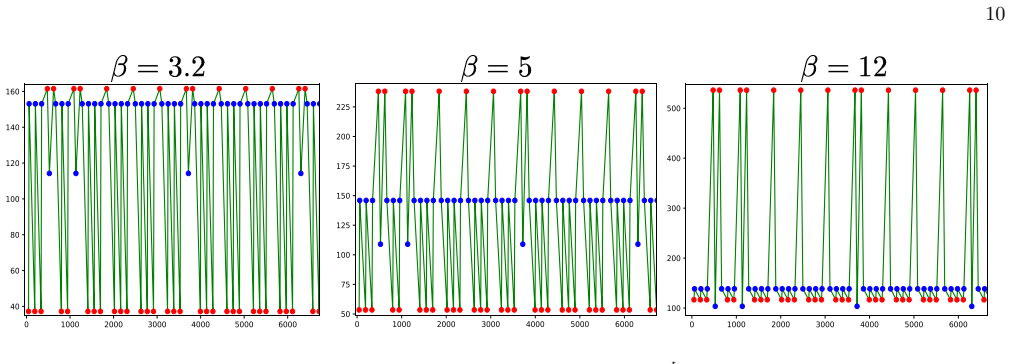
- [Supplement I.B and main text Eq. (4)] The claim that the site-dependent fluctuations ϵ_{i,m} decay exponentially as m→∞ is used to conclude that the decimation rule becomes asymptotically exact, but this decay is demonstrated only numerically (Fig. 1b) and via a heuristic 'longer patterns give tighter phase constraints' argument. An analytic bound on the bandwidths of A_m and B_m, or at least a precise statement that the exponential decay is a numerical finding, is needed to support the 'asymptotically exact' characterization.
- [Main text 'Quantum Potts model'; Supplement I.D] The spin exponent Δσ in Eq. (6) is derived analytically for the Fibonacci fixed point in which h_i and J_i are described by the same Fibonacci sequence, but the main text applies it to the more natural case of distinct quasiperiodic potentials with a relative phase. The Supplement notes that in that case the fixed point oscillates among multiple sequences and the equality of exponents is established only numerically (Fig. 2). The main text should state this qualification when presenting Eq. (6), rather than presenting the formula as applying directly to the distinct-potential case.
minor comments (5)
- [Supplement I.B] The simultaneous decimation of all B bonds is not obviously equivalent to the standard sequential SDRG when two B bonds are separated by a single A bond. I checked the explicit example ABABA: sequentially decimating B_{n-1} and then B_{n+1} yields exactly the formula for A_{m+1}(n) given in the Supplement, so the feared double-counting of the intervening A bond does not occur. The authors should add a sentence stating this equivalence, since the cluster decimation step is central to the derivation.
- [Main text Eq. (6)] The expression for Δσ is ambiguous as typeset: it should be made clear whether the argument of the logarithm is 1 + 2φ^{-1}/3 or 1 + 2φ^{-1/3}; the two readings give different numerical exponents.
- [Throughout] There are several typographical errors: 'an Heisenberg chain' in the Fig. 1 caption, 'pannel' in the Supplement, and 'satifies' in the main text near the MBL defect argument.
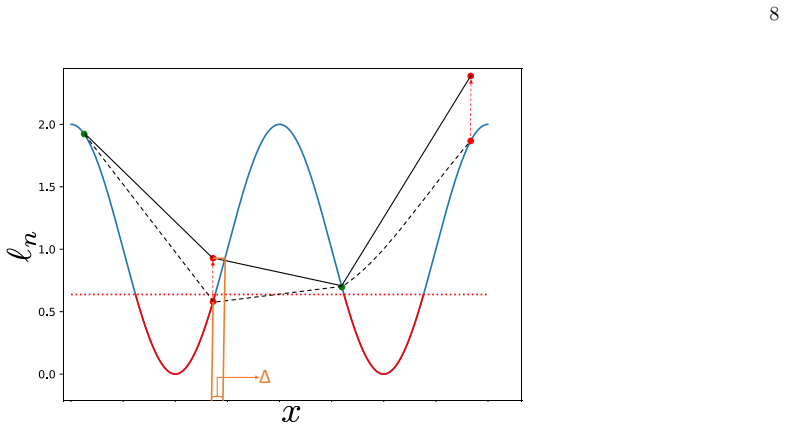
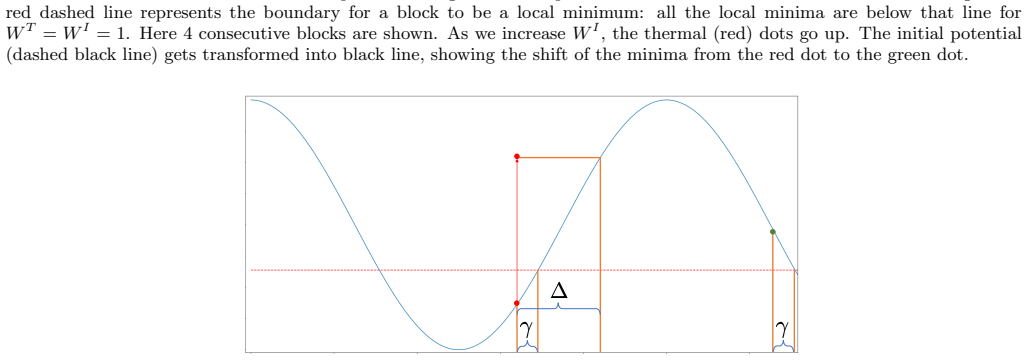
- [Supplement II.A.2, Fig. 5] The caption text says 'The red dot is a local minimum insulating block while the green dot corresponds to the adjacent thermal block,' but the main text example only discusses the red dashed line; the notation in the figure should be aligned with the definitions in the text.
- [Main text 'Ising model'] The phrase 'nonsingular sequences of 𝓁 are generically squashed under the RG' would benefit from a precise definition of 'squashed', since this is the mechanism behind the marginal irrelevance claim.
Circularity Check
No significant circularity: central claims are derived from RG dynamics and explicit combinatorics, not from fitted inputs or load-bearing self-citations.
full rationale
The derivation chain is self-contained. The claim that local minima of a cosine quasiperiodic potential form a Fibonacci word is proved explicitly in Supplement I.A by a trigonometric and Diophantine argument; it is not assumed by construction. The sharpening formulas and Eq. (4) are derived in Supplement I.B by summing the RG rule over the ABABA/ABA Fibonacci blocks and bounding the remaining fluctuations, rather than by fitting. The correlation length exponent nu = 1 follows from the RG eigenvalue lambda_delta = phi^3, and the Potts spin exponent is computed from subpattern probabilities, with numerical checks in Fig. 2. The MBL section explicitly adopts a prior phenomenological block RG, including Ref. [32] by one of the authors, as a model input rather than as an external theorem, and its nu = 1 output is benchmarked against exact diagonalization results; the self-citation is therefore not load-bearing in a circular sense. The paper itself flags places where control is imperfect, e.g. 'our RG procedure is not controlled for this model' in the Ising case, and the simultaneous decimation of all minima is justified by asymptotic separation rather than by an equivalence assumption; these are correctness or rigor concerns, not circularity. No fitted parameter is renamed as a prediction, and the central fixed-point structure is not equivalent to the inputs by definition.
Assumptions & free parameters
assumptions (6)
- domain assumption Strong-disorder real-space RG decimation rule l'_i = l_{i-1} - l_i + l_{i+1} + c is asymptotically exact at quasiperiodic fixed points.
- ad hoc to paper All local-minimum bonds can be decimated simultaneously in a Fibonacci RG step.
- ad hoc to paper Every sufficiently regular quasiperiodic potential with frequency phi is in the basin of attraction of a Fibonacci-like sequence.
- domain assumption For the q-state quantum Potts model, the decimation rule takes the same form with c = log(q/2).
- domain assumption The phenomenological RG of alternating thermal and insulating blocks captures the quasiperiodic MBL transition.
- standard math Fibonacci numbers provide the best Diophantine approximations to the golden ratio, so defects are spaced by Fibonacci numbers.
Cite this review
Pith. "Pith review of Universality and Quantum Criticality in Quasiperiodic Spin Chains." pith.science (2026). https://pith.science/paper/SY2AFEST
@misc{pith2026190802774,
  author       = {Pith},
  title        = {Pith review of: Universality and Quantum Criticality in Quasiperiodic Spin Chains},
  year         = {2026},
  howpublished = {\url{https://pith.science/paper/SY2AFEST}},
  note         = {Machine review of arXiv:1908.02774}
}
read the original abstract
Quasiperiodic systems are aperiodic but deterministic, so their critical behavior differs from that of clean systems as well as disordered ones. Quasiperiodic criticality was previously understood only in the special limit where the couplings follow discrete quasiperiodic sequences. Here we consider generic quasiperiodic modulations; we find, remarkably, that for a wide class of spin chains, generic quasiperiodic modulations flow to discrete sequences under a real-space renormalization group transformation. These discrete sequences are therefore fixed points of a \emph{functional} renormalization group. This observation allows for an asymptotically exact treatment of the critical points. We use this approach to analyze the quasiperiodic Heisenberg, Ising, and Potts spin chains, as well as a phenomenological model for the quasiperiodic many-body localization transition.
Figures


Figures from the paper (7 more)




Forward citations
Cited by 2 Pith papers
-
Mixed spectra and partially extended states in a two-dimensional quasiperiodic model
In a non-separable 2D Aubry-André model, partially extended states persist at arbitrarily strong quasiperiodic modulation, localised on a network of low-disorder lines, yielding a mixed spectrum without a mobility edge.
-
Dynamics and Transport at the Threshold of Many-Body Localization
A review organizing nearly many-body-localized systems around a common picture of localized degrees of freedom coupled to slow, nontrivial thermal baths.
Reference graph
Works this paper leans on
-
[1]
A. B. Harris, Journal of Physics C: Solid State Physics 7, 1671 (1974)
1974
-
[2]
D. S. Fisher, Physical Review Letters 69, 534 (1992)
work page 1992
-
[3]
D. S. Fisher, Phys. Rev. B 50, 3799 (1994)
work page 1994
-
[4]
D. S. Fisher, Phys. Rev. B 51, 6411 (1995)
work page 1995
- [5]
-
[6]
O. Motrunich, S.-C. Mau, D. A. Huse, and D. S. Fisher, Phys. Rev. B 61, 1160 (2000)
work page 2000
-
[7]
D. Shechtman, I. Blech, D. Gratias, and J. W. Cahn, Phys. Rev. Lett. 53, 1951 (1984)
work page 1984
-
[8]
Levine and P
D. Levine and P. J. Steinhardt, Phys. Rev. Lett. 53, 2477 (1984)
1984
Show all 79 references
-
[9]
Merlin, K
R. Merlin, K. Bajema, R. Clarke, F. Y. Juang, and P. K. Bhattacharya, Phys. Rev. Lett. 55, 1768 (1985)
1985
-
[10]
Bistritzer and A
R. Bistritzer and A. H. MacDonald, Proceedings of the National Academy of Sciences 108, 12233 (2011)
2011
-
[11]
Y. Cao, V. Fatemi, S. Fang, K. Watanabe, T. Taniguchi, E. Kaxiras, and P. Jarillo-Herrero, Nature 556, 43 EP (2018)
2018
-
[12]
Y. Cao, V. Fatemi, A. Demir, S. Fang, S. L. Tomarken, J. Y. Luo, J. D. Sanchez-Yamagishi, K. Watanabe, T. Taniguchi, E. Kaxiras, R. C. Ashoori, and P. Jarillo- Herrero, Nature 556, 80 EP (2018)
2018
-
[13]
Roati, C
G. Roati, C. D’Errico, L. Fallani, M. Fattori, C. Fort, M. Zaccanti, G. Modugno, M. Modugno, and M. Ingus- cio, Nature 453, 895 EP (2008)
2008
-
[14]
Deissler, M
B. Deissler, M. Zaccanti, G. Roati, C. D’Errico, M. Fat- tori, M. Modugno, G. Modugno, and M. Inguscio, Na- ture Physics 6, 354 EP (2010)
2010
-
[15]
Schreiber, S
M. Schreiber, S. S. Hodgman, P. Bordia, H. P. L¨ uschen, M. H. Fischer, R. Vosk, E. Altman, U. Schneider, and I. Bloch, Science 349, 842 (2015)
2015
-
[16]
H. P. L¨ uschen, P. Bordia, S. S. Hodgman, M. Schreiber, S. Sarkar, A. J. Daley, M. H. Fischer, E. Altman, I. Bloch, and U. Schneider, Phys. Rev. X 7, 011034 (2017)
2017
-
[17]
Bordia, H
P. Bordia, H. L¨ uschen, S. Scherg, S. Gopalakrishnan, M. Knap, U. Schneider, and I. Bloch, Phys. Rev. X 7, 041047 (2017)
2017
-
[18]
J. M. Luck, Europhysics Letters (EPL) 24, 359 (1993)
1993
-
[19]
Kohmoto, L
M. Kohmoto, L. P. Kadanoff, and C. Tang, Phys. Rev. Lett. 50, 1870 (1983)
1983
-
[20]
I. I. Satija and M. M. Doria, Physical Review B 38, 5174 (1988)
1988
-
[21]
Levitov, Journal de Physique 50, 707 (1989)
L. Levitov, Journal de Physique 50, 707 (1989)
1989
-
[22]
Igl´ oi, D
F. Igl´ oi, D. Karevski, and H. Rieger, The European Physical Journal B - Condensed Matter and Complex Systems 1, 513 (1998)
1998
-
[23]
Vidal, D
J. Vidal, D. Mouhanna, and T. Giamarchi, Physical Re- view Letters 83, 3908 (1999)
1999
-
[24]
Hermisson, Journal of Physics A: Mathematical and 6 General 33, 57 (1999)
J. Hermisson, Journal of Physics A: Mathematical and 6 General 33, 57 (1999)
1999
-
[25]
Hida, Physical Review Letters 93, 037205 (2004)
K. Hida, Physical Review Letters 93, 037205 (2004)
2004
-
[26]
A. P. Vieira, Physical Review B 71, 134408 (2005)
2005
-
[27]
Wilkinson, Proceedings of the Royal Society of Lon- don
M. Wilkinson, Proceedings of the Royal Society of Lon- don. A. Mathematical and Physical Sciences 391, 305 (1984)
1984
-
[28]
Chandran and C
A. Chandran and C. R. Laumann, Phys. Rev. X 7, 031061 (2017)
2017
-
[29]
P. J. D. Crowley, A. Chandran, and C. R. Laumann, arXiv:1812.01660 [cond-mat] (2018), arXiv: 1812.01660
2018 arXiv
-
[30]
Crowley, A
P. Crowley, A. Chandran, and C. Laumann, Physical Review Letters 120, 175702 (2018)
2018
-
[31]
Zhang, B
L. Zhang, B. Zhao, T. Devakul, and D. A. Huse, Physical Review B 93, 224201 (2016)
2016
-
[32]
Goremykina, R
A. Goremykina, R. Vasseur, and M. Serbyn, Physical Review Letters 122, 040601 (2019)
2019
-
[33]
Giamarchi and H
T. Giamarchi and H. J. Schulz, Physical Review B 37, 325 (1988)
1988
-
[34]
S.-k. Ma, C. Dasgupta, and C.-k. Hu, Physical Review Letters 43, 1434 (1979)
1979
-
[35]
Dasgupta and S.-k
C. Dasgupta and S.-k. Ma, Physical Review B 22, 1305 (1980)
1980
-
[36]
Hida, Journal of the Physical Society of Japan 68, 3177 (1999)
K. Hida, Journal of the Physical Society of Japan 68, 3177 (1999)
1999
-
[37]
Vidal, D
J. Vidal, D. Mouhanna, and T. Giamarchi, Physical Re- view B 65, 014201 (2001)
2001
-
[38]
See Supplemental Material for a detailed analysis of the emergence of sequences, calculations of the correlation length and spin exponents, and technical details for the quasi-periodic MBL transition
-
[39]
Szab´ o and U
A. Szab´ o and U. Schneider, Phys. Rev. B 98, 134201 (2018)
2018
-
[40]
Senthil and S
T. Senthil and S. N. Majumdar, Phys. Rev. Lett. 76, 3001 (1996)
1996
-
[41]
S. A. Parameswaran, A. C. Potter, and R. Vasseur, An- nalen der Physik 529, 1600302 (2017)
2017
-
[42]
P. W. Anderson, Phys. Rev. 109, 1492 (1958)
1958
-
[43]
Fleishman and P
L. Fleishman and P. Anderson, Phys. Rev. B 21, 2366 (1980)
1980
-
[44]
B. L. Altshuler, Y. Gefen, A. Kamenev, and L. S. Levi- tov, Phys. Rev. Lett. 78, 2803 (1997)
1997
-
[45]
Gornyi, A
I. Gornyi, A. Mirlin, and D. Polyakov, Phys. Rev. Lett. 95, 206603 (2005)
2005
-
[46]
Basko, I
D. Basko, I. Aleiner, and B. Altshuler, Ann. Phys. (N.Y.) 321, 1126 (2006)
2006
-
[47]
Oganesyan and D
V. Oganesyan and D. A. Huse, Phys. Rev. B 75, 155111 (2007)
2007
-
[48]
Pal and D
A. Pal and D. A. Huse, Phys. Rev. B 82, 174411 (2010)
2010
-
[49]
Nandkishore and D
R. Nandkishore and D. A. Huse, Annu. Rev. Condens. Matter Phys. 6, 15 (2015)
2015
-
[50]
Vasseur and J
R. Vasseur and J. E. Moore, J. Stat. Mech. Theor. Exp. 2016, 064010 (2016)
2016
-
[51]
D. A. Abanin, E. Altman, I. Bloch, and M. Serbyn, ArXiv e-prints (2018), arXiv:1804.11065
2018 arXiv
-
[52]
Serbyn, Z
M. Serbyn, Z. Papi´ c, and D. A. Abanin, Phys. Rev. X 5, 041047 (2015)
2015
-
[53]
J. A. Kj¨ all, J. H. Bardarson, and F. Pollmann, Phys. Rev. Lett. 113, 107204 (2014)
2014
-
[54]
D. J. Luitz, N. Laflorencie, and F. Alet, Phys. Rev. B 91, 081103 (2015)
2015
-
[55]
Agarwal, S
K. Agarwal, S. Gopalakrishnan, M. Knap, M. M¨ uller, and E. Demler, Phys. Rev. Lett. 114, 160401 (2015)
2015
-
[56]
Khemani, S
V. Khemani, S. P. Lim, D. N. Sheng, and D. A. Huse, Phys. Rev. X 7, 021013 (2017)
2017
-
[57]
Khemani, D
V. Khemani, D. Sheng, and D. A. Huse, Physical Review Letters 119, 075702 (2017)
2017
-
[58]
Zhang and H
S.-X. Zhang and H. Yao, Phys. Rev. Lett. 121, 206601 (2018)
2018
-
[59]
R. Vosk, D. A. Huse, and E. Altman, Phys. Rev. X 5, 031032 (2015)
2015
-
[60]
A. C. Potter, R. Vasseur, and S. A. Parameswaran, Phys. Rev. X 5, 031033 (2015)
2015
-
[61]
P. T. Dumitrescu, R. Vasseur, and A. C. Potter, Phys. Rev. Lett. 119, 110604 (2017)
2017
-
[62]
Thiery, F
T. Thiery, F. Huveneers, M. M¨ uller, and W. De Roeck, Phys. Rev. Lett. 121, 140601 (2018)
2018
-
[63]
Thiery, M
T. Thiery, M. M¨ uller, and W. De Roeck, ArXiv e-prints (2017), arXiv:1711.09880
2017 arXiv
-
[64]
P. T. Dumitrescu, A. Goremykina, S. A. Parameswaran, M. Serbyn, and R. Vasseur, Phys. Rev. B 99, 094205 (2019)
2019
-
[65]
Morningstar and D
A. Morningstar and D. A. Huse, Phys. Rev. B 99, 224205 (2019)
2019
-
[66]
Gopalakrishnan, M
S. Gopalakrishnan, M. M¨ uller, V. Khemani, M. Knap, E. Demler, and D. A. Huse, Phys. Rev. B 92, 104202 (2015)
2015
-
[67]
Agarwal, E
K. Agarwal, E. Altman, E. Demler, S. Gopalakrishnan, D. A. Huse, and M. Knap, Ann. Phys. (Berl.) 529, 1600326 (2017)
2017
-
[68]
Serbyn, Z
M. Serbyn, Z. Papi´ c, and D. A. Abanin, Phys. Rev. Lett. 110, 260601 (2013)
2013
-
[69]
D. A. Huse, R. Nandkishore, and V. Oganesyan, Phys. Rev. B 90, 174202 (2014)
2014
-
[70]
Serbyn, Z
M. Serbyn, Z. Papi´ c, and D. A. Abanin, Phys. Rev. Lett. 111, 127201 (2013)
2013
-
[71]
J. Z. Imbrie, J. Stat. Phys. 163, 998 (2016)
2016
-
[72]
J. Z. Imbrie, Phys. Rev. Lett. 117, 027201 (2016)
2016
-
[73]
A. D. Rutenberg and A. J. Bray, Phys. Rev. E 50, 1900 (1994)
1994
-
[74]
M. Lee, T. R. Look, S. P. Lim, and D. N. Sheng, Physical Review B 96, 075146 (2017)
2017
-
[75]
Universality and Quantum Criticality in Quasi-periodic Spin Chains
A. Jagannathan, Phys. Rev. Lett. 92, 047202 (2004). Supplemental Material for “Universality and Quantum Criticality in Quasi-periodic Spin Chains” Utkarsh Agrawal,1 Sarang Gopalakrishnan, 2 and Romain Vasseur 1 1Department of Physics, University of Massachusetts, Amherst, MA 0...
2004
-
[76]
Flow to Fibonacci Sequence 6
-
[77]
βI > 1 9 I
Correlation length exponent 7 B. βI > 1 9 I. GROUND ST A TES OF QUASIPERIODIC SPIN CHAINS This section elaborates on various aspects of the ground-state physics of quasiperiodic spin chains. The key result of this section is an explanation of why generic quasiperiodic patterns...
-
[78]
The RG assumes alternating thermal and insulating blocks parametrized by “lengths”,𝓁T/I
Flow to Fibonacci Sequence The arguments above can be readily generalized to the symmetric MBL RG (see main text). The RG assumes alternating thermal and insulating blocks parametrized by “lengths”,𝓁T/I . The RG flow is dictated by the decimation of the lowest length to get a n...
-
[79]
The mechanism responsible for driving the system to a phase (either thermal or MBL) is by introducing an asymmetry in the initial distribution via WI⁄=WT
Correlation length exponent We now compute the critical exponentν in the symmetric case (βI = 1). The mechanism responsible for driving the system to a phase (either thermal or MBL) is by introducing an asymmetry in the initial distribution via WI⁄=WT . This leads to formation...
Reviewed August 14, 2026 · model on record in the stance chip above.
Discussion (0). Continue with ORCID to comment.