Some universalities in the partition functions of low-dimensional gravity models
Pith reviewed 2026-06-29 23:24 UTC · model grok-4.3
The pith
Partition functions across low-dimensional gravity models display structural universalities.
A machine-rendered reading of the paper's core claim, the machinery that carries it, and where it could break.
Core claim
The author establishes that similarities between the JT partition function and the N=(2,2) partition function on S^2 and AdS2, along with consistent behaviors under parameter variations and in auxiliary quantities like eigenfunctions and entanglement entropy, indicate the presence of universalities in the partition functions of low-dimensional gravity models.
What carries the argument
The partition functions of the models, particularly their structural responses to parameter changes and the associated wavefunctions and entropy measures.
If this is right
- Parameter variations will produce analogous changes in partition function structures across the models.
- Similar spectra and eigenfunctions will appear in the different gravity models.
- Wheeler-DeWitt wavefunctions will behave similarly in the compared models.
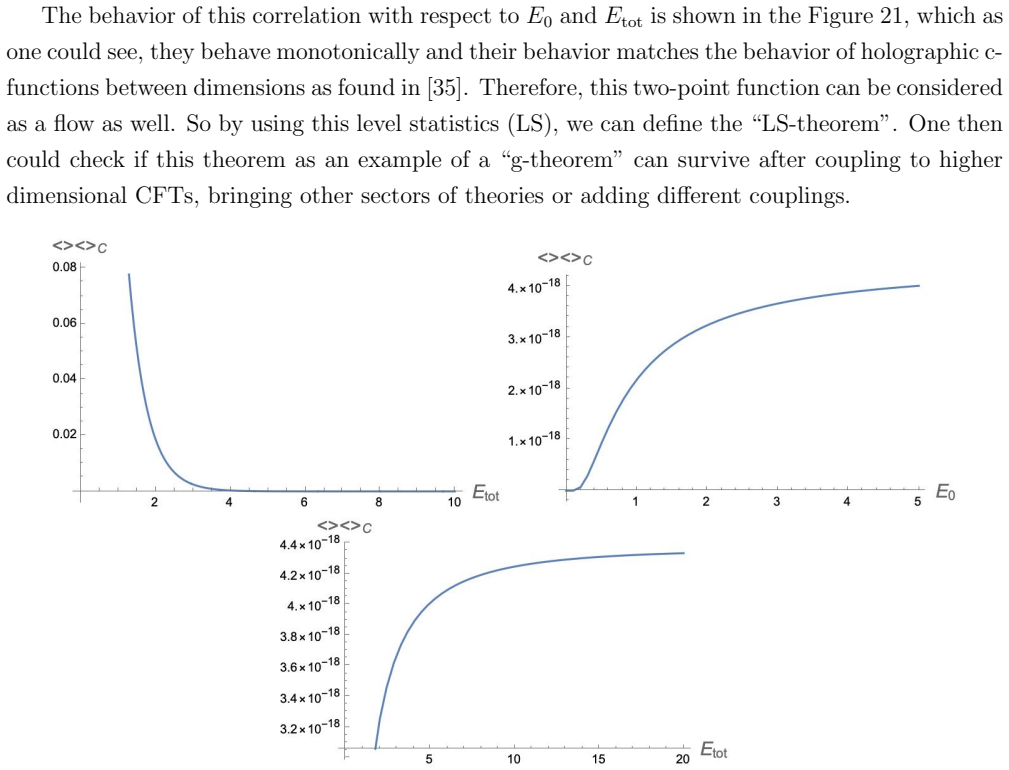
- Entanglement entropy and complexity will follow universal patterns in wormhole setups.
- RG flows will exhibit common features linked to the universal partition functions.
Where Pith is reading between the lines
- This suggests that predictions from one model could be transferred to others via the universal structures.
- Further exploration might connect these to higher-dimensional gravity or string theory models.
- Numerical checks on entanglement measures could test the universality.
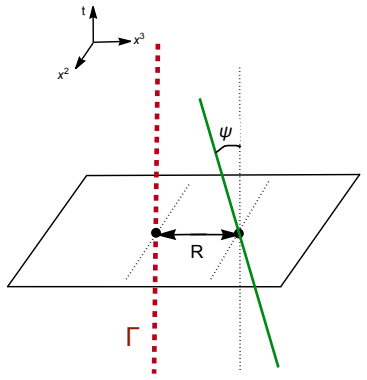
- The wormhole-defect connections might offer a new way to probe these universalities.
Load-bearing premise
The similarities observed in the partition functions and related quantities arise from fundamental universal features of the models rather than from specific choices in parametrization or coincidental alignments.
What would settle it
Demonstrating that a particular parameter change produces qualitatively different alterations in the JT partition function compared to the N=(2,2) partition function on AdS2 would disprove the universality.
Figures
read the original abstract
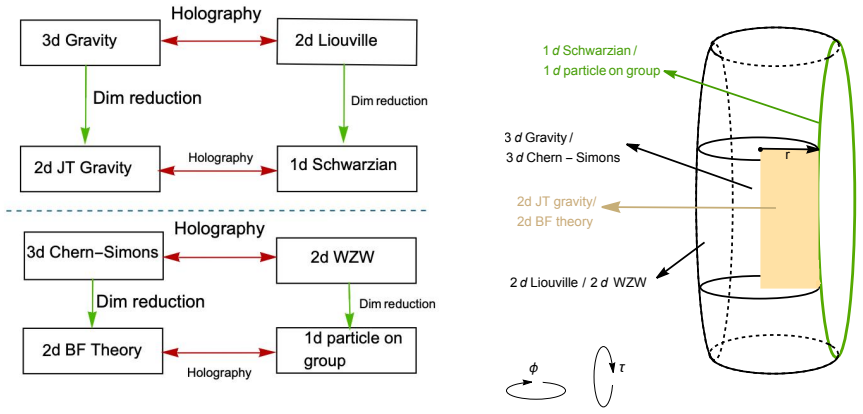
In this work, first, we discuss the connections between various low-dimensional quantum gravity models, including 3d Chern-Simons, 2d JT, 2d BF theory, 2d Liouville, 2d WZW, and 1d Schwarzian, which are related through holography and dimension reduction, and discuss some universalities in their partition functions. Then, we specifically examine the JT partition function and the partition function of $\mathcal{N}=(2,2)$ on $S^2$ and $\text{AdS}_2$ and discuss their similarities and therefore examine our proposed universalities. We change the parameters in each model and based on the change in the structure of the partition functions, strengthen our conjectures. We also use eigenfunctions, spectra and the behaviors of Wheeler-DeWitt wavefunctions to generate more universalities between these low-dimensional quantum gravity models, specifically in their partition functions. Then, we use entanglement entropy, complexity and RG flows, particularly in the context of wormholes, to find more universalities in quantum gravity models. Finally, we use the new results about the connections between wormholes and defects to discuss our universalities further.
Editorial analysis
A structured set of objections, weighed in public.
Referee Report
Summary. The manuscript claims that universalities exist in the partition functions of low-dimensional quantum gravity models (3d Chern-Simons, 2d JT, 2d BF, 2d Liouville, 2d WZW, 1d Schwarzian) related by holography and dimensional reduction. It focuses on structural similarities between the JT partition function and the N=(2,2) partition function on S^2 and AdS2, conjecturing these universalities are strengthened by parameter variations and further supported by eigenfunctions, spectra, Wheeler-DeWitt wavefunctions, entanglement entropy, complexity, RG flows, and wormhole-defect connections.
Significance. If the conjectures hold and can be made precise, they would indicate common structural features in partition functions across these models that extend beyond their established holographic and reduction relations, potentially unifying aspects of low-dimensional quantum gravity. The breadth of auxiliary quantities examined (entanglement entropy, complexity, RG flows) provides multiple angles for exploration. However, the absence of quantitative metrics, derivations, or falsifiable predictions means the work primarily flags patterns rather than establishing robust results, limiting its immediate significance to suggesting directions for follow-up research.
major comments (3)
- [Abstract] Abstract: The central claims are presented as conjectures strengthened by parameter variation and qualitative similarities, but no derivations, error estimates, or falsifiable predictions are supplied, leaving the evidential support for the universalities weak.
- [Abstract] Abstract: The approach of changing parameters in each model and using resulting changes in partition function structure to strengthen the conjectures risks circularity, as the universalities may be defined in terms of the similarities being invoked to support them.
- [Abstract] Abstract: The models are explicitly connected through holography and dimension reduction; a precise, model-independent definition of 'universality' is required to determine whether the observed partition function similarities reflect new structure or are expected consequences of these known relations.
minor comments (1)
- [Abstract] The abstract is lengthy and lists many auxiliary quantities without clear prioritization; separating the core partition function claims from the supporting observables would improve readability.
Simulated Author's Rebuttal
We thank the referee for their thoughtful review and constructive criticism of our manuscript. We address each major comment in turn below, providing clarifications on the scope of our conjectures and indicating revisions where appropriate to strengthen the presentation.
read point-by-point responses
-
Referee: [Abstract] Abstract: The central claims are presented as conjectures strengthened by parameter variation and qualitative similarities, but no derivations, error estimates, or falsifiable predictions are supplied, leaving the evidential support for the universalities weak.
Authors: We agree that the manuscript is exploratory in nature and presents conjectures based on observed structural patterns rather than rigorous derivations or quantitative metrics. The support comes from qualitative similarities in partition functions across models, their persistence under parameter changes, and connections to auxiliary quantities such as wavefunctions and entanglement. No error estimates or falsifiable predictions are provided because the work aims to flag potential universal features for future investigation. We will revise the abstract to more explicitly characterize the claims as conjectures and to note the qualitative character of the evidence. revision: partial
-
Referee: [Abstract] Abstract: The approach of changing parameters in each model and using resulting changes in partition function structure to strengthen the conjectures risks circularity, as the universalities may be defined in terms of the similarities being invoked to support them.
Authors: We maintain that the argument is not circular. The conjectured universalities are motivated by the established holographic and dimensional-reduction relations among the models. Parameter variations are then employed to examine whether the partition-function similarities remain robust under deformations, which would indicate they are intrinsic features rather than artifacts of particular parameter choices. This is a standard approach for identifying universal behavior. We will add a clarifying sentence in the revised abstract to distinguish the initial motivation from the robustness test. revision: no
-
Referee: [Abstract] Abstract: The models are explicitly connected through holography and dimension reduction; a precise, model-independent definition of 'universality' is required to determine whether the observed partition function similarities reflect new structure or are expected consequences of these known relations.
Authors: We accept that a precise definition would improve clarity. In the revised manuscript we will supply a working definition: universality here refers to structural features of the partition functions (e.g., specific functional forms or parameter dependences) that appear across the models in ways not directly implied by the known holographic or reduction mappings. We will illustrate how the JT–N=(2,2) similarities, together with the auxiliary quantities examined, point to additional common structure beyond those mappings. revision: yes
Circularity Check
Universalities conjectured from observed partition-function similarities after parameter variation, with models already linked by holography/reduction
specific steps
-
self definitional
[Abstract]
"We change the parameters in each model and based on the change in the structure of the partition functions, strengthen our conjectures. We also use eigenfunctions, spectra and the behaviors of Wheeler-DeWitt wavefunctions to generate more universalities between these low-dimensional quantum gravity models, specifically in their partition functions."
The universalities are strengthened and generated directly from the observed changes in partition-function structure and auxiliary quantities upon parameter variation; thus the claimed universalities are equivalent to the similarities being used to support them, with no external benchmark or independent derivation.
-
renaming known result
[Abstract]
"first, we discuss the connections between various low-dimensional quantum gravity models, including 3d Chern-Simons, 2d JT, 2d BF theory, 2d Liouville, 2d WZW, and 1d Schwarzian, which are related through holography and dimension reduction, and discuss some universalities in their partition functions. Then, we specifically examine the JT partition function and the partition function of N=(2,2) on S^2 and AdS2 and discuss their similarities and therefore examine our proposed universalities."
The models are already connected by holography and dimension reduction (explicitly listed), so shared partition-function features are expected; presenting these as 'universalities' renames the known relations without supplying a new, falsifiable criterion independent of the connections.
full rationale
The paper's central claim of universalities rests on structural similarities in partition functions (JT vs N=(2,2) on S^2/AdS2) that are examined after explicit parameter changes, plus auxiliary quantities like spectra and wavefunctions. These similarities are invoked to 'strengthen our conjectures' and 'generate more universalities,' but the models are stated to be connected by construction via holography and dimension reduction. No independent, model-independent definition or quantitative measure of universality is supplied that would survive reparametrization or apply outside the known relations, so the claimed universalities reduce to a renaming of expected shared features rather than an independent derivation.
Axiom & Free-Parameter Ledger
axioms (1)
- domain assumption The models (3d Chern-Simons, 2d JT, 2d BF, 2d Liouville, 2d WZW, 1d Schwarzian) are related through holography and dimension reduction
Forward citations
Cited by 1 Pith paper
-
Black holes with quantum corrections in $3d$: The case of Page curve in Lindblad, greybody factor, and Lyapunov exponent
Applies Lindblad open quantum system methods to quantum-corrected 3d AdS black holes to analyze Page curve zig-zag, greybody factors, and Lyapunov exponents in Cotler-Jensen theory.
Reference graph
Works this paper leans on
-
[1]
J. M. Maldacena, J. Michelson, and A. Strominger,Anti-de Sitter fragmentation,JHEP02 (1999) 011, [hep-th/9812073]
work page internal anchor Pith review Pith/arXiv arXiv 1999
-
[2]
Jackiw,Lower Dimensional Gravity,Nucl
R. Jackiw,Lower Dimensional Gravity,Nucl. Phys. B252(1985) 343–356
1985
-
[3]
Teitelboim,Gravitation and Hamiltonian Structure in Two Space-Time Dimensions, Phys
C. Teitelboim,Gravitation and Hamiltonian Structure in Two Space-Time Dimensions, Phys. Lett. B126(1983) 41–45
1983
-
[4]
M. Ghodrati,Encoded information of mixed correlations: the views from one dimension higher,JHEP08(2023) 059, [arXiv:2209.04548]
- [5]
-
[6]
A. Ahmadain, A. Frenkel, K. Ray, and R. M. Soni,Boundary description of microstates of the two-dimensional black hole,SciPost Phys.16(2024), no. 1 020, [arXiv:2210.11493]
-
[7]
Kitaev,Workshop on the Chaos, the SYK Model and AdS2,
A. Kitaev,Workshop on the Chaos, the SYK Model and AdS2, . 37
-
[8]
A. Gonzalez Lezcano, I. Jeon, and A. Ray,Erratum to: Supersymmetric localization: N= (2,2)theories on S 2 and AdS2,JHEP07(2023) 056, [arXiv:2302.10370]. [Erratum: JHEP 09, 003 (2023)]
-
[9]
Yang,The Quantum Gravity Dynamics of Near Extremal Black Holes,JHEP05(2019) 205, [arXiv:1809.08647]
Z. Yang,The Quantum Gravity Dynamics of Near Extremal Black Holes,JHEP05(2019) 205, [arXiv:1809.08647]
-
[10]
Statistical mechanics of a two-dimensional black hole
A. Kitaev and S. J. Suh,Statistical mechanics of a two-dimensional black hole,JHEP05 (2019) 198, [arXiv:1808.07032]
work page internal anchor Pith review Pith/arXiv arXiv 2019
-
[11]
Replica wormholes and the black hole interior
G. Penington, S. H. Shenker, D. Stanford, and Z. Yang,Replica wormholes and the black hole interior,JHEP03(2022) 205, [arXiv:1911.11977]
work page internal anchor Pith review Pith/arXiv arXiv 2022
-
[12]
Exact Results in D=2 Supersymmetric Gauge Theories
N. Doroud, J. Gomis, B. Le Floch, and S. Lee,Exact Results in D=2 Supersymmetric Gauge Theories,JHEP05(2013) 093, [arXiv:1206.2606]
work page internal anchor Pith review Pith/arXiv arXiv 2013
-
[13]
Gauge Theory Dynamics and Kahler Potential for Calabi-Yau Complex Moduli
N. Doroud and J. Gomis,Gauge theory dynamics and K¨ ahler potential for Calabi-Yau complex moduli,JHEP12(2013) 099, [arXiv:1309.2305]
work page internal anchor Pith review Pith/arXiv arXiv 2013
-
[14]
Exact Kahler Potential from Gauge Theory and Mirror Symmetry
J. Gomis and S. Lee,Exact Kahler Potential from Gauge Theory and Mirror Symmetry, JHEP04(2013) 019, [arXiv:1210.6022]
work page internal anchor Pith review Pith/arXiv arXiv 2013
-
[15]
Camporesi,The Spinor heat kernel in maximally symmetric spaces,Commun
R. Camporesi,The Spinor heat kernel in maximally symmetric spaces,Commun. Math. Phys.148(1992) 283–308
1992
-
[16]
Comtet,On the Landau Levels on the Hyperbolic Plane,Annals Phys.173(1987) 185
A. Comtet,On the Landau Levels on the Hyperbolic Plane,Annals Phys.173(1987) 185
1987
-
[17]
I. Jeon, H. Kim, N. Kim, A. Poole, and A. Ray,Localisation ofN= (2,2)theories on spindles of both twists,arXiv:2604.17975
work page internal anchor Pith review Pith/arXiv arXiv
-
[18]
The equivariant A-twist and gauged linear sigma models on the two-sphere
C. Closset, S. Cremonesi, and D. S. Park,The equivariant A-twist and gauged linear sigma models on the two-sphere,JHEP06(2015) 076, [arXiv:1504.06308]
work page internal anchor Pith review Pith/arXiv arXiv 2015
- [19]
- [20]
-
[21]
A. Amariti, J. Nian, L. A. Pando Zayas, and A. Segati,Universal Cardy-like behavior of 3D partition functions from supersymmetric localization,Nucl. Phys. B1018(2025) 117045, [arXiv:2306.05462]. 38
-
[22]
Y. Chen and G. J. Turiaci,Spin-statistics for black hole microstates,JHEP04(2024) 135, [arXiv:2309.03478]
-
[23]
Eberhardt,Off-shell Partition Functions in 3d Gravity,Commun
L. Eberhardt,Off-shell Partition Functions in 3d Gravity,Commun. Math. Phys.405 (2024), no. 3 76, [arXiv:2204.09789]
-
[24]
G. Giribet and M. Leoni,2D quantum gravity partition function on the fluctuating sphere, JHEP09(2022) 126, [arXiv:2206.05546]
-
[25]
The Cellular Automaton Interpretation of Quantum Mechanics
G. ’t Hooft,The Cellular Automaton Interpretation of Quantum Mechanics. A View on the Quantum Nature of our Universe, Compulsory or Impossible?,arXiv:1405.1548
work page internal anchor Pith review Pith/arXiv arXiv
-
[26]
Comtet,On the landau levels on the hyperbolic plane,Annals of Physics173(1987), no
A. Comtet,On the landau levels on the hyperbolic plane,Annals of Physics173(1987), no. 1 185–209
1987
-
[27]
Comtet and P
A. Comtet and P. J. Houston,Effective Action on the Hyperbolic Plane in a Constant External Field,J. Math. Phys.26(1985) 185
1985
-
[28]
Schwinger pair production in AdS2
B. Pioline and J. Troost,Schwinger pair production in AdS(2),JHEP03(2005) 043, [hep-th/0501169]
work page internal anchor Pith review Pith/arXiv arXiv 2005
- [29]
-
[30]
Conformal symmetry and its breaking in two dimensional Nearly Anti-de-Sitter space
J. Maldacena, D. Stanford, and Z. Yang,Conformal symmetry and its breaking in two dimensional Nearly Anti-de-Sitter space,PTEP2016(2016), no. 12 12C104, [arXiv:1606.01857]
work page internal anchor Pith review Pith/arXiv arXiv 2016
- [31]
-
[32]
D. Harlow and D. Jafferis,The Factorization Problem in Jackiw-Teitelboim Gravity,JHEP 02(2020) 177, [arXiv:1804.01081]
-
[33]
J. Cotler and K. Jensen,Wormholes and black hole microstates in AdS/CFT,JHEP09 (2021) 001, [arXiv:2104.00601]
-
[34]
J. Cotler and K. Jensen,A precision test of averaging in AdS/CFT,JHEP11(2022) 070, [arXiv:2205.12968]
-
[35]
A. Gonzalez Lezcano, J. Hong, J. T. Liu, L. A. Pando Zayas, and C. F. Uhlemann, c-functions in flows across dimensions,JHEP10(2022) 083, [arXiv:2207.09360]
-
[36]
W. Harvey and K. Jensen,Eternal traversable wormholes in three dimensions,JHEP10 (2023) 178, [arXiv:2302.14049]. 39
-
[37]
B. D. Simons, P. A. Lee, and B. L. Altshuler,Exact results for quantum chaotic systems and one-dimensional fermions from matrix models,Nucl. Phys. B409(1993) 487–508
1993
-
[38]
Szafer and B
A. Szafer and B. L. Altshuler,Universal correlation in the spectra of disordered systems with an Aharonov-Bohm flux,Phys. Rev. Lett.70(1993) 587–590
1993
-
[39]
V. E. Kravtsov, I. V. Lerner, B. L. Altshuler, and A. G. Aronov,Universal spectral correlations at the mobility edge,Phys. Rev. Lett.72(1994) 888–891, [cond-mat/9402026]
work page internal anchor Pith review Pith/arXiv arXiv 1994
-
[40]
B. D. Simons and B. L. Altshuler,Universal velocity correlations in disordered and chaotic systems,Phys. Rev. Lett.70(1993) 4063–4066
1993
-
[41]
M. V. Berry,Quantum Scars of Classical Closed Orbits in Phase Space,Proceedings of the Royal Society of London Series A423(May, 1989) 219–231
1989
-
[42]
E. J. Heller,Bound-State Eigenfunctions of Classically Chaotic Hamiltonian Systems: Scars of Periodic Orbits,Phys. Rev. Lett.53(1984) 1515–1518
1984
-
[43]
Y. Matsuo,Universal structure of islands in evaporating black holes,JHEP03(2025) 068, [arXiv:2407.20921]
-
[44]
J. Cotler and S. Rezchikov,Renormalization group flow as optimal transport,Phys. Rev. D 108(2023), no. 2 025003, [arXiv:2202.11737]
- [45]
-
[46]
J. S. Cotler, G. Gur-Ari, M. Hanada, J. Polchinski, P. Saad, S. H. Shenker, D. Stanford, A. Streicher, and M. Tezuka,Black Holes and Random Matrices,JHEP05(2017) 118, [arXiv:1611.04650]. [Erratum: JHEP 09, 002 (2018)]
work page internal anchor Pith review Pith/arXiv arXiv 2017
-
[47]
Y. Liu, M. A. Nowak, and I. Zahed,Disorder in the Sachdev-Yee-Kitaev Model,Phys. Lett. B773(2017) 647–653, [arXiv:1612.05233]
work page internal anchor Pith review Pith/arXiv arXiv 2017
-
[48]
Ghodrati,Correlations of mixed systems in confining backgrounds,Eur
M. Ghodrati,Correlations of mixed systems in confining backgrounds,Eur. Phys. J. C82 (2022), no. 6 531, [arXiv:2110.12970]
-
[49]
Ghodrati,Critical distance and Crofton form in confining geometries,J
M. Ghodrati,Critical distance and Crofton form in confining geometries,J. Korean Phys. Soc.81(2022), no. 2 77–90, [arXiv:2205.03565]
-
[50]
M. Ghodrati,Entanglement wedge reconstruction and correlation measures in mixed states: Modular flows versus quantum recovery channels,Phys. Rev. D104(2021), no. 4 046004, [arXiv:2012.04386]. 40
- [51]
-
[52]
A. C. Hirshfeld and T. Schwarzweller,Path integral quantization of the Poisson sigma model,Annalen Phys.9(2000) 83–101, [hep-th/9910178]
work page internal anchor Pith review Pith/arXiv arXiv 2000
-
[53]
Verlinde,Wormholes in Quantum Mechanics,arXiv:2105.02129
H. Verlinde,Wormholes in Quantum Mechanics,arXiv:2105.02129
- [54]
- [55]
-
[56]
M. Gutperle and C. Hultgreen-Mena,Janus and RG interfaces in three-dimensional gauged supergravity. Part II. Generalα,JHEP08(2022) 126, [arXiv:2205.10398]
- [57]
-
[58]
V. Balasubramanian, A. Lawrence, J. M. Magan, and M. Sasieta,Microscopic Origin of the Entropy of Astrophysical Black Holes,Phys. Rev. Lett.132(2024), no. 14 141501, [arXiv:2212.08623]
- [59]
-
[60]
A. Blommaert, J. Kruthoff, and S. Yao,The power of Lorentzian wormholes,JHEP10 (2023) 005, [arXiv:2302.01360]
-
[61]
A Constraint on Defect and Boundary Renormalization Group Flows
K. Jensen and A. O’Bannon,Constraint on Defect and Boundary Renormalization Group Flows,Phys. Rev. Lett.116(2016), no. 9 091601, [arXiv:1509.02160]
work page internal anchor Pith review Pith/arXiv arXiv 2016
-
[62]
M. Byun, K.-Y. Kim, and H. Lee,Quantum simulation of traversable-wormhole-inspired quantum teleportation in a chaotic binary sparse SYK model,arXiv:2604.10090
work page internal anchor Pith review Pith/arXiv arXiv
-
[63]
J. de Boer, V. Jahnke, K.-Y. Kim, and J. F. Pedraza,Worldsheet traversable wormholes, JHEP05(2023) 141, [arXiv:2211.13262]
- [64]
- [65]
- [66]
-
[67]
J. McNamara and C. Vafa,Baby Universes, Holography, and the Swampland, arXiv:2004.06738
-
[68]
Van Riet,Instantons, Euclidean wormholes and AdS/CFT,PoSCORFU2019(2020) 121, [arXiv:2004.08956]
T. Van Riet,Instantons, Euclidean wormholes and AdS/CFT,PoSCORFU2019(2020) 121, [arXiv:2004.08956]
- [69]
-
[70]
M. Mirjalali, S. A. Hosseini Mansoori, L. Shahkarami, and M. Rafiee,Probing inside a charged hairy black hole in massive gravity,JHEP09(2022) 222, [arXiv:2206.02128]
-
[71]
H. Zolfi,Complexity and Multi-boundary Wormholes in 2 + 1 dimensions,JHEP04(2023) 076, [arXiv:2302.07522]
-
[72]
J. Erdmenger, S.-K. Jian, and Z.-Y. Xian,Universal chaotic dynamics from Krylov space, JHEP08(2023) 176, [arXiv:2303.12151]
-
[73]
Circuit complexity in interacting QFTs and RG flows
A. Bhattacharyya, A. Shekar, and A. Sinha,Circuit complexity in interacting QFTs and RG flows,JHEP10(2018) 140, [arXiv:1808.03105]
work page internal anchor Pith review Pith/arXiv arXiv 2018
-
[74]
From the Weyl Anomaly to Entropy of Two-Dimensional Boundaries and Defects
K. Jensen, A. O’Bannon, B. Robinson, and R. Rodgers,From the Weyl Anomaly to Entropy of Two-Dimensional Boundaries and Defects,Phys. Rev. Lett.122(2019), no. 24 241602, [arXiv:1812.08745]
work page internal anchor Pith review Pith/arXiv arXiv 2019
- [75]
- [76]
- [77]
discussion (0)
Sign in with ORCID, Apple, or X to comment. Anyone can read and Pith papers without signing in.