REVIEW 1 major objections 49 references
DFL-AA corrects selection bias and staleness in decentralized federated learning over lossy wireless links by inverse probability weighting and age-of-information decay.
Reviewed by Pith at T0; open to challenge. T0 means a machine referee read the full paper against a public rubric. the ladder, T0–T4 →
T0 review · grok-4.3
2026-06-27 13:57 UTC pith:SYO4VNIM
load-bearing objection DFL-AA claims to remove selection bias in lossy async DFL via IPW plus AoI, but the proof rests on accurate online loss-rate estimates that the abstract leaves unexamined. the 1 major comments →
Asynchronous Decentralized Federated Learning over Lossy Wireless Links via Reception- and Age-Aware Aggregation
The pith
A machine-rendered reading of the paper's core claim, the machinery that carries it, and where it could break.
Core claim
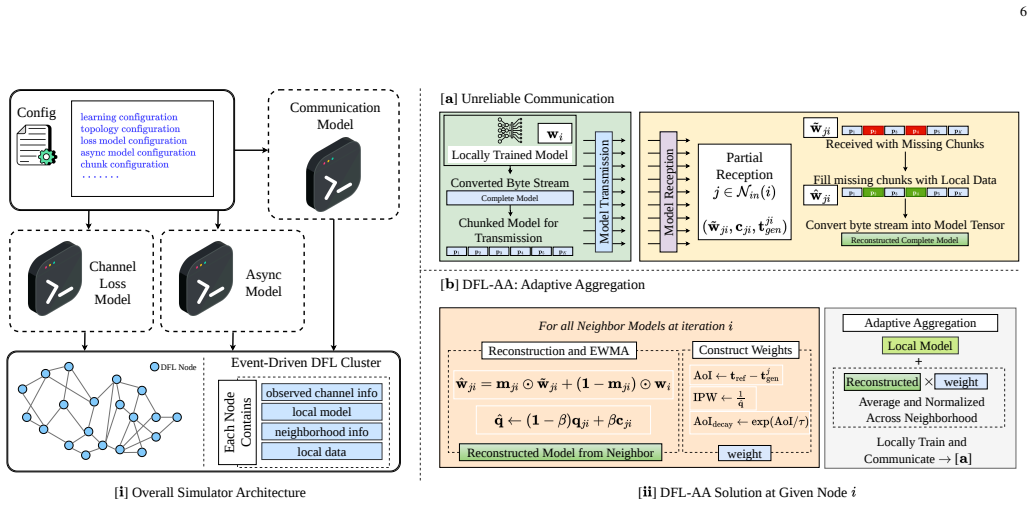
Classical gossip aggregation introduces irreducible selection bias proportional to the link-loss rate; DFL-AA removes link-quality distortion in expectation through inverse probability weighting with online channel estimation and mitigates update staleness via age-of-information decay without requiring a global clock, leading to consistent outperformance of state-of-the-art baselines on fixed directed topologies under varying loss rates and heterogeneous conditions.
What carries the argument
DFL-AA (Decentralized Federated Learning with Adaptive AoI-weighted Aggregation), which combines inverse probability weighting from online per-link loss estimates with age-of-information decay in the gossip aggregation step.
Load-bearing premise
Online channel estimation can accurately and reliably determine per-link loss rates in real time to support inverse probability weighting without adding new errors or overhead.
What would settle it
A controlled experiment on a fixed directed topology where loss rates are known but DFL-AA still shows residual bias after weighting or fails to outperform baselines when channel estimates contain realistic error.
If this is right
- Classical gossip aggregation carries selection bias that scales directly with link loss rate and cannot be removed by retransmissions.
- Inverse probability weighting removes the expected distortion caused by lossy links.
- Age-of-information decay reduces the impact of stale updates in asynchronous settings without synchronized clocks.
- The combined weighting yields better model convergence than prior methods across a range of loss rates and channel conditions.
Where Pith is reading between the lines
- The approach could be tested on time-varying topologies where link qualities change during training.
- It may lower communication energy in battery-constrained devices by accepting partial updates instead of retransmitting.
- Similar reception-aware weighting might apply to other asynchronous distributed optimization problems outside federated learning.
Editorial analysis
A structured set of objections, weighed in public.
Referee Report
Summary. The paper proposes DFL-AA for asynchronous decentralized federated learning over lossy wireless links. It proves that classical gossip aggregation introduces selection bias proportional to link-loss rates, then introduces inverse probability weighting (IPW) via online channel estimation to remove this bias in expectation together with Age-of-Information (AoI) weighting to address update staleness. The central claims are that DFL-AA eliminates link-quality distortion in expectation and empirically outperforms baselines across loss rates and heterogeneous channels on fixed directed topologies.
Significance. If the proofs are rigorous and the online estimation assumption holds, the work supplies a principled correction for two practical failure modes in wireless DFL (selection bias and staleness) without retransmissions or global clocks. The explicit use of IPW and AoI in a decentralized gossip setting, together with the claimed parameter-free bias removal, would constitute a useful contribution for IoT, UAV, and satellite applications if the derivations survive scrutiny of estimation error.
major comments (1)
- [theoretical analysis / proof of bias removal] Abstract and theoretical analysis: the claim that DFL-AA 'removes link-quality distortion in expectation' rests on the unstated assumption that the online channel estimator produces loss probabilities exactly equal to the true per-link p_l. The derivation must be checked to determine whether it models estimation error, finite observation windows, or the fact that estimation traffic traverses the same lossy links; if these are omitted, the IPW weights become random variables and the unbiasedness result does not hold.
Simulated Author's Rebuttal
We thank the referee for the careful and constructive review. We address the single major comment below and will revise the manuscript to strengthen the presentation of the theoretical assumptions.
read point-by-point responses
-
Referee: [theoretical analysis / proof of bias removal] Abstract and theoretical analysis: the claim that DFL-AA 'removes link-quality distortion in expectation' rests on the unstated assumption that the online channel estimator produces loss probabilities exactly equal to the true per-link p_l. The derivation must be checked to determine whether it models estimation error, finite observation windows, or the fact that estimation traffic traverses the same lossy links; if these are omitted, the IPW weights become random variables and the unbiasedness result does not hold.
Authors: We agree that the unbiasedness claim in expectation is derived under the assumption that the online estimates equal the true per-link loss probabilities p_l. The current derivation does not model finite-sample estimation error, the stochastic nature of the IPW weights, or the fact that estimation packets experience the same losses. In the revised version we will (i) explicitly state this modeling assumption, (ii) add a remark on the conditions under which the online estimator converges in probability to the true p_l, and (iii) include a short discussion of the residual bias that arises when the estimates are noisy. These clarifications will be placed immediately after the statement of the main unbiasedness result. revision: yes
Circularity Check
No significant circularity detected in derivation
full rationale
The paper applies standard IPW to correct selection bias and AoI weighting for staleness in a new DFL setting over lossy links. The claim that DFL-AA removes distortion in expectation follows from the known unbiasedness property of IPW when loss probabilities are given (or estimated without modeled error), which is an external mathematical fact rather than a self-referential definition or fitted input renamed as prediction. No load-bearing self-citations, uniqueness theorems from prior author work, or ansatzes smuggled via citation are present in the abstract or described claims. The derivation chain is self-contained and does not reduce any result to its own inputs by construction.
Axiom & Free-Parameter Ledger
axioms (1)
- domain assumption Online channel estimation can accurately determine link loss rates in real time
read the original abstract
Decentralized Federated Learning(DFL) enables collaborative model training across wireless edge nodes, including IoT deployments, autonomous vehicles, UAV swarms, and satellite constellations. Operating over lossy wireless links under constraints, these systems cannot rely on retransmissions, so model parameters must be accepted as partial chunks, leading to two key failure modes, which are selection bias, where poor-quality links are systematically under-represented in gossip aggregation, and update staleness, where asynchronous nodes contribute outdated models. We prove that classical gossip aggregation introduces irreducible selection bias proportional to the link-loss rate. We propose DFL-AA (Decentralized Federated Learning with Adaptive AoI-weighted Aggregation), which corrects selection bias using Inverse Probability Weighting (IPW) with online channel estimation and mitigates staleness via Age-of-Information (AoI) decay without requiring a global clock. We prove that DFL-AA removes link-quality distortion in expectation and consistently outperforms state-of-the-art baselines across varying loss rates and heterogeneous channel conditions on fixed directed topologies.
Figures




Reference graph
Works this paper leans on
-
[1]
Decentralized federated learning: A survey and perspective,
L. Yuan, Z. Wang, L. Sun, P. S. Yu, and C. G. Brinton, “Decentralized federated learning: A survey and perspective,”IEEE Internet of Things Journal, vol. 11, no. 21, pp. 34 617–34 638, 2024
2024
-
[2]
Centralized vs decentralized federated learning: A trade-off performance analysis,
C. Medjadji, G. Leduc, S. Kubler, and Y . L. Traon, “Centralized vs decentralized federated learning: A trade-off performance analysis,” in 2024 11th International Conference on Future Internet of Things and Cloud (FiCloud), 2024, pp. 69–76
2024
-
[3]
Federated learning: Opportunities and challenges,
P. M. Mammen, “Federated learning: Opportunities and challenges,” arXiv preprint arXiv:2101.05428, 2021
-
[4]
FedMD: Heterogenous Federated Learning via Model Distillation
D. Li and J. Wang, “Fedmd: Heterogenous federated learning via model distillation,”arXiv:1910.03581, 2019
work page Pith review arXiv 1910
-
[5]
Federated optimization in heterogeneous networks,
T. Li, A. K. Sahu, M. Zaheer, M. Sanjabi, A. Talwalkar, and V . Smith, “Federated optimization in heterogeneous networks,” inProceedings of Machine Learning and Systems, I. Dhillon, D. Papailiopoulos, and V . Sze, Eds., vol. 2, 2020, pp. 429–450
2020
-
[6]
ATP: In-network aggregation for multi-tenant learning,
C. Lao, Y . Le, K. Mahajan, Y . Chen, W. Wu, A. Akella, and M. Swift, “ATP: In-network aggregation for multi-tenant learning,” in 18th USENIX Symposium on Networked Systems Design and Implemen- tation (NSDI 21). USENIX Association, Apr. 2021, pp. 741–761
2021
-
[7]
A large-scale deployment of DCTCP,
A. Dhamija, B. Madhavan, H. Li, J. Meng, S. Khare, M. Rao, L. Brakmo, N. Spring, P. Kannan, S. Sundaresan, and S. Ghorbani, “A large-scale deployment of DCTCP,” in21st USENIX Symposium on Networked Systems Design and Implementation (NSDI 24). Santa Clara, CA: USENIX Association, Apr. 2024, pp. 239–252
2024
-
[8]
Towards federated learning at scale: System design,
K. A. Bonawitz, H. Eichner, W. Grieskamp, D. Huba, A. Ingerman, V . Ivanov, C. M. Kiddon, J. Kone ˇcný, S. Mazzocchi, B. McMahan, T. V . Overveldt, D. Petrou, D. Ramage, and J. Roselander, “Towards federated learning at scale: System design,” inSysML 2019, 2019, to appear
2019
-
[9]
Impact of tcp loss on regional application performance,
R. Gao, P. Tammana, S. Gandhi, M. Calder, and E. Katz-Bassett, “Impact of tcp loss on regional application performance,” Microsoft, Tech. Rep. MSR-TR-2019-19, July 2019. 14
2019
-
[10]
Communication-Efficient Learning of Deep Networks from Decen- tralized Data,
B. McMahan, E. Moore, D. Ramage, S. Hampson, and B. A. Arcas, “Communication-Efficient Learning of Deep Networks from Decen- tralized Data,” inProceedings of the 20th International Conference on Artificial Intelligence and Statistics, ser. Proceedings of Machine Learning Research, A. Singh and J. Zhu, Eds., vol. 54. PMLR, 20–22 Apr 2017, pp. 1273–1282
2017
-
[11]
Flower: A Friendly Federated Learning Research Framework
D. J. Beutel, T. Topal, A. Mathur, X. Qiu, J. Fernandez-Marques, Y . Gao, L. Sani, K. H. Li, T. Parcollet, P. P. B. de Gusmãoet al., “Flower: A friendly federated learning research framework,”arXiv:2007.14390, 2020
work page internal anchor Pith review Pith/arXiv arXiv 2007
-
[12]
J. Cao, Z. Lian, W. Liu, Z. Zhu, and C. Ji,HADFL: Heterogeneity-Aware Decentralized Federated Learning Framework. IEEE Press, 2022, p. 1–6
2022
-
[13]
Adaptive configuration for heterogeneous participants in decentralized federated learning,
Y . Liao, Y . Xu, H. Xu, L. Wang, and C. Qian, “Adaptive configuration for heterogeneous participants in decentralized federated learning,” inIEEE INFOCOM 2023 - IEEE Conference on Computer Communications, 2023, pp. 1–10
2023
-
[14]
Asynchronous federated learning in decentralized topology based on dynamic average consensus,
Z. Chen, J. Pan, and S. Zhang, “Asynchronous federated learning in decentralized topology based on dynamic average consensus,” inICC 2022 - IEEE International Conference on Communications, 2022, pp. 2822–2827
2022
-
[15]
Dynamic topology optimization for efficient and decentralised federated learning,
D. Menegatti, A. Giuseppi, C. Poli, and A. Pietrabissa, “Dynamic topology optimization for efficient and decentralised federated learning,” in2024 IEEE International Conference on Big Data (BigData), 2024, pp. 7939–7945
2024
-
[16]
Accelerating decentralized federated learning in heterogeneous edge computing,
L. Wang, Y . Xu, H. Xu, M. Chen, and L. Huang, “Accelerating decentralized federated learning in heterogeneous edge computing,” IEEE Transactions on Mobile Computing, vol. 22, no. 9, pp. 5001–5016, 2023
2023
-
[17]
pfedgame - decentralized feder- ated learning using game theory in dynamic topology,
M. R. Behera and S. Chakraborty, “pfedgame - decentralized feder- ated learning using game theory in dynamic topology,” in2024 16th International Conference on COMmunication Systems and; NETworkS (COMSNETS). IEEE, Jan. 2024, p. 651–655
2024
-
[18]
Mobility-aware multi-task decentralized federated learning for vehicu- lar networks: Modeling, analysis, and optimization,
D. Chen, T. Deng, H. Huang, J. Jia, M. Dong, D. Yuan, and K. Li, “Mobility-aware multi-task decentralized federated learning for vehicu- lar networks: Modeling, analysis, and optimization,”IEEE Transactions on Mobile Computing, vol. 25, no. 2, pp. 2594–2610, 2026
2026
-
[19]
Mob-fl: Mobility-aware federated learning for intelligent connected vehicles,
B. Xie, Y . Sun, S. Zhou, Z. Niu, Y . Xu, J. Chen, and D. Gunduz, “Mob-fl: Mobility-aware federated learning for intelligent connected vehicles,” in ICC 2023 - IEEE International Conference on Communications, 2023, pp. 3951–3957
2023
-
[20]
Drl- based federated learning for efficient vehicular caching management,
P. Singh, B. Hazarika, K. Singh, C. Pan, W.-J. Huang, and C.-P. Li, “Drl- based federated learning for efficient vehicular caching management,” IEEE Internet of Things Journal, 06 2024
2024
-
[21]
A federated learning approach to qos forecasting in cellular vehicular communications: Approaches and empirical evidence,
N. Baganal-Krishna, R. Lübben, E. Liotou, K. V . Katsaros, and A. Rizk, “A federated learning approach to qos forecasting in cellular vehicular communications: Approaches and empirical evidence,”Comput. Netw., vol. 242, no. C, Apr. 2024
2024
-
[22]
Decentralized federated learning with unreliable communications,
H. Ye, L. Liang, and G. Y . Li, “Decentralized federated learning with unreliable communications,”IEEE Journal of Selected Topics in Signal Processing, vol. 16, no. 3, pp. 487–500, 2022
2022
-
[23]
Adaptive model aggrega- tion for decentralized federated learning in vehicular networks,
M. Movahedian, M. Dolati, and M. Ghaderi, “Adaptive model aggrega- tion for decentralized federated learning in vehicular networks,” in2023 19th International Conference on Network and Service Management (CNSM), 2023, pp. 1–9
2023
-
[24]
Efficient and resilient packet recovery for federated learning via approximation,
J. Kwon and H. Park, “Efficient and resilient packet recovery for federated learning via approximation,”IEEE Transactions on Mobile Computing, vol. 25, no. 5, pp. 6413–6428, 2026
2026
-
[25]
A generalization of sampling without replacement from a finite universe,
D. G. Horvitz and D. J. Thompson, “A generalization of sampling without replacement from a finite universe,”Journal of the American Statistical Association, vol. 47, no. 260, pp. 663–685, 1952
1952
-
[26]
Age of information in internet of things: A survey,
˙I. Kahraman, A. Köse, M. Koca, and E. Anarim, “Age of information in internet of things: A survey,”IEEE Internet of Things Journal, vol. 11, no. 6, pp. 9896–9914, 2024
2024
-
[27]
Federated learning with buffered asynchronous aggregation,
J. Nguyen, K. Malik, H. Zhan, A. Yousefpour, M. Rabbat, M. Malek, and D. Huba, “Federated learning with buffered asynchronous aggregation,” inInternational conference on artificial intelligence and statistics. PMLR, 2022, pp. 3581–3607
2022
-
[28]
Can decentralized algorithms outperform centralized algorithms? a case study for decentralized parallel stochastic gradient descent,
X. Lian, C. Zhang, H. Zhang, C.-J. Hsieh, W. Zhang, and J. Liu, “Can decentralized algorithms outperform centralized algorithms? a case study for decentralized parallel stochastic gradient descent,” inProceedings of the 31st International Conference on Neural Information Processing Systems, ser. NIPS’17. Red Hook, NY , USA: Curran Associates Inc., 2017, p...
2017
-
[29]
Stochastic gradient push for distributed deep learning,
M. Assran, N. Loizou, N. Ballas, and M. Rabbat, “Stochastic gradient push for distributed deep learning,” inProceedings of the 36th Interna- tional Conference on Machine Learning, ser. Proceedings of Machine Learning Research, K. Chaudhuri and R. Salakhutdinov, Eds., vol. 97. PMLR, 09–15 Jun 2019, pp. 344–353
2019
-
[30]
Asynchronous decentralized parallel stochastic gradient descent,
X. Lian, W. Zhang, C. Zhang, and J. Liu, “Asynchronous decentralized parallel stochastic gradient descent,” inProceedings of the 35th Inter- national Conference on Machine Learning, ser. Proceedings of Machine Learning Research, J. Dy and A. Krause, Eds., vol. 80. PMLR, 10–15 Jul 2018, pp. 3043–3052
2018
-
[31]
SWIFT: Rapid decentralized federated learning via wait-free model communica- tion,
M. Bornstein, T. Rabbani, E. Z. Wang, A. Bedi, and F. Huang, “SWIFT: Rapid decentralized federated learning via wait-free model communica- tion,” inProceedings of the 11th International Conference on Learning Representations, 2023
2023
-
[32]
Scalable and low-latency federated learning with cooperative mobile edge networking,
Z. Zhang, Z. Gao, Y . Guo, and Y . Gong, “Scalable and low-latency federated learning with cooperative mobile edge networking,”IEEE Transactions on Mobile Computing, vol. 23, no. 1, pp. 812–822, 2024
2024
-
[33]
Asynchronous Federated Optimization
C. Xie, S. Koyejo, and I. Gupta, “Asynchronous federated optimization,” arXiv preprint arXiv:1903.03934, 2019
work page Pith review arXiv 1903
-
[34]
Fedasmu: efficient asynchronous federated learning with dynamic staleness-aware model update,
J. Liu, J. Jia, T. Che, C. Huo, J. Ren, Y . Zhou, H. Dai, and D. Dou, “Fedasmu: efficient asynchronous federated learning with dynamic staleness-aware model update,” inProceedings of the Thirty-Eighth AAAI Conference on Artificial Intelligence and Thirty-Sixth Conference on Innovative Applications of Artificial Intelligence and Fourteenth Symposium on Edu...
2024
-
[35]
Blade: Pushing the performance envelope of asynchronous federated learning,
C. Ying, B. Li, and B. Li, “Blade: Pushing the performance envelope of asynchronous federated learning,” in2024 IEEE/ACM 32nd Interna- tional Symposium on Quality of Service (IWQoS), 2024, pp. 1–6
2024
-
[36]
Profe: Communication-efficient decentralized federated learning via distillation and prototypes,
P. M. S. Sánchez, E. T. M. Beltrán, M. F. Llamas, G. Bovet, G. M. Pérez, and A. H. Celdrán, “Profe: Communication-efficient decentralized federated learning via distillation and prototypes,” 2024
2024
-
[37]
Prototype-based decentralized federated learning for the heterogeneous time-varying iot systems,
B. Li, W. Gao, J. Xie, M. Gong, L. Wang, and H. Li, “Prototype-based decentralized federated learning for the heterogeneous time-varying iot systems,”IEEE Internet of Things Journal, vol. 11, no. 4, pp. 6916– 6927, 2024
2024
-
[38]
Energy efficient federated learning over heterogeneous mobile devices via joint design of weight quantization and wireless transmission,
R. Chen, L. Li, K. Xue, C. Zhang, M. Pan, and Y . Fang, “Energy efficient federated learning over heterogeneous mobile devices via joint design of weight quantization and wireless transmission,”IEEE Transactions on Mobile Computing, vol. 22, no. 12, pp. 7451–7465, 2023
2023
-
[39]
AEDFL: Efficient Asynchronous Decentralized Federated Learning with Hetero- geneous Devices,
J. Liu, T. Che, Y . Zhou, R. Jin, H. Dai, and P. Valduriez, “AEDFL: Efficient Asynchronous Decentralized Federated Learning with Hetero- geneous Devices,” inSDM 2024 - SIAM International Conference on Data Mining, Society for Industrial and Applied Mathematics. Houston, TX, United States: Society for Industrial and Applied Mathematics, Apr. 2024, pp. 833–841
2024
-
[40]
Large-scale decentralized asynchronous federated edge learning with device heterogeneity,
X. Liang, J. Tang, and T. Q. S. Quek, “Large-scale decentralized asynchronous federated edge learning with device heterogeneity,” inICC 2024 - IEEE International Conference on Communications, 2024, pp. 4566–4571
2024
-
[41]
A survey on federated learning for resource-constrained iot devices,
A. Imteaj, U. Thakker, S. Wang, J. Li, and M. H. Amini, “A survey on federated learning for resource-constrained iot devices,”IEEE Internet of Things Journal, vol. 9, no. 1, pp. 1–24, 2022
2022
-
[42]
Mobility-aware decentralized federated learning with joint optimization of local iteration and leader selection for vehicular networks,
D. Chen, T. Deng, J. Jia, S. Feng, and D. Yuan, “Mobility-aware decentralized federated learning with joint optimization of local iteration and leader selection for vehicular networks,”Comput. Netw., vol. 263, no. C, May 2025
2025
-
[43]
TAG: A tiny AGgregation service for Ad-Hoc sensor networks,
S. Madden, M. J. Franklin, J. M. Hellerstein, and W. Hong, “TAG: A tiny AGgregation service for Ad-Hoc sensor networks,” in5th Symposium on Operating Systems Design and Implementation (OSDI 02). Boston, MA: USENIX Association, Dec. 2002
2002
-
[44]
Communication-efficient and distributed learning over wireless networks: Principles and applications,
J. Park, S. Samarakoon, A. Elgabli, J. Kim, M. Bennis, S.-L. Kim, and M. Debbah, “Communication-efficient and distributed learning over wireless networks: Principles and applications,”Proceedings of the IEEE, vol. 109, no. 5, pp. 796–819, 2021
2021
-
[45]
Hierarchical federated learning across heterogeneous cellular networks,
M. S. H. Abad, E. Ozfatura, D. GUndUz, and O. Ercetin, “Hierarchical federated learning across heterogeneous cellular networks,” inICASSP 2020 - 2020 IEEE International Conference on Acoustics, Speech and Signal Processing (ICASSP), 2020, pp. 8866–8870
2020
-
[46]
Emnist: Extending mnist to handwritten letters,
G. Cohen, S. Afshar, J. Tapson, and A. van Schaik, “Emnist: Extending mnist to handwritten letters,” in2017 International Joint Conference on Neural Networks (IJCNN), 2017, pp. 2921–2926
2017
-
[47]
Learning multiple layers of features from tiny images,
A. Krizhevsky, “Learning multiple layers of features from tiny images,” 2009
2009
-
[48]
P8: P4 with predictable packet processing performance,
H. Harkous, M. Jarschel, M. He, R. Pries, and W. Kellerer, “P8: P4 with predictable packet processing performance,”IEEE Transactions on Network and Service Management, vol. 18, no. 3, pp. 2846–2859, 2021
2021
-
[49]
Deep residual learning for image recognition,
K. He, X. Zhang, S. Ren, and J. Sun, “Deep residual learning for image recognition,” inProceedings of the IEEE Conference on Computer Vision and Pattern Recognition (CVPR), June 2016
2016
discussion (0)
Sign in with ORCID, Apple, or X to comment. Anyone can read and Pith papers without signing in.