Electromagnetic Characterization of Magnetic Bar: Case of Square Cross-Section Shape
Pith reviewed 2026-06-26 11:13 UTC · model grok-4.3
The pith
A 2D model of square magnetic bars produces an apparent permeability that enables fast characterization without finite element analysis.
A machine-rendered reading of the paper's core claim, the machinery that carries it, and where it could break.
Core claim
Through a two-dimensional Cartesian treatment of Maxwell's equations with integrated complex permeability, exact mathematical expressions are obtained for the electromagnetic quantities in square magnetic bars, leading to an apparent permeability parameter that enables efficient material characterization.
What carries the argument
The apparent permeability parameter, obtained by integrating complex permeability into the 2D hyperbolic-function solutions, which quantifies the effective response for fast characterization.
Load-bearing premise
The model assumes purely sinusoidal loading together with a strictly two-dimensional Cartesian treatment that ignores three-dimensional end effects and nonlinear material responses.
What would settle it
Direct comparison of the model's predicted apparent permeability values against laboratory measurements on actual square-section magnetic bars or against full three-dimensional finite element simulations would test whether the parameter matches observed behavior.
Figures
read the original abstract
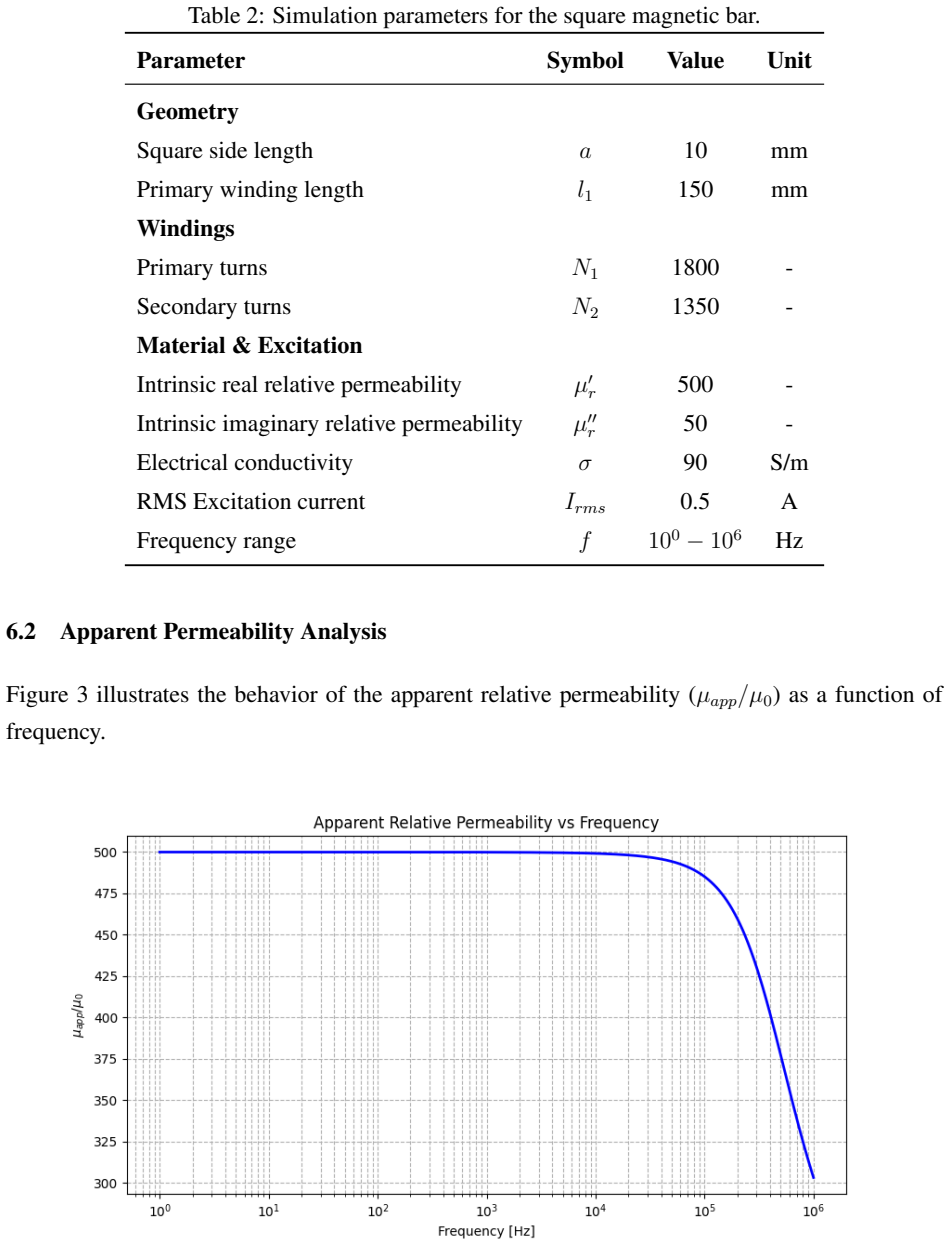
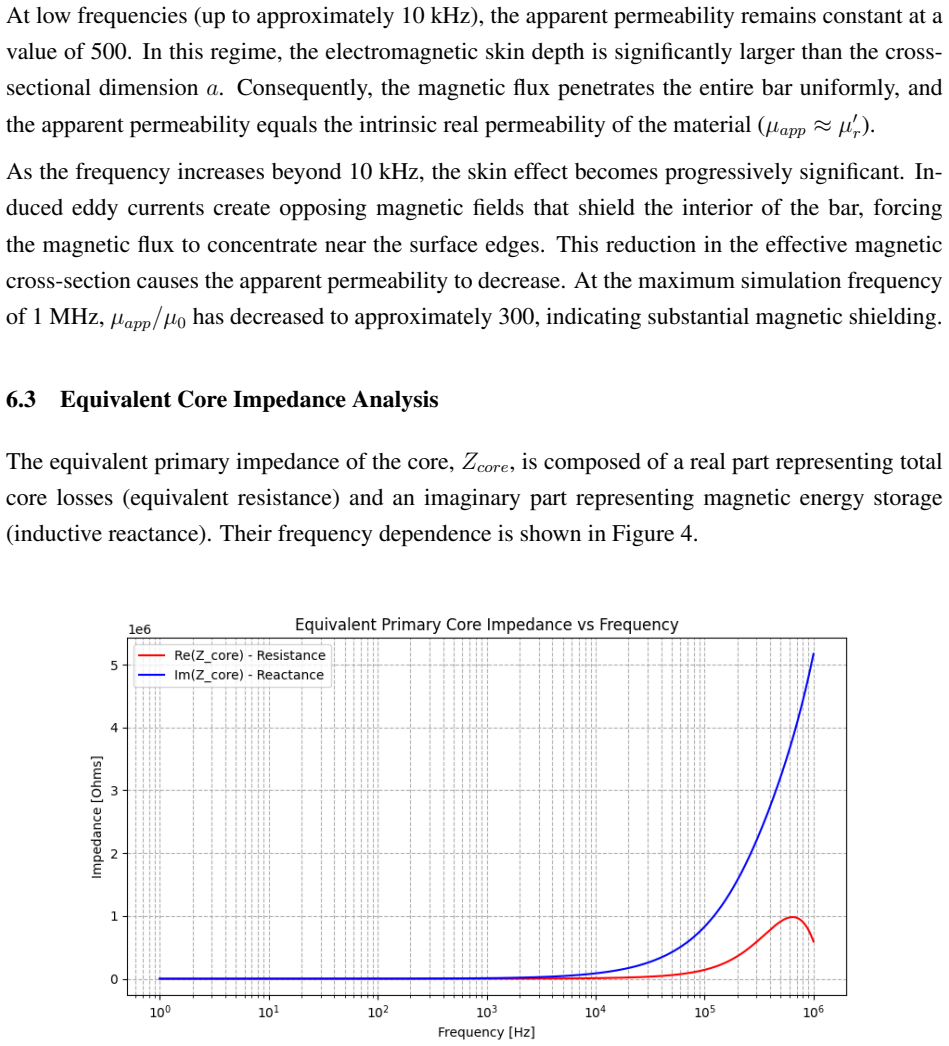
This paper presents a complete two-dimensional theoretical model for the electromagnetic behavior of square-section solid magnetic bars under sinusoidal loading. Through the application of Maxwell's equations within a Cartesian coordinate system and the integration of complex permeability, exact mathematical expressions are derived for mutual impedance, internal magnetic fields, flux, and core losses. Hyperbolic functions are utilized to separate the variables, enabling the accurate representation of edge flux accumulation and the 2D skin effect. In addition to mathematically decoupling eddy current and hysteresis losses, this formulation yields a new apparent permeability parameter. This parameter establishes a fast, reliable method for magnetic steel characterization that bypasses the extensive processing times associated with Finite Element Analysis (FEA). Numerical results over 1 Hz-1 MHz show the apparent relative permeability decreasing from 500 to 300 and a characteristic resistance peak near 700 kHz, marking the transition from volumetric to surface-dominated loss regimes.
Editorial analysis
A structured set of objections, weighed in public.
Referee Report
Summary. The manuscript presents a two-dimensional Cartesian model for square-cross-section magnetic bars under sinusoidal excitation, solving Maxwell's equations with complex permeability to derive exact expressions (via hyperbolic functions) for mutual impedance, internal fields, flux, and core losses. It introduces a new apparent permeability parameter claimed to enable fast magnetic steel characterization without FEA, with numerical results over 1 Hz–1 MHz showing apparent relative permeability dropping from 500 to 300 and a resistance peak near 700 kHz.
Significance. If the 2D derivations are rigorous and the apparent permeability is independently useful, the analytical expressions could aid design of linear, infinite-length bars. However, the claimed practical significance for bypassing FEA in real steel characterization does not hold without addressing the model's omissions, limiting impact to theoretical cases.
major comments (2)
- [Abstract] Abstract: the central claim that the apparent permeability 'establishes a fast, reliable method for magnetic steel characterization that bypasses the extensive processing times associated with Finite Element Analysis (FEA)' is unsupported, as no equations demonstrate independent derivation (versus reduction to the input complex permeability), and no validation against 3D FEA or experiments is provided.
- [Abstract] Abstract: the strictly 2D Cartesian formulation (with separation via hyperbolic functions) assumes infinite length and linear sinusoidal response, but the claim for practical characterization requires that neglected z-direction end effects and nonlinearity do not alter the internal field distribution or effective impedance; this assumption is load-bearing and untested.
minor comments (1)
- [Abstract] Abstract: the assertion of 'mathematically decoupling eddy current and hysteresis losses' via complex permeability requires clarification, as the complex permeability approach typically models their combined effect rather than separating them.
Simulated Author's Rebuttal
We thank the referee for the constructive comments on the abstract. We address each major comment below and revise the manuscript to ensure claims accurately reflect the 2D analytical scope.
read point-by-point responses
-
Referee: [Abstract] Abstract: the central claim that the apparent permeability 'establishes a fast, reliable method for magnetic steel characterization that bypasses the extensive processing times associated with Finite Element Analysis (FEA)' is unsupported, as no equations demonstrate independent derivation (versus reduction to the input complex permeability), and no validation against 3D FEA or experiments is provided.
Authors: The apparent permeability is derived by equating the 2D analytically computed flux (from the hyperbolic-function solutions for the square geometry) to an equivalent uniform-field expression, yielding a geometry-dependent effective parameter that incorporates edge effects and 2D skin effect. It is not a direct reduction of the input complex permeability. We agree the manuscript provides no experimental validation or 3D FEA comparisons, as the focus is the exact 2D derivation. We will revise the abstract to limit the claim to 'within the 2D infinite-length model, offering a rapid analytical alternative to FEA for such cases.' revision: partial
-
Referee: [Abstract] Abstract: the strictly 2D Cartesian formulation (with separation via hyperbolic functions) assumes infinite length and linear sinusoidal response, but the claim for practical characterization requires that neglected z-direction end effects and nonlinearity do not alter the internal field distribution or effective impedance; this assumption is load-bearing and untested.
Authors: The model is formulated under the explicit assumptions of infinite z-length and linear response with complex permeability, enabling the exact variable separation. These assumptions are stated in the manuscript. We acknowledge that end effects and nonlinearity in real finite bars remain untested here and could affect impedance. We will revise the abstract and add a clarifying sentence in the introduction noting the idealized scope. revision: yes
Circularity Check
No circularity detected; derivation is self-contained
full rationale
The provided abstract and description show a standard analytical derivation: Maxwell's equations are solved in 2D Cartesian coordinates for a square bar using complex permeability as an input material property, hyperbolic functions for separation of variables, and resulting expressions for impedance, fields, flux, and losses. The apparent permeability is described as an output parameter yielded by this formulation, not defined in terms of itself or obtained by fitting a subset of data and renaming the fit. No self-citation chains, uniqueness theorems, or ansatzes smuggled via prior work are referenced. The model assumptions (sinusoidal loading, 2D treatment) are stated explicitly as limitations rather than hidden equivalences. This is the common case of an independent analytical model whose central claim does not reduce to its inputs by construction.
Axiom & Free-Parameter Ledger
Reference graph
Works this paper leans on
-
[1]
2015 , url=
Measurements and estimation of the complex valued permeability of magnetic steel , author=. 2015 , url=
2015
-
[2]
Per-Unit Hysteresis and Eddy Loss Method Based on 3D Finite Elements for Non-Symmetric Toroidal Magnetic , author=. IEEE Access , volume=. 2020 , publisher=. doi:10.1109/ACCESS.2020.2975063 , url=
-
[3]
IEEE Transactions on Magnetics , volume=
Finite-Element Modeling and Measurements of Flux and Eddy Current Distribution in Toroidal Cores Wound From Electrical Steel , author=. IEEE Transactions on Magnetics , volume=. 2008 , publisher=. doi:10.1109/TMAG.2007.916232 , url=
-
[4]
2009 International Conference on Electrical Machines and Systems , pages=
Eddy current power losses in a toroidal laminated core with rectangular cross section , author=. 2009 International Conference on Electrical Machines and Systems , pages=. 2009 , organization=. doi:10.1109/ICEMS.2009.5382736 , url=
-
[5]
2020 , url=
Numerical modelling of magnetic characteristics of ferrite core taking account of both eddy current and displacement current , journal=. 2020 , url=
2020
-
[6]
IEEE Transactions on Magnetics , volume=
Eddy-current power loss in toroidal cores with rectangular cross section , author=. IEEE Transactions on Magnetics , volume=. 1998 , publisher=. doi:10.1109/20.668058 , url=
-
[7]
2026 , eprint=
Electromagnetic Characterization of magnetic ring: Case of square cross section shape , author=. 2026 , eprint=
2026
-
[8]
2026 , eprint=
Electromagnetic Characterization of Magnetic Ring: Case of Circular Cross-Section Shape , author=. 2026 , eprint=
2026
-
[9]
FEM Simulation of Effect of Non-Uniform Air Gap on Apparent Permeability of Cut Cores , year=
Zurek, Stan , journal=. FEM Simulation of Effect of Non-Uniform Air Gap on Apparent Permeability of Cut Cores , year=
-
[10]
Daniel Wöckinger and Christoph Dobler and Gereon Goldbeck and Gerd Bramerdorfer , keywords =. Electromagnetic characterization of ring-shaped specimens with a model-based parameter estimator , journal =. 2024 , issn =. doi:https://doi.org/10.1016/j.jmmm.2024.171773 , url =
-
[11]
Physics Education , abstract =
Linchevskyi, Igor , title =. Physics Education , abstract =. 2026 , month =. doi:10.1088/1361-6552/ae4a69 , url =
discussion (0)
Sign in with ORCID, Apple, or X to comment. Anyone can read and Pith papers without signing in.