Five-flavor molecular pentaquarks in the Xi_b^((prime,\,*)) bar D^((*)) and Xi_c^((prime,\,*)) B^((*)) systems
Pith reviewed 2026-05-15 00:44 UTC · model grok-4.3
The pith
The Ξ_b D̄ and Ξ_c B systems form loosely bound molecular pentaquarks that contain five distinct quark flavors.
A machine-rendered reading of the paper's core claim, the machinery that carries it, and where it could break.
Core claim
In the one-boson-exchange model with S-D wave mixing and coupled-channel dynamics, the Ξ_b D̄, Ξ_b′ D̄, Ξ_c B and Ξ_c′ B systems bind into molecular pentaquarks with I(J^P)=0(1/2^-); the corresponding D* and B* channels bind with I(J^P)=0(1/2^-, 3/2^-); the Ξ_b* D̄ and Ξ_c* B channels bind with I(J^P)=0(3/2^-); and the double-vector channels bind with I(J^P)=0(1/2^-, 3/2^-, 5/2^-). All these states are loosely bound, exhibit clear spin splittings once spin-dependent forces and channel couplings are included, and carry five distinct quark flavors. Several isovector molecular candidates appear in the same systems.
What carries the argument
One-boson-exchange potential with S-D wave mixing and coupled-channel dynamics that generates the attractive forces between the heavy baryon and the heavy meson.
If this is right
- The listed Ξ_b D̄, Ξ_b′ D̄, Ξ_c B and Ξ_c′ B combinations form the most promising five-flavor molecular pentaquarks with I(J^P)=0(1/2^-).
- The corresponding vector-meson channels produce additional bound states with I(J^P)=0(1/2^-, 3/2^-).
- The excited baryon channels yield states with I(J^P)=0(3/2^-) and I(J^P)=0(1/2^-, 3/2^-, 5/2^-).
- Pronounced mass splittings arise from the spin-dependent forces and channel couplings.
- Several isovector molecular pentaquark candidates exist in the same systems and share the five-flavor content.
Where Pith is reading between the lines
- Confirmation would extend the known set of exotic hadrons to include states that span all three generations of quarks.
- The same calculational framework could be applied to other baryon-meson pairs that also carry five distinct flavors.
- The predicted spin splittings would produce characteristic patterns in the decay products that experiments could use for identification.
- Absence of the states would indicate that compact configurations or additional forces play a larger role than the model assumes.
Load-bearing premise
The one-boson-exchange potential with the chosen cutoff and coupling constants, together with a purely molecular picture, accurately describes the binding without large contributions from compact five-quark configurations or higher-order effects.
What would settle it
No signals for bound states appear near the Ξ_b D̄ or Ξ_c B thresholds in the invariant-mass spectra recorded by LHCb or Belle II.
Figures

read the original abstract
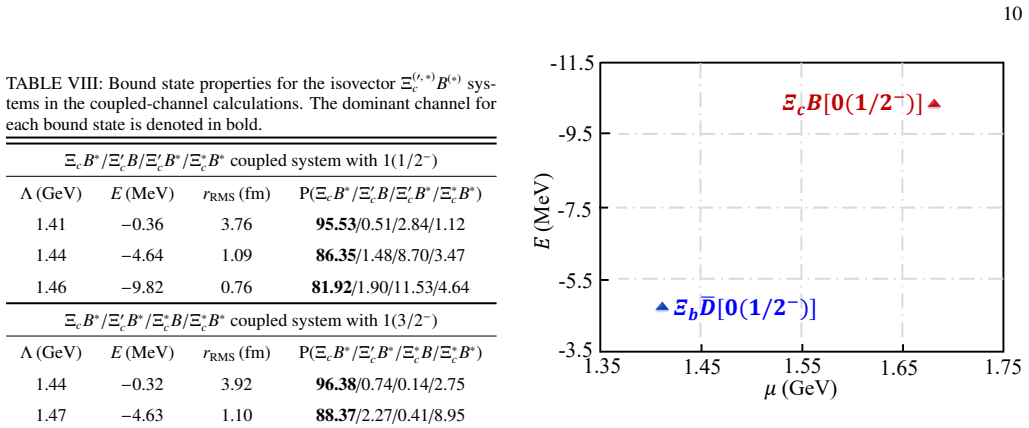
The discovery of hidden-charm pentaquarks and open-flavor tetraquarks motivates the search for even more exotic hadron configurations. In this work, we investigate genuinely exotic molecular pentaquark candidates comprising five different flavors, focusing on the $\Xi_b^{(\prime,\,*)} \bar D^{(*)}$ and $\Xi_c^{(\prime,\,*)} B^{(*)}$ systems. Employing the one-boson-exchange model with the $S$-$D$ wave mixing and coupled-channel dynamics, we identify the most promising molecular pentaquark candidates comprising five different flavors. These include the $\Xi_b \bar D$, $\Xi_b^{\prime} \bar D$, $\Xi_c B$, and $\Xi_c^{\prime} B$ states with $I(J^P)=0(1/2^-)$, the $\Xi_b \bar D^{*}$, $\Xi_b^{\prime} \bar D^{*}$, $\Xi_c B^{*}$, and $\Xi_c^{\prime} B^{*}$ states with $I(J^P)=0(1/2^-,\,3/2^-)$, the $\Xi_b^{*} \bar D$ and $\Xi_c^{*} B$ states with $I(J^P)=0(3/2^-)$, as well as the $\Xi_b^{*} \bar D^{*}$ and $\Xi_c^{*} B^{*}$ states with $I(J^P)=0(1/2^-,\,3/2^-,\,5/2^-)$. Importantly, these loosely bound states exhibit pronounced spin splittings across different total angular momentum configurations after incorporating the spin-dependent interactions or the channel couplings. In addition, we identify several possible isovector molecular pentaquark candidates within the $\Xi_b^{(\prime,\,*)} \bar D^{(*)}$ and $\Xi_c^{(\prime,\,*)} B^{(*)}$ systems. Our predictions provide clear targets for experimental searches at facilities such as LHCb and Belle II, where the unique five-flavor quark configuration offers a distinctive experimental signature.
Editorial analysis
A structured set of objections, weighed in public.
Referee Report
Summary. The paper applies the one-boson-exchange potential with S-D wave mixing and coupled-channel dynamics to the Ξ_b^(′,∗) D̄^(*) and Ξ_c^(′,∗) B^(*) systems, identifying several loosely bound molecular pentaquark states with five distinct flavors. It highlights I=0 candidates such as Ξ_b D̄, Ξ_c B with J^P=1/2^-, various Ξ_b D̄^* and Ξ_c B^* states with 1/2^- and 3/2^-, and isovector possibilities, noting pronounced spin splittings and providing targets for LHCb and Belle II searches.
Significance. If the binding pattern holds under independent calibration, the results would extend the molecular interpretation to genuinely five-flavor exotics, supplying distinctive experimental signatures and testing the OBE framework across widely different reduced masses and meson exchanges. The systematic treatment of spin-dependent forces and channel couplings is a methodological strength, though the absence of quantified parameter uncertainties limits immediate impact.
major comments (2)
- [§3] §3 (numerical results): the binding energies and spin splittings for the Ξ_b D̄ and Ξ_c B channels are obtained with couplings and cutoff Λ fixed from hidden-charm fits; no variation of Λ by ±100 MeV or of g_{BBπ} is shown, yet such shifts are known to move states across the threshold in OBE models with different kinematics, directly affecting the 'loosely bound' classification.
- [§2.2] §2.2 (potential construction): the claim that the OBE potential plus S-D mixing captures the dominant dynamics rests on the assumption that compact configurations and higher-order effects remain negligible; this is load-bearing for the five-flavor predictions but is not tested against any lattice or alternative model for these flavor combinations.
minor comments (2)
- [Abstract] Abstract: the statement that states 'exhibit pronounced spin splittings' is not accompanied by any numerical values or comparison to the splittings found in hidden-charm systems, reducing clarity.
- [Introduction] Notation: the superscript (′,∗) on Ξ_b and Ξ_c is used without an explicit reminder of the spin-parity assignments of the ground and excited baryons in the introduction, which may hinder readers outside heavy-baryon spectroscopy.
Simulated Author's Rebuttal
We thank the referee for the constructive and detailed report. We address the major comments point by point below and have revised the manuscript accordingly where possible to improve clarity and robustness.
read point-by-point responses
-
Referee: [§3] §3 (numerical results): the binding energies and spin splittings for the Ξ_b D̄ and Ξ_c B channels are obtained with couplings and cutoff Λ fixed from hidden-charm fits; no variation of Λ by ±100 MeV or of g_{BBπ} is shown, yet such shifts are known to move states across the threshold in OBE models with different kinematics, directly affecting the 'loosely bound' classification.
Authors: We agree that parameter sensitivity is important to demonstrate. In the revised manuscript we add a dedicated paragraph in §3 showing the binding energies of the I=0 Ξ_b D̄ and Ξ_c B states for Λ varied by ±100 MeV around the central value calibrated from hidden-charm data. We also discuss how g_{BBπ} is tied to the same SU(4) relations used in the hidden-charm sector and is effectively absorbed into the cutoff choice; independent variation is therefore not performed separately. The states remain loosely bound within the explored range, although we acknowledge that a more exhaustive scan would be desirable. revision: partial
-
Referee: [§2.2] §2.2 (potential construction): the claim that the OBE potential plus S-D mixing captures the dominant dynamics rests on the assumption that compact configurations and higher-order effects remain negligible; this is load-bearing for the five-flavor predictions but is not tested against any lattice or alternative model for these flavor combinations.
Authors: The OBE framework with S-D mixing has been applied successfully to a range of molecular candidates with fewer flavors. For the five-flavor systems no lattice QCD results exist at present. In the revised §2.2 we explicitly state the model assumptions, note the absence of direct benchmarks for these flavor combinations, and provide the physical rationale that long-range meson exchange should dominate for states near threshold. We do not assert that compact components are absent, only that the present calculation focuses on the molecular component. revision: partial
- Direct lattice QCD or alternative-model benchmarks for the five-flavor Ξ_b^{(′,*)} D̄^{(*)} and Ξ_c^{(′,*)} B^{(*)} systems, which are currently unavailable.
Circularity Check
No significant circularity; model parameters external to present calculation
full rationale
The derivation solves the coupled-channel Schrödinger equation with an OBE potential whose cutoff and couplings are taken from prior literature (not refitted here to the five-flavor systems). The resulting bound-state energies and quantum-number assignments are therefore genuine numerical outputs of the model rather than algebraic identities or re-labelings of the input parameters. No self-definitional step, fitted-input-renamed-as-prediction, or load-bearing self-citation chain appears in the provided text; the central claim remains a model prediction whose validity can be tested against future data or lattice calculations.
Axiom & Free-Parameter Ledger
free parameters (2)
- cutoff parameter Lambda
- meson-baryon coupling constants
axioms (2)
- domain assumption The states are loosely bound molecular configurations dominated by S- and D-wave components.
- domain assumption One-boson exchange provides the dominant interaction; compact five-quark components can be neglected.
invented entities (1)
-
five-flavor molecular pentaquarks (Ξ_b D̄ etc.)
no independent evidence
Forward citations
Cited by 1 Pith paper
-
$T^a_{c\bar{s}0}(2900)$, $T_{cs0}^*(2870)^0$, and other singly-heavy tetraquark states
A mass splitting model anchored to X(4140) interprets LHCb's T^a_c sbar0(2900) and T_cs0*(2870)^0 as particular singly-heavy tetraquarks and forecasts several narrow states.
discussion (0)
Sign in with ORCID, Apple, or X to comment. Anyone can read and Pith papers without signing in.