REVIEW 3 major objections 6 minor 15 references
Task-Aware Adaptive Modulation: A Replay-Free and Resource-Efficient Approach For Continual Graph Learning
T0 review · 3 major / 6 minor · reviewed 2026-08-05 · deepseek-v4-flash
Pith's one-line read A replay-free, pretraining-free continual graph learning method stores each task's expertise in a frozen lightweight modulator and routes test nodes by prototype similarity, achieving zero average forgetting on six benchmarks.
desk verdict Replay-free CGL that works well when test nodes arrive in task-homogeneous batches, but the batch-level task router leaves per-sample inference unsupported; worth reviewing with required experiments. read the letter →
The pith
A machine-rendered reading of the paper's core claim, the machinery that carries it, and where it could break.
The reading
What carries the argument
The Neural Synapse Modulator (NSM): a lightweight module inserted between frozen GNN layers that produces node-specific modulation parameters (γv, βv) by projecting a learned task embedding into K base heads and weighting them with a node-attention vector, then applying a FiLM-style affine transform to the normalized node features. The prototype-guided strategy carries the argument: mean aggregated features of each task act as a prototype that both selects the frozen expert NSM to run at inference (Eq. 14) and chooses which past modulator's weights seed the new task's modulator at training (Eqs. 9-11).
What would settle it
Evaluate TAAM under per-sample inference, where test nodes from different tasks are mixed in the same batch or queried individually, keeping the same training procedure. If average accuracy and average forgetting degrade sharply compared with the per-task batch evaluation, the prototype-router assumption is the cause; the paper reports no per-sample routing accuracy, so this measurement is missing.
Extended reading notes
Core claim
TAAM's central claim is that the stability-plasticity dilemma in graph class-incremental learning can be sidestepped rather than balanced: freeze a randomly initialized SGC backbone, isolate each task's knowledge in a separate frozen NSM, and route test inputs to the right NSM by matching prototypes in the SGC's feature space. Each NSM generates per-node FiLM-style scale and shift parameters from a learned task embedding and node attention, so it modulates the frozen network's internal computation flow rather than only its input. Because every NSM is frozen after training and the linear classifier only adds new class parameters, forgetting is structurally prevented; because each new NSM star
Load-bearing premise
The inference router assumes that all test nodes in a batch belong to a single task, so the batch's prototype closely matches one stored task prototype; if tasks arrive interleaved or one node at a time, the router's near-perfect selection and the zero-forgetting result may break down.
Editorial extensions
If this is right
- Replay-free and pretraining-free continual graph learning is achievable: the storage, compute, and privacy costs of replay buffers and pre-trained backbones are removed.
- Catastrophic forgetting can be driven to zero structurally, by freezing task-specific modulators, without sacrificing accuracy on new tasks.
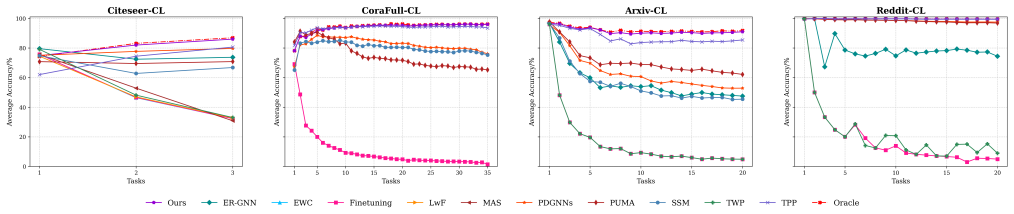
- Node-attentive internal modulation is a more expressive alternative to static prompts, improving on TPP by 4.0-7.3% average accuracy on Arxiv and Citeseer without needing its pre-trained backbone.
- The method scales to large graphs and unequal task splits, where the prompt-based competitor TPP runs out of memory.
- A randomly initialized two-layer SGC suffices as the backbone, so graph continual learning no longer depends on the availability of a strong pre-trained GNN.
Reading between the lines
- The prototype router effectively assumes batch-level task homogeneity: it builds one prototype over the whole test batch. My inference is that per-sample or interleaved inference would require a different routing mechanism, and the paper does not measure that regime.
- The 'copy from most similar past modulator' principle is broader than GCIL: it suggests that in non-stationary streams, knowledge transfer can be mediated by similarity in a frozen feature space rather than by rehearsal or shared trainable parameters, which could extend to continual learning with any frozen encoder.
- Because NSMs are frozen and accumulated, total parameter count grows linearly with the number of tasks. The benchmarks stop at 35 tasks, so long-horizon scaling or modulator-compression is an untested open question.
- A natural testable extension is to replace the prototype matcher with a small classifier trained on prototypes, then measure whether zero forgetting survives mixed-task or single-node queries.
Editorial analysis
A structured set of objections, weighed in public.
Referee Report
Summary. The paper proposes TAAM, a continual graph learning method for the graph class-incremental learning (GCIL) setting. It freezes a randomly initialized SGC backbone and inserts per-task Neural Synapse Modulators (NSMs) that produce node-attentive FiLM-style modulation parameters. A prototype-guided strategy is used twice: during training, a new NSM is warm-started from the most similar past NSM (Eqs. 9-12); at inference, a prototype computed from the test batch is matched to stored task prototypes to select one frozen NSM (Eq. 14, Algorithm 3). The final classifier is incrementally extended and past parameters are frozen. On six GCIL datasets, the paper reports state-of-the-art average accuracy and zero average forgetting, with ablations showing that the task-retrieval component is essential to the reported performance.
Significance. If the results hold under the intended protocol, TAAM would be a valuable contribution: it removes the pre-training dependency of prompt-based replay-free methods and avoids the storage costs of replay, while the per-task frozen modulators make forgetting structurally bounded. The prototype-guided warm start is a simple and plausible transfer mechanism, and the experimental suite is broad. The main caveat is that the central performance claims are obtained with a batch-level task-inference procedure whose assumptions are not stated or defended; because the retrieval component carries almost all of the performance (Table 4), the contribution cannot be fully assessed until that protocol question is resolved.
major comments (3)
- [Methods, Eq. (14); Appendix Algorithm 3] The test-time router computes ptest = (1/|Vtest|) Σ fagg(G,X)_v over the entire test batch and selects a single NSM for that batch. Under the per-task evaluation protocol, the test batch is task-homogeneous, so ptest is essentially the task prototype and retrieval is near-oracle. In the task-agnostic setting defined in the Preliminaries, test nodes may arrive singly or interleaved; then ptest is a diluted mixture and routing can collapse. Since Table 4 shows retrieval is load-bearing (Products AA falls from 94.9% to 3.6% without it), the reported AA/AF are not established outside task-homogeneous batches. Please report per-sample or mixed-task routing accuracy, or explicitly restrict the claims to transductive batch-level inference.
- [Methods, Training Objective and Algorithm 1] The text says that during a new task 'only the parameters ϕnew of the newly created modulator are updated' and Algorithm 1 line 13 updates only ϕnew, while the new output head is merely 'initialized.' With a randomly initialized and then frozen classifier head, new classes cannot be learned. Please clarify whether the new classifier head is trained and, if so, correct Algorithm 1 and the surrounding prose; this is essential for reproducibility.
- [Main Results, Table 2] The AF=0 result is largely structural: all past-task NSMs and past classifier weights are frozen, so forgetting can occur only if the router selects the wrong NSM. Under the per-task batch evaluation of Eq. (14), routing is near-perfect, making zero forgetting an expected property of the architecture/protocol combination rather than evidence of a learned stability-plasticity trade-off. The paper should state this and interpret the AF column accordingly.
minor comments (6)
- [Abstract/Introduction] Typos: 'repaly-free' in the abstract; 'Dateset' in the Experiments section; 'Sub-Modules' vs 'Synapse Modulators' used inconsistently.
- [Methods, Task-Aware Initialization] Abstract says the new NSM is initialized by 'deep-copying' from a similar past modulator, while the body (Eq. 11) copies only structural parameters and reinitializes the task embedding. Please use consistent terminology.
- [Appendix Algorithm 3] The algorithm labels ptest as 'Analogous to Eq. (9)' but does not specify whether fagg is the same fixed propagation used in training prototypes or the modulated forward pass. Please clarify.
- [Table 1] The table reports Cora with 7 classes and 3 tasks while Section Experiments says each task contains two classes; the last task must have one class. Please state this explicitly.
- [Main Results, Table 2] The Joint upper bound is far below Oracle and below TAAM on several datasets (e.g., Arxiv: 51.3 vs 90.4). Please explain the Joint setup, since readers may otherwise question whether it is a fair upper bound.
- [References] References for SSM are duplicated as Zhang et al. 2022b and 2022c.
Circularity Check
Headline SOTA/zero-forgetting claim rests on a test-batch self-selection router: Eq. (14) infers the task ID from the same test batch whose accuracy is then reported, so the 'task-aware' prediction is partly an artifact of batch homogeneity.
-
self definitional
[Methods, Task-Aware Retrieval (Eq. 14); Appendix Algorithm 3]
"During inference, the task ID for a given input graph is unknown. TAAM infers the most likely task ID, ˆτ, by applying the same prototype-matching logic. A prototype is computed for the test batch... τ̂ = arg minτ′∈{1,...,N} ‖p_test − p_τ′‖₂ (14). Algorithm 3: p_test ← (1/|V_test|) Σ_{v∈V_test} f_agg(G,X)_v."
The inferred task ID is defined as the nearest stored prototype to the average of the test batch's own aggregated features (Eq. 14 + Alg. 3). The same test batch is then classified with the NSM selected by this assignment and accuracy is reported on that same batch. Under the per-task evaluation protocol the batch is a single task, so the router is an oracle-like task-ID estimator that uses the test data itself rather than performing independent per-sample inference. Table 4's ablation shows removing this retrieval collapses Products AA from 94.9% to 3.6%, confirming the headline SOTA is carried by this self-selection. The paper reports no per-sample or mixed-task routing accuracy, so the 'task-aware' prediction is partly an artifact of batch-level self-assignment.
full rationale
The core NSM architecture, warm-start initialization, and the claim of avoiding pre-training are independent contributions and are not circular: the modulators are trained with a supervised objective on the current task, and the frozen-backbone/no-replay design is a genuine architectural choice. The only load-bearing circularity is the test-time router: the task ID is not predicted per sample but is defined as the nearest prototype to the average of the entire test batch, and the accuracy is then measured on that same batch. Because each NSM is task-specialized, the reported AA and zero-forgetting are conditional on this self-selection; the paper provides no per-sample or mixed-task evaluation to support the GCIL claim that task IDs are unavailable. There is no significant self-citation load-bearing: the benchmark comes from the corresponding author's prior work, but it is a public evaluation protocol, not an argument that forces the result. Thus the score is 6: partial circularity in the central task-identity prediction.
Assumptions & free parameters
free parameters (4)
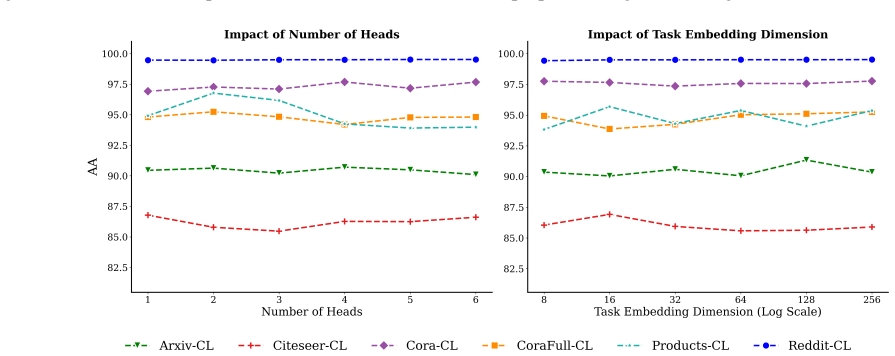
- Number of attention heads K =
3
- Task embedding dimension d_e =
64
- Training hyperparameters (learning rate 0.005, weight decay 5e-4, epochs 200)
- Backbone configuration (2-layer, hidden dim 256, no batch norm/dropout/bias)
assumptions (3)
- domain assumption Test batches at inference are task-homogeneous, so a batch-level prototype uniquely identifies the correct task.
- domain assumption Randomly initialized, frozen SGC features are expressive enough that per-task affine modulation makes classes linearly separable.
- domain assumption The graph setting is transductive: the aggregation function fagg uses the full graph including test nodes when computing prototypes.
Cite this review
Pith. "Pith review of Task-Aware Adaptive Modulation: A Replay-Free and Resource-Efficient Approach For Continual Graph Learning." pith.science (2026). https://pith.science/paper/T2KEC7U6
@misc{pith2026250900735,
  author       = {Pith},
  title        = {Pith review of: Task-Aware Adaptive Modulation: A Replay-Free and Resource-Efficient Approach For Continual Graph Learning},
  year         = {2026},
  howpublished = {\url{https://pith.science/paper/T2KEC7U6}},
  note         = {Machine review of arXiv:2509.00735}
}
read the original abstract
Continual Graph Learning(CGL)focuses on acquiring new knowledge while retaining previously learned information, essential for real-world graph applications. Current methods grapple with two main issues:1) The Stability-Plasticity Dilemma: Replay-based methods often create an imbalance between the Dilemma, while incurring significant storage costs.2) The Resource-Heavy Pre-training: Leading replay-free methods critically depend on extensively pre-trained backbones, this reliance imposes a substantial resource burden.In this paper, we argue that the key to overcoming these challenges lies not in replaying data or fine-tuning the entire network, but in dynamically modulating the internal computational flow of a frozen backbone. We posit that lightweight, task-specific modules can effectively steer a GNN's reasoning process. Motivated by this insight, we propose Task-Aware Adaptive Modulation(TAAM), a replay-free, resource-efficient approach that charts a new path for navigating the stability-plasticity dilemma. TAAM's core is its Neural Synapse Modulators(NSM), which are trained and then frozen for each task to store expert knowledge. A pivotal prototype-guided strategy governs these modulators: 1) For training, it initializes a new NSM by deep-copying from a similar past modulator to boost knowledge transfer. 2) For inference, it selects the most relevant frozen NSM for each task. These NSMs insert into a frozen GNN backbone to perform fine-grained, node-attentive modulation of its internal flow-different from the static perturbations of prior methods. Extensive experiments show that TAAM comprehensively outperforms state-of-the-art methods across six GCIL benchmark datasets. The code will be released upon acceptance of the paper.
Figures


Figures from the paper (3 more)

Reference graph
Works this paper leans on
-
[2]
In- ductive Representation Learning on Large Graphs. ArXiv, abs/1706.02216. Houlsby, N.; Giurgiu, A.; Jastrzebski, S.; Morrone, B.; de Laroussilhe, Q.; Gesmundo, A.; Attariyan, M.; and Gelly, S
-
[9]
Towards Robust Graph Incremental Learning on Evolving Graphs
Towards Robust Graph Incremental Learning on Evolving Graphs. ArXiv, abs/2402.12987. Tang, J.; Yang, Y .; Wei, W.; Shi, L.; Su, L.; Cheng, S.; Yin, D.; and Huang, C
-
[10]
Continual Learn- ing on Graphs: A Survey. ArXiv, abs/2402.06330. Wang, C.; Qiu, Y .; and Scherer, S. A
-
[11]
2022 IEEE/CVF Conference on Computer Vision and Pattern Recognition (CVPR), 13709–13718
Lifelong Graph Learning. 2022 IEEE/CVF Conference on Computer Vision and Pattern Recognition (CVPR), 13709–13718. Wang, Q.; Zhou, T.; Yuan, Y .; and Mao, R
work page 2022
-
[13]
IEEE Transactions on Pattern Analysis and Machine Intelligence, 45: 4622–4636
Hierarchical Proto- type Networks for Continual Graph Representation Learn- ing. IEEE Transactions on Pattern Analysis and Machine Intelligence, 45: 4622–4636. Zhang, X.; Song, D.; and Tao, D. 2022a. CGLB: Benchmark Tasks for Continual Graph Learning. In Neural Information Processing Systems. Zhang, X.; Song, D.; and Tao, D. 2022b. Sparsified Sub- graph M...
work page 2022
-
[15]
focuses on preserv- ing important parameters within a topological aggrega- tion framework and introduces a loss minimization strat- egy for previous tasks that relies on these preserved pa- rameters. • ER-GNN (Zhou and Cao 2021b) is a replay-based method that constructs a memory buffer by storing rep- resentative nodes selected from previous tasks. • SSM ...
work page 2023
-
[2014]
The objective is to classify posts into their corresponding communities (subreddits)
Here, nodes are individual posts, and an edge connects two posts if the same user has com- mented on both. The objective is to classify posts into their corresponding communities (subreddits). Node fea- tures are engineered from post attributes such as title, content, score, and comment count. • Products(Hu et al. 2020): An Amazon product co- purchase net...
work page 2020
-
[2016]
Semi-Supervised Classification with Graph Convolutional Networks. Arxiv, abs/1609.02907. Kirkpatrick, J.; Pascanu, R.; Rabinowitz, N. C.; Veness, J.; Desjardins, G.; Rusu, A. A.; Milan, K.; Quan, J.; Ramalho, T.; Grabska-Barwinska, A.; Hassabis, D.; Clopath, C.; Ku- maran, D.; and Hadsell, R
Show all 15 references
-
[2017]
ArXiv, abs/1711.09601
Memory Aware Synapses: Learning what (not) to forget. ArXiv, abs/1711.09601. Fang, T.; Zhang, Y .; Yang, Y .; Wang, C.; and Chen, L
-
[2019]
arXiv:1902.00751
Parameter-Efficient Transfer Learning for NLP. arXiv:1902.00751. Hu, W.; Fey, M.; Zitnik, M.; Dong, Y .; Ren, H.; Liu, B.; Catasta, M.; and Leskovec, J
1902 arXiv
-
[2020]
ArXiv, abs/2005.00687
Open Graph Bench- mark: Datasets for Machine Learning on Graphs. ArXiv, abs/2005.00687. Kipf, T. N.; and Welling, M
2005 arXiv
-
[2021]
arXiv:2107.13586
Pre-train, Prompt, and Predict: A Systematic Sur- vey of Prompting Methods in Natural Language Processing. arXiv:2107.13586. Liu, Y .; Qiu, R.; and Huang, Z
-
[2023]
Arxiv, abs/2309.09455
CaT: Balanced Con- tinual Graph Learning with Graph Condensation. Arxiv, abs/2309.09455. Liu, Y .; Qiu, R.; Tang, Y .; Yin, H.; and Huang, Z
-
[2024]
Arxiv, abs/2312.14439
PUMA: Efficient Continual Graph Learning for Node Clas- sification with Graph Condensation. Arxiv, abs/2312.14439. Liu, Z.; Yu, X.; Fang, Y .; and Zhang, X. 2023b. Graph- Prompt: Unifying Pre-Training and Downstream Tasks for Graph Neural Networks. Proceedings of the ACM Web C...
-
[2025]
ArXiv, abs/2502.06327
Prompt- Driven Continual Graph Learning. ArXiv, abs/2502.06327. Wu, F.; Zhang, T.; de Souza, A. H.; Fifty, C.; Yu, T.; and Weinberger, K. Q
Reviewed August 5, 2026 · model on record in the stance chip above.
Discussion (0). Sign in to comment.