REVIEW 3 major objections 5 minor 1 cited by
TSP3D: Text-guided Sparse Voxel Pruning for Efficient 3D Visual Grounding
T0 review · 3 major / 5 minor · reviewed 2026-08-07 · deepseek-v4-flash
Pith's one-line read TSP3D reports state-of-the-art 3D visual grounding accuracy with a single-stage sparse-convolution network running at 12.43 FPS.
desk verdict First sparse-conv single-stage 3D grounding with real speed gains; the speed margin needs a closer look but the core result holds up. read the letter →
The pith
A machine-rendered reading of the paper's core claim, the machinery that carries it, and where it could break.
The reading
What carries the argument
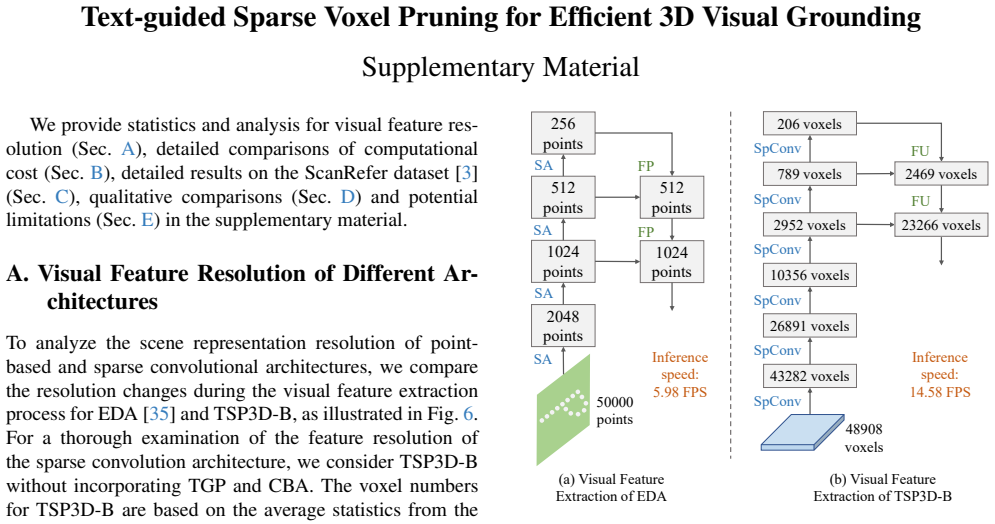
The load-bearing mechanism is text-guided pruning (TGP): at each feature upsampling level, text-conditioned cross-attention scores voxels and a step function at a threshold removes those with low scores, so the voxel count drops to about 7 percent of its unpruned size before the remaining voxels attend to text. The companion mechanism is completion-based addition (CBA), which uses a text-conditioned MLP to flag target regions in high-resolution backbone features and interpolates any of those regions missing from the pruned upsampled map, counteracting over-pruning. Together they convert a sparse-convolution detector into a single-stage grounding network in which deep multimodal interaction is computed on a tiny, text-focused voxel set.
What would settle it
Run each published baseline with its official checkpoint and tuned inference settings, including any 2D feature extraction time, on the same RTX 3090 at batch size 1, and compare end-to-end FPS with the released TSP3D code. If any baseline reaches or exceeds 12.43 FPS under those conditions, the paper's speed claim is falsified; if TSP3D's Acc@0.5 on ScanRefer drops below the published two-stage best of 45.58 when the comparison is re-run, the accuracy claim is falsified.
Extended reading notes
Core claim
TSP3D is a fully sparse single-stage 3D visual grounding network. It uses three levels of sparse convolutions to encode the scene, then, during each of two upsampling stages, uses text features to compute a retention mask and prune away voxels that are likely background or irrelevant objects. The pruned set is small enough that self-attention and cross-attention between voxels and text become cheap. A completion-based addition then compares the pruned upsampled features with high-resolution backbone features flagged as target-related, and interpolates the missing voxels, repairing over-pruning. The paper claims this design is the first to bring sparse convolutional architectures to 3D visual grounding and that it obtains state-of-the-art accuracy while being the fastest single-stage method.
Load-bearing premise
The central speed claim rests on the fairness of the authors' reproduction of every competing method's FPS on a single RTX 3090 at batch size 1; if those baselines were run with suboptimal settings, the claimed margin of roughly 100% faster could shrink or vanish.
Editorial extensions
If this is right
- If the reported FPS is reproducible, single-stage 3D grounding can operate at interactive rates on a consumer GPU, which matters for robots and AR/VR where two-stage pipelines at under 6 FPS are impractical.
- Text-guided pruning acts as a learned attention mask: it can discard background voxels early, so the cost of cross-modal attention scales with the referent and its nearby objects rather than the whole scene.
- Completion-based addition directly addresses the failure mode of aggressive pruning, suggesting that pruning-based efficiency need not trade away small or narrow objects.
- The architecture transfers the multi-level sparse-convolution recipe from 3D detection to grounding, implying that other detection-to-grounding transfers may inherit the speed benefit.
- The accuracy gains on ScanRefer, NR3D, and SR3D indicate that efficient sparse pipelines can exceed the accuracy of two-stage detect-then-match methods, not merely match them.
Reading between the lines
- A testable extension would supervise the pruning mask with a soft, class-agnostic segmentation signal instead of the current center-based cubes, which may sharpen pruning on thin and elongated objects.
- Because the paper excludes 2D feature extraction time for methods that use RGB input, an end-to-end comparison that includes those 2D backbones would likely widen TSP3D's speed lead rather than shrink it, but this should be measured.
- The pairing of hard pruning with a cheap restoration pathway suggests a general design principle: any aggressive pruning module should be accompanied by a high-resolution completion module, a pattern applicable beyond grounding.
- The reported 12.43 FPS is for PyTorch at batch size 1; deployment with TensorRT or larger batches could shift relative rankings, so the speed claim should be re-tested in the target inference environment.
Editorial analysis
A structured set of objections, weighed in public.
Referee Report
Summary. The paper proposes TSP3D, a single-stage 3D visual grounding architecture built on a multi-level sparse convolutional backbone. To make cross-modal attention tractable on a large voxel representation, it introduces text-guided pruning (TGP), which progressively removes background and irrelevant-object voxels under textual guidance, and completion-based addition (CBA), which restores target regions that are over-pruned. The method is evaluated on ScanRefer, Nr3D, and Sr3D, reporting state-of-the-art accuracy (Acc@0.5 46.71 on ScanRefer, 48.7 on Nr3D, 57.1 on Sr3D) and 12.43 FPS on a single RTX 3090, with ablations showing that TGP is the main accuracy driver. The paper also provides component-level speed analysis in the supplementary material and releases the TSP3D code.
Significance. If the efficiency numbers are reproducible, the paper makes a useful contribution: it is the first single-stage 3D visual grounding method based on sparse convolutions, and it demonstrates a principled way to make voxel-text cross-attention affordable through text-guided pruning. The accuracy experiments are extensive, the central TGP ablation is large and internally consistent, and the qualitative visualizations support the claimed pruning and completion behavior. The main risk is not the architecture idea but the external validity of the speed comparison, which relies on unreleased baseline reproductions, and an inconsistency between the final configuration and the CBA ablation. With those points addressed, the paper would be a solid contribution to efficient 3D visual grounding.
major comments (3)
- [§3.2, Eqs. (3)–(4); Fig. 2(d)] The formal description of TGP in Eqs. (3)–(4) is written for the non-simplified variant that uses FPS, predicts the pruning mask before any voxel-text interaction, and then performs self- and cross-attention after pruning. The paper then adopts a "simplified TGP" (Fig. 2(d)) that removes FPS, merges the two interactions into one, and moves the merged interaction before pruning. No equations, tensor-shape description, or cost analysis is given for this simplified variant, even though Table 5 indicates that the simplified TGP is the configuration used in the final model. A reader cannot tell which equations correspond to the method that produced Tables 1–5, which is a significant reproducibility gap.
- [§4.4, Tables 3–4; Table 1] The final model configuration is ambiguous. Table 4 shows that adding the level-2 CBA on top of the level-1 CBA slightly hurts accuracy (56.22 vs 56.45 at Acc@0.25; 46.68 vs 46.71 at Acc@0.5) and reduces speed (12.19 vs 12.43 FPS). The final TSP3D numbers in Table 1, 56.45/46.71 at 12.43 FPS, match exactly the row of Table 4 with only the level-1 CBA, not the row with both CBAs. The text and Figure 2, however, describe CBA as applied at multiple levels without stating that the level-2 CBA is dropped in the final model. The paper should explicitly state which CBA levels are used in the headline configuration and reconcile the ablation tables with the final numbers.
- [§4.3, Table 1; Supplementary Sec. B] The central efficiency claim depends on baseline FPS numbers that are not independently verifiable. Table 1 states that "the inference speeds of other methods are obtained through our reproduction with a single RTX 3090 and a batch size of 1," but no code, configuration files, checkpoints, or measurement scripts for these reproductions are released, and the paper does not report details such as warmup, mixed precision, input point counts, or post-processing times for the baselines. The factor-of-two FPS advantage over the previous fastest single-stage method is therefore an assertion about the quality of the authors' baseline implementations as much as about TSP3D. The caveat that 2D feature extraction time is excluded for 3D+2D methods is appropriate, but it also underlines that the comparison is not fully end-to-end. The authors should release the measurement setup and ideally the reproduced baseline code so that the speed claim can be checked.
minor comments (5)
- [Abstract; §3.1; §4.4] There are several typos and wording errors: "affect" should be "effect" in the abstract and elsewhere; "computetd" in §3.4 should be "computed"; "adpat" in §4.4 should be "adaptive" or "adaptively"; and the Figure 2 caption says "bulids" instead of "builds."
- [Table 2] The claim that TSP3D "outperforms previous works under the pipeline of Two-stage using Detected Boxes" is made against a subset of prior methods: VPP-Net and G3-LQ, which have strong two-stage ground-truth-box results, are not reported in the detected-box setting. The authors should either add those entries or qualify the claim.
- [Tables 3–4] Several ablation differences are very small (e.g., 55.20 vs 55.17 in Table 4, and 46.15 vs 46.06). The paper does not state the number of evaluation runs or report standard deviations, so it is unclear whether these differences are meaningful. This is not critical for the main TGP conclusion, but it would improve the rigor of the ablation discussion.
- [Supplementary Sec. B, Table 6] The component-level speed table is helpful, but the "text decouple" column lists high FPS values for methods that include RoBERTa-based decoding while TSP3D has no entry, which makes the comparison across architectures difficult to interpret. The authors should clarify what operations are included in each component for each method.
- [Supplementary Sec. E] The supplementary limitation that TSP3D is slightly slower than its own baseline TSP3D-B is consistent with Table 3, but the main text's framing of "top inference speed" refers only to comparison with prior methods. It would be helpful to state this internal trade-off explicitly when introducing the efficiency claims.
Circularity Check
No circularity: the accuracy and speed claims are empirical benchmark measurements against external datasets, and the self-citations are contextual rather than load-bearing.
full rationale
TSP3D is an empirical benchmark paper rather than a derivation. Its central claims are the ScanRefer, NR3D, and SR3D accuracy numbers and the FPS measurements in Tables 1 and 2, both of which are evaluated against external datasets and published baselines. The pruning masks in TGP are supervised by ground-truth object centers during training, and the final grounding output is selected by objectness score; the reported Acc@0.5/Acc@0.25 results are not defined in terms of the pruning supervision or any fitted parameter renamed as a prediction. The speed comparison is explicitly stated as a reproduction with a single RTX 3090 and batch size 1, which is a measurement protocol rather than a construction that forces the reported margin. The self-citations, references [36] and [37], provide context for sparse convolution and multi-level architectures, but the core architectural inspiration is also attributed to the external FCAF3D [29] and TR3D [30], and TGP/CBA are ablated from scratch. No uniqueness theorem or ansatz is imported solely through a self-citation, and no known result is simply renamed. The stated limitations (TSP3D being slightly slower than TSP3D-B, and the offline point-cloud input) are acknowledged weaknesses, not circular reasoning. Therefore, the paper's central results are self-contained empirical claims with no significant circularity.
Assumptions & free parameters
free parameters (6)
- sigma_sce (scene-level pruning threshold) =
0.7
- sigma_tar (target-level pruning threshold) =
0.3
- tau (CBA completion threshold) =
0.15
- L (pruning supervision cube side) =
7
- lambda_1 to lambda_4 (loss weights) =
1 each
- Voxel sizes (1 cm initial, 2^(i+2) cm per level) =
1, 8, 16, 32 cm
assumptions (4)
- domain assumption Farthest point sampling over voxel features preserves the spatial distribution needed for text-guided pruning.
- domain assumption Object-center cube masks of side L=7 provide adequate supervision for both scene-level and target-level pruning.
- domain assumption Pre-trained RoBERTa text features are sufficiently aligned with 3D features for pruning and completion decisions.
- domain assumption The authors' reproduced FPS numbers for baseline methods are faithful to those methods' actual implementations.
Cite this review
Pith. "Pith review of TSP3D: Text-guided Sparse Voxel Pruning for Efficient 3D Visual Grounding." pith.science (2026). https://pith.science/paper/T2NZZMUP
@misc{pith2026250210392,
  author       = {Pith},
  title        = {Pith review of: TSP3D: Text-guided Sparse Voxel Pruning for Efficient 3D Visual Grounding},
  year         = {2026},
  howpublished = {\url{https://pith.science/paper/T2NZZMUP}},
  note         = {Machine review of arXiv:2502.10392}
}
abstract
In this paper, we propose an efficient multi-level convolution architecture for 3D visual grounding. Conventional methods are difficult to meet the requirements of real-time inference due to the two-stage or point-based architecture. Inspired by the success of multi-level fully sparse convolutional architecture in 3D object detection, we aim to build a new 3D visual grounding framework following this technical route. However, as in 3D visual grounding task the 3D scene representation should be deeply interacted with text features, sparse convolution-based architecture is inefficient for this interaction due to the large amount of voxel features. To this end, we propose text-guided pruning (TGP) and completion-based addition (CBA) to deeply fuse 3D scene representation and text features in an efficient way by gradual region pruning and target completion. Specifically, TGP iteratively sparsifies the 3D scene representation and thus efficiently interacts the voxel features with text features by cross-attention. To mitigate the affect of pruning on delicate geometric information, CBA adaptively fixes the over-pruned region by voxel completion with negligible computational overhead. Compared with previous single-stage methods, our method achieves top inference speed and surpasses previous fastest method by 100\% FPS. Our method also achieves state-of-the-art accuracy even compared with two-stage methods, with $+1.13$ lead of Acc@0.5 on ScanRefer, and $+2.6$ and $+3.2$ leads on NR3D and SR3D respectively. The code is available at \href{https://github.com/GWxuan/TSP3D}{https://github.com/GWxuan/TSP3D}.
Figures


Figures from the paper (4 more)



Forward citations
Cited by 1 Pith paper
-
T-Rex: Task-Adaptive Spatial Representation Extraction for Robotic Manipulation with Vision-Language Models
A zero-training framework that adaptively selects spatial representation extractors per object and per task stage improves real-world robot manipulation success and efficiency over fixed-representation baselines.
Reference graph
Works this paper leans on
-
[1]
3dref- transformer: Fine-grained object identification in real-world scenes using natural language
Ahmed Abdelreheem, Ujjwal Upadhyay, Ivan Skorokhodov, Rawan Al Yahya, Jun Chen, and Mohamed Elhoseiny. 3dref- transformer: Fine-grained object identification in real-world scenes using natural language. In WACV, pages 3941–3950,
-
[2]
Referit3d: Neural listeners for fine-grained 3d object identification in real-world scenes
Panos Achlioptas, Ahmed Abdelreheem, Fei Xia, Mohamed Elhoseiny, and Leonidas Guibas. Referit3d: Neural listeners for fine-grained 3d object identification in real-world scenes. In ECCV, pages 422–440. Springer, 2020. 2, 6
work page 2020
-
[3]
Scanrefer: 3d object localization in rgb-d scans using natural language
Dave Zhenyu Chen, Angel X Chang, and Matthias Nießner. Scanrefer: 3d object localization in rgb-d scans using natural language. In ECCV, pages 202–221. Springer, 2020. 1, 2, 3, 6, 4
work page 2020
-
[4]
Hierarchical aggregation for 3d instance segmentation
Shaoyu Chen, Jiemin Fang, Qian Zhang, Wenyu Liu, and Xinggang Wang. Hierarchical aggregation for 3d instance segmentation. In ICCV, pages 15467–15476, 2021. 2
work page 2021
-
[5]
V oxelnext: Fully sparse voxelnet for 3d object detection and tracking
Yukang Chen, Jianhui Liu, Xiangyu Zhang, Xiaojuan Qi, and Jiaya Jia. V oxelnext: Fully sparse voxelnet for 3d object detection and tracking. In CVPR, pages 21674–21683, 2023. 2
work page 2023
-
[6]
4d spatio-temporal convnets: Minkowski convolutional neural networks
Christopher Choy, JunYoung Gwak, and Silvio Savarese. 4d spatio-temporal convnets: Minkowski convolutional neural networks. In CVPR, pages 3075–3084, 2019. 2, 3
work page 2019
-
[7]
Empirical evaluation of gated recurrent neural networks on sequence modeling
Junyoung Chung, Caglar Gulcehre, KyungHyun Cho, and Yoshua Bengio. Empirical evaluation of gated recurrent neural networks on sequence modeling. arXiv preprint arXiv:1412.3555, 2014. 2
arXiv 2014
-
[8]
V oxel r-cnn: Towards high performance voxel-based 3d object detection
Jiajun Deng, Shaoshuai Shi, Peiwei Li, Wengang Zhou, Yanyong Zhang, and Houqiang Li. V oxel r-cnn: Towards high performance voxel-based 3d object detection. In AAAI, pages 1201–1209, 2021. 2
work page 2021
Show all 41 references
-
[9]
Bert: Pre-training of deep bidirectional transformers for language understanding
Jacob Devlin. Bert: Pre-training of deep bidirectional transformers for language understanding. arXiv preprint arXiv:1810.04805, 2018. 2
2018 arXiv
-
[10]
Free-form description guided 3d visual graph net- work for object grounding in point cloud
Mingtao Feng, Zhen Li, Qi Li, Liang Zhang, XiangDong Zhang, Guangming Zhu, Hui Zhang, Yaonan Wang, and Aj- mal Mian. Free-form description guided 3d visual graph net- work for object grounding in point cloud. In ICCV, pages 3722–3731, 2021. 2, 6, 3
2021
-
[11]
3d semantic segmentation with submanifold sparse convolutional networks
Benjamin Graham, Martin Engelcke, and Laurens Van Der Maaten. 3d semantic segmentation with submanifold sparse convolutional networks. In CVPR, pages 9224–9232,
-
[12]
Generative sparse detection networks for 3d single-shot ob- ject detection
JunYoung Gwak, Christopher Choy, and Silvio Savarese. Generative sparse detection networks for 3d single-shot ob- ject detection. In ECCV, pages 297–313. Springer, 2020. 2, 3
2020
-
[13]
Transrefer3d: Entity-and- relation aware transformer for fine-grained 3d visual ground- ing
Dailan He, Yusheng Zhao, Junyu Luo, Tianrui Hui, Shaofei Huang, Aixi Zhang, and Si Liu. Transrefer3d: Entity-and- relation aware transformer for fine-grained 3d visual ground- ing. In ACM MM, pages 2344–2352, 2021. 2
2021
-
[14]
Text-guided graph neural networks for refer- ring 3d instance segmentation
Pin-Hao Huang, Han-Hung Lee, Hwann-Tzong Chen, and Tyng-Luh Liu. Text-guided graph neural networks for refer- ring 3d instance segmentation. In AAAI, pages 1610–1618,
-
[15]
Multi- view transformer for 3d visual grounding
Shijia Huang, Yilun Chen, Jiaya Jia, and Liwei Wang. Multi- view transformer for 3d visual grounding. In CVPR, pages 15524–15533, 2022. 6
2022
-
[16]
Bottom up top down detection transform- ers for language grounding in images and point clouds
Ayush Jain, Nikolaos Gkanatsios, Ishita Mediratta, and Kate- rina Fragkiadaki. Bottom up top down detection transform- ers for language grounding in images and point clouds. In ECCV, pages 417–433. Springer, 2022. 1, 2, 3, 6, 7
2022
-
[17]
Pointgroup: Dual-set point grouping for 3d instance segmentation
Li Jiang, Hengshuang Zhao, Shaoshuai Shi, Shu Liu, Chi- Wing Fu, and Jiaya Jia. Pointgroup: Dual-set point grouping for 3d instance segmentation. In CVPR, pages 4867–4876,
-
[18]
Grounded language-image pre-training
Liunian Harold Li, Pengchuan Zhang, Haotian Zhang, Jian- wei Yang, Chunyuan Li, Yiwu Zhong, Lijuan Wang, Lu Yuan, Lei Zhang, Jenq-Neng Hwang, et al. Grounded language-image pre-training. In CVPR, pages 10965–10975,
-
[19]
A survey on text-guided 3d visual grounding: Elements, recent advances, and future directions
Daizong Liu, Yang Liu, Wencan Huang, and Wei Hu. A survey on text-guided 3d visual grounding: Elements, recent advances, and future directions. arXiv preprint arXiv:2406.05785, 2024. 2
2024 arXiv
-
[20]
Roberta: A robustly optimized bert pretraining approach
Yinhan Liu. Roberta: A robustly optimized bert pretraining approach. arXiv preprint arXiv:1907.11692, 2019. 3, 1
1907 arXiv
-
[21]
Group-free 3d object detection via transformers
Ze Liu, Zheng Zhang, Yue Cao, Han Hu, and Xin Tong. Group-free 3d object detection via transformers. In ICCV, pages 2949–2958, 2021. 2
2021
-
[22]
3d-sps: Single-stage 3d visual grounding via referred point progressive selection
Junyu Luo, Jiahui Fu, Xianghao Kong, Chen Gao, Haibing Ren, Hao Shen, Huaxia Xia, and Si Liu. 3d-sps: Single-stage 3d visual grounding via referred point progressive selection. In CVPR, pages 16454–16463, 2022. 1, 2, 3, 6
2022
-
[23]
Pytorch: An imperative style, high-performance deep learning library
Adam Paszke, Sam Gross, Francisco Massa, Adam Lerer, James Bradbury, Gregory Chanan, Trevor Killeen, Zem- ing Lin, Natalia Gimelshein, Luca Antiga, et al. Pytorch: An imperative style, high-performance deep learning library. NeurIPS, 32, 2019. 6
2019
-
[24]
Glove: Global vectors for word representation
Jeffrey Pennington, Richard Socher, and Christopher D Man- ning. Glove: Global vectors for word representation. In EMNLP, pages 1532–1543, 2014. 2
2014
-
[25]
Pointnet++: Deep hierarchical feature learning on point sets in a metric space
Charles Ruizhongtai Qi, Li Yi, Hao Su, and Leonidas J Guibas. Pointnet++: Deep hierarchical feature learning on point sets in a metric space. NeurIPS, 30, 2017. 2, 3, 1
2017
-
[26]
Deep hough voting for 3d object detection in point clouds
Charles R Qi, Or Litany, Kaiming He, and Leonidas J Guibas. Deep hough voting for 3d object detection in point clouds. In ICCV, pages 9277–9286, 2019. 2
2019
-
[27]
Multi-branch collaborative learning network for 3d visual grounding
Zhipeng Qian, Yiwei Ma, Zhekai Lin, Jiayi Ji, Xiawu Zheng, Xiaoshuai Sun, and Rongrong Ji. Multi-branch collaborative learning network for 3d visual grounding. In ECCV, pages 381–398. Springer, 2025. 2, 6, 3
2025
-
[28]
Languagerefer: Spatial-language model for 3d visual grounding
Junha Roh, Karthik Desingh, Ali Farhadi, and Dieter Fox. Languagerefer: Spatial-language model for 3d visual grounding. In CoRL, pages 1046–1056. PMLR, 2022. 6
2022
-
[29]
Fcaf3d: Fully convolutional anchor-free 3d object detection
Danila Rukhovich, Anna V orontsova, and Anton Konushin. Fcaf3d: Fully convolutional anchor-free 3d object detection. In ECCV, pages 477–493. Springer, 2022. 2, 3
2022
-
[30]
Tr3d: Towards real-time indoor 3d object detection
Danila Rukhovich, Anna V orontsova, and Anton Konushin. Tr3d: Towards real-time indoor 3d object detection. InICIP, pages 281–285. IEEE, 2023. 2, 3
2023
-
[31]
Viewpoint- aware visual grounding in 3d scenes
Xiangxi Shi, Zhonghua Wu, and Stefan Lee. Viewpoint- aware visual grounding in 3d scenes. InCVPR, pages 14056– 14065, 2024. 3, 6
2024
-
[32]
Softgroup for 3d instance segmentation on point clouds
Thang Vu, Kookhoi Kim, Tung M Luu, Thanh Nguyen, and Chang D Yoo. Softgroup for 3d instance segmentation on point clouds. In CVPR, pages 2708–2717, 2022. 2
2022
-
[33]
Ca- group3d: Class-aware grouping for 3d object detection on point clouds
Haiyang Wang, Lihe Ding, Shaocong Dong, Shaoshuai Shi, Aoxue Li, Jianan Li, Zhenguo Li, and Liwei Wang. Ca- group3d: Class-aware grouping for 3d object detection on point clouds. NeurIPS, 35:29975–29988, 2022. 2
2022
-
[34]
Gˆ 3-lq: Marrying hyperbolic alignment with explicit semantic-geometric mod- eling for 3d visual grounding
Yuan Wang, Yali Li, and Shengjin Wang. Gˆ 3-lq: Marrying hyperbolic alignment with explicit semantic-geometric mod- eling for 3d visual grounding. InCVPR, pages 13917–13926,
-
[35]
Eda: Explicit text-decoupling and dense alignment for 3d visual grounding
Yanmin Wu, Xinhua Cheng, Renrui Zhang, Zesen Cheng, and Jian Zhang. Eda: Explicit text-decoupling and dense alignment for 3d visual grounding. In CVPR, pages 19231– 19242, 2023. 1, 2, 3, 6, 7, 4
2023
-
[36]
Binariz- ing sparse convolutional networks for efficient point cloud analysis
Xiuwei Xu, Ziwei Wang, Jie Zhou, and Jiwen Lu. Binariz- ing sparse convolutional networks for efficient point cloud analysis. In CVPR, pages 5313–5322, 2023. 2
2023
-
[37]
3d small object detection with dynamic spatial pruning
Xiuwei Xu, Zhihao Sun, Ziwei Wang, Hongmin Liu, Jie Zhou, and Jiwen Lu. 3d small object detection with dynamic spatial pruning. In ECCV. Springer, 2024. 2
2024
-
[38]
Sat: 2d semantics assisted training for 3d visual grounding
Zhengyuan Yang, Songyang Zhang, Liwei Wang, and Jiebo Luo. Sat: 2d semantics assisted training for 3d visual grounding. In ICCV, pages 1856–1866, 2021. 1, 6, 3
2021
-
[39]
Instancerefer: Cooperative holistic understanding for visual grounding on point clouds through instance multi-level contextual refer- ring
Zhihao Yuan, Xu Yan, Yinghong Liao, Ruimao Zhang, Sheng Wang, Zhen Li, and Shuguang Cui. Instancerefer: Cooperative holistic understanding for visual grounding on point clouds through instance multi-level contextual refer- ring. In ICCV, pages 1791–1800, 2021. 1, 2, 6, 3
2021
-
[40]
3dvg- transformer: Relation modeling for visual grounding on point clouds
Lichen Zhao, Daigang Cai, Lu Sheng, and Dong Xu. 3dvg- transformer: Relation modeling for visual grounding on point clouds. In ICCV, pages 2928–2937, 2021. 2
2021
-
[41]
multi-object
Ziyu Zhu, Xiaojian Ma, Yixin Chen, Zhidong Deng, Siyuan Huang, and Qing Li. 3d-vista: Pre-trained transformer for 3d vision and text alignment. In ICCV, pages 2911–2921, 2023. 6, 3 Text-guided Sparse Voxel Pruning for Efficient 3D Visual Grounding Supplementary Material We pro...
2023
Reviewed August 7, 2026 · model on record in the stance chip above.
Discussion (0). Sign in to comment.