Tensor network compression using fluid dynamics as a testbed: Analytical foundations in one dimension
Pith reviewed 2026-06-27 22:57 UTC · model grok-4.3
The pith
Tensor networks compress one-dimensional fluid data with memory scaling linearly by bond dimension and lossless results above a threshold.
A machine-rendered reading of the paper's core claim, the machinery that carries it, and where it could break.
Core claim
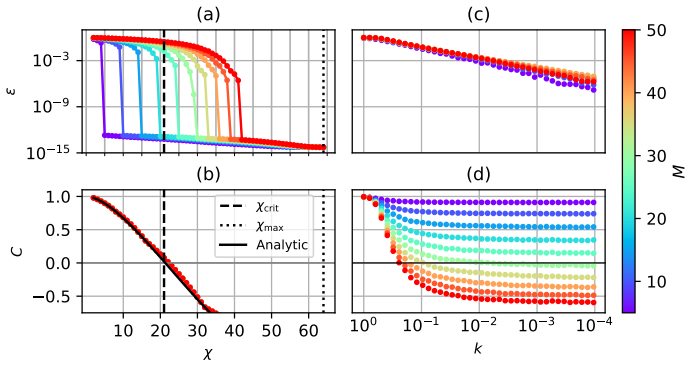
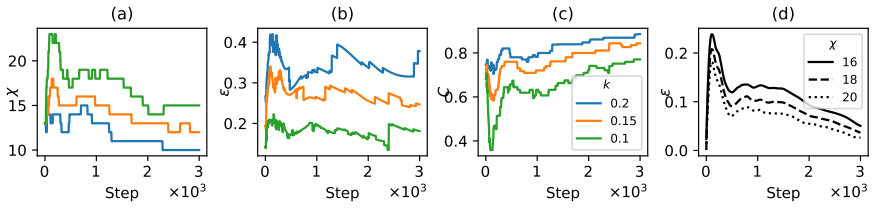
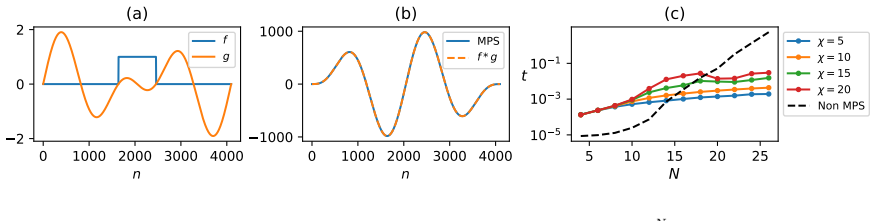
Matrix product states provide an objective, tunable compression method for one-dimensional fluid data whose memory footprint scales directly with the bond dimension. For random Fourier series the representation becomes lossless once the bond dimension is sufficiently high; at lower values the relative error remains within the tolerances typical of fluid simulations. The same compressed objects support a tensor-network periodic convolution that can be orders of magnitude faster than FFT-based methods, and the technique is shown to reproduce the evolution of Burgers' equation accurately.
What carries the argument
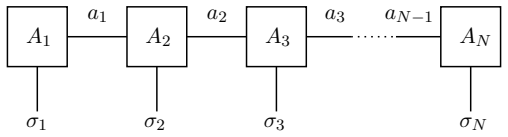
Matrix product states (tensor trains) whose bond dimension controls the rank of the factorization and therefore the compression ratio and error.
If this is right
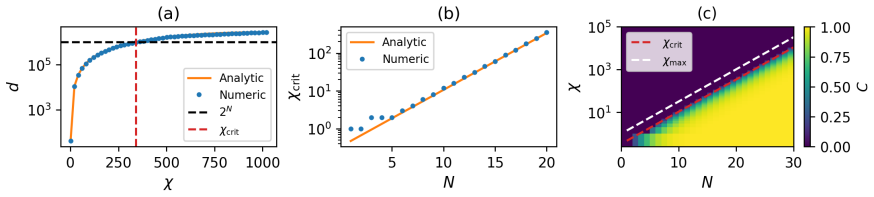
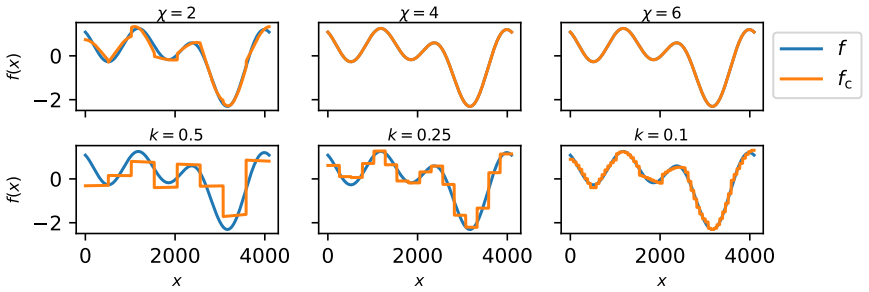
- Lossless compression of random Fourier series is achieved once the bond dimension exceeds a sufficient threshold.
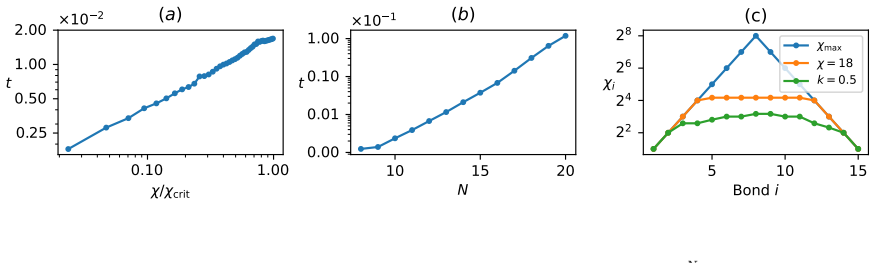
- Storage cost grows linearly with bond dimension.
- Lossy compression at moderate bond dimension keeps relative error inside the range accepted by many fluid simulations.
- Periodic convolution can be performed directly on the compressed tensor network and runs orders of magnitude faster than FFT methods.
- The same tensor-network objects are directly usable on quantum hardware.
Where Pith is reading between the lines
- The same bond-dimension control may allow compression of two- or three-dimensional fluid fields once the tensor network is generalized beyond a chain geometry.
- Direct compressed arithmetic could shorten the wall-clock time of entire simulation pipelines that repeatedly transform between physical and spectral representations.
- If the bond-dimension scaling remains favorable for other non-sparse scientific data sets, tensor-network compression could become a standard post-processing step on exascale archives.
Load-bearing premise
One-dimensional fluid data admits a low-rank matrix-product-state representation whose error remains controllable by the bond dimension alone and stays inside typical fluid-simulation tolerances.
What would settle it
A counter-example in which increasing the bond dimension fails to reduce the reconstruction error below fluid-simulation tolerances for general one-dimensional fluid fields.
Figures
read the original abstract
High performance computers produce extreme-scale data sets that require sampling or compression if they are to be used to their full potential. Existing data compression techniques typically exploit features such as sparsity in the data, homogeneity in the data, or {\it a priori} knowledge of what subsets of data are of most interest. Fluid dynamics data in general do not exhibit these features and so are attractive test beds for generic compression techniques that are objective, robust, and tuneable with respect to information lost due to compression. Presented here is a method based on tensor networks, specifically matrix product states or tensor trains, that meets these requirements. The method is demonstrated for compression in one-dimension and is extensible to higher dimensionality. Lossless compression is demonstrated for random Fourier series for sufficiently high bond dimension of the tensor network, with the memory required to store the tensor network scaling directly proportional to the bond dimension. The lossy compression exhibited at lower bond dimension can be well within the relative error of many fluid simulations. The compression algorithm is tested for the time evolution of Burger's equation with excellent results. We additionally demonstrate the capability to perform computations in the compressed form through a tensor network periodic convolution that can be orders of magnitude faster than using fast Fourier transforms and the convolution theorem. In addition to being an attractive method for working with data sets generated by existing computers, the tensor network methods utilised are directly translatable to the emerging paradigm of quantum computing.
Editorial analysis
A structured set of objections, weighed in public.
Referee Report
Summary. The manuscript proposes using matrix product states (tensor trains) as a generic, tunable compression method for one-dimensional fluid dynamics data that lacks sparsity or homogeneity. It reports lossless compression of random Fourier series once the bond dimension is sufficiently large, with storage cost scaling linearly with bond dimension; lossy compression at smaller bond dimensions claimed to remain within typical fluid-simulation tolerances; successful application to the time evolution of Burgers' equation; and the ability to perform periodic convolution directly in the compressed representation at speeds orders of magnitude faster than FFT-based methods. The approach is presented as extensible to higher dimensions and relevant to quantum computing.
Significance. If the central claims are substantiated with quantitative error metrics and broader test cases, the work would provide a concrete, objective compression technique whose only tunable parameter is bond dimension and that additionally supports in-compressed arithmetic. The demonstration of tensor-network convolution is a clear strength. The limited scope of the current demonstrations (Fourier series and Burgers evolution) leaves open whether the low-rank MPS structure persists for the broader class of 1D fluid fields the authors position as the target application.
major comments (3)
- [Abstract / numerical results] Abstract and numerical-results section: the claim that lossy compression 'can be well within the relative error of many fluid simulations' is unsupported by any reported quantitative error values, tolerance thresholds, or baseline comparisons. No tables or figures supply relative L2 or L∞ errors versus bond dimension, nor do they state the data-exclusion rules or grid resolutions used for the Burgers test.
- [Introduction / discussion of generality] The central extension from the Fourier-series and Burgers demonstrations to 'general fluid data' rests on the unverified assumption that arbitrary 1D fields admit an MPS representation whose truncation error is monotonically reducible by bond dimension D and remains below typical simulation tolerances (~10^{-3} relative error) at modest D. No singular-value spectra, decay-rate analysis, or additional test cases (e.g., discontinuous or multi-scale flows) are provided to bound this assumption.
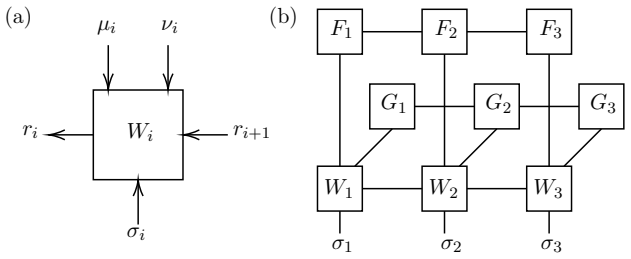
- [Methods / compression algorithm] The statement that memory 'scales directly proportional to the bond dimension' is presented without an explicit formula relating the number of parameters in the MPS to D, the physical grid size, or the local tensor dimensions; the scaling claim therefore cannot be verified from the given description.
minor comments (2)
- [Abstract / title] The abstract refers to 'Burger's equation' (possessive) while the title uses 'Burgers'; consistent spelling should be adopted throughout.
- [Numerical results] No explicit statement is given of the maximum bond dimension explored or the precise criterion used to declare 'lossless' compression for the Fourier-series test.
Simulated Author's Rebuttal
We thank the referee for their careful reading and constructive comments, which identify specific areas where additional quantitative support and clarifications will strengthen the manuscript. We address each major comment below and indicate the revisions made.
read point-by-point responses
-
Referee: [Abstract / numerical results] Abstract and numerical-results section: the claim that lossy compression 'can be well within the relative error of many fluid simulations' is unsupported by any reported quantitative error values, tolerance thresholds, or baseline comparisons. No tables or figures supply relative L2 or L∞ errors versus bond dimension, nor do they state the data-exclusion rules or grid resolutions used for the Burgers test.
Authors: We agree that the original manuscript did not provide the requested quantitative error metrics. In the revised version we have added a new figure (Fig. 3) displaying relative L2 and L∞ errors versus bond dimension D for the random Fourier series, together with a table for the Burgers evolution that reports grid resolution (N=1024 collocation points), the precise error thresholds considered, and the data-handling procedure (full grid, no subsampling or exclusion). These additions directly support the claim for the tested cases. revision: yes
-
Referee: [Introduction / discussion of generality] The central extension from the Fourier-series and Burgers demonstrations to 'general fluid data' rests on the unverified assumption that arbitrary 1D fields admit an MPS representation whose truncation error is monotonically reducible by bond dimension D and remains below typical simulation tolerances (~10^{-3} relative error) at modest D. No singular-value spectra, decay-rate analysis, or additional test cases (e.g., discontinuous or multi-scale flows) are provided to bound this assumption.
Authors: The referee correctly notes the limited scope of the demonstrations. While any finite 1D vector admits an exact MPS representation at D equal to the vector length, the rate at which truncation error decreases for arbitrary fluid fields is not characterized by singular-value spectra in the present work. We have added a paragraph in the revised discussion that explicitly acknowledges this limitation, states that performance on discontinuous or multi-scale flows must be verified case-by-case, and tempers the language regarding applicability to 'general fluid data'. No new test cases are introduced at this stage. revision: partial
-
Referee: [Methods / compression algorithm] The statement that memory 'scales directly proportional to the bond dimension' is presented without an explicit formula relating the number of parameters in the MPS to D, the physical grid size, or the local tensor dimensions; the scaling claim therefore cannot be verified from the given description.
Authors: We acknowledge the omission. The revised methods section now supplies the explicit formula: for an N-site 1D grid with local dimension χ the total number of MPS parameters is ∑_i χ D_i D_{i+1} ≈ N χ D² (open boundary) or N χ D² (periodic). For fixed N and χ the leading term is quadratic in D. We have corrected the abstract and main text to state 'scales quadratically with bond dimension' and included the formula so that the scaling can be verified. revision: yes
Circularity Check
No circularity; derivation chain is self-contained
full rationale
The paper presents tensor-network (MPS) compression as a method whose error is controlled explicitly by the tunable bond dimension D, demonstrates lossless behavior only at sufficiently high D on random Fourier series, and reports lossy performance on Burgers evolution. Bond dimension enters as an input parameter rather than a fitted quantity defined from the target compression ratio or error. No equations reduce reported performance to a self-defined fit, no load-bearing self-citations appear, and the extension to general 1-D fluid data is framed as an assumption rather than a derived claim that loops back on itself. The chain therefore contains no reductions of the form "prediction = input by construction."
Axiom & Free-Parameter Ledger
free parameters (1)
- bond dimension
axioms (2)
- standard math Any 1D data sequence admits an exact matrix-product-state representation whose bond dimension is bounded by the sequence length.
- domain assumption Fluid dynamics fields can be discretized into 1D tensors whose low-bond-dimension approximations remain within simulation error tolerances.
Reference graph
Works this paper leans on
-
[1]
S.M.deBruynKops, J.J.Riley, Theeffectsofstablestratificationonthedecayofinitially isotropic homogeneous turbulence, Journal of Fluid Mechanics 860 (2019) 787–821.doi: 10.1017/jfm.2018.888. 22
-
[2]
M. R. Norman, D. A. Bader, C. Eldred, W. M. Hannah, B. R. Hillman, C. R. Jones, J. M. Lee, L. R. Leung, I. Lyngaas, K. G. Pressel, S. Sreepathi, M. A. Taylor, X. Yuan, Unprece- dented cloud resolution in a GPU-enabled full-physics atmospheric climate simulation on OLCF’s summit supercomputer, International Journal of High Performance Computing Application...
-
[3]
S. Atchley, C. Zimmer, J. Lange, D. Bernholdt, V. Melesse Vergara, T. Beck, M. Brim, R. Budiardja, S. Chandrasekaran, M. Eisenbach, T. Evans, M. Ezell, N. Frontiere, A. Georgiadou, J. Glenski, P. Grete, S. Hamilton, J. Holmen, A. Huebl, D. Jacobson, W. Joubert, K. Mcmahon, E. Merzari, S. Moore, A. Myers, S. Nichols, S. Oral, T. Pap- atheodore, D. Perez, D...
-
[4]
J. J. Riley, M. M. P. Couchman, S. M. de Bruyn Kops, The effect of prandtl number on decaying stratified turbulence, Journal of Turbulence 24 (6-7) (2023) 330–348.arXiv:https://doi.org/10.1080/14685248.2023.2178654,doi:10.1080/ 14685248.2023.2178654. URLhttps://doi.org/10.1080/14685248.2023.2178654
-
[5]
P. Yeung, K. Ravikumar, S. Nichols, R. Uma-Vaideswaran, Gpu-enabled extreme-scale turbulence simulations: Fourier pseudo-spectral algorithms at the exascale using openmp offloading, Computer Physics Communications 306 (2025) 109364.doi:https://doi. org/10.1016/j.cpc.2024.109364. URLhttps://www.sciencedirect.com/science/article/pii/S001046552400287X
-
[6]
P. Yeung, K. Ravikumar, R. Uma-Vaideswaran, D. L. Dotson, K. R. Sreenivasan, S. B. Pope, C. Meneveau, S. Nichols, Small-scale properties from exascale computations of turbulence on a32 768 3 periodic cube, Journal of Fluid Mechanics 1019 (2025) R2. doi:10.1017/jfm.2025.10493
-
[7]
B. Wilfong, A. Radhakrishnan, H. Le Berre, D. Vickers, T. Prathi, N. Tselepidis, B. Dorschner, R. Budiardja, B. Cornille, S. Abbott, F. Schäfer, S. Bryngelson, Simulat- ing many-engine spacecraft: Exceeding 1 quadrillion degrees of freedom via information geometric regularization, in: Proceedings of the International Conference for High Perfor- mance Comp...
-
[8]
S. Bhattacharjee, S. M. de Bruyn Kops, A. D. Bragg, Mechanism generating reverse buoy- ancy flux at the small scales of stably stratified turbulence, Journal of Fluid Mechanics 1026 (2026) A35.doi:10.1017/jfm.2025.11010
-
[9]
S. S. Vazhkudai, B. R. de Supinski, A. S. Bland, A. Geist, J. Sexton, J. Kahle, C. J. Zimmer, S. Atchley, S. Oral, D. E. Maxwell, V. G. V. Larrea, A. Bertsch, R. Gold- stone, W. Joubert, C. Chambreau, D. Appelhans, R. Blackmore, B. Casses, G. Chochia, 23 G. Davison, M. A. Ezell, T. Gooding, E. Gonsiorowski, L. Grinberg, B. Hanson, B. Hart- ner, I. Karlin,...
-
[10]
W.E.Allcock, B.S.Allen, J.Anchell, V.Anisimov, T.Applencourt, A.Bagusetty, R.Bal- akrishnan, R. Balin, S. Bekele, C. Bertoni, C. Blackworth, R. Bustamante, K. Canada, J. Carrier, C. Chan-nui, L. C. Cheney, T. Childers, P. Coffman, S. Coghlan, T. Dey, M. D’Mello, A. Emani, M. Emani, K. G. Felker, S. Foreman, O. Franza, L. Gao, M. Gar- cía, M. Garzarán, B. ...
arXiv 2025
-
[11]
K. Manohar, B. W. Brunton, J. N. Kutz, S. L. Brunton, Data-driven sparse sensor place- ment for reconstruction: Demonstrating the benefits of exploiting known patterns, IEEE Control Systems Magazine 38 (3) (2018) 63–86.doi:10.1109/MCS.2018.2810460
-
[12]
W.Brewer, D.Martinez, M.GopalakrishnanMeena, A.Kashi, K.Borowiec, S.Liu, C.Pil- maier, G. Burgreen, S. Bhushan, Entropy-driven optimal sub-sampling of fluid dynamics for developing machine-learned surrogates, in: Proceedings of the SC ’23 Workshops of the International Conference on High Performance Computing, Network, Storage, and Analysis, SC-W ’23, Ass...
-
[13]
W. Brewer, M. Meena Gopalakrishnan, M. Maiterth, A. Kashi, J. Y. Choi, P. Zhang, S. Nichols, R. Balin, M. Couchman, S. de Bruyn Kops, P. Yeung, D. Dotson, R. Uma- Vaideswaran, S. Oral, F. Wang, Intelligent sampling of extreme-scale turbulence datasets for accurate and efficient spatiotemporal model training, in: Proceedings of the SC ’25 WorkshopsoftheInt...
-
[14]
J. L. Lumley, The structure of inhomogeneous turbulent flows, Atmospheric turbulence and radio wave propagation (1967) 166–178. URLhttps://ci.nii.ac.jp/naid/10012381873
arXiv 1967
-
[15]
P. J. SCHMID, Dynamic mode decomposition of numerical and experimental data, Jour- nal of Fluid Mechanics 656 (2010) 5–28.doi:10.1017/S0022112010001217
-
[16]
K. Taira, S. L. Brunton, S. T. M. Dawson, C. W. Rowley, T. Colonius, B. J. McKeon, O. T. Schmidt, S. Gordeyev, V. Theofilis, L. S. Ukeiley, Modal analysis of fluid flows: An overview, AIAA Journal 55 (12) (2017) 4013–4041.arXiv:https://doi.org/10.2514/ 1.J056060,doi:10.2514/1.J056060. URLhttps://doi.org/10.2514/1.J056060
-
[17]
K. Asztalos, R. Steijl, R. Maulik, Reduced-order modeling on a near-term quantum com- puter, Journal of Computational Physics 510 (2024) 113070.doi:https://doi.org/10. 1016/j.jcp.2024.113070. URLhttps://www.sciencedirect.com/science/article/pii/S002199912400319X
arXiv 2024
-
[18]
M. Gopalakrishnan Meena, A. G. Nair, K. Taira, Network community-based model re- duction for vortical flows, Phys. Rev. E 97 (2018) 063103.doi:10.1103/PhysRevE.97. 063103. URLhttps://link.aps.org/doi/10.1103/PhysRevE.97.063103
-
[19]
Z. Bai, N. B. Erichson, M. Gopalakrishnan Meena, K. Taira, S. L. Brunton, Random- ized methods to characterize large-scale vortical flow networks, PloS one 14 (11) (2019) e0225265.doi:https://doi.org/10.1371/journal.pone.0225265
-
[20]
H. Csala, S. T. M. Dawson, A. Arzani, Comparing different nonlinear dimensionality re- duction techniques for data-driven unsteady fluid flow modeling, Physics of Fluids 34 (11) (2022) 117119.arXiv:https://pubs.aip.org/aip/pof/article-pdf/doi/10.1063/5. 0127284/16607728/117119_1_online.pdf,doi:10.1063/5.0127284. URLhttps://doi.org/10.1063/5.0127284
work page doi:10.1063/5 2022
-
[21]
K. G. Wilson, The renormalization group and critical phenomena, Rev. Mod. Phys. 55 (1983) 583–600.doi:10.1103/RevModPhys.55.583. URLhttps://link.aps.org/doi/10.1103/RevModPhys.55.583
-
[22]
S. R. White, Density matrix formulation for quantum renormalization groups, Phys. Rev. Lett. 69 (1992) 2863–2866.doi:10.1103/PhysRevLett.69.2863. URLhttps://link.aps.org/doi/10.1103/PhysRevLett.69.2863
-
[23]
U. Schollwöck, The density-matrix renormalization group in the age of matrix product states, Annals of Physics 326 (1) (2011) 96–192, january 2011 Special Issue.doi:https: //doi.org/10.1016/j.aop.2010.09.012. URLhttps://www.sciencedirect.com/science/article/pii/S0003491610001752
-
[24]
S. R. White, Density-matrix algorithms for quantum renormalization groups, Phys. Rev. B 48 (1993) 10345–10356.doi:10.1103/PhysRevB.48.10345. URLhttps://link.aps.org/doi/10.1103/PhysRevB.48.10345 25
-
[25]
B. Khoromskij, I. Oseledets, Quantics-tt collocation approximation of parameter- dependent and stochastic elliptic pdes, Computational Methods in Applied Mathematics 10 (4) (2010) 376–394 [cited 2026-04-30].doi:doi:10.2478/cmam-2010-0023. URLhttps://doi.org/10.2478/cmam-2010-0023
-
[26]
B. N. Khoromskij, O (d log n)-quantics approximation of n-d tensors in high-dimensional numerical modeling, Constructive Approximation 34 (2) (2011) 257–280.doi:https: //doi.org/10.1007/s00365-011-9131-1
-
[27]
M. Lubasch, P. Moinier, D. Jaksch, Multigrid renormalization, Journal of Computational Physics 372 (2018) 587–602.doi:https://doi.org/10.1016/j.jcp.2018.06.065. URLhttps://www.sciencedirect.com/science/article/pii/S0021999118304431
-
[28]
J. J. García-Ripoll, Quantum-inspired algorithms for multivariate analysis: from interpo- lation to partial differential equations, Quantum 5 (2021) 431. URLhttps://doi.org/10.22331/q-2021-04-15-431
-
[29]
A. J. Pool, A. D. Somoza, C. Mc Keever, M. Lubasch, B. Horstmann, Nonlinear dynamics as a ground-state solution on quantum computers, Phys. Rev. Res. 6 (2024) 033257. doi:10.1103/PhysRevResearch.6.033257. URLhttps://link.aps.org/doi/10.1103/PhysRevResearch.6.033257
-
[30]
M. Gopalakrishnan Meena, Y. Zhang, W. Jiang, Y. Lin, S. Günther, X. Gao, Towards a quantum algorithm for the incompressible nonlinear navier-stokes equations, in: 2024 IEEE International Conference on Quantum Computing and Engineering (QCE), Vol. 1, IEEE, 2024, pp. 662–668.doi:https://doi.org/10.1109/QCE60285.2024.00083
-
[31]
R. J. J. Connor, C. W. Duncan, A. J. Daley, Tensor network methods for the gross–pitaevskii equation on fine grids, New Journal of Physics 28 (2) (2026) 023203. doi:10.1088/1367-2630/ae2b05. URLhttps://doi.org/10.1088/1367-2630/ae2b05
-
[32]
M. Kiffner, D. Jaksch, Tensor network reduced order models for wall-bounded flows, Phys. Rev. Fluids 8 (2023) 124101.doi:10.1103/PhysRevFluids.8.124101. URLhttps://link.aps.org/doi/10.1103/PhysRevFluids.8.124101
-
[33]
R. J. J. Connor, P. Soin, C. W. Duncan, A. J. Daley, Tensor network approaches for plasma dynamics (2025).arXiv:2512.15924. URLhttps://arxiv.org/abs/2512.15924
arXiv 2025
-
[34]
B. Ghahremani, H. Babaee, A deim tucker tensor cross algorithm and its application to dynamical low-rank approximation, Computer Methods in Applied Mechanics and Engineering 423 (2024) 116879.doi:https://doi.org/10.1016/j.cma.2024.116879. URLhttps://www.sciencedirect.com/science/article/pii/S004578252400135X
-
[35]
Gourianov, M
N. Gourianov, M. Lubasch, S. Dolgov, Q. Y. van den Berg, H. Babaee, P. Givi, M. Kiffner, D. Jaksch, A quantum-inspired approach to exploit turbulence structures, Nature Computational Science 2 (1) (2022) 30–37.doi:https://doi.org/10.1038/ s43588-021-00181-1. 26
2022
-
[36]
E. Ye, N. F. G. Loureiro, Quantum-inspired method for solving the vlasov-poisson equa- tions, Phys. Rev. E 106 (2022) 035208.doi:10.1103/PhysRevE.106.035208. URLhttps://link.aps.org/doi/10.1103/PhysRevE.106.035208
-
[37]
L. Hölscher, P. Rao, L. Müller, J. Klepsch, A. Luckow, T. Stollenwerk, F. K. Wilhelm, Quantum-inspired fluid simulation of two-dimensional turbulence with gpu acceleration, Phys. Rev. Res. 7 (2025) 013112.doi:10.1103/PhysRevResearch.7.013112. URLhttps://link.aps.org/doi/10.1103/PhysRevResearch.7.013112
-
[38]
N. Gourianov, P. Givi, D. Jaksch, S. B. Pope, Tensor networks enable the calculation of turbulence probability distributions, Science Advances 11 (5) (2025) eads5990.arXiv: https://www.science.org/doi/pdf/10.1126/sciadv.ads5990,doi:10.1126/sciadv. ads5990. URLhttps://www.science.org/doi/abs/10.1126/sciadv.ads5990
- [39]
-
[40]
I. V. Oseledets, Tensor-train decomposition, SIAM Journal on Scientific Computing 33 (5) (2011) 2295–2317.arXiv:https://doi.org/10.1137/090752286,doi:10.1137/ 090752286. URLhttps://doi.org/10.1137/090752286
-
[41]
M. Ali, A. Nouy, Approximation theory of tree tensor networks: Tensorized univariate functions, Constructive Approximation 58 (2) (2023) 463–544.doi:https://doi.org/ 10.1007/s00365-023-09620-w
-
[42]
J. M. Burgers, Hydrodynamics. — Application of a model system to illustrate some points of the statistical theory of free turbulence, Springer Netherlands, Dordrecht, 1995, pp. 390–400.doi:10.1007/978-94-011-0195-0_12. URLhttps://doi.org/10.1007/978-94-011-0195-0_12
-
[43]
S. Walters, S. M. Guzik, X. Gao, Favre-averaged spatiotemporal-filtered large eddy simulation, in: 2018 AIAA Aerospace Sciences Meeting, 2018, p. 0373.doi:https: //doi.org/10.2514/6.2018-0373
-
[44]
M. G. Meena, V. Jones, Y. Zhang, X. Gao, A Tensor Network-Based Quantum Algorithm for the Nonlinear 1D Burgers’ Equation.arXiv:https://arc.aiaa.org/doi/pdf/10. 2514/6.2026-1932,doi:10.2514/6.2026-1932. URLhttps://arc.aiaa.org/doi/abs/10.2514/6.2026-1932
-
[45]
A. N. Kolmogorov, V. Levin, J. C. R. Hunt, O. M. Phillips, D. Williams, The lo- cal structure of turbulence in incompressible viscous fluid for very large reynolds numbers, Proceedings of the Royal Society of London. Series A: Mathematical and Physical Sciences 434 (1890) (1991) 9–13.arXiv:https://royalsocietypublishing. org/rspa/article-pdf/434/1890/9/68...
-
[46]
Canuto, M
C. Canuto, M. Hussaini, A. Quarteroni, T. Zang, Spectral Methods: Evolution to Com- plex Geometries and Applications to Fluid Dynamics, Scientific Computation, Springer Berlin Heidelberg, 2007. URLhttps://books.google.co.uk/books?id=7COgEw5_EBQC
2007
-
[47]
J. Chen, E. Stoudenmire, S. R. White, Quantum fourier transform has small entangle- ment, PRX Quantum 4 (2023) 040318.doi:10.1103/PRXQuantum.4.040318. URLhttps://link.aps.org/doi/10.1103/PRXQuantum.4.040318
-
[48]
V. A. Kazeev, B. N. Khoromskij, E. E. Tyrtyshnikov, Multilevel toeplitz matrices gen- erated by tensor-structured vectors and convolution with logarithmic complexity, SIAM Journal on Scientific Computing 35 (3) (2013) A1511–A1536.doi:10.1137/110844830
-
[49]
F. Verstraete, J. I. Cirac, Renormalization algorithms for quantum-many body systems in two and higher dimensions (2004).arXiv:cond-mat/0407066. URLhttps://arxiv.org/abs/cond-mat/0407066
Pith/arXiv arXiv 2004
-
[50]
Y. N. Fernández, M. K. Ritter, M. Jeannin, J.-W. Li, T. Kloss, T. Louvet, S. Terasaki, O. Parcollet, J. von Delft, H. Shinaoka, X. Waintal, Learning tensor networks with tensor cross interpolation: New algorithms and libraries, SciPost Phys. 18 (2025) 104.doi: 10.21468/SciPostPhys.18.3.104. URLhttps://scipost.org/10.21468/SciPostPhys.18.3.104
-
[51]
H. Bayraktar, A. Charara, D. Clark, S. Cohen, T. Costa, Y.-L. L. Fang, Y. Gao, J. Guan, J. Gunnels, A. Haidar, A. Hehn, M. Hohnerbach, M. Jones, T. Lubowe, D. Lyakh, S. Morino, P. Springer, S. Stanwyck, I. Terentyev, S. Varadhan, J. Wong, T. Yamaguchi, cuquantum sdk: A high-performance library for accelerating quantum science (2023). arXiv:2308.01999. URL...
arXiv 2023
-
[52]
A. Termanova, A. Melnikov, E. Mamenchikov, N. Belokonev, S. Dolgov, A. Berezutskii, R. Ellerbrock, C. Mansell, M. Perelshtein, Tensor quantum programming, New Journal of Physics 26 (12) (2024) 123019.doi:10.1088/1367-2630/ad985b. 28
discussion (0)
Sign in with ORCID, Apple, or X to comment. Anyone can read and Pith papers without signing in.