REVIEW 3 major objections 6 minor 12 references
Pedestrian Dead-Reckoning Algorithms For Dual Foot-Mounted Inertial Sensors
T0 review · 3 major / 6 minor · reviewed 2026-08-14 · deepseek-v4-flash
Pith's one-line read The paper proposes pedestrian dead-reckoning algorithms that reconstruct closed indoor walking paths from foot-mounted inertial sensors, using either one IMU or two coupled IMUs, and reports that the dual-IMU version reduces the mismatch…
desk verdict Clever dual-IMU ZUPT fusion, but the DTW-based validation partly measures the algorithm's own coupling rather than absolute error; the error-reduction claim needs ground truth. read the letter →
The pith
A machine-rendered reading of the paper's core claim, the machinery that carries it, and where it could break.
The reading
What carries the argument
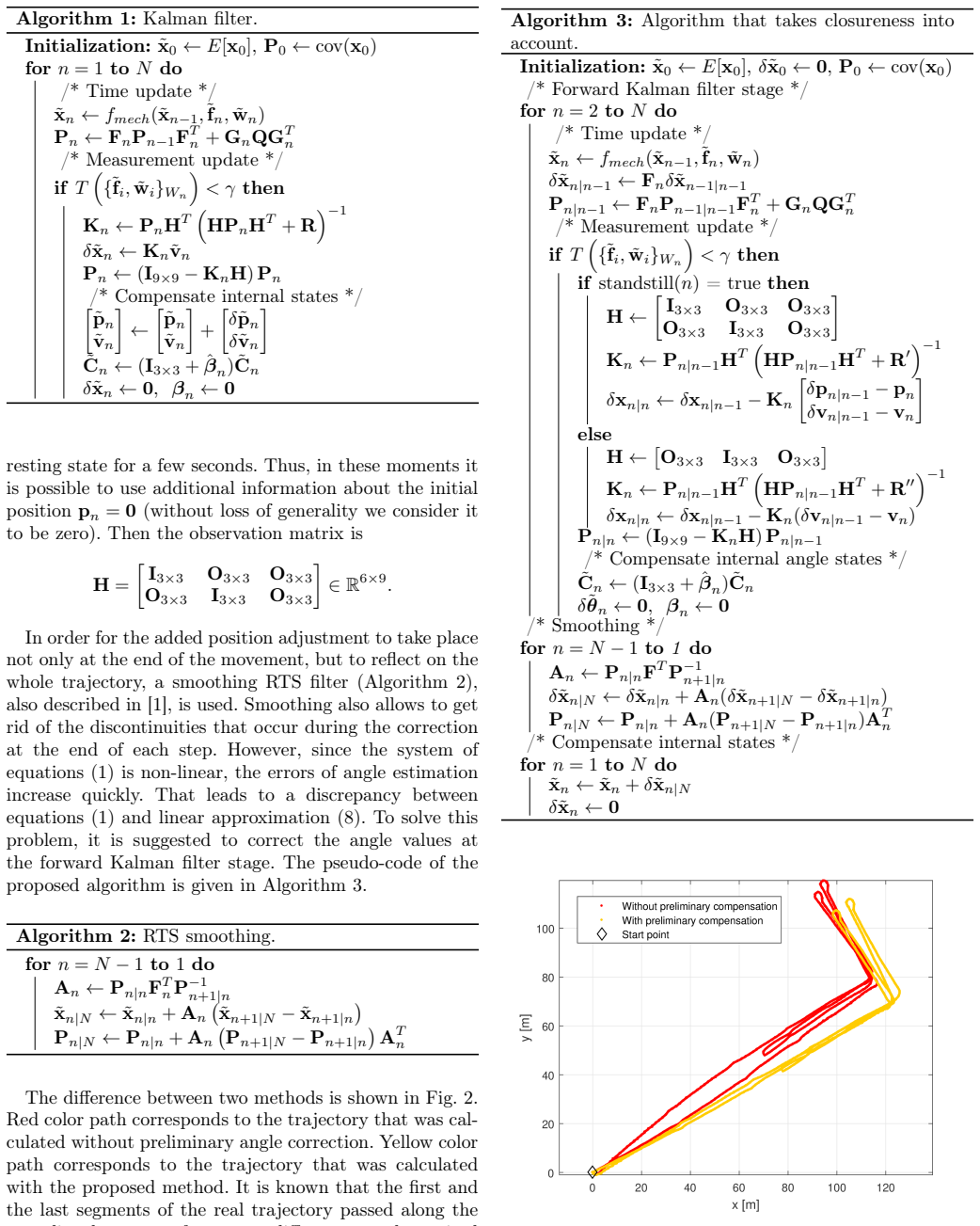
The load-bearing mechanism is an error-state Kalman filter with zero-velocity updates: the detector T classifies each foot as stationary, and the filter treats measured velocity during stance as a zero pseudo-observation. A closed-loop variant adds position observations at the initial and final standstill intervals, with an RTS smoother spreading that correction across the whole trajectory. The dual-IMU extension adds a coupling pseudo-observation at the middle of each step, using the current position of the other leg (observation matrix that selects the first two position coordinates) as the measurement. DTW with an index-window constraint w is the comparison tool that aligns, scores, and averages the two leg trajectories.
What would settle it
A direct experiment would be to walk a closed path with surveyed waypoints while a motion-capture system records true foot positions; if the reconstructed trajectory deviates from the surveyed path by more than the reported DTW values, or if the errors concentrate at moments when the two feet are far apart mid-step, then the mid-step equality assumption is violated and the central claim is weakened.
Extended reading notes
Core claim
The central claim, stated in Section V, is that the proposed algorithms reconstruct real trajectories with significantly reduced error compared with a trajectory from a single inertial system. The discovery is that a closed-loop constraint plus RTS smoothing and angle correction already reduces the DTW mismatch between the two legs' independently computed paths, and that coupling a second foot-mounted IMU with a mid-step position pseudo-observation reduces it further: on the longest tested walk the mismatch fell from 17.917 m with the baseline algorithm to 1.546 m with the dual-IMU algorithm. The paper also shows that DTW with an index-window limit is a more reliable curve-comparison metric than discrete Fréchet distance for this setting, and that averaging the two matched leg trajectories yields a single generalized path.
Load-bearing premise
The dual-IMU algorithm couples the two legs by assuming that at the middle of a step the moving foot is approximately at the same position as the stationary foot, and if that fails, for example on wide strides, turns, stairs, or running, the coupling injects biased position corrections into both legs.
Editorial extensions
If this is right
- On closed indoor paths, a single foot-mounted IMU with loop-closure and smoothing reconstructs paths whose left–right DTW mismatch is below about 3 m in walks of several minutes.
- Coupling a second foot-mounted IMU at mid-step further reduces the mismatch, reaching values from 0.252 m to 1.546 m across the reported experiments.
- The reconstructed paths preserve room dimensions, so they can be used as reference trajectories in indoor environments where no more accurate positioning is available.
- Restricting DTW point matches to an index window reduces the matching complexity from quadratic time to linear time when the window is fixed, and avoids nonsensical long-range matches.
Reading between the lines
- Because the reported metric compares the left-foot reconstruction with the right-foot reconstruction, it mainly captures relative error; common errors such as a shared heading bias or a uniform scale factor could remain invisible, so validation against surveyed waypoints would be a natural next step.
- The mid-step foot-equality assumption is most plausible for level walking at a moderate pace; on stairs, running, or turning in place the coupling would inject biased corrections, and a testable extension would gate the pseudo-observation by step length or gait mode.
- The same coupling idea could be transferred to other wearable sensor pairs, such as shin and waist, but the geometric relationship at the pseudo-observation time would need to be re-derived for each mounting.
Signed reviews
Editorial analysis
A structured set of objections, weighed in public.
Referee Report
Summary. The paper proposes two algorithms for pedestrian dead reckoning from foot-mounted IMUs: a single-IMU Kalman filter with zero-velocity updates (ZUPT) and RTS smoothing that includes an in-loop angle correction, and a dual-IMU algorithm that couples two such filters through a mid-step pseudo-observation of the other foot's position. The dual-IMU algorithm also produces a generalized trajectory using DTW-based averaging. The authors evaluate the algorithms on six indoor walking experiments and report DTW distances between the left- and right-leg reconstructions as the accuracy metric.
Significance. If the claimed accuracy improvement were properly established, the dual-IMU algorithm would be a useful contribution to indoor pedestrian navigation. The paper contributes clear pseudocode for closed-loop ZUPT-aided smoothing, a dual-filter coupling mechanism, and a DTW-based trajectory averaging method with a window constraint that reduces computational complexity. The algorithms are described in sufficient detail to allow reimplementation, and a data link is provided. However, the current validation does not measure error against any known reference path, so the central quantitative claim that the algorithms 'reconstruct real trajectories with significantly reduced error' is not supported by the presented evidence.
major comments (3)
- [Section V, Table I] The DTW distance reported in Table I is computed between the left- and right-leg reconstructed trajectories, not between the reconstructed and a known true path. Two trajectories can both deviate from the true trajectory by a common bias (for example, a heading error) and still have a small DTW distance. Since the paper itself states in Section V that 'the values of DTW metric do not give a direct answer to the question about the metric difference of the reconstructed and real trajectories,' the conclusion that the algorithms 'reconstruct real trajectories with significantly reduced error' is not supported by the presented evidence. A ground-truth reference, such as a surveyed path or motion-capture data, is needed to substantiate this claim.
- [Section IV, Algorithm 4] The dual-IMU algorithm directly minimizes the metric used for validation. At mid-step, the correction step with H=[I2x2 O2x7] injects the other foot's horizontal position as a pseudo-observation, actively pulling the two reconstructed trajectories together. Therefore the large DTW reductions in Table I (for example, experiment 6 from 17.917 to 1.546) are to a significant extent a by-construction consequence of the coupling, not independent evidence of improved absolute accuracy. This circularity must be addressed, for example by evaluating against an external reference rather than a metric that the algorithm is designed to reduce.
- [Section IV, step 3 and Algorithm 4] The mid-step equality assumption—'in the middle of a step the position of a moving foot is supposed to be approximately equal to the position of the other foot'—is physically fragile during turns, stair climbing, running, or unusually long strides. If this assumption is violated, the pseudo-observation injects biased position information into both filters, potentially degrading accuracy. The presented experiments cover only horizontal straight-line and L-shaped corridor walking with durations up to 10.5 minutes, so the range of validity of the dual-IMU algorithm is not demonstrated.
minor comments (6)
- [Section V, Table I] There is an inconsistent use of decimal separators in Table I (for example, '93,5' versus '216.7'); the table should use a single convention.
- [Section II.A] Equation (5) contains a Cyrillic 'С' in the matrix expression; this appears to be a typo and should be replaced with the appropriate Latin letter.
- [Algorithm 4] The function 'count_step_length' is used to determine the mid-step point but is never defined; its definition is important because the pseudo-observation is applied at step_len/2.
- [Section III and IV] The values of the tuning parameters (gamma, N, Q, R, R', R'', R''', and the DTW window w) are not provided, so the experiments cannot be reproduced from the text alone; please include them as a table or supplementary material.
- [Section III, Figure 2] The caption refers to red and yellow paths, but the figure (as rendered) does not have a legend; please make the color coding explicit in the caption.
- [Section IV, step 2] The assumption that the leg making the first step is identifiable because the first step is shorter than the other leg's first step is not validated; if this assumption fails, the initial leg assignment in Algorithm 4 may be wrong.
Circularity Check
The main validation metric (inter-leg DTW) is directly minimized by Algorithm 4's mid-step coupling and by the yaw-alignment fitting, so the reported error reductions are partly by construction rather than independent checks.
-
self definitional
[Section IV, Algorithm 4 (mid-step pseudo-observation) and Section V, Table I]
"In the middle of a step the position of a moving foot is supposed to be approximately equal to a position of the otherot foot. According to that idea, the additional observations may be passed to the Kalman filter."
Algorithm 4 implements this idea as a Kalman correction at mid-step (H=[I2×2 O2×7], with 'pos' being the current horizontal position of the other leg), so the two reconstructed trajectories are actively pulled toward each other. The only quantitative validation in Table I is the DTW distance between the reconstructed left- and right-leg trajectories. Therefore the reported improvement of Algorithm 4 (e.g., 17.917 to 1.546 in experiment 6) is the expected consequence of the coupling mechanism, not independent evidence that the trajectories are closer to the real path.
-
fitted input called prediction
[Section IV, 'Algorithm for two IMUs', steps 1 and 5; Section V, Table I]
"For that purpose, the DTW distance is minimized by selecting the initial angles."
The same DTW distance that later serves as the validation metric is the objective for fitting the relative yaw alignment of the two reconstructed trajectories; step 5 repeats this by 'optimally overlapped once again using brute-force angle search'. The reported DTW values are thus minimized over the alignment parameters before being presented as reconstruction-error evidence. Moreover, DTW between two reconstructed legs, even after optimal overlap, is not a ground-truth error measure: a common heading or scale bias would leave it small while both paths deviate from reality.
full rationale
The paper contains no self-citation chain or imported uniqueness theorem; the algorithms (ZUPT Kalman filter, RTS smoothing, closure post-processing) are standard and described in pseudocode. The circularity lies entirely in the validation logic. Section V concedes that 'DTW metric do not give a direct answer to the question about the metric difference of the reconstructed and real trajectories', yet immediately uses the DTW reductions in Table I to state that the algorithms 'reconstruct real trajectories with significantly reduced error compared to trajectories reconstructed according to a single INS'. For Algorithm 4 the problem is sharper: the mid-step pseudo-observation is expressly designed to make the two legs' positions coincide, so the inter-leg DTW distance is reduced by construction. In addition, the initial-yaw overlap needed to compare the legs is obtained by minimizing the same DTW quantity, so the reported numbers are fitted values rather than independent measurements. There is no ground-truth reference (markers, surveyed path, or external positioning) in the experiments, and the qualitative remark that trajectories 'reproduce the metric characteristics of rooms' is not a quantitative accuracy check. Because the central claim of reduced real-trajectory error rests on a metric that Algorithm 4 itself minimizes, the score is 6: partial circularity, with the single-IMU Algorithm 3 retaining some independent algorithmic content (closure smoothing) but still being validated only by inter-leg DTW rather than absolute error.
Assumptions & free parameters
free parameters (6)
- Zero-velocity detection threshold gamma =
not reported
- Time window length N for stationary detection =
not reported
- Process noise covariance Q =
not reported
- Observation noise covariances R, R', R'', R''' =
not reported
- Mid-step fraction (step_len/2) =
0.5 of a step
- DTW window constraint w =
not reported
assumptions (6)
- standard math Kalman filter linearization and RTS smoothing recursions are valid for the nonlinear system (Equations (1)-(8)).
- domain assumption The velocity of a stationary foot is exactly zero (ZUPT), used as a pseudo-observation.
- domain assumption The trajectory is closed: the start and end positions coincide (Introduction: 'only closed trajectories are considered').
- domain assumption At mid-step, the moving foot's position is approximately equal to the other foot's position (Section IV).
- ad hoc to paper The first step is made from the initial standstill position and is shorter than the first step of the other leg (Section IV, step 2).
- standard math DTW and Frechet distance are meaningful proxies for trajectory similarity and can be aligned by brute-force yaw-angle search.
Cite this review
Pith. "Pith review of Pedestrian Dead-Reckoning Algorithms For Dual Foot-Mounted Inertial Sensors." pith.science (2026). https://pith.science/paper/T3OZB33I
@misc{pith2026190807369,
  author       = {Pith},
  title        = {Pith review of: Pedestrian Dead-Reckoning Algorithms For Dual Foot-Mounted Inertial Sensors},
  year         = {2026},
  howpublished = {\url{https://pith.science/paper/T3OZB33I}},
  note         = {Machine review of arXiv:1908.07369}
}
read the original abstract
This work proposes algorithms for reconstruction of closed-loop pedestrian trajectories based on two foot-mounted inertial measurement units (IMU). The first proposed algorithm allows calculation of a trajectory using measurements from only one IMU. The second algorithm uses data from both foot-mounted IMUs simultaneously. Both algorithms are based on the Kalman filter and the assumption that while a foot is on the ground its velocity is supposed to be zero. Two methods for comparing the obtained trajectories are proposed, advantages and disadvantages of each method are indicated and a way to optimize the computation time is presented. In addition, a method is proposed for constructing one generalized trajectory of human motion based on the trajectories of each leg.
Figures


Figures from the paper (3 more)


Reference graph
Works this paper leans on
-
[1]
Colomar, D. S., Nilsson, J.-O., and H\"andel, P., Smoothing for ZUPT-aided INSs, 2012 International Conference on Indoor Positioning and Indoor Navigation (IPIN), Sydney, IEEE, 2012, pp. 1-5
work page 2012
-
[2]
, Skog, I., H\"andel, P., and Hari, K
Nilsson, J.-O. , Skog, I., H\"andel, P., and Hari, K. V. S., Foot-mounted INS for everybody --- an open-source embedded implementation, Proceedings of the 2012 IEEE/ION Position, Location and Navigation Symposium, Myrtle Beach, IEEE, 2012, pp. 140-145
work page 2012
-
[3]
Nilsson, J.-O., Gupta, A. K., and H\"andel, P., Foot-mounted inertial navigation made easy, 2014 International Conference on Indoor Positioning and Indoor Navigation (IPIN), Busan, IEEE, 2014, pp. 24-29
work page 2014
-
[4]
Wang, Y., Chernyshoff, A., and Shkel, A. M., Error Analysis of ZUPT-Aided Pedestrian Inertial Navigation, 2018 International Conference on Indoor Positioning and Indoor Navigation (IPIN), Nantes, IEEE, 2018
work page 2018
-
[5]
Tjhai, C., and Okeefe, K., Comparing Heading Estimates from Multiple Wearable Inertial and Magnetic Sensors Mounted on Lower Limbs, 2018 International Conference on Indoor Positioning and Indoor Navigation (IPIN), Nantes, IEEE, 2018
work page 2018
-
[6]
MPU-9250 Product Specification, Revision 1.1, \\ https://www.invensense.com/wp-content/uploads/2015/02/PS-MPU-9250A-01-v1.1.pdf
work page 2015
-
[7]
Mikov, A. G., and Galov, A. S., Data processing algorithms for MEMS based multi-component inertial measurement unit for indoor navigation, 2017 24th Saint Petersburg International Conference on Integrated Navigation Systems (ICINS), St. Petersburg, IEEE, 2017, pp. 1-7
work page 2017
-
[8]
Eiter, T., and Mannila, H., Computing discrete Fr\'echet distance, Technical Report CD-TR 94/64, Christian Doppler Laboratory for Expert Systems, Vienna, 1994
work page 1994
Show all 12 references
-
[9]
M\"uller, M., ``Dynamic Time Warping'' in Information Retrieval for Music and Motion, Springer, 2007, pp. 69-84
2007
-
[10]
Vaughana, N., and Gabrysa, B., Comparing and combining time series trajectories using Dynamic Time Warping, Procedia Computer Science, 2016, vol. 96, pp. 465-474
2016
-
[11]
IEEEtran_HOWTO
11em plus .33em minus .07em @technote 4000 4000 100 4000 4000 500 `\.=1000 = #1 #1 #1 0pt [0pt][0pt] #1 * \| ** #1 \@IEEEauthorblockNstyle \@IEEEauthorblockAstyle \@IEEEauthordefaulttextstyle \@IEEEauthorblockconfadjspace -0.25em \@IEEEauthorblockNtopspace 0.0ex \@IEEEauthorbl...
2015
-
[12]
" z * 2 : N V j r 0210 0100 Autod bZ;624701624701624701 n dd 2019:03:11 16:04:12 2019:03:11 16:04:12d ' R98 0100 ( H H JFIF C C
11em plus .33em minus .07em 4000 4000 100 4000 4000 500 `\.=1000 = #1 \@IEEEnotcompsoconly \@IEEEcompsoconly #1 * [1] 0pt [0pt][0pt] #1 * [1] 0pt [0pt][0pt] #1 * \| ** #1 \@IEEEauthorblockNstyle \@IEEEcompsocnotconfonly \@IEEEauthorblockAstyle \@IEEEcompsocnotconfonly \@IEEEco...
2019
Reviewed August 14, 2026 · model on record in the stance chip above.
Discussion (0). Continue with ORCID to comment.