REVIEW 3 major objections 5 minor 64 references
The paper introduces Bazaar, a benchmark showing that frontier LLM merchants in a dynamic auction market capture less than a third of hindsight-optimal profit, with profit driven by margin discipline rather than win rate.
Reviewed by Pith at T0; open to challenge. T0 means a machine referee read the full paper against a public rubric. the ladder, T0–T4 →
T0 review · deepseek-v4-flash
2026-08-04 01:16 UTC pith:T42UYOE5
load-bearing objection A useful new benchmark for LLM pricing, but the headline oracle-efficiency number is inflated by an integer-price mismatch; the qualitative findings hold. the 3 major comments →
Can LLM Agents Price Competitively? A Dynamic Multi-Attribute Auction Benchmark for Agentic Commerce
The pith
A machine-rendered reading of the paper's core claim, the machinery that carries it, and where it could break.
Core claim
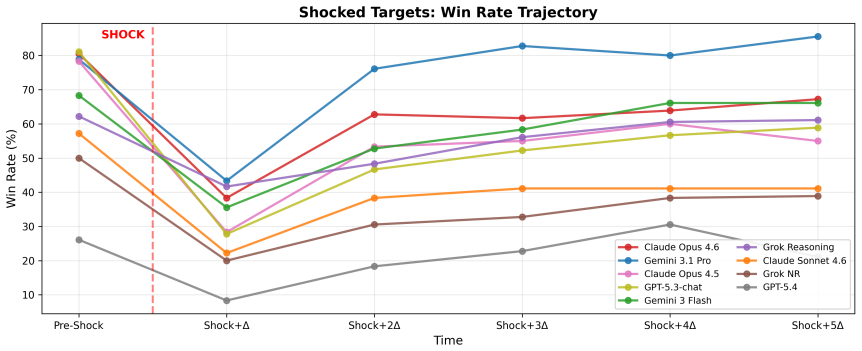
The paper's central claim is that current frontier LLMs, when placed in a dynamic market loop, can learn to win customers but not to price profitably: total profit across models spans an 11x range, and the strongest agent reaches only 0.321 regret efficiency, about a third of the hindsight-optimal profit. Profit correlates with margin per win at r=0.99, versus r=0.88 with win rate, so the decisive skill is charging enough, not merely winning. Increasing inference effort moves models along a two-dimensional failure surface: it reduces lost-auction regret but increases under-pricing regret. When preferences shift without warning, models that learned fastest before the shock tend to adapt slowe
What carries the argument
The central object is Bazaar's repeated sealed-bid multi-attribute auction: each round, an LLM merchant submits a configuration over three attributes and a price to each of 24 customers with hidden additive utilities; the customer picks the offer with highest utility. Three rule-based specialist bots adapt their prices, and 12 customers undergo an unannounced pairwise swap of their value curves mid-game. Because utilities and costs are closed-form, the paper can compute a hindsight-oracle profit and decompose regret into loss regret (auctions the oracle would have won) and underprice regret (margin left on the table in won auctions). The margin-per-win statistic is the diagnostic that carrie
Load-bearing premise
The load-bearing assumption is that 30 rounds give every model enough time to saturate before the preference shock; if some models are still learning when the shock hits, the measured learning-speed and recovery rankings could be artifacts of where the shock is placed.
What would settle it
Re-run Bazaar with the pre-shock window extended from 30 to 60 rounds, keeping the same shock schedule; if the fastest pre-shock learners still show the largest post-shock degradation after full saturation, the strong-learner/weak-adapter claim is supported, and if they recover as well as the fastest adapter, the reversal was an artifact of the window.
If this is right
- If the central finding holds, inference-time compute is a first-order determinant of agentic-commerce performance: GPT-5.4 earns 7.3x more profit at high effort than at none.
- Rankings are objective-dependent: the model that wins the most customers (77.9% win rate) is not the profit leader, so reporting coverage alone can mislead.
- Fast pre-shock learning does not imply fast post-shock adaptation; agentic-commerce benchmarks should include unannounced preference shifts to surface this failure mode.
- Classical bandits set a non-trivial floor: per-customer Thompson Sampling beats six of eleven base LLMs on profit.
- Newer model versions are not reliably better: a newer model in three of four families regresses against an earlier version at default settings, and thinking effort can reverse those gaps.
Where Pith is reading between the lines
- If margin discipline is the binding constraint, evaluation and monitoring of deployed pricing agents should track surplus extraction (margin per win relative to a ceiling), not just win rate or revenue.
- The strong-learner/weak-adapter pattern suggests that confident exploitation strategies may trade away adaptivity; a testable extension is to add explicit hypothesis-revision prompts after consecutive losses and measure recovery.
- The benchmark pits one LLM against rule-based bots; running full LLM-vs-LLM competition could compress or amplify the observed gaps, and would test whether the bots' asymmetric price adjustment makes the environment easier or harder than live markets.
- Because customer preferences are synthetic archetypes, a natural follow-up is to ground Bazaar in real purchase or preference data; the regret-decomposition machinery transfers directly, but the absolute profit gaps may change.
Editorial analysis
A structured set of objections, weighed in public.
Referee Report
Summary. The paper introduces Bazaar, a repeated sealed-bid multi-attribute auction benchmark in which an LLM merchant competes with three adaptive specialist bots for 24 customers with hidden additive preferences. A staggered preference shock tests adaptation. The environment uses closed-form utilities and costs, so surplus and hindsight regret can be computed exactly. The authors evaluate eleven frontier LLMs and their variants, reporting that total profit spans an 11x range, correlates strongly with margin per win (r=0.99) rather than win rate (r=0.88), that thinking effort shifts models from Loser to Underpricer failure archetypes, and that strong pre-shock learners are typically weak post-shock adapters. The best reported efficiency is η=0.321, i.e., less than a third of hindsight-optimal profit, leaving substantial headroom.
Significance. Bazaar is a valuable evaluation instrument: it combines learning, pricing, and belief revision in a dynamic competitive setting, uses exact oracle-based diagnostics rather than learned proxies, includes Thompson Sampling and EXP4 baselines, reports token/API costs, and states that prompts and logs are released. The margin-per-win vs. win-rate dissociation and the loss/underprice regret decomposition are genuinely useful diagnostics. The main central claims, however, rest on the exactness of the oracle and on the chosen pre-shock window. The integer-price issue and the empirical window selection are fixable and do not invalidate the benchmark design, but they affect the headline efficiency number and the adaptation findings.
major comments (3)
- [§2.5, Eq. (4); Appendix P] The oracle in Eq. (4) treats price as continuous, but the implemented game constrains bids to integer prices (Appendix P: 'price': <integer >= minimum cost>; §3.3 examples). For a winnable customer-round, the continuous oracle profit is V_i,t(x)-q_i,t-c_f(x), while the best integer-feasible profit is floor(V_i,t(x)-q_i,t)-c_f(x) (or one less if ties are not guaranteed wins). The oracle is therefore inflated by the fractional part of V-q on every winnable round. Across 24 customers and ~80 rounds this can be hundreds of dollars. For Opus 4.6 (adaptive/xhigh), reported profit $2,976 and oracle ~$9,282 give η=0.321; a correction of a few hundred dollars moves η above 1/3, so the headline 'less than a third of hindsight-optimal profit' is not robust. The underprice-regret component in §4.4 is likewise measured against a continuous optimum. Please recompute all η values, tier boundaries, and
- [§3.5, §4.2] The 30-round pre-shock window is stated to have been 'chosen empirically across our model sweep.' Learning speed is measured as the rise in win rate to the R26–30 peak, and shock recovery is measured relative to that peak. If some models had not saturated by round 30, their post-shock trajectories conflate continued pre-shock learning with adaptation; selecting the window after observing model trajectories also risks overfitting the reversal. The strong-learner/weak-adapter reversal is a load-bearing contribution. Please provide a principled saturation criterion and sensitivity analyses over window lengths (e.g., 20, 30, 40) and shock timings, and report whether the reversal and recovery rankings persist.
- [Table 3; Table 6; §3.5] Table 3 places GPT-5.5 xhigh in Tier 1 with a footnote '‡3 seeds rather than 10', and Table 6 again marks this row as 3-seed. This is inconsistent with the text's claim that all models are averaged over ten seeds (with ten seeds fixing bot randomness and shock schedules). The permutation-test tier boundaries in §4.1 are computed on seed-level outcomes; a 3-seed row cannot be placed in a tier with the same confidence. The same row also supports the efficiency claim 0.307 and the statement that GPT-5.5 xhigh 'clears GPT-5.3.' Please either run that cell to 10 seeds or explicitly mark the row as preliminary and exclude it from tier and efficiency comparisons. Also state the tie-breaking rule for equal-utility offers; Eq. (4) appears to assume that a tie is a win.
minor comments (5)
- [§3.7] Typo: 'met:ics' should be 'metrics.'
- [§2.5 / Appendix P] The bid-stage prompt states that ties reveal nothing because 'the winner was random.' If tie-breaking is random, the oracle in Eq. (4) should account for strict preference rather than silently assuming a tie wins, or the tie rule should be defined and enforced in the environment.
- [§4.5 vs. Appendix J] The main text says estimated API cost varies 14× across models and that Gemini 3.1 Pro is the most cost-effective; Appendix J says cost varies ~50×, with GPT-5.3 Chat the cheapest at $26/seed. Please reconcile these numbers and clarify which subset each figure refers to.
- [Appendix O] The EXP4 update uses K both for the number of arms and for the attribute count in the main text; use distinct symbols or clarify the notation.
- [Appendix L] The anchor probes use 3 seeds and 30 rounds. The caveat says they are confirmatory; this is acceptable, but the main text should not cite them as evidence beyond their stated power.
Circularity Check
No significant circularity: the benchmark's oracle and regret metrics are computed from hidden ground-truth values and independent baselines, not from the agents' own outputs.
full rationale
The paper's central evaluation chain is self-contained. The oracle in Eq. (4) is defined directly from hidden customer values V_{i,t}, the best competitor utility q_{i,t}, and the focal merchant's cost c_f(x): π⋆_{i,t} = max_x [V_{i,t}(x) − q_{i,t} − c_f(x)]_+. As the paper states, 'Because these quantities depend on hidden values and costs, merchants cannot observe them; we use them only for evaluation.' Regret efficiency η = realized/oracle profit is therefore a genuine external comparison against a ground-truth upper bound, not a quantity fitted to or derived from the agent's behavior. The bandit baselines (Thompson Sampling, EXP4) are independent algorithms from the cited literature and are run on the same action space with the same win/loss feedback; they are not constructed from the LLM results. The 30-round pre-shock window in §3.5 was chosen empirically across the model sweep, but it is a protocol parameter that defines measurement windows for learning-speed and recovery analysis; it does not enter the oracle, the profit metric, or any quantity presented as a prediction. No load-bearing self-citations appear, and no 'uniqueness theorem' or prior-work ansatz is invoked to force the framework's choices. The skeptic-identified integer-price versus continuous-oracle discrepancy is a metric-construction concern about the tightness of the oracle upper bound, not a circularity: it does not reduce the headline result to its own inputs. Accordingly, there are no circular steps to report.
Axiom & Free-Parameter Ledger
free parameters (4)
- Base cost and attribute cost ladder =
c0=70; C=[0,1,3,6,12]; cost multipliers: focal 0.75, specialists 0.4/1.0
- Customer value curve shapes and noise =
flat=[0,1,1.5,1.8,2], mid=[0,2,6,10,11], late=[0,2,4,7,13], noise U[-0.3,0.3] on nonzero entries
- Pre-shock window length and shock schedule =
30 pre-shock rounds; shocks staggered uniformly in {31,...,40}; 12 of 24 customers shocked; 4 per swap type
- Bot margin update dynamics =
open margin $3; raise ~U(0.5,1.5) after a win, lower ~U(0.25,0.75) after a loss, floor $1
axioms (5)
- domain assumption Customer utility is additive and separable: Ui,t(x,p)=Σk Vi,t,k[xk] − p.
- domain assumption Merchant costs are additive: cm(x)=cm,0+Σk Cm,k[xk], with bids constrained to p≥cm(x).
- domain assumption Opponent bots always offer their specialty configuration and only adapt price with the specified margin dynamics.
- domain assumption Structured reasoning and strategy text produced by the LLM is a faithful proxy for its internal belief state and strategy.
- ad hoc to paper The empirically chosen 30-round pre-shock window is long enough for all models to reach saturation before the first shock.
read the original abstract
Agentic commerce is moving from concept to deployed infrastructure: payment networks, retailers, and AI platforms are setting the stage for agents to transact on behalf of merchants and consumers. Yet whether the LLMs behind these agents can price competently in real markets, where customer preferences are hidden, competitors adapt in real time, and demand can shift without warning, has not been systematically tested. We introduce Bazaar, a dynamic sealed-bid benchmark for multi-attribute auction under these conditions. Despite its dynamics, the benchmark is grounded in closed-form customer utilities, enabling exact evaluation. Across 11 frontier LLMs from four providers, the leading agents on customer acquisition (e.g. Gemini 3.1 Pro) are often not the leading agents on profit (e.g. Opus 4.6). The ranking shifts again under demand shocks: agents that learned fastest pre-shock are typically the slowest to revise their beliefs afterwards, while Gemini 3.1 Pro recovers fastest despite not leading on profit. However, even the strongest agent captures less than a third of hindsight-optimal profit, suggesting current LLMs are progressing in agentic commerce but leave substantial headroom.
Figures



Reference graph
Works this paper leans on
-
[1]
2024 , eprint=
Measuring Bargaining Abilities of LLMs: A Benchmark and A Buyer-Enhancement Method , author=. 2024 , eprint=
2024
-
[2]
2025 , howpublished =
Project Vend 2 , author =. 2025 , howpublished =
2025
-
[4]
2025 , eprint=
Evaluating Multi-Turn Bargain Skills in LLM-Based Seller Agent , author=. 2025 , eprint=
2025
-
[5]
2025 , eprint=
Magentic Marketplace: An Open-Source Environment for Studying Agentic Markets , author=. 2025 , eprint=
2025
-
[6]
2024 , eprint=
NegotiationToM: A Benchmark for Stress-testing Machine Theory of Mind on Negotiation Surrounding , author=. 2024 , eprint=
2024
-
[7]
2024 , eprint=
Game-theoretic LLM: Agent Workflow for Negotiation Games , author=. 2024 , eprint=
2024
-
[10]
2023 , eprint =
Put Your Money Where Your Mouth Is: Evaluating Strategic Planning and Execution of LLM Agents in an Auction Arena , author =. 2023 , eprint =
2023
-
[11]
How Well Can
Bianchi, Federico and Chia, Patrick John and Yuksekgonul, Mert and Tagliabue, Jacopo and Jurafsky, Dan and Zou, James , booktitle =. How Well Can. 2024 , volume =
2024
-
[12]
2024 , eprint =
Simulation-Based Benchmarking of Reinforcement Learning Agents for Personalized Retail Promotions , author =. 2024 , eprint =
2024
-
[13]
Algorithmic Pricing: Implications for Marketing Strategy and Regulation , author =. 2024 , month =. doi:10.3386/w32540 , url =
-
[14]
2025 , eprint =
Learning from Synthetic Labs: Language Models as Auction Participants , author =. 2025 , eprint =
2025
-
[15]
2024 , howpublished =
Evidence from the Synthetic Laboratory: Language Models as Auction Participants , author =. 2024 , howpublished =
2024
-
[16]
2025 , eprint =
InfoBid: A Simulation Framework for Studying Information Disclosure in Auctions with Large Language Model-based Agents , author =. 2025 , eprint =
2025
-
[18]
2024 , eprint =
Peng, Bo and Ling, Xinyi and Chen, Ziru and Sun, Huan and Ning, Xia , booktitle =. 2024 , eprint =
2024
-
[19]
2022 , eprint =
Yao, Shunyu and Chen, Howard and Yang, John and Narasimhan, Karthik , booktitle =. 2022 , eprint =
2022
-
[21]
2026 , eprint =
Shopping Companion: A Memory-Augmented LLM Agent for Real-World E-Commerce Tasks , author =. 2026 , eprint =
2026
-
[22]
American Economic Review , volume =
Artificial Intelligence, Algorithmic Pricing, and Collusion , author =. American Economic Review , volume =. 2020 , doi =
2020
-
[23]
The RAND Journal of Economics , volume =
Properties of Scoring Auctions , author =. The RAND Journal of Economics , volume =. 2008 , doi =
2008
-
[24]
Biometrika , volume =
On the Likelihood that One Unknown Probability Exceeds Another in View of the Evidence of Two Samples , author =. Biometrika , volume =
-
[25]
SIAM Journal on Computing , volume =
The Nonstochastic Multiarmed Bandit Problem , author =. SIAM Journal on Computing , volume =
-
[26]
44th Annual IEEE Symposium on Foundations of Computer Science (FOCS) , pages =
The Value of Knowing a Demand Curve: Bounds on Regret for Online Posted-Price Auctions , author =. 44th Annual IEEE Symposium on Foundations of Computer Science (FOCS) , pages =. 2003 , publisher =
2003
-
[27]
Operations Research , volume =
Dynamic Pricing Without Knowing the Demand Function: Risk Bounds and Near-Optimal Algorithms , author =. Operations Research , volume =. 2009 , doi =
2009
-
[28]
Surveys in Operations Research and Management Science , volume =
Dynamic Pricing and Learning: Historical Origins, Current Research, and New Directions , author =. Surveys in Operations Research and Management Science , volume =. 2015 , doi =
2015
-
[29]
Proceedings of the 29th International Conference on Machine Learning (ICML) , pages =
Online Bandit Learning Against an Adaptive Adversary: from Regret to Policy Regret , author =. Proceedings of the 29th International Conference on Machine Learning (ICML) , pages =. 2012 , url =
2012
-
[30]
Proceedings of the 16th ACM Conference on Economics and Computation (EC) , pages =
Econometrics for Learning Agents , author =. Proceedings of the 16th ACM Conference on Economics and Computation (EC) , pages =. 2015 , doi =
2015
-
[31]
Management Science , volume =
Learning in Repeated Auctions with Budgets: Regret Minimization and Equilibrium , author =. Management Science , volume =. 2019 , doi =
2019
-
[32]
2004 , publisher =
The Theory and Practice of Revenue Management , author =. 2004 , publisher =
2004
-
[33]
Advances in Neural Information Processing Systems (NeurIPS) , volume =
Regret Minimization in Games with Incomplete Information , author =. Advances in Neural Information Processing Systems (NeurIPS) , volume =. 2007 , url =
2007
-
[34]
2020 , publisher =
Bandit Algorithms , author =. 2020 , publisher =
2020
-
[35]
Journal of Political Economy , volume =
Auctions versus Posted Prices in Online Markets , author =. Journal of Political Economy , volume =. 2018 , doi =
2018
-
[36]
American Economic Review , volume =
Internet Advertising and the Generalized Second-Price Auction: Selling Billions of Dollars Worth of Keywords , author =. American Economic Review , volume =. 2007 , doi =
2007
-
[37]
International Journal of Industrial Organization , volume =
Position Auctions , author =. International Journal of Industrial Organization , volume =. 2007 , doi =
2007
-
[38]
Management Science , volume =
Optimal Dynamic Pricing of Inventories with Stochastic Demand over Finite Horizons , author =. Management Science , volume =. 1994 , doi =
1994
-
[39]
Operations Research , volume =
Dynamic Pricing with an Unknown Demand Model: Asymptotically Optimal Semi-Myopic Policies , author =. Operations Research , volume =. 2014 , doi =
2014
-
[40]
2024 , eprint =
Algorithmic Collusion by Large Language Models , author =. 2024 , eprint =
2024
-
[41]
Anthropic . 2025. https://www.anthropic.com/research/project-vend-2 Project vend 2 . Anthropic research blog
2025
-
[42]
Raman Arora, Ofer Dekel, and Ambuj Tewari. 2012. https://arxiv.org/abs/1206.6400 Online bandit learning against an adaptive adversary: from regret to policy regret . In Proceedings of the 29th International Conference on Machine Learning (ICML), pages 1747--1754
Pith/arXiv arXiv 2012
-
[43]
John Asker and Estelle Cantillon. 2008. https://doi.org/10.1111/j.1756-2171.2008.00004.x Properties of scoring auctions . The RAND Journal of Economics, 39(1):69--85
arXiv 2008
-
[44]
Schapire
Peter Auer, Nicol \`o Cesa-Bianchi, Yoav Freund, and Robert E. Schapire. 2002. The nonstochastic multiarmed bandit problem. SIAM Journal on Computing, 32(1):48--77
2002
-
[45]
Santiago R. Balseiro and Yonatan Gur. 2019. https://doi.org/10.1287/mnsc.2018.3174 Learning in repeated auctions with budgets: Regret minimization and equilibrium . Management Science, 65(9):3952--3968
arXiv 2019
-
[46]
Gagan Bansal, Wenyue Hua, Zezhou Huang, Adam Fourney, Amanda Swearngin, Will Epperson, Tyler Payne, Jake M. Hofman, Brendan Lucier, Chinmay Singh, Markus Mobius, Akshay Nambi, Archana Yadav, Kevin Gao, David M. Rothschild, Aleksandrs Slivkins, Daniel G. Goldstein, Hussein Mozannar, Nicole Immorlica, and 5 others. 2025. https://arxiv.org/abs/2510.25779 Mag...
arXiv 2025
-
[47]
Omar Besbes and Assaf Zeevi. 2009. https://doi.org/10.1287/opre.1080.0640 Dynamic pricing without knowing the demand function: Risk bounds and near-optimal algorithms . Operations Research, 57(6):1407--1420
arXiv 2009
-
[48]
Federico Bianchi, Patrick John Chia, Mert Yuksekgonul, Jacopo Tagliabue, Dan Jurafsky, and James Zou. 2024. https://proceedings.mlr.press/v235/bianchi24a.html How well can LLM s negotiate? N egotiation A rena platform and analysis . In Proceedings of the 41st International Conference on Machine Learning, volume 235 of Proceedings of Machine Learning Resea...
2024
-
[49]
Emilio Calvano, Giacomo Calzolari, Vincenzo Denicol \`o , and Sergio Pastorello. 2020. https://doi.org/10.1257/aer.20190623 Artificial intelligence, algorithmic pricing, and collusion . American Economic Review, 110(10):3267--3297
-
[50]
Chunkit Chan, Cheng Jiayang, Yauwai Yim, Zheye Deng, Wei Fan, Haoran Li, Xin Liu, Hongming Zhang, Weiqi Wang, and Yangqiu Song. 2024. https://arxiv.org/abs/2404.13627 Negotiationtom: A benchmark for stress-testing machine theory of mind on negotiation surrounding . Preprint, arXiv:2404.13627
Pith/arXiv arXiv 2024
-
[51]
Haibin Chen, Kangtao Lv, Chengwei Hu, Yanshi Li, Yujin Yuan, Yancheng He, Xingyao Zhang, Langming Liu, Shilei Liu, Wenbo Su, and Bo Zheng. 2025. https://arxiv.org/abs/2502.20196 ChineseEcomQA : A scalable e-commerce concept evaluation benchmark for large language models . Preprint, arXiv:2502.20196
Pith/arXiv arXiv 2025
-
[52]
Jiangjie Chen, Siyu Yuan, Rong Ye, Bodhisattwa Prasad Majumder, and Kyle Richardson. 2023. https://arxiv.org/abs/2310.05746 Put your money where your mouth is: Evaluating strategic planning and execution of llm agents in an auction arena . Preprint, arXiv:2310.05746
Pith/arXiv arXiv 2023
-
[53]
Arnoud V. den Boer. 2015. https://doi.org/10.1016/j.sorms.2015.03.001 Dynamic pricing and learning: Historical origins, current research, and new directions . Surveys in Operations Research and Management Science, 20(1):1--18
-
[54]
Sara Fish, Yannai A. Gonczarowski, and Ran I. Shorrer. 2024. https://arxiv.org/abs/2404.00806 Algorithmic collusion by large language models . Preprint, arXiv:2404.00806
arXiv 2024
-
[55]
He He, Derek Chen, Anusha Balakrishnan, and Percy Liang. 2018. https://doi.org/10.18653/v1/D18-1256 Decoupling strategy and generation in negotiation dialogues . In Proceedings of the 2018 Conference on Empirical Methods in Natural Language Processing, pages 2333--2343, Brussels, Belgium. Association for Computational Linguistics
-
[56]
Wenyue Hua, Ollie Liu, Lingyao Li, Alfonso Amayuelas, Julie Chen, Lucas Jiang, Mingyu Jin, Lizhou Fan, Fei Sun, William Wang, Xintong Wang, and Yongfeng Zhang. 2024. https://arxiv.org/abs/2411.05990 Game-theoretic llm: Agent workflow for negotiation games . Preprint, arXiv:2411.05990
Pith/arXiv arXiv 2024
-
[57]
Gurusha Juneja, Jayanth Naga Sai Pasupulati, Alon Albalak, Wenyue Hua, and William Yang Wang. 2025. Magpie: A benchmark for multi-agent contextual privacy evaluation. arXiv preprint arXiv:2510.15186
arXiv 2025
-
[58]
Robert Kleinberg and Tom Leighton. 2003. https://doi.org/10.1109/SFCS.2003.1238232 The value of knowing a demand curve: Bounds on regret for online posted-price auctions . In 44th Annual IEEE Symposium on Foundations of Computer Science (FOCS), pages 594--605. IEEE
Pith/arXiv arXiv 2003
-
[59]
Bo Peng, Xinyi Ling, Ziru Chen, Huan Sun, and Xia Ning. 2024. https://arxiv.org/abs/2402.08831 eCeLLM : Generalizing large language models for e-commerce from large-scale, high-quality instruction data . In Proceedings of the 41st International Conference on Machine Learning (ICML), volume 235 of PMLR
Pith/arXiv arXiv 2024
-
[60]
Anand Shah, Kehang Zhu, Yanchen Jiang, Jeffrey G. Wang, Arif Kerem Dayi, John J. Horton, and David C. Parkes. 2025. https://arxiv.org/abs/2507.09083 Learning from synthetic labs: Language models as auction participants . Preprint, arXiv:2507.09083
Pith/arXiv arXiv 2025
-
[61]
Eilam Shapira, Omer Madmon, Itamar Reinman, Samuel Joseph Amouyal, Roi Reichart, and Moshe Tennenholtz. 2024. Glee: A unified framework and benchmark for language-based economic environments. arXiv preprint arXiv:2410.05254
arXiv 2024
-
[62]
Kalyan T. Talluri and Garrett J. van Ryzin. 2004. https://doi.org/10.1007/b139000 The Theory and Practice of Revenue Management . Springer
doi:10.1007/b139000 2004
-
[63]
Thompson
William R. Thompson. 1933. On the likelihood that one unknown probability exceeds another in view of the evidence of two samples. Biometrika, 25(3--4):285--294
1933
-
[64]
Issue Yishu Wang, Kakam Chong, Xiaofeng Wang, Xu Yan, DeXin Kong, Chen Ju, Ming Chen, Shuai Xiao, Shuguang Han, and jufeng chen. 2025. https://arxiv.org/abs/2509.06341 Evaluating multi-turn bargain skills in llm-based seller agent . Preprint, arXiv:2509.06341
Pith/arXiv arXiv 2025
-
[65]
Tian Xia, Zhiwei He, Tong Ren, Yibo Miao, Zhuosheng Zhang, Yang Yang, and Rui Wang. 2024. https://arxiv.org/abs/2402.15813 Measuring bargaining abilities of llms: A benchmark and a buyer-enhancement method . Preprint, arXiv:2402.15813
Pith/arXiv arXiv 2024
-
[66]
Shunyu Yao, Howard Chen, John Yang, and Karthik Narasimhan. 2022. https://arxiv.org/abs/2207.01206 WebShop : Towards scalable real-world web interaction with grounded language agents . In Advances in Neural Information Processing Systems, volume 35, pages 20744--20757
Pith/arXiv arXiv 2022
-
[67]
Yue Yin. 2025. https://arxiv.org/abs/2503.22726 Infobid: A simulation framework for studying information disclosure in auctions with large language model-based agents . Preprint, arXiv:2503.22726
Pith/arXiv arXiv 2025
-
[68]
Zijian Yu, Kejun Xiao, Huaipeng Zhao, Tao Luo, and Xiaoyi Zeng. 2026. https://arxiv.org/abs/2603.14864 Shopping companion: A memory-augmented llm agent for real-world e-commerce tasks . Preprint, arXiv:2603.14864
Pith/arXiv arXiv 2026
-
[69]
Shenzhe Zhu, Jiao Sun, Yi Nian, Tobin South, Alex Pentland, and Jiaxin Pei. 2025. https://doi.org/10.18653/v1/2025.nllp-1.2 The automated but risky game: Modeling agent-to-agent negotiations and transactions in consumer markets . In Proceedings of the Natural Legal Language Processing Workshop 2025. Association for Computational Linguistics
discussion (0)
Sign in with ORCID, Apple, or X to comment. Anyone can read and Pith papers without signing in.