REVIEW 5 major objections 5 minor 4 cited by
InfinityHuman claims a two-stage, pose-guided pipeline keeps identity, color, hands, and lip-sync stable in minute-scale audio-driven human videos, with state-of-the-art results on EMTD and HDTF.
Reviewed by Pith at T0; open to challenge. T0 means a machine referee read the full paper against a public rubric. the ladder, T0–T4 →
A coarse-to-fine audio-driven animation framework that uses pose-guided refinement and hand-specific reward learning to generate long, identity-stable talking videos.
T0 review reviewed 2026-08-05 challenge →
load-bearing objection A solid systems paper with real EMTD gains, but the SOTA claim is too broad and the pose-stability premise needs direct measurement. the 5 major comments →
InfinityHuman: Towards Long-Term Audio-Driven Human
The pith
A machine-rendered reading of the paper's core claim, the machinery that carries it, and where it could break.
The reading
Core claim
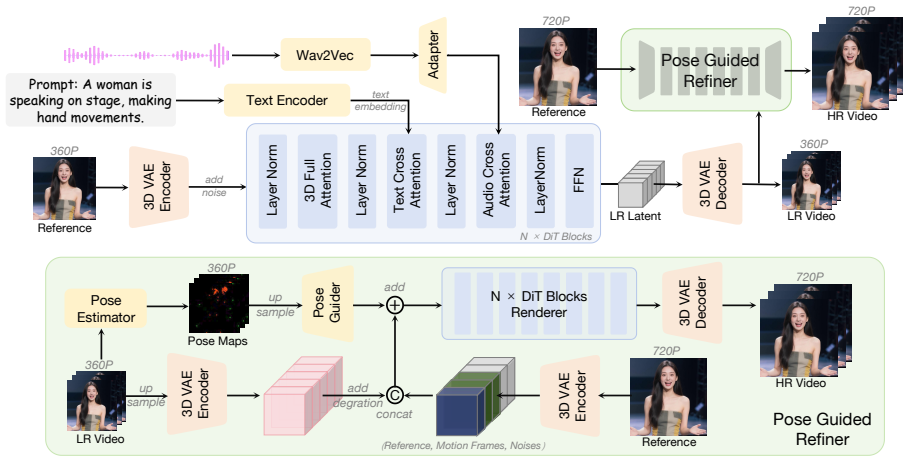
The central claim is that long-form audio-driven human animation can be made visually stable by splitting the problem into a coarse motion stage and a pose-guided refinement stage. Specifically, InfinityHuman first produces a low-resolution video whose motion is synchronized with audio, then estimates pose maps from that low-resolution video and feeds them, together with the reference image as a prefix latent, into a high-resolution diffusion refiner. Because pose encodes structure rather than appearance, the authors argue, it survives long generation runs without the drift that corrupts color and identity; the first frame anchors appearance. The paper further claims that adding a hand-speci
What carries the argument
The load-bearing object is the pose sequence P, an 8-channel pixel-level tensor whose first seven channels encode human keypoints and whose last channel encodes up to 20 background keypoints, extracted from the low-resolution video by the Sapiens pose estimator. The refiner (PG-Refiner) tokenizes P along temporal and spatial dimensions, projects it into the DiT latent space, and adds it to the high-resolution latent; the first reference frame is kept noise-free as a prefix latent and its noise prediction is masked out of the loss. This combination is what the paper credits for correcting accumulated errors, preserving lip-sync, and reducing artifacts. The second mechanism is the hand-specifi
Load-bearing premise
The whole refinement stage trusts pose maps extracted from the low-resolution video: if those poses drift or distort as the video gets longer, the refiner is conditioning on wrong structure, and the paper does not measure pose error over time.
What would settle it
Measure pose-estimation error (e.g., keypoint PCK or average keypoint distance) between poses extracted from V_lr and ground-truth poses at 10s, 20s, 30s, 40s, 50s, and 60s on EMTD. If error grows with duration, or if replacing extracted poses with ground-truth poses substantially improves FSIM, FaceSIM, or HKC, then the paper's premise that pose sequences resist temporal degradation is the load-bearing and vulnerable point.
If this is right
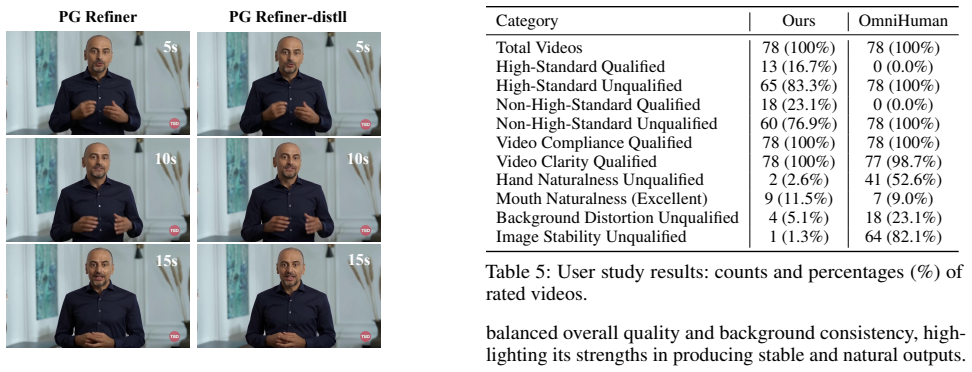
- Long-video generation can be decomposed so that most denoising happens at low resolution, with a separate high-resolution refinement stage, making minute-scale 720p video practical; the appendix reports refiner distillation to a one-step model with comparable FID and FVD.
- Because pose is the structural signal and appearance is anchored by the first frame, identity and color drift are bounded by the anchor rather than by accumulated frame-to-frame errors, which is why the method maintains FaceSIM and FID over 40–60 second clips.
- Hand quality need not be modeled architecturally; an image-level reward applied to sampled video frames is enough to raise hand keypoint confidence and reduce visible distortions, including semantic gestures like a two-finger sign during the word 'twenty'.
- Chunked continuation with overlapping latents (first m latents carried from the previous chunk) plus pose guidance produces smooth motion transitions without retraining on curated long-video datasets.
- On both a long upper-body benchmark (EMTD) and a talking-head benchmark (HDTF), the method beats current full-body and portrait baselines on the reported metrics, and in short clips it also outperforms a 15-second model (OmniHuman) on all reported metrics.
Where Pith is reading between the lines
- The paper assumes pose estimated from V_lr is reliable, but never reports pose error over time; a direct test would be to compare the refiner fed with extracted poses versus ground-truth poses. If the gap is large, pose quality is the true bottleneck; if small, the claimed stability comes mostly from the reference anchor.
- The hand reward samples a single frame per video, so temporal consistency of hands is only indirectly optimized; a video-level reward or a keypoint-trajectory consistency term would be a natural next step and could improve the reported HKV.
- The long-form stability table shows FID and Sync staying nearly flat while FVD fluctuates; this suggests the stability claim is mainly about identity, color, and appearance, not about smoothness of dynamics, and duration-wise motion quality deserves its own metric.
- The appendix's multi-person extension (silent audio for a non-speaking character, bounding-box gated attention) is a lightweight workaround; combining it with multiple pose streams in the refiner could be a testable path toward true multi-character interaction.
Editorial analysis
A structured set of objections, weighed in public.
Referee Report
Summary. InfinityHuman proposes a two-stage coarse-to-fine framework for long audio-driven full-body animation. A low-resolution audio-to-video (LR-A2V) stage generates 360p motion, and a pose-guided refiner (PG-Refiner) upscales to high resolution using pose sequences extracted from the LR video, the initial reference frame as a visual anchor, and degraded LR latents. A hand-specific reward fine-tuning step is added to improve hand realism. The paper reports quantitative results on EMTD and HDTF, ablations, a user study, and long-form stability analysis, claiming state-of-the-art performance in video quality, identity preservation, hand accuracy, and lip-sync.
Significance. If the central claims hold, the paper offers a practical recipe for minute-scale, high-resolution audio-driven animation: the pose-guided refiner is a reasonable mechanism for reducing drift while preserving motion, and the hand-reward stage addresses a known weak point of full-body animation. The paper includes extensive experiments, a large training corpus, and an ablation study indicating that pose conditioning is important. The main strengths are the industrial-scale training setup, the explicit coarse-to-fine design, and the attempt to measure long-form stability. However, the reported numbers do not uniformly support the headline 'state-of-the-art' claim, and several load-bearing assumptions are not directly verified.
major comments (5)
- [Abstract; Table 1] The abstract and Section 4.2 claim 'state-of-the-art performance in video quality, identity preservation, hand accuracy, and lip-sync.' Table 1 does not support this broadly. On HDTF, the proposed method's FaceSIM (0.89) is below SadTalker (0.93) and Hallo3 (0.91), and its Sync-C (8.59) is below SadTalker (8.87) and OmniAvatar (8.81). On EMTD, the HKV value (16.0) is worse than Hallo3 (6.3) if lower is better, and worse than HyAva (29.2) and OmniAvatar (28.7) if higher is better; the table does not specify the direction for HKV. The claims should be restricted to the metrics for which the paper actually reports best results, or the table should be corrected and discussed.
- [§3.2, eq. (5)-(6)] The pose-stability premise is load-bearing but unverified. The paper states that pose sequences 'remain highly stable with minimal error accumulation in long-duration generation tasks' and then extracts poses from the progressively degraded low-resolution video V_lr using Sapiens. No pose error or drift measurement is reported as a function of duration, and no comparison is made between poses extracted from V_lr and poses from a clean reference. The ablation 'w/o pose cond' (Table 2) removes pose entirely; it does not test whether the pose condition is accurate. If Sapiens degrades on V_lr (e.g., due to color shifts or distortions shown in Fig. 2), the refiner may be guided by erroneous structure, and the claimed advantage over direct LR-to-HR refinement collapses. Please add a direct evaluation of pose estimation accuracy on V_lr as a function of duration and demonstrate that pose error
- [§3.3, eq. (9)] The hand-specific reward mechanism is described as improving 'the realism, stability, and audio synchronization of hand motion,' but eq. (9) optimizes only a randomly selected single decoded frame using an image-level reward model. An image-level, single-frame reward cannot directly enforce temporal stability or audio synchronization. Moreover, the paper does not specify how the reward gradient is propagated through the 3D VAE and the diffusion model (e.g., policy gradient, differentiable rendering, or score distillation), which is essential for reproducibility. Please clarify the optimization procedure and report temporal or audio-sync hand metrics (e.g., temporal keypoint consistency, hand-audio alignment) beyond HKC and HKV.
- [Table 2] The ablation results contain an unexplained anomaly: removing the hand reward ('w/o hand refl') improves FID from 91.74 to 86.32 while HKC drops by only 0.02. This contradicts the impression that the hand reward improves overall video quality. The paper should discuss this trade-off explicitly and, if the claim is only about hand quality, separate the video-quality metrics from the hand-specific metrics. Otherwise, the ablation provides evidence that the hand reward may actually hurt image-level quality.
- [§6.7, Table 6] The long-form stability analysis reports FSIM decreasing from 0.8357 at 10s to 0.8057 at 50s and HKC decreasing from 0.9224 to 0.9059. The paper labels this 'minimal degradation,' but there is no baseline comparison on the same duration bins. Without showing the trajectories of previous methods over identical 10s intervals, the central claim that InfinityHuman 'corrects accumulated errors' and maintains stability better than alternatives is not established. Please include baseline long-form stability curves or otherwise quantify the improvement over existing methods.
minor comments (5)
- [Throughout] There are several typos: 'vanilly' (Introduction), 'Sapines' (Section 4.1), 'refl' for 'reward' in Figure 5 and Table 2, and the Hallo3 reference is duplicated (Cui et al. 2024a and 2024b).
- [Table 1] The HKV column lacks an arrow indicating whether lower or higher is better. Please add the direction and define the metric in Section 4.2.
- [§3.2] The notation for the pose tensor and pose tokens is confusing: P is defined as ∈ R^{(4f+1)×4h×4w×8}, but P' is ∈ R^{(f+1)×h×w×(64×8)}. Please clarify the temporal downsampling factor and the channel-to-patch reshaping.
- [§4.2] The evaluation metrics are reported as point estimates without confidence intervals or the number of videos used for each metric. Please state the sample size and, where feasible, report statistical significance.
- [§6.6] The user study uses 'six expert raters' and reports percentages, but no inter-rater agreement (e.g., Cohen's kappa) or statistical test is provided.
Circularity Check
No circularity: InfinityHuman's claims rest on external benchmarks and separated optimization/evaluation; pose-stability is an empirical premise, not a circular reduction.
full rationale
The central derivation chain is an empirical coarse-to-fine pipeline, not a set of equations that reduce predictions to fitted inputs. The LR-A2V stage (Eqs. 1–3) regresses flow-matching velocities; the pose-guided refiner (Eqs. 5–8) is a diffusion refiner conditioned on low-resolution latents, pose maps, and the reference frame. No equation defines the output in terms of the evaluation metrics (FID, FVD, FSIM, HKC, Sync-C/D), and the SOTA claim is validated on external benchmarks (EMTD, HDTF) against published baselines. The pose condition is extracted from the low-resolution video V_lr, but the paper treats pose stability as an assumption and tests the refiner's contribution via ablations (Table 2); whether Sapiens remains accurate on degraded V_lr is a robustness/correctness concern, not a definitional equivalence. The hand-specific reward model (Eq. 9) is trained with human-annotated hand data, while the reported hand metric HKC comes from Sapiens keypoint confidence, so optimization and evaluation use different signals. SyncNet is used for training-data filtering and for lip-sync evaluation, but filtering is applied to the training corpus, not to the held-out test sets, so evaluation remains externally grounded. Self-citations to Humandit and Goku-I2V concern training recipes or base models and are not invoked as proof of the paper's central empirical claims. No step exhibits the required pattern of a fitted parameter renamed as a prediction or a result equivalent to its input by construction.
Axiom & Free-Parameter Ledger
free parameters (4)
- alpha_deg (degradation noise strength) =
0.7
- T (hand-quality reward threshold) =
0.4
- CFG weights and denoising steps =
audio/text CFG 6.5, pose CFG 1.5; 30 and 20 steps
- m (number of clean prefix or anchor latents) =
not specified
axioms (5)
- standard math Flow matching and DiT training is a valid generative objective for video latents.
- domain assumption Sapiens pose estimation returns keypoints accurate enough to guide high-resolution refinement, including background keypoints.
- domain assumption Pretrained Goku-I2V provides a suitable base model for both stages.
- domain assumption The 7,700h and 1,800h curated single-person video datasets are sufficiently representative for training long video generation.
- domain assumption The hand reward model fine-tuned from MPS is a valid proxy for hand realism and transfers from single frames to video.
Cite this review
Pith. "Pith review of InfinityHuman: Towards Long-Term Audio-Driven Human." pith.science (2026). https://pith.science/paper/T4MDMYDQ
@misc{pith2026250820210,
  author       = {Pith},
  title        = {Pith review of: InfinityHuman: Towards Long-Term Audio-Driven Human},
  year         = {2026},
  howpublished = {\url{https://pith.science/paper/T4MDMYDQ}},
  note         = {Machine review of arXiv:2508.20210}
}
read the original abstract
Audio-driven human animation has attracted wide attention thanks to its practical applications. However, critical challenges remain in generating high-resolution, long-duration videos with consistent appearance and natural hand motions. Existing methods extend videos using overlapping motion frames but suffer from error accumulation, leading to identity drift, color shifts, and scene instability. Additionally, hand movements are poorly modeled, resulting in noticeable distortions and misalignment with the audio. In this work, we propose InfinityHuman, a coarse-to-fine framework that first generates audio-synchronized representations, then progressively refines them into high-resolution, long-duration videos using a pose-guided refiner. Since pose sequences are decoupled from appearance and resist temporal degradation, our pose-guided refiner employs stable poses and the initial frame as a visual anchor to reduce drift and improve lip synchronization. Moreover, to enhance semantic accuracy and gesture realism, we introduce a hand-specific reward mechanism trained with high-quality hand motion data. Experiments on the EMTD and HDTF datasets show that InfinityHuman achieves state-of-the-art performance in video quality, identity preservation, hand accuracy, and lip-sync. Ablation studies further confirm the effectiveness of each module. Code will be made public.
Figures






Forward citations
Cited by 4 Pith papers
-
ViBES: A Conversational Agent with Behaviorally-Intelligent 3D Virtual Body
ViBES introduces a speech-language-behavior model using modality-specific transformer experts that jointly generates dialogue and 3D body actions, showing gains over separate co-speech and text-to-motion baselines on ...
-
SyncCache: Exploiting Asymmetric Dynamics for Fast Audio-Driven Portrait Animation
SyncCache accelerates DiT-based audio-driven portrait animation up to 4.12x via spatially-asymmetric probing and modality-decoupled caching while preserving near-lossless quality and audio sync.
-
Generate Your Talking Avatar from Video Reference
TAVR generates high-fidelity talking avatars from cross-scene video references via token selection and three-stage training (same-scene pretraining, cross-scene fine-tuning, identity RL), outperforming baselines on a ...
-
EchoTorrent: Towards Swift, Sustained, and Streaming Multi-Modal Video Generation
EchoTorrent combines multi-teacher distillation, adaptive CFG calibration, hybrid long-tail forcing, and VAE decoder refinement to enable few-pass autoregressive streaming video generation with improved temporal consi...
Reference graph
Works this paper leans on
-
[1]
, " * write output.state after.block = add.period write newline
ENTRY address archivePrefix author booktitle chapter edition editor eid eprint howpublished institution isbn journal key month note number organization pages publisher school series title type volume year label extra.label sort.label short.list INTEGERS output.state before.all mid.sentence after.sentence after.block FUNCTION init.state.consts #0 'before.a...
-
[2]
write newline
" write newline "" before.all 'output.state := FUNCTION n.dashify 't := "" t empty not t #1 #1 substring "-" = t #1 #2 substring "--" = not "--" * t #2 global.max substring 't := t #1 #1 substring "-" = "-" * t #2 global.max substring 't := while if t #1 #1 substring * t #2 global.max substring 't := if while FUNCTION word.in bbl.in capitalize " " * FUNCT...
-
[3]
ai, S.; Teng, H.; Jia, H.; Sun, L.; Li, L.; Li, M.; Tang, M.; Han, S.; Zhang, T.; Zhang, W. Q.; Luo, W.; Kang, X.; Sun, Y.; Cao, Y.; Huang, Y.; Lin, Y.; Fang, Y.; Tao, Z.; Zhang, Z.; Wang, Z.; Liu, Z.; Shi, D.; Su, G.; Sun, H.; Pan, H.; Wang, J.; Sheng, J.; Cui, M.; Hu, M.; Yan, M.; Yin, S.; Zhang, S.; Liu, T.; Yin, X.; Yang, X.; Song, X.; Hu, X.; Zhang, ...
Pith/arXiv arXiv 2025
-
[4]
Bao, F.; Xiang, C.; Yue, G.; He, G.; Zhu, H.; Zheng, K.; Zhao, M.; Liu, S.; Wang, Y.; and Zhu, J. 2024. Vidu: a Highly Consistent, Dynamic and Skilled Text-to-Video Generator with Diffusion Models. arXiv preprint arXiv:2405.04233
Pith/arXiv arXiv 2024
-
[5]
Brandon, C. 2024. PySceneDetect. https://github.com/Breakthrough/PySceneDetect/
work page 2024
-
[6]
Chen, S.; Ge, C.; Zhang, Y.; Zhang, Y.; Zhu, F.; Yang, H.; Hao, H.; Wu, H.; Lai, Z.; Hu, Y.; et al. 2025 a . Goku: Flow based video generative foundation models. In Proceedings of the Computer Vision and Pattern Recognition Conference, 23516--23527
work page 2025
-
[7]
E.; Fang, Y.; Lee, H.-Y.; Ren, J.; Yang, M.-H.; et al
Chen, T.-S.; Siarohin, A.; Menapace, W.; Deyneka, E.; Chao, H.-w.; Jeon, B. E.; Fang, Y.; Lee, H.-Y.; Ren, J.; Yang, M.-H.; et al. 2024. Panda-70m: Captioning 70m videos with multiple cross-modality teachers. In Proceedings of the IEEE/CVF Conference on Computer Vision and Pattern Recognition, 13320--13331
work page 2024
-
[8]
Chen, Y.; Liang, S.; Zhou, Z.; Huang, Z.; Ma, Y.; Tang, J.; Lin, Q.; Zhou, Y.; and Lu, Q. 2025 b . HunyuanVideo-Avatar: High-Fidelity Audio-Driven Human Animation for Multiple Characters. arXiv:2505.20156
Pith/arXiv arXiv 2025
-
[9]
Chen, Z.; Cao, J.; Chen, Z.; Li, Y.; and Ma, C. 2025 c . Echomimic: Lifelike audio-driven portrait animations through editable landmark conditions. In Proceedings of the AAAI Conference on Artificial Intelligence, volume 39, 2403--2410
work page 2025
-
[10]
Chung, J. S.; and Zisserman, A. 2017. Out of time: automated lip sync in the wild. In Computer Vision--ACCV 2016 Workshops: ACCV 2016 International Workshops, Taipei, Taiwan, November 20-24, 2016, Revised Selected Papers, Part II 13, 251--263. Springer
work page 2017
-
[12]
Cui, J.; Li, H.; Zhan, Y.; Shang, H.; Cheng, K.; Ma, Y.; Mu, S.; Zhou, H.; Wang, J.; and Zhu, S. 2024 b . Hallo3: Highly Dynamic and Realistic Portrait Image Animation with Video Diffusion Transformer. arXiv preprint arXiv:2412.00733
Pith/arXiv arXiv 2024
-
[13]
Gan, Q.; Ren, Y.; Zhang, C.; Ye, Z.; Xie, P.; Yin, X.; Yuan, Z.; Peng, B.; and Zhu, J. 2025 a . Humandit: Pose-guided diffusion transformer for long-form human motion video generation. arXiv preprint arXiv:2502.04847
Pith/arXiv arXiv 2025
-
[14]
Gan, Q.; Yang, R.; Zhu, J.; Xue, S.; and Hoi, S. 2025 b . OmniAvatar: Efficient Audio-Driven Avatar Video Generation with Adaptive Body Animation. arXiv preprint arXiv:2506.18866
Pith/arXiv arXiv 2025
-
[15]
Henschel, R.; Khachatryan, L.; Hayrapetyan, D.; Poghosyan, H.; Tadevosyan, V.; Wang, Z.; Navasardyan, S.; and Shi, H. 2024. StreamingT2V: Consistent, Dynamic, and Extendable Long Video Generation from Text. arXiv preprint arXiv:2403.14773
Pith/arXiv arXiv 2024
-
[16]
Heusel, M.; Ramsauer, H.; Unterthiner, T.; Nessler, B.; and Hochreiter, S. 2017. Gans trained by a two time-scale update rule converge to a local nash equilibrium. Advances in neural information processing systems, 30
2017
-
[17]
Ho, J.; and Salimans, T. 2022. Classifier-free diffusion guidance. arXiv preprint arXiv:2207.12598
Pith/arXiv arXiv 2022
-
[18]
Hogue, S.; Zhang, C.; Daruger, H.; Tian, Y.; and Guo, X. 2024. DiffTED: One-shot Audio-driven TED Talk Video Generation with Diffusion-based Co-speech Gestures. In Proceedings of the IEEE/CVF Conference on Computer Vision and Pattern Recognition, 1922--1931
work page 2024
-
[19]
Hu, L.; Gao, X.; Zhang, P.; Sun, K.; Zhang, B.; and Bo, L. 2023. Animate anyone: Consistent and controllable image-to-video synthesis for character animation. arXiv preprint arXiv:2311.17117
Pith/arXiv arXiv 2023
-
[20]
Huang, J.; Dong, X.; Song, W.; Chong, Z.; Tang, Z.; Zhou, J.; Cheng, Y.; Chen, L.; Li, H.; Yan, Y.; et al. 2024. Consistentid: Portrait generation with multimodal fine-grained identity preserving. arXiv preprint arXiv:2404.16771
Pith/arXiv arXiv 2024
-
[21]
Jiang, J.; Liang, C.; Yang, J.; Lin, G.; Zhong, T.; and Zheng, Y. 2024. Loopy: Taming Audio-Driven Portrait Avatar with Long-Term Motion Dependency. arXiv preprint arXiv:2409.02634
Pith/arXiv arXiv 2024
-
[22]
Jocher, G.; Qiu, J.; and Chaurasia, A. 2023. Ultralytics YOLO. https://github.com/ultralytics/ultralytics
work page 2023
-
[23]
Khirodkar, R.; Bagautdinov, T.; Martinez, J.; Zhaoen, S.; James, A.; Selednik, P.; Anderson, S.; and Saito, S. 2024. Sapiens: Foundation for Human Vision Models. arXiv preprint arXiv:2408.12569
Pith/arXiv arXiv 2024
-
[24]
Kong, Z.; Gao, F.; Zhang, Y.; Kang, Z.; Wei, X.; Cai, X.; Chen, G.; and Luo, W. 2025. Let Them Talk: Audio-Driven Multi-Person Conversational Video Generation. arXiv preprint arXiv:2505.22647
Pith/arXiv arXiv 2025
-
[25]
Lin, G.; Jiang, J.; Liang, C.; Zhong, T.; Yang, J.; and Zheng, Y. 2024. CyberHost: Taming Audio-driven Avatar Diffusion Model with Region Codebook Attention. arXiv preprint arXiv:2409.01876
Pith/arXiv arXiv 2024
-
[26]
Lin, G.; Jiang, J.; Yang, J.; Zheng, Z.; and Liang, C. 2025. OmniHuman-1: Rethinking the Scaling-Up of One-Stage Conditioned Human Animation Models. arXiv preprint arXiv:2502.01061
Pith/arXiv arXiv 2025
-
[27]
T.; Ben-Hamu, H.; Nickel, M.; and Le, M
Lipman, Y.; Chen, R. T.; Ben-Hamu, H.; Nickel, M.; and Le, M. 2022. Flow matching for generative modeling. arXiv preprint arXiv:2210.02747
Pith/arXiv arXiv 2022
-
[28]
Meng, R.; Zhang, X.; Li, Y.; and Ma, C. 2024. EchoMimicV2: Towards Striking, Simplified, and Semi-Body Human Animation. arXiv preprint arXiv:2411.10061
arXiv 2024
-
[29]
Peebles, W.; and Xie, S. 2023. Scalable diffusion models with transformers. In Proceedings of the IEEE/CVF international conference on computer vision, 4195--4205
work page 2023
-
[30]
Qiu, H.; Xia, M.; Zhang, Y.; He, Y.; Wang, X.; Shan, Y.; and Liu, Z. 2023. Freenoise: Tuning-free longer video diffusion via noise rescheduling. arXiv preprint arXiv:2310.15169
Pith/arXiv arXiv 2023
-
[31]
Ren, Y.; Xia, X.; Lu, Y.; Zhang, J.; Wu, J.; Xie, P.; Wang, X.; and Xiao, X. 2024. Hyper-sd: Trajectory segmented consistency model for efficient image synthesis. Advances in Neural Information Processing Systems, 37: 117340--117362
work page 2024
-
[32]
Sauer, A.; Boesel, F.; Dockhorn, T.; Blattmann, A.; Esser, P.; and Rombach, R. 2024. Fast high-resolution image synthesis with latent adversarial diffusion distillation. In SIGGRAPH Asia 2024 Conference Papers, 1--11
work page 2024
-
[33]
Unterthiner, T.; Van Steenkiste, S.; Kurach, K.; Marinier, R.; Michalski, M.; and Gelly, S. 2018. Towards accurate generative models of video: A new metric & challenges. arXiv preprint arXiv:1812.01717
Pith/arXiv arXiv 2018
-
[35]
Wang, C.; Tian, K.; Zhang, J.; Guan, Y.; Luo, F.; Shen, F.; Jiang, Z.; Gu, Q.; Han, X.; and Yang, W. 2024 b . V-express: Conditional dropout for progressive training of portrait video generation. arXiv preprint arXiv:2406.02511
Pith/arXiv arXiv 2024
-
[36]
Wang, F.-Y.; Chen, W.; Song, G.; Ye, H.-J.; Liu, Y.; and Li, H. 2023. Gen-l-video: Multi-text to long video generation via temporal co-denoising. arXiv preprint arXiv:2305.18264
Pith/arXiv arXiv 2023
-
[37]
Wang, F.-Y.; Huang, Z.; Bergman, A.; Shen, D.; Gao, P.; Lingelbach, M.; Sun, K.; Bian, W.; Song, G.; Liu, Y.; et al. 2024 c . Phased consistency models. Advances in neural information processing systems, 37: 83951--84009
work page 2024
-
[38]
Wang, M.; Wang, Q.; Jiang, F.; Fan, Y.; Zhang, Y.; Qi, Y.; Zhao, K.; and Xu, M. 2025. FantasyTalking: Realistic Talking Portrait Generation via Coherent Motion Synthesis. arXiv preprint arXiv:2504.04842
Pith/arXiv arXiv 2025
-
[39]
Wei, H.; Yang, Z.; and Wang, Z. 2024. Aniportrait: Audio-driven synthesis of photorealistic portrait animation. arXiv preprint arXiv:2403.17694
Pith/arXiv arXiv 2024
-
[40]
Wu, H.; Zhang, Z.; Zhang, W.; Chen, C.; Liao, L.; Li, C.; Gao, Y.; Wang, A.; Zhang, E.; Sun, W.; et al. 2023. Q-align: Teaching lmms for visual scoring via discrete text-defined levels. arXiv preprint arXiv:2312.17090
Pith/arXiv arXiv 2023
-
[41]
Xie, L.; Li, Y.; Du, S.; Xia, M.; Wang, X.; Yu, F.; Chen, Z.; Wan, P.; Zhou, J.; and Dong, C. 2025. SimpleGVR: A Simple Baseline for Latent-Cascaded Video Super-Resolution. arXiv preprint arXiv:2506.19838
arXiv 2025
-
[42]
Xu, M.; Li, H.; Su, Q.; Shang, H.; Zhang, L.; Liu, C.; Wang, J.; Van Gool, L.; Yao, Y.; and Zhu, S. 2024. Hallo: Hierarchical Audio-Driven Visual Synthesis for Portrait Image Animation. arXiv preprint arXiv:2406.08801
Pith/arXiv arXiv 2024
-
[43]
T.; Durand, F.; Shechtman, E.; and Huang, X
Yin, T.; Zhang, Q.; Zhang, R.; Freeman, W. T.; Durand, F.; Shechtman, E.; and Huang, X. 2025. From Slow Bidirectional to Fast Autoregressive Video Diffusion Models. In CVPR
work page 2025
-
[44]
Yuan, S.; Huang, J.; He, X.; Ge, Y.; Shi, Y.; Chen, L.; Luo, J.; and Yuan, L. 2025. Identity-preserving text-to-video generation by frequency decomposition. In Proceedings of the Computer Vision and Pattern Recognition Conference, 12978--12988
work page 2025
-
[45]
Zeng, Y.; Wei, G.; Zheng, J.; Zou, J.; Wei, Y.; Zhang, Y.; and Li, H. 2024. Make pixels dance: High-dynamic video generation. In Proceedings of the IEEE/CVF Conference on Computer Vision and Pattern Recognition, 8850--8860
work page 2024
-
[46]
Zhang, L.; and Agrawala, M. 2025. Packing Input Frame Contexts in Next-Frame Prediction Models for Video Generation. Arxiv
work page 2025
-
[47]
Zhang, S.; Wang, B.; Wu, J.; Li, Y.; Gao, T.; Zhang, D.; and Wang, Z. 2024. Learning multi-dimensional human preference for text-to-image generation. In Proceedings of the IEEE/CVF Conference on Computer Vision and Pattern Recognition, 8018--8027
work page 2024
-
[48]
Zhang, W.; Cun, X.; Wang, X.; Zhang, Y.; Shen, X.; Guo, Y.; Shan, Y.; and Wang, F. 2023. Sadtalker: Learning realistic 3d motion coefficients for stylized audio-driven single image talking face animation. In Proceedings of the IEEE/CVF conference on computer vision and pattern recognition, 8652--8661
work page 2023
-
[49]
Zhang, Z.; Li, L.; Ding, Y.; and Fan, C. 2021. Flow-guided one-shot talking face generation with a high-resolution audio-visual dataset. In Proceedings of the IEEE/CVF conference on computer vision and pattern recognition, 3661--3670
work page 2021
This paper was first reviewed by deepseek-v4-flash on August 5, 2026.
discussion (0)
Sign in with ORCID, Apple, or X to comment. Anyone can read and Pith papers without signing in.