REVIEW 5 major objections 6 minor 104 references
Spiking Neural Predictive Coding for Continual Learning from Data Streams
T0 review · 5 major / 6 minor · reviewed 2026-08-14 · deepseek-v4-flash
Pith's one-line read This paper claims that a spiking predictive-coding network with purely local spike-triggered weight updates can learn online from one-pass data streams, matching multi-epoch spiking networks on MNIST and forgetting less on sequential…
desk verdict A spiking predictive-coding network with a promising local rule, but the central equations are inconsistent and the empirics are hard to verify. read the letter →
The pith
A machine-rendered reading of the paper's core claim, the machinery that carries it, and where it could break.
The reading
What carries the argument
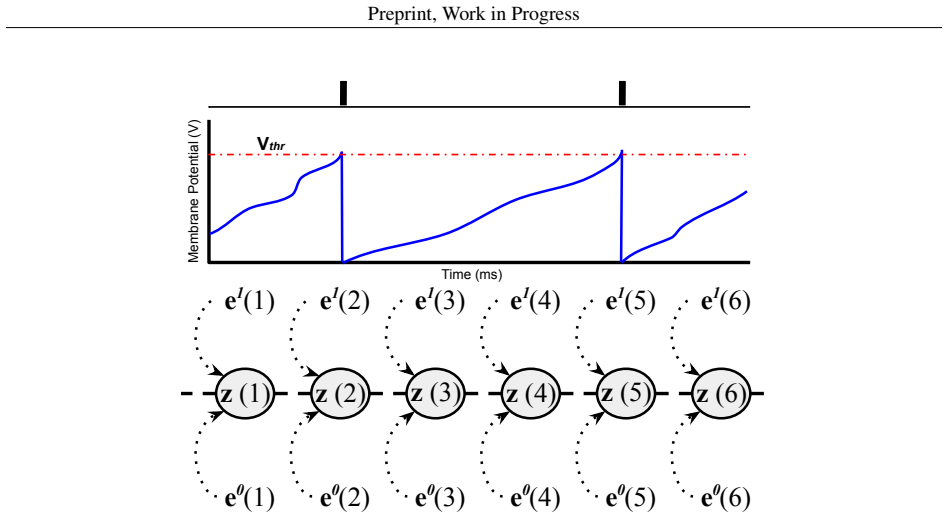
The mechanism that carries the argument is the spiking predictive-coding loop closed by dedicated error neurons and a spike-triggered local update rule. Predictions $z^\mu_\ell = W_\ell s_\ell(t)$ are compared against low-pass filtered spike traces $z_\ell(t)$ to produce error signals $e_\ell(t) = z^\mu_\ell - z_\ell(t)$; these errors are fed back through error synapses $E_\ell$ into the recurrent current equation $J_\ell(t) = (1-\kappa)J_\ell(t) + \kappa(-\gamma_J J_\ell(t) + \varphi(-e_\ell(t) + E_\ell e_{\ell-1}(t)))$ for intermediate layers, with only $E_L e_{L-1}(t)$ for the top layer. Learning is by Spike-Triggered Local Representation Alignment (ST-LRA), the event-driven rule $\Delta W_\ell = e_{\ell-1}(t) s_\ell(t)^\top$, $\Delta E_\ell = -\beta s_\ell(t) e_{\ell-1}(t)^\top$, an error-driven Hebbian outer-product update analogous to the delta rule. The paper uses a leaky integrate-and-fire spike-response model, but states the same three computations would accommodate richer neuron models such as Izhikevich or Hodgkin-Huxley units.
What would settle it
Train the reported four-layer SpNCN on MNIST with the error signals $e_\ell(t)$ replaced by independent noise of the same magnitude during learning, so that ST-LRA still updates but carries no predictive information: if test error stays near $4.72\%$, the mismatch computation is not the source of learning, and if it collapses toward chance, the predictive-coding error is confirmed as the mechanism.
Extended reading notes
Core claim
The central discovery claimed is that a spiking network built on predictive coding can learn online without a global error signal or repeated exposure to data. At every simulated time step, a layer $\ell$ predicts the filtered spike trace of another population, $z^\mu_\ell = W_\ell s_\ell(t)$, error neurons form the mismatch $e_\ell(t) = z^\mu_\ell - z_\ell(t)$, and these error activities are routed through error synapses $E_\ell$ back into the membrane currents $J_\ell(t)$ that drive the spike-response model. Synaptic change happens only when spikes occur, under the Spike-Triggered Local Representation Alignment rule $\Delta W_\ell = e_{\ell-1}(t) s_\ell(t)^\top$ and $\Delta E_\ell = -\beta s_\ell(t) e_{\ell-1}(t)^\top$. The paper reports that with four layers of leaky integrate-and-fire units, this loop reaches $4.72\%$ MNIST test error in one online pass, predicts a bouncing-ball video stream with lower error than a frame-repetition baseline, keeps working when most labels are missing, and retains more accuracy across Split MNIST and NotMNIST task streams than an equivalently sized backprop-trained ANN or a spiking network trained with derivative-free broadcast feedback alignment.
Load-bearing premise
The whole approach depends on the assumption that the mismatch signals computed at each layer, together with the local spike-triggered weight updates, are enough to train every layer correctly, a premise the paper motivates by analogy to the delta rule but does not prove or isolate.
Editorial extensions
If this is right
- A four-layer SpNCN reaches $4.72 \pm 0.11\%$ test error on MNIST after one online pass, placing it alongside spiking networks that train over many epochs and above the paper's implemented spiking baselines.
- On the continual-learning streams Split MNIST and NotMNIST, the SpNCN achieves $76.455\%$ and $77.945\%$ average accuracy, outperforming the self-implemented spiking baseline and a backprop-trained ANN under task-boundary fuzzing.
- With labels on only $0.5\%$ of stream samples, a two-layer SpNCN still gets $24.08\%$ MNIST error versus $37.35\%$ for the derivative-free broadcast feedback alignment baseline, showing the generative side makes unlabeled data usable.
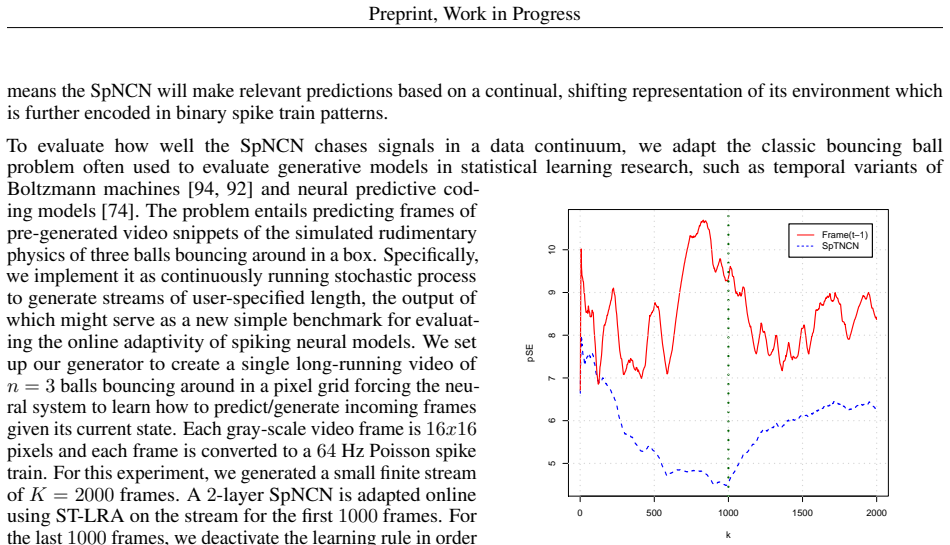
- On the bouncing-ball stream, the SpNCN's prequential squared error reached 6.672 versus 10.225 for a frame-repetition baseline, and it made only about 46,393 lower-layer and 28,998 upper-layer weight updates over 300,000 simulation steps.
- Because ST-LRA is local and event-driven, the paper expects it to combine with STDP and to fit neuromorphic hardware where sparse spike-driven updates translate to energy savings.
Reading between the lines
- Inference: the claimed continual-learning gains are moderate, and the authors themselves note that sparsity alone will not solve catastrophic forgetting; a direct next test implied by their results is to combine ST-LRA with a complementary consolidation mechanism and measure forgetting on the same Split MNIST stream.
- Inference: the generative side of the model suggests the same spike-driven loop could be used for sequence prediction and motor control, not just classification, by treating prediction error on future sensor frames as the learning signal in an event-camera or robotics stream.
- Inference: because the paper does not compare its spiking version against a rate-coded version with the same local rule, a useful test is to run the same architecture with continuous units and non-spiking local representation alignment on the one-pass benchmarks to see whether spiking itself, rather than the update rule, drives the reported robustness.
Signed reviews
Editorial analysis
A structured set of objections, weighed in public.
Referee Report
Summary. The paper proposes the Spiking Neural Coding Network (SpNCN), a recurrent network of leaky integrate-and-fire neurons trained by a spike-triggered local representation alignment (ST-LRA) update derived from predictive coding. The model is evaluated online and in continuous time on a bouncing-ball prediction task, on MNIST, Fashion-MNIST, Stanford OCR, and Caltech-101 classification, on semi-supervised variants of MNIST/Fashion-MNIST, and on Split-MNIST/NotMNIST continual-learning benchmarks. The central claims are that ST-LRA provides a local, backprop-free credit-assignment rule for multi-layer spiking networks, that SpNCN is competitive with existing SNNs after a single pass over the data, that it can exploit unlabeled data, and that its sparse spike-based representations forget less when tasks are presented sequentially.
Significance. If the learning mechanism performs as claimed, the paper offers a genuinely local, online, spike-based alternative to backpropagation-style training for spiking networks and a concrete test of the hypothesis that sparsity mitigates catastrophic forgetting. The paper has real strengths: all classification results are evaluated on held-out test sets rather than training data; the authors implement and compare against derivative-free spiking baselines under the same LIF SRM; the sparse weight-update counts in the bouncing-ball experiment give a concrete computational-economy datum; and the semi-supervised comparison is an informative stress test. The significance is conditional, however, because the central learning rule is not consistently specified and key simulation hyperparameters are missing.
major comments (5)
- [Section 2.2, Eqs. (2) and (5), Algorithm 1] The learning rule as printed is not internally consistent. Eq. (2) defines e_l(t) = W_l s_l(t) − z_l(t), so W_l appears to predict layer l's own filtered activity from its own spikes, whereas Eq. (5) updates W_l with ΔW_l = e_{l−1}(t)(s_l(t))^T, which is a predictive-coding update only under an off-by-one indexing convention in which W_l predicts z_{l−1}(t) from s_l(t). The subsequent sentence "W_l ← W_l − α_u ΔE_l and E_l ← E_l − α_u ΔW_l" then swaps the two matrices relative to their definitions, and the shapes of W_l and E_l are never stated. Algorithm 1 repeats Eqs. (2) and (5) without resolving the indexing. Since no code is provided, a reader cannot determine which variant produced Tables 1–4; if the equations are implemented literally, the rule may not be performing predictive-coding credit assignment at all. Please restate the model with consistent subscripts, specify the dimensions of all weight matrices, and reconcile Algorithm 1 with the equations.
- [Sections 2.2 and 3.2] The firing threshold v_thr is never reported. The text states only that a threshold is chosen and that voltages operate in the [0,1] decivolt range, while the MNIST experiments report 4 layers of 1000 LIF units, T_st = 100 ms, Δt = 0.25 ms, α = 0.0025, β = 1.0, and K = 63.75 Hz, but not the threshold, the membrane time constant τ_m, R_m, γ_m, τ_f, or whether an inter-stimulus interval T_ist was used. Because the threshold controls spiking frequency, the sparse spike-triggered updates, and hence the online learning dynamics, the headline 4.72% single-pass error cannot be reproduced or checked against the claim that sparse activity drives learning. Please provide a complete hyperparameter table for every experiment, including the bouncing-ball and continual-learning settings.
- [Table 4] The reported standard errors (±0.001% to ±0.003% over 10 trials) are implausibly small. For a binary accuracy near 0.76 on a held-out test set of even 10,000 examples, the per-trial standard deviation is roughly 0.4 percentage points and the standard error of the mean is about 0.13 percentage points, so the printed error bars are one to two orders of magnitude too small. As written, the error bars imply either that the metric is not what is stated, a typo, or an averaging artifact. This matters because the continual-learning advantage over the SNN baseline is the main quantitative support for the "less forgetting" claim, and its precision must be reported correctly.
- [Section 3.1, Figure 3] The bouncing-ball result is a single run: one stream of K = 2000 frames, one simulated 30-second sequence, and no repeated seeds, initializations, or error bars, and the 1000-frame train/freeze boundary is not justified. The Frame(t−1) comparison is useful, but a single-run pSE difference (6.672 vs 10.225) is anecdotal evidence for the model's predictive-tracking ability, which is one of the paper's three experimental pillars. Please report results over multiple random streams and initializations, with variance or interquartile ranges.
- [Table 4 and Section 3 ("On Catastrophic Forgetting")] The continual-learning experiments report only aggregate average accuracy (ACC) after the full stream. Aggregate accuracy does not directly measure forgetting; a model can achieve high ACC while still overwriting earlier tasks if later tasks are easier or if the final average is dominated by later performance. Since the stated goal is to determine whether spiking sparsity reduces forgetting, please also report per-task accuracy after each task, backward transfer, or an explicit forgetting measure such as final average per-task accuracy versus peak per-task accuracy.
minor comments (6)
- [Equation (1)] The first form of the trace filter writes z_l(t) on both sides; please use an explicit time index such as z_l(t+Δt) to remove the ambiguity between an in-place recurrence and a fixed-point equation.
- [Table 3] The caption says the columns vary "the proportion of samples that arrive labeled," but the first column is 0% and is described as fully supervised; please clarify whether the column percentages refer to labeled or unlabeled samples.
- [Table 4 and Section 3.1] Table 4 labels the baseline "SNN df-BDA," which should read "SNN df-BFA," and Section 3.1 plus Figure 3 use "SpTNCN" where "SpNCN" is meant.
- [Section 3.2, Table 1 caption] The caption says performance was "averaged over 10 trails"; this should be "10 trials."
- [Appendix (df-BFA and df-DRTP)] No hyperparameters are reported for the df-BFA and df-DRTP baselines (learning rates, numbers of layers and units, feedback weight initialization, training epochs, tuning procedure). Please provide these settings so the comparisons in Tables 1–3 cannot be attributed to under-tuned baselines.
- [Algorithm 1] In COMPUTE STATES, currents and voltages are updated layer by layer before the prediction/error loop; please state explicitly whether e_l(t) is computed from the post-update z_l(t) or from the previous value, since this timing changes the effective ST-LRA update.
Circularity Check
No significant circularity: the paper's empirical claims rest on external benchmark evaluations rather than fitted constants or self-citation chains.
full rationale
The paper's core claims—classification accuracy, online semi-supervised performance, reduced forgetting, and computational economy—are supported by measurements on held-out external benchmarks: MNIST test error in Table 1, Fashion MNIST / Stanford OCR / Caltech 101 in Table 2, semi-supervised errors in Table 3, and Split MNIST / NotMNIST ACC in Table 4. These quantities are not recovered from fitted constants or from the model equations by construction; they are empirical outcomes of running the described network on data. The ST-LRA learning rule (Eq. 5) is adopted from the author's prior LRA/NPC line of work ([72,73,74,75,77]), and self-citations appear in the motivation, but the present paper does not ask the reader to accept its results on the authority of those citations: it supplies its own spiking implementation and direct comparisons against df-BFA and df-DRTP baselines. No uniqueness theorem, no imported ansatz, and no definitional identity is used to force the main results. A separate concern about the consistency of Eq. 2 and Eq. 5, and about the weight-application line swapping ΔW and ΔE, is a correctness/reproducibility defect, not a circularity, because the published equations do not define the target accuracy in terms of the update's own outputs. Accordingly, the finding is 'no significant circularity,' with score 1 reflecting only the presence of non-load-bearing self-citations.
Assumptions & free parameters
free parameters (7)
- Step size alpha_u =
0.0025
- Error weight coefficient beta =
1.0 (0.9 suggested earlier)
- Maximum input firing rate K =
63.75 Hz
- Spike threshold v_thr =
not reported numerically
- Weight column norm bound =
20
- Stimulus presentation time T_st =
100 ms for image tasks; 30 ms for bouncing ball
- Integration step Delta t =
0.25 ms (0.1 ms for bouncing ball)
assumptions (4)
- domain assumption Leaky integrate-and-fire (LIF) neuron model adequately captures computation for pattern recognition.
- domain assumption Poisson spike encoding faithfully represents input patterns.
- ad hoc to paper Error neurons and local representation alignment provide correct credit assignment in spiking networks.
- domain assumption Single presentation of each stream sample is sufficient for learning.
Cite this review
Pith. "Pith review of Spiking Neural Predictive Coding for Continual Learning from Data Streams." pith.science (2026). https://pith.science/paper/T4QNAEVB
@misc{pith2026190808655,
  author       = {Pith},
  title        = {Pith review of: Spiking Neural Predictive Coding for Continual Learning from Data Streams},
  year         = {2026},
  howpublished = {\url{https://pith.science/paper/T4QNAEVB}},
  note         = {Machine review of arXiv:1908.08655}
}
read the original abstract
For energy-efficient computation in specialized neuromorphic hardware, we present spiking neural coding, an instantiation of a family of artificial neural models grounded in the theory of predictive coding. This model, the first of its kind, works by operating in a never-ending process of "guess-and-check", where neurons predict the activity values of one another and then adjust their own activities to make better future predictions. The interactive, iterative nature of our system fits well into the continuous time formulation of sensory stream prediction and, as we show, the model's structure yields a local synaptic update rule, which can be used to complement or as an alternative to online spike-timing dependent plasticity. In this article, we experiment with an instantiation of our model consisting of leaky integrate-and-fire units. However, the framework within which our system is situated can naturally incorporate more complex neurons such as the Hodgkin-Huxley model. Our experimental results in pattern recognition demonstrate the potential of the model when binary spike trains are the primary paradigm for inter-neuron communication. Notably, spiking neural coding is competitive in terms of classification performance and experiences less forgetting when learning from task sequence, offering a more computationally economical, biologically-plausible alternative to popular artificial neural networks.
Figures

Figures from the paper (1 more)

Reference graph
Works this paper leans on
-
[1]
Lateral competition for cortical space by layer-specific horizontal circuits
ADESNIK , H., AND SCANZIANI , M. Lateral competition for cortical space by layer-specific horizontal circuits. Nature 464, 7292 (2010), 1155
2010
-
[2]
Y., AND DAYAN, P
A NGELA , J. Y., AND DAYAN, P. Uncertainty, neuromodulation, and attention. Neuron 46, 4 (2005), 681–692
2005
-
[3]
Predictive coding of speech signals and subjective error criteria
ATAL, B., AND SCHROEDER , M. Predictive coding of speech signals and subjective error criteria. IEEE Transactions on Acoustics, Speech, and Signal Processing 27, 3 (1979), 247–254
1979
-
[4]
M., U SREY, W
BASTOS , A. M., U SREY, W. M., A DAMS , R. A., M ANGUN , G. R., F RIES , P., AND FRISTON , K. J. Canonical microcircuits for predictive coding. Neuron 76, 4 (2012), 695–711
2012
-
[5]
Simultaneous unsupervised and supervised learning of cognitive functions in biologically plausible spiking neural networks
BEKOLAY, T., K OLBECK , C., AND ELIASMITH , C. Simultaneous unsupervised and supervised learning of cognitive functions in biologically plausible spiking neural networks. In Proceedings of the Annual Meeting of the Cognitive Science Society (2013), vol. 35
2013
-
[6]
H., S UMMERFIELD , C., M ORIN , E
BELL , A. H., S UMMERFIELD , C., M ORIN , E. L., M ALECEK , N. J., AND UNGERLEIDER , L. G. Encoding of stimulus probability in macaque inferior temporal cortex. Current Biology 26, 17 (2016), 2280–2290
2016
-
[7]
D., AND KRICHMAR , J
BEYELER , M., D UTT, N. D., AND KRICHMAR , J. L. Categorization and decision-making in a neurobiologically plausible spiking network using a stdp-like learning rule. Neural Networks 48 (2013), 109–124
2013
-
[8]
Synaptic modifications in cultured hippocampal neurons: dependence on spike timing, synaptic strength, and postsynaptic cell type
BI, G.- Q., AND POO, M.- M. Synaptic modifications in cultured hippocampal neurons: dependence on spike timing, synaptic strength, and postsynaptic cell type. Journal of neuroscience 18, 24 (1998), 10464–10472
1998
Show all 104 references
-
[9]
Synaptic modification by correlated activity: Hebb’s postulate revisited
BI, G.- Q., AND POO, M.- M. Synaptic modification by correlated activity: Hebb’s postulate revisited. Annual review of neuroscience 24, 1 (2001), 139–166
2001
-
[10]
Neuromorphic microchips
B OAHEN , K. Neuromorphic microchips. Scientific American 292, 5 (2005), 56–63
2005
-
[11]
K., AND DENÈVE , S
BOERLIN , M., M ACHENS , C. K., AND DENÈVE , S. Predictive coding of dynamical variables in balanced spiking networks. PLoS computational biology 9, 11 (2013), e1003258
2013
-
[12]
M., K OK, J
BOHTE , S. M., K OK, J. N., AND LA POUTRE , H. Error-backpropagation in temporally encoded networks of spiking neurons. Neurocomputing 48, 1-4 (2002), 17–37
2002
-
[13]
M., S ENN , W., AND FUSI , S
BRADER , J. M., S ENN , W., AND FUSI , S. Learning real-world stimuli in a neural network with spike-driven synaptic dynamics. Neural computation 19, 11 (2007), 2881–2912
2007
-
[14]
W., AND AGGLETON , J
BROWN , M. W., AND AGGLETON , J. P. Recognition memory: what are the roles of the perirhinal cortex and hippocampus? Nature Reviews Neuroscience 2, 1 (2001), 51
2001
-
[15]
Pattern recogni- tion with spiking neural networks: a simple training method
CHRISTOPHE , F., M IKKONEN , T., A NDALIBI , V., KOSKIMIES , K., AND LAUKKARINEN , T. Pattern recogni- tion with spiking neural networks: a simple training method. In SPLST (2015), pp. 296–308
2015
-
[16]
H., D IMOU , G., J OSHI , P., IMAM , N., J AIN , S., ET AL
DAVIES , M., S RINIVASA , N., L IN, T.-H., C HINYA , G., C AO, Y., C HODAY, S. H., D IMOU , G., J OSHI , P., IMAM , N., J AIN , S., ET AL . Loihi: A neuromorphic manycore processor with on-chip learning. IEEE Micro 38, 1 (2018), 82–99
2018
-
[17]
Correlation between neural spike trains increases with firing rate
DE LA ROCHA , J., D OIRON , B., S HEA -B ROWN , E., J OSI ´C, K., AND REYES , A. Correlation between neural spike trains increases with firing rate. Nature 448, 7155 (2007), 802
2007
-
[18]
Bert: Pre-training of deep bidirectional transformers for language understanding
DEVLIN , J., C HANG , M.-W., L EE, K., AND TOUTANOVA , K. Bert: Pre-training of deep bidirectional transformers for language understanding. arXiv preprint arXiv:1810.04805 (2018)
2018 arXiv
-
[19]
U., AND COOK , M
DIEHL , P. U., AND COOK , M. Unsupervised learning of digit recognition using spike-timing-dependent plasticity. Frontiers in computational neuroscience 9(2015), 99
2015
-
[20]
U., N EIL , D., B INAS , J., C OOK , M., L IU, S.-C., AND PFEIFFER , M
DIEHL , P. U., N EIL , D., B INAS , J., C OOK , M., L IU, S.-C., AND PFEIFFER , M. Fast-classifying, high-accuracy spiking deep networks through weight and threshold balancing. In 2015 International Joint Conference on Neural Networks (IJCNN) (2015), IEEE, pp. 1–8. 12 Preprint...
2015
-
[21]
U., Z ARRELLA , G., C ASSIDY , A., P EDRONI , B
DIEHL , P. U., Z ARRELLA , G., C ASSIDY , A., P EDRONI , B. U., AND NEFTCI , E. Conversion of artificial recurrent neural networks to spiking neural networks for low-power neuromorphic hardware. In 2016 IEEE International Conference on Rebooting Computing (ICRC) (2016), IEEE, pp. 1–8
2016
-
[22]
Metalearning and neuromodulation
D OYA, K. Metalearning and neuromodulation. Neural Networks 15, 4-6 (2002), 495–506
2002
-
[23]
Semi-supervised classification with hybrid genera- tive/discriminative methods
DRUCK , G., P AL, C., M CCALLUM , A., AND ZHU, X. Semi-supervised classification with hybrid genera- tive/discriminative methods. In Proceedings of the 13th ACM SIGKDD international conference on Knowledge discovery and data mining (2007), ACM, pp. 280–289
2007
-
[24]
ELIASMITH , C., AND ANDERSON , C. H. Neural engineering: Computation, representation, and dynamics in neurobiological systems. MIT press, 2004
2004
-
[25]
C., C HOO , X., B EKOLAY, T., D EWOLF, T., TANG , Y., AND RASMUSSEN , D
ELIASMITH , C., S TEWART, T. C., C HOO , X., B EKOLAY, T., D EWOLF, T., TANG , Y., AND RASMUSSEN , D. A large-scale model of the functioning brain. science 338, 6111 (2012), 1202–1205
2012
-
[26]
K., P ETERSEN , A
FISER , A., M AHRINGER , D., O YIBO , H. K., P ETERSEN , A. V., L EINWEBER , M., AND KELLER , G. B. Experience-dependent spatial expectations in mouse visual cortex. Nature neuroscience 19, 12 (2016), 1658
2016
-
[27]
FRENCH , R. M. Catastrophic forgetting in connectionist networks. Trends in cognitive sciences 3, 4 (1999), 128–135
1999
-
[28]
Learning without feedback: Direct random target projection as a feedback-alignment algorithm with layerwise feedforward training
FRENKEL , C., L EFEBVRE , M., AND BOL, D. Learning without feedback: Direct random target projection as a feedback-alignment algorithm with layerwise feedforward training. arXiv preprint arXiv:1909.01311 (2019)
2019 arXiv
-
[29]
Predictive coding under the free-energy principle
FRISTON , K., AND KIEBEL , S. Predictive coding under the free-energy principle. Philosophical Transactions of the Royal Society B: Biological Sciences 364, 1521 (2009), 1211–1221
2009
-
[30]
B., G ALLUPPI , F., T EMPLE , S., AND PLANA , L
FURBER , S. B., G ALLUPPI , F., T EMPLE , S., AND PLANA , L. A. The spinnaker project. Proceedings of the IEEE 102, 5 (2014), 652–665
2014
-
[31]
GAMA , J., S EBASTIÃO , R., AND RODRIGUES , P. P. On evaluating stream learning algorithms. Machine learning 90, 3 (2013), 317–346
2013
-
[32]
Understanding the difficulty of training deep feedforward neural networks
GLOROT, X., AND BENGIO , Y. Understanding the difficulty of training deep feedforward neural networks. In Proceedings of the thirteenth international conference on artificial intelligence and statistics(2010), pp. 249–256
2010
-
[33]
F., AND BRETTE , R
G OODMAN , D. F., AND BRETTE , R. The brian simulator. Frontiers in neuroscience 3(2009), 26
2009
-
[34]
Competitive learning: From interactive activation to adaptive resonance
GROSSBERG , S. Competitive learning: From interactive activation to adaptive resonance. Cognitive science 11, 1 (1987), 23–63
1987
-
[35]
Evolving spiking neural network controllers for autonomous robots
HAGRAS , H., P OUNDS -CORNISH , A., C OLLEY , M., C ALLAGHAN , V., AND CLARKE , G. Evolving spiking neural network controllers for autonomous robots. InIEEE International Conference on Robotics and Automation,
-
[36]
A biologically plausible supervised learning method for spiking neural networks using the symmetric stdp rule
HAO, Y., HUANG , X., D ONG , M., AND XU, B. A biologically plausible supervised learning method for spiking neural networks using the symmetric stdp rule. arXiv preprint arXiv:1812.06574 (2018)
2018 arXiv
-
[37]
T., S IEGELMANN , H., AND KOZMA , R
HAZAN , H., S AUNDERS , D., S ANGHAVI , D. T., S IEGELMANN , H., AND KOZMA , R. Unsupervised learning with self-organizing spiking neural networks. In 2018 International Joint Conference on Neural Networks (IJCNN) (2018), IEEE, pp. 1–6
2018
-
[38]
Identity mappings in deep residual networks
HE, K., Z HANG , X., R EN, S., AND SUN, J. Identity mappings in deep residual networks. In European conference on computer vision (2016), Springer, pp. 630–645
2016
-
[39]
O., ET AL
H EBB , D. O., ET AL . The organization of behavior, 1949
1949
-
[40]
Deep neural networks for acoustic modeling in speech recognition
HINTON , G., D ENG , L., Y U, D., D AHL , G., M OHAMED , A.- R., JAITLY, N., S ENIOR , A., V ANHOUCKE , V., NGUYEN , P., K INGSBURY , B., ET AL . Deep neural networks for acoustic modeling in speech recognition. IEEE Signal processing magazine 29 (2012)
2012
-
[41]
E., AND MCCLELLAND , J
HINTON , G. E., AND MCCLELLAND , J. L. Learning representations by recirculation. In Neural information processing systems (1988), pp. 358–366
1988
-
[42]
L., AND HUXLEY , A
HODGKIN , A. L., AND HUXLEY , A. F. A quantitative description of membrane current and its application to conduction and excitation in nerve. The Journal of physiology 117, 4 (1952), 500–544
1952
-
[43]
Improved margin multi-class classification using dendritic neurons with morphological learning
HUSSAIN , S., L IU, S.-C., AND BASU , A. Improved margin multi-class classification using dendritic neurons with morphological learning. In 2014 IEEE International Symposium on Circuits and Systems (ISCAS) (2014), IEEE, pp. 2640–2643
2014
-
[44]
A self-driving robot using deep convolutional neural networks on neuromorphic hardware
HWU, T., I SBELL , J., O ROS, N., AND KRICHMAR , J. A self-driving robot using deep convolutional neural networks on neuromorphic hardware. In 2017 International Joint Conference on Neural Networks (IJCNN) (2017), IEEE, pp. 635–641. 13 Preprint, Work in Progress
2017
-
[45]
Frontiers in neuromorphic engineering
INDIVERI , G., AND HORIUCHI , T. Frontiers in neuromorphic engineering. Frontiers in Neuroscience 5(2011), 118
2011
-
[46]
IZHIKEVICH , E. M. Simple model of spiking neurons. IEEE Transactions on neural networks 14, 6 (2003), 1569–1572
2003
-
[47]
M., O SINDERO , S., V INYALS , O., G RAVES , A., S ILVER , D., AND KAVUKCUOGLU , K
JADERBERG , M., C ZARNECKI , W. M., O SINDERO , S., V INYALS , O., G RAVES , A., S ILVER , D., AND KAVUKCUOGLU , K. Decoupled neural interfaces using synthetic gradients. In Proceedings of the 34th International Conference on Machine Learning-Volume 70(2017), JMLR. org, pp. 1627–1635
2017
-
[48]
Improving protein fold recognition by deep learning networks
JO, T., H OU, J., E ICKHOLT , J., AND CHENG , J. Improving protein fold recognition by deep learning networks. Scientific reports 5 (2015), 17573
2015
-
[49]
R., G ANJTABESH , M., T HORPE , S
KHERADPISHEH , S. R., G ANJTABESH , M., T HORPE , S. J., AND MASQUELIER , T. Stdp-based spiking deep convolutional neural networks for object recognition. Neural Networks 99 (2018), 56–67
2018
-
[50]
Retrospective and prospective coding for predicted reward in the sensory thalamus
KOMURA , Y., TAMURA , R., U WANO, T., N ISHIJO , H., K AGA, K., AND ONO, T. Retrospective and prospective coding for predicted reward in the sensory thalamus. Nature 412, 6846 (2001), 546
2001
-
[51]
KRIZHEVSKY , A., S UTSKEVER , I., AND HINTON , G. E. Imagenet classification with deep convolutional neural networks. In Advances in neural information processing systems (2012), pp. 1097–1105
2012
-
[52]
KROTOV, D., AND HOPFIELD , J. J. Unsupervised learning by competing hidden units. Proceedings of the National Academy of Sciences 116, 16 (2019), 7723–7731
2019
-
[53]
Learning algorithms for the classification restricted boltzmann machine
LAROCHELLE , H., M ANDEL , M., P ASCANU , R., AND BENGIO , Y. Learning algorithms for the classification restricted boltzmann machine. Journal of Machine Learning Research 13, Mar (2012), 643–669
2012
-
[54]
H., D ELBRUCK , T., AND PFEIFFER , M
LEE, J. H., D ELBRUCK , T., AND PFEIFFER , M. Training deep spiking neural networks using backpropagation. Frontiers in neuroscience 10(2016), 508
2016
-
[55]
On the relation between catastrophic interference and generalization in connectionist networks
LEWANDOWSKY , S. On the relation between catastrophic interference and generalization in connectionist networks. Journal of Biological Systems 2, 03 (1994), 307–333
1994
-
[56]
Networks of spiking neurons: the third generation of neural network models
MAASS , W. Networks of spiking neurons: the third generation of neural network models. Neural networks 10, 9 (1997), 1659–1671
1997
-
[57]
Fine-tuning and the stability of recurrent neural networks
MACNEIL , D., AND ELIASMITH , C. Fine-tuning and the stability of recurrent neural networks. PLOS ONE 6, 9 (09 2011), 1–16
2011
-
[58]
C., AND JOHNSTON , D
MAGEE , J. C., AND JOHNSTON , D. A synaptically controlled, associative signal for hebbian plasticity in hippocampal neurons. Science 275, 5297 (1997), 209–213
1997
-
[59]
MCCLOSKEY , M., AND COHEN , N. J. Catastrophic interference in connectionist networks: The sequential learning problem. The psychology of learning and motivation 24, 109 (1989), 92
1989
-
[60]
Neurotransmitters as developmental signals
MEIER , E., H ERTZ , L., AND SCHOUSBOE , A. Neurotransmitters as developmental signals. Neurochemistry international 19, 1-2 (1991), 1–15
1991
-
[61]
MEROLLA , P., A RTHUR , J., A KOPYAN , F., I MAM , N., M ANOHAR , R., AND MODHA , D. S. A digital neurosynaptic core using embedded crossbar memory with 45pj per spike in 45nm. In 2011 IEEE custom integrated circuits conference (CICC)(2011), IEEE, pp. 1–4
2011
-
[62]
A., A RTHUR , J
MEROLLA , P. A., A RTHUR , J. V., A LVAREZ-I CAZA , R., C ASSIDY , A. S., S AWADA, J., A KOPYAN , F., JACKSON , B. L., I MAM , N., G UO, C., N AKAMURA , Y., ET AL . A million spiking-neuron integrated circuit with a scalable communication network and interface. Science 345, 61...
2014
-
[63]
K., L I, L., AND DESIMONE , R
MILLER , E. K., L I, L., AND DESIMONE , R. Activity of neurons in anterior inferior temporal cortex during a short-term memory task. Journal of Neuroscience 13, 4 (1993), 1460–1478
1993
-
[64]
J., AND MASQUELIER , T
MOZAFARI , M., G ANJTABESH , M., N OWZARI -DALINI , A., T HORPE , S. J., AND MASQUELIER , T. Bio- inspired digit recognition using reward-modulated spike-timing-dependent plasticity in deep convolutional networks. Pattern Recognition 94 (2019), 87–95
2019
-
[65]
Event-driven contrastive divergence for spiking neuromorphic systems
NEFTCI , E., D AS, S., P EDRONI , B., K REUTZ -D ELGADO , K., AND CAUWENBERGHS , G. Event-driven contrastive divergence for spiking neuromorphic systems. Frontiers in neuroscience 7 (2014), 272
2014
-
[66]
Cognitive psychology: Classic edition
N EISSER , U. Cognitive psychology: Classic edition. Psychology Press, 2014
2014
-
[67]
Real-time classification and sensor fusion with a spiking deep belief network
O’CONNOR , P., N EIL , D., L IU, S.-C., D ELBRUCK , T., AND PFEIFFER , M. Real-time classification and sensor fusion with a spiking deep belief network. Frontiers in neuroscience 7 (2013), 178
2013
-
[68]
A., AND FIELD , D
OLSHAUSEN , B. A., AND FIELD , D. J. Sparse coding with an overcomplete basis set: A strategy employed by v1? Vision research 37, 23 (1997), 3311–3325. 14 Preprint, Work in Progress
1997
-
[69]
OORD , A. V. D., D IELEMAN , S., Z EN, H., S IMONYAN , K., V INYALS , O., G RAVES , A., K ALCHBRENNER , N., S ENIOR , A., AND KAVUKCUOGLU , K. Wavenet: A generative model for raw audio. arXiv preprint arXiv:1609.03499 (2016)
2016 arXiv
-
[70]
O’REILLY, R. C. Six principles for biologically based computational models of cortical cognition. Trends in cognitive sciences 2, 11 (1998), 455–462
1998
-
[71]
C., AND MUNAKATA , Y
O’REILLY, R. C., AND MUNAKATA , Y. Computational explorations in cognitive neuroscience: Understanding the mind by simulating the brain. MIT press, 2000
2000
-
[72]
L., AND KIFER , D
ORORBIA , A., M ALI , A., G ILES , C. L., AND KIFER , D. Continual learning of recurrent neural networks by locally aligning distributed representations. arXiv preprint arXiv:1810.07411 (2018)
2018 arXiv
-
[73]
ORORBIA , A., M ALI , A., K IFER , D., AND GILES , C. L. Lifelong neural predictive coding: Sparsity yields less forgetting when learning cumulatively. arXiv preprint arXiv:1905.10696 (2019)
2019 arXiv
-
[74]
G., H AFFNER , P., R EITTER , D., AND GILES , C
ORORBIA , A. G., H AFFNER , P., R EITTER , D., AND GILES , C. L. Learning to adapt by minimizing discrepancy. arXiv preprint arXiv:1711.11542 (2017)
2017 arXiv
-
[75]
G., AND MALI , A
ORORBIA , A. G., AND MALI , A. Biologically motivated algorithms for propagating local target representations. In Proceedings of the AAAI Conference on Artificial Intelligence (2019), vol. 33, pp. 4651–4658
2019
-
[76]
G., M ALI , A., K ELLY, M
ORORBIA , A. G., M ALI , A., K ELLY, M. A., AND REITTER , D. Like a Baby: Visually Situated Neural Language Acquisition. In Proceedings of the 57th Annual Meeting of the Association for Computational Linguistics (Florence, Italy, 2019)
2019
-
[77]
G., M ALI , A., K IFER , D., AND GILES , C
ORORBIA , A. G., M ALI , A., K IFER , D., AND GILES , C. L. Deep credit assignment by aligning local representations. arXiv preprint arXiv:1803.01834 (2018)
2018 arXiv
-
[78]
L., AND REITTER , D
ORORBIA , I., A LEXANDER , G., G ILES , C. L., AND REITTER , D. Online semi-supervised learning with deep hybrid boltzmann machines and denoising autoencoders. arXiv preprint arXiv:1511.06964 (2015)
2015 arXiv
-
[79]
L., AND REITTER , D
ORORBIA II, A., G ILES , C. L., AND REITTER , D. Learning a deep hybrid model for semi-supervised text classification. In Proceedings of the 2015 Conference on Empirical Methods in Natural Language Processing (2015), pp. 471–481
2015
-
[80]
G., M IKOLOV, T., AND REITTER , D
ORORBIA II, A. G., M IKOLOV, T., AND REITTER , D. Learning simpler language models with the differential state framework. Neural Computation 29, 12 (2017), 3327–3352
2017
-
[81]
G., R EITTER , D., W U, J., AND GILES , C
ORORBIA II, A. G., R EITTER , D., W U, J., AND GILES , C. L. Online learning of deep hybrid architectures for semi-supervised categorization. In Machine Learning and Knowledge Discovery in Databases (Proceedings, ECML PKDD 2015), vol. 9284 of Lecture Notes in Computer Science....
2015
-
[82]
Deep learning for regulatory genomics
P ARK , Y., AND KELLIS , M. Deep learning for regulatory genomics. Nature biotechnology 33, 8 (2015), 825
2015
-
[83]
On the difficulty of training recurrent neural networks
PASCANU , R., M IKOLOV, T., AND BENGIO , Y. On the difficulty of training recurrent neural networks. In International conference on machine learning (2013), pp. 1310–1318
2013
-
[84]
V., B LUMER , K., L IU, Y., M CCONNELL , M
P OPLIN , R., V ARADARAJAN , A. V., B LUMER , K., L IU, Y., M CCONNELL , M. V., C ORRADO , G. S., P ENG , L., AND WEBSTER , D. R. Prediction of cardiovascular risk factors from retinal fundus photographs via deep learning. Nature Biomedical Engineering 2, 3 (2018), 158
2018
-
[85]
Immunity to device variations in a spiking neural network with memristive nanodevices
QUERLIOZ , D., B ICHLER , O., D OLLFUS , P., AND GAMRAT, C. Immunity to device variations in a spiking neural network with memristive nanodevices. IEEE Transactions on Nanotechnology 12, 3 (2013), 288–295
2013
-
[86]
C., AND MILLER , E
RAINER , G., R AO, S. C., AND MILLER , E. K. Prospective coding for objects in primate prefrontal cortex. Journal of Neuroscience 19, 13 (1999), 5493–5505
1999
-
[87]
M., H AJAJ , N., H ARDT , M., L IU, P
RAJKOMAR , A., O REN , E., C HEN , K., D AI, A. M., H AJAJ , N., H ARDT , M., L IU, P. J., L IU, X., M ARCUS , J., S UN, M., ET AL . Scalable and accurate deep learning with electronic health records. NPJ Digital Medicine 1, 1 (2018), 18
2018
-
[88]
P., AND BALLARD , D
RAO, R. P., AND BALLARD , D. H. Predictive coding in the visual cortex: a functional interpretation of some extra-classical receptive-field effects. Nature neuroscience 2, 1 (1999)
1999
-
[89]
Connectionist models of recognition memory: constraints imposed by learning and forgetting functions
RATCLIFF , R. Connectionist models of recognition memory: constraints imposed by learning and forgetting functions. Psychological review 97, 2 (1990), 285
1990
-
[90]
Recurrent spiking networks solve planning tasks
RUECKERT , E., K APPEL , D., T ANNEBERG , D., P ECEVSKI , D., AND PETERS , J. Recurrent spiking networks solve planning tasks. Scientific reports 6 (2016), 21142
2016
-
[91]
P., AND TWEED , D
SAMADI , A., L ILLICRAP , T. P., AND TWEED , D. B. Deep learning with dynamic spiking neurons and fixed feedback weights. Neural computation 29, 3 (2017), 578–602. 15 Preprint, Work in Progress
2017
-
[92]
E., AND TAYLOR , G
SUTSKEVER , I., H INTON , G. E., AND TAYLOR , G. W. The recurrent temporal restricted boltzmann machine. In Advances in Neural Information Processing Systems (2009), pp. 1601–1608
2009
-
[93]
D., G REGOR , K., AND CUN, Y
SZLAM , A. D., G REGOR , K., AND CUN, Y. L. Structured sparse coding via lateral inhibition. In Advances in Neural Information Processing Systems (2011), pp. 1116–1124
2011
-
[94]
W., H INTON , G
TAYLOR , G. W., H INTON , G. E., AND ROWEIS , S. T. Modeling human motion using binary latent variables. In Advances in neural information processing systems (2007), pp. 1345–1352
2007
-
[95]
C., B ICHLER , O., AND DUPRET , A
THIELE , J. C., B ICHLER , O., AND DUPRET , A. Event-based, timescale invariant unsupervised online deep learning with stdp. Frontiers in computational neuroscience 12(2018), 46
2018
-
[96]
THRUN , S., AND MITCHELL , T. M. Lifelong robot learning. Robotics and autonomous systems 15, 1-2 (1995), 25–46
1995
-
[97]
J., ET AL
WERBOS , P. J., ET AL . Backpropagation through time: what it does and how to do it. Proceedings of the IEEE 78, 10 (1990), 1550–1560
1990
-
[98]
WIDROW, B., AND HOFF, M. E. Adaptive switching circuits. Tech. rep., Stanford Univ Ca Stanford Electronics Labs, 1960
1960
-
[99]
WISKOTT , L., AND SEJNOWSKI , T. J. Slow feature analysis: Unsupervised learning of invariances. Neural computation 14, 4 (2002), 715–770
2002
-
[100]
Fashion-mnist: a novel image dataset for benchmarking machine learning algorithms
X IAO, H., R ASUL , K., AND VOLLGRAF , R. Fashion-mnist: a novel image dataset for benchmarking machine learning algorithms. arXiv preprint arXiv:1708.07747 (2017)
2017 arXiv
-
[101]
Continual learning of context-dependent processing in neural networks
ZENG , G., C HEN , Y., C UI, B., AND YU, S. Continual learning of context-dependent processing in neural networks. Nature Machine Intelligence 1, 8 (2019), 364–372
2019
-
[102]
Feedforward categorization on aer motion events using cortex-like features in a spiking neural network
ZHAO, B., D ING , R., C HEN , S., L INARES -BARRANCO , B., AND TANG , H. Feedforward categorization on aer motion events using cortex-like features in a spiking neural network. IEEE transactions on neural networks and learning systems 26, 9 (2014), 1963–1978
2014
-
[103]
O”) shape from an X-cross (“X
ZMARZ , P., AND KELLER , G. B. Mismatch receptive fields in mouse visual cortex. Neuron 92, 4 (2016), 766–772. 16 Preprint, Work in Progress Appendix Algorithmic Specification In this section, we present the full pseudocode, i.e., Algorithm 1, for computing state updates and syn...
2016
-
[2004]
Proceedings. ICRA’04. 2004(2004), vol. 5, IEEE, pp. 4620–4626
2004
Reviewed August 14, 2026 · model on record in the stance chip above.
Discussion (0). Continue with ORCID to comment.