REVIEW 4 major objections 5 minor 4 cited by
SMPLest-X: Ultimate Scaling for Expressive Human Pose and Shape Estimation
T0 review · 4 major / 5 minor · reviewed 2026-08-10 · deepseek-v4-flash
Pith's one-line read By training two deliberately simple vision-transformer architectures on 40 datasets and up to 10 million images, this paper shows that scaling data and model size alone produces state-of-the-art expressive human pose and shape estimation…
desk verdict Big, useful data-scaling study for EHPS, but the 'generalist' claim is not tested on a truly held-out whole-body benchmark. read the letter →
The pith
A machine-rendered reading of the paper's core claim, the machinery that carries it, and where it could break.
The reading
What carries the argument
The carrying object is a minimal encoder-decoder pipeline: a Vision Transformer that turns a 512 by 384 crop into image tokens, plus, in SMPLest-X, 80 learnable task tokens (30 for hand poses, the rest for body pose, face expression, orientations, and translation) that are concatenated with the image tokens and read out through a six-layer transformer decoder. SMPLer-X instead keeps a component-guiding module that predicts hand and face bounding boxes and crops features before regression. The decisive comparison is that removing that module, making the network one-stage and letting task tokens attend to fingers on their own, cuts hand error by roughly 13 to 15 percent, which the paper attributes to avoiding the information loss and error accumulation of feature cropping. Scaling operates through two axes this design is built for: dataset count and instance count under balanced sampling, and backbone size from ViT-Small to ViT-Huge, with the newly proposed MPE and hand-PA-MPE metrics used to read the scaling curves.
What would settle it
Retrain the identical SMPLest-X-H40 recipe on the same 40 datasets with the training splits of every evaluation benchmark that has one (AGORA, UBody, EgoBody, 3DPW, ARCTIC, and DNA-Rendering) removed, then compare mean primary error on those test sets against the paper's numbers; if the margin over prior single-domain methods shrinks to a few millimeters, the central generalization claim is largely an in-domain training effect, whereas a large surviving margin would confirm genuine scaling-driven transfer.
Extended reading notes
Core claim
The paper's claim is that expressive human pose and shape estimation, recovering body, hands, and face as a single SMPL-X mesh from one image, is bottlenecked less by algorithmic design than by training scale. Using two deliberately minimal architectures, SMPLer-X (a ViT encoder with a hand-and-face guiding module plus regression heads) and SMPLest-X (the same encoder with a bare transformer decoder and task tokens), and training on 40 datasets totaling up to 10 million instances, the authors report mean whole-body primary error across AGORA, UBody, EgoBody, 3DPW, and EHF falling from over 110 mm for prior methods to 58.9 mm, and hand error across six hand benchmarks from over 62 mm to 31.6 mm. They further report that the one-stage SMPLest-X beats the two-stage SMPLer-X on hands by roughly 13 to 15 percent, that results transfer to unseen benchmarks such as ARCTIC and DNA-Rendering, that finetuning the generalist sets new records including the first 96.2 mm NMVE on the AGORA leaderboard, and that growing instances from 7.5M to 10M within the same 40-dataset pool yields diminishing returns, which they take as evidence that scaling has reached a saturation point and algorithmic work should resume on top of large diverse pretraining.
Load-bearing premise
The headline gains are measured on benchmark test sets whose training splits are inside the model's 40-dataset training pool, and the paper's own Table 13 shows that seeing a benchmark's training split accounts for a large part of the improvement, so the reported margin over prior methods bundles in-domain training together with genuine cross-domain transfer.
Editorial extensions
If this is right
- Whole-body pose and shape estimation follows a scaling law: increasing dataset count and model capacity monotonically reduces mean primary error until roughly 10M training instances, after which returns diminish.
- A one-stage design without hand-specific cropping outperforms a two-stage design with explicit component localization on hand pose, suggesting that component guidance is not required for accurate articulations.
- Generalists trained on many datasets beat models trained only on a benchmark's own training split, and finetuning a generalist into a specialist sets new state-of-the-art numbers on AGORA, UBody, and EgoBody.
- The data-scaling conclusion holds for CNN architectures as well: scaling a Hand4Whole-style model from 0.65M to 4.5 to 5.6 million instances cuts its MPE from about 116.6 mm to between 96.9 and 98.3 mm.
- Adding instances from 7.5M to 10M within the same 40-dataset pool raises per-epoch compute cost by about 43 percent with only marginal gains, indicating data scale has saturated for the current model family.
Reading between the lines
- The paper's own Table 13 (rows R2 versus R3) implies that part of the reported advantage over prior methods comes from seeing each benchmark's training split; a fair head-to-head would hold out all evaluation-benchmark training data and measure how much of the gain is genuine cross-domain transfer rather than in-domain training.
- The saturation observed at 10M instances is a statement about the current minimalist architectures; a richer decoder or explicit hand-focusing supervision could shift the saturation point, so the right reading may be that architecture now matters more, not that data no longer matters.
- SynHand's deliberate bias toward non-relaxed hand poses could serve as a diagnostic: if a model trained without SynHand degrades selectively on complex-hand images, that would confirm that standard whole-body datasets underspecify hand articulation, a claim about data composition rather than scale.
- Balanced sampling treats all 40 datasets equally despite large quality differences; quality-weighted sampling might reach the same MPE with fewer total instances, an experiment hinted at by the paper's weighted-strategy results but not pursued.
Signed reviews
Editorial analysis
A structured set of objections, weighed in public.
Referee Report
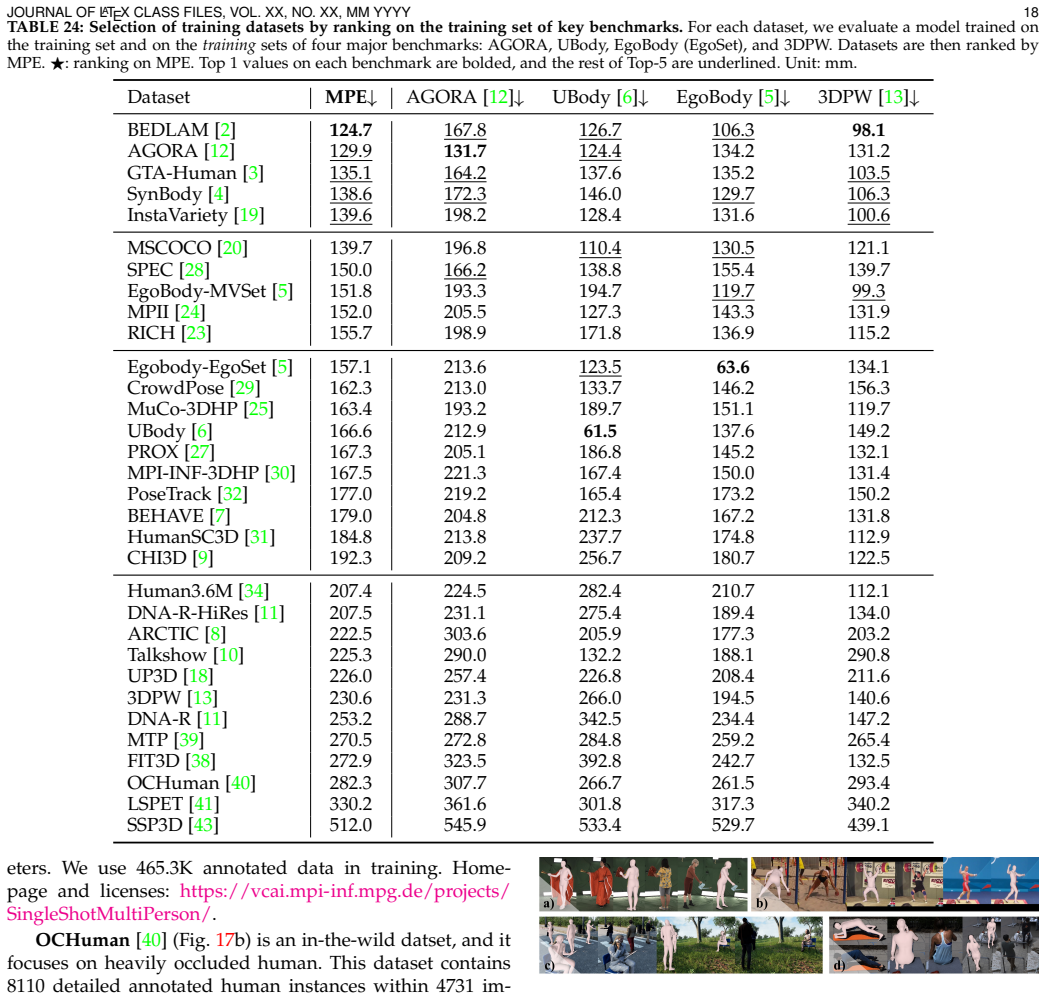
Summary. This manuscript investigates data- and model-scaling for expressive human pose and shape estimation (EHPS). The authors assemble a large pool of 40 datasets (up to 10M instances), introduce a new synthetic hand-focused benchmark called SynHand, define a mean-primary-error (MPE) metric for whole-body and hand evaluation, and train two deliberately simple architectures (SMPLer-X and SMPLest-X) with ViT backbones up to ViT-Huge. They report monotonic improvements with more data and larger models, specialist fine-tuning results on AGORA, UBody, EgoBody, and a claim of strong transfer to unseen environments. The central quantitative claims are in Tables 1-5, with an in-domain-training analysis in Table 13.
Significance. The systematic dataset benchmark, the train-set-based selection protocol in Appendix C.1, the release of code, and the inclusion of Table 13 are real strengths; if the scaling conclusions survive a clean held-out evaluation, this would be a valuable reference for data mixing and model scaling in EHPS. However, the headline MPE and hand-MPE numbers are computed largely on benchmarks whose training splits are present in the training pool, so the central 'generalist / transfer to unseen environments' claim is not yet crisply demonstrated. The paper is honest about the in-domain effect in Table 13, but that analysis also exposes the gap between the paper's claims and its evaluation protocol.
major comments (4)
- [Sec. 5.1.3, Tables 5 and 13] The headline MPE and Hand-MPE in Table 5 are averaged over AGORA-val, UBody, EgoBody, 3DPW, and EHF, with ARCTIC and SynHand added for the hand metrics. Table 13 (rows R6-R9) shows that AGORA, UBody, EgoBody, and 3DPW train splits are seen during training, and from R7 onward ARCTIC and DNA-Rendering-HiRes are also seen, leaving only EHF (one subject, 100 curated frames, Section 3.3) as a fully held-out benchmark at the final 40-dataset scale. The central claim of transferability to unseen environments is therefore not crisply tested, and part of the reported improvement over prior methods reflects in-domain training. Please add a genuinely held-out whole-body benchmark that is absent from all training configurations, or at minimum report seen and unseen benchmark averages separately and state explicitly which benchmark train splits are included in each training pool.
- [Sec. 3.5, Tables 1 and 4] The newly proposed SynHand dataset appears both as a benchmarked data source in Table 1 (462.8K instances) and as an evaluation benchmark in Table 4, and the hand-MPE in Table 5 averages over SynHand and ARCTIC. The manuscript does not state explicitly whether the SynHand training split is included in the final 40-dataset training pool, nor whether the ARCTIC train split is seen by the H40/H40+ models. If either is included, the hand-MPE is partly in-domain by construction. Please clarify these memberships and, where possible, recompute hand-MPE excluding any benchmark whose training split was used, or report a fully held-out hand benchmark separately.
- [Sec. 3.1, Tables 3-5] The proposed MPE and Hand-MPE are averages over heterogeneous primary metrics (MPJPE for 3DPW, PVE elsewhere) and are not validated against established aggregate protocols or leaderboard orderings. No uncertainty estimates or multiple seeds are reported, and several entries are non-monotonic, e.g., SMPLest-X-H40 vs H40+ in Table 3/Table 4 (MPE 58.9 vs 59.9; Hand-MPE 31.6 vs 32.7), and ARCTIC hand-PA-PVE in Table 4 worsens monotonically from S5 to S40 (16.7 to 19.2). These patterns make the scaling-law claims hard to separate from noise. Please report per-benchmark results for every scale and backbone, add multiple seeds or confidence intervals, and show that MPE ordering agrees with standard benchmark ordering before using it as the main summary statistic.
- [Sec. 5.1.1, Tables 3 and 4] The balanced sampling protocol resamples all selected datasets to the same length, so the effective per-dataset instance count and upsampling factor change as the dataset count grows (e.g., 0.75M/5 = 150K per dataset for the 5-dataset setting vs 10M/40 = 250K per dataset for the 40-dataset setting). The comparison across #Datasets therefore changes both dataset diversity and per-dataset repetition/epoch exposure simultaneously, and the reported 'scaling law' may partly reflect training intensity rather than dataset count alone. Please report the total epochs, per-dataset repetition factors, and effective number of unique instances per dataset for each row in Tables 3 and 4.
minor comments (5)
- [Fig. 2 caption] The caption contains the fragment 'Real/eot', which appears to be a typo for 'Real/Photo' or a similar label; please correct it.
- [Appendix B and Table 22] The text refers to 'RenBody' in some places and 'DNA-Rendering' elsewhere, and Table 22 is titled 'DNA-Rendering-HiRes' while the appendix text uses 'RenBody-HiRes'; please standardize the dataset name throughout.
- [Appendix D, PoseTrack paragraph] The sentence 'Ee use the annotations generated by EFT' contains a typo and should read 'We use the annotations generated by EFT'.
- [Table 1 vs Section 3.2] Table 1 lists 41 rows, while the text repeatedly says 40 datasets; please clarify whether SynHand is the 40th dataset or whether one row is counted differently, and state explicitly whether SynHand is part of the 40-dataset training pool.
- [Sec. 3.5, SynHand description] The sentence 'We adopt the official train and test split provided for InterHand datasets' is ambiguous because SynHand combines hand poses from InterHand, AGORA, and GRAB with body poses from AMASS; please state explicitly how the official InterHand split is mapped onto SynHand images and whether the AGORA-derived hand poses overlap with AGORA train images.
Circularity Check
No significant circularity: the scaling claims are empirical observations, and the benchmark-in-training-set caveat is acknowledged and partially controlled for.
full rationale
The paper's central claims are empirical scaling observations (more data and larger ViT backbones reduce mean primary error on external benchmarks), not derivations from assumptions that already contain the conclusions. The apparent concern that the training splits of AGORA, UBody, EgoBody, 3DPW, ARCTIC, and SynHand are inside the 40-dataset pool is a generalization-validity caveat, not a circular reduction: the model must still learn to map images to SMPL-X parameters, and nothing in the training objective forces the reported test errors. The paper explicitly acknowledges the in-domain advantage in Table 13 ('seeing' the dataset always brings significant performance improvement, R2 vs. R3) and it re-runs dataset selection on a train-set benchmark (Appendix C.1) precisely to avoid test-set leakage. EHF, which is genuinely unseen, also improves with scaling (e.g., 89.5 to 49.7 mm PVE), providing an external check. MPE is a mean of standard per-vertex and per-joint errors, not a fitted quantity. Prior self-citations (SynBody, GTA-Human, WHAC, OSX, AiOS) are used as data sources or baselines, not as load-bearing proofs. The proposed SynHand benchmark is partly self-referential in that its train split is included in the 40-dataset training pool, but the paper reports this transparently and does not present SynHand as an unseen-transfer test. No step in the claimed derivation chain equates an output to an input by construction.
Assumptions & free parameters
assumptions (4)
- domain assumption The mean primary error (MPE), which averages PVE and MPJPE across benchmarks with different units and error distributions, is a meaningful measure of generalization.
- domain assumption Synthetic datasets such as SynHand, BEDLAM, and GTA-Human transfer to real-world images sufficiently well to improve real-world performance.
- domain assumption Pseudo-labels from EFT and NeuralAnnot are accurate enough to serve as training supervision.
- domain assumption The adapter that converts gendered SMPL-X shape parameters to neutral ones (8.4 mm vertex error on AGORA) is accurate enough for training on gendered datasets.
invented entities (1)
-
SynHand dataset
independent evidence
Cite this review
Pith. "Pith review of SMPLest-X: Ultimate Scaling for Expressive Human Pose and Shape Estimation." pith.science (2026). https://pith.science/paper/T5D7W6OQ
@misc{pith2026250109782,
  author       = {Pith},
  title        = {Pith review of: SMPLest-X: Ultimate Scaling for Expressive Human Pose and Shape Estimation},
  year         = {2026},
  howpublished = {\url{https://pith.science/paper/T5D7W6OQ}},
  note         = {Machine review of arXiv:2501.09782}
}
read the original abstract
Expressive human pose and shape estimation (EHPS) unifies body, hands, and face motion capture with numerous applications. Despite encouraging progress, current state-of-the-art methods focus on training innovative architectural designs on confined datasets. In this work, we investigate the impact of scaling up EHPS towards a family of generalist foundation models. 1) For data scaling, we perform a systematic investigation on 40 EHPS datasets, encompassing a wide range of scenarios that a model trained on any single dataset cannot handle. More importantly, capitalizing on insights obtained from the extensive benchmarking process, we optimize our training scheme and select datasets that lead to a significant leap in EHPS capabilities. Ultimately, we achieve diminishing returns at 10M training instances from diverse data sources. 2) For model scaling, we take advantage of vision transformers (up to ViT-Huge as the backbone) to study the scaling law of model sizes in EHPS. To exclude the influence of algorithmic design, we base our experiments on two minimalist architectures: SMPLer-X, which consists of an intermediate step for hand and face localization, and SMPLest-X, an even simpler version that reduces the network to its bare essentials and highlights significant advances in the capture of articulated hands. With big data and the large model, the foundation models exhibit strong performance across diverse test benchmarks and excellent transferability to even unseen environments. Moreover, our finetuning strategy turns the generalist into specialist models, allowing them to achieve further performance boosts. Notably, our foundation models consistently deliver state-of-the-art results on seven benchmarks such as AGORA, UBody, EgoBody, and our proposed SynHand dataset for comprehensive hand evaluation. (Code is available at: https://github.com/wqyin/SMPLest-X).
Figures


Figures from the paper (13 more)



Forward citations
Cited by 4 Pith papers
-
ADHMR: Aligning Diffusion-based Human Mesh Recovery via Direct Preference Optimization
ADHMR aligns diffusion-based human mesh recovery with a learned scorer and direct preference optimization, improving accuracy and in-the-wild robustness without human preference labels.
-
Human Mesh Modeling for Anny Body
A scan-free, interpretable body model built from MakeHuman artist assets matches scan-trained SMPL-X models for human mesh recovery and scan fitting.
-
CoT-Pose: Chain-of-Thought Reasoning for 3D Pose Generation from Abstract Prompts
CoT-Pose fine-tunes UniPose so that an abstract action phrase is expanded into a detailed pose description, which is then decoded into a 3D SMPL pose.
-
Perspectives on Capturing Emotional Expressiveness in Sign Language
Interviews with eight signers show that emotional meaning in sign language comes from manual and non-manual cues built into the grammar, so translation tools should model faces, bodies, and signing dynamics, not just signs.
Reference graph
Works this paper leans on
-
[1]
Expressive body capture: 3d hands, face, and body from a single image,
G. Pavlakos, V . Choutas, N. Ghorbani, T. Bolkart, A. A. Osman, D. Tzionas, and M. J. Black, “Expressive body capture: 3d hands, face, and body from a single image,” inProceedings of the IEEE/CVF Conference on Computer Vision and Pattern Recognition , 2019, pp. 10 975–10 985. 1, 3, 16, 18
work page 2019
-
[2]
Bedlam: A synthetic dataset of bodies exhibiting detailed lifelike animated motion,
M. J. Black, P . Patel, J. Tesch, and J. Yang, “Bedlam: A synthetic dataset of bodies exhibiting detailed lifelike animated motion,” in Proceedings of the IEEE/CVF Conference on Computer Vision and Pattern Recognition, 2023, pp. 8726–8737. 1, 3, 4, 6, 10, 14, 18
work page 2023
-
[3]
Playing for 3d human recovery,
Z. Cai, M. Zhang, J. Ren, C. Wei, D. Ren, Z. Lin, H. Zhao, L. Yang, C. C. Loy, and Z. Liu, “Playing for 3d human recovery,” IEEE Transactions on Pattern Analysis and Machine Intelligence , 2024. 1, 3, 4, 18
work page 2024
-
[4]
Synbody: Synthetic dataset with layered human models for 3d human perception and modeling,
Z. Yang, Z. Cai, H. Mei, S. Liu, Z. Chen, W. Xiao, Y. Wei, Z. Qing, C. Wei, B. Dai et al. , “Synbody: Synthetic dataset with layered human models for 3d human perception and modeling,” in Pro- ceedings of the IEEE International Conference on Computer Vision , 2023, pp. 20 282–20 292. 1, 3, 4, 6, 18, 19
work page 2023
-
[5]
Egobody: Human body shape and motion of interacting people from head-mounted devices,
S. Zhang, Q. Ma, Y. Zhang, Z. Qian, T. Kwon, M. Pollefeys, F. Bogo, and S. Tang, “Egobody: Human body shape and motion of interacting people from head-mounted devices,” in Proceedings of the European Conference on Computer Vision, 2022, pp. 180–200. 1, 2, 3, 4, 6, 8, 11, 15, 18
work page 2022
-
[6]
One-stage 3d whole-body mesh recovery with component aware transformer,
J. Lin, A. Zeng, H. Wang, L. Zhang, and Y. Li, “One-stage 3d whole-body mesh recovery with component aware transformer,” in Proceedings of the IEEE/CVF Conference on Computer Vision and Pattern Recognition, 2023, pp. 21 159–21 168. 1, 2, 3, 4, 5, 7, 8, 9, 10, 11, 18, 19
work page 2023
-
[7]
Behave: Dataset and method for tracking hu- man object interactions,
B. L. Bhatnagar, X. Xie, I. A. Petrov, C. Sminchisescu, C. Theobalt, and G. Pons-Moll, “Behave: Dataset and method for tracking hu- man object interactions,” in Proceedings of the IEEE/CVF Conference on Computer Vision and Pattern Recognition, 2022, pp. 15 935–15 946. 1, 3, 18
work page 2022
-
[8]
Arctic: A dataset for dexterous bimanual hand-object manipulation,
Z. Fan, O. Taheri, D. Tzionas, M. Kocabas, M. Kaufmann, M. J. Black, and O. Hilliges, “Arctic: A dataset for dexterous bimanual hand-object manipulation,” in Proceedings of the IEEE/CVF Confer- ence on Computer Vision and Pattern Recognition , 2023, pp. 12 943– 12 954. 1, 2, 3, 4, 6, 8, 11, 14, 18
work page 2023
Show all 75 references
-
[9]
Three-dimensional reconstruction of human interactions,
M. Fieraru, M. Zanfir, E. Oneata, A.-I. Popa, V . Olaru, and C. Sminchisescu, “Three-dimensional reconstruction of human interactions,” in Proceedings of the IEEE/CVF Conference on Computer Vision and Pattern Recognition, 2020, pp. 7214–7223. 1, 3, 4, 15, 18
2020
-
[10]
Generating holistic 3d human motion from speech,
H. Yi, H. Liang, Y. Liu, Q. Cao, Y. Wen, T. Bolkart, D. Tao, and M. J. Black, “Generating holistic 3d human motion from speech,” in Proceedings of the IEEE/CVF Conference on Computer Vision and Pattern Recognition, 2023, pp. 469–480. 1, 3, 4, 5, 18, 19 JOURNAL OF LATEX CLASS F...
2023
-
[11]
Dna-rendering: A diverse neural actor repository for high-fidelity human-centric rendering,
W. Cheng, R. Chen, S. Fan, W. Yin, K. Chen, Z. Cai, J. Wang, Y. Gao, Z. Yu, Z. Lin et al. , “Dna-rendering: A diverse neural actor repository for high-fidelity human-centric rendering,” in Proceedings of the IEEE International Conference on Computer Vision , 2023, pp. 19 982–1...
2023
-
[12]
AGORA: Avatars in geography optimized for regression analysis,
P . Patel, C.-H. P . Huang, J. Tesch, D. T. Hoffmann, S. Tripathi, and M. J. Black, “AGORA: Avatars in geography optimized for regression analysis,” in Proceedings of the IEEE/CVF Conference on Computer Vision and Pattern Recognition, 2021, pp. 13 468–13 478. 2, 3, 4, 6, 8, 11...
2021
-
[13]
Recovering accurate 3d human pose in the wild using imus and a moving camera,
T. von Marcard, R. Henschel, M. J. Black, B. Rosenhahn, and G. Pons-Moll, “Recovering accurate 3d human pose in the wild using imus and a moving camera,” in Proceedings of the European Conference on Computer Vision, 2018, pp. 601–617. 2, 3, 4, 8, 11, 14, 18
2018
-
[14]
Expressive body capture: 3d hands, face, and body from a single image,
G. Pavlakos, V . Choutas, N. Ghorbani, T. Bolkart, A. A. Osman, D. Tzionas, and M. J. Black, “Expressive body capture: 3d hands, face, and body from a single image,” inProceedings of the IEEE/CVF Conference on Computer Vision and Pattern Recognition , 2019. 2, 3, 4, 8, 11, 13, 15
2019
-
[15]
Hybrik-x: Hybrid analytical-neural inverse kinematics for whole-body mesh recovery,
J. Li, S. Bian, C. Xu, Z. Chen, L. Yang, and C. Lu, “Hybrik-x: Hybrid analytical-neural inverse kinematics for whole-body mesh recovery,” arXiv preprint arXiv:2304.05690, 2023. 2, 4, 6, 7, 9, 10, 11
2023 arXiv
-
[16]
Exemplar fine-tuning for 3d human model fitting towards in-the-wild 3d human pose estimation,
H. Joo, N. Neverova, and A. Vedaldi, “Exemplar fine-tuning for 3d human model fitting towards in-the-wild 3d human pose estimation,” 2022 International Conference on 3D Vision , 2022. 3, 17, 18
2022
-
[17]
Neuralannot: Neural annotator for 3d human mesh training sets,
G. Moon, H. Choi, and K. M. Lee, “Neuralannot: Neural annotator for 3d human mesh training sets,” in Proceedings of the IEEE/CVF Conference on Computer Vision and Pattern Recognition , 2022, pp. 2299–2307. 3, 4, 15, 16, 17
2022
-
[18]
Unite the people: Closing the loop between 3d and 2d human representations,
C. Lassner, J. Romero, M. Kiefel, F. Bogo, M. J. Black, and P . V . Gehler, “Unite the people: Closing the loop between 3d and 2d human representations,” in Proceedings of the IEEE/CVF Conference on Computer Vision and Pattern Recognition, 2017, pp. 6050–6059. 3, 18, 19
2017
-
[19]
Learning 3d human dynamics from video,
A. Kanazawa, J. Y. Zhang, P . Felsen, and J. Malik, “Learning 3d human dynamics from video,” in Proceedings of the IEEE/CVF Conference on Computer Vision and Pattern Recognition , 2019, pp. 5614–5623. 3, 4, 17, 18
2019
-
[20]
Microsoft coco: Common objects in context,
T.-Y. Lin, M. Maire, S. Belongie, J. Hays, P . Perona, D. Ramanan, P . Doll´ar, and C. L. Zitnick, “Microsoft coco: Common objects in context,” in Proceedings of the European Conference on Computer Vision, 2014, pp. 740–755. 3, 4, 17, 18
2014
-
[21]
Motion-x: A large-scale 3d expressive whole-body human motion dataset,
J. Lin, A. Zeng, S. Lu, Y. Cai, R. Zhang, H. Wang, and L. Zhang, “Motion-x: A large-scale 3d expressive whole-body human motion dataset,” Advances in Neural Information Processing Systems, 2023. 3, 4, 17
2023
-
[22]
Whac: World-grounded humans and cameras,
W. Yin, Z. Cai, R. Wang, F. Wang, C. Wei, H. Mei, W. Xiao, Z. Yang, Q. Sun, A. Yamashita et al., “Whac: World-grounded humans and cameras,” in Proceedings of the European Conference on Computer Vision, 2025, pp. 20–37. 3, 4, 19
2025
-
[23]
Capturing and inferring dense full-body human-scene contact,
C.-H. P . Huang, H. Yi, M. H ¨oschle, M. Safroshkin, T. Alexiadis, S. Polikovsky, D. Scharstein, and M. J. Black, “Capturing and inferring dense full-body human-scene contact,” in Proceedings of the IEEE/CVF Conference on Computer Vision and Pattern Recognition, 2022, pp. 13 2...
2022
-
[24]
2d human pose estimation: New benchmark and state of the art analysis,
M. Andriluka, L. Pishchulin, P . Gehler, and B. Schiele, “2d human pose estimation: New benchmark and state of the art analysis,” in Proceedings of the IEEE/CVF Conference on Computer Vision and Pattern Recognition, 2014. 3, 4, 17, 18
2014
-
[25]
Single-shot multi-person 3d pose esti- mation from monocular rgb,
D. Mehta, O. Sotnychenko, F. Mueller, W. Xu, S. Sridhar, G. Pons- Moll, and C. Theobalt, “Single-shot multi-person 3d pose esti- mation from monocular rgb,” 2018 International Conference on 3D Vision, pp. 120–130, 2018. 3, 4, 17, 18
2018
-
[26]
EMDB: The Electromagnetic Database of Global 3D Human Pose and Shape in the Wild,
M. Kaufmann, J. Song, C. Guo, K. Shen, T. Jiang, C. Tang, J. J. Z´arate, and O. Hilliges, “EMDB: The Electromagnetic Database of Global 3D Human Pose and Shape in the Wild,” in Proceedings of the IEEE International Conference on Computer Vision, 2023. 3, 4, 15
2023
-
[27]
Resolving 3d human pose ambiguities with 3d scene constraints,
M. Hassan, V . Choutas, D. Tzionas, and M. J. Black, “Resolving 3d human pose ambiguities with 3d scene constraints,” in Proceedings of the IEEE International Conference on Computer Vision , 2019, pp. 2282–2292. 3, 4, 18
2019
-
[28]
Spec: Seeing people in the wild with an estimated camera,
M. Kocabas, C.-H. P . Huang, J. Tesch, L. M ¨uller, O. Hilliges, and M. J. Black, “Spec: Seeing people in the wild with an estimated camera,” in Proceedings of the IEEE International Conference on Computer Vision, 2021, pp. 11 035–11 045. 3, 4, 18, 19
2021
-
[29]
Crowdpose: Efficient crowded scenes pose estimation and a new benchmark,
J. Li, C. Wang, H. Zhu, Y. Mao, H.-S. Fang, and C. Lu, “Crowdpose: Efficient crowded scenes pose estimation and a new benchmark,” in Proceedings of the IEEE/CVF Conference on Computer Vision and Pattern Recognition, 2019, pp. 10 863–10 872. 3, 4, 15, 18
2019
-
[30]
Monocular 3d human pose estimation in the wild using improved cnn supervision,
D. Mehta, H. Rhodin, D. Casas, P . Fua, O. Sotnychenko, W. Xu, and C. Theobalt, “Monocular 3d human pose estimation in the wild using improved cnn supervision,” in 2017 International Conference on 3D Vision, 2017, pp. 506–516. 3, 4, 17, 18
2017
-
[31]
Learning complex 3d human self-contact,
M. Fieraru, M. Zanfir, E. Oneata, A.-I. Popa, V . Olaru, and C. Sminchisescu, “Learning complex 3d human self-contact,” in Proceedings of the AAAI Conference on Artificial Intelligence , vol. 35, no. 2, 2021, pp. 1343–1351. 3, 4, 16, 18
2021
-
[32]
Posetrack: A benchmark for human pose estimation and tracking,
M. Andriluka, U. Iqbal, E. Insafutdinov, L. Pishchulin, A. Milan, J. Gall, and B. Schiele, “Posetrack: A benchmark for human pose estimation and tracking,” in Proceedings of the IEEE/CVF Conference on Computer Vision and Pattern Recognition, 2018, pp. 5167–5176. 3, 4, 18
2018
-
[33]
Deco: Dense estimation of 3d human-scene contact in the wild,
S. Tripathi, A. Chatterjee, J.-C. Passy, H. Yi, D. Tzionas, and M. J. Black, “Deco: Dense estimation of 3d human-scene contact in the wild,” in Proceedings of the IEEE International Conference on Computer Vision, 2023, pp. 8001–8013. 3, 4, 15
2023
-
[34]
Hu- man3.6m: Large scale datasets and predictive methods for 3d human sensing in natural environments,
C. Ionescu, D. Papava, V . Olaru, and C. Sminchisescu, “Hu- man3.6m: Large scale datasets and predictive methods for 3d human sensing in natural environments,” IEEE Transactions on Pattern Analysis and Machine Intelligence , vol. 36, no. 7, pp. 1325– 1339, 2013. 3, 4, 16, 18
2013
-
[35]
Hi4d: 4d instance segmentation of close human interaction,
Y. Yin, C. Guo, M. Kaufmann, J. Zarate, J. Song, and O. Hilliges, “Hi4d: 4d instance segmentation of close human interaction,” in Proceedings of the IEEE/CVF Conference on Computer Vision and Pattern Recognition, 2023. 3, 4, 16
2023
-
[36]
Sloper4d: A scene-aware dataset for global 4d human pose estimation in urban environments,
Y. Dai, Y. Lin, X. Lin, C. Wen, L. Xu, H. Yi, S. Shen, Y. Ma, and C. Wang, “Sloper4d: A scene-aware dataset for global 4d human pose estimation in urban environments,” in Proceedings of the IEEE/CVF Conference on Computer Vision and Pattern Recognition, 2023, pp. 682–692. 3, 4, 19
2023
-
[37]
Signavatars: A large- scale 3d sign language holistic motion dataset and benchmark,
Z. Yu, S. Huang, Y. Cheng, and T. Birdal, “Signavatars: A large- scale 3d sign language holistic motion dataset and benchmark,” in Proceedings of the European Conference on Computer Vision, 2025, pp. 1–19. 3, 4, 5, 19
2025
-
[38]
Aifit: Automatic 3d human-interpretable feedback models for fitness training,
M. Fieraru, M. Zanfir, S. C. Pirlea, V . Olaru, and C. Sminchisescu, “Aifit: Automatic 3d human-interpretable feedback models for fitness training,” in Proceedings of the IEEE/CVF Conference on Computer Vision and Pattern Recognition , 2021, pp. 9919–9928. 3, 4, 16, 18
2021
-
[39]
On self-contact and human pose,
L. Muller, A. A. Osman, S. Tang, C.-H. P . Huang, and M. J. Black, “On self-contact and human pose,” in Proceedings of the IEEE/CVF Conference on Computer Vision and Pattern Recognition , 2021, pp. 9990–9999. 3, 4, 17, 18
2021
-
[40]
Pose2seg: Detection free human in- stance segmentation,
S.-H. Zhang, R. Li, X. Dong, P . Rosin, Z. Cai, X. Han, D. Yang, H. Huang, and S.-M. Hu, “Pose2seg: Detection free human in- stance segmentation,” in Proceedings of the IEEE/CVF Conference on Computer Vision and Pattern Recognition, 2019, pp. 889–898. 3, 4, 18
2019
-
[41]
Learning effective human pose estimation from inaccurate annotation,
S. Johnson and M. Everingham, “Learning effective human pose estimation from inaccurate annotation,” Proceedings of the IEEE/CVF Conference on Computer Vision and Pattern Recognition , pp. 1465–1472, 2011. 3, 4, 18
2011
-
[42]
3D human pose estimation via intuitive physics,
S. Tripathi, L. M ¨uller, C.-H. P . Huang, T. Omid, M. J. Black, and D. Tzionas, “3D human pose estimation via intuitive physics,” in Proceedings of the IEEE/CVF Conference on Computer Vision and Pattern Recognition, 2023, pp. 4713–4725. 3, 4, 5, 17
2023
-
[43]
Synthetic training for accurate 3d human pose and shape estimation in the wild,
A. Sengupta, R. Cipolla, and I. Budvytis, “Synthetic training for accurate 3d human pose and shape estimation in the wild,” in Proceedings of the British Machine Vision Conference, 2020. 3, 4, 18
2020
-
[44]
Monocular total capture: Posing face, body, and hands in the wild,
D. Xiang, H. Joo, and Y. Sheikh, “Monocular total capture: Posing face, body, and hands in the wild,” in Proceedings of the IEEE/CVF Conference on Computer Vision and Pattern Recognition, 2019. 2
2019
-
[45]
Monocular expressive body regression through body-driven at- tention,
G. Pavlakos, V . Choutas, T. Bolkart, D. Tzionas, M. J. Black, V . Choutas, G. Pavlakos, T. Bolkart, D. Tzionas, and M. J. Black, “Monocular expressive body regression through body-driven at- tention,” Proceedings of the European Conference on Computer Vision ,
-
[46]
FrankMocap: A monocular 3d whole-body pose estimation system via regression and integra- tion,
Y. Rong, T. Shiratori, and H. Joo, “FrankMocap: A monocular 3d whole-body pose estimation system via regression and integra- tion,” in Proceedings of the IEEE International Conference on Computer Vision, 2021. 2, 6
2021
-
[47]
Monocular real-time full body capture with inter-part JOURNAL OF LATEX CLASS FILES, VOL. XX, NO. XX, MM YYYY 21 correlations,
Y. Zhou, M. Habermann, I. Habibie, A. Tewari, C. Theobalt, and F. Xu, “Monocular real-time full body capture with inter-part JOURNAL OF LATEX CLASS FILES, VOL. XX, NO. XX, MM YYYY 21 correlations,” in Proceedings of the IEEE/CVF Conference on Computer Vision and Pattern Recogn...
2021
-
[48]
Collaborative regression of expressive bodies using moderation,
Y. Feng, V . Choutas, T. Bolkart, D. Tzionas, and M. J. Black, “Collaborative regression of expressive bodies using moderation,” in 2021 International Conference on 3D Vision, 2021. 2, 6, 10
2021
-
[49]
Learning monocular mesh recovery of multiple body parts via synthesis,
Y. Sun, T. Huang, Q. Bao, W. Liu, W. Gao, and Y. Fu, “Learning monocular mesh recovery of multiple body parts via synthesis,” in Proceedings of the IEEE International Conference on Acoustics, Speech and Signal Processing. IEEE, 2022. 2
2022
-
[50]
Pymaf-x: Towards well-aligned full-body model regression from monocular images,
H. Zhang, Y. Tian, Y. Zhang, M. Li, L. An, and Y. Liu, “Pymaf-x: Towards well-aligned full-body model regression from monocular images,” arXiv:2207.06400, 2022. 2, 6, 10
2022
-
[51]
Accurate 3d hand pose estima- tion for whole-body 3d human mesh estimation,
G. Moon, H. Choi, and K. M. Lee, “Accurate 3d hand pose estima- tion for whole-body 3d human mesh estimation,” in Proceedings of the IEEE/CVF Conference on Computer Vision and Pattern Recognition, 2022, pp. 2308–2317. 2, 4, 6, 9, 10, 11, 12
2022
-
[52]
An image is worth 16x16 words: Transformers for image recognition at scale,
A. Dosovitskiy, L. Beyer, A. Kolesnikov, D. Weissenborn, X. Zhai, T. Unterthiner, M. Dehghani, M. Minderer, G. Heigold, S. Gelly, J. Uszkoreit, and N. Houlsby, “An image is worth 16x16 words: Transformers for image recognition at scale,” in Proceedings of the International Con...
2021
-
[53]
Aios: All-in-one-stage expressive human pose and shape estimation,
Q. Sun, Y. Wang, A. Zeng, W. Yin, C. Wei, W. Wang, H. Mei, C.- S. Leung, Z. Liu, L. Yang et al., “Aios: All-in-one-stage expressive human pose and shape estimation,” in Proceedings of the IEEE/CVF Conference on Computer Vision and Pattern Recognition , 2024, pp. 1834–1843. 2, ...
2024
-
[54]
Multi-hmr: Multi-person whole-body human mesh recovery in a single shot,
F. Baradel, M. Armando, S. Galaaoui, R. Br ´egier, P . Weinzaepfel, G. Rogez, and T. Lucas, “Multi-hmr: Multi-person whole-body human mesh recovery in a single shot,” in Proceedings of the European Conference on Computer Vision, 2024. 2, 4, 10
2024
-
[55]
Humanbench: Towards general human- centric perception with projector assisted pretraining,
S. Tang, C. Chen, Q. Xie, M. Chen, Y. Wang, Y. Ci, L. Bai, F. Zhu, H. Yang, L. Yi et al. , “Humanbench: Towards general human- centric perception with projector assisted pretraining,” in Proceed- ings of the IEEE/CVF Conference on Computer Vision and Pattern Recognition, 2023,...
2023
-
[56]
Unihcp: A unified model for human- centric perceptions,
Y. Ci, Y. Wang, M. Chen, S. Tang, L. Bai, F. Zhu, R. Zhao, F. Yu, D. Qi, and W. Ouyang, “Unihcp: A unified model for human- centric perceptions,” in Proceedings of the IEEE/CVF Conference on Computer Vision and Pattern Recognition, 2023, pp. 17 840–17 852. 3
2023
-
[57]
Learning 3d human pose estimation from dozens of datasets using a geometry-aware au- toencoder to bridge between skeleton formats,
I. S ´ar´andi, A. Hermans, and B. Leibe, “Learning 3d human pose estimation from dozens of datasets using a geometry-aware au- toencoder to bridge between skeleton formats,” in Proceedings of the IEEE/CVF Winter Conference on Applications of Computer Vision , 2023, pp. 2956–2966. 3
2023
-
[58]
Benchmarking and analyzing 3d human pose and shape estimation beyond algorithms,
H. E. Pang, Z. Cai, L. Yang, T. Zhang, and Z. Liu, “Benchmarking and analyzing 3d human pose and shape estimation beyond algorithms,” in Advances in Neural Information Processing Systems ,
-
[59]
Reconstructing hands in 3D with transformers,
G. Pavlakos, D. Shan, I. Radosavovic, A. Kanazawa, D. Fouhey, and J. Malik, “Reconstructing hands in 3D with transformers,” in Proceedings of the IEEE/CVF Conference on Computer Vision and Pattern Recognition, 2024. 3
2024
-
[60]
Neural localizer fields for continu- ous 3d human pose and shape estimation,
I. S ´ar´andi and G. Pons-Moll, “Neural localizer fields for continu- ous 3d human pose and shape estimation,” in Advances in Neural Information Processing Systems, 2024. 3, 10
2024
-
[61]
Exemplar fine-tuning for 3d human model fitting towards in-the-wild 3d human pose estimation,
H. Joo, N. Neverova, and A. Vedaldi, “Exemplar fine-tuning for 3d human model fitting towards in-the-wild 3d human pose estimation,” in 2021 International Conference on 3D Vision, 2021, pp. 42–52. 4
2021
-
[62]
Umap: Uniform manifold approximation and projection for dimension reduction,
L. McInnes, J. Healy, and J. Melville, “Umap: Uniform manifold approximation and projection for dimension reduction,” arXiv preprint arXiv:1802.03426, 2018. 4, 5, 13
2018 arXiv
-
[63]
Delving deep into hybrid annotations for 3d human recovery in the wild,
Y. Rong, Z. Liu, C. Li, K. Cao, and C. C. Loy, “Delving deep into hybrid annotations for 3d human recovery in the wild,” in Proceedings of the IEEE International Conference on Computer Vision , 2019, pp. 5340–5348. 4
2019
-
[64]
Pymaf-x: Towards well-aligned full-body model regression from monocular images,
H. Zhang, Y. Tian, Y. Zhang, M. Li, L. An, Z. Sun, and Y. Liu, “Pymaf-x: Towards well-aligned full-body model regression from monocular images,” IEEE Transactions on Pattern Analysis and Machine Intelligence, vol. 45, no. 10, pp. 12 287–12 303, 2023. 4, 6, 9, 10, 11
2023
-
[65]
Openxrlab synthetic data rendering toolbox,
X. Contributors, “Openxrlab synthetic data rendering toolbox,” https://github.com/openxrlab/xrfeitoria, 2023. 6
2023
-
[66]
Inter- hand2.6m: A dataset and baseline for 3d interacting hand pose estimation from a single rgb image,
G. Moon, S.-I. Yu, H. Wen, T. Shiratori, and K. M. Lee, “Inter- hand2.6m: A dataset and baseline for 3d interacting hand pose estimation from a single rgb image,” in Proceedings of the European Conference on Computer Vision, 2020. 6
2020
-
[67]
Grab: A dataset of whole-body human grasping of objects,
O. Taheri, N. Ghorbani, M. J. Black, and D. Tzionas, “Grab: A dataset of whole-body human grasping of objects,” in Proceedings of the European Conference on Computer Vision, 2020, pp. 581–600. 6
2020
-
[68]
Amass: Archive of motion capture as surface shapes,
N. Mahmood, N. Ghorbani, N. F. Troje, G. Pons-Moll, and M. J. Black, “Amass: Archive of motion capture as surface shapes,” in Proceedings of the IEEE International Conference on Computer Vision , 2019, pp. 5442–5451. 6
2019
-
[69]
Zolly: Zoom focal length correctly for perspective-distorted human mesh reconstruction,
W. Wang, Y. Ge, H. Mei, Z. Cai, Q. Sun, Y. Wang, C. Shen, L. Yang, and T. Komura, “Zolly: Zoom focal length correctly for perspective-distorted human mesh reconstruction,” Proceedings of the IEEE International Conference on Computer Vision, 2023. 6
2023
-
[70]
Openmmlab 3d human parametric model toolbox and benchmark,
M. Contributors, “Openmmlab 3d human parametric model toolbox and benchmark,” https://github.com/open-mmlab/ mmhuman3d, 2021. 7, 16
2021
-
[71]
Behave: Dataset and method for tracking hu- man object interactions,
B. L. Bhatnagar, X. Xie, I. A. Petrov, C. Sminchisescu, C. Theobalt, and G. Pons-Moll, “Behave: Dataset and method for tracking hu- man object interactions,” in Proceedings of the IEEE/CVF Conference on Computer Vision and Pattern Recognition, 2022, pp. 15 935–15 946. 14
2022
-
[72]
Playing for 3d human recovery,
Z. Cai, M. Zhang, J. Ren, C. Wei, D. Ren, Z. Lin, H. Zhao, L. Yang, and Z. Liu, “Playing for 3d human recovery,” arXiv preprint arXiv:2110.07588, 2021. 16
2021 arXiv
-
[73]
Clustered pose and nonlinear appearance models for human pose estimation,
S. Johnson and M. Everingham, “Clustered pose and nonlinear appearance models for human pose estimation,” in Proceedings of the British Machine Vision Conference . British Machine Vision Association, 2010, pp. 1–11. 17
2010
-
[74]
Synthetic training for accurate 3d human pose and shape estimation in the wild,
A. Sengupta, I. Budvytis, and R. Cipolla, “Synthetic training for accurate 3d human pose and shape estimation in the wild,” in Proceedings of the British Machine Vision Conference, September 2020. 19
2020
-
[75]
Keep it smpl: Automatic estimation of 3d human pose and shape from a single image,
F. Bogo, A. Kanazawa, C. Lassner, P . Gehler, J. Romero, and M. J. Black, “Keep it smpl: Automatic estimation of 3d human pose and shape from a single image,” in Proceedings of the European Conference on Computer Vision, 2016, pp. 561–578. 19 Wanqi Yin is currently a Ph.D. can...
2016
Reviewed August 10, 2026 · model on record in the stance chip above.
Discussion (0). Continue with ORCID to comment.