REVIEW 3 major objections 5 minor 56 references
Deep Dexterous Grasping of Novel Objects from a Single View
T0 review · 3 major / 5 minor · reviewed 2026-08-14 · deepseek-v4-flash
Pith's one-line read Learning to re-rank generated grasps lifts single-view dexterous grasping from 57% to 88% on a real robot.
desk verdict Solid systems paper on generative-evaluative dexterous grasping with a strong simulation study and real-robot checks, but the headline real-robot improvement confounds two changes and the cleanest real-robot comparison for the best variant is not statistically significant. read the letter →
The pith
A machine-rendered reading of the paper's core claim, the machinery that carries it, and where it could break.
The reading
What carries the argument
The load-bearing mechanism is the generative-evaluative loop. The generative model (GM1 or GM2) represents contacts as kernel-density estimates over local surface features and a hand configuration model learned from demonstrations; given a new single-view point cloud it samples and refines candidate full hand trajectories. The evaluative model (EM1, EM2, or EM3) is a deep network that ingests the colorized depth image with curvature channels in one branch and a 270-dimensional grasp trajectory vector in another, fuses them, and outputs success probability. Crucially, the evaluative model is trained on 2.4 million simulated grasps whose labels come from rigid-body simulation with domain randomization of mass, friction, scale, and viewpoint, so the success signal reflects robustness to unobservable variation rather than a known object model. Re-ranking by this learned probability is the operation that converts a generative proposal distribution into a reliable choice of one grasp to execute.
What would settle it
Run all seventeen variants on the real robot over the same 49 object-pose pairs with the paper's own success criterion, then check whether V11 remains the best; a cheaper test is to replay the V11 grasps with the hold criterion extended from five seconds to ten seconds or with small external perturbations and see whether success falls toward the 57.1% baseline, which would indicate the evaluator learned simulation-specific robustness rather than grasp stability.
Extended reading notes
Core claim
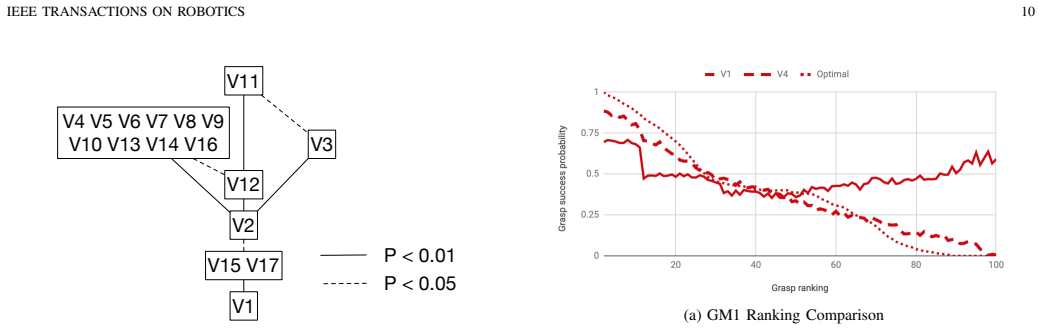
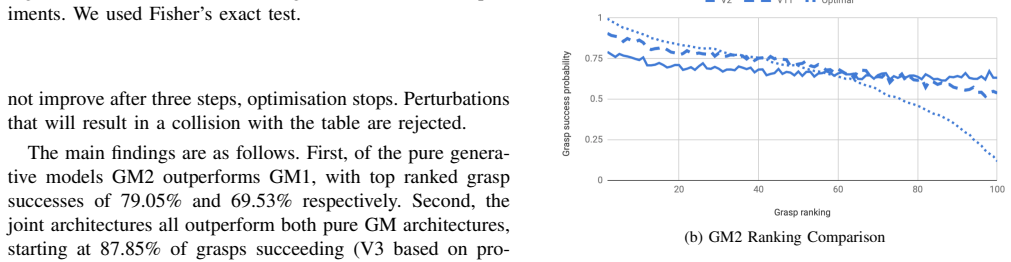
On the paper's own terms, the central discovery is that an architecture in which both the grasp generator and the grasp evaluator are learned outperforms the pure generative model alone. The generative model is learned from ten demonstrated grasps and proposes candidates from a single-view point cloud; the evaluative model is a convolutional network, with VGG-16 or ResNet-50 backbones, that takes a colorized depth image plus the full wrist-and-finger trajectory and outputs a success probability. Re-ranking the generated candidates by this predicted probability removes more than half of the residual failures in simulation: the top-ranked grasp succeeds in 90.49% of simulated test scenes for variant V11 (GM2 generation plus EM3 evaluation) versus 69.53% for the pure GM1 baseline. The controlled real-robot comparison on 49 object-pose pairs shows V11 at 87.8% and the corresponding pure generative variant V2 at 81.6%, while V4 reaches 75.5% against V1's 57.1%. The paper also reports that using the evaluative model as an objective for gradient ascent or simulated annealing does not improve, and sometimes degrades, actual grasp success in simulation.
Load-bearing premise
The whole result rests on the assumption that the simulated success labels, produced by a rigid-body simulator with randomized mass, friction, scale, and simulated depth noise, rank real grasps in the same order as real outcomes; if simulated robustness does not transfer, the 87.8% figure would not follow.
Editorial extensions
If this is right
- In simulation, the best generative-evaluative variant (V11) raises top-ranked grasp success from 69.53% (V1) to 90.49%; adding either evaluative re-ranking, more training data, or the better generative model each reduces residual failures.
- On the real five-fingered robot hand over 196 grasps, the best generative-evaluative variant reaches 87.8% success versus 57.1% for the pure generative baseline, and the paired comparison is statistically significant.
- The architecture deploys a variety of grasp types (pinch support, pinch, pinchbottom, rimside, rim, power edge), so the improvement is not confined to one power-grasp strategy.
- Optimizing grasp parameters directly against the evaluative network's output, by gradient ascent or simulated annealing, does not beat simple re-ranking in simulation; the gains come from selection rather than local search.
- Training the evaluative model on a larger, more varied simulated data set (DS1 plus DS2) improves prediction accuracy and top-ranked grasp success on the held-out test scenes.
Reading between the lines
- Beyond the paper: if this re-ranking recipe transfers, any existing generative grasp proposer could be upgraded by training an evaluative network on domain-randomized simulation, without changing the proposer's internal model.
- Beyond the paper: the failure of EM-guided optimization hints that the learned success landscape is locally unreliable; a testable extension would be to smooth gradients or optimize in a latent space before concluding that gradient ascent is useless for dexterous grasps.
- Beyond the paper: because the real-robot test covered only 4 of 17 variants on 49 object-pose pairs, an immediate test is whether the simulation ranking of the remaining 13 variants also predicts their real-robot ordering; that would verify the sim-to-real transfer assumption directly.
- Beyond the paper: the same simulated data set could probe whether an evaluative network trained on one hand or one depth sensor transfers to another hand or camera; the domain-randomized labels suggest it might, but the paper does not test this.
Signed reviews
Editorial analysis
A structured set of objections, weighed in public.
Referee Report
Summary. The paper presents a generative-evaluative architecture for dexterous grasping of novel objects from a single view. The generative models GM1 and GM2 are learned from a small number of demonstrated grasps, while the evaluative models EM1-EM3 are CNNs trained on 2.4 million simulated grasps. The authors build a simulator, release a dataset and source code, evaluate 17 architectural variants in simulation, and test four variants on a real DLR-II hand over 49 object-pose pairs. The main claim is that learned re-ranking raises the top-ranked grasp success rate from 69.5% to 90.49% in simulation and from 57.1% to 87.8% on a real robot.
Significance. If the claims hold, this is a meaningful advance: it combines a data-efficient generative prior with a data-intensive learned evaluative model, and it contributes a large public simulated dataset and simulator. The simulation study is systematic across 17 variants, and the real-robot evaluation uses paired trials on novel objects. However, the statistical support for the strongest real-robot claim is currently incomplete, and the simulated dataset is conditioned on scenes with at least one successful grasp, so the absolute success rates should be interpreted with care. The released code and dataset are concrete strengths for reproducibility.
major comments (3)
- [Section VIII, Table VII] The real-robot evidence does not isolate the learned evaluative model for the headline V11 result. The paper reports V11 43/49 versus V2 40/49, but significance testing is reported only for V11:V1 and V2:V1. Because V11 and V2 both use GM2, the correct paired comparison for the value of re-ranking is V11 versus V2; with 49 pairs this yields at best an exact two-sided McNemar p of 0.25 (a 3-0 discordant split), so the observed difference is not statistically significant. The abstract and conclusion headline ('from 57.1% for V1 to 87.8% for V11') therefore confounds the change of generative model with the addition of the evaluative model; the only statistically supported real-robot isolation of the EM is V4 versus V1 (same GM1), which is not the variant used for the headline claim. Please report discordant-pair counts and a significance test for V11 versus V2, or revise the claim to what the data support.
- [Section V-B, Table IV] The simulated data sets are conditioned on feasibility: 'DS1 and DS2 only contain scenes that have at least one successful grasp.' Consequently the reported top-grasp success rates (69.53% for V1, 79.05% for V2, 90.49% for V11) are conditional on at least one generated grasp succeeding in the scene, and the test sets exclude deployment cases in which the generative model proposes no successful grasp. This is a load-bearing limitation for the absolute success-rate claims and for the simulated comparison against the pure generative baselines; please report the success rates on the full set of scenes including those with zero successes, or explicitly frame all reported numbers as conditional and discuss how the conditioning affects the comparison.
- [Section V-B and Section VIII] The simulation success criterion (lift 1 m and hold for 2 s) differs from the real-robot criterion (lift for 5 s, then remain stable for a further 5 s). Since the evaluative model is trained entirely on simulated labels, the transfer of rankings from simulation to the stricter real criterion is a load-bearing assumption that is not examined. The paper should at least analyze whether the V11-versus-V2 and V4-versus-V1 differences in the real data are consistent with the simulation criterion, for example by examining which simulated marginal grasps failed on the robot, or by discussing the expected effect of the criterion mismatch.
minor comments (5)
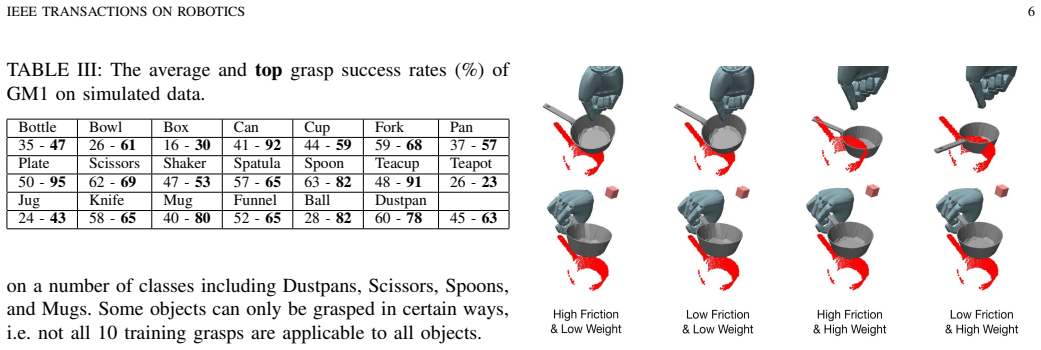
- [Table III] The Teapot row reads '26 - 23', which inverts the average/top ordering used elsewhere in the table; please correct.
- [Section II] 'An key restriction' should be 'A key restriction'.
- [Table IV] The validation row reports '49,8%' with a comma decimal separator; please use a consistent decimal format throughout.
- [Section VI-D, footnote 4] The asymmetry between DS1 (colliding grasps preserved in validation) and DS2 (colliding grasps removed) should be discussed as a potential distribution shift in the training data.
- [Section VI] The paper would benefit from stating training compute time, number of parameters for each EM architecture, and the total training epochs, as these are relevant for reproducibility.
Circularity Check
No significant circularity: the evaluative model is trained on simulated labels and tested on held-out simulated scenes plus a real robot; prior self-cited generative models are components, not proofs.
full rationale
The derivation chain is self-contained. The evaluative models (EM1-EM3) are trained on simulated grasp outcomes from DS1-Tr and DS2-Tr, with success labels produced by MuJoCo rigid-body simulation (Section V-B: "a grasp is considered a success if an object is lifted one metre above the table, and held there for two seconds"). The reported top-ranked grasp success rates are computed on held-out test sets DS1-Te and DS2-Te (Table VI), which contain grasps generated by GM1/GM2 but whose success/failure labels are determined by the simulator, not by the models being compared. No parameter is fit to the test-set labels, so the V3-V11 improvements are not fitted-input predictions. The real-robot experiment (Section VIII) provides independent out-of-simulation evidence on 49 object-pose pairs for the central generative-evaluative claim. The self-citations [1] and [2] supply the generative model components; those are prior published algorithms used as modules, and the paper sketches GM2's differences in Section IV. Neither a uniqueness theorem nor a forced ansatz is imported via these citations: the paper's contribution is the learned evaluative model and its integration, which is evaluated against pure generative baselines on the same candidate sets. The V11-versus-V1 headline comparison is confounded in that it changes both the generative and evaluative models, but that is an experimental-design and statistical concern, not a circularity; the matched V11-versus-V2 real-robot comparison is reported (43 vs 40 of 49), and the simulation improvements are on held-out test sets. Overall, the central claim does not reduce by construction to its inputs.
Assumptions & free parameters
free parameters (6)
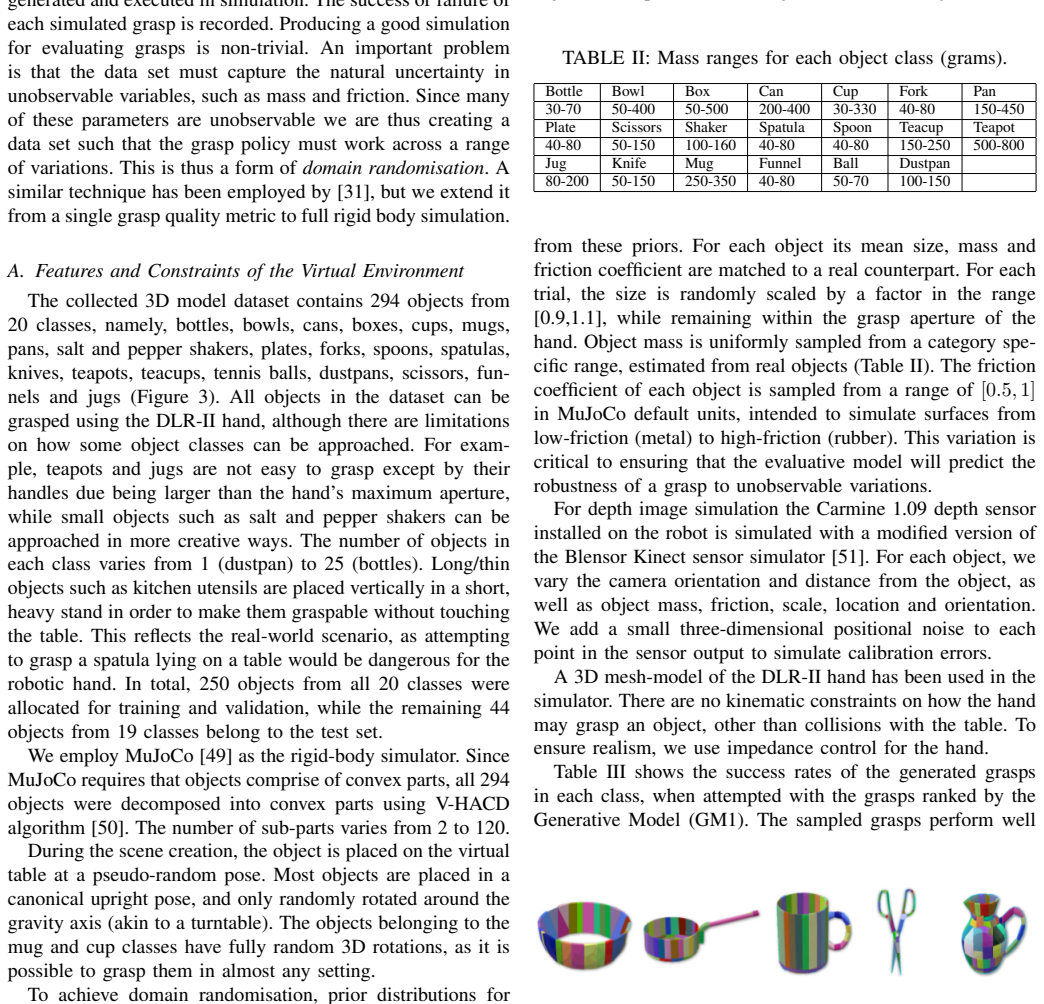
- Category-specific mass ranges =
e.g., bottles 30-70 g, teapot 500-800 g (Table II)
- Friction coefficient range =
[0.5, 1] MuJoCo units
- Scale variation range =
[0.9, 1.1]
- Depth sensor noise sigma =
0.004 m, zero-mean Gaussian
- EM training and optimization hyperparameters =
lr 0.01 halved every 5 epochs; dropout 0.5; early stopping; GA lr 0.001 position and 0.01 joints; SA temperature 0.2…
- Generative model parameters inherited from [1] and [2] =
not re-estimated in this paper
assumptions (4)
- domain assumption MuJoCo rigid-body simulation with V-HACD convex decomposition faithfully represents DLR-II hand contacts for grasp success labeling.
- domain assumption Blensor Kinect simulation plus additive Gaussian noise approximates the Carmine depth sensor well enough for sim-to-real transfer.
- domain assumption Grasp transfer via contact models learned from 10 demonstrations generalizes to novel object classes.
- domain assumption ImageNet-pretrained VGG and ResNet features transfer to colorized depth and curvature images.
Cite this review
Pith. "Pith review of Deep Dexterous Grasping of Novel Objects from a Single View." pith.science (2026). https://pith.science/paper/T7P52AOO
@misc{pith2026190804293,
  author       = {Pith},
  title        = {Pith review of: Deep Dexterous Grasping of Novel Objects from a Single View},
  year         = {2026},
  howpublished = {\url{https://pith.science/paper/T7P52AOO}},
  note         = {Machine review of arXiv:1908.04293}
}
read the original abstract
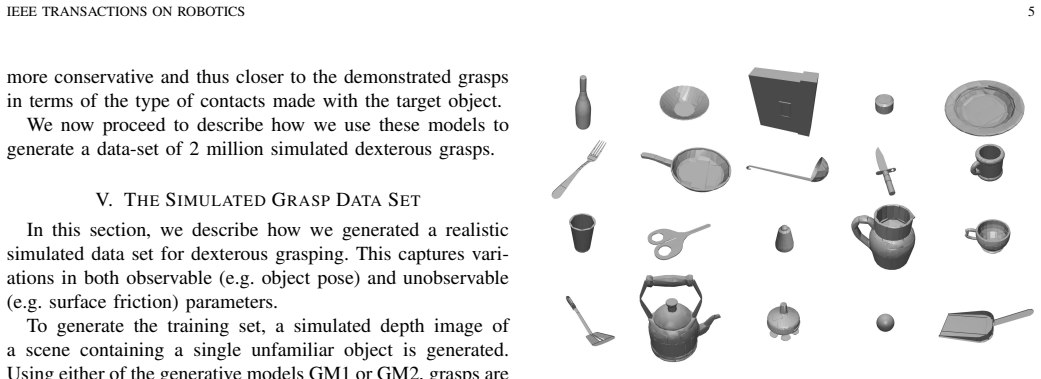
Dexterous grasping of a novel object given a single view is an open problem. This paper makes several contributions to its solution. First, we present a simulator for generating and testing dexterous grasps. Second we present a data set, generated by this simulator, of 2.4 million simulated dexterous grasps of variations of 294 base objects drawn from 20 categories. Third, we present a basic architecture for generation and evaluation of dexterous grasps that may be trained in a supervised manner. Fourth, we present three different evaluative architectures, employing ResNet-50 or VGG16 as their visual backbone. Fifth, we train, and evaluate seventeen variants of generative-evaluative architectures on this simulated data set, showing improvement from 69.53% grasp success rate to 90.49%. Finally, we present a real robot implementation and evaluate the four most promising variants, executing 196 real robot grasps in total. We show that our best architectural variant achieves a grasp success rate of 87.8% on real novel objects seen from a single view, improving on a baseline of 57.1%.
Figures


Figures from the paper (10 more)




Reference graph
Works this paper leans on
-
[1]
One-shot learning and generation of dexterous grasps for novel objects,
M. Kopicki, R. Detry, M. Adjigble, R. Stolkin, A. Leonardis, and J. L. Wyatt, “One-shot learning and generation of dexterous grasps for novel objects,” The International Journal of Robotics Research, vol. 35, pp. 959–976, 2015. [Online]. Available: https: //doi.org/10.1177/0278364915594244
-
[2]
Learning better generative mod- els for dexterous, single-view grasping of novel objects,
M. Kopicki, D. Belter, and J. L. Wyatt, “Learning better generative mod- els for dexterous, single-view grasping of novel objects,” International Journal of Robotics Research , vol. Forthcoming, 2019
work page 2019
-
[3]
Data-driven grasp synthesis – a survey,
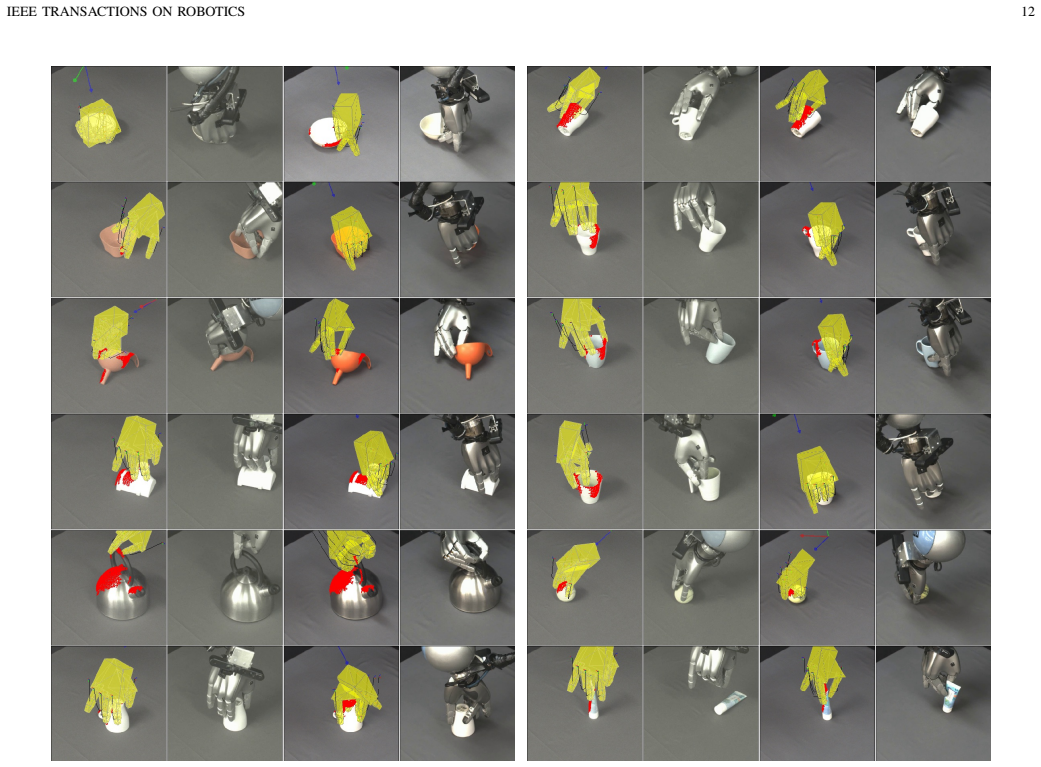
J. Bohg, A. Morales, T. Asfour, and D. Kragic, “Data-driven grasp synthesis – a survey,” IEEE Transactions on Robotics , vol. 30, no. 2, pp. 289–309, 2014. [Online]. Available: http: //doi.org/10.1109/TRO.2013.2289018 IEEE TRANSACTIONS ON ROBOTICS 12 Fig. 12: V1 vs V4. This shows grasps from methods based on generative model GM1. The V1 grasps are shown i...
-
[4]
An overview of 3d object grasp synthesis algorithms,
A. Sahbani, S. El-Khoury, and P. Bidaud, “An overview of 3d object grasp synthesis algorithms,” Robotics and Autonomous Systems, vol. 60, no. 3, pp. 326–336, 2012. [Online]. Available: https://doi.org/10.1016/j.robot.2011.07.016
-
[5]
Robotic grasping and contact: a review,
A. Bicchi and V . Kumar, “Robotic grasping and contact: a review,” in International Conference on Robotics and Automation . IEEE, 2000, pp. 348–353. [Online]. Available: https://doi.org/10.1109/ROBOT.2000. 844081
-
[6]
Computing n-finger form-closure grasps on polygonal objects,
Y .-H. Liu, “Computing n-finger form-closure grasps on polygonal objects,” The International Journal of Robotics Research , vol. 19, no. 2, pp. 149–158, 2000. [Online]. Available: https://doi.org/10.1177/ 02783640022066798
-
[7]
Closure and quality equivalence for efficient synthesis of grasps from examples,
N. Pollard, “Closure and quality equivalence for efficient synthesis of grasps from examples,” The International Journal of Robotics Research, vol. 23, no. 6, pp. 595–613, 2004. [Online]. Available: https://doi.org/10.1177/0278364904044402
-
[8]
Graspit! a versatile simulator for robotic grasping,
A. Miller and P. Allen, “Graspit! a versatile simulator for robotic grasping,” IEEE Robotics & Automation Magazine , vol. 11, no. 4, pp. 110–122, 2004. [Online]. Available: https://doi.org/10.1109/MRA.2004. 1371616
Show all 56 references
-
[9]
Planning optimal grasps,
C. Ferrari and J. Canny, “Planning optimal grasps,” in International Conference on Robotics and Automation , 1992, pp. 2290–2295. [Online]. Available: https://doi.org/10.1109/ROBOT.1992.219918
1992
-
[10]
Grasp quality measures: Review and performance,
M. Roa and R. Suarez, “Grasp quality measures: Review and performance,” Autonomous Robots , vol. 38, no. 1, pp. 65–88, 2015. [Online]. Available: https://doi.org/10.1007/s10514-014-9402-3
2015 doi
-
[11]
Robot grasp synthesis algorithms: A survey,
K. B. Shimoga, “Robot grasp synthesis algorithms: A survey,” The International Journal of Robotics Research, vol. 15, no. 3, pp. 230–266,
-
[12]
Task specific robust grasping for multifingered robot hands,
G. Boutselis, C. Bechlioulis, M. Liarokapis, and K. Kyriakopoulos, “Task specific robust grasping for multifingered robot hands,” in IEEE International Conference on Robotics and Automation . IEEE, 2014, pp. 858–863. [Online]. Available: https://doi.org/10.1109/IROS.2014. 6942660
2014 doi
-
[13]
Three-finger precision grasp on incomplete 3D point clouds,
I. Gori, U. Pattacini, V . Tikhanoff, and G. Metta, “Three-finger precision grasp on incomplete 3D point clouds,” in IEEE International Conference on Robotics and Automation . IEEE, 2014, pp. 5366–5373. [Online]. Available: https://doi.org/10.1109/ICRA.2014.6907648
2014
-
[14]
Combinatorial opti- mization for hierarchical contact-level grasping,
K. Hang, J. Stork, F. Pokorny, and D. Kragic, “Combinatorial opti- mization for hierarchical contact-level grasping,” in IEEE International Conference on Robotics and Automation . IEEE, 2014, pp. 381–388. [Online]. Available: https://doi.org/10.1109/ICRA.2014.6906885
2014
-
[15]
On the synthesis of feasible and prehensile robotic grasps,
C. Rosales, R. Su ´arez, M. Gabiccini, and A. Bicchi, “On the synthesis of feasible and prehensile robotic grasps,” in IEEE International Conference on Robotics and Automation . IEEE, 2012, pp. 550–556. [Online]. Available: https://doi.org/10.1109/ICRA.2012.6225238
2012
-
[16]
Efficient models for grasp planning with a multi-fingered hand,
J. Saut and D. Sidobre, “Efficient models for grasp planning with a multi-fingered hand,” Robotics and Autonomous Systems , vol. 60, no. 3, pp. 347–357, 2012. [Online]. Available: https: //doi.org/10.1016/j.robot.2011.07.019
2012 doi
-
[17]
Hand posture subspaces for dexterous robotic grasping,
M. Ciocarlie and P. Allen, “Hand posture subspaces for dexterous robotic grasping,” IJRR, vol. 28, no. 7, pp. 851–867, 2009
2009
-
[18]
Coping with the grasping uncertainties in force-closure analysis,
Y . Zheng and W.-H. Qian, “Coping with the grasping uncertainties in force-closure analysis,” The International Journal of Robotics Research, vol. 24, no. 4, pp. 311–327, 2005. [Online]. Available: https://doi.org/10.1177/0278364905049469
2005 doi
-
[19]
Integrating grasp planning with online stability assessment using tactile sensing,
Y . Bekiroglu, K. Huebner, and D. Kragic, “Integrating grasp planning with online stability assessment using tactile sensing,” in International Conference on Robotics and Automation . IEEE, 2011, pp. 4750–4755. [Online]. Available: https://doi.org/10.1109/ICRA.2011.5980049
2011
-
[20]
Physically based grasp quality evaluation under pose uncertainty,
J. Kim, K. Iwamoto, J. J. Kuffner, Y . Ota, and N. S. Pollard, “Physically based grasp quality evaluation under pose uncertainty,” IEEE Transac- IEEE TRANSACTIONS ON ROBOTICS 13 Fig. 13: V1 vs V4. This shows grasps from methods based on generative model GM1. The V1 grasps are ...
2013
-
[21]
Evaluating the efficacy of grasp metrics for utilization in a gaussian process-based grasp predictor,
A. K. Goins, R. Carpenter, W.-K. Wong, and R. Balasubramanian, “Evaluating the efficacy of grasp metrics for utilization in a gaussian process-based grasp predictor,” in IEEE/RSJ International Conference on Intelligent Robots and Systems . IEEE/RSJ, 2014, pp. 3353–3360
2014
-
[22]
Gaussian process implicit surfaces for shape estimation and grasping,
S. Dragiev, M. Toussaint, and M. Gienger, “Gaussian process implicit surfaces for shape estimation and grasping,” in Robotics and Automation (ICRA), 2011 IEEE International Conference on . IEEE, 2011, pp. 2845–2850
2011
-
[23]
Generalization of human grasping for multi-fingered robot hands,
H. Ben Amor, O. Kroemer, U. Hillenbrand, G. Neumann, and J. Peters, “Generalization of human grasping for multi-fingered robot hands,” in IEEE/RSJ International Conference on Intelligent Robots and Systems , 2012
2012
-
[24]
Hierarchical reinforcement learning of multiple grasping strategies with human instructions,
T. Osa, J. Peters, and G. Neumann, “Hierarchical reinforcement learning of multiple grasping strategies with human instructions,” Advanced Robotics, vol. 32, no. 18, pp. 955–968, 2018. [Online]. Available: https://doi.org/10.1080/01691864.2018.1509018
2018
-
[25]
Robotic Grasping of Novel Objects using Vision,
A. Saxena, J. Driemeyer, and A. Y . Ng, “Robotic Grasping of Novel Objects using Vision,” International Journal of Robotics Research , vol. 27, no. 2, p. 157, 2008. [Online]. Available: http://ai.stanford.edu/ ∼asaxena/learninggrasp/IJRR saxena etal roboticgraspingofnovelobjects.pdf
2008
-
[26]
Generalizing grasps across partly similar objects,
R. Detry, C. H. Ek, M. Madry, J. Piater, and D. Kragic, “Generalizing grasps across partly similar objects,” in IEEE International Conference on Robotics and Automation , 2012
2012
-
[27]
Learning continuous grasp affordances by sen- sorimotor exploration,
R. Detry, E. Bas ¸eski, M. Popovi ´c, Y . Touati, N. Kr ¨uger, O. Kroemer, J. Peters, and J. Piater, “Learning continuous grasp affordances by sen- sorimotor exploration,” in From Motor Learning to Interaction Learning in Robots , O. Sigaud and J. Peters, Eds. Springer-Verlag,...
2010
-
[28]
Learning hand- eye coordination for robotic grasping with large-scale data collection,
S. Levine, P. Pastor, A. Krizhevsky, and D. Quillen, “Learning hand- eye coordination for robotic grasping with large-scale data collection,” in 2016 International Symposium on Experimental Robotics , D. Kuli ´c, Y . Nakamura, O. Khatib, and G. Venture, Eds. Cham: Springer Int...
2016
-
[29]
Deep learning for detecting robotic grasps,
I. Lenz, H. Lee, and A. Saxena, “Deep learning for detecting robotic grasps,” The International Journal of Robotics Research , vol. 34, no. 4-5, pp. 705–724, 2015
2015
-
[31]
Dex-net 2.0: Deep learning to plan robust grasps with synthetic point clouds and analytic grasp metrics,
J. Mahler, J. Liang, S. Niyaz, M. Laskey, R. Doan, X. Liu, J. A. Ojea, and K. Goldberg, “Dex-net 2.0: Deep learning to plan robust grasps with synthetic point clouds and analytic grasp metrics,” arXiv preprint arXiv:1703.09312, 2017
2017 arXiv
-
[32]
Supersizing self-supervision: Learning to grasp from 50k tries and 700 robot hours,
L. Pinto and A. Gupta, “Supersizing self-supervision: Learning to grasp from 50k tries and 700 robot hours,” inRobotics and Automation (ICRA), 2016 IEEE International Conference on . IEEE, 2016, pp. 3406–3413
2016
-
[33]
Deep learning a grasp function for grasping under gripper pose uncertainty,
E. Johns, S. Leutenegger, and A. J. Davison, “Deep learning a grasp function for grasping under gripper pose uncertainty,” in Intelligent Robots and Systems (IROS), 2016 IEEE/RSJ International Conference on. IEEE, 2016, pp. 4461–4468
2016
-
[34]
Real-time grasp detection using convolu- tional neural networks,
J. Redmon and A. Angelova, “Real-time grasp detection using convolu- tional neural networks,” in Robotics and Automation (ICRA), 2015 IEEE International Conference on . IEEE, 2015, pp. 1316–1322
2015
-
[35]
Robotic grasp detection using deep convolu- tional neural networks,
S. Kumra and C. Kanan, “Robotic grasp detection using deep convolu- tional neural networks,” in 2017 IEEE/RSJ International Conference on Intelligent Robots and Systems (IROS) , Sept 2017, pp. 769–776
2017
-
[36]
Closing the loop for robotic grasping: A real-time, generative grasp synthesis approach,
D. Morrison, J. Leitner, and P. Corke, “Closing the loop for robotic grasping: A real-time, generative grasp synthesis approach,” in Proceed- ings of Robotics: Science and Systems XIV , 2018
2018
-
[37]
Using simulation and domain adaptation to improve efficiency of deep robotic grasping,
K. Bousmalis, A. Irpan, P. Wohlhart, Y . Bai, M. Kelcey, M. Kalakrish- nan, L. Downs, J. Ibarz, P. Pastor, K. Konolige et al., “Using simulation and domain adaptation to improve efficiency of deep robotic grasping,” arXiv preprint arXiv:1709.07857 , 2017
2017 arXiv
-
[38]
Closing the loop for robotic grasping: A real-time, generative grasp synthesis approach,
D. Morrison, J. Leitner, and P. Corke, “Closing the loop for robotic grasping: A real-time, generative grasp synthesis approach,” in Proceedings of Robotics: Science and Systems, Pittsburgh, Pennsylvania, June 2018. [Online]. Available: https://dx.doi.org/10.15607/RSS.2018. XIV .021
2018 doi
-
[39]
Learning IEEE TRANSACTIONS ON ROBOTICS 14 hand-eye coordination for robotic grasping with deep learning and large-scale data collection,
S. Levine, P. Pastor, A. Krizhevsky, J. Ibarz, and D. Quillen, “Learning IEEE TRANSACTIONS ON ROBOTICS 14 hand-eye coordination for robotic grasping with deep learning and large-scale data collection,” International Journal of Robotics Research,
-
[40]
High precision grasp pose detection in dense clutter,
M. Gualtieri, A. ten Pas, K. Saenko, and R. Platt, “High precision grasp pose detection in dense clutter,” in IEEE/RSJ International Conference on Inteligent Robots and Systems . IEEE, 2016, pp. 598–605. [Online]. Available: https://doi.org/10.1109/IROS.2016.7759114
2016
-
[41]
Leveraging big data for grasp planning,
D. Kappler, J. Bohg, and S. Schaal, “Leveraging big data for grasp planning,” in Robotics and Automation (ICRA), 2015 IEEE International Conference on. IEEE, 2015, pp. 4304–4311
2015
-
[42]
6dof grasp planning by optimizing a deep learning scoring function,
Y . Zhou and K. Hauser, “6dof grasp planning by optimizing a deep learning scoring function,” in Robotics: Science and Systems (RSS) Workshop on Revisiting Contact-Turning a Problem into a Solution , 2017
2017
-
[43]
Planning multi-fingered grasps as probabilistic inference in a learned deep network,
Q. Lu, K. Chenna, B. Sundaralingam, and T. Hermans, “Planning multi-fingered grasps as probabilistic inference in a learned deep network,” in International Symposium on Robotics Research , 2017. [Online]. Available: https://arxiv.org/abs/1804.03289
2017 arXiv
-
[44]
Generating multi-fingered robotic grasps via deep learning,
J. Varley, J. Weisz, J. Weiss, and P. Allen, “Generating multi-fingered robotic grasps via deep learning,” in Intelligent Robots and Systems (IROS), 2015 IEEE/RSJ International Conference on . IEEE, 2015, pp. 4415–4420
2015
-
[45]
Modeling grasp motor imagery through deep conditional generative models,
M. Veres, M. Moussa, and G. W. Taylor, “Modeling grasp motor imagery through deep conditional generative models,” IEEE Robotics and Automation Letters , vol. 2, no. 2, pp. 757–764, 2017. [Online]. Available: https://doi.org/10.1109/LRA.2017.2651945
2017
-
[46]
Active vision for dexterous grasping of novel objects,
E. Arruda, J. Wyatt, and M. Kopicki, “Active vision for dexterous grasping of novel objects,” in Intelligent Robots and Systems (IROS), 2016 IEEE/RSJ International Conference on . IEEE, 2016, pp. 2881–
2016
-
[47]
Clustering by passing messages between data points,
B. J. Frey and D. Dueck, “Clustering by passing messages between data points,” Science, vol. 315, no. 5814, pp. 972–976, 2007. [Online]. Available: https://doi.org/10.1126/science.1136800
2007 doi
-
[48]
Learning better generative models for dexterous, single-view grasping of novel objects,
M. Kopicki, D. Belter, and J. L. Wyatt, “Learning better generative models for dexterous, single-view grasping of novel objects,” 2019
2019
-
[49]
Mujoco: A physics engine for model-based control,
E. Todorov, T. Erez, and Y . Tassa, “Mujoco: A physics engine for model-based control,” in 2012 IEEE/RSJ International Conference on Intelligent Robots and Systems , Oct 2012, pp. 5026–5033
2012
-
[50]
A simple and efficient approach for 3d mesh approximate convex decomposition,
K. Mamou and F. Ghorbel, “A simple and efficient approach for 3d mesh approximate convex decomposition,” in Proceedings of the 16th IEEE International Conference on Image Processing , ser. ICIP’09. Piscataway, NJ, USA: IEEE Press, 2009, pp. 3465–3468. [Online]. Available: http:...
2009
-
[51]
Robot arm pose estimation through pixel-wise part classification,
J. Bohg, J. Romero, A. Herzog, and S. Schaal, “Robot arm pose estimation through pixel-wise part classification,” in IEEE International Conference on Robotics and Automation (ICRA) 2014 , Jun. 2014, pp. 3143–3150
2014
-
[52]
Very deep convolutional networks for large-scale image recognition,
K. Simonyan and A. Zisserman, “Very deep convolutional networks for large-scale image recognition,” in 3rd International Conference on Learning Representations, ICLR 2015, San Diego, CA, USA, May 7-9, 2015, Conference Track Proceedings , 2015. [Online]. Available: http://arxiv...
2015 arXiv
-
[53]
Learning hand-eye coordination for robotic grasping with deep learning and large-scale data collection,
S. Levine, P. Pastor, A. Krizhevsky, J. Ibarz, and D. Quillen, “Learning hand-eye coordination for robotic grasping with deep learning and large-scale data collection,” The International Journal of Robotics Research, vol. 0, no. 0, p. 0278364917710318, 0. [Online]. Available: ...
-
[54]
Deep residual learning for image recognition,
K. He, X. Zhang, S. Ren, and J. Sun, “Deep residual learning for image recognition,” CoRR, vol. abs/1512.03385, 2015. [Online]. Available: http://arxiv.org/abs/1512.03385
2015 arXiv
-
[55]
Feature-wise transformations,
V . Dumoulin, E. Perez, N. Schucher, F. Strub, H. de Vries, A. Courville, and Y . Bengio, “Feature-wise transformations,” Distill, 2018, https://distill.pub/2018/feature-wise-transformations. Umit Rusen Aktas Umit Rusen Aktas is a Research Engineer at Blue Prism in London. He ...
2018
-
[1996]
Available: https://doi.org/10.1177/027836499601500302
[Online]. Available: https://doi.org/10.1177/027836499601500302
-
[2888]
Available: http://doi.org/10.1109/IROS.2016.7759446
[Online]. Available: http://doi.org/10.1109/IROS.2016.7759446
2016
Reviewed August 14, 2026 · model on record in the stance chip above.
Discussion (0). Continue with ORCID to comment.