REVIEW 2 major objections 2 minor 58 references
Reviewed by Pith at T0; open to challenge.
T0 means a machine referee read the full paper against a public rubric. The mark states how deep the mechanical check went, never who wrote it. the ladder, T0–T4 →
T0 review · grok-4.3
An ambipolar PdSe₂ transistor electrically tracks the fraction of mobile ions in supercooled ionic liquids as they approach the glass transition.
2026-06-26 22:31 UTC pith:T7QDOURT
load-bearing objection The ambipolar PdSe2 transistor offers a device-compatible electrical route to p_eq(T) in ionic glass formers, but the direct mapping from hysteresis and transients still needs controls against interface artifacts. the 2 major comments →
Electronic access to glass transition in supercooled ionic liquids using ambipolar transistor
The pith
A machine-rendered reading of the paper's core claim, the machinery that carries it, and where it could break.
Core claim
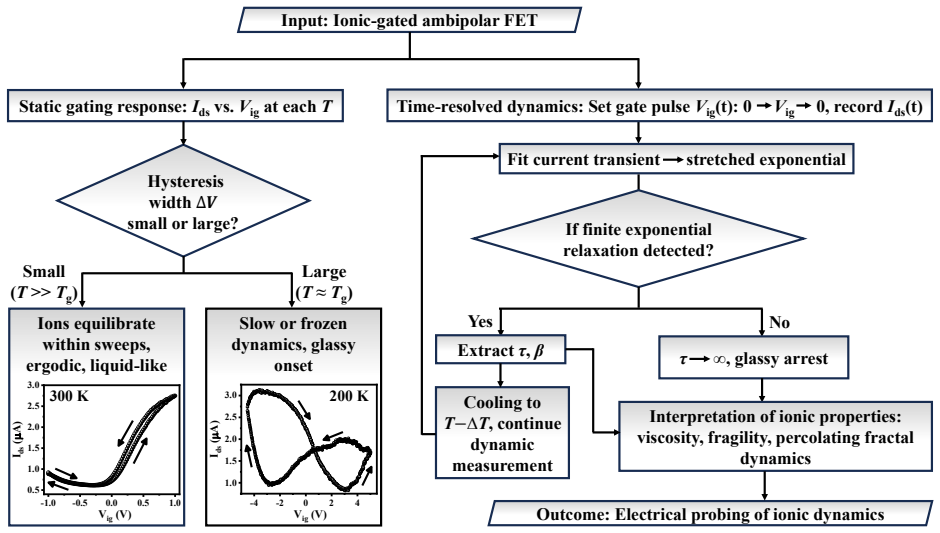
The temperature evolution of hysteresis and time-resolved current transients under ionic-gate pulses maps directly onto p_eq(T), the electrically accessible fraction of mobile ions. Upon cooling, p_eq(T) collapses sharply as dynamically equilibrated liquid regions fragment into percolating fractal clusters, consistent with the entropy reduction predicted for fragile glass formers; this collapse supplies the scaling needed to infer viscosity and the ergodic-to-nonergodic crossover temperatures inside an operating transistor.
What carries the argument
p_eq(T), the fraction of mobile ions able to relax within the experimental timescale, extracted from transfer-curve hysteresis and current transients.
Load-bearing premise
Changes in hysteresis and current transients reflect only the physical fraction of mobile ions and are not dominated by interface traps, contact resistance, or non-ionic polarization.
What would settle it
Independent rheological or dielectric measurements on the same ionic liquid that yield a mobile-ion fraction versus temperature differing from the transistor-derived p_eq(T) would falsify the direct mapping.
If this is right
- Viscosity can be scaled with temperature using p_eq(T) data inside the device.
- Characteristic temperatures for the ergodic-to-nonergodic crossover become extractable from electrical signals.
- Polymer confinement raises the crossover temperatures, showing the method detects matrix-imposed structural constraints.
- The approach works in solid-state device geometries where bulk rheometry is impossible.
Where Pith is reading between the lines
- Embedding such transistors in circuits could enable real-time electrical monitoring of local glass transitions in ionic-liquid-based devices.
- The fractal-cluster description of mobile regions invites direct comparison with percolation models used for other fragile glass formers.
- The same electrical readout might be adapted to other two-dimensional ambipolar channels to broaden the range of accessible ionic liquids.
Editorial analysis
A structured set of objections, weighed in public.
Referee Report
Summary. The manuscript demonstrates an ambipolar PdSe₂ field-effect transistor as an in-device electrical probe for ion relaxation dynamics in fragile supercooled ionic liquids. By tracking temperature-dependent transfer-curve hysteresis and current transients under ionic-gate pulsing, the authors extract an electrically accessible quantity p_eq(T) that quantifies the fraction of mobile ions able to relax on experimental timescales. They report non-Arrhenius fragile slowdown, a sharp collapse of p_eq(T) near the glass transition consistent with percolation of mobile regions, and extraction of viscosity scaling plus ergodic-to-nonergodic crossover temperatures; polymer confinement is shown to shift these temperatures upward.
Significance. If the direct mapping from electrical transients to p_eq(T) and rheological parameters holds with sub-dominant device artifacts, the approach would enable rheological characterization inside solid-state device architectures where conventional rheometry is incompatible. The method's reported sensitivity to polymer confinement adds practical value for confined ionic-liquid systems in electronics.
major comments (2)
- [Abstract and § on p_eq(T) extraction] The central claim that hysteresis width and transient amplitudes map directly to the physical mobile-ion fraction p_eq(T) (and thence to viscosity scaling) is load-bearing, yet the manuscript supplies no quantitative controls or bounds on temperature-dependent device artifacts such as interface traps, contact resistance, or non-ionic polarization. No channel-length scaling, gate-dielectric swap, or equivalent-circuit analysis is described to demonstrate that these contributions remain sub-dominant across the full T-range.
- [Results on temperature evolution and viscosity scaling] No error bars, reproducibility metrics, or comparison to independent rheological data are provided for the extracted p_eq(T) curves or the inferred characteristic temperatures (ergodic-to-nonergodic crossover, etc.). This leaves the semiquantitative inference of rheological parameters without a clear uncertainty estimate or external validation.
minor comments (2)
- [Abstract] Notation for p_eq(T) should be defined explicitly at first use with the precise experimental timescale on which 'mobile' is defined.
- [Figures] Figure captions for transfer curves and transients should state the exact pulse durations, voltage amplitudes, and channel dimensions used.
Simulated Author's Rebuttal
We thank the referee for the positive assessment of the method's potential significance and for the constructive major comments. We address each point below and will revise the manuscript to strengthen the claims where the concerns are valid.
read point-by-point responses
-
Referee: [Abstract and § on p_eq(T) extraction] The central claim that hysteresis width and transient amplitudes map directly to the physical mobile-ion fraction p_eq(T) (and thence to viscosity scaling) is load-bearing, yet the manuscript supplies no quantitative controls or bounds on temperature-dependent device artifacts such as interface traps, contact resistance, or non-ionic polarization. No channel-length scaling, gate-dielectric swap, or equivalent-circuit analysis is described to demonstrate that these contributions remain sub-dominant across the full T-range.
Authors: The referee correctly identifies that the manuscript does not present channel-length scaling, gate-dielectric swaps, or a full equivalent-circuit analysis to bound possible artifacts. While the ambipolar PdSe2 channel and the distinct temperature evolution of p-type versus n-type branches provide some internal consistency checks against purely electronic artifacts, these are not quantitative. We will add an equivalent-circuit model, bounds on contact-resistance and trap contributions, and channel-length dependence data in the revised manuscript to demonstrate that ionic polarization remains the dominant contribution. revision: yes
-
Referee: [Results on temperature evolution and viscosity scaling] No error bars, reproducibility metrics, or comparison to independent rheological data are provided for the extracted p_eq(T) curves or the inferred characteristic temperatures (ergodic-to-nonergodic crossover, etc.). This leaves the semiquantitative inference of rheological parameters without a clear uncertainty estimate or external validation.
Authors: We agree that the absence of error bars, device-to-device reproducibility statistics, and direct comparison to independent rheological measurements weakens the quantitative claims. The p_eq(T) data were collected on multiple devices, but these statistics were not reported. In the revision we will include error bars (standard deviation across devices and repeated temperature sweeps), reproducibility metrics, and a comparison of the extracted crossover temperatures and viscosity scaling to published rheological data on the same ionic liquids. revision: yes
Circularity Check
No circularity: experimental observations map directly to p_eq(T) without self-referential derivation
full rationale
The manuscript is an experimental study that reports measured transfer-curve hysteresis and current transients in a PdSe2 ambipolar FET, from which the authors extract an electrically accessible quantity p_eq(T) defined as the fraction of mobile ions able to relax on the experimental timescale. No equations, fits, or derivations are presented that reduce the target rheological parameters or glass-transition markers back to the same fitted inputs by construction. The central claims rest on direct device measurements rather than any self-definitional loop, fitted-input prediction, or self-citation load-bearing step. The mapping from raw electrical signals to p_eq(T) is presented as an empirical correspondence, not a mathematical identity.
Axiom & Free-Parameter Ledger
invented entities (1)
-
p_eq(T)
no independent evidence
read the original abstract
Relaxation dynamics of supercooled liquids approaching glassy arrest remain a central challenge in integrated electronic architectures, where conventional rheometry becomes incompatible. Here, we demonstrate that an ambipolar PdSe$_2$ field-effect transistor functions as an electrical probe capable of resolving ion-specific relaxation dynamics in fragile ionic glass formers and semiquantitatively inferring rheological parameters within an operating device environment. Temperature evolution of the transfer curve hysteresis and time-resolved current transients under ionic-gate pulse reveal a non-Arrhenius fragile slowdown. We track the continuous reduction of dynamically equilibrated liquid regions approaching the glass transition through an electrically accessible quantity $p_\text{eq}(T)$, quantifying the fraction of the mobile ions able to relax within the experimental timescale. Upon cooling, $p_\text{eq}$ collapses sharply as mobile regions fragment into percolating fractal clusters, consistent with a reduction of configurational entropy predicted for fragile glass formers. This approach enables temperature-dependent scaling of viscosity and extraction of characteristic temperatures marking the ergodic-to-nonergodic crossover, within a solid-state device architecture where conventional rheological characterization is inapplicable. Further, polymer confinement of the ionic liquid shifts these characteristic temperatures upward, demonstrating the sensitivity of this method to structural constraints imposed by the polymer matrix.
Figures



Reference graph
Works this paper leans on
-
[1]
C. A. Angell, Formation of glasses from liquids and biopolymers,Science267, 1924–1935 (1995)
1924
-
[2]
M. D. Ediger, C. A. Angell, and S. R. Nagel, Supercooled liquids and glasses,J. Phys. Chem. 100, 13200–13212 (1996)
1996
-
[3]
Shakeel, H
A. Shakeel, H. Mahmood, U. Farooq, Z. Ullah, S. Yasin, T. Iqbal, C. Chassagne, and M. Moniruzzaman, Rheology of pure ionic liquids and their complex fluids: A review,ACS Sus- tainable Chem. Eng.7, 13586–13626 (2019)
2019
-
[4]
J. C. Mauro, Y. Yue, A. J. Ellison, P. K. Gupta, and D. C. Allan, Viscosity of glass-forming liquids,Proc. Natl. Acad. Sci. U.S.A.106, 19780–19784 (2009)
2009
-
[5]
R. G. Larson, The Structure and Rheology of Complex Fluids (Oxford University Press, Oxford, 1999)
1999
-
[6]
Y. Zuo, Y. Zhang, R. Huang, and Y. Min, The effect of nanoconfinement on the glass transition temperature of ionic liquids,Phys. Chem. Chem. Phys.21, 22 (2019)
2019
-
[7]
M. Han, S. A. Rogers, and R. M. Espinosa-Marzal, Rheological characteristics of ionic liquids under nanoconfinement,Langmuir38, 2961–2971 (2022)
2022
-
[8]
Hayes, G
R. Hayes, G. G. Warr, and R. Atkin, Structure and nanostructure in ionic liquids,Chem. Rev. 115, 6357–6426 (2015)
2015
-
[9]
Y. U. Paulechka, G. J. Kabo, A. V. Blokhin, O. A. Vydrov, J. W. Magee, and M. Frenkel, Thermodynamic properties of 1-Butyl-3-methylimidazolium Hexafluorophosphate in the ideal gas state,J. Chem. Eng. Data48, 457–462 (2003)
2003
-
[10]
Pereira, R
J. Pereira, R. Souza, A. Moreira, and A. Moita, An overview of the ionic liquids and their hybrids operating in electrochemical cells and capacitors,Ionics30, 4343–4385 (2024)
2024
-
[11]
Pachernegg, J
L. Pachernegg, J. Maier, R. Yagmur, M. Damm, R. Kalb, A. M. Coclite, and S. Spirk, Physic- ochemical Properties of 20 ionic liquids prepared by the carbonate-based IL (CBILS) process, J. Chem. Eng. Data69, 1814–1823 (2024). xii
2024
-
[12]
J. Ye, M. F. Craciun, M. Koshino, S. Russo, S. Inoue, H. Yuan, H. Shimotani, A. F. Morpurgo, and Y. Iwasa, Accessing the transport properties of graphene and its multilayers at high carrier density,Proc. Natl. Acad. Sci. U.S.A.108, 13002–13006 (2011)
2011
-
[14]
Cheng, W.-L
C.-Y. Cheng, W.-L. Pai, Y.-H. Chen, N. T. Paylaga, P.-Y. Wu, C.-W. Chen, C.-T. Liang, F.-C. Chou, R. Sankar, M. S. Fuhrer, S.-Y. Chen, and W.-H. Wang, Phase modulation of self-gating in ionic liquid-functionalized InSe field-effect transistors,NanoLett.22, 2270-2276 (2022)
2022
-
[15]
Saito, and Y
Y. Saito, and Y. Iwasa, Ambipolar insulator-to-metal transition in black phosphorus by ionic- liquid gating,ACS Nano9, 3192–3198 (2015)
2015
-
[16]
F. Wang, Y. Zhang, Z. Wang, H. Zhang, X. Wu, C. Bao, J. Li, P. Yu, and S. Zhou, Ionic liquid gating induced self-intercalation of transition metal chalcogenides,Nat Commun14, 4945 (2023)
2023
-
[17]
S. Jo, D. Costanzo, H. Berger, and A. F. Morpurgo, Electrostatically induced superconduc- tivity at the surface of WS 2,Nano Lett.15, 1197–1202 (2015)
2015
-
[18]
Q. Chen, J. Lu, L. Liang, O. Zheliuk, A. A. E. Yumin, and J. Ye, Continuous low-bias switching of superconductivity in a MoS 2 transistor,Adv. Mater.30, 1800399 (2018)
2018
-
[19]
Grzybowska, A
K. Grzybowska, A. Grzybowski, Z. Wojnarowska, J. Knapik, and M. Paluch, Ionic liquids and their bases: Striking differences in the dynamic heterogeneity near the glass transition,Sci Rep5, 16876 (2015)
2015
-
[20]
Lubchenko, Theory of the structural glass transition: a pedagogical review.Advances in Physics64, 283–443 (2015)
V. Lubchenko, Theory of the structural glass transition: a pedagogical review.Advances in Physics64, 283–443 (2015)
2015
-
[21]
G. Liu, H. Luo, Y. Dan, Y. Niu, and G. Li, Scaling relation and rheological behaviors of polymerized ionic liquids in ionic liquid/dimethylformamide solutions,Macromolecules57, 8409–8420 (2024)
2024
-
[22]
A. D. Oyedele, S. Yang, L. Liang, A. A. Puretzky, K. Wang, J. Zhang, P. Yu, P. R. Pudasaini, A. W. Ghosh, Z. Liu, C. M. Rouleau, B. G. Sumpter, M. F. Chisholm, W. Zhou, P. D. Rack, D. B. Geohegan, and K. Xiao, PdSe 2: Pentagonal two-dimensional layers with high air stability for electronics,J. Am. Chem. Soc.139, 14090–14097 (2017)
2017
-
[23]
A. Das, S. Pisana, B. Chakraborty, S. Piscanec, S. K. Saha, U. V. Waghmare, K. S. Novoselov, xiii H. R. Krishnamurthy, A. K. Geim, A. C. Ferrari, and A. K. Sood, Monitoring dopants by Raman scattering in an electrochemically top-gated graphene transistor,Nature Nanotech3, 210–215 (2008)
2008
-
[24]
Palaia, A
I. Palaia, A. J. Asta, M. Dutta, P. B. Warren, B. Rotenberg, and E. Trizac, Poisson - Nernst - Planck charging dynamics of an electric double-layer capacitor: Symmetric and asymmetric binary electrolytes,Phys. Rev. E112, 035417 (2025)
2025
-
[25]
Ishisone, G
K. Ishisone, G. Ori, and M. Boero, Structural, dynamical, and electronic properties of the ionic liquid 1-ethyl-3-methylimidazolium bis(trifluoromethylsulfonyl)imide,Phys. Chem. Chem. Phys.24, 9597-9607 (2022)
2022
-
[26]
C. Yuan, X. Zhu, L. Su, D. Yang, Y. Wang, K. Yang, and X. Cheng, Preparation and charac- terization of a novel ionic conducting foam-type polymeric gel based on polymer PVdF-HFP and ionic liquid [EMIM][TFSI],Colloid Polym Sci293, 1945–1952 (2015)
1945
-
[27]
H. M. Yang, Y. K. Kwon, S. B. Lee, S. Kim, K. Hong, and K. H. Lee, Physically cross-linked homopolymer ion gels for high performance electrolyte-gated transistors,ACS Appl. Mater. Interfaces9, 8813–8818 (2017)
2017
-
[28]
Cut and Stick
K. H. Lee, M. S. Kang, S. Zhang, Y. Gu, T. P. Lodge, and C. D. Frisbie, “Cut and Stick” rubbery ion gels as high capacitance gate dielectrics,Adv. Mater.24, 4457–4462 (2012)
2012
-
[29]
B¨ ohmer, K
R. B¨ ohmer, K. L. Ngai, C. A. Angell, D. J. Plazek, Nonexponential relaxations in strong and fragile glass formers,J. Chem. Phys.99, 4201–4209 (1993)
1993
-
[30]
Coslovich, and G
D. Coslovich, and G. Pastore, Understanding fragility in supercooled Lennard-Jones mixtures. I. Locally preferred structures,J. Chem. Phys.127, 124504 (2007)
2007
-
[31]
Comez, S
L. Comez, S. Corezzi, G. Monaco, R. Verbeni, and D. Fioretto, Ergodic to nonergodic tran- sition in liquids with a local order: The case ofm-Toluidine,Phys. Rev. Lett.94, 155702 (2005)
2005
-
[32]
Vila-Costa, M
A. Vila-Costa, M. Gonzalez-Silveira, C. Rodr´ ıguez-Tinoco, M. Rodr´ ıguez-L´ opez, and J. Rodriguez-Viejo, Emergence of equilibrated liquid regions within the glass,Nat. Phys.19, 114–119 (2023)
2023
-
[33]
R. P. Wool, Twinkling fractal theory of the glass transition,J. Polym. Sci. B Polym. Phys. 46, 2765–2778 (2008)
2008
-
[34]
D. Ma, A. D. Stoica, and X.-L. Wang, Power-law scaling and fractal nature of medium-range order in metallic glasses,Nature Mater8, 30–34 (2009). xiv
2009
-
[35]
Adam, and J
G. Adam, and J. H. Gibbs, On the temperature dependence of cooperative relaxation prop- erties in glass-forming liquids,J. Chem. Phys.43, 139–146 (1965)
1965
-
[36]
Kundu, B
T. Kundu, B. Pal, B. Das, R. Paramanik, S. Maity, A. Ghosh, M. Palit, M. Kopciuszynski, A. Barinov, S. K. Mahatha, and S. Datta, Tunable electron transport in defect-engineered PdSe2,Chem. Mater.35, 13, 5212–5221 (2023)
2023
-
[37]
Kundu, S
T. Kundu, S. Das, K. Dey, B. Joseph, C. Nayak, M. Palit, S. K. Mahatha, K. Dolui, and S. Datta, Dimensional crossover and emergence of novel phases in puckered PdSe 2 under pressure,Phys. Rev. B112, 024109 (2025)
2025
-
[38]
See Supplemental Material at https://doi.org/10.1103/fwv5-9t53 for the device architecture, static and dynamic measurement protocols, confinement effect in configurational entropy, back-gated and ionic-gated transfer characteristics at different temperatures, temperature- dependent current transients for ionic-liquid and ionogel gate pulse, and scaling of...
-
[39]
Y. Li, Q. Wang, X. Li, J. Deng, M. Cheng, J. Wang, Q. Jin, W. Wen, H. Wang, W. Yang, Y.-z. Long, H. Xiao, L. Wang, and M. Li, Impact of ionic liquid gels on the mixed ionic-electronic transport in solid-state organic electrochemical transistors,Adv. Mater. Technol.10, e00691 (2025)
2025
-
[40]
C. Zhao, J. Yang, and W. Ma, Transient response and ionic dynamics in organic electrochem- ical transistors,Nano-Micro Lett.16, 233 (2024)
2024
-
[41]
D. D. Vela, and D. S. Simmons, The microscopic origins of stretched exponential relaxation in two model glass-forming liquids as probed by simulations in the isoconfigurational ensemble, J. Chem. Phys.153, 234503 (2020)
2020
-
[42]
C. A. Angell, K. L. Ngai, G. B. McKenna, P. F. McMillan, and S. W. Martin, Relaxation in glassforming liquids and amorphous solids,J. Appl. Phys.88, 3113–3157 (2000)
2000
-
[43]
Rodr´ ıguez-Tinoco, J
C. Rodr´ ıguez-Tinoco, J. R` afols-Rib´ e, M. Gonz´ alez-Silveira, and J. Rodr´ ıguez-Viejo, Relax- ation dynamics of glasses along a wide stability and temperature range,Sci Rep6, 35607 (2016)
2016
-
[44]
Jaiswal, T
A. Jaiswal, T. Egami, K. F. Kelton, K. S. Schweizer, and Y. Zhang, Correlation between fragility and the arrhenius crossover phenomenon in metallic, molecular, and network liquids, Phys. Rev. Lett.117, 205701 (2016)
2016
-
[45]
Zhang, N
S. Zhang, N. Sun, X. He, X. Lu, and X. Zhang, Physical properties of ionic liquids: Database xv and evaluation,J. Phys. Chem. Ref. Data35, 1475–1517 (2006)
2006
-
[46]
M. Qu, S. Li, J. Chen, Y. Xiao, and J. Xiao, Ion transport in the EMITFSI/PVDF System at different temperatures: A molecular dynamics simulation,ACS Omega7, 9333–9342 (2022)
2022
-
[47]
J. A. Hodgdon, and F. H. Stillinger, Stokes-Einstein violation in glass-forming liquids,Phys. Rev. E48, 207 (1993)
1993
-
[48]
S. Pan, Z. W. Wu, W. H. Wang, M. Z. Li, and L. Xu, Structural origin of fractional Stokes- Einstein relation in glass-forming liquids,Sci Rep7, 39938 (2017)
2017
-
[49]
R. N. Chacko, F. P. Landes, G. Biroli, O. Dauchot, A. J. Liu, and D. R. Reichman, Dynamical facilitation governs the equilibration dynamics of glasses,Phys. Rev. X14, 031012 (2024)
2024
-
[50]
J. F. Stanzione III, K. E. Strawhecker, and R. P. Wool, Observing the twinkling fractal nature of the glass transition,J. Non-Cryst. Solids357(2011)
2011
-
[52]
T. R. Kirkpatrick, D. Thirumalai, and P. G. Wolynes, Scaling concepts for the dynamics of viscous liquids near an ideal glassy state,Phys. Rev. A40, 1045 (1989)
1989
-
[54]
Alcoutlabi, and G
M. Alcoutlabi, and G. B. McKenna, Effects of confinement on material behaviour at the nanometre size scale,J. Phys.: Condens. Matter17, R461 (2005). xvi (a) D RIL Ids CEDL Cox Vig S Vbg 0.0 0.2 0.4 0.6 0.8 1.0 1.2 1.4 1.6 -80 -70 -60 -50 -40 -30VCNP (V) Vig (V) 300 K 200 K (c) -80 -60 -40 -20 0 20 40 60 80 1.6 2.0 2.4 2.8 3.2 3.6 4.0 VCNP Ids (mA) Vbg (V)...
2005
-
[55]
Fujimoto, and K
T. Fujimoto, and K. Awaga, Electric-double-layer field-effect transistors with ionic liquids, Phys. Chem. Chem. Phys.15, 8983 (2013)
2013
-
[56]
Y. Li, Q. Wang, X. Li, J. Deng, M. Cheng, J. Wang, Q. Jin, W. Wen, H. Wang, W. Yang, Y.-z. Long, H. Xiao, L. Wang, and M. Li, Impact of ionic liquid gels on the mixed ionic-electronic transport in solid-state organic electrochemical transistors,Adv. Mater. Technol.10, no. 17: 10, e00691 (2025)
2025
-
[57]
C. Zhao, J. Yang, and W. Ma, Transient response and ionic dynamics in organic electrochemical transistors,Nano-Micro Lett.16, 233 (2024). iv
2024
-
[58]
Richert, Dynamics of nanoconfined supercooled liquids,Annual Review Physical Chemistry, 62, 65–84 (2011)
R. Richert, Dynamics of nanoconfined supercooled liquids,Annual Review Physical Chemistry, 62, 65–84 (2011)
2011
-
[59]
T. R. Kirkpatrick, and D. Thirumalai, Scaling concepts for the dynamics of viscous liquids near an ideal glassy state,Phys. Rev. A40, 1045 (1989)
1989
-
[60]
J. L. Keddie, R. A. L. Jones, and R. A. Cory, Size-dependent depression of the glass transition temperature in polymer films,Europhys. Lett.27, 59–64 (1994)
1994
-
[61]
Alcoutlabi, and G
M. Alcoutlabi, and G. B. McKenna, Effects of confinement on material behaviour at the nanometre size scale,J. Phys.: Condens. Matter17, R461 (2005). v -80 -60 -40 -20 0 20 40 60 80 0.0 0.2 0.4 0.6 0.8 1.0 Normalized Ids Vbg (V) -1.4 V -1.2 V -1 V -0.8 V -0.6 V -0.4 V -0.2 V 0 V 0.2 V 0.4 V 0.6 V 0.8 V 1 V 1.2 V 300 K FIG. S1: Back-gated transfer curves (I...
2005
discussion (0)
Sign in with ORCID, Apple, or X to comment. Anyone can read and Pith papers without signing in.