Evaluating the Limits of QAOA Parameter Transfer at High-Rounds on Sparse Ising Models With Geometrically Local Cubic Terms
Pith reviewed 2026-05-18 15:28 UTC · model grok-4.3
The pith
QAOA angles transferred from small heavy-hex Ising instances improve expectation values on large unseen instances as depth increases.
A machine-rendered reading of the paper's core claim, the machinery that carries it, and where it could break.
Core claim
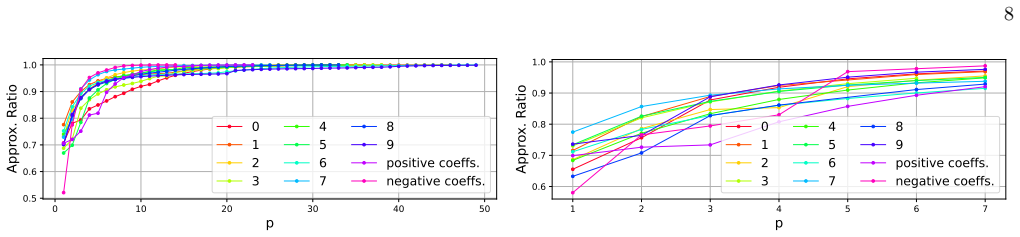
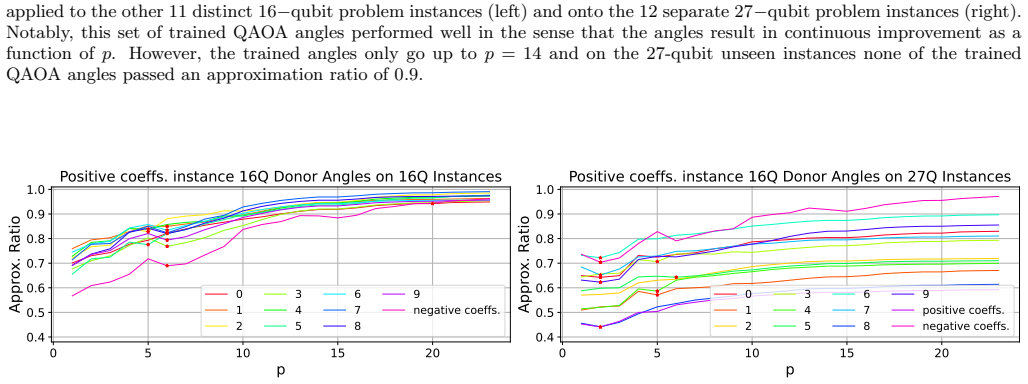
The paper establishes that QAOA parameter transfer from single small instances to unseen large instances of the same model family does not always provide monotonically improving performance as a function of p, but the transferred angles exhibit a general trend of improved expectation value as the QAOA depth increases, in many cases converging close to the true ground-state energy of the 100+ qubit instances. Validation uses full statevector, PEPS, MPS, and LOWESA simulations plus direct runs on IBM superconducting processors.
What carries the argument
QAOA parameter transfer, in which a fixed set of angles optimized on one small instance is applied without re-optimization to larger instances from the same family of heavy-hex Ising models with local cubic terms.
If this is right
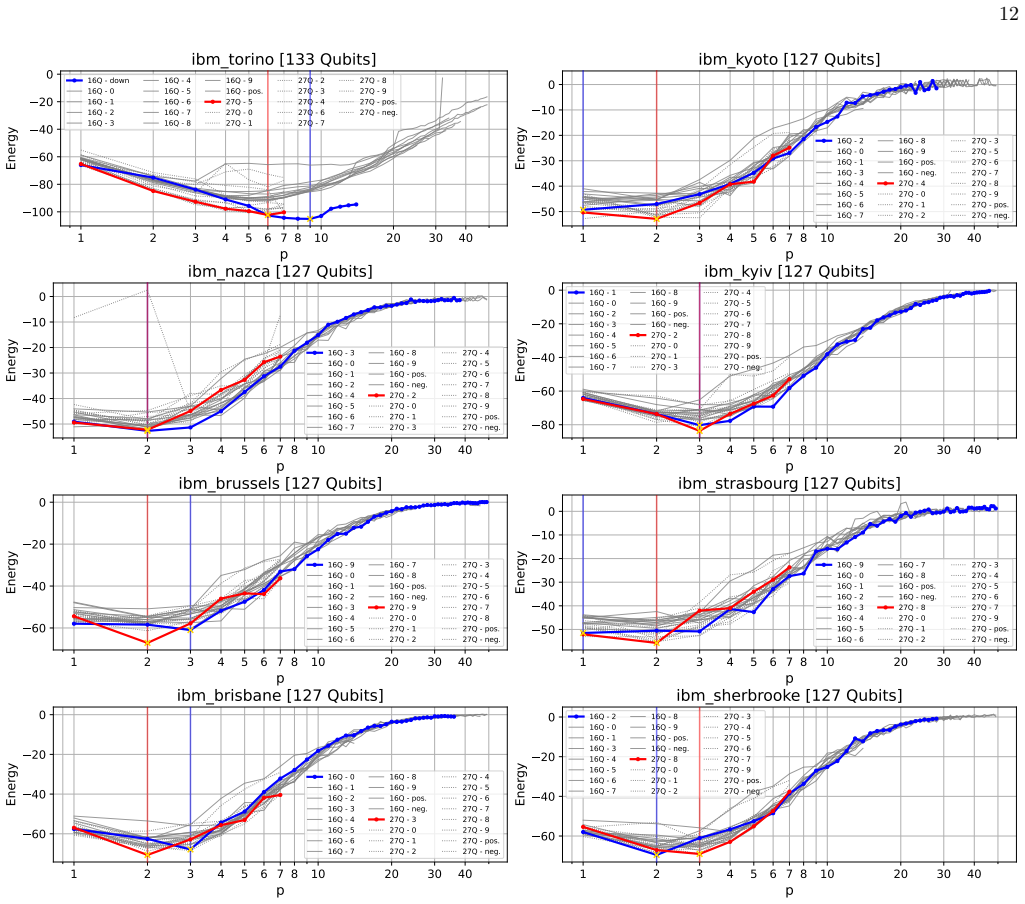
- Solution quality improves continuously with added layers on IBM hardware up to p=5 on ibm_fez, p=9 on ibm_torino, and p=10 on ibm_pittsburgh.
- Simulations show the transferred angles often reach expectation values near the true ground-state energy for instances over 100 qubits.
- Parameter transfer supplies a non-variational route to usable QAOA angles on large problems.
- Non-monotonic performance drops at intermediate depths do not block the overall upward trend with increasing p.
Where Pith is reading between the lines
- The same transfer principle could be tested on other sparse graphs that preserve local geometric structure at different sizes.
- Using the transferred angles as an initial guess for a short round of re-optimization on the large instance might yield further gains.
- Hardware noise appears to cap the useful depth at processor-dependent values, suggesting noise-aware angle selection could extend the approach.
Load-bearing premise
The heavy-hex Ising models with geometrically local cubic terms are self-similar enough across scales that angles optimized on 16-27 qubit instances remain effective when applied to 100+ qubit instances.
What would settle it
A clear failure of the transferred angles to approach ground-state energy or systematic worsening of expectation value when applied to instances substantially larger than 156 qubits or to graphs lacking the same local cubic structure.
Figures







read the original abstract
The emergent practical applicability of the Quantum Approximate Optimization Algorithm (QAOA) for approximate combinatorial optimization is a subject of considerable interest. One of the primary limitations of QAOA is the task of finding a set of good parameters. Parameter transfer is a phenomenon where QAOA angles trained on problem instances that are self-similar tend to perform well for other problem instances from that similar class. This suggests a potentially highly efficient and scalable non-variational learning method for QAOA angle finding. We systematically study QAOA parameter transferability from small problems (16, 27 qubits) onto large problem instances (up to 156 qubits) for heavy-hex graph Ising models with geometrically local higher order terms using the Julia based QAOA simulation tool JuliQAOA to perform classical angle finding for up to 49 QAOA layers. Parameter transfer of the fixed angles is validated using a combination of full statevector, Projected Entangled Pair States, Matrix Product State, and LOWESA numerical simulations. We find that the QAOA parameter transfer from single instances applied to unseen problem instances does not in general provide monotonically improving performance as a function of p - there are many cases where the performance temporarily decreases as a function of p - but despite this the transferred angles have a general trend of improved expectation value as the QAOA depth increases, in many cases converging close to the true ground-state energy of the 100+ qubit instances. We also sample the hardware-compatible Ising models using the ensemble of fixed QAOA angles on several superconducting qubit IBM Quantum processors with 127, 133, and 156 qubits. We find continuous solution quality improvement of the hardware-compatible QAOA circuits run on the IBM NISQ processors up to p=5 on ibm_fez, p=9 on ibm_torino, and p=10 on ibm_pittsburgh.
Editorial analysis
A structured set of objections, weighed in public.
Referee Report
Summary. The manuscript empirically studies QAOA parameter transfer on heavy-hex Ising models with geometrically local cubic terms. Angles are classically optimized on small instances (16-27 qubits) and transferred without re-optimization to large unseen instances (up to 156 qubits) for depths up to p=49. Multiple backends (statevector, PEPS, MPS, LOWESA) plus IBM hardware runs are used to evaluate performance; the central observation is a general improving trend in expectation value with depth despite non-monotonicity, with many cases approaching the reported ground-state energy.
Significance. If the reference energies are accurate, the results indicate that parameter transfer from single small instances can yield scalable, non-variational QAOA angles that improve with depth on sparse, geometrically structured models, supporting practical use on NISQ hardware without per-instance optimization. The multi-method cross-validation and hardware data up to p=10 provide concrete empirical support for the trend.
major comments (2)
- [Numerical Simulations and Results] Numerical validation sections: the bond-dimension truncation errors for MPS, PEPS, and LOWESA are not quantified or shown to converge for p up to 49 on 100+ qubit heavy-hex graphs with cubic terms. High-depth QAOA states generically develop volume-law entanglement, so fixed-bond approximations can produce systematically biased energies; without controlled error estimates, claims that transferred angles converge close to the true ground-state energy rest on unverified reference values.
- [Large Instance Evaluation] Large-instance results: the reported closeness to ground-state energy on 100+ qubit instances is load-bearing for the central claim, yet the paper provides no independent verification (e.g., exact diagonalization on smaller proxies or extrapolation of truncation error) that the tensor-network energies are accurate to the precision needed to support the convergence statement.
minor comments (2)
- [Figures] Figure captions and axis labels should explicitly state the bond dimensions or truncation thresholds used for each backend at each p to allow readers to assess approximation quality.
- [Abstract and Results] The abstract states 'converging close to the true ground-state energy' while the text notes non-monotonicity; a brief quantitative statement of the typical deviation from the reported GS energy at highest p would improve clarity.
Simulated Author's Rebuttal
We thank the referee for their careful and constructive review of our manuscript. The comments on numerical validation and reference energy accuracy are well-taken, and we outline targeted revisions below to address them while preserving the core empirical findings on parameter transfer.
read point-by-point responses
-
Referee: [Numerical Simulations and Results] Numerical validation sections: the bond-dimension truncation errors for MPS, PEPS, and LOWESA are not quantified or shown to converge for p up to 49 on 100+ qubit heavy-hex graphs with cubic terms. High-depth QAOA states generically develop volume-law entanglement, so fixed-bond approximations can produce systematically biased energies; without controlled error estimates, claims that transferred angles converge close to the true ground-state energy rest on unverified reference values.
Authors: We agree that explicit quantification of truncation errors strengthens the claims. In the revised manuscript we will add a dedicated appendix with bond-dimension scaling studies on representative 100+ qubit instances at selected high p values (including p=49), reporting energy differences as a function of bond dimension for MPS, PEPS, and LOWESA. We will also include a brief discussion of entanglement growth on these sparse, geometrically local models and why the observed cross-method agreement supports the reported trends despite possible volume-law contributions. revision: yes
-
Referee: [Large Instance Evaluation] Large-instance results: the reported closeness to ground-state energy on 100+ qubit instances is load-bearing for the central claim, yet the paper provides no independent verification (e.g., exact diagonalization on smaller proxies or extrapolation of truncation error) that the tensor-network energies are accurate to the precision needed to support the convergence statement.
Authors: We acknowledge the need for additional verification. The revision will incorporate (i) exact-diagonalization comparisons on smaller proxy heavy-hex instances with cubic terms to benchmark the tensor-network methods, and (ii) explicit extrapolation of truncation error versus bond dimension for the largest instances. We note that the hardware results (up to p=10 on 127–156 qubit devices) already provide an independent, non-tensor-network confirmation of the improving trend with depth. revision: yes
Circularity Check
Empirical numerical study exhibits no circular derivation chain
full rationale
The paper reports direct numerical experiments: QAOA angles are classically optimized on small (16-27 qubit) heavy-hex Ising instances and then transferred without re-optimization to larger (up to 156 qubit) instances of the same family. Expectation values are evaluated via statevector, MPS, PEPS, and LOWESA simulations on the target instances. No first-principles derivation, uniqueness theorem, or ansatz is invoked whose validity reduces to the fitted angles or to self-citation of the present work. The central observations (non-monotonic but generally improving performance with depth, occasional convergence toward reference energies) are statistical outcomes of these independent computations rather than algebraic identities or re-labeled fits. Any self-citations present are incidental and non-load-bearing for the empirical claims.
Axiom & Free-Parameter Ledger
free parameters (1)
- QAOA angles (gamma, beta) per layer
axioms (1)
- standard math Standard Schrödinger evolution and measurement postulates for QAOA circuit simulation
Lean theorems connected to this paper
-
IndisputableMonolith/Cost/FunctionalEquation.leanwashburn_uniqueness_aczel unclear?
unclearRelation between the paper passage and the cited Recognition theorem.
We systematically study QAOA parameter transferability from small problem sizes (16 and 27 decision variables) onto large problem instances (up to 156 qubits) for heavy-hex graph Ising models with geometrically local higher order terms
-
IndisputableMonolith/Foundation/AlexanderDuality.leanalexander_duality_circle_linking unclear?
unclearRelation between the paper passage and the cited Recognition theorem.
Parameter transfer of the fixed angles is validated using a combination of full statevector, Projected Entangled Pair States, Matrix Product State, and LOWESA numerical simulations
What do these tags mean?
- matches
- The paper's claim is directly supported by a theorem in the formal canon.
- supports
- The theorem supports part of the paper's argument, but the paper may add assumptions or extra steps.
- extends
- The paper goes beyond the formal theorem; the theorem is a base layer rather than the whole result.
- uses
- The paper appears to rely on the theorem as machinery.
- contradicts
- The paper's claim conflicts with a theorem or certificate in the canon.
- unclear
- Pith found a possible connection, but the passage is too broad, indirect, or ambiguous to say the theorem truly supports the claim.
Forward citations
Cited by 1 Pith paper
-
Tensor network surrogate models for variational quantum computation
Tensor network simulations act as effective surrogate models for training QAOA on large 2D lattices, overcoming limits of parameter transfer from small instances and remaining classically feasible with moderate bond d...
Reference graph
Works this paper leans on
-
[1]
A Quantum Approximate Optimization Algorithm
E. Farhi, J. Goldstone, and S. Gutmann, A Quantum Approximate Optimization Algorithm, arXiv preprint (2014), arXiv:1411.4028
work page internal anchor Pith review Pith/arXiv arXiv 2014
-
[2]
A Quantum Approximate Optimization Algorithm Applied to a Bounded Occurrence Constraint Problem
E. Farhi, J. Goldstone, and S. Gutmann, A Quan- tum Approximate Optimization Algorithm Applied to a Bounded Occurrence Constraint Problem, arXiv preprint (2015), arXiv:1412.6062
work page internal anchor Pith review Pith/arXiv arXiv 2015
-
[3]
From the Quantum Approximate Optimization Algorithm to a Quantum Alternating Operator Ansatz
S. Hadfield, Z. Wang, B. O 'Gorman, E. Rieffel, D. Ven- turelli, and R. Biswas, From the Quantum Approx- imate Optimization Algorithm to a Quantum Alter- nating Operator Ansatz, Algorithms 12, 34 (2019), arXiv:1709.03489
work page internal anchor Pith review Pith/arXiv arXiv 2019
-
[4]
E. Farhi, D. Gamarnik, and S. Gutmann, The Quantum Approximate Optimization Algorithm Needs to See the Whole Graph: A Typical Case, arXiv preprint (2020), arXiv:2004.09002
- [5]
-
[6]
Quantum Computing in the NISQ era and beyond
J. Preskill, Quantum Computing in the NISQ era and beyond, Quantum 2, 79 (2018), arXiv:1801.00862
work page internal anchor Pith review Pith/arXiv arXiv 2018
-
[7]
Quantum supremacy through the quantum approx- imate optimization algorithm
E. Farhi and A. W. Harrow, Quantum Supremacy through the Quantum Approximate Optimization Al- gorithm, arXiv preprint (2019), arXiv:1602.07674
-
[8]
R. Shaydulin, C. Li, S. Chakrabarti, M. DeCross, D. Herman, N. Kumar, J. Larson, D. Lykov, P. Minssen, Y. Sun, Y. Alexeev, J. M. Dreiling, J. P. Gaebler, T. M. Gatterman, J. A. Gerber, K. Gilmore, D. Gresh, N. Hewitt, C. V. Horst, S. Hu, J. Johansen, M. Ma- theny, T. Mengle, M. Mills, S. A. Moses, B. Neyen- huis, P. Siegfried, R. Yalovetzky, and M. Pistoi...
-
[9]
M. P. Harrigan, K. J. Sung, M. Neeley, K. J. Satzinger, F. Arute, K. Arya, J. Atalaya, J. C. Bardin, R. Barends, S. Boixo, M. Broughton, B. B. Buck- ley, D. A. Buell, B. Burkett, N. Bushnell, Y. Chen, Z. Chen, B. Chiaro, R. Collins, W. Courtney, S. De- mura, A. Dunsworth, D. Eppens, A. Fowler, B. Foxen, C. Gidney, M. Giustina, R. Graff, S. Habegger, A. Ho...
-
[10]
E. Pelofske, A. B¨ artschi, J. Golden, and S. Eidenbenz, High-Round QAOA for MAX k-SAT on Trapped Ion NISQ Devices, in IEEE International Conference on Quantum Computing and Engineering QCE’23 (2023) p. 506–517, arXiv:2306.03238
-
[11]
R. Shaydulin and M. Pistoia, QAOA with N · p ≥ 200, in IEEE International Conference on Quantum Com- puting and Engineering QCE’23 (2023) p. 1074–1077, arXiv:2303.02064
-
[12]
J. Weidenfeller, L. C. Valor, J. Gacon, C. Tornow, L. Bello, S. Woerner, and D. J. Egger, Scaling of the quantum approximate optimization algorithm on su- perconducting qubit based hardware, Quantum 6, 870 (2022), arXiv:2202.03459
-
[13]
J. Golden, A. B¨ artschi, S. Eidenbenz, and D. O’Malley, Numerical Evidence for Exponential Speed-up of QAOA over Unstructured Search for Approximate Constrained Optimization, in IEEE International Conference on Quantum Computing and Engineering QCE’23 (2023) p. 496–505, arXiv:2202.00648
-
[14]
S. Boulebnane and A. Montanaro, Solving Boolean Sat- isfiability Problems With The Quantum Approximate Optimization Algorithm, PRX Quantum 5, 030348 (2024), arXiv:2208.06909
-
[15]
Variational quantum algorithms
M. Cerezo, A. Arrasmith, R. Babbush, S. C. Benjamin, S. Endo, K. Fujii, J. R. McClean, K. Mitarai, X. Yuan, L. Cincio, and P. J. Coles, Variational quantum al- gorithms, Nature Reviews Physics 3, 625–644 (2021), arXiv:2012.09265
-
[16]
The QAOA parameter similarity property comes by several different terms, including parameter transfer , problem instance independent QAOA parameters , fixed angles, parameter concentration, parameter fixing, size invariant QAOA parameters , fixed control parameters, and transfer learning
- [17]
- [18]
-
[19]
J. Basso, E. Farhi, K. Marwaha, B. Villalonga, and L. Zhou, The Quantum Approximate Optimization Al- gorithm at High Depth for MaxCut on Large-Girth Reg- ular Graphs and the Sherrington-Kirkpatrick Model, in 17th Conference on the Theory of Quantum Computa- tion, Communication and Cryptography TQC’22 (2022) arXiv:2110.14206
-
[20]
E. Farhi, J. Goldstone, S. Gutmann, and L. Zhou, The Quantum Approximate Optimization Algorithm and the Sherrington-Kirkpatrick Model at Infinite Size, Quantum 6, 759 (2022), arXiv:1910.08187
-
[21]
S. Boulebnane and A. Montanaro, Predicting param- eters for the quantum approximate optimization algo- rithm for max-cut from the infinite-size limit, arXiv preprint (2021), arXiv:2110.10685
-
[22]
R. Shaydulin, P. C. Lotshaw, J. Larson, J. Ostrowski, and T. S. Humble, Parameter Transfer for Quantum Approximate Optimization of Weighted MaxCut, ACM Transactions on Quantum Computing 4, 19 (2023), 24 arXiv:2201.11785
- [23]
-
[24]
The fixed angle conjecture for QAOA on regular MaxCut graphs.arXiv preprint arXiv:2107.00677, 2021
J. Wurtz and D. Lykov, Fixed-angle conjectures for the quantum approximate optimization algorithm on reg- ular MaxCut graphs, Physical Review A 104, 052419 (2021), arXiv:2107.00677
-
[25]
J. Wurtz and P. Love, Maxcut quantum approxi- mate optimization algorithm performance guarantees for p > 1, Physical Review A 103, 042612 (2021), arXiv:2010.11209
-
[26]
M. Streif and M. Leib, Training the Quantum Approxi- mate Optimization Algorithm without access to a Quan- tum Processing Unit, Quantum Science and Technology 5, 034008 (2020), arXiv:1908.08862
- [27]
-
[28]
E. Pelofske, A. B¨ artschi, L. Cincio, J. Golden, and S. Ei- denbenz, Scaling whole-chip QAOA for higher-order ising spin glass models on heavy-hex graphs, npj Quan- tum Information 10, 109 (2024), arXiv:2312.00997
-
[29]
F. G. S. L. Brandao, M. Broughton, E. Farhi, S. Gut- mann, and H. Neven, For fixed control parameters the quantum approximate optimization algorithm’s objec- tive function value concentrates for typical instances, arXiv preprint (2018), arXiv:1812.04170
work page internal anchor Pith review Pith/arXiv arXiv 2018
- [30]
- [31]
- [32]
- [33]
-
[34]
Z. He, R. Shaydulin, D. Herman, C. Li, R. Raymond, S. H. Sureshbabu, and M. Pistoia, Parameter Setting Heuristics Make the Quantum Approximate Optimiza- tion Algorithm Suitable for the Early Fault-Tolerant Era, in 43rd IEEE/ACM International Conference on Computer-Aided Design ICCAD’24 (2024) p. 63:1–36:7, arXiv:2408.09538
- [35]
- [36]
-
[37]
E. Pelofske, A. B¨ artschi, and S. Eidenbenz, Short-Depth QAOA Circuits and Quantum Annealing on Higher- Order Ising Models, npj Quantum Information 10, 30 (2024)
work page 2024
-
[38]
E. Pelofske, A. B¨ artschi, and S. Eidenbenz, Quantum Annealing vs. QAOA: 127 Qubit Higher-Order Ising Problems on NISQ Computers, in International Con- ference on High Performance Computing ISC HPC’23 (2023) p. 240–258, arXiv:2301.00520
- [39]
- [40]
-
[41]
The QAOA parameter p can be found under several dif- ferent terms in the literature, including layers, rounds, depth (importantly not the same quantity as circuit depth), and levels, in this study we will typically refer to this parameter as either rounds or depth
-
[42]
Julia: A Fresh Approach to Numerical Computing
J. Bezanson, A. Edelman, S. Karpinski, and V. B. Shah, Julia: A Fresh Approach to Numerical Computing, SIAM review 59, 65–98 (2017), arXiv:1411.1607
work page internal anchor Pith review Pith/arXiv arXiv 2017
-
[43]
J. Golden, A. Baertschi, D. O’Malley, E. Pelofske, and S. Eidenbenz, JuliQAOA: Fast, Flexible QAOA Sim- ulation, in Workshops of The International Confer- ence on High Performance Computing, Network, Stor- age, and Analysis SC-W’23 (ACM, 2023) p. 1454–1459, arXiv:2312.06451
- [44]
- [45]
- [46]
-
[47]
G. Pagano, A. Bapat, P. Becker, K. S. Collins, A. De, P. W. Hess, H. B. Kaplan, A. Kyprianidis, W. L. Tan, C. Baldwin, L. T. Brady, A. Deshpande, F. Liu, S. Jor- dan, A. V. Gorshkov, and C. Monroe, Quantum approx- imate optimization of the long-range ising model with a trapped-ion quantum simulator, Proceedings of the Na- tional Academy of Sciences 117, 2...
- [48]
-
[49]
A. Apte, S. H. Sureshbabu, R. Shaydulin, S. Bouleb- nane, Z. He, D. Herman, J. Sud, and M. Pistoia, It- erative interpolation schedules for quantum approxi- mate optimization algorithm, arXiv preprint (2025), arXiv:2504.01694
work page internal anchor Pith review Pith/arXiv arXiv 2025
-
[50]
C. Chamberland, G. Zhu, T. J. Yoder, J. B. Hertzberg, and A. W. Cross, Topological and Subsystem Codes on Low-Degree Graphs with Flag Qubits, Physical Review 25 X 10, 011022 (2020), arXiv:1907.09528
-
[51]
C. Benito, E. L´ opez, B. Peropadre, and A. Bermudez, Comparative study of quantum error correction strate- gies for the heavy-hexagonal lattice, Quantum 9, 1623 (2025), arXiv:2402.02185
-
[52]
B. Het´ enyi and J. R. Wootton, Creating Entan- gled Logical Qubits in the Heavy-Hex Lattice with Topological Codes, PRX Quantum 5, 040334 (2024), arXiv:2404.15989
- [53]
-
[54]
Ef- ficient online quantum circuit learning with no up- front training,
T. O’Leary, P. Czarnik, E. Pelofske, A. T. Sornborger, M. McKerns, and L. Cincio, Efficient Online Quan- tum Circuit Learning with No Upfront Training, arXiv preprint (2025), arXiv:2501.04636
-
[55]
Classical Combinatorial Optimization Scaling for Random Ising Models on 2D Heavy-Hex Graphs
E. Pelofske, A. B¨ artschi, and S. Eidenbenz, Classi- cal Combinatorial Optimization Scaling for Random Ising Models on 2D Heavy-Hex Graphs, arXiv preprint (2024), arXiv:2412.15572
work page internal anchor Pith review Pith/arXiv arXiv 2024
-
[56]
A. A. Hagberg, D. A. Schult, and P. J. Swart, Exploring Network Structure, Dynamics, and Function using Net- workX, in 7th Python in Science Conference SciPy’08 (2008) p. 11–15
work page 2008
- [57]
-
[58]
J. M. Chow, A. D. C´ orcoles, J. M. Gambetta, C. Rigetti, B. R. Johnson, J. A. Smolin, J. R. Rozen, G. A. Keefe, M. B. Rothwell, M. B. Ketchen, and M. Steffen, Sim- ple All-Microwave Entangling Gate for Fixed-Frequency Superconducting Qubits, Physical Review Letters 107, 080502 (2011), arXiv:1106.0553
work page internal anchor Pith review Pith/arXiv arXiv 2011
-
[59]
Qiskit contributors, Qiskit: An Open-source Framework for Quantum Computing (2023)
work page 2023
-
[60]
A. Javadi-Abhari, M. Treinish, K. Krsulich, C. J. Wood, J. Lishman, J. Gacon, S. Martiel, P. D. Nation, L. S. Bishop, A. W. Cross, B. R. Johnson, and J. M. Gam- betta, Quantum computing with Qiskit, arXiv preprint (2024), arXiv:2405.08810
work page internal anchor Pith review Pith/arXiv arXiv 2024
-
[61]
IBM ILOG CPLEX, V12.10.0 : User’s Manual for CPLEX, International Business Machines Corporation 46, 157 (2019)
work page 2019
-
[62]
Gurobi Optimization, LLC, Gurobi Optimizer Refer- ence Manual (2024)
work page 2024
-
[63]
Efficient classical simulation of slightly entangled quantum computations
G. Vidal, Efficient Classical Simulation of Slightly En- tangled Quantum Computations, Physical Review Let- ters 91, 147902 (2003), arXiv:quant-ph/0301063
work page internal anchor Pith review Pith/arXiv arXiv 2003
-
[64]
Classical simulation of quantum many-body systems with a tree tensor network
Y.-Y. Shi, L.-M. Duan, and G. Vidal, Classical sim- ulation of quantum many-body systems with a tree tensor network, Physical Review A 74, 022320 (2006), arXiv:quant-ph/0511070
work page internal anchor Pith review Pith/arXiv arXiv 2006
-
[65]
On the simulation of quantum circuits
R. Jozsa, On the simulation of quantum circuits, arXiv preprint (2006), arXiv:quant-ph/0603163
work page internal anchor Pith review Pith/arXiv arXiv 2006
-
[66]
R. Alkabetz and I. Arad, Tensor networks contraction and the belief propagation algorithm, Physical Review Research 3, 023073 (2021), arXiv:2008.04433
-
[67]
J. Tindall and M. Fishman, Gauging tensor networks with belief propagation, SciPost Physics 15, 222 (2023), arXiv:2306.17837
-
[68]
H. C. Jiang, Z. Y. Weng, and T. Xiang, Accurate De- termination of Tensor Network State of Quantum Lat- tice Models in Two Dimensions, Physical Review Let- ters 101, 090603 (2008), arXiv:0806.3719
work page internal anchor Pith review Pith/arXiv arXiv 2008
-
[69]
J. Tindall, M. Fishman, E. M. Stoudenmire, and D. Sels, Efficient Tensor Network Simulation of IBM’s Eagle Kicked Ising Experiment, PRX Quantum 5, 010308 (2024), arXiv:2306.14887
-
[70]
T. Beguˇ si´ c, J. Gray, and G. K.-L. Chan, Fast and con- verged classical simulations of evidence for the utility of quantum computing before fault tolerance, Science Advances 10, eadk4321 (2024), arXiv:2308.05077
- [71]
- [72]
- [73]
-
[74]
M. Fishman, S. R. White, and E. M. Stoudenmire, The ITensor Software Library for Tensor Network Calculations, SciPost Physics Codebases , 4 (2022), arXiv:2007.14822
-
[75]
M. Fishman, S. R. White, and E. M. Stoudenmire, Codebase release 0.3 for ITensor, SciPost Physics Code- bases , 4 (2022)
work page 2022
-
[76]
Rams, PEPS Heavy-Hex QAOA Simulation Github (2025)
M. Rams, PEPS Heavy-Hex QAOA Simulation Github (2025)
work page 2025
-
[77]
E. Fontana, M. S. Rudolph, R. Duncan, I. Rungger, and C. Cˆ ırstoiu, Classical simulations of noisy varia- tional quantum circuits, npj Quantum Information 11, 84 (2025), arXiv:2306.05400
- [78]
-
[79]
G. Vidal, Efficient classical simulation of slightly entan- gled quantum computations, Physical review letters 91, 147902 (2003)
work page 2003
-
[80]
R. Or´ us, A practical introduction to tensor networks: Matrix product states and projected entangled pair states, Annals of physics 349, 117 (2014)
work page 2014
discussion (0)
Sign in with ORCID, Apple, or X to comment. Anyone can read and Pith papers without signing in.