REVIEW 4 major objections 6 minor 39 references
Mesh Variational Autoencoders with Edge Contraction Pooling
T0 review · 4 major / 6 minor · reviewed 2026-08-14 · deepseek-v4-flash
Pith's one-line read A simplification-based pooling operation lets a mesh variational autoencoder reconstruct unseen 3D shapes more accurately while using far fewer parameters.
desk verdict New pooling operation worth knowing, but the empirical claims need a serious redo before I'd believe the numbers. read the letter →
The pith
A machine-rendered reading of the paper's core claim, the machinery that carries it, and where it could break.
The reading
What carries the argument
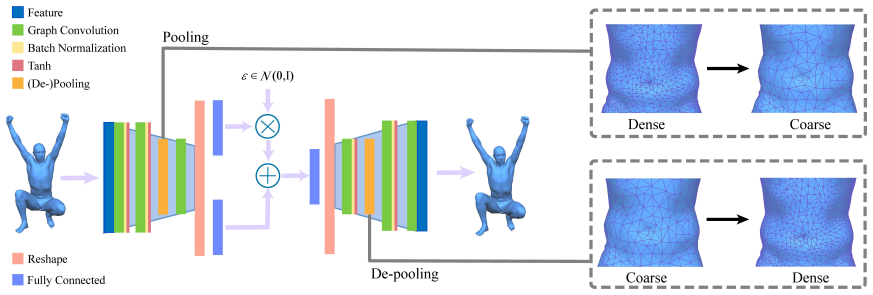
The central object is edge-contraction pooling with a modified simplification metric. The network contracts half the vertices between adjacent levels; the simplification cost is $$\bar{v}^T \bar{Q}\bar{v} + \$\lambda$ \max\{L_{km}, L_{kn}\},$$ penalizing the longest new edge so triangles stay reasonably uniform. Pooling sets the coarse vertex feature to the average of the contracted pair, and de-pooling is its exact inverse. On top of this hierarchy, graph convolutions use localized polynomial spectral filters, and the input and output features are 9-dimensional deformation gradients per vertex, giving the VAE a latent space that supports generation, interpolation, and embedding.
What would settle it
Train the same architecture on a same-connectivity deformable dataset with the edge-length penalty removed and with all correspondence between simplification levels shuffled after simplification; if reconstruction error on unseen shapes stays unchanged, the claimed gains do not come from the pooling correspondence. A simpler decisive check is to run the method on a dense dataset that the fully connected baseline cannot fit in memory: the paper's claim predicts both a lower RMS error and a parameter count an order of magnitude smaller.
Extended reading notes
Core claim
The central claim is that replacing fully connected layers in a mesh variational auto-encoder with spectral graph convolutions plus edge-contraction pooling consistently reduces the reconstruction errors of unseen data, showing superior generalizability, while needing far fewer parameters. The mechanism is a modified mesh simplification: at each level half the vertices are contracted, the simplification cost is the usual quadric error plus a penalty on over-long new edges, and each new vertex's feature is the average of the two merged vertices. De-pooling simply copies a coarse feature back to the corresponding contracted pair. This keeps a well-defined topology for further convolutions, gives the network a genuine receptive field, and lets it process meshes with over ten thousand vertices that a fully connected baseline cannot fit in memory.
Load-bearing premise
Every mesh in the dataset must share the same connectivity; otherwise the simplification hierarchy, the pooling and de-pooling map, and the shared graph convolutions cannot be built, and the method does not apply.
Editorial extensions
If this is right
- Adding pooling lowers the average RMS reconstruction error on unseen shapes by 8.36% across the comparison datasets in Table 1.
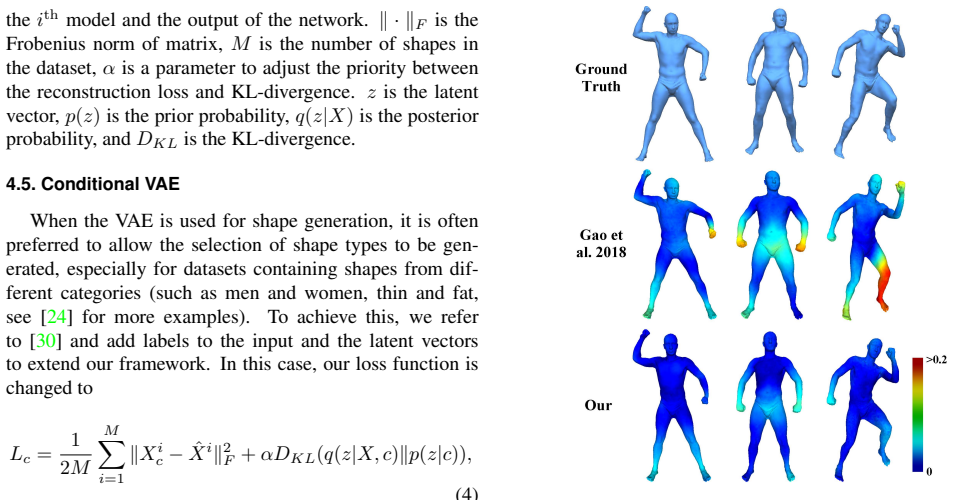
- Compared with a spatial-convolution mesh VAE using the same per-vertex features, the method achieves 29% and 32% lower average errors on the SCAPE and Face datasets.
- Dense meshes become practical: the fully connected baseline runs out of memory on SCAPE, Swing, Face, Horse, and Camel, while the pooled network processes all of them and produces finer interpolation details.
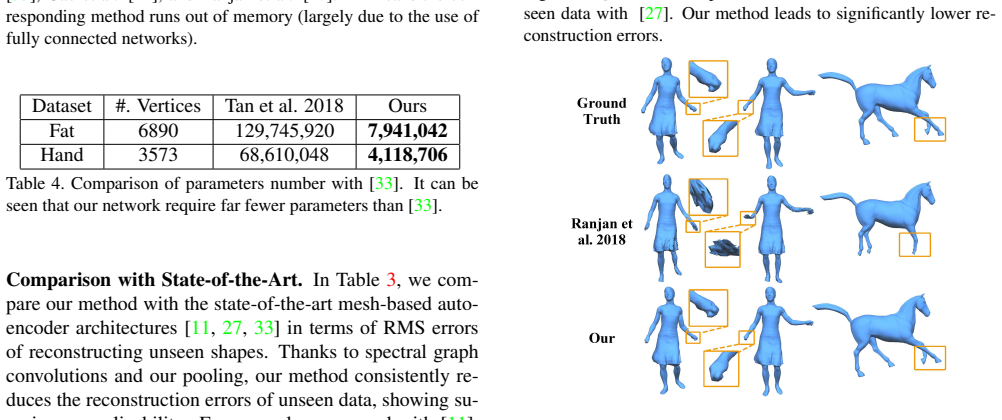
- The parameter count drops from 129,745,920 to 7,941,042 on the Fat dataset and from 68,610,048 to 4,118,706 on the Hand dataset.
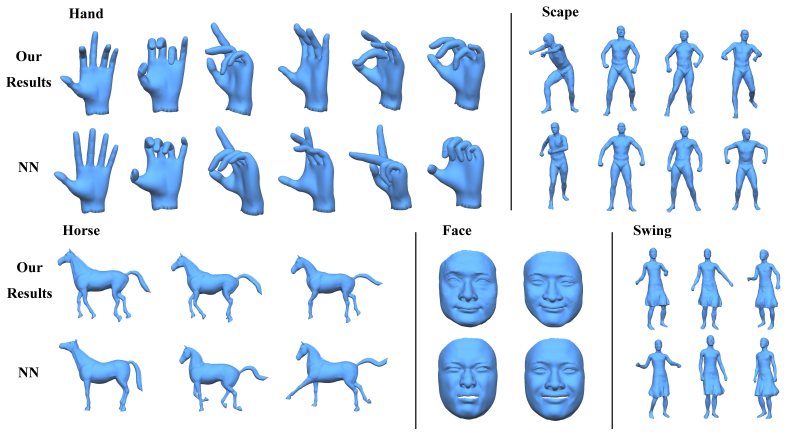
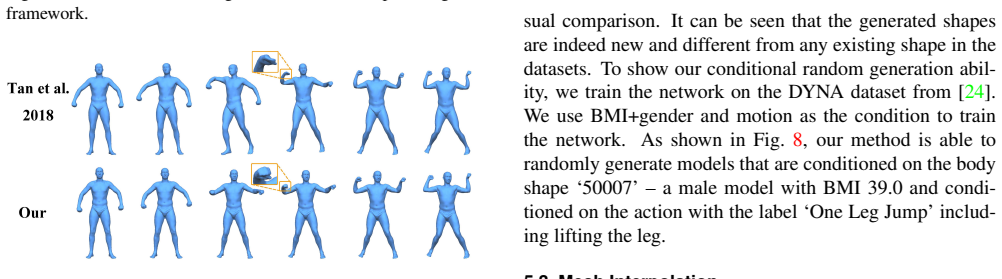
- The learned latent space supports conditional generation by body shape and motion labels, shape interpolation with fewer artifacts, and 2D embeddings that recover cyclic motion structure.
Reading between the lines
- Since the pooling only relies on the simplification hierarchy, the same edge-contraction scheme could in principle support other pooling strategies, such as max pooling or attention-weighted aggregation, without changing the decoder's inverse mapping.
- The edge-length penalty is a small, testable change to a standard simplification algorithm; if it is truly what makes pooling effective, a similar penalty should improve other simplification-based pooling or sampling methods.
- The same-connectivity assumption means the method cannot generalize across topologies; a route beyond the paper would be to align a template hierarchy across a heterogeneous collection before training.
- Because the latent space is fixed-dimensional and the features are deformation gradients, linear interpolation in the latent space likely corresponds to plausible deformation blending, which the paper demonstrates implicitly but does not analyze.
Editorial analysis
A structured set of objections, weighed in public.
Referee Report
Summary. The paper proposes a variational auto-encoder for triangle meshes with shared connectivity, using spectral graph convolutions and a new pooling/de-pooling operation derived from a modified edge-contraction mesh simplification. Per-vertex deformation-gradient features from [10] are used as input. The authors claim that the pooling operation improves generalization, greatly reduces parameter count relative to the fully connected MeshVAE, and enables shape generation, interpolation, and embedding. The evaluation reports RMS reconstruction errors on held-out halves of seven datasets and compares with prior mesh auto-encoders.
Significance. If the empirical claims were fully supported, this would be a useful contribution: edge-contraction pooling with explicitly recorded correspondences is a natural hierarchical operation for meshes with fixed connectivity, and the reported parameter reduction is substantial (e.g., Fat: 129,745,920 to 7,941,042 in Table 4). The architectural idea is clearly motivated and the deformation-representation choice is well founded. However, the current evaluation does not yet establish the central comparative claims because of the single-split protocol, missing variance information, and internal inconsistencies in the reported summary percentages.
major comments (4)
- [Section 5.1, Tables 1 and 3] The central claim that the proposed network 'consistently reduces the reconstruction errors of unseen data' rests on a single random 50/50 split with one RMS value per dataset and no variance, confidence intervals, or significance tests. Several reported margins are small (e.g., Horse 0.0128 vs 0.0119 and Camel 0.0134 vs 0.0115 in Table 3), so a single split cannot establish consistent superiority. The authors should report results over multiple seeds or splits as mean ± standard deviation (or confidence intervals) and state whether the identical split was used for all compared methods.
- [Section 5.1, Table 1] The claimed '8.36%' average improvement from pooling is not reproducible from the table. For the four datasets in Table 1, the relative reductions of Column 3 (Only Spectral Conv., no pooling) versus Column 8 (Our Method) are approximately 7.5%, 5.0%, 6.7%, and 8.5%, averaging about 6.9%, not 8.36%. Other stated averages in Section 5.1 (9.17% vs [12]-based pooling, 8.06% vs graph pooling [28], 9.64% vs mesh sampling [27]) also disagree with direct calculation from the table (approximately 9.3%, 9.1%, and 8.1%, respectively). The summary statistics must be recomputed and the averaging formula stated explicitly.
- [Sections 4.1 and 4.2] The paper does not state whether the edge-contraction hierarchy is built once on a template or reference mesh or recomputed for each input shape. This is load-bearing: if the simplification is recomputed per shape, the surviving vertex sets and hence the pooling/de-pooling matrices differ across shapes, and the subsequent shared graph-convolution layers and the transposed decoder weights are not well defined. The authors should clarify that a single hierarchy is computed on one reference mesh and reused for all shapes, or, if per-shape hierarchies are intended, explain how the shared decoder remains consistent.
- [Section 5.1, Table 3] The comparison with state-of-the-art methods [11], [27], and [33] is not described as a controlled re-run. It is not stated whether these baselines were trained on the same data split, with the same feature representation, loss function, latent dimension, training epochs, and hyperparameter selection, or whether some numbers are quoted from the original papers. Because the paper's main claim is comparative, the baseline evaluation protocol must be fully specified, including how out-of-memory cases were handled.
minor comments (6)
- [Section 5.1] There is a typo: 'we compare our pooling with with the original algorithm' should read 'with the original algorithm.'
- [Figure 2] The caption area contains a stray artifact, '4JNQMJGZ', which appears to be garbled text from the figure; please clean this up.
- [Table 1] The header row is malformed ('Only Only [12] Uniform Graph Mesh Our' over 'Spatial Conv. Spectral Conv. Simp. Pooling Sampling Method'), making it hard to identify columns. Please format the header clearly and label the no-pooling column explicitly.
- [Equation (1)] The notation for the neighborhood maximum is hard to parse. Please define N_i and N_j explicitly and state the range or default value of λ.
- [Section 4.4] The decoder is said to use transposed weights of the corresponding encoder convolutional layers, but the exact weight-tying rule for the Chebyshev coefficients θ_h is not specified. A precise statement would improve reproducibility.
- [Throughout] Please unify the notation for the method name: the text alternates between 'MeshVAE', 'Mesh VAE', and 'V AE' with inconsistent spacing.
Circularity Check
No circularity found: the proposed pooling and VAE are evaluated on held-out shapes; self-citations are prior-art artifacts, not load-bearing reductions.
full rationale
The paper's central claim is an empirical comparison: a VAE with edge-contraction pooling and spectral graph convolutions reduces reconstruction errors on held-out data. The derivation chain is constructive, not definitional: pooling is defined via mesh simplification and average pooling (Sec. 4.1-4.2), de-pooling is its inverse, and the network is trained with an MSE plus KL loss (Eq. 3) on a random half of each dataset while errors are reported on the other half ('For each dataset, it is randomly split into halves for training and testing'). No fitted parameter is later renamed as a prediction. The authors do cite their own deformation representation [10] and compare with their own earlier Mesh VAE [33], but those are external artifacts with stated assumptions, not definitions that entail the reported RMS improvements. No uniqueness theorem or ansatz is imported from the authors' prior work to force the result. The stated limitation that only homogeneous meshes can be processed (Sec. 6) narrows scope but does not create circularity. Concerns about the unseeded single split, missing error bars, and the unreproducible 8.36% pooling-benefit figure are experimental rigor and reproducibility risks, not circularity, and do not meet the standard of a specific reduction of a prediction to its input.
Assumptions & free parameters
free parameters (5)
- lambda (edge-length weight in simplification) =
0.001
- alpha (KL weight) =
0.3
- H (Chebyshev filter order) =
3
- latent dimension =
128
- contraction ratio =
half the vertices per level
assumptions (3)
- domain assumption All meshes in a dataset share the same connectivity.
- domain assumption The vertex-based deformation representation [10] faithfully encodes shape deformations so that MSE on these features is a meaningful reconstruction objective.
- standard math Chebyshev polynomial approximation of spectral graph filters (Defferrard et al.) is a valid convolution operator on mesh graphs.
Cite this review
Pith. "Pith review of Mesh Variational Autoencoders with Edge Contraction Pooling." pith.science (2026). https://pith.science/paper/TC3LF6I5
@misc{pith2026190802507,
  author       = {Pith},
  title        = {Pith review of: Mesh Variational Autoencoders with Edge Contraction Pooling},
  year         = {2026},
  howpublished = {\url{https://pith.science/paper/TC3LF6I5}},
  note         = {Machine review of arXiv:1908.02507}
}
read the original abstract
3D shape analysis is an important research topic in computer vision and graphics. While existing methods have generalized image-based deep learning to meshes using graph-based convolutions, the lack of an effective pooling operation restricts the learning capability of their networks. In this paper, we propose a novel pooling operation for mesh datasets with the same connectivity but different geometry, by building a mesh hierarchy using mesh simplification. For this purpose, we develop a modified mesh simplification method to avoid generating highly irregularly sized triangles. Our pooling operation effectively encodes the correspondence between coarser and finer meshes in the hierarchy. We then present a variational auto-encoder structure with the edge contraction pooling and graph-based convolutions, to explore probability latent spaces of 3D surfaces. Our network requires far fewer parameters than the original mesh VAE and thus can handle denser models thanks to our new pooling operation and convolutional kernels. Our evaluation also shows that our method has better generalization ability and is more reliable in various applications, including shape generation, shape interpolation and shape embedding.
Figures


Figures from the paper (9 more)




Reference graph
Works this paper leans on
-
[10]
Sparse Data Driven Mesh Deformation
L. Gao, Y .-K. Lai, J. Yang, L.-X. Zhang, L. Kobbelt, and S. Xia. Sparse data driven mesh deformation. arXiv preprint arXiv:1709.01250, 2017. 1, 2, 3, 4
work page Pith review arXiv 2017
-
[12]
M. Garland and P. S. Heckbert. Surface simplification using quadric error metrics. In Siggraph, pages 209–216, 1997. 1, 2, 3, 4, 5, 6
work page 1997
-
[28]
Y . Shen, C. Feng, Y . Yang, and D. Tian. Mining point cloud local structures by kernel correlation and graph pooling. In CVPR, volume 4, 2018. 5, 6
work page 2018
- [27]
-
[11]
L. Gao, J. Yang, Y .-L. Qiao, Y . Lai, P. Rosin, W. Xu, and S. Xia. Automatic unpaired shape deformation transfer.ACM Transactions on Graphics, 37(6):1–15, 2018. 1, 2, 5, 6
work page 2018
-
[33]
Q. Tan, L. Gao, Y .-K. Lai, and S. Xia. Variational autoen- coders for deforming 3d mesh models. In CVPR, June 2018. 1, 2, 3, 4, 6, 7, 8
work page 2018
-
[1]
D. Anguelov, P. Srinivasan, D. Koller, S. Thrun, J. Rodgers, and J. Davis. Scape: shape completion and animation of peo- ple. ACM transactions on graphics, 24(3):408–416, 2005. 3, 5, 8
work page 2005
- [2]
Show all 39 references
-
[3]
Boscaini, J
D. Boscaini, J. Masci, E. Rodol `a, and M. Bronstein. Learn- ing shape correspondence with anisotropic convolutional neural networks. In NIPS, pages 3189–3197, 2016. 2
2016
-
[4]
Boscaini, J
D. Boscaini, J. Masci, E. Rodol `a, M. M. Bronstein, and D. Cremers. Anisotropic diffusion descriptors. Computer Graphics F orum, 35(2):431–441, 2016. 2
2016
-
[5]
Botsch and L
M. Botsch and L. Kobbelt. A remeshing approach to mul- tiresolution modeling. In SGP, pages 185–192, 2004. 2, 5, 6
2004
-
[6]
M. M. Bronstein, J. Bruna, Y . LeCun, A. Szlam, and P. Van- dergheynst. Geometric deep learning: going beyond eu- clidean data. IEEE Signal Processing Magazine , 34(4):18– 42, 2017. 2
2017
-
[7]
Defferrard, X
M. Defferrard, X. Bresson, and P. Vandergheynst. Convolu- tional neural networks on graphs with fast localized spectral filtering. In Advances in NIPS, pages 3844–3852, 2016. 2, 3
2016
-
[8]
Gao, S.-Y
L. Gao, S.-Y . Chen, Y .-K. Lai, and S. Xia. Data-driven shape interpolation and morphing editing. Computer Graphics F o- rum, 36(8):19–31, 2017. 1, 2, 7, 8
2017
-
[9]
Gao, Y .-K
L. Gao, Y .-K. Lai, D. Liang, S.-Y . Chen, and S. Xia. Efficient and flexible deformation representation for data- driven surface modeling. ACM Transactions on Graphics , 35(5):158:1–158:17, 2016. 2
2016
-
[13]
Henaff, J
M. Henaff, J. Bruna, and Y . LeCun. Deep convolu- tional networks on graph-structured data. arXiv preprint arXiv:1506.05163, 2015. 2
2015 arXiv
-
[14]
Huang, H
J. Huang, H. Zhang, L. Yi, T. Funkhouser, M. Niessner, and L. J. Guibas. Texturenet: Consistent local parametrizations for learning from high-resolution signals on meshes. In The IEEE Conference on Computer Vision and Pattern Recogni- tion (CVPR), June 2019. 2
2019
-
[15]
Huber, R
P. Huber, R. Perl, and M. Rumpf. Smooth interpolation of key frames in a riemannian shell space. Computer Aided Geometric Design, 52:313–328, 2017. 2
2017
-
[16]
D. P. Kingma and J. Ba. Adam: A method for stochastic optimization. arXiv preprint arXiv:1412.6980, 2014. 5
2014 arXiv
-
[17]
D. P. Kingma and M. Welling. Auto-encoding variational bayes. arXiv preprint arXiv:1312.6114, 2013. 1
2013 arXiv
-
[18]
Kullback and R
S. Kullback and R. A. Leibler. On information and suffi- ciency. The annals of mathematical statistics , 22(1):79–86,
-
[19]
Litany, A
O. Litany, A. Bronstein, M. Bronstein, and A. Makadia. De- formable shape completion with graph convolutional autoen- coders. In The IEEE Conference on Computer Vision and Pattern Recognition (CVPR), June 2018. 1, 2, 8
2018
-
[20]
Maron, M
H. Maron, M. Galun, N. Aigerman, M. Trope, N. Dym, E. Yumer, V . G. Kim, and Y . Lipman. Convolutional neu- ral networks on surfaces via seamless toric covers. ACM Transactions on Graphics, 36(4):71, 2017. 2
2017
-
[21]
Masci, D
J. Masci, D. Boscaini, M. Bronstein, and P. Vandergheynst. Geodesic convolutional neural networks on riemannian man- ifolds. In ICCV workshops, pages 37–45, 2015. 2
2015
-
[22]
Maturana and S
D. Maturana and S. Scherer. V oxNet: A 3D Convolutional Neural Network for Real-Time Object Recognition. InIROS,
-
[23]
Neumann, K
T. Neumann, K. Varanasi, S. Wenger, M. Wacker, M. Mag- nor, and C. Theobalt. Sparse localized deformation compo- nents. ACM Transactions on Graphics (TOG) , 32(6):179,
-
[24]
Pons-Moll, J
G. Pons-Moll, J. Romero, N. Mahmood, and M. J. Black. Dyna: A model of dynamic human shape in motion. ACM Transactions on Graphics, 34(4):120, 2015. 5, 7
2015
-
[25]
C. R. Qi, H. Su, K. Mo, and L. J. Guibas. Pointnet: Deep learning on point sets for 3d classification and segmentation. arXiv preprint arXiv:1612.00593, 2016. 1
2016 arXiv
-
[26]
C. R. Qi, L. Yi, H. Su, and L. J. Guibas. Pointnet++: Deep hi- erarchical feature learning on point sets in a metric space. In Advances in Neural Information Processing Systems , pages 5099–5108. Curran Associates, Inc., 2017. 2
2017
-
[29]
Sinha, J
A. Sinha, J. Bai, and K. Ramani. Deep learning 3d shape surfaces using geometry images. In ECCV, pages 223–240,
-
[30]
K. Sohn, H. Lee, and X. Yan. Learning structured output representation using deep conditional generative models. In Advances in NIPS, pages 3483–3491, 2015. 5
2015
-
[31]
R. W. Sumner and J. Popovi´c. Deformation transfer for trian- gle meshes. ACM Transactions on Graphics, 23(3):399–405,
-
[32]
Q. Tan, L. Gao, Y . Lai, J. Yang, and S. Xia. Mesh-based autoencoders for localized deformation component analysis. In AAAI, 2018. 1, 2
2018
-
[34]
Vlasic, I
D. Vlasic, I. Baran, W. Matusik, and J. Popovi ´c. Articulated mesh animation from multi-view silhouettes. ACM Transac- tions on Graphics, 27(3):97, 2008. 3, 5
2008
-
[35]
P.-S. Wang, Y . Liu, Y .-X. Guo, C.-Y . Sun, and X. Tong. O-CNN: Octree-based Convolutional Neural Networks for 3D Shape Analysis. ACM Transactions on Graphics (SIG- GRAPH), 36(4), 2017. 2
2017
-
[36]
P.-S. Wang, Y . Liu, Y .-X. Guo, C.-Y . Sun, and X. Tong. Adaptive O-CNN: A Patch-based Deep Representation of 3D Shapes. ACM Transactions on Graphics (SIGGRAPH Asia), 37(6), 2018. 2
2018
-
[37]
J. Wu, C. Zhang, T. Xue, W. T. Freeman, and J. B. Tenen- baum. Learning a Probabilistic Latent Space of Object Shapes via 3D Generative-Adversarial Modeling. In Ad- vances In Neural Information Processing Systems, pages 82– 90, 2016. 1
2016
-
[38]
L. Yi, H. Su, X. Guo, and L. J. Guibas. Syncspeccnn: Syn- chronized spectral cnn for 3d shape segmentation. In Pro- ceedings of the IEEE Conference on Computer Vision and Pattern Recognition, pages 2282–2290, 2017. 2
2017
-
[39]
J.-Y . Zhu, T. Park, P. Isola, and A. A. Efros. Unpaired image- to-image translation using cycle-consistent adversarial net- works. In ICCV, 2017. 2
2017
Reviewed August 14, 2026 · model on record in the stance chip above.
Discussion (0). Continue with ORCID to comment.