Nuclear shell evolution near N = 6, 14, 20 and 28: insights from nuclear charge radii of short-lived nuclei derived from binding energies
Pith reviewed 2026-07-03 17:59 UTC · model grok-4.3
The pith
An improved Coulomb-energy method extracts charge radii for 59 nuclei from mirror-partner binding energies and maps shell evolution near N=6, 14, 20 and 28.
A machine-rendered reading of the paper's core claim, the machinery that carries it, and where it could break.
Core claim
By accounting for the exchange term, charge-symmetry breaking effect, and odd-even staggering effect in the Coulomb energy formulation, the improved method determines the R_ch values of 59 nuclei from their measured binding energies and those of their mirror partners, enabling systematic study of shell evolution near the N=6, 14, 20 and 28 subshells with particular insights into neutron-deficient sectors.
What carries the argument
The improved method for determining R_ch from mirror-partner binding energies, which adds corrections for exchange term, charge-symmetry breaking, and odd-even staggering compared to prior formulations.
If this is right
- More comprehensive data on charge radii in p, sd, and pf shells for neutron-deficient nuclei.
- Advancement in understanding nuclear shell evolution in light and intermediate mass regions.
- Ability to probe shell properties where direct measurements are scarce.
- Insights into fundamental nuclear structure properties far from beta-stability.
Where Pith is reading between the lines
- The method could be extended to other mirror pairs beyond the 59 studied to fill more gaps in charge radius data.
- These derived radii might help test theoretical models of nuclear forces in exotic regions.
- Future experiments could verify the predicted radii to refine the correction terms.
Load-bearing premise
The corrections for exchange term, charge-symmetry breaking, and odd-even staggering sufficiently capture the Coulomb energy differences without introducing large unaccounted systematic errors.
What would settle it
Direct measurement of the charge radius for one of the 59 nuclei and comparison to the value derived from its mirror partner's binding energy.
Figures


read the original abstract
A deep understanding of the evolution of nuclear shell structure correlating with the nucleon number is crucial for unraveling the fundamental properties of the nuclear structure and for exploring new nuclear physics phenomena far from the $\beta$-stability line. Although significant progress has been made in probing nuclear shell evolution via the measurements of nuclear root-mean-square charge radii, $R_{\text{ch}}$, the scarcity of new data for short-lived and exotic nuclei due to the increasing difficulty of measurements presents a formidable challenge in obtaining deeper and more universal insights into the nature of shell evolution. To mitigate this issue, we develop an improved method, accounting for the exchange term, charge-symmetry breaking effect, and odd-even staggering effect in the Coulomb energy formulation compared with that proposed by Liu et al. [Phys. Lett. B 872, 140046 (2026)], to determine unmeasured $R_{\text{ch}}$ values. Using the improved method, the $R_{\text{ch}}$ values of 59 nuclei are determined from their measured binding energies ($B$) and the respective $B$ and $R_{\text{ch}}$ of their mirror partners. We then systematically study the shell evolution near $N=6$, 14, 20 and 28 (sub)shells by placing the newly obtained $R_{\text{ch}}$ values into the corresponding isotopic chains. More comprehensive insights into the properties of nuclear shell evolution, particularly for the neutron-deficient sectors of the studied shell regions, e.g., $p$, $sd$ and $pf$ shells, are acquired, advancing our understanding of nuclear shell evolution in the light and intermediate mass region.
Editorial analysis
A structured set of objections, weighed in public.
Referee Report
Summary. The paper develops an improved Coulomb-energy formulation that incorporates the exchange term, charge-symmetry breaking (CSB), and odd-even staggering (OES) effects relative to the earlier approach of Liu et al. Using measured binding energies B together with the B and R_ch values of mirror partners, the method extracts R_ch for 59 short-lived nuclei. These radii are then inserted into isotopic chains to examine shell evolution near the N=6, 14, 20 and 28 closures, with emphasis on neutron-deficient sectors of the p, sd and pf shells.
Significance. If the extracted radii prove accurate to the ~0.02–0.05 fm level needed to resolve shell-driven changes, the work supplies otherwise inaccessible data on exotic nuclei and thereby strengthens empirical constraints on shell evolution in light-to-intermediate mass regions. The explicit functional form of the three corrections and the application to both known and unknown cases constitute a concrete advance over the prior formulation.
major comments (3)
- [Abstract and method section] Abstract and §3 (method): the manuscript states that 59 R_ch values are 'determined' but supplies neither a systematic comparison table of extracted versus measured radii for the subset of nuclei where experimental data exist nor an error budget that propagates uncertainties in the three corrections; without these, the reliability of the new values for unmeasured cases cannot be quantified.
- [Coulomb-energy formulation] Coulomb-energy formulation (Eqs. defining the exchange, CSB and OES terms): although the functional forms are given explicitly, the paper does not demonstrate that the numerical coefficients in the CSB and OES corrections are fixed by independent external benchmarks (e.g., mirror-energy differences or electromagnetic observables) rather than being adjusted to the same binding-energy data used for the radius extraction; this leaves open a possible circularity that must be closed before the 59 values can be treated as independent determinations.
- [Results and discussion] Results and discussion sections: the shell-evolution conclusions rest on placing the new R_ch values into isotopic chains, yet no sensitivity analysis or residual-isospin-breaking estimate is provided to show that the post-correction systematic error is smaller than the ~0.01–0.05 fm scale of the shell effects being discussed; this is load-bearing for the central claim.
minor comments (2)
- Table captions and figure legends should explicitly state which nuclei have experimental R_ch anchors and which are purely extrapolated.
- The reference to Liu et al. (Phys. Lett. B 872, 140046 (2026)) appears to contain a typographical error in the year; please correct.
Simulated Author's Rebuttal
We thank the referee for the constructive and detailed comments. These points identify key areas where the manuscript can be strengthened to better quantify the reliability of the extracted radii and support the shell-evolution claims. We address each major comment below and will revise the manuscript accordingly.
read point-by-point responses
-
Referee: [Abstract and method section] Abstract and §3 (method): the manuscript states that 59 R_ch values are 'determined' but supplies neither a systematic comparison table of extracted versus measured radii for the subset of nuclei where experimental data exist nor an error budget that propagates uncertainties in the three corrections; without these, the reliability of the new values for unmeasured cases cannot be quantified.
Authors: We agree that a systematic comparison table and error budget are essential for assessing reliability. In the revised manuscript we will add a table comparing extracted versus measured R_ch for all nuclei where experimental data exist. We will also include a propagated error budget accounting for uncertainties in the exchange, CSB, and OES corrections. These additions will allow quantitative evaluation of the 59 values. revision: yes
-
Referee: [Coulomb-energy formulation] Coulomb-energy formulation (Eqs. defining the exchange, CSB and OES terms): although the functional forms are given explicitly, the paper does not demonstrate that the numerical coefficients in the CSB and OES corrections are fixed by independent external benchmarks (e.g., mirror-energy differences or electromagnetic observables) rather than being adjusted to the same binding-energy data used for the radius extraction; this leaves open a possible circularity that must be closed before the 59 values can be treated as independent determinations.
Authors: The coefficients for the CSB and OES terms are taken from independent literature on mirror-energy differences and electromagnetic observables (as cited). To explicitly close the circularity concern, we will expand the method section with a dedicated demonstration showing the external origin of these coefficients and confirming they were not adjusted to the binding-energy data employed for radius extraction. revision: yes
-
Referee: [Results and discussion] Results and discussion sections: the shell-evolution conclusions rest on placing the new R_ch values into isotopic chains, yet no sensitivity analysis or residual-isospin-breaking estimate is provided to show that the post-correction systematic error is smaller than the ~0.01–0.05 fm scale of the shell effects being discussed; this is load-bearing for the central claim.
Authors: We agree that a sensitivity analysis is required to substantiate the conclusions. In the revision we will add a sensitivity study that varies the correction parameters within their uncertainties and provides an estimate of residual isospin-breaking effects, demonstrating that post-correction systematic errors remain below the 0.01–0.05 fm scale of the shell effects under discussion. revision: yes
Circularity Check
No significant circularity; derivation self-contained against external benchmarks
full rationale
The paper presents an explicit improved Coulomb-energy formula (exchange term + CSB + OES corrections) applied to mirror-partner binding energies to extract R_ch. It validates the method on nuclei with known R_ch, shows consistency, and inserts the new values into isotopic chains. No step reduces by construction to a fit on the target data, no self-citation is load-bearing for the central extraction (the prior Liu et al. work is referenced only for comparison), and no ansatz or uniqueness theorem is smuggled in. The chain is externally falsifiable via direct R_ch measurements and does not equate inputs to outputs by definition.
Axiom & Free-Parameter Ledger
axioms (1)
- domain assumption Mirror nuclei differ primarily by Coulomb energy, allowing binding-energy differences to be inverted for charge radii once corrections are applied.
Reference graph
Works this paper leans on
-
[1]
does not consider the quantum-mechanical exchange effect which arises from the anti-symmetrization of the wave function [ 46]. In the finite-range droplet model, the correction for the quantum-mechanical exchange considers the addition of the Z 4/ 3-dependent exchange term in Eq. ( 2) EC = − aC Z 2 A1/ 3 [ 1 − 5 4 ( 3 2π )2/ 3 Z − 2/ 3 ] . (3) Equation (3) ...
-
[2]
can be rewritten as EC = − ˜aC Z 2 Rch [ 1 − 5 4 ( 3 2π )2/ 3 Z − 2/ 3 ] , (4) of which the Coulomb coefficient correlated with Rch is denoted as ˜aC. Then, based on the empirical mass for- mula [ 48], the binding energy difference between a given mirror pair with interchanged numbers of Z and N (Z > N ) can be derived as ∆ B(Z, N ) ≡ B(Z, N ) − B(N, Z ) = E...
-
[3]
[ 27]. III. RESULTS OF Rch DETERMINATION A. ˜aC extraction To determine the Rch for unmeasured short-lived nu- clei from the existing B and Rch data using the ∆ B-Rch relations for mirror nuclei, one of the most crucial steps is the extraction of ˜aC. Nevertheless, up to 2021, the avail- able B and Rch data is limited to only seven |N − Z| ≥ 2 mirror pair...
work page 2021
-
[4]
with the average ˜aC 6 0.05 0.1 0.15 0.2 |N-Z|/A 0 0.05 0.1 0.15 0.2 0.25 0.3 0.35 0.4 (fm)chR∆ this work Novario et al. Ohayon FIG. 2. Difference of the mirror-pair nuclear charge radii ∆ Rch versus |N − Z|/A . The data points are deduced from the Rch values listed in Table II and the experimental values of the mirror partners. The lines with shaded bands...
-
[5]
574|N − Z|/A fm by Novario et al [55] (purple band), with a 1 σ confidence level. extracted in Fig. 1. The results are listed in Table II. Since the experimental B and Rch values of 32Ar/ 32Si and 40Sc/ 40K mirror pairs are not incorporated in the current ˜aC extraction in Fig. 1, the recently measured Rch values of 32Si [ 59] and 40Sc [ 6] can serve as an...
work page 2001
-
[6]
With the newly obtained Rch values of the C, N and O isotopes, two distinct minima appear at N = 6 and 8 along the three isotopic chains. Given the well-established N = 8 shell closure in the present mass region, the minima at N = 6 clearly indicate the significant N = 6 subshell closure and the coexistence of N = 6 and 8 magic numbers in both stable and n...
work page 2016
-
[7]
disappearance → appearance → dis- appearance
We observe that the Rch shows an identical kink with a minimum at N = 14 as N increases from 10 to 18, clearly demonstrating a strong N = 14 subshell closure. The decrease of Rch at N = 8 for 18Ne is attributed to the N = 8 shell closure. The newly ob- tained Rch values of 23, 25Al, 24, 26Si, 27, 29, 33P and 28, 30S extend the predominant range of the N =...
-
[8]
disappearance → ap- pearance → disappearance
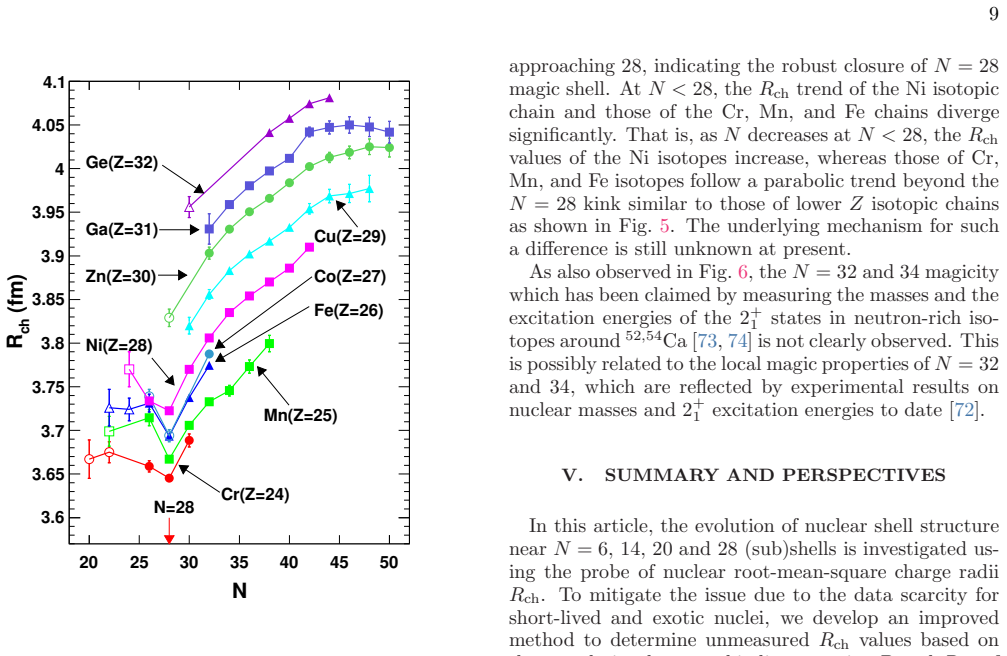
The underlying mechanism for such a difference is still unknown at present. As also observed in Fig. 6, the N = 32 and 34 magicity which has been claimed by measuring the masses and the excitation energies of the 2 + 1 states in neutron-rich iso- topes around 52, 54Ca [ 73, 74] is not clearly observed. This is possibly related to the local magic properties...
- [9]
- [10]
-
[11]
S. Khasanov, Y. Su, A. Safarov, H. M. Tedila, and O. Ma- matkulov, Eur. Phys. J. Plus 140, 638 (2025)
work page 2025
- [12]
- [13]
-
[14]
K. K¨ onig, S. Fritzsche, G. Hagen, J. D. Holt, A. Klose, J. Lantis, Y. Liu, K. Minamisono, T. Miyagi, W. Nazarewicz, T. Papenbrock, S. V. Pineda, R. Powel, and P.-G. Reinhard, Phys. Rev. Lett. 131, 102501 (2023)
work page 2023
-
[15]
J. Karthein, C. M. Ricketts, R. F. Garcia Ruiz, J. Bil- lowes, C. L. Binnersley, T. E. Cocolios, J. Dobaczewski, G. J. Farooq-Smith, K. T. Flanagan, G. Georgiev, W. Gins, R. P. de Groote, F. P. Gustafsson, J. D. Holt, A. Kanellakopoulos, ´A. Koszor´ us, D. Leimbach, K. M. Lynch, T. Miyagi, W. Nazarewicz, G. Neyens, P.-G. Reinhard, B. K. Sahoo, A. R. Verno...
work page 2024
-
[16]
F. P. Gustafsson, L. V. Rodr ´ ıguez, R. F. Garcia Ruiz, T. Miyagi, S. W. Bai, D. L. Balabanski, C. L. Binner- sley, M. L. Bissell, K. Blaum, B. Cheal, T. E. Cocol- ios, G. J. Farooq-Smith, K. T. Flanagan, S. Franchoo, A. Galindo-Uribarri, G. Georgiev, W. Gins, C. Gorges, R. P. de Groote, H. Heylen, J. D. Holt, A. Kanel- lakopoulos, J. Karthein, S. Kaufma...
work page 2025
- [17]
-
[18]
I. Angeli and K. P. Marinova, At. Data Nucl. Data Tables 99, 69 (2013) . 11
work page 2013
-
[19]
T. Li, Y. Luo, and N. Wang, At. Data Nucl. Data Tables 140, 101440 (2021)
work page 2021
-
[20]
M. Bazzi, G. Beer, L. Bombelli, A. M. Bragadire- anu, M. Cargnelli, G. Corradi, C. Curceanu (Petrascu), A. D’Uffizi, C. Fiorini, T. Frizzi, F. Ghio, B. Giro- lami, C. Guaraldo, R. S. Hayano, M. Iliescu, T. Ishi- watari, M. Iwasaki, P. Kienle, P. Levi Sandri, A. Lon- goni, J. Marton, S. Okada, D. Pietreanu, T. Ponta, A. Rizzo, A. Romero Vidal, A. Scordo, H. ...
work page 2011
- [21]
- [22]
-
[24]
S. Geldhof, M. Kortelainen, O. Beliuskina, P. Campbell, L. Caceres, L. Ca˜ nete, B. Cheal, K. Chrysalidis, C. S. De- vlin, R. P. de Groote, A. de Roubin, T. Eronen, Z. Ge, W. Gins, A. Koszorus, S. Kujanp¨ a¨ a, D. Nesterenko, A. Ortiz-Cortes, I. Pohjalainen, I. D. Moore, A. Rag- gio, M. Reponen, J. Romero, and F. Sommer, Phys. Rev. Lett. 128, 152501 (2022)
work page 2022
-
[25]
T. Day Goodacre, A. V. Afanasjev, A. E. Barzakh, B. A. Marsh, S. Sels, P. Ring, H. Nakada, A. N. Andreyev, P. Van Duppen, N. A. Althubiti, B. Andel, D. Atanasov, J. Billowes, K. Blaum, T. E. Cocolios, J. G. Cubiss, G. J. Farooq-Smith, D. V. Fedorov, V. N. Fedosseev, K. T. Flanagan, L. P. Gaffney, L. Ghys, M. Huyse, S. Kreim, D. Lunney, K. M. Lynch, V. Mane...
work page 2021
-
[26]
S. Malbrunot-Ettenauer, S. Kaufmann, S. Bacca, C. Bar- bieri, J. Billowes, M. L. Bissell, K. Blaum, B. Cheal, T. Duguet, R. F. G. Ruiz, W. Gins, C. Gorges, G. Hagen, H. Heylen, J. D. Holt, G. R. Jansen, A. Kanellakopoulos, M. Kortelainen, T. Miyagi, P. Navr´ atil, W. Nazarewicz, R. Neugart, G. Neyens, W. N¨ ortersh¨ auser, S. J. Novario, T. Papenbrock, T....
work page 2022
-
[27]
S. V. Pineda, K. K¨ onig, D. M. Rossi, B. A. Brown, A. In- corvati, J. Lantis, K. Minamisono, W. N¨ ortersh¨ auser, J. Piekarewicz, R. Powel, and F. Sommer, Phys. Rev. Lett. 127, 182503 (2021)
work page 2021
-
[28]
R. P. de Groote, J. Billowes, C. L. Binnersley, M. L. Bissell, T. E. Cocolios, T. Day Goodacre, G. J. Farooq- Smith, D. V. Fedorov, K. T. Flanagan, S. Franchoo, R. F. Garcia Ruiz, W. Gins, J. D. Holt, ´A. Koszor´ us, K. M. Lynch, T. Miyagi, W. Nazarewicz, G. Neyens, P.-G. Reinhard, S. Rothe, H. H. Stroke, A. R. Vernon, K. D. A. Wendt, S. G. Wilkins, Z. Y....
work page 2020
-
[29]
´A. Koszor´ us, X. F. Yang, W. G. Jiang, S. J. Novario, S. W. Bai, J. Billowes, C. L. Binnersley, M. L. Bis- sell, T. E. Cocolios, B. S. Cooper, R. P. de Groote, A. Ekstr¨ om, K. T. Flanagan, C. Forss´ en, S. Franchoo, R. F. G. Ruiz, F. P. Gustafsson, G. Hagen, G. R. Jansen, A. Kanellakopoulos, M. Kortelainen, W. Nazarewicz, G. Neyens, T. Papenbrock, P.-G...
work page 2021
-
[30]
X. F. Yang, S. J. Wang, S. G. Wilkins, and R. F. G. Ruiz, Prog. Part. Nucl. Phys. 129, 104005 (2023)
work page 2023
-
[31]
W. J. Huang, M. Wang, F. G. Kondev, G. Audi, and S. Naimi, Chin. Phys. C 45 , 030002 (2021)
work page 2021
- [32]
-
[33]
J. Dilling, K. Blaum, M. Brodeur, and S. Eliseev, Ann. Rev. Nucl. Part. Sci. 68, 45 (2018)
work page 2018
-
[34]
M. Matoˇ s, A. Estrade, A. M. Amthor, D. Bazin, A. Be- cerril, T. Elliot, M. Famiano, A. Gade, D. Galaviz, G. Lorusso, J. Pereira, M. Portillo, A. Rogers, H. Schatz, D. Shapira, E. Smith, A. Stolz, and M. Wallace, Acta Phys. Pol. B 40 , 695 (2009)
work page 2009
-
[35]
X. Liu, W. Chen, H. He, H. Zheng, X. Xu, W. Lin, J. Han, G. Qu, P. Ren, and X. Zhang, Phys. Lett. B 872, 140046 (2026)
work page 2026
-
[36]
M. Zhang, X. Zhou, M. Wang, Y. H. Zhang, Y. A. Litvi- nov, H. S. Xu, R. J. Chen, H. Y. Deng, C. Y. Fu, W. W. Ge, H. F. Li, T. Liao, S. A. Litvinov, P. Shuai, J. Y. Shi, R. S. Sidhu, Y. N. Song, M. Z. Sun, S. Suzuki, Q. Wang, Y. M. Xing, X. Xu, T. Yamaguchi, X. L. Yan, J. C. Yang, Y. J. Yuan, Q. Zeng, and X. H. Zhou, Eur. Phys. J. A 59, 27 (2023)
work page 2023
-
[37]
Y. Yu, Y. M. Xing, Y. H. Zhang, M. Wang, X. H. Zhou, J. G. Li, H. H. Li, Q. Yuan, Y. F. Niu, Y. N. Huang, J. Geng, J. Y. Guo, J. W. Chen, J. C. Pei, F. R. Xu, Y. A. Litvinov, K. Blaum, G. de Angelis, I. Tanihata, T. Yamaguchi, X. Zhou, H. S. Xu, Z. Y. Chen, R. J. Chen, H. Y. Deng, C. Y. Fu, W. W. Ge, W. J. Huang, H. Y. Jiao, Y. F. Luo, H. F. Li, T. Liao, ...
work page 2024
- [38]
-
[39]
J. A. Nolen and J. P. Schiffer, Ann. Rev. Nucl. Part. Sci. 19, 471 (1969)
work page 1969
-
[40]
J. M. Dong, L. J. Wang, W. Zuo, and J. Z. Gu, Phys. Rev. C 97 , 034318 (2018)
work page 2018
-
[41]
J. M. Dong, X. L. Shang, W. Zuo, Y. F. Niu, and Y. Sun, Nucl. Phys. A 983 , 133 (2019)
work page 2019
-
[42]
J. M. Dong and X. L. Shang, Phys. Rev. C 101 , 014305 (2020)
work page 2020
- [43]
-
[44]
Y. Tanimura, T. Naito, H. Sagawa, and M.-K. Cheoun, Eur. Phys. J. A 61 , 229 (2025)
work page 2025
-
[45]
T.-T. Sun, Y. Tanimura, H. Sagawa, and E. Hiyama, 12 Phys. Lett. B 865 , 139460 (2025)
work page 2025
- [46]
-
[47]
M. Goeppert Mayer, The shell model, Nobel Lecture, https://www.nobelprize.org/prizes/physics/1963/mayer/lecture (1963)
work page 1963
- [48]
-
[49]
D. T. Tran, H. J. Ong, G. Hagen, T. D. Morris, N. Aoi, T. Suzuki, Y. Kanada-En’yo, L. S. Geng, S. Terashima, I. Tanihata, T. T. Nguyen, Y. Ayyad, P. Y. Chan, M. Fukuda, H. Geissel, M. N. Harakeh, T. Hashimoto, T. H. Hoang, E. Ideguchi, A. Inoue, G. R. Jansen, R. Kanungo, T. Kawabata, L. H. Khiem, W. P. Lin, K. Matsuta, M. Mihara, S. Momota, D. Nagae, N. D...
work page 2018
- [50]
-
[51]
E. Becheva, Y. Blumenfeld, E. Khan, D. Beaumel, J. M. Daugas, F. Delaunay, C.-E. Demonchy, A. Drouart, M. Fallot, A. Gillibert, L. Giot, M. Grasso, N. Kee- ley, K. W. Kemper, D. T. Khoa, V. Lapoux, V. Lima, A. Musumarra, L. Nalpas, E. C. Pollacco, O. Roig, P. Roussel-Chomaz, J. E. Sauvestre, J. A. Scarpaci, F. Skaza, and H. S. Than, Phys. Rev. Lett. 96, 0...
work page 2006
- [52]
-
[53]
C. F. von Weizs¨ acker,Z. Phys. 96, 431 (1935)
work page 1935
-
[54]
H. A. Bethe and R. F. Bacher, Rev. Mod. Phys. 8, 82 (1936)
work page 1936
-
[55]
N. Wang, M. Liu, X. Wu, and J. Meng, Phys. Lett. B 734, 215 (2014)
work page 2014
-
[56]
S. Gjorgievska, H. Kochankovski, K. Stankovic, and L. Barandovski, Nucl. Eng. Des. 426, 113403 (2024)
work page 2024
-
[57]
Y. H. Lam, B. Blank, N. A. Smirnova, J. B. Bueb, and M. S. Antony, At. Data Nucl. Data Tables 99, 680 (2013)
work page 2013
-
[58]
Y. H. Lam, N. A. Smirnova, and E. Caurier, Phys. Rev. C 87 , 054304 (2013)
work page 2013
-
[59]
X. Roca-Maza, G. Col` o, and H. Sagawa, Phys. Rev. Lett. 120, 202501 (2018)
work page 2018
- [60]
- [61]
- [62]
-
[63]
S. J. Novario, D. Lonardoni, S. Gandolfi, and G. Hagen, Phys. Rev. Lett. 130, 032501 (2023)
work page 2023
-
[64]
Y. Y. Zong, C. Ma, M. Q. Lin, and Y. M. Zhao, Phys. Rev. C 105 , 034321 (2022)
work page 2022
-
[65]
J. B. Ehrman, Phys. Rev. 81, 412 (1951)
work page 1951
-
[66]
R. G. Thomas, Physical Review 88, 1109 (1952)
work page 1952
-
[67]
K. K¨ onig, J. C. Berengut, A. Borschevsky, A. Brinson, B. A. Brown, A. Dockery, S. Elhatisari, E. Eliav, R. F. Garcia Ruiz, J. D. Holt, B.-S. Hu, J. Karthein, D. Lee, Y.-Z. Ma, U.-G. Meißner, K. Minamisono, A. V. Oleyn- ichenko, S. V. Pineda, S. D. Prosnyak, M. L. Reitsma, L. V. Skripnikov, A. Vernon, and A. Zaitsevskii, Phys. Rev. Lett. 132, 162502 (2024)
work page 2024
- [68]
-
[69]
W. Chen, X. Liu, H. Zheng, X. Zhang, H. He, W. Lin, J. Han, C. W. Ma, C. Y. Qiao, and R. Wada, Phys. Rev. C 112 , 024301 (2025)
work page 2025
-
[70]
M. Wang, Y. H. Zhang, X. Zhou, X. H. Zhou, H. S. Xu, M. L. Liu, J. G. Li, Y. F. Niu, W. J. Huang, Q. Yuan, S. Zhang, F. R. Xu, Y. A. Litvinov, K. Blaum, Z. Meisel, R. F. Casten, R. B. Cakirli, R. J. Chen, H. Y. Deng, C. Y. Fu, W. W. Ge, H. F. Li, T. Liao, S. A. Litvinov, P. Shuai, J. Y. Shi, Y. N. Song, M. Z. Sun, Q. Wang, Y. M. Xing, X. Xu, X. L. Yan, J....
work page 2023
-
[71]
S. F. Paul, J. Bergmann, J. D. Cardona, K. A. Diet- rich, E. Dunling, Z. Hockenbery, C. Hornung, C. Izzo, A. Jacobs, A. Javaji, B. Kootte, Y. Lan, E. Leistenschnei- der, E. M. Lykiardopoulou, I. Mukul, T. Murb¨ ock, W. S. Porter, R. Silwal, M. B. Smith, J. Ringuette, T. Brun- ner, T. Dickel, I. Dillmann, G. Gwinner, M. MacCormick, M. P. Reiter, H. Schatz,...
work page 2021
- [72]
-
[73]
R. Kanungo, W. Horiuchi, G. Hagen, G. R. Jansen, P. Navratil, F. Ameil, J. Atkinson, Y. Ayyad, D. Cortina- Gil, I. Dillmann, A. Estrad´ e, A. Evdokimov, F. Fari- non, H. Geissel, G. Guastalla, R. Janik, M. Kimura, R. Kn¨ obel, J. Kurcewicz, Y. A. Litvinov, M. Marta, M. Mostazo, I. Mukha, C. Nociforo, H. J. Ong, S. Pietri, A. Prochazka, C. Scheidenberger, ...
work page 2016
-
[74]
R. K. Gupta, S. Kumar, M. Balasubramaniam, G. M¨ unzenberg, and W. Scheid, J. Phys. G 28, 699 (2002)
work page 2002
-
[75]
H. Li, H. J. Ong, D.-L. Fang, I. A. Mazur, I. J. Shin, A. M. Shirokov, J. P. Vary, P. Yin, X.-B. Zhao, and W. Zuo, Chin. Phys. C 48 , 124103 (2024)
work page 2024
-
[76]
S. Bagchi, R. Kanungo, W. Horiuchi, G. Hagen, T. D. Morris, S. R. Stroberg, T. Suzuki, F. Ameil, J. Atkin- son, Y. Ayyad, D. Cortina-Gil, I. Dillmann, A. Estrad´ e, A. Evdokimov, F. Farinon, H. Geissel, G. Guastalla, R. Janik, S. Kaur, R. Kn¨ obel, J. Kurcewicz, Y. A. Litvi- nov, M. Marta, M. Mostazo, I. Mukha, C. Nociforo, H. J. Ong, S. Pietri, A. Procha...
work page 2019
-
[77]
Z. Ren, S. Elhatisari, and U.-G. Meißner, Phys. Rev. Lett. 135, 152502 (2025)
work page 2025
-
[78]
M. Belleguic, M.-J. L` opez-Jim´ enez, M. Stanoiu, F. Azaiez, M.-G. Saint-Laurent, O. Sorlin, N. L. Achouri, J.-C. Ang´ elique, C. Bourgeois, C. Borcea, J.-M. Daugas, C. Donzaud, F. De Oliveira-Santos, J. Duprat, S. Gr´ evy, D. Guillemaud-Mueller, S. Leenhardt, M. Lewitowicz, Y.-E. Penionzhkevich, and Y. Sobolev, Nucl. Phys. A 682, 136c (2001)
work page 2001
-
[79]
P. G. Thirolf, B. V. Pritychenko, B. A. Brown, P. D. Cottle, M. Chromik, T. Glasmacher, G. Hackman, R. W. Ibbotson, K. W. Kemper, T. Otsuka, L. A. Riley, and H. Scheit, Phys. Lett. B 485 , 16 (2000)
work page 2000
-
[80]
Y. Ye, X. Yang, H. Sakurai, and B. Hu, Nat. Rev. Phys. 7, 21 (2025) . 13
work page 2025
-
[81]
F. Wienholtz, D. Beck, K. Blaum, C. Borgmann, M. Breitenfeldt, R. B. Cakirli, S. George, F. Her- furth, J. D. Holt, M. Kowalska, S. Kreim, D. Lunney, V. Manea, J. Men´ endez, D. Neidherr, M. Rosenbusch, L. Schweikhard, A. Schwenk, J. Simonis, J. Stanja, R. N. Wolf, and K. Zuber, Nature 498, 346 (2013)
work page 2013
discussion (0)
Sign in with ORCID, Apple, or X to comment. Anyone can read and Pith papers without signing in.