REVIEW 3 major objections 5 minor 2 cited by
The ESO SupJup Survey V: Exploring Atmospheric Variability and Orbit of the Super-Jupiter AB Pictoris b with CRIRES+
T0 review · 3 major / 5 minor · reviewed 2026-08-10 · deepseek-v4-flash
Pith's one-line read Four nights of spectra of the young super-Jupiter AB Pic b show a solar C/O ratio, carbon isotope shifts tied to clouds, and a spin axis that is either slow or pole-on.
desk verdict The composition and v sin i results on AB Pic b are solid, but the spin-axis headline depends on an unpropagated 1.6σ rotation period. read the letter →
The pith
A machine-rendered reading of the paper's core claim, the machinery that carries it, and where it could break.
The reading
What carries the argument
The analysis rests on high-resolution ($R \approx 93{,}000$–$113{,}000$) CRIRES+ spectra in the K-band, processed with a dedicated reduction pipeline and high-pass filtered so that all constraints come from the shapes and depths of individual molecular lines rather than the continuum. The retrieval engine is HyDRA, a Bayesian atmospheric retrieval code that fits the pressure–temperature profile with a smoothness penalty, a Gaussian-process covariance model for correlated residuals, vertically constant chemical abundances, and a power-law cloud deck with wavelength-dependent opacity. The carbon isotope ratio is read off directly from the line strengths of $^{13}$CO relative to $^{12}$CO, while the projected rotation velocity is measured by convolving the model with a rotational broadening kernel after removing the assumed instrumental resolution; converting that $\sim 3.7$ km/s broadening into a pole-on spin-axis and obliquity then uses a published probability-density method that takes the rotation period from earlier photometry.
What would settle it
Independently calibrate the per-night spectral resolution with a fast-rotating standard star or a telluric-line fit through the same 0.4-inch slit and re-derive the rotation speed: if the true resolution is more than about 10–15 percent above the assumed value, $v \sin i$ would rise to roughly 5–8 km/s and overturn the pole-on interpretation, while a confirmed value near 3.7 km/s would support it.
Extended reading notes
Core claim
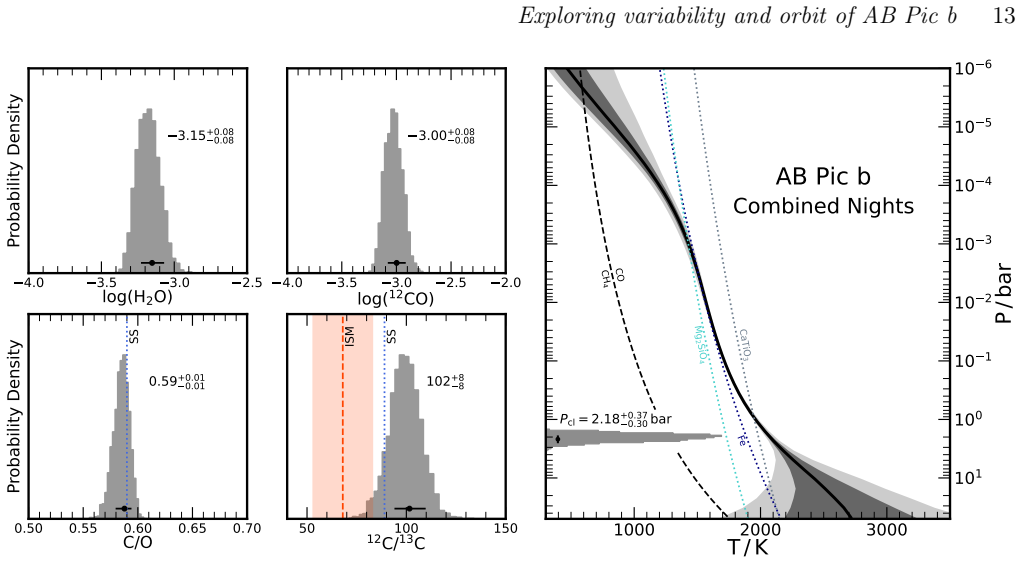
Using the HyDRA retrieval framework on high-pass-filtered spectra, the paper detects H$_2$O, $^{12}$CO, and $^{13}$CO in each of the four nights, with $^{13}$CO detected at $12\sigma$ in the combined dataset. The individual nights give broadly consistent abundances that vary at the ${\sim}2\sigma$ level, with the variation tracking the steepness of the deep temperature profile, and $^{12}$C/$^{13}$C ratios that vary between $70^{+16}_{-9}$ and $120^{+16}_{-15}$, anti-correlated with the retrieved cloud-deck pressure. Combining all nights gives C/O $= 0.59 \pm 0.01$, matching the solar value, and $^{12}$C/$^{13}$C $= 102 \pm 8$, slightly higher than the ISM and Solar System values. From the low $v \sin i \approx 3.7$ km/s, the paper argues that AB Pic b is either an intrinsically slow rotator due to its young age or is seen pole-on, with a revised orbit (inclination $98^{+12}_{-5}$ degrees) yielding a projected spin-orbit obliquity of $86.4 \pm 18.6$ degrees; the paper flags that this rotation measurement is highly dependent on the assumed spectral resolution.
Load-bearing premise
The load-bearing premise is that each night's spectral resolution, estimated from the width of the trace on the detector assuming the blur is symmetric in all directions, is correct; because the measured rotation speed is only about $3.7$ km/s, comparable to the resolution uncertainty, any error in that resolution directly changes the rotation speed and, with it, the pole-on and near-90-degree obliquity interpretation.
Editorial extensions
If this is right
- If the C/O $= 0.59 \pm 0.01$ result holds, AB Pic b formed from material with a solar carbon-to-oxygen ratio, placing its formation near the CO snowline rather than in a strongly carbon-enriched disk region.
- If the night-to-night isotope shifts are real, single-epoch $^{12}$C/$^{13}$C measurements of variable companions mix formation chemistry with cloud structure, so repeat observations are needed before interpreting isotope ratios as formation tracers.
- If the projected obliquity of $86.4 \pm 18.6$ degrees is correct, AB Pic b joins a small list of directly imaged companions with Uranus-like spin-orbit misalignment, constraining dynamical histories with wide-orbit scattering or disk migration.
- If AB Pic b is intrinsically slow-rotating because it is young, then it should spin up as it contracts, making its rotation period evolve measurably over time.
- The revised orbit (semi-major axis about 307 AU, inclination about 98 degrees) strengthens the case that AB Pic b is on a very wide, highly inclined orbit, with the companion currently moving toward its host star in projection.
Reading between the lines
- If the cloud-deck correlation with $^{12}$C/$^{13}$C is confirmed in other objects, multi-epoch high-resolution spectroscopy could turn isotope-ratio retrievals into a diagnostic of vertical mixing and cloud patchiness in giant-planet atmospheres, since $^{13}$CO forms deeper than $^{12}$CO.
- The pole-on scenario predicts little rotational variability, so a survey comparing low-$v \sin i$ companions with fast rotators of similar age could test whether low projected rotation speeds systematically suppress spectroscopic variability.
- A Doppler-imaging campaign spanning several rotation periods could break the slow-rotator-versus-pole-on degeneracy: a fast rotator seen pole-on would show a symmetric polar velocity field, while an intrinsically slow rotator would show essentially no line-profile distortion.
- Explicitly modeling telluric contamination night by night could turn the reported 2–3-sigma parameter shifts into a quantitative test of whether the variability is atmospheric or instrumental, since the nights with the lowest signal-to-noise show the largest deviations from the median.
Editorial analysis
A structured set of objections, weighed in public.
Referee Report
Summary. The paper presents four nights of VLT/CRIRES+ K-band spectroscopy of the directly-imaged companion AB Pic b, analyzed with the HyDRA retrieval framework. The authors report robust per-night detections of H2O, 12CO, and 13CO (the latter at 4.8–7.2σ per night and 12.0σ combined), with broadly consistent abundances across nights but 1–3σ differences that they interpret as atmospheric variability. A combined retrieval yields C/O = 0.59 ± 0.01 (solar-like) and 12C/13C = 102 ± 8. From a low projected rotational velocity v sin i ≈ 3.7 km/s and a newly updated orbital fit, they argue that AB Pic b is either intrinsically slow-rotating or viewed pole-on, and they quote a projected obliquity of 86.4° ± 18.6° that would imply a Uranus-like spin–orbit misalignment.
Significance. If the detections and C/O and isotope constraints hold, this is a valuable data point for the SupJup survey: it extends high-resolution atmospheric retrievals and isotope-ratio measurements to a young, directly-imaged super-Jupiter, and it presents one of the first systematic night-to-night variability studies of such an object with CRIRES+. The paper is transparent about its parameter choices and priors, uses publicly available data and established reduction/retrieval tools, and the per-night 13CO detections are supported by both retrievals and cross-correlation functions. The variability and obliquity interpretations are more fragile, but the former is cautiously worded in the text and the latter is a testable claim that can be strengthened or softened with the period-uncertainty propagation suggested below.
major comments (3)
- [§3.4.2, Eq. (10) from Bryan et al. (2020)] The quoted spin-axis inclination ip = 1.8° ± 1.3° and projected obliquity 86.4° ± 18.6° are computed with the rotational period fixed to P = 2.1 h from Zhou et al. (2019), a candidate detected at only 1.6σ. Because ip ≈ arcsin(v sin i P / 2πR) is nearly linear in P for small angles, the period uncertainty dominates the error budget. The paper tests P = 8.4 and 16.8 h but does not propagate the period posterior or address the possibility that the 2.1 h signal is spurious. The abstract and conclusions therefore overstate the case for a '~90° misalignment'; the robust claim is the disjunctive one (intrinsically slow rotator or viewed pole-on). Please propagate the full period uncertainty or explicitly present the obliquity as conditional on the Zhou et al. period.
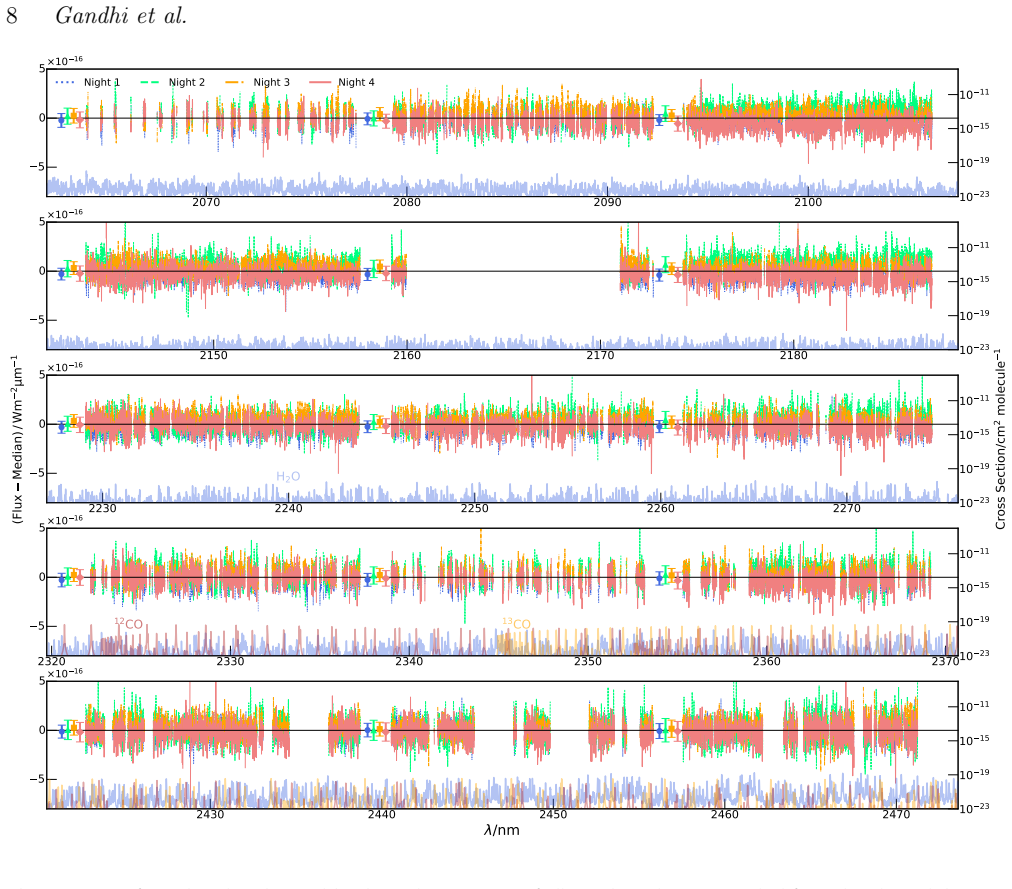
- [§3.1, Fig. 6, Table 3] The evidence for night-to-night atmospheric variability rests on (i) a CCF of median-subtracted data against the best-fit model from the combined retrieval of the same four nights, and (ii) 1–3σ differences in retrieved parameters among four nights. The |CCF| ≲ 4 values are a scaled proxy, not a detection significance, and the template is derived from the same data being tested, so the variability significance is not fully quantified. Please provide a formal significance estimate (for example, a posterior predictive test or a cross-validation where the template is built from the other three nights), or explicitly state that the variability is suggestive rather than detected.
- [§2.1/Table 1, §3.2.4] The low v sin i ≈ 3.7 km/s is derived from line broadening after convolving models with per-night resolutions inferred from the trace width under an isotropic PSF assumption. At this value, the broadening is comparable to the resolution uncertainty, and the pole-on/slow-rotator interpretation depends on v sin i being genuinely small. Although the paper acknowledges this in §3.2.4, a sensitivity test that varies the assumed R by, say, ±10–20% would show whether the qualitative conclusion is robust; without it, the systematic error on v sin i is not quantified.
minor comments (5)
- [§2.2.3, Eq. (7)] The word 'pofints' in the sentence containing Eq. (7) should be 'points'.
- [§2.2] The text reads 'uses the the HyDRA retrieval framework'; the duplicate 'the' should be removed.
- [§3.4.2] Near the end of the section, 'the orbital period could be as high as ~65 hours' should read 'rotation period', since the estimate is derived from the spin–orbit alignment assumption rather than from orbital dynamics.
- [Fig. 6 caption] The caption contains 'We divide the the values by the standard deviation'; the duplicate 'the' should be removed.
- [§2.2.1, Eq. (1)] The notation 'PEN(3) gps' in Eq. (1) is unexplained and appears to be a typesetting artifact; please clarify or fix.
Circularity Check
No significant circularity: all central claims are standard retrievals of the same data, and the flagged caveats are external inputs or instrument systematics, not self-referential reductions.
full rationale
The paper's central claims stem from atmospheric retrievals and cross-correlation analyses of new CRIRES+ observations, which are fitted to the data rather than derived from the model assumptions used to make them. The C/O and 12C/13C constraints, night-to-night abundance variations, and 13CO detections are standard retrieval outputs, not predictions of quantities already defined by the priors or by the retrieval setup. The variability analysis in Figure 6 uses the combined-retrieval best-fit model as a template for the median-subtracted data, which is a matched-filter diagnostic; the actual variability conclusions are independently supported by per-night retrievals, so the template does not force the result by construction. The v sin i measurement is explicitly stated in Section 3.2.4 to be dependent on the assumed spectral resolution, which is a calibration systematic rather than a circular reduction. The obliquity calculation in Section 3.4.2 adopts the external rotation period from Zhou et al. (2019), explicitly tests alternative periods of 8.4 and 16.8 hours, and notes the 1.6-sigma significance; while the quantitative pole-on obliquity depends on this unpropagated external input, that is a robustness concern, not a self-referential derivation. The paper also identifies the degeneracy between temperature gradient and abundances in Section 3.2.2 as a fit degeneracy, not a prediction. No load-bearing self-citation chain or equation-level reduction of an output to an input was found.
Assumptions & free parameters
free parameters (21)
- log(H2O) volume mixing ratio =
-3.15 ± 0.08 (combined nights)
- log(12CO) volume mixing ratio =
-3.00 ± 0.08 (combined nights)
- log(13CO) volume mixing ratio =
Implied by 12CO/13CO = 102 ± 8
- log(C18O) volume mixing ratio =
Upper limit < -6.7 (2σ)
- log(HCN) volume mixing ratio =
Upper limit near -6 (2σ)
- log(CH4) volume mixing ratio =
Upper limit near -6 (2σ)
- log(NH3) volume mixing ratio =
Upper limit near -6 (2σ)
- log(CO2) volume mixing ratio =
Upper limit near -6 (2σ)
- T at 100 bar, 10 bar, 3 bar, 1 bar, 0.3 bar, 0.1 bar, 0.01 bar, 10^-4 bar, 10^-6 bar =
T(0.1 bar) = 1714 ± 5 K; other knots not tabulated, see Figure 11
- log(gamma) P-T penalty factor =
Not tabulated
- log(kappa_cl,2um) cloud opacity =
Posterior in Figure 12
- log(kappa_cl,2.5um) cloud opacity =
Posterior in Figure 12
- log(P_cl) cloud deck pressure =
P_cl = 2.18 +0.37/-0.30 bar (combined)
- log(alpha_cl) cloud opacity power-law index =
Not tabulated
- GP amplitude a per order per night =
5 per night, 20 combined; not tabulated
- GP lengthscale log(l/um) =
Not tabulated
- Radius R_p/R_J =
~1.85 R_J (per night and combined)
- log(g/cm/s^2) =
~4.4, weak constraint
- v sin i (projected rotational velocity) =
3.7 km/s (combined)
- epsilon (limb darkening coefficient) =
Not tabulated
- Radial velocity per night (4 values) =
About 20.5 to 21 km/s in Figure 13; star at 22.65 km/s
assumptions (7)
- domain assumption One-dimensional, plane-parallel, hydrostatic, LTE atmosphere with vertically constant chemical abundance profiles.
- domain assumption Temperature profile smoothness enforced through a 3rd-derivative penalty.
- ad hoc to paper Semi-grey cloud parameterization: power-law opacity in pressure and log-linear opacity between 2 and 2.5 microns.
- domain assumption High-pass filtering with a 100-pixel boxcar removes continuum but preserves line ratios and abundance ratios.
- domain assumption Nightly spectral resolution can be derived from the trace width assuming an isotropic point-spread function.
- domain assumption Solid-body rotation and the adopted rotation period of 2.1 hours from Zhou et al. (2019) are used to convert v sin i into spin inclination.
- standard math Gaussian process covariance model, uniform priors, and MultiNest nested sampling provide unbiased posteriors.
Cite this review
Pith. "Pith review of The ESO SupJup Survey V: Exploring Atmospheric Variability and Orbit of the Super-Jupiter AB Pictoris b with CRIRES+." pith.science (2026). https://pith.science/paper/TCEWVMAW
@misc{pith2026250105114,
  author       = {Pith},
  title        = {Pith review of: The ESO SupJup Survey V: Exploring Atmospheric Variability and Orbit of the Super-Jupiter AB Pictoris b with CRIRES+},
  year         = {2026},
  howpublished = {\url{https://pith.science/paper/TCEWVMAW}},
  note         = {Machine review of arXiv:2501.05114}
}
abstract
A growing number of directly-imaged companions have been recently characterised, with robust constraints on carbon-to-oxygen ratios and even isotopic ratios. Many companions and isolated targets have also shown spectral variability. In this work we observed the super-Jupiter AB~Pictoris~b across four consecutive nights using VLT/CRIRES+ as part of the ESO SupJup survey, exploring how the constraints on chemical composition and temperature profile change over time using spectral line shape variations between nights. We performed atmospheric retrievals of the high-resolution observations and found broadly consistent results across all four nights, but there were differences for some parameters. We clearly detect H$_2$O, $^{12}$CO and $^{13}$CO in each night, but abundances varied by $\sim2\sigma$, which was correlated to the deep atmosphere temperature profiles. We also found differences in the $^{12}$C$/^{13}$C ratios in each night by up to $\sim3\sigma$, which seemed to be correlated with the cloud deck pressure. Our combined retrieval simultaneously analysing all nights together constrained broadly the average of each night individually, with the C/O$=0.59\pm0.01$, consistent with solar composition, and $^{12}$C$/^{13}$C~$ = 102\pm8$, slightly higher than the ISM and Solar System values. We also find a low projected rotational velocity, suggesting that AB~Pictoris~b is either intrinsically a slow rotator due to its young age or that the spin axis is observed pole-on with a $\sim90^\circ$ misalignment with its orbit inclination. Future observations will be able to further explore the variability and orbit of AB~Pictoris~b as well as for other companions.
Figures


Figures from the paper (12 more)





Forward citations
Cited by 2 Pith papers
-
Pyrat Bay 2.0: an Upgraded Framework for Exoplanet Atmosphere Modeling in the JWST Era
Pyrat Bay 2.0 adds equilibrium chemistry, radiative equilibrium, and vertically varying abundance retrieval, and simulations indicate JWST-quality spectra can recover such variations.
-
The planetary-mass-limit VLT/SINFONI library: Spectral extraction and atmospheric characterization via forward modeling
A homogeneous reanalysis of 21 archival SINFONI K-band spectra yields new C/O ratios for three companions and a model-dependent 500 K temperature drop at the M/L transition.
Reference graph
Works this paper leans on
-
[1]
write newline
" write newline "" before.all 'output.state := FUNCTION fin.entry write newline FUNCTION new.block output.state before.all = 'skip after.block 'output.state := if FUNCTION new.sentence output.state after.block = 'skip output.state before.all = 'skip after.sentence 'output.state := if if FUNCTION not #0 #1 if FUNCTION and 'skip pop #0 if FUNCTION or pop #1...
-
[2]
write newline
" write newline "" before.all 'output.state := FUNCTION fin.entry write newline FUNCTION new.block output.state before.all = 'skip after.block 'output.state := if FUNCTION new.sentence output.state after.block = 'skip output.state before.all = 'skip after.sentence 'output.state := if if FUNCTION not #0 #1 if FUNCTION and 'skip pop #0 if FUNCTION or pop #1...
-
[3]
Artigau \'E ., Bouchard S., Doyon R., Lafreni \`e re D., 2009, @doi [ ] 10.1088/0004-637X/701/2/1534 , https://ui.adsabs.harvard.edu/abs/2009ApJ...701.1534A 701, 1534
-
[4]
Asplund M., Amarsi A. M., Grevesse N., 2021, @doi [ ] 10.1051/0004-6361/202140445 , https://ui.adsabs.harvard.edu/abs/2021A&A...653A.141A 653, A141
-
[5]
Barber R. J., Strange J. K., Hill C., Polyansky O. L., Mellau G. C., Yurchenko S. N., Tennyson J., 2014, @doi [Mon. Not. R. Astron. Soc.] 10.1093/mnras/stt2011 , http://adsabs.harvard.edu/abs/2014MNRAS.437.1828B 437, 1828
-
[6]
Barman T. S., Macintosh B., Konopacky Q. M., Marois C., 2011, @doi [ ] 10.1088/0004-637X/733/1/65 , https://ui.adsabs.harvard.edu/abs/2011ApJ...733...65B 733, 65
-
[7]
Barrado D., et al., 2023, @doi [ ] 10.1038/s41586-023-06813-y , https://ui.adsabs.harvard.edu/abs/2023Natur.624..263B 624, 263
-
[8]
Biller B. A., et al., 2015, @doi [ ] 10.1088/2041-8205/813/2/L23 , https://ui.adsabs.harvard.edu/abs/2015ApJ...813L..23B 813, L23
Show all 123 references
-
[9]
A., et al., 2024, @doi [ ] 10.1093/mnras/stae1602 , https://ui.adsabs.harvard.edu/abs/2024MNRAS.532.2207B 532, 2207
Biller B. A., et al., 2024, @doi [ ] 10.1093/mnras/stae1602 , https://ui.adsabs.harvard.edu/abs/2024MNRAS.532.2207B 532, 2207
2024 doi
-
[10]
Blunt S., et al., 2017, @doi [The Astrophysical Journal] 10.3847/1538-3881/aa6930 , 153, 229
2017 doi
-
[11]
M., Homeier D., Dumas C., Beuzit J
Bonnefoy M., Chauvin G., Rojo P., Allard F., Lagrange A. M., Homeier D., Dumas C., Beuzit J. L., 2010, @doi [ ] 10.1051/0004-6361/200912688 , https://ui.adsabs.harvard.edu/abs/2010A&A...512A..52B 512, A52
2010 doi
-
[12]
M., Rojo P., Allard F., Pinte C., Dumas C., Homeier D., 2014, @doi [ ] 10.1051/0004-6361/201118270 , https://ui.adsabs.harvard.edu/abs/2014A&A...562A.127B 562, A127
Bonnefoy M., Chauvin G., Lagrange A. M., Rojo P., Allard F., Pinte C., Dumas C., Homeier D., 2014, @doi [ ] 10.1051/0004-6361/201118270 , https://ui.adsabs.harvard.edu/abs/2014A&A...562A.127B 562, A127
2014 doi
-
[13]
V., 2021, @doi [ ] 10.1093/mnras/staa3631 , https://ui.adsabs.harvard.edu/abs/2021MNRAS.500.5552B 500, 5552
Booth M., del Burgo C., Hambaryan V. V., 2021, @doi [ ] 10.1093/mnras/staa3631 , https://ui.adsabs.harvard.edu/abs/2021MNRAS.500.5552B 500, 5552
2021 doi
-
[14]
Brandl B., et al., 2021, @doi [The Messenger] 10.18727/0722-6691/5218 , https://ui.adsabs.harvard.edu/abs/2021Msngr.182...22B 182, 22
2021 doi
-
[15]
L., Ginzburg S., Chiang E., Morley C., Bowler B
Bryan M. L., Ginzburg S., Chiang E., Morley C., Bowler B. P., Xuan J. W., Knutson H. A., 2020, @doi [ ] 10.3847/1538-4357/abc0ef , https://ui.adsabs.harvard.edu/abs/2020ApJ...905...37B 905, 37
2020 doi
-
[16]
L., Chiang E., Morley C
Bryan M. L., Chiang E., Morley C. V., Mace G. N., Bowler B. P., 2021, Astronomical Journal
2021
-
[17]
Buchner J., et al., 2014, @doi [ ] 10.1051/0004-6361/201322971 , http://adsabs.harvard.edu/abs/2014A
2014 doi
-
[18]
S., Line M
Burningham B., Marley M. S., Line M. R., Lupu R., Visscher C., Morley C. V., Saumon D., Freedman R., 2017, @doi [ ] 10.1093/mnras/stx1246 , https://ui.adsabs.harvard.edu/abs/2017MNRAS.470.1177B 470, 1177
2017 doi
-
[19]
Burningham B., et al., 2021, @doi [ ] 10.1093/mnras/stab1361 , https://ui.adsabs.harvard.edu/abs/2021MNRAS.506.1944B 506, 1944
2021 doi
-
[20]
L., Bonnefoy M., Boccaletti A., Galicher R., 2018, @doi [ ] 10.3847/1538-4357/aaac7d , https://ui.adsabs.harvard.edu/abs/2018ApJ...854..172C 854, 172
Charnay B., B \'e zard B., Baudino J. L., Bonnefoy M., Boccaletti A., Galicher R., 2018, @doi [ ] 10.3847/1538-4357/aaac7d , https://ui.adsabs.harvard.edu/abs/2018ApJ...854..172C 854, 172
2018 doi
-
[21]
Chauvin G., et al., 2005, @doi [ ] 10.1051/0004-6361:200500111 , https://ui.adsabs.harvard.edu/abs/2005A&A...438L..29C 438, L29
2005 doi
-
[22]
Chomez A., et al., 2023, @doi [ ] 10.1051/0004-6361/202245723 , https://ui.adsabs.harvard.edu/abs/2023A&A...675A.205C 675, A205
2023 doi
-
[23]
A., Yurchenko S
Coles P. A., Yurchenko S. N., Tennyson J., 2019, @doi [ ] 10.1093/mnras/stz2778 , https://ui.adsabs.harvard.edu/abs/2019MNRAS.490.4638C 490, 4638
2019 doi
-
[24]
C., et al., 2024, @doi [arXiv e-prints] 10.48550/arXiv.2404.11523 , https://ui.adsabs.harvard.edu/abs/2024arXiv240411523C p
Costes J. C., et al., 2024, @doi [arXiv e-prints] 10.48550/arXiv.2404.11523 , https://ui.adsabs.harvard.edu/abs/2024arXiv240411523C p. arXiv:2404.11523
2024 doi
-
[25]
Crossfield I. J. M., et al., 2014, @doi [ ] 10.1038/nature12955 , https://ui.adsabs.harvard.edu/abs/2014Natur.505..654C 505, 654
2014 doi
-
[26]
Currie T., et al., 2011, @doi [ ] 10.1088/0004-637X/729/2/128 , https://ui.adsabs.harvard.edu/abs/2011ApJ...729..128C 729, 128
2011 doi
-
[27]
L., Bonnefoy M., De Rosa R
Currie T., Biller B., Lagrange A., Marois C., Guyon O., Nielsen E. L., Bonnefoy M., De Rosa R. J., 2023, in Inutsuka S., Aikawa Y., Muto T., Tomida K., Tamura M., eds, Astronomical Society of the Pacific Conference Series Vol. 534, Protostars and Planets VII. p. 799 ( @eprint ...
-
[28]
M., et al., 2003, VizieR Online Data Catalog, https://ui.adsabs.harvard.edu/abs/2003yCat.2246....0C p
Cutri R. M., et al., 2003, VizieR Online Data Catalog, https://ui.adsabs.harvard.edu/abs/2003yCat.2246....0C p. II/246
2003
-
[29]
J., et al., 2014, The Messenger, https://ui.adsabs.harvard.edu/abs/2014Msngr.156....7D 156, 7
Dorn R. J., et al., 2014, The Messenger, https://ui.adsabs.harvard.edu/abs/2014Msngr.156....7D 156, 7
2014
-
[30]
J., et al., 2023, @doi [ ] 10.1051/0004-6361/202245217 , https://ui.adsabs.harvard.edu/abs/2023A&A...671A..24D 671, A24
Dorn R. J., et al., 2023, @doi [ ] 10.1051/0004-6361/202245217 , https://ui.adsabs.harvard.edu/abs/2023A&A...671A..24D 671, A24
2023 doi
-
[31]
C., Janson M., Calissendorff P., 2019, @doi [ ] 10.1051/0004-6361/201935671 , https://ui.adsabs.harvard.edu/abs/2019A&A...629A.145E 629, A145
Eriksson S. C., Janson M., Calissendorff P., 2019, @doi [ ] 10.1051/0004-6361/201935671 , https://ui.adsabs.harvard.edu/abs/2019A&A...629A.145E 629, A145
2019 doi
-
[32]
P., 2008, @doi [ ] 10.1111/j.1365-2966.2007.12353.x , http://adsabs.harvard.edu/abs/2008MNRAS.384..449F 384, 449
Feroz F., Hobson M. P., 2008, @doi [ ] 10.1111/j.1365-2966.2007.12353.x , http://adsabs.harvard.edu/abs/2008MNRAS.384..449F 384, 449
2008
-
[33]
P., Bridges M., 2009, @doi [ ] 10.1111/j.1365-2966.2009.14548.x , http://adsabs.harvard.edu/abs/2009MNRAS.398.1601F 398, 1601
Feroz F., Hobson M. P., Bridges M., 2009, @doi [ ] 10.1111/j.1365-2966.2009.14548.x , http://adsabs.harvard.edu/abs/2009MNRAS.398.1601F 398, 1601
2009
-
[34]
P., Cameron E., Pettitt A
Feroz F., Hobson M. P., Cameron E., Pettitt A. N., 2013, preprint, http://adsabs.harvard.edu/abs/2013arXiv1306.2144F ( @eprint arXiv 1306.2144 )
2013 arXiv
-
[35]
Finnerty L., et al., 2023, @doi [ ] 10.3847/1538-3881/acda91 , https://ui.adsabs.harvard.edu/abs/2023AJ....166...31F 166, 31
2023 doi
-
[36]
Gaia Collaboration 2020, VizieR Online Data Catalog, https://ui.adsabs.harvard.edu/abs/2020yCat.1350....0G p. I/350
2020
-
[37]
Gandhi S., Madhusudhan N., 2017, @doi [ ] 10.1093/mnras/stx1601 , https://ui.adsabs.harvard.edu/abs/2017MNRAS.472.2334G 472, 2334
2017 doi
-
[38]
Gandhi S., Madhusudhan N., Hawker G., Piette A., 2019, @doi [ ] 10.3847/1538-3881/ab4efc , https://ui.adsabs.harvard.edu/abs/2019AJ....158..228G 158, 228
2019 doi
-
[39]
Gandhi S., et al., 2020, @doi [ ] 10.1093/mnras/staa981 , https://ui.adsabs.harvard.edu/abs/2020MNRAS.495..224G 495, 224
2020 doi
-
[40]
P., Parmentier V., Welbanks L., Savel A
Gandhi S., Kesseli A., Snellen I., Brogi M., Wardenier J. P., Parmentier V., Welbanks L., Savel A. B., 2022, @doi [ ] 10.1093/mnras/stac1744 , https://ui.adsabs.harvard.edu/abs/2022MNRAS.515..749G 515, 749
2022 doi
-
[41]
Gandhi S., et al., 2023a, @doi [ ] 10.3847/1538-3881/accd65 , https://ui.adsabs.harvard.edu/abs/2023AJ....165..242G 165, 242
-
[42]
Gandhi S., de Regt S., Snellen I., Zhang Y., Rugers B., van Leur N., Bosschaart Q., 2023b, @doi [ ] 10.3847/2041-8213/ad07e2 , https://ui.adsabs.harvard.edu/abs/2023ApJ...957L..36G 957, L36
-
[43]
P., et al., 2020, @doi [ ] 10.1093/mnras/staa228 , https://ui.adsabs.harvard.edu/abs/2020MNRAS.493.2215G 493, 2215
Gibson N. P., et al., 2020, @doi [ ] 10.1093/mnras/staa228 , https://ui.adsabs.harvard.edu/abs/2020MNRAS.493.2215G 493, 2215
2020 doi
- [44]
-
[45]
Hallinan G., et al., 2015, @doi [ ] 10.1038/nature14619 , https://ui.adsabs.harvard.edu/abs/2015Natur.523..568H 523, 568
2015 doi
-
[46]
J., Gordon I
Hargreaves R. J., Gordon I. E., Rey M., Nikitin A. V., Tyuterev V. G., Kochanov R. V., Rothman L. S., 2020, @doi [ ] 10.3847/1538-4365/ab7a1a , https://ui.adsabs.harvard.edu/abs/2020ApJS..247...55H 247, 55
2020 doi
-
[47]
J., Tennyson J., Kaminsky B
Harris G. J., Tennyson J., Kaminsky B. M., Pavlenko Y. V., Jones H. R. A., 2006, @doi [Mon. Not. R. Astron. Soc.] 10.1111/j.1365-2966.2005.09960.x , http://adsabs.harvard.edu/abs/2006MNRAS.367..400H 367, 400
2006
-
[48]
Holmberg M., Madhusudhan N., 2022, @doi [ ] 10.3847/1538-3881/ac77eb , https://ui.adsabs.harvard.edu/abs/2022AJ....164...79H 164, 79
2022 doi
- [49]
-
[50]
Horne K., 1986, @doi [ ] 10.1086/131801 , https://ui.adsabs.harvard.edu/abs/1986PASP...98..609H 98, 609
1986 doi
- [51]
-
[52]
S., Tashkun S
Huang X., Freedman R. S., Tashkun S. A., Schwenke D. W., Lee T. J., 2013, @doi [ ] 10.1016/j.jqsrt.2013.05.018 , https://ui.adsabs.harvard.edu/abs/2013JQSRT.130..134H 130, 134
2013 doi
-
[53]
W., Freedman R
Huang X., Schwenke D. W., Freedman R. S., Lee T. J., 2017, @doi [Journal of Quantitative Spectroscopy and Radiative Transfer] https://doi.org/10.1016/j.jqsrt.2017.04.026 , 203, 224
2017 doi
-
[54]
Jones A., Noll S., Kausch W., Szyszka C., Kimeswenger S., 2013, @doi [ ] 10.1051/0004-6361/201322433 , https://ui.adsabs.harvard.edu/abs/2013A&A...560A..91J 560, A91
2013 doi
-
[55]
Kaeufl H.-U., et al., 2004, in Moorwood A. F. M., Iye M., eds, Society of Photo-Optical Instrumentation Engineers (SPIE) Conference Series Vol. 5492, Ground-based Instrumentation for Astronomy. pp 1218--1227, @doi 10.1117/12.551480
2004 doi
-
[56]
Landman R., et al., 2024, @doi [ ] 10.1051/0004-6361/202347846 , https://ui.adsabs.harvard.edu/abs/2024A&A...682A..48L 682, A48
2024 doi
-
[57]
Lavie B., et al., 2017, @doi [ ] 10.3847/1538-3881/aa7ed8 , https://ui.adsabs.harvard.edu/abs/2017AJ....154...91L 154, 91
2017 doi
-
[58]
Lee E. K. H., Tan X., Tsai S.-M., 2024, @doi [ ] 10.1093/mnras/stae537 , https://ui.adsabs.harvard.edu/abs/2024MNRAS.529.2686L 529, 2686
2024 doi
-
[59]
Lew B. W. P., et al., 2024, @doi [ ] 10.3847/1538-3881/ad3425 , https://ui.adsabs.harvard.edu/abs/2024AJ....167..237L 167, 237
2024 doi
- [60]
-
[61]
E., Rothman L
Li G., Gordon I. E., Rothman L. S., Tan Y., Hu S.-M., Kassi S., Campargue A., Medvedev E. S., 2015, @doi [The Astrophysical Journal Supplement Series] 10.1088/0067-0049/216/1/15 , 216, 15
2015 doi
-
[62]
R., Teske J., Burningham B., Fortney J
Line M. R., Teske J., Burningham B., Fortney J. J., Marley M. S., 2015, @doi [ ] 10.1088/0004-637X/807/2/183 , https://ui.adsabs.harvard.edu/abs/2015ApJ...807..183L 807, 183
2015 doi
-
[63]
R., et al., 2017, @doi [ ] 10.3847/1538-4357/aa7ff0 , https://ui.adsabs.harvard.edu/abs/2017ApJ...848...83L 848, 83
Line M. R., et al., 2017, @doi [ ] 10.3847/1538-4357/aa7ff0 , https://ui.adsabs.harvard.edu/abs/2017ApJ...848...83L 848, 83
2017 doi
-
[64]
R., et al., 2021, @doi [ ] 10.1038/s41586-021-03912-6 , https://ui.adsabs.harvard.edu/abs/2021Natur.598..580L 598, 580
Line M. R., et al., 2021, @doi [ ] 10.1038/s41586-021-03912-6 , https://ui.adsabs.harvard.edu/abs/2021Natur.598..580L 598, 580
2021 doi
-
[65]
Liu P., et al., 2024, @doi [ ] 10.1093/mnras/stad3502 , https://ui.adsabs.harvard.edu/abs/2024MNRAS.527.6624L 527, 6624
2024 doi
-
[66]
Lodders K., Fegley B., 2002, @doi [ ] 10.1006/icar.2001.6740 , https://ui.adsabs.harvard.edu/abs/2002Icar..155..393L 155, 393
2002
-
[67]
Madhusudhan N., 2012, @doi [ ] 10.1088/0004-637X/758/1/36 , https://ui.adsabs.harvard.edu/abs/2012ApJ...758...36M 758, 36
2012 doi
-
[68]
P., Nugroho S
Maguire C., Gibson N. P., Nugroho S. K., Fortune M., Ramkumar S., Gandhi S., de Mooij E., 2024, @doi [ ] 10.1051/0004-6361/202449449 , https://ui.adsabs.harvard.edu/abs/2024A&A...687A..49M 687, A49
2024 doi
-
[69]
S., Saumon D., Cushing M., Ackerman A
Marley M. S., Saumon D., Cushing M., Ackerman A. S., Fortney J. J., Freedman R., 2012, @doi [ ] 10.1088/0004-637X/754/2/135 , https://ui.adsabs.harvard.edu/abs/2012ApJ...754..135M 754, 135
2012 doi
-
[70]
M., et al., 2024, arXiv e-prints, https://ui.adsabs.harvard.edu/abs/2024arXiv241116577M p
McCarthy A. M., et al., 2024, arXiv e-prints, https://ui.adsabs.harvard.edu/abs/2024arXiv241116577M p. arXiv:2411.16577
2024 arXiv
-
[71]
A., et al., 2015, @doi [ ] 10.1088/0004-637X/799/2/154 , https://ui.adsabs.harvard.edu/abs/2015ApJ...799..154M 799, 154
Metchev S. A., et al., 2015, @doi [ ] 10.1088/0004-637X/799/2/154 , https://ui.adsabs.harvard.edu/abs/2015ApJ...799..154M 799, 154
2015 doi
-
[72]
N., Savage C., Brewster M
Milam S. N., Savage C., Brewster M. A., Ziurys L. M., Wyckoff S., 2005, @doi [ ] 10.1086/497123 , https://ui.adsabs.harvard.edu/abs/2005ApJ...634.1126M 634, 1126
2005 doi
-
[73]
F., 2014, @doi [ ] 10.1051/0004-6361/201424712 , https://ui.adsabs.harvard.edu/abs/2014A&A...572A..96M 572, A96
Miotello A., Bruderer S., van Dishoeck E. F., 2014, @doi [ ] 10.1051/0004-6361/201424712 , https://ui.adsabs.harvard.edu/abs/2014A&A...572A..96M 572, A96
2014 doi
-
[74]
Molli \`e re P., Snellen I. A. G., 2019, @doi [ ] 10.1051/0004-6361/201834169 , https://ui.adsabs.harvard.edu/abs/2019A&A...622A.139M 622, A139
2019 doi
-
[75]
Molli \`e re P., et al., 2020, @doi [ ] 10.1051/0004-6361/202038325 , https://ui.adsabs.harvard.edu/abs/2020A&A...640A.131M 640, A131
2020 doi
-
[76]
Mordasini C., van Boekel R., Molli \`e re P., Henning T., Benneke B., 2016, @doi [ ] 10.3847/0004-637X/832/1/41 , https://ui.adsabs.harvard.edu/abs/2016ApJ...832...41M 832, 41
2016 doi
-
[77]
V., Skemer A
Morley C. V., Skemer A. J., Miles B. E., Line M. R., Lopez E. D., Brogi M., Freedman R. S., Marley M. S., 2019, @doi [ ] 10.3847/2041-8213/ab3c65 , https://ui.adsabs.harvard.edu/abs/2019ApJ...882L..29M 882, L29
2019 doi
-
[78]
C., et al., 2024, @doi [ ] 10.3847/1538-3881/ad4ecf , https://ui.adsabs.harvard.edu/abs/2024AJ....168..144M 168, 144
Morris E. C., et al., 2024, @doi [ ] 10.3847/1538-3881/ad4ecf , https://ui.adsabs.harvard.edu/abs/2024AJ....168..144M 168, 144
2024 doi
-
[79]
M., Szyszka C., Kimeswenger S., Vinther J., 2012, @doi [ ] 10.1051/0004-6361/201219040 , https://ui.adsabs.harvard.edu/abs/2012A&A...543A..92N 543, A92
Noll S., Kausch W., Barden M., Jones A. M., Szyszka C., Kimeswenger S., Vinther J., 2012, @doi [ ] 10.1051/0004-6361/201219040 , https://ui.adsabs.harvard.edu/abs/2012A&A...543A..92N 543, A92
2012 doi
- [80]
-
[81]
I., Murray-Clay R., Bergin E
\"O berg K. I., Murray-Clay R., Bergin E. A., 2011, @doi [ ] 10.1088/2041-8205/743/1/L16 , https://ui.adsabs.harvard.edu/abs/2011ApJ...743L..16O 743, L16
2011 doi
-
[82]
Palma-Bifani P., et al., 2023, @doi [ ] 10.1051/0004-6361/202244294 , https://ui.adsabs.harvard.edu/abs/2023A&A...670A..90P 670, A90
2023 doi
-
[83]
R., De Rosa R
Patience J., King R. R., De Rosa R. J., Vigan A., Witte S., Rice E., Helling C., Hauschildt P., 2012, @doi [ ] 10.1051/0004-6361/201118058 , https://ui.adsabs.harvard.edu/abs/2012A&A...540A..85P 540, A85
2012 doi
-
[84]
Pelletier S., et al., 2021, @doi [ ] 10.3847/1538-3881/ac0428 , https://ui.adsabs.harvard.edu/abs/2021AJ....162...73P 162, 73
2021 doi
-
[85]
Pelletier S., et al., 2023, @doi [ ] 10.1038/s41586-023-06134-0 , https://ui.adsabs.harvard.edu/abs/2023Natur.619..491P 619, 491
2023 doi
- [86]
-
[87]
Pinhas A., Madhusudhan N., 2017, @doi [ ] 10.1093/mnras/stx1849 , https://ui.adsabs.harvard.edu/abs/2017MNRAS.471.4355P 471, 4355
2017 doi
-
[88]
L., Kyuberis A
Polyansky O. L., Kyuberis A. A., Zobov N. F., Tennyson J., Yurchenko S. N., Lodi L., 2018, @doi [ ] 10.1093/mnras/sty1877 , https://ui.adsabs.harvard.edu/abs/2018MNRAS.480.2597P 480, 2597
2018 doi
-
[89]
Poon M., Bryan M., Rein H., Morley C., Mace G., Zhou Y., Bowler B., 2024, in AAS/Division of Dynamical Astronomy Meeting. p. 100.04
2024
-
[90]
Radigan J., Jayawardhana R., Lafreni \`e re D., Artigau \'E ., Marley M., Saumon D., 2012, @doi [ ] 10.1088/0004-637X/750/2/105 , https://ui.adsabs.harvard.edu/abs/2012ApJ...750..105R 750, 105
2012 doi
-
[91]
Radigan J., Lafreni \`e re D., Jayawardhana R., Artigau E., 2014, @doi [ ] 10.1088/0004-637X/793/2/75 , https://ui.adsabs.harvard.edu/abs/2014ApJ...793...75R 793, 75
2014 doi
-
[92]
Rameau J., et al., 2013, @doi [ ] 10.1051/0004-6361/201220984 , https://ui.adsabs.harvard.edu/abs/2013A&A...553A..60R 553, A60
2013 doi
-
[93]
Richard C., et al., 2012, @doi [ ] 10.1016/j.jqsrt.2011.11.004 , https://ui.adsabs.harvard.edu/abs/2012JQSRT.113.1276R 113, 1276
2012 doi
-
[94]
D., Marley M
Robinson T. D., Marley M. S., 2014, @doi [ ] 10.1088/0004-637X/785/2/158 , https://ui.adsabs.harvard.edu/abs/2014ApJ...785..158R 785, 158
2014 doi
-
[95]
S., et al., 2010, @doi [JQSRT] 10.1016/j.jqsrt.2010.05.001 , http://adsabs.harvard.edu/abs/2010JQSRT.111.2139R 111, 2139
Rothman L. S., et al., 2010, @doi [JQSRT] 10.1016/j.jqsrt.2010.05.001 , http://adsabs.harvard.edu/abs/2010JQSRT.111.2139R 111, 2139
2010 doi
- [96]
-
[97]
Ruffio J.-B., et al., 2019, @doi [ ] 10.3847/1538-3881/ab4594 , https://ui.adsabs.harvard.edu/abs/2019AJ....158..200R 158, 200
2019 doi
-
[98]
J., Snellen I
Schwarz H., Ginski C., de Kok R. J., Snellen I. A. G., Brogi M., Birkby J. L., 2016, @doi [ ] 10.1051/0004-6361/201628908 , https://ui.adsabs.harvard.edu/abs/2016A&A...593A..74S 593, A74
2016 doi
-
[99]
Snellen I. A. G., Brandl B. R., de Kok R. J., Brogi M., Birkby J., Schwarz H., 2014, @doi [ ] 10.1038/nature13253 , https://ui.adsabs.harvard.edu/abs/2014Natur.509...63S 509, 63
2014 doi
-
[100]
Soubiran C., et al., 2018, @doi [ ] 10.1051/0004-6361/201832795 , https://ui.adsabs.harvard.edu/abs/2018A&A...616A...7S 616, A7
2018 doi
-
[101]
P., 2021, @doi [ ] 10.1093/mnras/stab060 , https://ui.adsabs.harvard.edu/abs/2021MNRAS.502..678T 502, 678
Tan X., Showman A. P., 2021, @doi [ ] 10.1093/mnras/stab060 , https://ui.adsabs.harvard.edu/abs/2021MNRAS.502..678T 502, 678
2021 doi
-
[102]
E., et al., 2021, @doi [ ] 10.3847/1538-3881/abeb67 , https://ui.adsabs.harvard.edu/abs/2021AJ....161..224T 161, 224
Tannock M. E., et al., 2021, @doi [ ] 10.3847/1538-3881/abeb67 , https://ui.adsabs.harvard.edu/abs/2021AJ....161..224T 161, 224
2021 doi
-
[103]
Tennyson J., et al., 2016, @doi [Journal of Molecular Spectroscopy] 10.1016/j.jms.2016.05.002 , https://ui.adsabs.harvard.edu/abs/2016JMoSp.327...73T 327, 73
2016 doi
-
[104]
Tremblin P., Amundsen D. S., Chabrier G., Baraffe I., Drummond B., Hinkley S., Mourier P., Venot O., 2016, @doi [ ] 10.3847/2041-8205/817/2/L19 , https://ui.adsabs.harvard.edu/abs/2016ApJ...817L..19T 817, L19
2016 doi
-
[105]
Triaud A. H. M. J., 2018, The Rossiter–McLaughlin Effect in Exoplanet Research. Springer International Publishing, p. 1375–1401, @doi 10.1007/978-3-319-55333-7_2 , http://dx.doi.org/10.1007/978-3-319-55333-7_2
2018 doi
-
[106]
I., 2011, @doi [ ] 10.1088/0004-637X/738/1/72 , https://ui.adsabs.harvard.edu/abs/2011ApJ...738...72V 738, 72
Visscher C., Moses J. I., 2011, @doi [ ] 10.1088/0004-637X/738/1/72 , https://ui.adsabs.harvard.edu/abs/2011ApJ...738...72V 738, 72
2011 doi
-
[107]
Visscher C., Lodders K., Fegley Bruce J., 2010, @doi [ ] 10.1088/0004-637X/716/2/1060 , https://ui.adsabs.harvard.edu/abs/2010ApJ...716.1060V 716, 1060
2010 doi
-
[108]
M., et al., 2019, @doi [ ] 10.1093/mnras/sty3123 , https://ui.adsabs.harvard.edu/abs/2019MNRAS.483..480V 483, 480
Vos J. M., et al., 2019, @doi [ ] 10.1093/mnras/sty3123 , https://ui.adsabs.harvard.edu/abs/2019MNRAS.483..480V 483, 480
2019 doi
-
[109]
M., Faherty J
Vos J. M., Faherty J. K., Gagn \'e J., Marley M., Metchev S., Gizis J., Rice E. L., Cruz K., 2022, @doi [ ] 10.3847/1538-4357/ac4502 , https://ui.adsabs.harvard.edu/abs/2022ApJ...924...68V 924, 68
2022 doi
-
[110]
M., et al., 2023, @doi [ ] 10.3847/1538-4357/acab58 , https://ui.adsabs.harvard.edu/abs/2023ApJ...944..138V 944, 138
Vos J. M., et al., 2023, @doi [ ] 10.3847/1538-4357/acab58 , https://ui.adsabs.harvard.edu/abs/2023ApJ...944..138V 944, 138
2023 doi
-
[111]
R., Sing D
Wakeford H. R., Sing D. K., 2015, @doi [ ] 10.1051/0004-6361/201424207 , https://ui.adsabs.harvard.edu/abs/2015A&A...573A.122W 573, A122
2015 doi
-
[112]
R., Visscher C., Lewis N
Wakeford H. R., Visscher C., Lewis N. K., Kataria T., Marley M. S., Fortney J. J., Mandell A. M., 2017, @doi [ ] 10.1093/mnras/stw2639 , https://ui.adsabs.harvard.edu/abs/2017MNRAS.464.4247W 464, 4247
2017 doi
-
[113]
F., Hubeny I., Spiegelman F., Leininger T., 2019, @doi [ ] 10.3847/2041-8213/ab5a89 , https://ui.adsabs.harvard.edu/abs/2019ApJ...887L..20W 887, L20
Welbanks L., Madhusudhan N., Allard N. F., Hubeny I., Spiegelman F., Leininger T., 2019, @doi [ ] 10.3847/2041-8213/ab5a89 , https://ui.adsabs.harvard.edu/abs/2019ApJ...887L..20W 887, L20
2019 doi
-
[114]
L., 1999, @doi [Reports on Progress in Physics] 10.1088/0034-4885/62/2/002 , https://ui.adsabs.harvard.edu/abs/1999RPPh...62..143W 62, 143
Wilson T. L., 1999, @doi [Reports on Progress in Physics] 10.1088/0034-4885/62/2/002 , https://ui.adsabs.harvard.edu/abs/1999RPPh...62..143W 62, 143
1999 doi
- [115]
-
[116]
W., et al., 2024b, @doi [ ] 10.1038/s41586-024-08064-x , https://ui.adsabs.harvard.edu/abs/2024Natur.634.1070X 634, 1070
Xuan J. W., et al., 2024b, @doi [ ] 10.1038/s41586-024-08064-x , https://ui.adsabs.harvard.edu/abs/2024Natur.634.1070X 634, 1070
-
[117]
W., et al., 2024c, @doi [ ] 10.3847/1538-4357/ad1243 , https://ui.adsabs.harvard.edu/abs/2024ApJ...962...10X 962, 10
Xuan J. W., et al., 2024c, @doi [ ] 10.3847/1538-4357/ad1243 , https://ui.adsabs.harvard.edu/abs/2024ApJ...962...10X 962, 10
-
[118]
Zhang Y., et al., 2021a, @doi [ ] 10.1038/s41586-021-03616-x , https://ui.adsabs.harvard.edu/abs/2021Natur.595..370Z 595, 370
-
[119]
Zhang Y., Snellen I. A. G., Molli \`e re P., 2021b, @doi [ ] 10.1051/0004-6361/202141502 , https://ui.adsabs.harvard.edu/abs/2021A&A...656A..76Z 656, A76
- [120]
-
[121]
Zhou Y., et al., 2019, @doi [The Astronomical Journal] 10.3847/1538-3881/ab037f , 157, 128
2019 doi
-
[122]
P., Apai D., Kataria T., Morley C
Zhou Y., Bowler B. P., Apai D., Kataria T., Morley C. V., Bryan M. L., Skemer A. J., Benneke B., 2022, @doi [ ] 10.3847/1538-3881/ac9905 , https://ui.adsabs.harvard.edu/abs/2022AJ....164..239Z 164, 239
2022 doi
- [123]
Reviewed August 10, 2026 · model on record in the stance chip above.
Discussion (0). Continue with ORCID to comment.