Chaos to Synchronization and Dissipative Quantum Scarring in Open Coupled top-Dicke model in a Lossy Cavity
Pith reviewed 2026-05-25 05:39 UTC · model grok-4.3
The pith
In the open coupled-top Dicke model realized in a lossy cavity, photon loss produces spontaneous synchronization and two distinct dissipative quantum scars, one protected with persistent revivals and one in the superradiant phase that shows
A machine-rendered reading of the paper's core claim, the machinery that carries it, and where it could break.
Core claim
Photon loss induces spontaneous synchronization via projection onto a dissipation-free subspace, along with transient chaos followed by restoration of synchronization and coherence. Two distinct scarring phenomena appear in the presence of dissipation: one remains protected and exhibits persistent revivals, while the scar associated with the superradiant phase displays a dissipation-induced slow decay of the survival probability. For sufficiently small spin magnitude, the chaos-assisted macroscopic quantum tunneling is linked to the latter type of scarring.
What carries the argument
Projection onto a dissipation-free subspace induced by photon loss, which generates spontaneous synchronization and separates two classes of dissipative quantum scars in the open coupled-top Dicke model.
If this is right
- Photon loss projects the system onto a dissipation-free subspace that produces spontaneous synchronization.
- Transient chaos appears before synchronization and coherence are restored.
- One scar remains protected and yields persistent revivals under dissipation.
- The superradiant scar exhibits a dissipation-induced slow decay of survival probability.
- For small spin magnitude the decaying scar connects to chaos-assisted macroscopic quantum tunneling.
Where Pith is reading between the lines
- The same projection mechanism may produce analogous protected and decaying scars in other open many-body platforms such as circuit QED arrays.
- Varying spin magnitude offers an experimental knob to switch between dominant scar types.
- The protected scar could serve as a resource for maintaining coherence in engineered dissipative environments.
- The reported link between chaos-assisted tunneling and a specific scar type suggests a route to control tunneling rates through dissipation strength.
Load-bearing premise
Coupling a two-species Bose-Josephson junction to a lossy cavity produces an effective open coupled-top Dicke model in which photon loss projects the system onto a dissipation-free subspace that drives synchronization.
What would settle it
A cavity QED experiment on the coupled-top system that finds neither persistent revivals in one scar type nor slow decay of survival probability in the superradiant scar, or that shows no link between the decaying scar and macroscopic quantum tunneling at small spin values, would falsify the central claims.
Figures


read the original abstract
We present a variant of the Dicke model, termed as the open coupled-top Dicke model, which enables the exploration of rich non-equilibrium phenomena, particularly the fate of quantum scars in an open environment. This model can effectively be realized by coupling a two-species Bose-Josephson junction to a lossy cavity. Photon loss induces spontaneous synchronization via projection onto a dissipation-free subspace, along with transient chaos followed by restoration of synchronization and coherence. We identify two distinct scarring phenomena in the presence of dissipation. One remains protected, exhibiting persistent revivals, while the scar associated with the superradiant phase displays a dissipation-induced slow decay of the survival probability. Remarkably, for sufficiently small spin magnitude, the chaos-assisted macroscopic quantum tunneling is linked to the latter type of scarring. The results can be readily tested in ongoing cavity QED experiments and have broader applicability in other platforms.
Editorial analysis
A structured set of objections, weighed in public.
Referee Report
Summary. The manuscript introduces the open coupled-top Dicke model, a variant of the Dicke model realized by coupling a two-species Bose-Josephson junction to a lossy cavity. Photon loss is claimed to induce spontaneous synchronization via projection onto a dissipation-free subspace, accompanied by transient chaos followed by restoration of synchronization and coherence. The central results identify two distinct scarring phenomena under dissipation: one protected scar with persistent revivals, and a superradiant-phase scar exhibiting dissipation-induced slow decay of the survival probability. For sufficiently small spin magnitude, the latter is linked to chaos-assisted macroscopic quantum tunneling. The findings are presented as testable in cavity QED experiments.
Significance. If the derivations, numerics, and effective-model mapping hold, the work would contribute to the study of dissipative quantum scarring and the interplay between chaos, synchronization, and open-system dynamics. The distinction between protected and decaying scars, along with the link to chaos-assisted tunneling at small spin, offers a concrete extension of closed-system scar physics to lossy environments with potential relevance for cavity QED platforms.
minor comments (2)
- [Abstract] Abstract: the claim of 'two distinct scarring phenomena' is stated without reference to the specific sections, equations, or figures that present the supporting survival-probability data or the projection onto the dissipation-free subspace.
- The effective realization via two-species Bose-Josephson junction plus lossy cavity is asserted but would benefit from an explicit mapping of the cavity-loss term to the projection operator in the main text.
Simulated Author's Rebuttal
We thank the referee for their positive summary, significance assessment, and recommendation of minor revision. No major comments were raised in the report.
Circularity Check
No significant circularity; derivation self-contained
full rationale
The abstract and provided description outline a model variant realized via Bose-Josephson junction plus lossy cavity, with claims about synchronization via projection onto a dissipation-free subspace and two distinct scarring phenomena identified through analysis of survival probability and revivals. No equations or steps are shown that reduce predictions to fitted inputs by construction, self-define quantities in terms of each other, or rely on load-bearing self-citations whose prior results are unverified. The scarring distinction and chaos-assisted tunneling link appear derived from independent dynamical analysis rather than tautological renaming or ansatz smuggling. This is the expected honest outcome for a paper whose central results rest on explicit model evolution rather than internal redefinition.
Axiom & Free-Parameter Ledger
Reference graph
Works this paper leans on
-
[1]
We set ℏ= 1 and measure energy (time) in units ofJ(1/J)
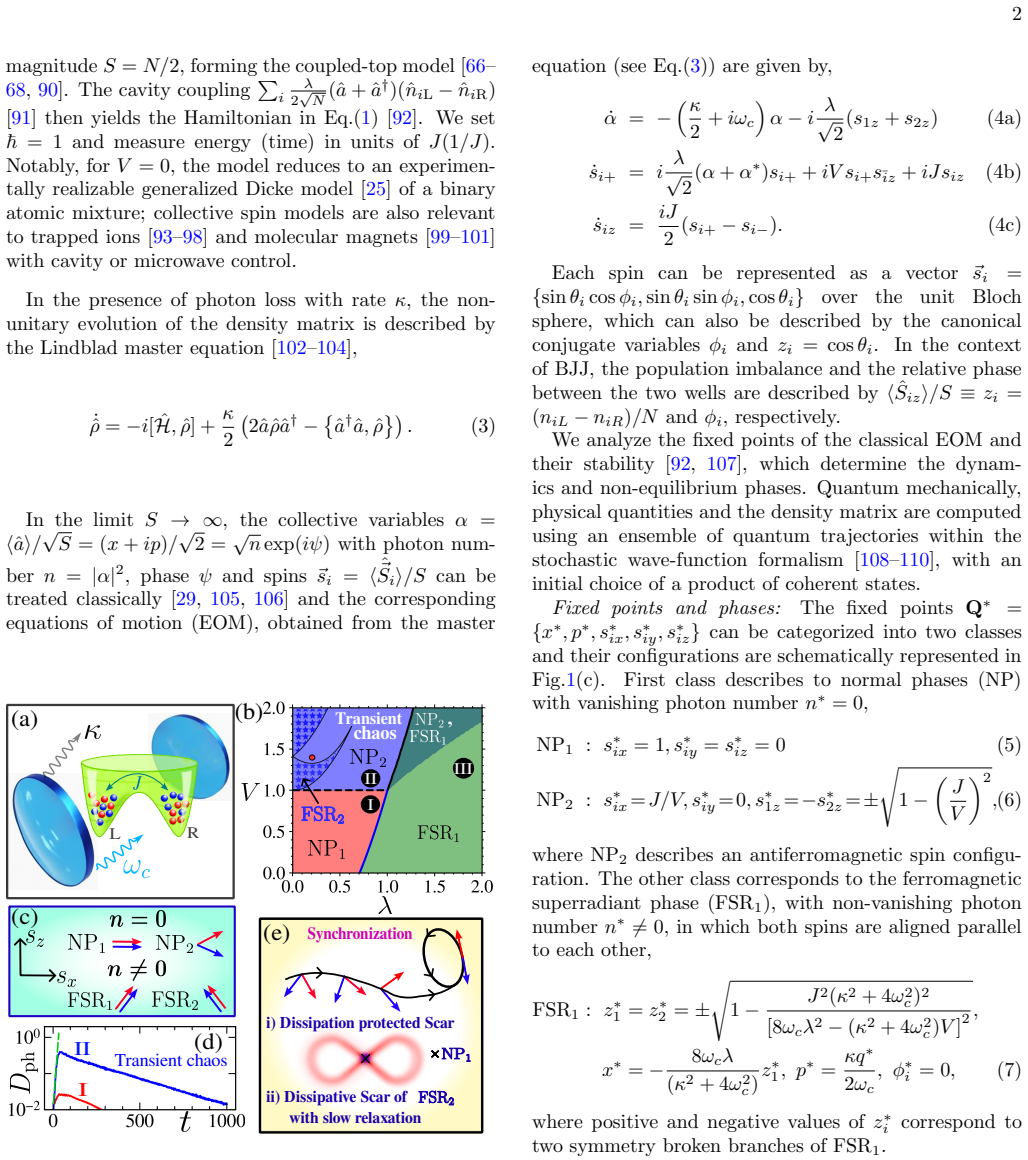
then yields the Hamiltonian in Eq.(1) [92]. We set ℏ= 1 and measure energy (time) in units ofJ(1/J). Notably, forV= 0, the model reduces to an experimen- tally realizable generalized Dicke model [25] of a binary atomic mixture; collective spin models are also relevant to trapped ions [93–98] and molecular magnets [99–101] with cavity or microwave control....
-
[2]
L. D’Alessio, Y. Kafri, A. Polkovnikov, and M. Rigol, Advances in Physics65, 239 (2016)
work page 2016
-
[3]
F. Borgonovi, F. M. Izrailev, L. F. Santos, and V. G. Zelevinsky, Physics Reports626, 1 (2016)
work page 2016
- [4]
-
[5]
J. M. Deutsch, Reports on Progress in Physics81, 082001 (2018)
work page 2018
-
[6]
O. Bohigas, M.-J. Giannoni, and C. Schmit, Physical Review Letters52, 1 (1984)
work page 1984
- [7]
-
[8]
A. Chandran, T. Iadecola, V. Khemani, and R. Moess- ner, Annu. Rev. Condens. Matter Phys.14, 443 (2023)
work page 2023
-
[9]
S. Moudgalya, B. A. Bernevig, and N. Regnault, Rep. Prog. Phys.85, 086501 (2022)
work page 2022
- [10]
-
[11]
G. G. Carlo, G. Benenti, and D. L. Shepelyansky, Phys. Rev. Lett.95, 164101 (2005)
work page 2005
- [12]
-
[13]
F. Ferrari, L. Gravina, D. Eeltink, P. Scarlino, V. Savona, and F. Minganti, Phys. Rev. Research7, 013276 (2025)
work page 2025
- [14]
-
[15]
L. S´ a, P. Ribeiro, and T. Prosen, Phys. Rev. X10, 021019 (2020)
work page 2020
- [16]
-
[17]
D. Villase˜ nor, L. F. Santos, and P. Barberis-Blostein, Phys. Rev. Lett.133, 240404 (2024)
work page 2024
-
[18]
D. Villase˜ nor, H. Yan, M. Orel, and M. Robnik, Phys. Rev. E112, L042204 (2025)
work page 2025
- [19]
- [20]
-
[21]
P. D. Drummond and D. F. Walls, Phys. Rev. A23, 2563 (1981)
work page 1981
- [22]
- [23]
-
[24]
L. Zhou, H. Pu, H. Y. Ling, and W. Zhang, Phys. Rev. Lett.103, 160403 (2009)
work page 2009
-
[25]
A. Ali, F. Saif, and H. Saito, Phys. Rev. A105, 063318 (2022)
work page 2022
- [26]
- [27]
-
[28]
P. Kongkhambut, J. Skulte, L. Mathey, J. G. Cosme, A. Hemmerich, and H. Keßler, Science377, 670 (2022)
work page 2022
-
[29]
X. Wu, Z. Wang, F. Yang, R. Gao, C. Liang, M. K. Tey, X. Li, T. Pohl, and L. You, Nature Physics20, 1389 (2024)
work page 2024
-
[30]
L. da Silva Souza, L. F. dos Prazeres, and F. Iemini, Phys. Rev. Lett.130, 180401 (2023)
work page 2023
- [31]
-
[32]
P. Solanki, A. Cabot, M. Brunelli, F. Carollo, C. Bruder, and I. Lesanovsky, Phys. Rev. A112, L030601 (2025)
work page 2025
-
[33]
A. W. Laskar, P. Adhikary, S. Mondal, P. Katiyar, S. Vinjanampathy, and S. Ghosh, Phys. Rev. Lett.125, 013601 (2020)
work page 2020
-
[34]
Y. Li, Z. Xie, X. Yang, Y. Li, X. Zhao, X. Cheng, X. Peng, J. Li, E. Lutz, Y. Lin, and J. Du, Sci. Adv. 11, eady5649 (2025)
work page 2025
-
[35]
A. Mari, A. Farace, N. Didier, V. Giovannetti, and R. Fazio, Phys. Rev. Lett.111, 103605 (2013)
work page 2013
- [36]
- [37]
-
[38]
D. A. Lidar, I. L. Chuang, and K. B. Whaley, Phys. Rev. Lett.81, 2594 (1998)
work page 1998
- [39]
- [40]
-
[41]
P. G. Kwiat, A. J. Berglund, J. B. Altepeter, and A. G. White, Science290, 498 (2000)
work page 2000
-
[42]
J. B. Altepeter, P. G. Hadley, S. M. Wendelken, A. J. Berglund, and P. G. Kwiat, Phys. Rev. Lett.92, 147901 (2004)
work page 2004
-
[43]
M. Mohseni, J. S. Lundeen, K. J. Resch, and A. M. Steinberg, Phys. Rev. Lett.91, 187903 (2003)
work page 2003
-
[44]
Z. D. Walton, A. F. Abouraddy, A. V. Sergienko, B. E. A. Saleh, and M. C. Teich, Phys. Rev. Lett.91, 6 087901 (2003)
work page 2003
-
[45]
L.-X. Cen, Z. D. Wang, and S. J. Wang, Phys. Rev. A 74, 032321 (2006)
work page 2006
-
[46]
F. Mivehvar, F. Piazza, T. Donner, and H. Ritsch, Ad- vances in Physics70, 1 (2021)
work page 2021
- [47]
- [48]
- [49]
- [50]
-
[51]
A. A. Houck, H. E. T¨ ureci, and J. Koch, Nature Phys. 8, 292 (2012)
work page 2012
-
[52]
K. Baumann, C. Guerlin, F. Brennecke, and T. Esslinger, Nature464, 1301 (2010)
work page 2010
-
[53]
J. Klinder, H. Keßler, M. Wolke, L. Mathey, and A. Hemmerich, Proceedings of the National Academy of Sciences of the United States of America112, 3290 (2015)
work page 2015
-
[54]
J. L´ eonard, A. Morales, P. Zupancic, T. Esslinger, and T. Donner, Nature543, 87 (2017)
work page 2017
-
[55]
H. Bernien, S. Schwartz, A. Keesling, H. Levine, A. Om- ran, H. Pichler, S. Choi, A. S. Zibrov, M. Endres, M. Greiner, V. Vuleti´ c, and M. D. Lukin, Nature551, 579 (2017)
work page 2017
-
[56]
S. Moudgalya, O. I. Motrunich, D. A. Huse,et al., Na- ture Physics18, 1231 (2022)
work page 2022
-
[57]
C. J. Turner, A. A. Michailidis, D. A. Abanin, M. Ser- byn, and Z. Papi´ c, Nat. Phys.14, 745 (2018)
work page 2018
-
[58]
C. J. Turner, A. A. Michailidis, D. A. Abanin, M. Ser- byn, and Z. Papi´ c, Phys. Rev. B98, 155134 (2018)
work page 2018
- [59]
-
[60]
W. W. Ho, S. Choi, H. Pichler, and M. D. Lukin, Phys. Rev. Lett.122, 040603 (2019)
work page 2019
-
[61]
A. A. Michailidis, C. J. Turner, Z. Papi´ c, D. A. Abanin, and M. Serbyn, Phys. Rev. X10, 011055 (2020)
work page 2020
-
[62]
A. Pizzi, L.-H. Kwan, B. Evrard, C. B. Dag, and J. Knolle, Nat. Commun.16, 6722 (2025)
work page 2025
- [63]
- [64]
- [65]
- [66]
- [67]
- [68]
- [70]
-
[71]
E. J. Heller, Phys. Rev. Lett.53, 1515 (1984)
work page 1984
-
[72]
A. M. Garc´ ıa-Garc´ ıa, Z. Lu, L. S´ a, and J. J. M. Ver- baarschot, Phys. Rev. E113, 024116 (2026)
work page 2026
-
[73]
J.-L. Ma, Z. Guo, Y. Gao, Z. Papi´ c, and L. Ying, Phys. Rev. Lett.135, 180401 (2025)
work page 2025
- [74]
-
[75]
H.-R. Wang, D. Yuan, S.-Y. Zhang, Z. Wang, D.-L. Deng, and L.-M. Duan, Phys. Rev. Lett.132, 150401 (2024)
work page 2024
- [76]
-
[77]
R. H. Dicke, Phys. Rev.93, 99 (1954)
work page 1954
-
[78]
Z. Zhiqiang, C. H. Lee, R. Kumar, K. J. Arnold, S. J. Masson, A. S. Parkins, and M. D. Barrett, Optica4, 424 (2017)
work page 2017
-
[79]
M. P. Baden, K. J. Arnold, A. L. Grimsmo, S. Parkins, and M. D. Barrett, Phys. Rev. Lett.113, 020408 (2014)
work page 2014
- [80]
- [81]
discussion (0)
Sign in with ORCID, Apple, or X to comment. Anyone can read and Pith papers without signing in.