Meromorphic amplitudes from 3-dimensional supersymmetry
Pith reviewed 2026-06-26 23:29 UTC · model grok-4.3
The pith
The Coon amplitude equals the 3d N=2 half-index of the XYZ model with nontrivial boundary conditions.
A machine-rendered reading of the paper's core claim, the machinery that carries it, and where it could break.
Core claim
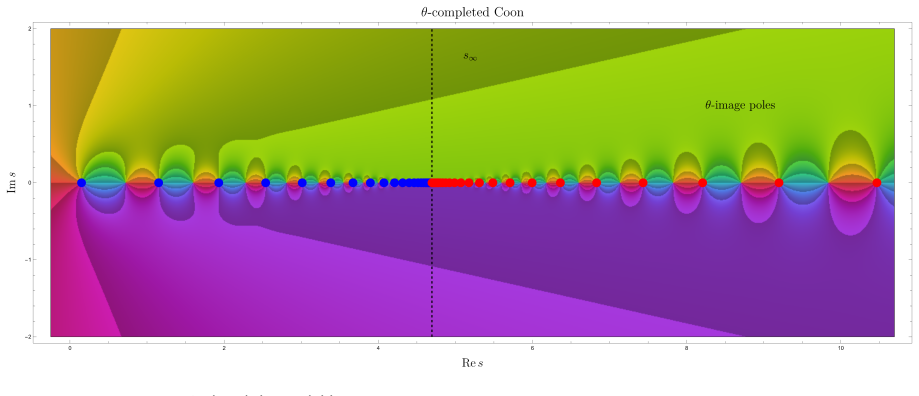
The Coon amplitude coincides with the 3d N=2 half-index of the XYZ model with nontrivial boundary conditions. The 3d UV theory flows in the IR to a sigma model whose partition function is the Veneziano amplitude. Crossing symmetry is realized as a consequence of 3d N=2 mirror symmetry between XYZ and SQED. A meromorphic modification of the Coon amplitude is constructed by promoting the dressing factor q^{ST} to an elliptic completion thereof, showing that single-valuedness is compatible with positivity at the physical poles.
What carries the argument
the 3d N=2 half-index of the XYZ model with nontrivial boundary conditions, which equals the Coon amplitude
If this is right
- Crossing symmetry of the amplitude follows from 3d mirror symmetry between XYZ and SQED.
- The infrared limit of the boundary-conditioned theory reproduces the Veneziano amplitude.
- The elliptic completion of the dressing factor yields a single-valued meromorphic amplitude.
- Positivity of residues at physical poles is preserved under the meromorphic modification.
Where Pith is reading between the lines
- The same boundary-condition construction may generate other known deformations of the Veneziano amplitude.
- Partition functions of 3d supersymmetric theories with boundaries could serve as a source for new amplitude expressions.
- The elliptic-completion technique may extend to higher-point or higher-spin amplitudes while retaining meromorphicity.
Load-bearing premise
The 3d UV theory with the chosen boundary conditions flows in the IR to a sigma model whose partition function is exactly the Veneziano amplitude.
What would settle it
Explicit computation of the half-index for the XYZ model with the stated boundary conditions, followed by direct comparison to the closed-form expression for the Coon amplitude.
Figures
read the original abstract
We establish a new connection between supersymmetric theories and scattering amplitudes. We show that the Coon amplitude coincides with the 3d $\mathcal{N}=2$ half-index of the XYZ model with nontrivial boundary conditions. Our 3d theory, intrinsically defined in the UV, flows to a sigma model in the IR whose partition function is the Veneziano amplitude. Crossing symmetry is realized as a consequence of 3d $\mathcal{N}=2$ mirror symmetry between XYZ and SQED. We use this correspondence to construct a meromorphic modification of the Coon amplitude by promoting the long-standing dressing factor $\mathfrak{q}^{ST}$ responsible for a branch cut to an elliptic completion thereof. This illustrates that one does not have to give up single-valuedness to achieve positivity at the physical poles.
Editorial analysis
A structured set of objections, weighed in public.
Referee Report
Summary. The paper claims that the Coon amplitude coincides with the 3d N=2 half-index of the XYZ model with nontrivial boundary conditions. The intrinsically UV-defined 3d theory flows in the IR to a sigma model whose partition function is exactly the Veneziano amplitude. Crossing symmetry arises from 3d N=2 mirror symmetry between XYZ and SQED. The authors construct a meromorphic modification of the Coon amplitude by replacing the dressing factor q^{ST} with an elliptic completion, preserving single-valuedness while maintaining positivity at physical poles.
Significance. If the identification holds, the work supplies a supersymmetric origin for the Coon amplitude and derives crossing symmetry from mirror symmetry, both of which are strengths. The explicit construction of the elliptic completion illustrates a route to single-valued meromorphic amplitudes with positivity, which may be useful for analytic continuations in string and field theory amplitudes. The reliance on an RG-protected half-index computed in the UV is a positive methodological feature.
major comments (1)
- [IR limit paragraph] The section on the IR limit asserts without detailed derivation that the XYZ model with the chosen boundary conditions flows to a sigma model whose partition function is exactly the Veneziano amplitude. This matching of operators, parameters, and target-space geometry is load-bearing for the central claim that the half-index equals the Coon amplitude; any surviving relevant deformation or boundary-induced change in the effective sigma-model metric would break the exact coincidence.
minor comments (2)
- The notation for the elliptic completion of the dressing factor q^{ST} should be defined more explicitly, including its transformation properties under the relevant modular group.
- Add a brief comparison table or equation reference showing how the modified amplitude reduces to the original Coon amplitude in the appropriate limit.
Simulated Author's Rebuttal
We thank the referee for the careful reading and for highlighting the need for a more explicit derivation of the IR limit. We address this point below and will revise the manuscript to strengthen the presentation.
read point-by-point responses
-
Referee: [IR limit paragraph] The section on the IR limit asserts without detailed derivation that the XYZ model with the chosen boundary conditions flows to a sigma model whose partition function is exactly the Veneziano amplitude. This matching of operators, parameters, and target-space geometry is load-bearing for the central claim that the half-index equals the Coon amplitude; any surviving relevant deformation or boundary-induced change in the effective sigma-model metric would break the exact coincidence.
Authors: We agree that the current presentation of the IR limit is too terse and requires a more detailed derivation to make the matching fully rigorous. In the revised manuscript we will expand this section with an explicit step-by-step argument: (i) identification of the chiral ring generators and their relations under the chosen boundary conditions, (ii) matching of the Kähler parameters to the Veneziano variables s and t, (iii) verification that the effective target-space metric remains flat (or the appropriate Calabi-Yau metric) with no boundary-induced corrections at leading order, and (iv) confirmation that no relevant deformations survive the RG flow that would alter the partition function. This will be supported by a direct computation of the effective superpotential and a brief discussion of the absence of boundary-induced relevant operators. revision: yes
Circularity Check
No significant circularity; IR flow to Veneziano sigma model asserted but not shown to reduce to self-definition or fitted input
full rationale
The central identification equates the Coon amplitude to the 3d half-index of the XYZ model, with the UV-to-IR flow to a sigma model whose partition function is the Veneziano amplitude stated in the abstract. No quoted equations or text demonstrate that any amplitude is defined in terms of itself, that a parameter is fitted to data and then renamed a prediction, or that a load-bearing step collapses via self-citation to an unverified prior result by the same authors. Mirror symmetry is invoked as a standard 3d N=2 fact. The derivation chain therefore remains self-contained against external benchmarks, warranting only the minimal score for an asserted flow whose detailed matching is not exhibited here.
Axiom & Free-Parameter Ledger
free parameters (1)
- q
axioms (2)
- domain assumption 3d N=2 mirror symmetry between XYZ and SQED realizes crossing symmetry
- domain assumption UV 3d theory with nontrivial boundary conditions flows to IR sigma model whose partition function is the Veneziano amplitude
Reference graph
Works this paper leans on
-
[1]
Veneziano,Construction of a crossing - symmetric, Regge behaved amplitude for linearly rising trajectories,Nuovo Cim
G. Veneziano,Construction of a crossing - symmetric, Regge behaved amplitude for linearly rising trajectories,Nuovo Cim. A57(1968) 190–197
1968
-
[2]
D. D. Coon,Uniqueness of the veneziano representation,Phys. Lett. B29(1969) 669–672
1969
-
[3]
Baker and D
M. Baker and D. D. Coon,Dual resonance theory with nonlinear trajectories,Phys. Rev. D2(1970) 2349–2358
1970
-
[4]
D. D. Coon, U. P. Sukhatme, and J. Tran Thanh Van,DUALITY AND PROTON PROTON SCATTERING AT ALL ANGLES,Phys. Lett. B45(1973) 287–291
1973
-
[5]
L. J. Romans,A NEW FAMILY OF DUAL MODELS (’q strings’),
-
[6]
L. J. Romans,Deforming the Veneziano model (’q strings’),Conf. Proc. C8903131 (1989) 57–66
1989
-
[7]
Gonzalez Mestres and R
L. Gonzalez Mestres and R. Hong Tuan,New Dual n-Point Amplitudes with Logarithmic Trajectories,Phys. Rev. D13(1976) 3460
1976
-
[8]
S. Caron-Huot, Z. Komargodski, A. Sever, and A. Zhiboedov,Strings from Massive Higher Spins: The Asymptotic Uniqueness of the Veneziano Amplitude,JHEP10(2017) 026, [arXiv:1607.04253]
Pith/arXiv arXiv 2017
-
[9]
F. Figueroa and P. Tourkine,Unitarity and Low Energy Expansion of the Coon Amplitude,Phys. Rev. Lett.129(2022), no. 12 121602, [arXiv:2201.12331]
arXiv 2022
-
[10]
N. Geiser and L. W. Lindwasser,Properties of infinite product amplitudes: Veneziano, Virasoro, and Coon,JHEP12(2022) 112, [arXiv:2207.08855]
arXiv 2022
-
[11]
J. Chakravarty, P. Maity, and A. Mishra,On the positivity of Coon amplitude in D = 4, JHEP10(2022) 043, [arXiv:2208.02735]
arXiv 2022
-
[12]
N. Geiser,The Baker-Coon-Romans N-point amplitude and an exact field theory limit of the Coon amplitude,JHEP10(2024) 010, [arXiv:2311.04130]
arXiv 2024
-
[13]
R. Bhardwaj, S. De, M. Spradlin, and A. Volovich,On unitarity of the Coon amplitude, JHEP08(2023) 082, [arXiv:2212.00764]
arXiv 2023
-
[14]
J. Maldacena and G. N. Remmen,Accumulation-point amplitudes in string theory,JHEP 08(2022) 152, [arXiv:2207.06426]
arXiv 2022
-
[15]
C. B. Jepsen,Cutting the Coon amplitude,JHEP06(2023) 114, [arXiv:2303.02149]
arXiv 2023
-
[16]
C. Cheung and G. N. Remmen,Stringy dynamics from an amplitudes bootstrap,Phys. Rev. D108(2023), no. 2 026011, [arXiv:2302.12263]
arXiv 2023
-
[17]
Wang,Positivity of the hypergeometric Coon amplitude,JHEP04(2024) 143, [arXiv:2403.00906]
B. Wang,Positivity of the hypergeometric Coon amplitude,JHEP04(2024) 143, [arXiv:2403.00906]
arXiv 2024
-
[18]
C. Cheung, G. N. Remmen, F. Sciotti, and M. Tarquini,Strings from Almost Nothing, arXiv:2508.09246
-
[19]
S. Komatsu and P. Maity,Worldsheet for Generalized Veneziano Amplitudes, arXiv:2511.16280
-
[20]
Aomoto,Les équations aux différences linéaires et les intégrales des fonctions multiformes,Journal of the Faculty of Science, the University of Tokyo
K. Aomoto,Les équations aux différences linéaires et les intégrales des fonctions multiformes,Journal of the Faculty of Science, the University of Tokyo. Sect. 1A, Mathematics22(1975), no. 3 271–297
1975
-
[21]
I. M. Gel’fand,General theory of hypergeometric functions,Soviet Math. Dokl.33(1986), no. 3 573–577. Translated from Doklady Akademii Nauk SSSR, 288(1): 14–18, 1986
1986
-
[22]
I. M. Gelfand, A. V. Zelevinsky, and M. M. Kapranov,Hypergeometric functions and toric varieties,Functional Analysis and Its Applications23(1989), no. 2 94–106. 30
1989
- [23]
-
[24]
K. Hori and M. Romo,Exact Results In Two-Dimensional (2,2) Supersymmetric Gauge Theories With Boundary,arXiv:1308.2438
-
[25]
M. Bullimore, T. Dimofte, D. Gaiotto, and J. Hilburn,Boundaries, Mirror Symmetry, and Symplectic Duality in 3dN= 4Gauge Theory,JHEP10(2016) 108, [arXiv:1603.08382]
Pith/arXiv arXiv 2016
-
[26]
M. Bullimore, S. Crew, and D. Zhang,Boundaries, Vermas, and Factorisation,JHEP04 (2021) 263, [arXiv:2010.09741]
arXiv 2021
-
[27]
T. Okazaki,Abelian mirror symmetry ofN= (2, 2) boundary conditions,JHEP03 (2021) 163, [arXiv:2010.13177]
arXiv 2021
-
[28]
M. Dedushenko and N. Nekrasov,Interfaces and quantum algebras, I: Stable envelopes,J. Geom. Phys.194(2023) 104991, [arXiv:2109.10941]
arXiv 2023
-
[29]
M. Bullimore and D. Zhang,3dN= 4Gauge Theories on an Elliptic Curve,SciPost Phys.13(2022), no. 1 005, [arXiv:2109.10907]
arXiv 2022
-
[30]
M. Aganagic, E. Frenkel, and A. Okounkov,Quantumq-Langlands correspondence,Trud. Mosk. Mat. Obshch.79(2018), no. 1 1–95, [arXiv:1701.03146]
Pith/arXiv arXiv 2018
-
[31]
N. Haouzi,A new realization of quantum algebras in gauge theory and Ramification in the Langlands program,arXiv:2311.04367
-
[32]
A. B. Zamolodchikov,Z(4) SYMMETRIC FACTORIZED S MATRIX IN TWO SPACE-TIME DIMENSIONS,Commun. Math. Phys.69(1979) 165–178
1979
-
[33]
O. A. Castro-Alvaredo and A. Fring,Breathers in the elliptic sine-Gordon model,J. Phys. A36(2003) 10233–10249, [hep-th/0303245]
Pith/arXiv arXiv 2003
-
[34]
Ambrosino and N
F. Ambrosino and N. Haouzi,Amplitudes from supersymmetry,Work in progress
- [35]
-
[36]
T. Dimofte, D. Gaiotto, and S. Gukov,Gauge Theories Labelled by Three-Manifolds, Commun. Math. Phys.325(2014) 367–419, [arXiv:1108.4389]
Pith/arXiv arXiv 2014
-
[37]
T. Dimofte, D. Gaiotto, and S. Gukov,3-Manifolds and 3d Indices,Adv. Theor. Math. Phys.17(2013), no. 5 975–1076, [arXiv:1112.5179]
Pith/arXiv arXiv 2013
-
[38]
Y. Imamura, H. Matsuno, and D. Yokoyama,Factorization of theS3/Zn partition function,Phys. Rev. D89(2014), no. 8 085003, [arXiv:1311.2371]
Pith/arXiv arXiv 2014
-
[39]
Dimofte,Complex Chern–Simons Theory at Level k via the 3d–3d Correspondence, Commun
T. Dimofte,Complex Chern–Simons Theory at Level k via the 3d–3d Correspondence, Commun. Math. Phys.339(2015), no. 2 619–662, [arXiv:1409.0857]
Pith/arXiv arXiv 2015
-
[40]
D. J. Gross,Factorization and the generalized veneziano model with satellites,Nucl. Phys. B13(1969) 467–476
1969
-
[41]
S. Pasquetti,Factorisation of N = 2 Theories on the Squashed 3-Sphere,JHEP04(2012) 120, [arXiv:1111.6905]
Pith/arXiv arXiv 2012
-
[42]
K. C. Rigatos,Positivity of the hypergeometric Veneziano amplitude,Phys. Rev. D109 (2024), no. 8 086008, [arXiv:2310.12207]
arXiv 2024
-
[43]
D. Galakhov, W. Li, and M. Yamazaki,Gauge/Bethe correspondence from quiver BPS algebras,JHEP11(2022) 119, [arXiv:2206.13340]
arXiv 2022
-
[44]
O. Aharony, A. Hanany, K. A. Intriligator, N. Seiberg, and M. J. Strassler,Aspects of N=2 supersymmetric gauge theories in three-dimensions,Nucl. Phys. B499(1997) 67–99, [hep-th/9703110]. 31
Pith/arXiv arXiv 1997
-
[45]
J. de Boer, K. Hori, Y. Oz, and Z. Yin,Branes and mirror symmetry in N=2 supersymmetric gauge theories in three-dimensions,Nucl. Phys. B502(1997) 107–124, [hep-th/9702154]
Pith/arXiv arXiv 1997
-
[46]
A. Gadde, S. Gukov, and P. Putrov,Walls, Lines, and Spectral Dualities in 3d Gauge Theories,JHEP05(2014) 047, [arXiv:1302.0015]
Pith/arXiv arXiv 2014
-
[47]
T. Okazaki and S. Yamaguchi,Supersymmetric boundary conditions in three-dimensional N=2 theories,Phys. Rev. D87(2013), no. 12 125005, [arXiv:1302.6593]
Pith/arXiv arXiv 2013
-
[48]
T. Dimofte, D. Gaiotto, and N. M. Paquette,Dual boundary conditions in 3d SCFT’s, JHEP05(2018) 060, [arXiv:1712.07654]
Pith/arXiv arXiv 2018
-
[49]
Thomae,Beiträge zur Theorie der durch die Heinesche Reihe ...,Journal für die reine und angewandte Mathematik1869(1869), no
J. Thomae,Beiträge zur Theorie der durch die Heinesche Reihe ...,Journal für die reine und angewandte Mathematik1869(1869), no. 70 258–281
-
[50]
F. H. Jackson,Onq-definite integrals,The Quarterly Journal of Pure and Applied Mathematics41(1910) 193–203
1910
-
[51]
Heine,Untersuchungen über die reihe .,Journal für die reine und angewandte Mathematik (Crelles Journal)1847(1847) 285 – 328
E. Heine,Untersuchungen über die reihe .,Journal für die reine und angewandte Mathematik (Crelles Journal)1847(1847) 285 – 328
-
[52]
F. H. Jackson,A generalisation of the functions gamma (n) and xn.,Proceedings of the Royal Society of London74(1905) 64 – 72
1905
-
[53]
T. Dimofte, S. Gukov, and L. Hollands,Vortex Counting and Lagrangian 3-manifolds, Lett. Math. Phys.98(2011) 225–287, [arXiv:1006.0977]
Pith/arXiv arXiv 2011
-
[54]
C. Beem, T. Dimofte, and S. Pasquetti,Holomorphic Blocks in Three Dimensions,JHEP 12(2014) 177, [arXiv:1211.1986]
Pith/arXiv arXiv 2014
-
[55]
R. Gopakumar and C. Vafa,M theory and topological strings. 1.,hep-th/9809187
-
[56]
M. Aganagic and C. Vafa,Mirror symmetry, D-branes and counting holomorphic discs, hep-th/0012041
-
[57]
N. C. Leung and C. Vafa,Branes and toric geometry,Adv. Theor. Math. Phys.2(1998) 91–118, [hep-th/9711013]
Pith/arXiv arXiv 1998
-
[58]
A. Hanany and E. Witten,Type IIB superstrings, BPS monopoles, and three-dimensional gauge dynamics,Nucl. Phys. B492(1997) 152–190, [hep-th/9611230]
Pith/arXiv arXiv 1997
-
[59]
S. Elitzur, A. Giveon, and D. Kutasov,Branes and N=1 duality in string theory,Phys. Lett. B400(1997) 269–274, [hep-th/9702014]
Pith/arXiv arXiv 1997
-
[60]
A. Hanany and K. Hori,Branes and N=2 theories in two-dimensions,Nucl. Phys. B513 (1998) 119–174, [hep-th/9707192]
Pith/arXiv arXiv 1998
-
[61]
T. Kitao, K. Ohta, and N. Ohta,Three-dimensional gauge dynamics from brane configurations with (p,q)-fivebrane,Nucl. Phys. B539(1999) 79–106, [hep-th/9808111]
Pith/arXiv arXiv 1999
-
[62]
A. Hanany and D. Tong,Vortices, instantons and branes,JHEP07(2003) 037, [hep-th/0306150]
Pith/arXiv arXiv 2003
-
[63]
Y. Yoshida and K. Sugiyama,Localization of three-dimensionalN= 2supersymmetric theories onS 1×D2,PTEP2020(2020), no. 11 113B02, [arXiv:1409.6713]
arXiv 2020
-
[64]
H.-J. Chung and T. Okazaki,(2,2) and (0,4) supersymmetric boundary conditions in 3d N= 4 theories and type IIB branes,Phys. Rev. D96(2017), no. 8 086005, [arXiv:1608.05363]
Pith/arXiv arXiv 2017
-
[65]
Jaffe and C
A. Jaffe and C. Taubes,Vortices and Monopoles: Structure of Static Gauge Theories, vol. 2 ofProgress in Physics. Birkhäuser, Boston, 1980
1980
-
[66]
C. Cordova and S.-H. Shao,An Index Formula for Supersymmetric Quantum Mechanics, arXiv:1406.7853. 32
-
[67]
K. Hori, H. Kim, and P. Yi,Witten Index and Wall Crossing,JHEP01(2015) 124, [arXiv:1407.2567]
Pith/arXiv arXiv 2015
-
[68]
C. Hwang, J. Kim, S. Kim, and J. Park,General instanton counting and 5d SCFT,JHEP 07(2015) 063, [arXiv:1406.6793]. [Addendum: JHEP 04, 094 (2016)]
Pith/arXiv arXiv 2015
-
[69]
Okounkov,Lectures on K-theoretic computations in enumerative geometry, arXiv:1512.07363
A. Okounkov,Lectures on K-theoretic computations in enumerative geometry, arXiv:1512.07363
-
[70]
Matsuo,Jackson integrals of Jordan-Pochhammer type and quantum Knizhnik-Zamolodchikov equations,Communications in Mathematical Physics151(1993), no
A. Matsuo,Jackson integrals of Jordan-Pochhammer type and quantum Knizhnik-Zamolodchikov equations,Communications in Mathematical Physics151(1993), no. 2 263 – 273
1993
-
[71]
Ciocan-Fontanine, B
I. Ciocan-Fontanine, B. Kim, and D. Maulik,Stable quasimaps to git quotients,Journal of geometry and physics75(2014) 17–47
2014
-
[72]
33 lectures on quasimaps and elliptic stable envelopes
A. Okounkov, “33 lectures on quasimaps and elliptic stable envelopes.” With guest lectures by Igor Krichever and Chiu-Chu Melissa Liu, Mar., 2022
2022
-
[73]
M. Aganagic and A. Okounkov,Elliptic stable envelopes,J. Am. Math. Soc.34(2021), no. 1 79–133, [arXiv:1604.00423]
arXiv 2021
-
[74]
Dinkins,Symplectic Duality ofT∗Gr(k,n),arXiv:2008.05516
H. Dinkins,Symplectic Duality ofT∗Gr(k,n),arXiv:2008.05516. 33
arXiv 2008
discussion (0)
Sign in with ORCID, Apple, or X to comment. Anyone can read and Pith papers without signing in.