REVIEW 3 major objections 4 minor 300 references
The thesis argues that gene regulatory network inference is best split into two stages: a sequence-based prior that transfers across species and a probabilistic factorization that refines edges with calibrated uncertainty.
Reviewed by Pith at T0; open to challenge. T0 means a machine referee read the full paper against a public rubric. the ladder, T0–T4 →
T0 review · deepseek-v4-flash
2026-08-01 21:28 UTC pith:TEMT24EL
load-bearing objection A solid two-method thesis whose main real weakness is that the headline transferability claim rests on cross-species experiments that don't report homology-based leakage controls. the 3 major comments →
Deep and Probabilistic Models for Gene Regulatory Network Inference
The pith
A machine-rendered reading of the paper's core claim, the machinery that carries it, and where it could break.
Core claim
On the thesis's own terms, the central discovery is that GRN reconstruction decomposes cleanly into two complementary problems. PMF-GRN treats observed expression W as generated from latent TF activities U and a regulatory matrix V = A ⊙ B; the prior over A encodes known or hypothesized TF-gene interactions, and variational inference returns posterior means and variances for every edge. The variances are well calibrated in the sense that lower-uncertainty edges are more likely to reproduce gold-standard interactions. GLM-Prior learns to predict whether a TF and a gene interact from their concatenated sequences using a transformer-based genomic language model; a model trained on one or severa
What carries the argument
The load-bearing object is the prior-knowledge matrix that anchors factorization to named transcription factors. In PMF-GRN, the regulatory matrix is decomposed as V = A ⊙ B, where A is an interaction-existence matrix with a logistic-normal prior whose means come from external evidence; without that prior, the factorization is identifiable only up to column permutation because U V^T is permutation-invariant. Variational inference maximizes a beta-weighted ELBO, and validation AUPRC on held-out prior entries selects hyperparameters. In GLM-Prior, a transformer encoder maps concatenated TF-motif and gene sequences to a pooled embedding, and a binary classifier scores the pair; the scores assem
Load-bearing premise
The load-bearing premise is that TF-gene regulatory interactions can be predicted from nucleotide sequence alone—gene sequence plus TF motif—without chromatin state, cell-type context, or cofactors; if sequence is insufficient for cross-species transfer, the GLM-Prior strategy collapses (the thesis itself acknowledges this in its background chapter).
What would settle it
Train GLM-Prior with the TF-binding motifs replaced by length-matched random sequence while keeping labels and gene sequences fixed, then evaluate on held-out species. If AUPRC does not fall substantially, the classifier is exploiting gene-sequence or label artifacts rather than TF-gene sequence compatibility, and the sequence-prior claim fails.
If this is right
- Practitioners can replace heuristic model selection with a single variational objective and a validation AUPRC, so different generative models become comparable on the same footing.
- Inferred networks carry per-edge uncertainty that is well calibrated: low-variance edges are more accurate, which helps prioritize predictions when gold standards are incomplete.
- Priors built from sequence alone remove the dependence on cell-type-specific chromatin and ChIP assays, extending GRN inference to less-characterized systems.
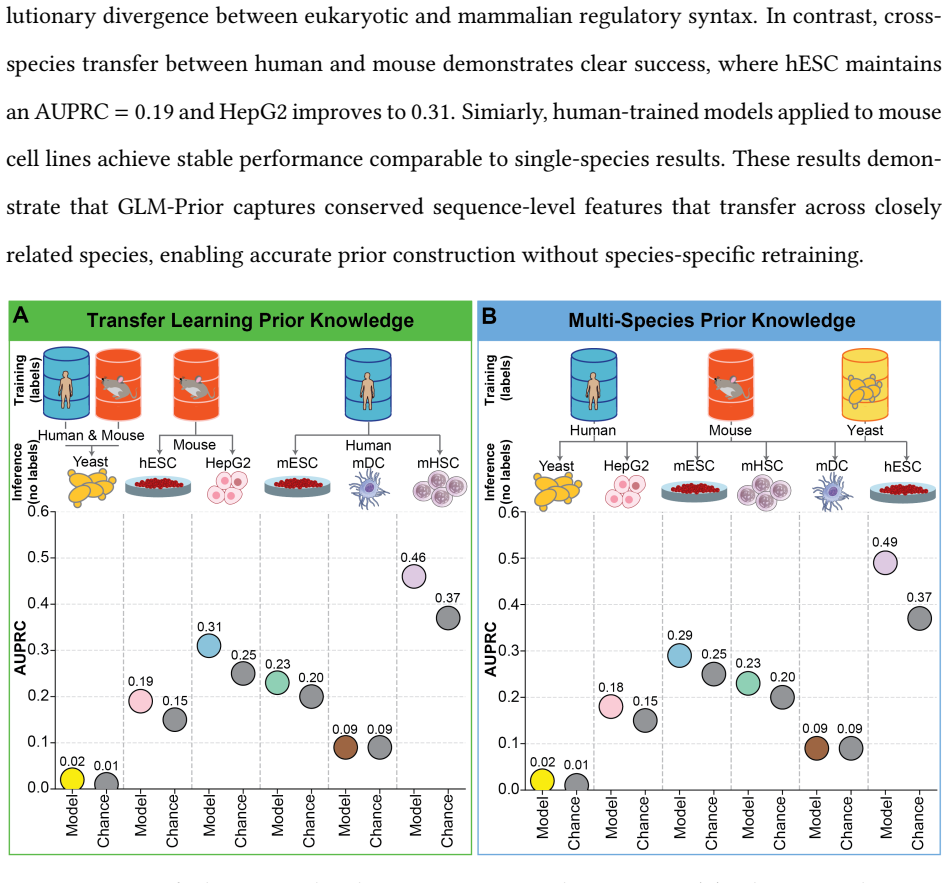
- A model trained on one species or jointly on several transfers to other species, so regulatory knowledge from well-studied organisms can scaffold inference elsewhere.
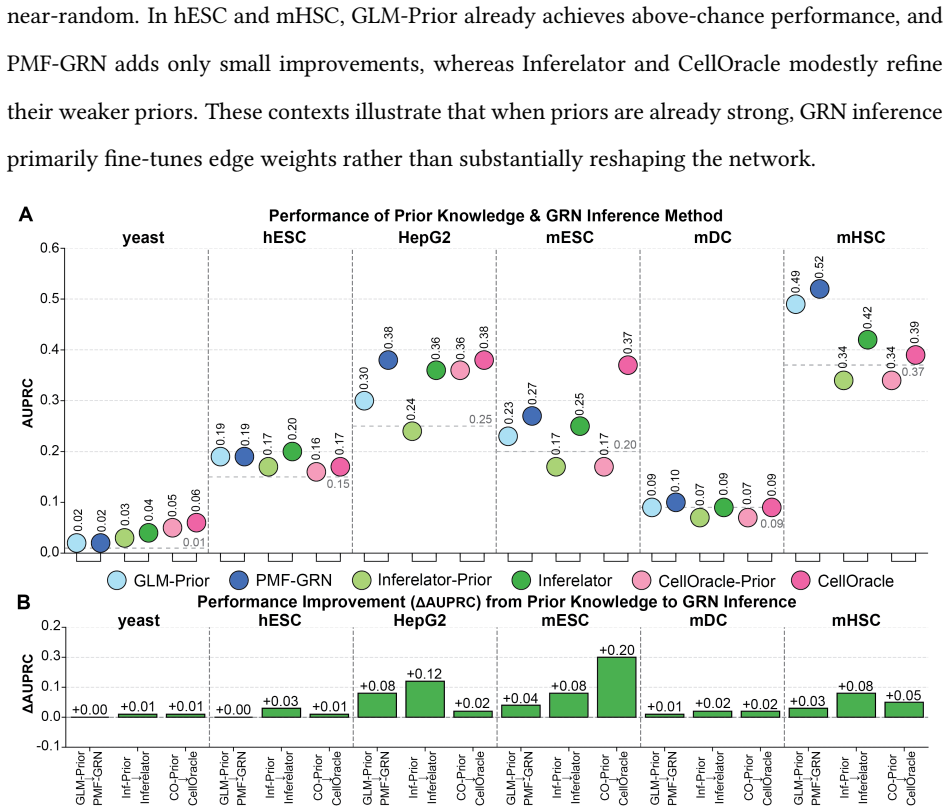
- Coupling the sequence prior with probabilistic expression-based inference yields higher accuracy than either alone across yeast, mouse, and human cell lines, supporting the dual-stage design.
Where Pith is reading between the lines
- If sequence-derived priors truly transfer across species, the same scaffold could be applied to non-model organisms and clinical samples lacking chromatin data; the thesis does not test this directly.
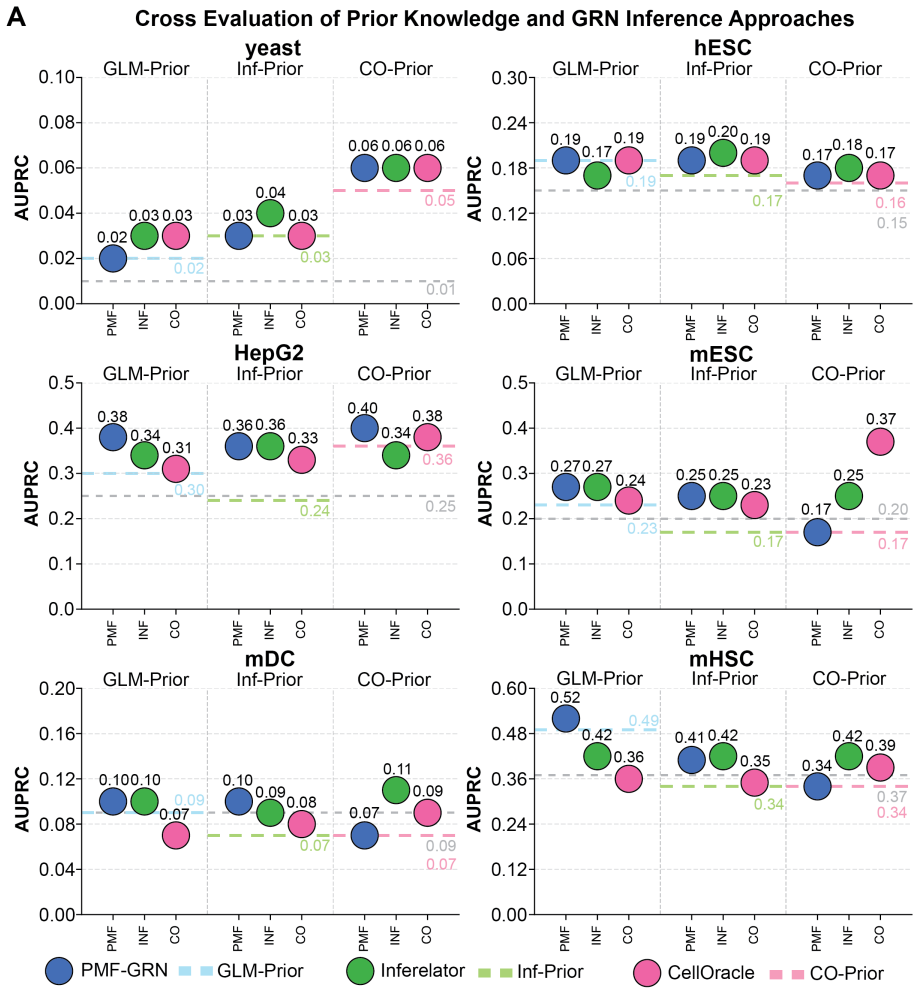
- The three-by-three cross-comparison of priors and inferers suggests the two stages are modular—improving either stage should improve the whole pipeline—a design principle the thesis demonstrates but does not state as a general claim.
- Calibrated posterior variances could double as an active-learning signal for choosing which edges to validate experimentally; the thesis stops at calibration and does not explore this use.
- The synthetic-trajectory experiments show the factorization struggles with long linear cascades, hinting that explicit temporal structure is the natural next extension rather than a refutation of the approach.
Editorial analysis
A structured set of objections, weighed in public.
Referee Report
Summary. The thesis develops two complementary frameworks for gene regulatory network (GRN) inference. Chapter 3 presents PMF-GRN, a probabilistic matrix factorization model with variational inference, which decomposes single-cell expression into transcription factor activity and TF–gene interaction matrices, incorporates prior knowledge through the prior on the interaction matrix, performs hyperparameter selection via a held-out portion of the prior, and outputs posterior uncertainty estimates. Chapter 4 introduces GLM-Prior, a sequence-based prior constructed by fine-tuning a nucleotide transformer to classify TF–gene pairs as interacting or non-interacting, with experiments in yeast, mouse, and human, including single-species training, cross-species transfer, and multi-species training. The thesis argues for a dual-stage view in which sequence-derived priors provide a transferable scaffold and probabilistic inference refines the network with uncertainty quantification. The empirical chapters benchmark against Inferelator, SCENIC, CellOracle, and BEELINE synthetic networks.
Significance. If the claims are borne out, the work makes useful contributions: PMF-GRN decouples generative modeling from inference, provides a principled model-selection procedure, and produces uncertainty estimates that appear well-calibrated in yeast. GLM-Prior addresses a real bottleneck—constructing priors without cell-type-specific assays—and the multi-species experiments are ambitious. The thesis also ships a large amount of experimental work across organisms and synthetic benchmarks, and it is commendably explicit about limitations such as the long-linear synthetic case and the acknowledged incompleteness of gold standards. However, the current evidence does not fully support the strongest claims: the abstract's assertion that PMF-GRN is 'more accurate' than state-of-the-art methods is contradicted by the paper's own figures showing competitive rather than uniformly superior performance, and the cross-species transfer claim for GLM-Prior lacks a homology-aware leakage control for the mouse↔human experiments that are its main evidence.
major comments (3)
- [§3.1 Abstract; §3.3.3, Fig. 3.2A; §3.3.6, Fig. 3.5B] The abstract states that 'PMF-GRN infers GRNs more accurately than current state-of-the-art single-cell GRN inference methods,' but the results do not support this uniformly. In Fig. 3.2A, PMF-GRN is competitive with BBSR and CellOracle rather than clearly better; in the 5-fold CV comparison it is similar to BBSR and StARS; and in the BEELINE long-linear synthetic networks (Fig. 3.5B) PMF-GRN is explicitly non-competitive. The wording should be tempered to 'competitive with, and often better than' and the per-dataset exceptions should be stated. This is not merely a presentational issue: the abstract is the central claim of the chapter.
- [§3.3.1, Fig. 3.1C; §3.3.3, Fig. 3.2; §3.4.8] The evaluation of PMF-GRN mixes prior-recovery with true discovery in a way that is not quantified. Hyperparameters are selected by AUPRC against a held-out 20% of the prior matrix (Fig. 3.1C), and the final AUPRC is then computed against a 'gold standard.' If the gold standard shares many edges with the prior (as is likely for database- and ChIP-derived references versus motif/accessibility priors), tuning on the prior directly inflates the reported AUPRC because the model is optimized to recover prior-known edges. The manuscript does not report the overlap between the prior and the gold standard, nor performance restricted to gold-standard edges absent from the prior. Please quantify this overlap and report AUPRC on prior-absent edges, or otherwise demonstrate that the reported gains are not primarily prior-recovery.
- [§4.3.3, Figs. 4.4–4.5; Supplement Fig. 4.12] The species-transfer claim for GLM-Prior depends on the mouse↔human transfer experiments, but the only homology-aware leakage control (hashFrag) is reported for yeast gene and TF splits (Supplement Fig. 4.12). No equivalent pruning or leakage analysis is described for the mouse→human and human→mouse transfer or multi-species experiments. Because human and mouse share substantial orthologous promoter and TF sequences, a model trained on mouse could score human TF–gene pairs highly merely by recognizing near-identical sequence, without learning a generalizable regulatory code. The transfer AUPRC gains in Figs. 4.4–4.5 could therefore be inflated by sequence homology. This is load-bearing for the dual-stage thesis, which depends on GLM-Prior being genuinely transferable. Please apply hashFrag-based homology pruning to the transfer and multi-species training/test splits, or otherwise quantif
minor comments (4)
- [§2.4.4.3, Eq. (2.5)] Equation (2.5) is written as p(W|U,V,σ) = p(U)p(V)p(σ), which equates a conditional likelihood with prior distributions. This should be corrected to define the prior p(U,V,σ) and the likelihood separately, e.g., p(U,V,σ) = p(U)p(V)p(σ).
- [Various] The text contains several typos and inconsistent spellings: 'Sacchromyces cerevisiae' (Chapter 3), 'Cell Oracle' versus 'CellOracle', 'releationships' in Fig. 2.4 caption, 'Seqence Language Models' as a section heading, and 'messanger RNA'. These should be corrected in a final pass.
- [§4.3.3 and Supplement Fig. 4.12] The hashFrag homology analysis is only in the supplementary material and is not cited in the main text of Section 4.3.3 where transfer learning is described. Add a reference to this control and explicitly note its scope (yeast only) so readers are not misled about the coverage of the leakage analysis.
- [§3.4.4 / §3.3.3] The term 'independent gold standard' is used without defining what 'independent' means in relation to the prior. Since the prior and gold standard may share edges, please state explicitly how the gold standard was constructed and what overlap with the prior was measured.
Circularity Check
No significant circularity: PMF-GRN and GLM-Prior use held-out evaluation; self-citations are not load-bearing.
full rationale
The thesis's central claims are supported by internally conducted experiments with held-out evaluation. PMF-GRN's hyperparameter selection uses a held-out portion of the prior knowledge matrix as a validation criterion, but the reported performance is evaluated against independent gold standards, and the BEELINE experiment explicitly splits ground truth so that the half used as prior is disjoint from the half used for evaluation. Negative controls with shuffled or absent priors further show that the model is not merely recapitulating its input by construction. GLM-Prior is trained on labeled TF-gene pairs and evaluated on held-out gold standards across cell lines and species; the acknowledged limitation that sequence alone does not encode all regulatory determinants (Section 2.4.4.5) is a scope caveat, not a circular reduction. The self-citations to the author's own prior work ([Skok Gibbs et al. 2022, 2024, 2025]) are cross-references to content reproduced or extended in the thesis, and no load-bearing premise depends solely on an unverified self-citation. The concern that mouse-human transfer experiments lack the hashFrag homology control reported for yeast (Supplement Figure 4.12) is a legitimate evaluation-robustness caveat, but it does not make the reported AUPRC equivalent to the training input by construction. No equation or fitted parameter is reused as its own prediction.
Axiom & Free-Parameter Ledger
free parameters (4)
- PMF-GRN prior strength σ_a =
tuned via validation AUPRC
- PMF-GRN TF activity prior σ_u =
tuned
- β (beta) in modified ELBO =
tuned
- GLM-Prior class weights / negative downsampling rate =
selected by one-epoch sweep
axioms (3)
- domain assumption TF-gene regulatory interactions are predictable from nucleotide sequence alone (gene sequence + TF motif), without chromatin context or cell-type-specific data.
- domain assumption Observed gene expression is a linear combination of latent TF activities, W ≈ U V^T with V = A ⊙ B, under Gaussian noise.
- domain assumption Reference gold standards are sufficiently complete to benchmark GRN inference methods.
read the original abstract
Gene regulatory networks (GRNs) link transcription factor (TF) proteins to their target genes, yet reconstructing these networks from genome-wide data remains challenging under practical and methodological constraints. Many methods couple modeling assumptions to a specific inference procedure and rely on heuristic model selection, while evaluation is constrained by incomplete reference networks and point-estimate outputs that lack uncertainty. GRN reconstruction also depends on prior knowledge to constrain TF-gene interactions, yet available priors are often assay-dependent and difficult to transfer across species and less-characterized systems. In this thesis, we develop two complementary frameworks that address these limitations. In the first, PMF-GRN casts GRN inference as a probabilistic graphical model optimized by variational inference, enabling principled model selection and uncertainty-aware edge estimates. In the second, GLM-Prior addresses the prior bottleneck by fine-tuning the pretrained Nucleotide Transformer to predict TF-target gene interactions directly from nucleotide sequence, while generalizing across yeast, mouse, and human settings. Together, PMF-GRN and GLM-Prior motivate a dual-stage view of GRN reconstruction in which sequence-derived priors provide a transferable starting scaffold and probabilistic inference refines regulatory estimates with quantified uncertainty under incomplete evaluation resources.
Figures







Reference graph
Works this paper leans on
-
[1]
Biosystems , volume=
Gene regulatory network inference: data integration in dynamic models—a review , author=. Biosystems , volume=. 2009 , publisher=
2009
-
[2]
Computers in biology and medicine , volume=
A review on the computational approaches for gene regulatory network construction , author=. Computers in biology and medicine , volume=. 2014 , publisher=
2014
-
[3]
Bioinformatics , volume=
Learning gene regulatory networks from gene expression measurements using non-parametric molecular kinetics , author=. Bioinformatics , volume=. 2009 , publisher=
2009
-
[4]
Bioinformatics , volume=
Inferring quantitative models of regulatory networks from expression data , author=. Bioinformatics , volume=. 2004 , publisher=
2004
-
[5]
arXiv preprint arXiv:1902.08138 , year=
A nonparametric multi-view model for estimating cell type-specific gene regulatory networks , author=. arXiv preprint arXiv:1902.08138 , year=
Pith/arXiv arXiv 1902
-
[6]
Cell , volume=
A validated regulatory network for Th17 cell specification , author=. Cell , volume=. 2012 , publisher=
2012
-
[7]
Proceedings of the National Academy of Sciences , volume=
Inflammatory regulatory network mediated by the joint action of NF-kB, STAT3, and AP-1 factors is involved in many human cancers , author=. Proceedings of the National Academy of Sciences , volume=. 2019 , publisher=
2019
-
[8]
Nature , volume=
Dynamic regulatory network controlling TH17 cell differentiation , author=. Nature , volume=. 2013 , publisher=
2013
-
[9]
Nature genetics , volume=
Module networks: identifying regulatory modules and their condition-specific regulators from gene expression data , author=. Nature genetics , volume=. 2003 , publisher=
2003
-
[10]
Biochimica et Biophysica Acta (BBA)-Gene Regulatory Mechanisms , volume=
Gene regulatory network inference resources: A practical overview , author=. Biochimica et Biophysica Acta (BBA)-Gene Regulatory Mechanisms , volume=. 2020 , publisher=
2020
-
[11]
Genome research , volume=
Predictive regulatory models in Drosophila melanogaster by integrative inference of transcriptional networks , author=. Genome research , volume=. 2012 , publisher=
2012
-
[12]
Genome biology , volume=
The Inferelator: an algorithm for learning parsimonious regulatory networks from systems-biology data sets de novo , author=. Genome biology , volume=. 2006 , publisher=
2006
-
[13]
2009 Annual International Conference of the IEEE Engineering in Medicine and Biology Society , pages=
The Inferelator 2.0: a scalable framework for reconstruction of dynamic regulatory network models , author=. 2009 Annual International Conference of the IEEE Engineering in Medicine and Biology Society , pages=. 2009 , organization=
2009
-
[14]
BMC bioinformatics , volume=
Defining transcriptional networks through integrative modeling of mRNA expression and transcription factor binding data , author=. BMC bioinformatics , volume=. 2004 , publisher=
2004
-
[15]
Human heredity , volume=
Biophysically motivated regulatory network inference: progress and prospects , author=. Human heredity , volume=. 2016 , publisher=
2016
-
[16]
Science , volume=
Microbial single-cell RNA sequencing by split-pool barcoding , author=. Science , volume=. 2021 , publisher=
2021
-
[17]
2006 , publisher=
Scalable optimization via probabilistic modeling , author=. 2006 , publisher=
2006
-
[18]
arXiv preprint arXiv:1610.09787 , year=
Edward: A library for probabilistic modeling, inference, and criticism , author=. arXiv preprint arXiv:1610.09787 , year=
-
[19]
2015 2nd International Conference on Electronics and Communication Systems (ICECS) , pages=
Survey on recommendation system methods , author=. 2015 2nd International Conference on Electronics and Communication Systems (ICECS) , pages=. 2015 , organization=
2015
-
[20]
Procedia Computer Science , volume=
Matrix factorization model in collaborative filtering algorithms: A survey , author=. Procedia Computer Science , volume=. 2015 , publisher=
2015
-
[21]
Proceedings of the 10th international conference on World Wide Web , pages=
Item-based collaborative filtering recommendation algorithms , author=. Proceedings of the 10th international conference on World Wide Web , pages=
-
[22]
Computer , volume=
Matrix factorization techniques for recommender systems , author=. Computer , volume=. 2009 , publisher=
2009
-
[23]
data Science (Second Edition) , pages=
Recommendation engines , author=. data Science (Second Edition) , pages=
-
[24]
Heredity , volume=
Epigenetics and gene expression , author=. Heredity , volume=. 2010 , publisher=
2010
-
[25]
Annual review of cell and developmental biology , volume=
Comparative analysis of gene regulatory networks: from network reconstruction to evolution , author=. Annual review of cell and developmental biology , volume=. 2015 , publisher=
2015
-
[26]
Current opinion in biotechnology , volume=
Network-based approaches for analysis of complex biological systems , author=. Current opinion in biotechnology , volume=. 2016 , publisher=
2016
-
[27]
Cell , volume=
Comprehensive integration of single-cell data , author=. Cell , volume=. 2019 , publisher=
2019
-
[28]
Bioinformatics , volume=
Estimating the activity of transcription factors by the effect on their target genes , author=. Bioinformatics , volume=. 2014 , publisher=
2014
-
[29]
The Journal of Machine Learning Research , volume=
Pyro: Deep universal probabilistic programming , author=. The Journal of Machine Learning Research , volume=. 2019 , publisher=
2019
-
[30]
arXiv preprint arXiv:1912.11554 , year=
Composable effects for flexible and accelerated probabilistic programming in NumPyro , author=. arXiv preprint arXiv:1912.11554 , year=
Pith/arXiv arXiv 1912
-
[31]
2012 IEEE Symposium on Computational Intelligence in Bioinformatics and Computational Biology (CIBCB) , pages=
Matrix factorization for transcriptional regulatory network inference , author=. 2012 IEEE Symposium on Computational Intelligence in Bioinformatics and Computational Biology (CIBCB) , pages=. 2012 , organization=
2012
-
[32]
elife , volume=
A new protocol for single-cell RNA-seq reveals stochastic gene expression during lag phase in budding yeast , author=. elife , volume=. 2020 , publisher=
2020
-
[33]
Nature , volume=
Neuronal diversity and convergence in a visual system developmental atlas , author=. Nature , volume=. 2021 , publisher=
2021
-
[34]
Neuron , volume=
Transcriptional programs of circuit assembly in the Drosophila visual system , author=. Neuron , volume=. 2020 , publisher=
2020
-
[35]
Cell reports , volume=
Condition-specific modeling of biophysical parameters advances inference of regulatory networks , author=. Cell reports , volume=. 2018 , publisher=
2018
-
[36]
Nucleic acids research , volume=
YEASTRACT+: a portal for cross-species comparative genomics of transcription regulation in yeasts , author=. Nucleic acids research , volume=. 2020 , publisher=
2020
-
[37]
Nucleic acids research , volume=
YEASTRACT: an upgraded database for the analysis of transcription regulatory networks in Saccharomyces cerevisiae , author=. Nucleic acids research , volume=. 2018 , publisher=
2018
-
[38]
Frontiers in Microbiology , volume=
Reconstruction of the regulatory network for Bacillus subtilis and reconciliation with gene expression data , author=. Frontiers in Microbiology , volume=. 2016 , publisher=
2016
-
[39]
Nature , pages=
Decoding gene regulation in the fly brain , author=. Nature , pages=. 2022 , publisher=
2022
-
[40]
Nature communications , volume=
Characterizing chromatin landscape from aggregate and single-cell genomic assays using flexible duration modeling , author=. Nature communications , volume=. 2020 , publisher=
2020
-
[41]
Nucleic acids research , volume=
MEME SUITE: tools for motif discovery and searching , author=. Nucleic acids research , volume=. 2009 , publisher=
2009
-
[42]
Artificial intelligence and statistics , pages=
Black box variational inference , author=. Artificial intelligence and statistics , pages=. 2014 , organization=
2014
-
[43]
Irina Higgins and Loic Matthey and Arka Pal and Christopher Burgess and Xavier Glorot and Matthew Botvinick and Shakir Mohamed and Alexander Lerchner , booktitle=. beta-. 2017 , url=
2017
-
[44]
Proceedings of the National Academy of Sciences , volume=
Singular value decomposition for genome-wide expression data processing and modeling , author=. Proceedings of the National Academy of Sciences , volume=. 2000 , publisher=
2000
-
[45]
Bioinformatics , volume=
Application of Bayesian decomposition for analysing microarray data , author=. Bioinformatics , volume=. 2002 , publisher=
2002
-
[46]
Genome research , volume=
Subsystem identification through dimensionality reduction of large-scale gene expression data , author=. Genome research , volume=. 2003 , publisher=
2003
-
[47]
Proceedings of the national academy of sciences , volume=
Metagenes and molecular pattern discovery using matrix factorization , author=. Proceedings of the national academy of sciences , volume=. 2004 , publisher=
2004
-
[48]
Bioinformatics , volume=
Improving molecular cancer class discovery through sparse non-negative matrix factorization , author=. Bioinformatics , volume=. 2005 , publisher=
2005
-
[49]
Bioinformatics , volume=
A non-negative matrix factorization method for detecting modules in heterogeneous omics multi-modal data , author=. Bioinformatics , volume=. 2016 , publisher=
2016
-
[50]
Proceedings of the National Academy of Sciences , volume=
Integrative analysis of single-cell genomics data by coupled nonnegative matrix factorizations , author=. Proceedings of the National Academy of Sciences , volume=. 2018 , publisher=
2018
-
[51]
PLoS computational biology , volume=
Building gene regulatory networks from scATAC-seq and scRNA-seq using linked self organizing maps , author=. PLoS computational biology , volume=. 2019 , publisher=
2019
-
[52]
Current Opinion in Systems Biology , volume=
Gene regulatory network inference in single-cell biology , author=. Current Opinion in Systems Biology , volume=. 2021 , publisher=
2021
-
[53]
Genome biology , volume=
Eleven grand challenges in single-cell data science , author=. Genome biology , volume=. 2020 , publisher=
2020
-
[54]
Science , volume=
Condition-dependent transcriptome reveals high-level regulatory architecture in Bacillus subtilis , author=. Science , volume=. 2012 , publisher=
2012
-
[55]
Nucleic acids research , volume=
Subti Wiki 2.0—an integrated database for the model organism Bacillus subtilis , author=. Nucleic acids research , volume=. 2016 , publisher=
2016
-
[56]
Nucleic acids research , volume=
Subti Wiki in 2018: from genes and proteins to functional network annotation of the model organism Bacillus subtilis , author=. Nucleic acids research , volume=. 2018 , publisher=
2018
-
[57]
Nucleic Acids Research , volume=
The current state of Subti Wiki, the database for the model organism Bacillus subtilis , author=. Nucleic Acids Research , volume=. 2022 , publisher=
2022
-
[58]
Bioinformatics , volume=
Inferring gene regulatory networks from multiple microarray datasets , author=. Bioinformatics , volume=. 2006 , publisher=
2006
-
[59]
Bioinformatics , volume=
Fast network component analysis (FastNCA) for gene regulatory network reconstruction from microarray data , author=. Bioinformatics , volume=. 2008 , publisher=
2008
-
[60]
Cell , volume=
Integrated analysis of multimodal single-cell data , author=. Cell , volume=. 2021 , publisher=
2021
-
[61]
bioRxiv , pages=
Structure primed embedding on the transcription factor manifold enables transparent model architectures for gene regulatory network and latent activity inference , author=. bioRxiv , pages=. 2023 , publisher=
2023
-
[62]
Frontiers in immunology , volume=
IRF2 is required for development and functional maturation of human NK cells , author=. Frontiers in immunology , volume=. 2022 , publisher=
2022
-
[63]
Immunity , volume=
The transcription factor IRF2 drives interferon-mediated CD8+ T cell exhaustion to restrict anti-tumor immunity , author=. Immunity , volume=. 2022 , publisher=
2022
-
[64]
Blood, The Journal of the American Society of Hematology , volume=
Regulation of human 2-microglobulin transactivation in hematopoietic cells , author=. Blood, The Journal of the American Society of Hematology , volume=. 2003 , publisher=
2003
-
[65]
PLoS One , volume=
Immunopathology of childhood celiac disease—Key role of intestinal epithelial cells , author=. PLoS One , volume=. 2017 , publisher=
2017
-
[66]
Nature communications , volume=
IRF2 is a master regulator of human keratinocyte stem cell fate , author=. Nature communications , volume=. 2019 , publisher=
2019
-
[67]
Cell Reports , volume=
A Golgi-resident GPR108 cooperates with E3 ubiquitin ligase Smurf1 to suppress antiviral innate immunity , author=. Cell Reports , volume=. 2023 , publisher=
2023
-
[68]
Immunity , volume=
The ubiquitin ligase RNF5 regulates antiviral responses by mediating degradation of the adaptor protein MITA , author=. Immunity , volume=. 2009 , publisher=
2009
-
[69]
Biomolecules & Therapeutics , volume=
Identification of small GTPases that phosphorylate IRF3 through TBK1 activation using an active mutant library screen , author=. Biomolecules & Therapeutics , volume=. 2023 , publisher=
2023
-
[70]
Nature immunology , volume=
Pax5: the guardian of B cell identity and function , author=. Nature immunology , volume=. 2007 , publisher=
2007
-
[71]
Nature immunology , volume=
The contribution of transcription factor IRF1 to the interferon- --interleukin 12 signaling axis and TH1 versus TH-17 differentiation of CD4+ T cells , author=. Nature immunology , volume=. 2008 , publisher=
2008
-
[72]
Immunology , volume=
SMAD regulatory networks construct a balanced immune system , author=. Immunology , volume=. 2013 , publisher=
2013
-
[73]
Nature methods , volume=
Benchmarking algorithms for gene regulatory network inference from single-cell transcriptomic data , author=. Nature methods , volume=. 2020 , publisher=
2020
-
[74]
Genome biology , volume=
SCANPY: large-scale single-cell gene expression data analysis , author=. Genome biology , volume=. 2018 , publisher=
2018
-
[75]
Proceedings of the international AAAI conference on web and social media , volume=
Gephi: an open source software for exploring and manipulating networks , author=. Proceedings of the international AAAI conference on web and social media , volume=
-
[76]
BMC Molecular Biology , volume=
Properties of STAT1 and IRF1 enhancers and the influence of SNPs , author=. BMC Molecular Biology , volume=. 2017 , publisher=
2017
-
[77]
Jak-stat , volume=
Transcriptional regulation by STAT1 and STAT2 in the interferon JAK-STAT pathway , author=. Jak-stat , volume=. 2013 , publisher=
2013
-
[78]
Addiction biology , volume=
Dysregulation of the histone demethylase KDM6B in alcohol dependence is associated with epigenetic regulation of inflammatory signaling pathways , author=. Addiction biology , volume=. 2021 , publisher=
2021
-
[79]
Blood , volume=
Activation of the STAT1-BCL-2/MCL-1 Axis in Leukemic Cells Carrying a SPAG9-JAK2 Fusion , author=. Blood , volume=. 2021 , publisher=
2021
-
[80]
Immunity , volume=
Tumor necrosis factor receptor signaling in keratinocytes triggers interleukin-24-dependent psoriasis-like skin inflammation in mice , author=. Immunity , volume=. 2013 , publisher=
2013
discussion (0)
Sign in with ORCID, Apple, or X to comment. Anyone can read and Pith papers without signing in.