REVIEW 2 major objections 6 minor 62 references
A Möbius-inversion compiler keeps many-body diagonal phase terms as native multiqubit gates on neutral-atom hardware, improving estimated success rates over decomposed baselines.
Reviewed by Pith at T0; open to challenge. T0 means a machine referee read the full paper against a public rubric. the ladder, T0–T4 →
A Möbius-inversion compiler that preserves native multiqubit controlled-phase gates improves estimated success rates for diagonal circuits on neutral-atom hardware.
T0 review reviewed 2026-08-02 challenge →
load-bearing objection A well-built compiler-level testbed: the Möbius-native pipeline and break-even analysis are sound, but the headline P0 advantage rests on uncalibrated native multiqubit fidelities. the 2 major comments →
M\"obius-Guided Diagonal-Gate Compilation with Native Multiqubit Controlled-Phase Gates on Neutral-Atom Processors
The pith
A machine-rendered reading of the paper's core claim, the machinery that carries it, and where it could break.
The reading
Core claim
The central discovery is that Möbius inversion on the subset lattice—θ_S = Σ_{R⊆S} (−1)^{|S|−|R|} F(R)—exactly converts a diagonal unitary's basis-state phases into irreducible occupation-projector phases, and these align with the physical trigger condition of Rydberg multiqubit controlled-phase gates. The compiler keeps supports of size three and four as native candidates, decomposes larger supports, and schedules the result on a storage/entanglement-zone architecture with a common fidelity model. In the benchmark, this Möbius-native stream has larger P0 than both a one-/two-qubit decomposed stream and a ZX-calculus stream for 3-SAT, 3-local QAOA, p-spin Ising, 4-local hypergraph, QRAM, and
What carries the argument
The central object is the occupation-projector phase gate P_S(θ)=exp(iθ ∏_{j∈S} n_j), which applies phase θ only when all qubits in S are in |1⟩. The identity carrying the argument is subset-lattice Möbius inversion: F(T)=Σ_{S⊆T} θ_S, inverted to θ_S = Σ_{R⊆S} (−1)^{|S|−|R|} F(R). This converts any diagonal phase function into a weighted phase hypergraph whose hyperedges are native multiqubit controlled-phase candidates. Around that sits a storage-partitioned neutral-atom scheduler and an independent-factor no-fault fidelity model that evaluates motion, idle exposure, and native-gate errors on the same footing for all strategies.
Load-bearing premise
The load-bearing premise is that native three- and four-qubit Rydberg controlled-phase gates are available at the assumed fidelities (F_nat^(3)=0.981557, F_nat^(4)=0.968852) and that the independent-factor no-fault model captures the dominant errors; if real fidelities are worse or correlated errors dominate, the reported P0 advantage shrinks or disappears.
What would settle it
Run the routed 3-SAT and QRAM benchmarks with measured, not assumed, native 3- and 4-qubit gate fidelities: if the measured (p3,p4) point lies above the break-even curves in Fig. 7 for the corresponding baseline, the Möbius-native advantage in P0 is not realized.
If this is right
- For circuits with exploitable three- and four-body diagonal terms, replacing decomposed one-/two-qubit ladders with routed native multiqubit phase gates raises the estimated no-fault success rate P0 across system sizes up to 40 qubits.
- The same compiler produces shorter routed durations and fewer atom-move events in the many-body families, and its classical compile time stays low up to 100 qubits.
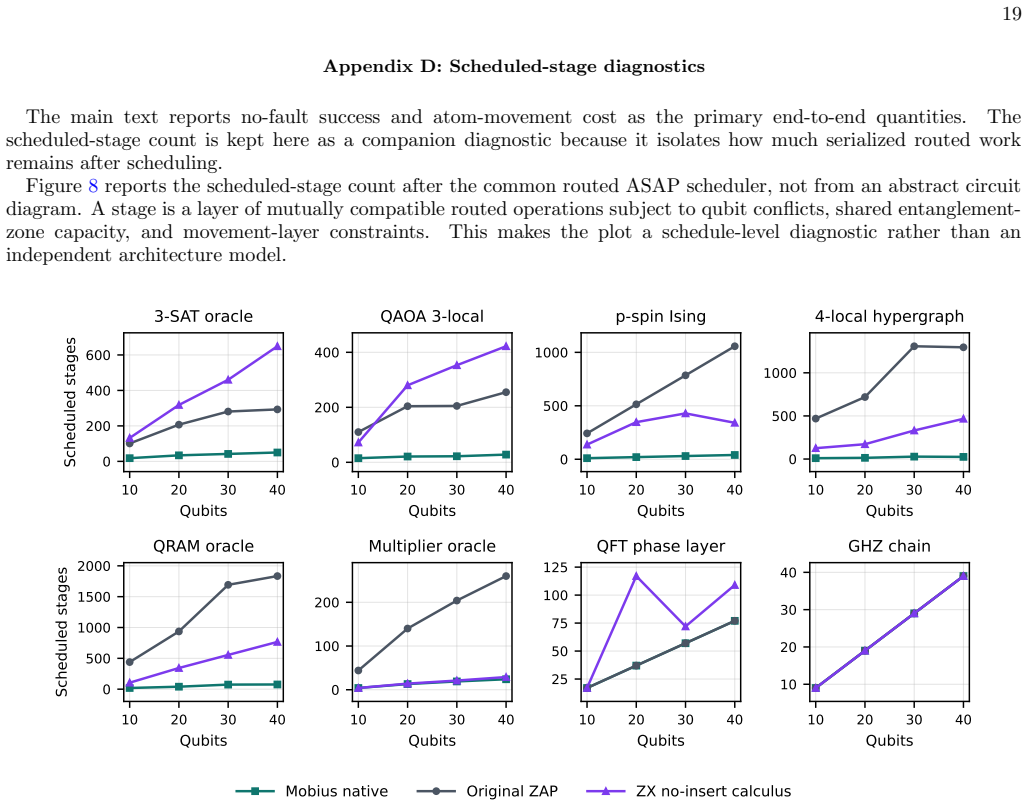
- The QFT and GHZ controls confirm that the method does not invent an advantage when only one- and two-body structure exists: all three streams overlap.
- The advantage is conditional on native-gate fidelities: the break-even analysis shows exactly where better native three- or four-qubit errors extend the regime and worse errors erase it.
Where Pith is reading between the lines
- If real calibrated Rydberg multiqubit gates approach the assumed fidelities, compiler designers could adopt phase-hypergraph intermediate representations as a standard front end for diagonal layers on any hardware with native multiqubit phase gates, not just neutral atoms.
- The same Möbius phase hypergraph could expose parity-check and syndrome-projector phases in measurement-free quantum error correction and stabilizer readout, where native CCZ-type gates have been proposed; the paper suggests this connection but does not develop it.
- A testable engineering inference from the break-even analysis is that improving four-qubit native gate fidelity is at least as valuable as improving three-qubit gates for this compilation strategy, since p4 sensitivity can erase the advantage in p-spin Ising and QRAM instances.
- The independent-factor fidelity model could be extended to correlated errors and atom loss; doing so would likely shift break-even boundaries, and the compiler's framework is designed to accept such calibrated data.
Editorial analysis
A structured set of objections, weighed in public.
Referee Report
Summary. The paper proposes a Möbius-guided compilation framework for diagonal quantum circuits on neutral-atom processors. A diagonal phase function is expressed as a weighted phase hypergraph through subset-lattice Möbius inversion, so that each many-body occupation-projector phase term P_S(θ) remains explicit. A native-gate table retains supports of size 3 and 4 as native Rydberg multiqubit controlled-phase gates, while larger supports are decomposed. The resulting gate stream is scheduled and routed on a storage-partitioned, shared-entanglement-zone neutral-atom architecture, and the strategies are compared through an independent-factor no-fault fidelity estimate P0. The benchmark suite covers eight families (3-SAT, QAOA-3, p-spin Ising, hypergraph-4, QRAM, multiplier, QFT, GHZ), with additional larger-system timing/compile-time plots and a two-parameter break-even sweep over native three- and four-qubit error probabilities. The main claim is that preserving high-degree Möbius supports as native multiqubit phases improves routed P0 for diagonal-heavy instances while matching baselines on two-body circuits.
Significance. The mathematical core—subset Möbius inversion and the local-term sparsity bound—is sound and self-contained (Appendices A and B). The benchmark is a strength: all strategies share the same scheduler, router, and fidelity model; the ZAP and ZX baselines provide meaningful external comparisons; and Fig. 7 gives explicit break-even diagnostics rather than a single favorable operating point. The paper is transparent that the native three-/four-qubit fidelities are representative assumptions. If the assumed native multiqubit gates are available at the quoted fidelities, the work offers a practical compiler strategy and a useful intermediate representation for neutral-atom diagonal-gate compilation. The log-cost reconstruction check (Fig. 7(a)) and the noiseless-equivalence checks are additional positive signs. The contribution is incremental over existing ZX/ZAP work, but the Möbius-phase-hypergraph viewpoint is a genuine organizing principle for this hardware.
major comments (2)
- [Table I, Sec. V.B, Fig. 7] Table I lists F_nat^(3)=0.981557 and F_nat^(4)=0.968852 as 'representative assumptions, not experimental claims,' and Fig. 7 shows that the sign of ΔL_B is not fixed: for several families there is a (p3,p4) region where a baseline wins. The reference star sits inside the Möbius-favorable region, and the text does not report how the main P0 ordering changes at the explicitly labeled 'conservative profile' (p3,p4)=(0.03,0.05). Because the abstract's 'improved estimated success' and the Sec. V.B explanation rest on this reference point, the robustness of the central quantitative claim is not yet demonstrated. Please add a quantitative summary (e.g., number/fraction of instances with ΔL_B<0 at the reference and conservative profiles and at the break-even boundary) and, where the ordering reverses, state this in the abstract and conclusion.
- [Eq. (19), Sec. IV.B] The headline metric P0 is an independent-factor product that omits correlated errors, atom loss, and distance-dependent motion. The differentiator between strategies is the presence of native multiqubit gates, which are precisely the operations where correlated Rydberg errors and loss are most likely. The authors correctly state that device prediction would require jointly calibrated models, but the central comparison is still presented as a benchmark of the strategy. Please add a sensitivity test with a simple correlated-error or loss model (e.g., a common-mode factor per native block), or at least an argument for the direction of the bias. Without this, the P0 ranking could be an artifact of the independence assumption.
minor comments (6)
- [Sec. III A, Eq. (16)] The degree histogram h_k is defined and said to organize the benchmark design, but the actual histograms are not reported. Please include them (or a summary) to support the claim that the benchmark families have the intended degree spectrum.
- [Fig. 7 caption] Define 'reference table' and 'conservative profile' in the caption; currently these terms appear only in the text, and the star and diamond markers are not explained in the figure itself.
- [Sec. V.B] The sentence 'And the advantage comes from these structure.' is ungrammatical and should be corrected.
- [Figs. 4-8 legend] The legend label 'Original ZAP' is confusing; the text consistently uses 'ZAP-decomposed.' Please use one term.
- [Appendix C] Clarify the timeout threshold ('timeout (>1h)') and the hardware/implementation details for the classical compile-time measurements.
- [General] No code/data availability statement is provided. For a benchmark-heavy compiler paper, a public release would materially aid reproducibility.
Circularity Check
No significant circularity. The Möbius inversion and compiler comparison are self-contained; the P0 advantage is conditional on clearly labeled native-gate assumptions, not a fitted input renamed as a prediction.
full rationale
The central derivation is an exact mathematical transform: Eq. (6) states F(T)=sum_{S⊆T} θ_S, and Eq. (7) gives its Möbius inverse, θ_S = sum_{R⊆S} (-1)^{|S|-|R|} F(R). Appendix A proves this inversion directly from the projector-phase accumulation rule; it does not assume any hardware outcome. The phase hypergraph is therefore fixed by the diagonal unitary, not by the conclusion the paper draws. The claimed P0 advantage is an evaluated consequence of routing the resulting gate streams under a common scheduler, router, and fidelity model. Eq. (19) is the same independent-factor model applied to all three strategies; no fitted parameter is inserted into it to force the Möbius-native curve above the baselines. The native three- and four-qubit fidelities F_nat^(3)=0.981557 and F_nat^(4)=0.968852 are explicitly described in Table I as 'representative assumptions, not experimental claims', and Fig. 7 sweeps p3 and p4 to show where the advantage disappears. That is honest sensitivity analysis, not circularity. The self-citation to ZAP [49] supplies a baseline compilation stream, but the comparison also includes the external ZX-calculus baseline [26] and QFT/GHZ two-body controls, so the central claim does not reduce to an unverified self-citation chain. No uniqueness theorem from the authors is invoked to forbid alternatives, and no ansatz is smuggled in via citation. The main limitation is that the practical conclusion is conditional on unvalidated hardware parameters, which is a correctness/evidence concern, not a circularity defect.
Axiom & Free-Parameter Ledger
free parameters (6)
- p3 = 1 - F_nat^(3) =
0.018443 (F_nat^(3)=0.981557)
- p4 = 1 - F_nat^(4) =
0.031148 (F_nat^(4)=0.968852)
- tmultiq =
0.576 μs (1.6 t2q)
- R_nat =
8 μm
- k_max_nat =
4
- movement duration constants =
200*sqrt(d/110) μs
axioms (6)
- standard math Subset-lattice Möbius inversion inverts the subset-zeta relation F(T) = sum_{S⊆T} θ_S (Appendix A, Eqs. A1-A2).
- standard math Occupation projector arithmetic n_j = (I - Z_j)/2 (Eq. 8) and the phase-accumulation rule for products of projector phases (Eq. 5).
- domain assumption Rydberg-blockade dynamics (Eq. 2) with van der Waals interactions V_ij = C6/d^6 can be pulsed to realize arbitrary occupation-projector phases P_S(θ) for supports up to the native cutoff.
- domain assumption The independent-factor no-fault fidelity model P0 in Eq. (19) is a valid proxy for circuit success probability.
- domain assumption The storage-partitioned architecture with a shared entanglement zone, movement throughput limits, and R_nat clique-feasibility predicate accurately models target neutral-atom hardware.
- domain assumption Benchmark diagonal phase functions have sparse/local Möbius support, so the phase hypergraph is polynomial-size (Eqs. 12-13).
Cite this review
Pith. "Pith review of M\"obius-Guided Diagonal-Gate Compilation with Native Multiqubit Controlled-Phase Gates on Neutral-Atom Processors." pith.science (2026). https://pith.science/paper/TEZMQJYM
@misc{pith2026260708212,
  author       = {Pith},
  title        = {Pith review of: M\"obius-Guided Diagonal-Gate Compilation with Native Multiqubit Controlled-Phase Gates on Neutral-Atom Processors},
  year         = {2026},
  howpublished = {\url{https://pith.science/paper/TEZMQJYM}},
  note         = {Machine review of arXiv:2607.08212}
}
read the original abstract
Diagonal gates are ubiquitous primitives in quantum algorithms, from phase oracles, hypergraph-state preparation, and multi-control logic to Hamiltonian simulation of spin models and digitized lattice field theories, where Ising interactions and local potential terms are diagonal in the encoded basis. Standard compilers, however, often lower diagonal structure into one- and two-qubit gates before neutral-atom hardware can exploit native Rydberg-mediated multiqubit controlled-phase operations. We propose a M\"obius-guided compiler that maps a diagonal phase function to a phase hypergraph via subset-lattice M\"obius inversion. The hypergraph retains the support and angle of each many-body phase term, allowing sparse or local high-order structure to be routed as native multiqubit controlled-phase candidates when feasible and decomposed otherwise. The neutral-atom scheduler accounts for atom motion, interaction-zone constraints, blockade feasibility, and error costs, enabling a direct comparison between native high-order execution and decomposed alternatives. Benchmarks against routed ZAP and ZX-calculus baselines show improved estimated success for algorithmic instances with exploitable three- and four-body phase terms, and comparable performance on predominantly two-body instances. These results provide a feasible compilation strategy for more fully exploiting the native capabilities of neutral-atom hardware, using atom reconfigurability and Rydberg-mediated multiqubit phase operations as practical resources for more efficient quantum computation.
Figures




Reference graph
Works this paper leans on
-
[1]
L. K. Grover, A fast quantum mechanical algorithm for database search, inProceedings of the 28th Annual ACM Symposium on Theory of Computing(1996) pp. 212–219
1996
-
[2]
E. Farhi, J. Goldstone, and S. Gutmann, A quan- tum approximate optimization algorithm (2014), arXiv:1411.4028
Pith/arXiv arXiv 2014
-
[3]
Z. Wang, S. Hadfield, Z. Jiang, and E. G. Rieffel, Quan- tum approximate optimization algorithm for MaxCut: A fermionic view, Phys. Rev. A97, 022304 (2018)
2018
-
[4]
Hadfieldet al., From the quantum approximate op- timization algorithm to a quantum alternating operator ansatz, Algorithms12, 34 (2019)
S. Hadfieldet al., From the quantum approximate op- timization algorithm to a quantum alternating operator ansatz, Algorithms12, 34 (2019)
2019
-
[5]
Welch, D
J. Welch, D. Greenbaum, S. Mostame, and A. Aspuru- Guzik, Efficient quantum circuits for diagonal unitaries without ancillas, New J. Phys.16, 033040 (2014)
2014
-
[6]
Rossi, M
M. Rossi, M. Huber, D. Bruß, and C. Macchiavello, Quantum hypergraph states, New J. Phys.15, 113022 (2013)
2013
-
[7]
R. Qu, J. Wang, Z.-s. Li, and Y.-r. Bao, Encoding hy- pergraphs into quantum states, Phys. Rev. A87, 022311 (2013)
2013
-
[8]
M. A. Perlin, Z. H. Saleem, M. Suchara, and J. M. Baker, Fault-tolerant measurement-free quantum error correc- tion with multiqubit gates, Phys. Rev. A108, 062426 (2023)
2023
-
[9]
M. B. Hastings and J. Haah, Dynamically generated log- ical qubits, Quantum5, 564 (2021)
2021
-
[10]
Gidney, M
C. Gidney, M. Newman, A. Fowler, and M. Broughton, A fault-tolerant honeycomb memory, Quantum5, 605 (2021)
2021
-
[11]
D. F. Locher, J. Old, K. Brechtelsbauer, J. Holschbach, H. P. B¨ uchler, S. Weber, and M. M¨ uller, Multiqubit ryd- berg gates for quantum error correction, PRX Quantum 7, 020354 (2026)
2026
-
[12]
Morgado and S
M. Morgado and S. Whitlock, Quantum simulation and computing with rydberg-interacting qubits, A VS Quan- tum Sci.3, 023501 (2021)
2021
-
[13]
Schollet al., Quantum simulation of 2d antiferromag- nets with hundreds of rydberg atoms, Nature595, 233 (2021)
P. Schollet al., Quantum simulation of 2d antiferromag- nets with hundreds of rydberg atoms, Nature595, 233 (2021)
2021
-
[14]
Ebadiet al., Quantum phases of matter on a 256- atom programmable quantum simulator, Nature595, 227 (2021)
S. Ebadiet al., Quantum phases of matter on a 256- atom programmable quantum simulator, Nature595, 227 (2021)
2021
-
[15]
Byrnes and Y
T. Byrnes and Y. Yamamoto, Simulating lattice gauge theories on a quantum computer, Phys. Rev. A73, 022328 (2006)
2006
-
[16]
S. P. Jordan, K. S. M. Lee, and J. Preskill, Quantum algorithms for quantum field theories, Science336, 1130 (2012)
2012
-
[17]
V. V. Shende, S. S. Bullock, and I. L. Markov, Synthesis of quantum logic circuits, inProceedings of the 2005 Asia and South Pacific Design Automation Conference(2005) pp. 272–275
2005
-
[18]
M. Amy, P. Azimzadeh, and M. Mosca, On the CNOT- complexity of CNOT-PHASE circuits, Quantum Sci. Technol.4, 015002 (2018)
2018
-
[19]
Y. Nam, N. J. Ross, Y. Su, A. M. Childs, and D. Maslov, Automated optimization of large quantum circuits with continuous parameters, npj Quantum Inf.4, 23 (2018)
2018
-
[20]
Cowtan, S
A. Cowtan, S. Dilkes, R. Duncan, W. Simmons, and S. Sivarajah, Phase gadget synthesis for shallow circuits, Electron. Proc. Theor. Comput. Sci.318, 213 (2020)
2020
-
[21]
Kliuchnikov, D
V. Kliuchnikov, D. Maslov, and M. Mosca, Fast and ef- ficient exact synthesis of single-qubit unitaries generated by clifford and t gates, Quantum Inf. Comput.13, 607 (2013)
2013
-
[22]
Bocharov, M
A. Bocharov, M. Roetteler, and K. M. Svore, Efficient synthesis of universal repeat-until-success quantum cir- cuits, Phys. Rev. Lett.114, 080502 (2015)
2015
-
[23]
Maslov, Advantages of using relative-phase toffoli gates with an application to multiple control toffoli opti- mization, Phys
D. Maslov, Advantages of using relative-phase toffoli gates with an application to multiple control toffoli opti- mization, Phys. Rev. A93, 022311 (2016)
2016
-
[24]
Carette, D
T. Carette, D. Horsman, and S. Perdrix, SZX-calculus: Scalable graphical quantum reasoning, inProceedings of MFCS 2019, LIPIcs, Vol. 138 (2019) pp. 55:1–55:15
2019
-
[25]
Carette, A note on diagonal gates in SZX-calculus (2020), arXiv:2012.09540
T. Carette, A note on diagonal gates in SZX-calculus (2020), arXiv:2012.09540
Pith/arXiv arXiv 2020
-
[26]
Staudacher, L
K. Staudacher, L. Schmid, J. Zeiher, R. Wille, and D. Kranzlm¨ uller, Multi-controlled phase gate synthesis with ZX-calculus applied to neutral atom hardware, Elec- tron. Proc. Theor. Comput. Sci.406, 96 (2024)
2024
-
[27]
Jaksch, J
D. Jaksch, J. I. Cirac, P. Zoller, S. L. Rolston, R. Cˆ ot´ e, and M. D. Lukin, Fast quantum gates for neutral atoms, Phys. Rev. Lett.85, 2208 (2000)
2000
-
[28]
M. D. Lukin, M. Fleischhauer, R. Cˆ ot´ e, L. M. Duan, D. Jaksch, J. I. Cirac, and P. Zoller, Dipole blockade and quantum information processing in mesoscopic atomic ensembles, Phys. Rev. Lett.87, 037901 (2001)
2001
-
[29]
Saffman, T
M. Saffman, T. G. Walker, and K. Mølmer, Quantum information with rydberg atoms, Rev. Mod. Phys.82, 2313 (2010)
2010
-
[30]
Saffman, Quantum computing with atomic qubits and rydberg interactions: progress and challenges, J
M. Saffman, Quantum computing with atomic qubits and rydberg interactions: progress and challenges, J. Phys. B 49, 202001 (2016)
2016
-
[31]
Henriet, L
L. Henriet, L. Beguin, A. Signoles, T. Lahaye, A. Browaeys, G.-O. Reymond, and C. Jurczak, Quantum computing with neutral atoms, Quantum4, 327 (2020)
2020
-
[32]
Browaeys and T
A. Browaeys and T. Lahaye, Many-body physics with individually controlled rydberg atoms, Nat. Phys.16, 132 (2020)
2020
-
[33]
Endres, H
M. Endres, H. Bernien, A. Keesling, H. Levine, E. R. Anschuetz, A. Krajenbrink, C. Senko, V. Vuletic, M. Greiner, and M. D. Lukin, Atom-by-atom assembly of defect-free one-dimensional cold atom arrays, Science 354, 1024 (2016)
2016
-
[34]
Barredo, S
D. Barredo, S. de L´ es´ eleuc, V. Lienhard, T. Lahaye, and A. Browaeys, An atom-by-atom assembler of defect-free arbitrary two-dimensional atomic arrays, Science354, 1021 (2016)
2016
-
[35]
Barredo, V
D. Barredo, V. Lienhard, S. de L´ es´ eleuc, T. Lahaye, and A. Browaeys, Synthetic three-dimensional atomic struc- tures assembled atom by atom, Nature561, 79 (2018)
2018
-
[36]
H. Kim, W. Lee, H.-g. Lee, H. Jo, Y. Song, and J. Ahn, In situ single-atom array synthesis using dynamic holo- graphic optical tweezers, Nat. Commun.7, 13317 (2016)
2016
-
[37]
Bluvstein, H
D. Bluvstein, H. Levine, G. Semeghini, T. T. Wang, S. Ebadi, M. Kalinowski, A. Keesling, N. Maskara, H. Pichler, M. Greiner,et al., A quantum processor based on coherent transport of entangled atom arrays, Nature 604, 451 (2022)
2022
-
[38]
Graham, M
T. Graham, M. Kwon, B. Grinkemeyer, Z. Marra, X. Jiang, M. Lichtman, Y. Sun, M. Ebert, and 21 M. Saffman, Rydberg-mediated entanglement in a two- dimensional neutral atom qubit array, Physical review letters123, 230501 (2019)
2019
-
[39]
I. S. Madjarov, J. P. Covey, A. L. Shaw, J. Choi, A. Kale, A. Cooper, H. Pichler, V. Schkolnik, J. R. Williams, and M. Endres, High-fidelity entanglement and detection of alkaline-earth rydberg atoms, Nature Physics16, 857 (2020)
2020
-
[40]
S. J. Evered, D. Bluvstein, M. Kalinowski, S. Ebadi, T. Manovitz, H. Zhou, S. H. Li, A. A. Geim, T. T. Wang, N. Maskara,et al., High-fidelity parallel entangling gates on a neutral-atom quantum computer, Nature622, 268 (2023)
2023
-
[41]
Bluvstein, S
D. Bluvstein, S. J. Evered, A. A. Geim, S. H. Li, H. Zhou, T. Manovitz, S. Ebadi, M. Cain, M. Kalinowski, D. Hangleiter,et al., Logical quantum processor based on reconfigurable atom arrays, Nature626, 58 (2024)
2024
-
[42]
H. Pichler, S.-T. Wang, L. Zhou, S. Choi, and M. D. Lukin, Quantum optimization for maximum independent set using rydberg atom arrays (2018), arXiv:1808.10816
Pith/arXiv arXiv 2018
-
[43]
J. M. Baker, A. Litteken, C. Duckering, H. Hoffmann, H. Bernien, and F. T. Chong, Exploiting long-distance in- teractions and tolerating atom loss in neutral atom quan- tum architectures, inProceedings of the 2021 ACM/IEEE 48th Annual International Symposium on Computer Ar- chitecture(2021) pp. 818–831
2021
-
[44]
I. Cong, H. Levine, A. Keesling, D. Bluvstein, S.- T. Wang, and M. D. Lukin, Hardware-efficient, fault- tolerant quantum computation with rydberg atoms, Phys. Rev. X12, 021049 (2022)
2022
-
[45]
Nguyen, J.-G
M.-T. Nguyen, J.-G. Liu, J. Wurtz, M. D. Lukin, S.- T. Wang, and H. Pichler, Quantum optimization with arbitrary connectivity using rydberg atom arrays, PRX Quantum4, 010316 (2023)
2023
-
[46]
C. Zhu, X. Wu, Z. Yang, J. Wang, A. Wu, S. Zheng, and X. Wang, Quantum compiler design for qubit mapping and routing: A cross-architectural survey of supercon- ducting, trapped-ion, and neutral atom systems, arXiv preprint arXiv:2505.16891 (2025)
Pith/arXiv arXiv 2025
-
[47]
Rota, On the foundations of combinatorial theory i
G.-C. Rota, On the foundations of combinatorial theory i. theory of m¨ obius functions, Z. Wahrscheinlichkeitstheorie verw. Gebiete2, 340 (1964)
1964
-
[48]
Aigner,Combinatorial Theory(Springer, Berlin, 1979)
M. Aigner,Combinatorial Theory(Springer, Berlin, 1979)
1979
-
[49]
Huang, X
C. Huang, X. Zhao, H. Xu, W. Zhuang, M.-J. Hu, D. E. Liu, and J. Wang, ZAP: Zoned architecture and perfor- mant compiler for field programmable atom array, IEEE Trans. Quantum Eng. , 1 (2026)
2026
-
[50]
D. Yu, H. Wang, J.-M. Liu, S.-L. Su, J. Qian, and W. Zhang, Multiqubit toffoli gates and optimal geom- etry with rydberg atoms, Phys. Rev. Applied18, 034072 (2022)
2022
-
[51]
Stein, C
S. Stein, C. Liu, S. Kan, E. Crane, Y. Ding, Y. Mao, A. Schuckert, and A. Li, Multitarget rydberg gates via spatial blockade engineering, Phys. Rev. Res.8, 013254 (2026)
2026
-
[52]
Sun, Suppression of high-frequency components in off-resonant modulated driving protocols for rydberg- blockade gates, Physical Review Applied20, L061002 (2023)
Y. Sun, Suppression of high-frequency components in off-resonant modulated driving protocols for rydberg- blockade gates, Physical Review Applied20, L061002 (2023)
2023
-
[53]
Sun, Buffer-atom-mediatedquantumlogicgateswithoff- resonantmodulateddriving, ScienceChina- Physics,MechanicsandAstronomy67, 120311 (2024)
Y. Sun, Buffer-atom-mediatedquantumlogicgateswithoff- resonantmodulateddriving, ScienceChina- Physics,MechanicsandAstronomy67, 120311 (2024)
2024
-
[54]
Pelegr ´ ı, A
G. Pelegr ´ ı, A. J. Daley, and J. D. Pritchard, High-fidelity multiqubit rydberg gates via two-photon adiabatic rapid passage, Quantum Sci. Technol.7, 045020 (2022)
2022
-
[55]
Levineet al., Parallel implementation of high-fidelity multiqubit gates with neutral atoms, Phys
H. Levineet al., Parallel implementation of high-fidelity multiqubit gates with neutral atoms, Phys. Rev. Lett. 123, 170503 (2019)
2019
-
[56]
Mohan, J
M. Mohan, J. De Hond, and S. Kokkelmans, Parametrized multiqubit gates for neutral-atom quantum platforms, Physical Review Applied23, 054074 (2025)
2025
-
[57]
E. T. Campbell, H. Anwar, and D. E. Browne, Magic- state distillation in all prime dimensions using quantum reed-muller codes, Phys. Rev. X2, 041021 (2012)
2012
-
[58]
J. Courtney, An oracle-free quantum algorithm for nonadiabatic quantum molecular dynamics (2026), arXiv:2604.19319 [quant-ph]
Pith/arXiv arXiv 2026
-
[59]
C. Huang, J. Wang, Z. Zhang, M. Zhong, Z. Fu, Z. Liang, Y. Sun, and D. E. Liu, Lazy-move compilation for neutral-atom quantum computers via a buffer-relay fab- ric, arXiv preprint arXiv:2606.31833 (2026)
Pith/arXiv arXiv 2026
-
[60]
Gu, W.-F
Y. Gu, W.-F. Zhuang, X. Chai, and D. E. Liu, Bench- marking universal quantum gates via channel spectrum, Nat. Commun.14, 5880 (2023)
2023
-
[61]
Dennis, A
E. Dennis, A. Kitaev, A. Landahl, and J. Preskill, Topo- logical quantum memory, J. Math. Phys.43, 4452 (2002)
2002
-
[62]
A. G. Fowler, M. Mariantoni, J. M. Martinis, and A. N. Cleland, Surface codes: Towards practical large-scale quantum computation, Phys. Rev. A86, 032324 (2012)
2012
This paper was first reviewed by deepseek-v4-flash on August 2, 2026.
discussion (0)
Sign in with ORCID, Apple, or X to comment. Anyone can read and Pith papers without signing in.