REVIEW 2 major objections 2 minor
XGBoost lifts LHC exclusion of a singlet vectorlike lepton mixing with the tau to 500 GeV in the three-lepton channel.
Reviewed by Pith at T0; open to challenge. T0 means a machine referee read the full paper against a public rubric. the ladder, T0–T4 →
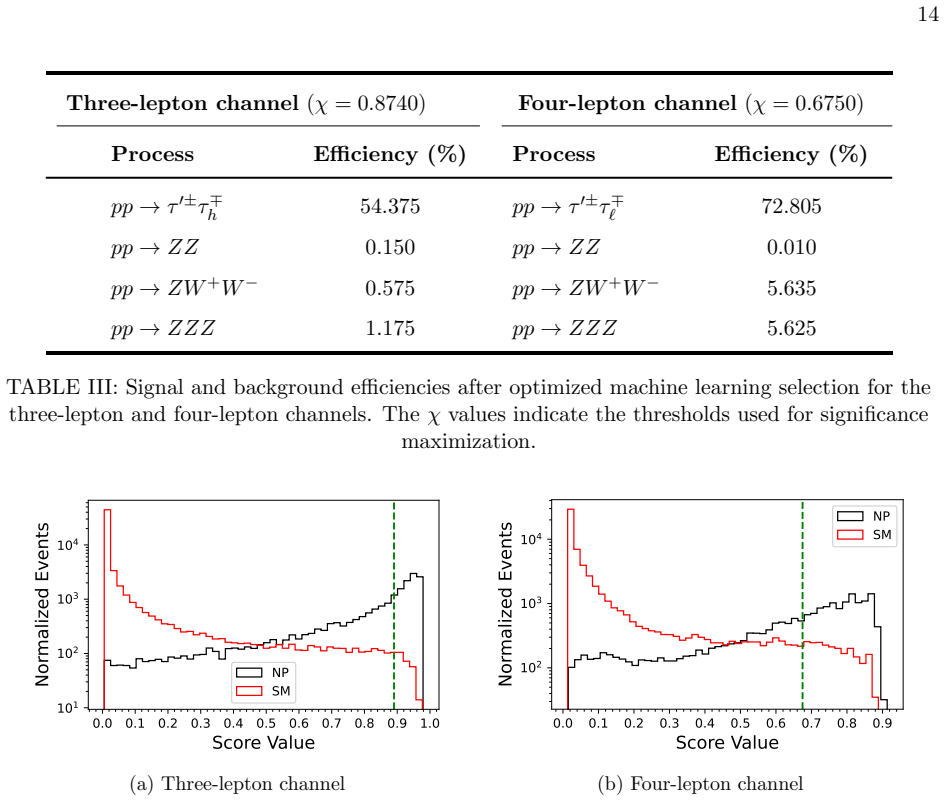
With XGBoost at 14 TeV and 3000 fb⁻¹, 2σ exclusion of a tau-mixing singlet vectorlike lepton can reach ~500 GeV (3-lepton) and ~405 GeV (4-lepton) if systematics are negligible.
T0 review reviewed 2026-07-12 challenge →
load-bearing objection Abstract-only VLL single-production projection with XGBoost; concrete 500/405 GeV 2σ numbers under negligible systematics, standard but usable collider pheno. the 2 major comments →
Machine learning study on single production of a singlet vectorlike lepton at the Large Hadron Collider
The pith
A machine-rendered reading of the paper's core claim, the machinery that carries it, and where it could break.
The reading
Core claim
At 14 TeV with 3000 fb^{-1} and negligible systematics, XGBoost-enhanced analyses of the three- and four-lepton final states can exclude a tau-mixing singlet vectorlike lepton up to 500 GeV and 405 GeV, respectively, throughout the parameter space still allowed by electroweak precision data.
What carries the argument
The XGBoost classifier trained on kinematic and event-shape features of the three- and four-lepton final states; it supplies a single multivariate discriminant that replaces sequential cut-based selection and thereby raises the signal significance for a given mass and mixing.
Load-bearing premise
The quoted mass reaches rest on the premise that all experimental systematic uncertainties (luminosity, lepton identification, background normalization, PDF and scale variations) can be treated as negligible.
What would settle it
A full experimental re-analysis of the same channels that includes realistic O(10 percent) systematics and finds the 2 sigma exclusion contour falling well below 500 GeV (or 405 GeV) would falsify the numerical claim.
If this is right
- HL-LHC three-lepton searches with multivariate classifiers can cover a large fraction of the oblique-parameter-allowed mass-mixing plane for a singlet VLL.
- The four-lepton channel remains complementary, though its reach is roughly 100 GeV lower under the same assumptions.
- Machine-learning discriminants can be substituted for traditional cut-based selections in future vectorlike-lepton analyses without altering the underlying production or decay kinematics.
- Any improvement in systematic control would translate almost directly into higher mass sensitivity for this signature.
Where Pith is reading between the lines
- Because the analysis is abstract-only, the precise gain of XGBoost over a cut-based baseline is not quantified here; a follow-up note comparing ROC curves or significance ratios would make the claimed improvement concrete.
- The same multivariate strategy should apply with little modification to doublet or triplet VLLs that also mix with the tau, provided the production modes remain single-production dominated.
- Once realistic systematics are restored, the optimal operating point of the XGBoost score may shift, suggesting that systematics-aware training (e.g., adversarial or nuisance-parameterized networks) could recover part of the lost sensitivity.
Editorial analysis
A structured set of objections, weighed in public.
Referee Report
Summary. The manuscript studies single production of a singlet vectorlike lepton (VLL) that mixes with the tau lepton at the LHC, focusing on three- and four-lepton final states. XGBoost is used to improve signal–background discrimination. Under the explicit premise of negligible systematic uncertainties, the abstract reports expected 2σ exclusion reaches of 500 GeV (three-lepton) and 405 GeV (four-lepton) at √s = 14 TeV with 3000 fb⁻¹, inside the region allowed by electroweak oblique-parameter constraints, and claims that machine learning substantially improves sensitivity.
Significance. Projected HL-LHC sensitivity to singly produced, tau-mixing singlet VLLs is a relevant phenomenological question, and a careful comparison of multivariate methods against cut-based analyses would be useful to the community. Credit is due for framing the search in both three- and four-lepton channels and for connecting the exclusion contours to the electroweak oblique-parameter allowed region. If the numerical reaches survive a realistic treatment of systematics and a transparent ML validation, the work would provide a concrete benchmark for future experimental analyses. With only the abstract available, however, those strengths cannot yet be confirmed.
major comments (2)
- The abstract conditions the central numerical claims (2σ mass reaches of 500 GeV and 405 GeV at 3000 fb⁻¹) on the assumption of negligible systematic uncertainties. That premise is load-bearing: experimental systematics at the O(10 %) level (luminosity, lepton identification/isolation, background normalization, PDF and scale variations) routinely degrade projected limits by a large factor. The manuscript must quantify how the exclusion contours shift once realistic systematics are included; without that, the quoted mass reaches cannot be taken as robust projections.
- Only the abstract is available for this review. Consequently the Monte-Carlo generation setup, background composition and normalization, XGBoost feature list, training/validation splits, hyperparameter choices, and the concrete implementation of the electroweak oblique-parameter constraint cannot be inspected. These elements are essential to the central claim that XGBoost 'substantially improve[s] the sensitivity'; until they are documented and reproducible, the quantitative exclusion limits remain unverifiable.
minor comments (2)
- The abstract should state more clearly whether the quoted mass reaches are for a fixed mixing angle (or coupling) or are contours in the (m_L, mixing) plane, so that the reader can immediately see the free-parameter coverage.
- A brief indication of the dominant backgrounds in each lepton multiplicity channel would help the reader assess the plausibility of the claimed improvement before consulting the full text.
Circularity Check
No circularity: abstract-only collider sensitivity projection with no derivation that re-uses fitted constants as predictions.
full rationale
Only the abstract is available. It reports a standard forward projection of LHC sensitivity for single production of a singlet vectorlike lepton mixing with τ, using simulated three- and four-lepton channels and XGBoost for discrimination. The quoted 2σ mass reaches (500 GeV / 405 GeV at 14 TeV, 3000 fb⁻¹) are explicitly conditioned on negligible systematics and on the electroweak oblique-parameter allowed region; they are not obtained by fitting a parameter to data and then re-predicting a related quantity, nor by defining an observable in terms of itself. No equations, uniqueness theorems, ansatzes imported via self-citation, or renaming of known empirical patterns appear in the available text. Self-citation of prior VLL work by overlapping authors, if present in the full paper, would be normal literature practice and is not load-bearing for the numerical claims as stated. The weakest assumption (negligible systematics) is a modeling premise, not a circularity. Per the hard rules, an abstract-only sensitivity study that does not reduce its central claim to its inputs by construction scores 0; steps remain empty.
Axiom & Free-Parameter Ledger
free parameters (2)
- VLL mass m_L
- tau-VLL mixing angle / coupling
axioms (4)
- domain assumption A singlet vectorlike lepton that mixes primarily with the tau exists and can be produced singly at the LHC.
- ad hoc to paper Systematic uncertainties can be neglected for the projected 2σ limits.
- domain assumption Electroweak oblique-parameter constraints define the allowed parameter region.
- domain assumption XGBoost provides a reliable signal-background discriminant for multi-lepton final states.
Cite this review
Pith. "Pith review of Machine learning study on single production of a singlet vectorlike lepton at the Large Hadron Collider." pith.science (2026). https://pith.science/paper/TFJZ6WBH
@misc{pith2026260411232,
  author       = {Pith},
  title        = {Pith review of: Machine learning study on single production of a singlet vectorlike lepton at the Large Hadron Collider},
  year         = {2026},
  howpublished = {\url{https://pith.science/paper/TFJZ6WBH}},
  note         = {Machine review of arXiv:2604.11232}
}
read the original abstract
Vectorlike leptons are nonchiral, colorless fermions from new physics beyond the Standard Model, appearing in many theoretical extensions. We investigate the prospect for detecting the single production of a singlet vectorlike lepton that mixes with the $\tau$ lepton at the Large Hadron Collider. The corresponding final states are classified as the three- and four-lepton search channels. The machine learning algorithm XGBoost is employed to enhance signal-background discrimination. Our analysis indicates that, at $\sqrt{s} = 14~\mathrm{TeV}$ with an integrated luminosity of $3000~\mathrm{fb}^{-1}$ under the assumption of negligible systematic uncertainties, the expected $2\sigma$ exclusion limits in the three- and four-lepton channels can reach vectorlike lepton masses up to $500$ and $405~\mathrm{GeV}$ in the parameter region allowed by the electroweak oblique parameter constraint, respectively. These findings demonstrate that machine learning techniques can substantially improve the sensitivity of collider searches for vectorlike leptons.
Figures



This paper was first reviewed by grok-4.5 on July 12, 2026.
discussion (0)
Sign in with ORCID, Apple, or X to comment. Anyone can read and Pith papers without signing in.