REVIEW 4 major objections 4 minor 1 cited by
Topological Reality Switch: Towards Bulk-Boundary Selective Lasing
T0 review · 4 major / 4 minor · reviewed 2026-08-06 · deepseek-v4-flash
Pith's one-line read This paper shows that in a 2D non-Hermitian SSH lattice, one on-site potential makes the periodic-boundary bulk spectrum real and another makes the full open-boundary spectrum real, with a complex-gap topological transition at the switch.
desk verdict Plausible and interesting boundary-selective reality switch; the PBC side is rigorous, but the full-OBC reality claim needs a finite-size scaling check before it can be taken as proven. read the letter →
The pith
A machine-rendered reading of the paper's core claim, the machinery that carries it, and where it could break.
The reading
What carries the argument
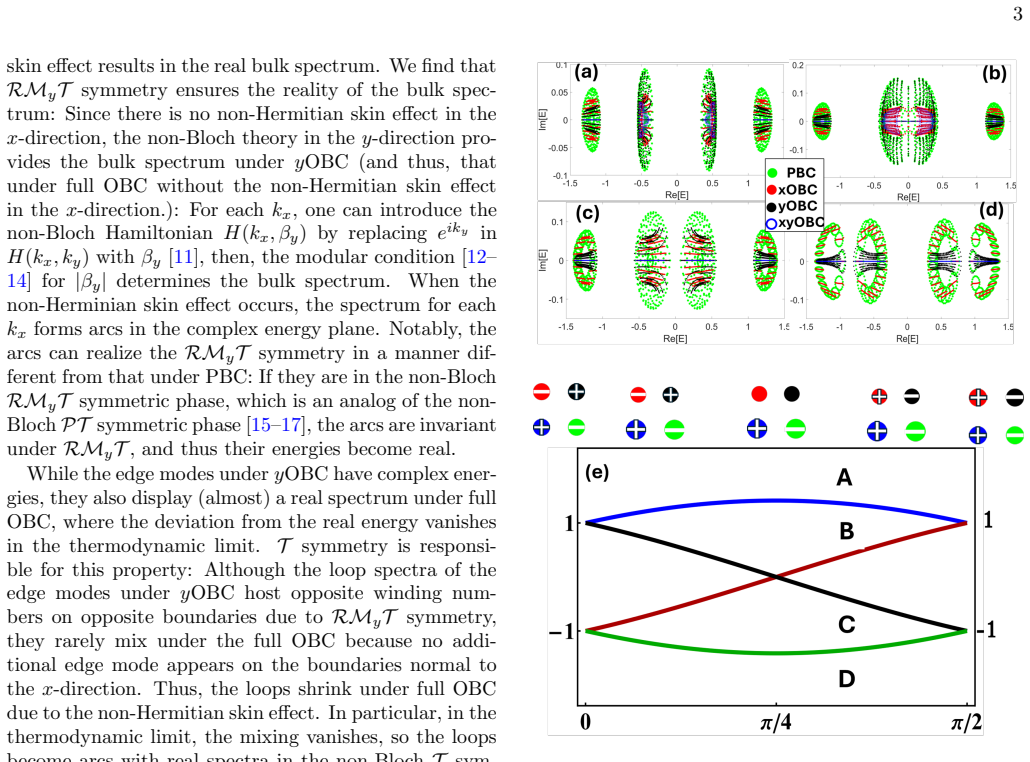
The central objects are the two on-site potentials $\alpha\sigma_0\sigma_z$ and $\beta\sigma_z\sigma_0$, where $\sigma_\mu\sigma_\nu$ are Kronecker products of Pauli matrices acting on the two sublattice spaces of the four-site unit cell; the first shifts one pair of internal states relative to the other while preserving inversion and PT-related symmetries, and the second shifts a different pair while preserving reciprocal mirror and time-reversal symmetries. The argument is carried by three mechanisms: PT symmetry ensures real PBC bulk energies under the $\alpha$ term; the non-Hermitian skin effect in the y-direction plus non-Bloch band theory—replacing $e^{ik_y}$ by $\beta_y$ and imposing the modular condition on $|\beta_y|$—puts the $\beta$-term bulk into a non-Bloch $RM_yT$ symmetric phase whose arcs have real energies; and T symmetry with no edge modes on the x-normal boundaries makes the oppositely wound edge-mode loops under yOBC shrink to real arcs under full OBC in the thermodynamic limit. The one-parameter family $\cos\theta\,\sigma_0\sigma_3+\sin\theta\,\sigma_3\sigma_0$ is the switch that rotates between the two mechanisms, with a line-gap closing at $\theta=\pi/4$ marking the topological transition.
What would settle it
Fix $\beta$ large and compute the full OBC spectrum for a sequence of system sizes $L_x,L_y$; the paper's claim predicts that the largest imaginary part of any eigenvalue tends to zero and the edge-mode loops collapse to arcs as $L$ grows. If the imaginary parts instead saturate at a finite value or the edge loops continue to enclose finite area, the thermodynamic-limit reality claim fails.
Extended reading notes
Core claim
In the 2D non-Hermitian SSH model with asymmetric hoppings, the authors identify two on-site perturbations with opposite boundary selectivity. For sufficiently large $\alpha$, the perturbation $\alpha\sigma_0\sigma_z$ keeps PT symmetry and drives the PT-broken bulk branches into a PT-unbroken phase, so the full PBC bulk spectrum is real and exhibits arcs rather than areas; the boundary modes remain complex but show no skin effect because oppositely wound edge loops on opposite boundaries cancel. For sufficiently large $\beta$, the perturbation $\beta\sigma_z\sigma_0$ preserves $RM_yT$ and $T$; under yOBC the non-Hermitian skin effect sets in, the bulk is described by non-Bloch band theory with a modular condition on $\beta_y$, and the non-Bloch $RM_yT$ symmetric phase makes the bulk arcs real, while the edge-mode loops shrink under full OBC and become real arcs in the thermodynamic limit. The combined potential interpolates between the two regimes and passes through a line-gap-closing topological phase transition at $\theta=\pi/4$, where the on-site potential vanishes on one pair of sites; the authors propose that the redistribution of on-site potential signs drives the transition.
Load-bearing premise
The full open-boundary reality result rests on the assumption that edge-mode loops wound oppositely on opposite boundaries collapse and stop mixing under full open boundaries in the thermodynamic limit, a step the authors state rather than prove.
Editorial extensions
If this is right
- For sufficiently large $\alpha$, the PBC bulk spectrum becomes entirely real while edge modes remain complex, so an open sample would show boundary-selective spectral complexity even though its bulk is Hermitian-like.
- For sufficiently large $\beta$, the full OBC spectrum becomes real in the thermodynamic limit, so a finite non-Hermitian sample can have an entirely real spectrum despite asymmetric hoppings.
- The transition between the two regimes at $\theta=\pi/4$ is a line-gap-closing topological phase transition in the complex energy plane, so the reality switch is not a crossover but a phase transition.
- The mechanism is not restricted to these two potentials: inter-site perturbations such as $\sigma_1\sigma_1+\sigma_2\sigma_2$ can also act as a reality switch, and combinations such as $\sigma_1\sigma_0+\sigma_1\sigma_3$ can induce reality for all boundary conditions simultaneously.
- The reality switch persists in the 2D Hatano-Nelson limit $\gamma_{in}=\gamma_{ex}$, $\gamma'_{in}=\gamma'_{ex}$, suggesting the mechanism is robust to hopping anisotropy.
Reading between the lines
- As an extension, if the central claim holds, the same lattice should show a lasing contrast: pumping the $\alpha$ regime should favor bulk gain while the edge modes stay complex, and pumping the $\beta$ regime should favor boundary gain while the bulk is real; the paper points toward this goal but does not compute lasing thresholds.
- As an extension, the asserted collapse of edge-mode loops under full OBC lacks a quantitative derivation; an exact or large-scale numerical treatment of the full OBC spectrum as a function of system size would be the natural next step and would fix the crossover scale in $\beta$.
- As an extension, because the on-site potential vanishes on one pair of sites exactly at $\theta=\pi/4$, the line-gap-closing transition may be a general sublattice-decoupling mechanism; testing the same combined potential on other two-dimensional non-Hermitian lattices, such as the 2D Hatano-Nelson limit the authors mention, would show whether the transition point is universal.
Editorial analysis
A structured set of objections, weighed in public.
Referee Report
Summary. The paper studies a 2D non-Hermitian Su-Schrieffer-Heeger model and proposes two on-site potentials, ασ0σz and βσzσ0, that act as a boundary-selective 'reality switch': a sufficiently large α makes the PBC bulk spectrum real via PT symmetry, while a sufficiently large β is claimed to make the full OBC spectrum real in the thermodynamic limit via the non-Hermitian skin effect combined with a non-Bloch RMyT symmetry. The authors also study the combined potential cos(θ)σ0σ3 + sin(θ)σ3σ0 and identify a line-gap-closing transition at θ = π/4 that they interpret as a topological transition. The central claim is that the switch can selectively control the reality of bulk versus boundary spectra, with potential implications for bulk-boundary selective lasing.
Significance. If established, the proposal would be a useful, parameter-free mechanism for controlling spectral reality by boundary conditions in a concrete lattice model, and the non-Bloch RMyT symmetry concept could generalize the known non-Bloch PT framework. The paper is concise and the symmetry reasoning is clearly laid out; the numerical spectra are consistent with the stated symmetries, and no parameters are fitted to target spectra. However, the full-OBC reality claim depends on an unproved edge-mode argument and on an undefined non-Bloch symmetry, and the finite-size behavior is not quantified. The result is therefore promising but not yet established at the level of proof required for the paper's central assertion.
major comments (4)
- [OBC reality switch (paragraph on edge modes under full OBC)] The assertion that the edge-mode loops under yOBC 'shrink under full OBC due to the non-Hermitian skin effect' and that 'in the thermodynamic limit, the mixing vanishes' is load-bearing for the central claim that the entire full-OBC spectrum becomes real for large β. Yet this is a verbal argument only: no equation of motion for the edge-mode eigenvalues under the second open direction is given, no non-Bloch analysis of the 2D generalized Brillouin zone is provided, and no finite-size scaling of the maximum imaginary part of the edge eigenvalues is shown. Furthermore, the statement that 'no additional edge mode appears on the boundaries normal to the x-direction' ignores the possibility of bulk-boundary hybridization. If any of these steps fails, the full-OBC spectrum retains complex edge eigenvalues and the switch controls only the bulk. Please either supply a quantitative derivation or present finite-size scaling data that demonstrate the loops collapsing to real arcs.
- [OBC reality switch, paragraph on non-Bloch RMyT symmetry] The paper introduces 'non-Bloch RMyT symmetry' as the mechanism ensuring the reality of the bulk spectrum under yOBC, but it never defines the symmetry transformation on the non-Bloch Hamiltonian H(kx, βy) nor proves that the non-Bloch RMyT symmetric phase implies real arcs. The statement 'When the non-Hermitian skin effect occurs... the arcs can realize the RMyT symmetry in a manner different from that under PBC... thus their energies become real' is a claim, not a derivation. Please specify the operator action on βy, state the condition under which the arcs are invariant, and demonstrate that this condition holds in the parameter regime of Figs. 2(g)-(h). Without this step, the bulk part of the OBC reality switch is not established.
- [On-demand PBC-OBC reality switch, Fig. 3 and following paragraph] The paper calls the line-gap closing at θ = π/4 a 'topological phase transition', but no topological invariant is computed. A complex-energy line-gap closing is necessary but not sufficient for a topological transition; the accompanying statement about 'redistribution of the signs of the on-site potential' is descriptive rather than topological. Please either compute an appropriate complex-spectrum invariant (e.g., a winding number of the PBC or non-Bloch spectrum) and show that it changes at θ = π/4, or explicitly rephrase the claim as a 'line-gap-closing transition' without the topological label.
- [All numerical spectra (Figs. 2 and 3)] The manuscript does not report the lattice sizes Lx and Ly used in any of the boundary-condition spectra, nor does it provide any finite-size scaling. Since the central thermodynamic-limit statement is that the full-OBC spectrum becomes real for large β, the reader cannot distinguish a genuine thermodynamic effect from a finite-size artifact. Please state the lattice sizes in the captions, show the maximum Im E as a function of system size for fixed β, and demonstrate that the deviations from reality extrapolate to zero in the thermodynamic limit.
minor comments (4)
- [Fig. 2 caption] The caption states 'Green, red, black, and blue represent PBC, xOBC, yOBC, and full OBC (xyOBC), deceptively, as is shown in the inset of (a).' The word 'deceptively' should be 'respectively'.
- [Model section] The text refers to 'the 2D non-Hermitian SSH model in Fig.1(d)', but the lattice is shown in Fig.1(b); this cross-reference should be corrected.
- [Title and Introduction] There are several typographical errors, including 'Su-Schriffer-Heeger' in the Introduction, 'controlability' in the Introduction, and 'non-Herminian skin effect' in the OBC reality switch section; these should be fixed.
- [On-demand PBC-OBC reality switch] The text uses both 'line-gap' and 'lin-gap' (in 'Upon reopening the lin-gap away from θ = π/4'); the spelling should be made consistent.
Circularity Check
No circularity: the reality-switch results follow from independent PT and non-Bloch PT theorems; the only weakness is an unquantified edge-mode argument, which is a correctness risk rather than a circular reduction.
full rationale
The derivation chain is not circular. (1) The PBC reality switch is obtained by adding ασ0σz, which preserves PT symmetry; the paper states that 'a sufficiently large α induces the real bulk spectrum under PBC, ensured by PT symmetry.' This is a direct application of the standard PT-reality theorem (refs. [5–7]); the potential is chosen to preserve an independent symmetry, and the real spectrum is a theorem consequence of the unbroken-PT regime, not an output baked into the input. (2) The OBC bulk reality switch uses βσzσ0, which preserves RMy and T. The argument that RMy forbids x-direction winding and that the non-Bloch RMyT-symmetric phase yields real arcs relies on external non-Bloch band theory and non-Bloch PT results (refs. [11–17]). No parameter is fitted to the target spectrum, and no 'prediction' is a renamed fit. (3) The full-OBC edge-mode reality claim is the weakest point: the paper asserts that the yOBC edge-mode loops 'shrink under full OBC due to the non-Hermitian skin effect' and that 'in the thermodynamic limit, the mixing vanishes,' without a quantitative non-Bloch analysis or finite-size scaling. This is an unproven assumption and a legitimate correctness risk, but it is not a circular step: it does not reduce by construction to an input, nor is it justified by a load-bearing self-citation. The self-citations [18–20] appear only in the concluding remarks as future generalizations and are not load-bearing. Because no step exhibits the quoted reduction required for circularity, the correct finding is no significant circularity.
Assumptions & free parameters
free parameters (3)
- hopping amplitudes gamma_in, gamma_ex, gamma'_in, gamma'_ex =
0.2, 0.4, 0.1, 0.2 (gamma' = 0.5 gamma)
- combined potential prefactor =
0.8
- lattice size =
not specified
assumptions (5)
- standard math Unbroken PT symmetry implies a real spectrum.
- domain assumption Non-Bloch band theory with the generalized Brillouin zone gives the OBC spectrum through the modular condition |beta_y|.
- domain assumption Non-Bloch RMyT symmetry ensures real bulk arcs under yOBC.
- domain assumption T symmetry plus vanishing mixing in the thermodynamic limit makes OBC edge modes have real energies.
- standard math Line-gap closing and reopening signals a topological phase transition in the complex gap.
Cite this review
Pith. "Pith review of Topological Reality Switch: Towards Bulk-Boundary Selective Lasing." pith.science (2026). https://pith.science/paper/TFOZX7TK
@misc{pith2026250702038,
  author       = {Pith},
  title        = {Pith review of: Topological Reality Switch: Towards Bulk-Boundary Selective Lasing},
  year         = {2026},
  howpublished = {\url{https://pith.science/paper/TFOZX7TK}},
  note         = {Machine review of arXiv:2507.02038}
}
read the original abstract
The emergence of complex spectra in non-Hermitian systems causes dramatic changes even under weak perturbations, significantly hindering their precise control for study and integration into practical applications. Achieving a controlled method to generate a real spectrum in non-Hermitian systems has long been a key objective in the field. In this study, we explore the 2D non-Hermitian Su-Schrieffer-Heeger (SSH) model and introduce a reality switch that allows for the controllable induction of a real spectrum depending on the imposed boundary condition. We show that a topological phase transition in the complex gap accompanies the switching process. Our work lays the cornerstone for developing a selective bulk-boundary control mechanism for the gain and lasing behaviors in non-Hermitian systems.
Figures


Forward citations
Cited by 1 Pith paper
-
Non-Hermitian second-order topological insulator with point gap
For a 2D non-Hermitian SSH model, the number of stable zero singular values of H (or of U(T)−I and U(T)+I) equals the number of topological corner states in the thermodynamic limit, restoring bulk-boundary correspondence.
Reference graph
Works this paper leans on
-
[1]
Ashida, Z
Y. Ashida, Z. Gong, and M. Ueda, Non-hermitian physics, Advances in Physics 69, 249–435 (2020)
2020
-
[2]
E. J. Bergholtz, J. C. Budich, and F. K. Kunst, Ex- ceptional topology of non-hermitian systems, Rev. Mod. Phys. 93, 015005 (2021)
2021
-
[3]
W. Heiss, The physics of exceptional points, Journal of Physics A: Mathematical and Theoretical 45, 444016 (2012)
work page 2012
-
[4]
N. Okuma and M. Sato, Non-hermitian topological phe- nomena: A review, Annual Review of Condensed Matter Physics 14, 83 (2023)
work page 2023
-
[5]
C. M. Bender and S. Boettcher, Real spectra in non- hermitian hamiltonians having PT symmetry, Phys. Rev. Lett. 80, 5243 (1998)
1998
-
[6]
A. Mostafazadeh, Pseudo-hermiticity versus pt symme- try: The necessary condition for the reality of the spec- trum of a non-hermitian hamiltonian, Journal of Mathe- matical Physics 43, 205 (2002)
2002
-
[7]
K. Kawabata and M. Sato, Real spectra in non-hermitian topological insulators, Phys. Rev. Res. 2, 033391 (2020)
work page 2020
-
[8]
Y. Long, H. Xue, and B. Zhang, Non-hermitian topolog- ical systems with eigenvalues that are always real, Phys. Rev. B 105, L100102 (2022)
work page 2022
Show all 22 references
-
[9]
R. Yang, J. W. Tan, T. Tai, J. M. Koh, L. Li, S. Longhi, and C. H. Lee, Designing non-hermitian real spectra through electrostatics, Science Bulletin 67, 1865 (2022)
2022
-
[10]
E. Tang, J. Agudo-Canalejo, and R. Golestanian, Topol- ogy protects chiral edge currents in stochastic systems, Phys. Rev. X 11, 031015 (2021)
2021
-
[11]
Yokomizo and S
K. Yokomizo and S. Murakami, Non-bloch bands in two- dimensional non-hermitian systems, Phys. Rev. B 107, 195112 (2023)
2023
-
[12]
Yokomizo and S
K. Yokomizo and S. Murakami, Non-bloch band theory of non-hermitian systems, Phys. Rev. Lett. 123, 066404 (2019)
2019
-
[13]
Schmidt and F
P. Schmidt and F. Spitzer, The toeplitz matrices of an arbitrary laurent polynomial, Math. Scand. 8, 15 (1960)
1960
-
[14]
Delvaux, Equilibrium problem for the eigenvalues of banded block toeplitz matrices, Math
S. Delvaux, Equilibrium problem for the eigenvalues of banded block toeplitz matrices, Math. Nachr. 285, 1935 (2012)
2012
-
[15]
Longhi, Probing non-hermitian skin effect and non- bloch phase transitions, Phys
S. Longhi, Probing non-hermitian skin effect and non- bloch phase transitions, Phys. Rev. Res. 1, 023013 (2019)
2019
-
[16]
Longhi, Non-bloch pt symmetry breaking in non- hermitian photonic quantum walks, Opt
S. Longhi, Non-bloch pt symmetry breaking in non- hermitian photonic quantum walks, Opt. Lett. 44, 5804 (2019)
2019
-
[17]
Song, H.-Y
F. Song, H.-Y. Wang, and Z. Wang, Non-bloch pt sym- metry: Universal threshold and dimensional surprise, in A Festschrift in Honor of the C N Yang Centenary(world scientific, 2022) pp. 299–311
2022
-
[18]
S. A. A. Ghorashi, T. Li, and T. L. Hughes, Higher-order weyl semimetals, Phys. Rev. Lett. 125, 266804 (2020)
2020
-
[19]
S. A. A. Ghorashi, T. Li, M. Sato, and T. L. Hughes, Non-hermitian higher-order dirac semimetals, Phys. Rev. B 104, L161116 (2021)
2021
-
[20]
S. A. A. Ghorashi, T. Li, and M. Sato, Non-hermitian higher-order weyl semimetals, Phys. Rev. B 104, L161117 (2021)
2021
-
[21]
D. Zou, T. Chen, W. He, J. Bao, C. H. Lee, H. Sun, and X. Zhang, Observation of hybrid higher-order skin- topological effect in non-hermitian topolectrical circuits, Nature Communications 12, 7201 (2021)
2021
-
[22]
Slootman, W
E. Slootman, W. Cherifi, L. Eek, R. Arouca, E. J. Bergholtz, M. Bourennane, and C. M. Smith, Break- ing and resurgence of symmetry in the non-hermitian su-schrieffer-heeger model in photonic waveguides, Phys. Rev. Res. 6, 023140 (2024)
2024
Reviewed August 6, 2026 · model on record in the stance chip above.
Discussion (0). Sign in to comment.